All posts by perryt77

Opera Carolina Taps into a New Audience with Three Short Operas – Including a World Premiere

Reviews: “A Hand of Bridge,” “The Telephone,” and “Connection Lost (The Tinder Opera)”

14907223_10154107627428367_1574786247935966109_n

By Perry Tannenbaum

Just when you might have thought Opera Carolina was turning away from fruitful collaborations, they are diving back in with renewed vigor. Last month’s production of The Barber of Seville, kicking off their 2016-17 mainstage season, rose to the same high level of the previous Op Carolina production of Rossini’s comic gem directed by Bernard Uzan in 2002. Yet a noteworthy difference was the absence of Piedmont Opera as a co-producer, so after its Charlotte run ended on October 30, there was no second run in Winston-Salem as there had been 14 years earlier. Not to fear, new collaborators came into play within four days as Op Carolina forged new bonds with the D9 Brewing Company and the Warehouse Performing Arts Center. While these two Cornelius, NC, outfits are non-operatic, they fit in with the Charlotte company’s aim to remind us that all operas aren’t grand and that all opera audiences need not be elderly, strait-laced, and richly appareled. Everything about their world premiere of Scott Joiner’s “Connection Lost (The Tinder Opera)” was youthful, casual, and populist.

The free event was at D9, where a line of draught beer taps greeted me near the entrance, and a row of tall stainless steel brew tanks caught my eye as I made my way to my front row seat – on a folding chair. Joiner’s new opera would half-surround me, a string quartet and pianist/music director Emily Jarrell Urbanek slightly behind me and a cast of 14 in front of me in a far corner of the brewery that served as a stage. Two smaller chamber operas with librettos by Gian Carlo Menotti led up to the premiere. Music director Erin Palmer accompanied from the keyboard as the triptych opened with “A Hand of Bridge,” the 1959 score by Menotti’s life partner Samuel Barber, almost axiomatically a four-hander. Dr. Greg Thompson took over at the keyboard for “The Telephone,” a two-hander that Menotti wrote all by himself in 1947, when it premiered together with The Medium.

Clocking at around a scant 10 minutes, “A Hand of Bridge” is a bit long for its subject, problematical for singers and stage directors because Menotti frequently loses interest in the cardplaying once the bidding stage is over. It’s the characters who matter, except perhaps for Sally, whose thoughts don’t go beyond the depth of craving a peacock-feather hat, appropriately the dummy for this hand. The way she announces her passive status gives her husband Bill a spasm of anxiety: maybe she has discovered that he’s having an affair! Sally, sung with slightly more personality than a tape loop by Anna Harrevald, seems like sufficient reason for a husband to stray. Singing about his beloved Cymbeline, tenor Kyle Melton seemed less blissfully committed to his paramour than disaffected with his wife. Cymbeline seemed to have six or other men to choose from, rousing jealousy within Melton’s aria, but his roiling passions made for a comical contrast with Harrevald’s shrill shallowness when they sang together.

The other couple had a different disconnect that evoked a little more sympathy. Geraldine has suddenly realized that nobody loves her, not her stock-trading husband, her football son, or even Bill, whose days of playing footsie with her under the table are long gone. With her pure soprano, Lindsey Gallegos took advantage of her opportunity to turn in the most heartfelt singing of the evening, crossing over the edge of maudlin when Menotti’s lyrics took her to regrets over her breach with her dying mother, the only person alive whom she feels truly cares. Her husband, David, underscored Geraldine’s isolation in a more human fashion than I anticipated. As David, baritone David Clark could sing feelingly about his status as a downtrodden stock market underling, dreaming of the excesses he would indulge in if he were richer than his hateful boss Pritchett, until he realized that, even with fabulous wealth, he’d still be likely to spend humdrum bridge nights with Bill and Sally. So the materialistic David had a wider range of emotion than Clark to contrast with his wife. Altogether the closing quartet sketched the separate subterranean streams that run through the minds of people who have known each other a long time but don’t truly know each other at all. Perhaps the most timely aspect of this quartet happened when “A Hand of Bridge” dropped us off in our current world with its final exclamation: “Trump!”

“The Telephone” was clearly the fulcrum of the program, linked to the “Bridge” miniature by its librettist and the world premiere to follow with its comical use of the phone. Separated by 79 years, those phones ought to look radically different, but stage director Jessica Zingher opted for an update, equipping both Ben and Lucy with cellphones. Poor Ben. He hopes to propose to Lucy before he must leave on a business trip, but the woman can’t be torn loose from her phone. I believe soprano Kate Edahl handled five phone calls while Ben attempted to present her with an engagement ring and pop the question, over 15 minutes of delays, exacerbated by some fine coloratura filigree. Three of the calls – chattering to Margaret, fielding a wrong number, and inquiring about the time – were frustrating for their triviality. Another two were connected: after getting a furious call from George, she had to tell Pamela about the false accusation. Unlike Ben, I found myself thankful for the follow-up call, because Edahl was mostly unintelligible responding to George’s unheard verbal assault.

Both of the modifications required by the update fell to baritone Eric Lofton to execute. Back in 1947, Ben attempted to disable Lucy’s phone by cutting the cord with a scissors while she was momentarily out of the room. Here he flipped a pair of scissors over and attempted the bludgeon her cell with the butt end, arguably improving the comedy effect. Lofton carried all of this off with a nice mixture of ardent devotion and helpless frustration, though the vocal lines afforded to Edahl were more flattering. And to tell the truth, the tech update applied to “The Telephone” leaves Ben looking a little less bright. Lucy occupies herself so long in phone chatter that Ben must leave on his business trip before he can propose. In 1947, he found a handy phone booth along the way, but in Opera Carolina’s revival, he simply pulls a cellphone out of his pocket – a stratagem he could have resorted to earlier instead of wielding those scissors. With all of Edahl’s giddiness and all of Loftin’s dogged earnestness, I found myself in a forgiving mood as the couple reached their happy ending, but what Thompson had provided from the keyboard to simulate the ringing of Lucy’s cell definitely needed a reboot.

Keeping those production shortfalls in mind, I was very happy to see the technical polish lavished upon “Connection Lost (The Tinder Opera).” If you haven’t heard of Tinder, I can tell you that it’s a smartphone app that facilitates getting acquainted with strangers through photos and texting. Getting information about the app and installing it are impressively easy. On my iPhone’s app store, I simply entered t in the search box and Tinder appeared instantly on the top of the list of choices, lending credence to their claim that they have made 10 billion matches worldwide. Joiner’s opera, extolling the joy, the excitement, and the pain of prospecting for a date with Tinder, explains the key difference between the free and paid versions of the app, shows us the app in action, and ends in delicious mock tragedy.

Besides the extra instrumental artillery of a string quartet, Michael Baumgarten completely covered the fevered Tinder activity of our protagonist, Graham, with a set of projection designs that were superbly synchronized to the texting/singing. Color-coded text balloons, white for Graham and blue for the parade of his dating prospects, were sequenced on opposite sides of brewery’s white wall behind the players, scrolling upwards as the sound and text conversations moved along. Glued to his smaller screen, Johnny Harmon was the young man fervently looking for love – within the constraints of the free app. In the only non-telephone conversation, Graham and a Waiter (Tim Laurio) concur that the monthly rate for the premium version of the app is way too high. Among the dozen prospects who texted with Graham, my favorites were Amber (Xela Pinkerton), Sakura (Sarah Musick), and – for obvious reasons – the dolled-up Dennis (David Clark). Sakura’s answers were in disconcerting Asian characters, and when Graham asked Amber whether she was free that night, she insisted she would only take cash.

Graham finally appeared to find a soulmate in Katie, wholesomely sung by Corey Lovelace. What clinched Katie’s attraction for Graham was her revelation that she liked opera, all the proof we needed that both Katie and Graham were people of genuine substance. But that was precisely the moment when tragedy struck. Dropped connection? Battery drain? Unlike his title, Joiner’s libretto offered the production team a choice, and Baumgarter chose the latter for his final screen shot. Graham’s expression of devastated anguish was worthy of Verdi’s Rigoletto. Instead of crying out “la maledizione!” (“the curse!”) as the inconsolable jester always does, Harmon let out a single word – “Tinder!” – with all the might of an overstressed lumberjack. A memorable ending to a fun hour of opera that absolutely delighted the standing-room-only crowd. Of course, the craft beer didn’t hurt, either. D9’s other collaboration with Opera Carolina is a West Coast IPA “boasting grapefruit and tropical fruit flavors.” If you haven’t guessed the name, it’s HOpera Carolina. I hope that more of these collaborations are on tap for the future.

Forget All That Money Stuff and Be Happy

Review:  You Can’t Take It With You

By Perry Tannenbaum

When it first came to Broadway, just after the 1936 election, Moss Hart and George S. Kaufman’s You Can’t Take It With You was steeped in the Great Depression – and a deep suspicion of the efficacy of government. Twenty elections later, as the audience favorite returns to Theatre Charlotte yet again in a truly sharp production directed by Mitzi Corrigan, the anti-government sentiments of the Sycamores and family patriarch Martin Vanderhof may strike some longtime subscribers as more virulently right wing than they remember.

Previous revivals of the show that I’ve seen tended to portray the whole extended family – except for Alice, who has ambitions and craves normality – as lovably eccentric, even borderline daffy. With the pandemonium that cuts loose at the end of the first two acts, that’s certainly a major part of the impression that Kaufman & Hart sought to convey.img_5635But the wonderfully avuncular Dennis Delamar as Grampa Vanderhof has a bit of an edge to him when an IRS agent comes calling about those income taxes he has never paid. There’s a “government of the people” tinge to his reaction as he demands to know how his money will be spent, but there’s also a saintly element of renunciation – for he has willfully abandoned the hustle-and-bustle of capitalism outside his home and devoted himself completely to doing as he pleases in and about his own roost.
Although there’s plenty of hustle-and-bustle inside the home, all except Alice fit the same mold: busy and industrious though they are, none of them has a job. How pleasant and agreeable such a bunch must have seemed to Depression Era Americans! Not only aren’t they competing with anybody in the jungle of a desperately shrunken job market, they’re genially and energetically coaxing us to toss aside all our anxieties about getting and spending. Forget all that stuff and be happy.

Corrigan softens the usual daffiness just enough for us to see the eccentricities of the Sycamore household winking at us as the sunny side of American individualism rather than principled silliness. This puts Alice in a somewhat different light, more akin to the disagreeable hetero son in La Cage aux Folles than we usually see. Cora Breakfield takes nicely to these fresh shadings of her role, subtly aided by costume designer Chelsea Retalic. The dresses she changes into for dates with her beau Tony Kirby are darkly elegant, but the clothes she wears coming home from work are less flattering.

Set design by Chris Timmons is uncommonly handsome, further discouraging our impulse to view the household as a clown car. Della Knowles is less outré as Essie, Alice’s hopelessly bad ballet dancing sister, and Stephen Peterson is mellower than most versions of their father Paul, the fireworks enthusiast. Johnny Hohenstein mostly lurks contentedly in the background as Paul’s lab assistant, Mr. De Pinna, briefly taking the spotlight when he models for Penny Sycamore’s long-unfinished painting of a Greek athlete.

These finely judged touchups allow Alice’s mom, Penny, and Russian dance teacher Boris Kolenkhov to emerge more emphatically from the general hullaballoo. When Tony’s parents unexpectedly arrive to meet their prospective daughter-in-law’s family, these emphases pay off. It’s Penny, after all, who scandalizes Mrs. Kirby by declaring spiritualism an obvious fake, shortly before Boris shocks Mr. Kirby by wrestling him to the ground.

Jill Bloede makes Penny a blithe short-attention-span spirit, while Frank Dominguez turns Boris into a spectacularly bellicose poseur – with some brash assistance from costumer Retalic. The Kirbys are nicely matched to absorb these indignities, John Price as the orchid-cultivating plutocrat and Corlis Hayes as the delicate Mrs. Kirby. Price especially traces a graceful character curve, ultimately receptive to Vanderhof’s soft sermon – and itching for a rematch with Boris! Armie Hicks cuts a fine figure as Tony, well mannered yet susceptible to the charms of both Alice and her family.

Standing out among the unwelcome intruders, Mike Carroll brings a starchy persistence to the IRS agent, while Rick Taylor layers on a New York vulgarity to the Head G-Man. The aging waifs that the Sycamores embrace during this farce are closer to caricature and more delectable. Zendyn Duellman has a regal tipsiness to her as the soused actress who wanders into the scene, and Suzanne Newsom is superbly compromised as the Russian royal, Olga Katarina, exiled to waiting tables at a Child’s restaurant.

I waited and bussed tables at multiple Child’s locations around Times Square during one memorable summer break. There were 45s by the Four Tops playing on the jukebox and no aristocrats sitting down for dinner. So I can personally vouch for Olga’s humiliation.

Fung’s Virtuosity Pushes the Bechtler’s Schubertiade Envelope

Review: “Schubertiade…and Then Some!”

ar-310099447

By Perry Tannenbaum

The whole idea of a Schubertiades, impromptu revels organized by musician friends during Franz Schubert’s lifetime to keep abreast of the composer’s astonishing output, would seem to be inimical to the traditional concert format or a museum setting. Yet it has been the Bechtler Museum of Modern Art that has brought the idea to Charlotte. Early in 2013, a First Tuesday program imported a chamber ensemble from the UNC School of the Arts in Winston-Salem to serve up Schubert’s “Trout Quintet” with a side dish of the Notturno piano trio in E flat. So the original Schubertiade up in the Bechtler’s fourth floor gallery didn’t stray from its namesake’s work.

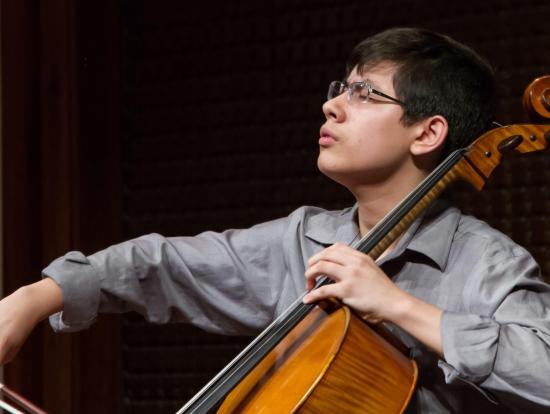
The sequel, with a main dish of the “Arpeggione” Sonata, featuring pianist Bruce Murray and 17-year-old cello phenom Zlatomir Fung, expanded the concept. Yielding to additions from J.S. Bach and Krzysztof Penderecki, the Bechtler made their “Schubertiade… and Then Some” mostly Schubert. Murray and Fung combined on an adaptation of a song, “Ständchen,” from Schubert’s posthumously published Schwanengesang, before the pianist took over the floor for two of the four posthumous Impromptus. Those solo selections helped the ensuing departures make more sense, since there are no solo works by Schubert for a cellist to play.

“Ständchen” or “Serenade” is certainly a dark and lovely ballad, but it offered no great challenges to either musician. The wordless lyricism of the piece likely did more to ingratiate the players with the audience than it did to warm them up. Winner of numerous competitions in the US and Europe, with six appearances logged on NPR’s From the Top, Fung has a luscious tone on his instrument – and, one guesses from his surprisingly mellow speaking voice, an affinity for singing. Sitting in the front row, maybe five feet from the platform that Fung was playing on, I found the sound of his cello more powerful than expected. I’d also recommend the left side of the room, where I found myself near the wall, over my customary spot on the right side near the passageway to the main exhibition hall. The sound of the Steinway also seemed better defined from this fresh vantage point.

brevard_murray_082012

While Benjamin K. Roe, long associated with both the WDAV classical station and NPR, did the initial introduction for the concert, Murray zeroed in on Impromptu No.’s 2 and 4, clearly indicating his preference for the latter and its touch of madness. He played the A flat No. 2 with admirably contrasting dynamics within each of the three sections and linked the middle section to the outer sections in a manner that made them sound very much like a set of variations on the same theme. But the liveliness of Murray’s playing sounded nothing like madness at the start of the F minor No. 4, with jollity echoing Mozart giving way to waves of romanticism presaging Chopin and Liszt. The sudden stops and plunges into more ruminative passages were a different matter, indeed simulating the depths of a depression, when we reached the midsection of the piece before jollity returned.

Fung’s introductions were no less lucid than Murray’s, making a virtue out of the necessity of explaining why Bach and Penderecki belonged at a Schubertiade. Apparently, Bach inspired Schubert to take up the study of counterpoint late in his abbreviated life, a fair connection, but the charm of Fung’s intro to the Penderecki was his frank acknowledgement of how weak and lame his explanation was for any linkage at all. The two pieces fit the profiles of these introductions very nicely, for the Prelude from the Cello Suite No. 6 in D was rich and meditative, more like Yo-Yo Ma’s account of the Bach classic than Rostropovich’s. Aside from one stray squeak, the only complaint I can lodge against the performance was that Fung only played one of the six movements.

If the 1994 Divertimento by Penderecki wasn’t as whimsical as Fung’s intro, it was certainly as unusual and unpredictable. Perhaps the better course of linking the piece to the Schubert repertoire would have been to underscore the title of the first movement, Serenade, as the translation of the opening “Ständchen” he had played with Murray. Certainly, there was something to say about how different a serenade this was. No wooing here. On the contrary, after the preliminary pizzicatos and soft tapping of the wooden side of the bow on the strings – a soft knocking on milady’s door? – the knocking grew more violent after a gentle section of conventional bowing, hinting at a growing desperation. The ensuing Scherzo movement (Fung only played two of the three listed on the program) was less playful than the Serenade was tender, quickening the pace and hurtling into chaos with furious double bowing, leavened only with a sprinkling of harmonics. This was the most startling display of Fung’s virtuosity that we would see but definitely not a piece that I would expect Yo-Yo Ma to record soon.

Completing the “posthumous-ness” of the Schubert selections, Fung and Murray played the “Arpeggione” Sonata in A minor after a brief intro from the pianist that chiefly described the instrument. The six-stringed guitar-like cello with its fretted fingerboard passed out of vogue not long after Schubert wrote his sonata, perhaps because this piece wasn’t published until 47 years after it was written in 1824. My late father introduced me to the work many years ago when he asked me to buy him a recording of it for Hannukah, and I was fortunate enough to hear Mischa Maisky play it live to a standing-room-only audience at the Verbier Festival in 2004.

In this more sedate museum setting, Fung’s adrenalin didn’t seem to be pumping nearly as hard as Maisky’s when he took the fast outer movements, the opening Allegro moderato and the closing Allegretto, at a dangerous clip. At a more prudent pace, I did detect one little scrape as Fung sped along, but there were none of Maisky’s intonation errors marring his celebratory virtuosity. Fung’s heavenly tone was showcased once again in the middle Adagio movement, and there was a nice clearing in the closing movement for Murray to shine in before Fung made his most intensely joyous entrance. Such a rousing ending deserved a mellow encore, and the duo obliged with an eloquent transcription of “An die Musik,” another Schubert favorite. The translation of that title, “Ode to Music,” could accurately be applied to all we heard.

The Nerd Who Terrorized New Jersey

toxic-press-5

Theater Reviews:  The Toxic Avenger and Pride and Prejudice

By Perry Tannenbaum

I’m not sure how or when such epithets as “Armpit of the East” or “Scrotum of the Nation” rained down on New Jersey, but they were certainly commonplace before the onset of The Sopranos or Chris Christie. It’s also clear that when Lloyd Kaufman and Joe Ritter cooked up their 1984 screenplay for The Toxic Avenger, they weren’t intending to prettify the Garden State’s battered image. About the only love they showed for Jersey was shooting the film there.

A mere 24 years elapsed before Joe DiPietro and Bon Jovi keyboardist David Bryan, following their successful collaboration on Memphis, hooked up on a Toxic musical adaptation. The record-breaking reception of the show in New Brunswick, before its off-Broadway transfer in 2009, only underscored how highly Jerseyites cherish their notoriety.

DiPietro liberally refashions Kaufman’s original plot, but political corruption, organized crime, unconscionable pollution, and unchecked violence are still among its hallmarks. Actor’s Theatre of Charlotte, newly resurrected on Freedom Drive after its recent homelessness, embraces all of these horrors with the merry glee it applied to Evil Dead The Musical seven years ago. Billy Ensley directed that 2009 gorefest on Stonewall Street, but ATC artistic director Chip Decker takes the reins here, reminding us that crass sci-fi musical parodies are at the core of this company’s DNA.

toxic-press-1

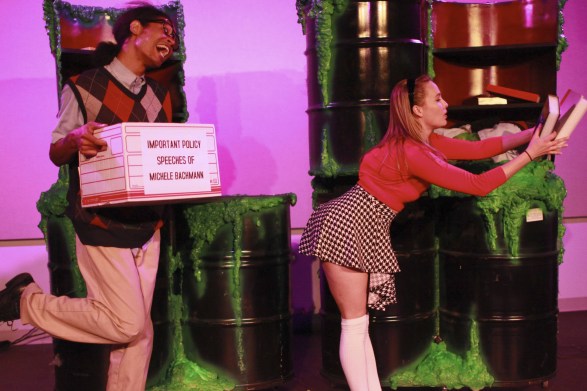
Journeying from screen to stage, Melvin Ferd the Third has lost his signature janitorial mop, but he’s still a hopeless nerd and still smitten by the blind Sarah, who is now a librarian. The new Melvin is an environmental crusader from the get-go, and his plunge into an oozing drum of green toxic goo is far more malignant, ordered by corrupt Tromaville mayor Babs Belgoody. Where does Melvin find the goods on Mayor Belgoody’s polluting schemes? At the library, of course, cleverly filed away by Sarah where they are least likely to be found: among the important policy speeches of Michele Bachmann.

toxic-press-7

Something underhanded seems to have occurred here, since Bachmann didn’t achieve her peak infamy until the 2012 election cycle. Suspicion falls on the prankish Decker, who compounds his violations of DiPietro’s script by introducing the image of Donald Trump later in the evening. Hopefully, that glorified groper will be forgotten by the time the Avenger concludes his rampages on November 12.

Yes, if you didn’t already know, what doesn’t kill Melvin makes him Toxie, the avenging mutant monster. This is exactly where Actor’s Theatre upstages the off-Broadway production once again. In 2009, Ensley simply had the luxury of a better pool of actors to choose from for Evil Dead. This year, Decker enjoys no luxuries whatsoever. ATC and City Hall couldn’t dot all the i’s on permits for the new location at 2219 Freedom Drive in time for opening night last Wednesday, so Decker & Co. were obliged to move next door to Center City Church & The Movement Center at 2225 Freedom.

toxic-press-3

On very short notice. So the set designer is listed as Dire Circumstance in the playbill while other members of the design team have vanished altogether. Whether by accident or design, then, Decker doesn’t make the mistake that plagued the off-Broadway show: overproduction. In the New York version, when Melvin emerged from the chemical dumpsite as Toxie, the green carbuncled mask that covered his head was not only horrific, it robbed actor Nick Cordero of all further facial expression.

Jeremy DeCarlos doesn’t have to combat that handicap. As cool, graceful, and intelligent as DeCarlos has always seemed onstage, I expected both the nerdy Melvin and the homicidal Toxie to be difficult stretches for him. Clearly, I had no idea how well DeCarlos could channel the dopey sound and body language of Jerry Lewis as the socially inept earth scientist. When he emerged from the flimsy façade of chemical drums as Toxie, there were some wrappings on his arms to offer a semblance of might, but it was Decker at the soundboard who offered the more telling boost, amping up DeCarlos’ voice and synthesizing his monster roar.

No, the wrappings and the roars don’t close the gap between DeCarlos and fearsomeness – but that’s another reason why his Toxie is so much more hilarious than the more technically polished off-Broadway version, which often forgot it was a spoof. Leslie Giles certainly isn’t forgetting her spoofery as Sarah, helpless ingénue or aggressive vamp as the occasion demands – and her blind stick shtick with the hapless Melvin is a corny gift that keeps on giving. Sarah’s big number, “My Big French Boyfriend,” struck me as the best in the show.

toxic-press-4

Lisa Hugo, who was so precisely calibrated in the complex leading role of Stage Kiss earlier this year, the last ATC production at Stonewall Street, gets to loosen up in multiple roles. When she isn’t the melodramatic, megalomaniacal Mayor, she’s usually Melvin’s disapproving Mom. These two nasty women turn out to be old enemies from their school days, so their “Bitch/Slut/Liar/Whore” confrontation deep in Act 2 was a manic reminder of a similar duet in the Jekyll & Hyde musical. Ma Ferd also gets an effective “All Men Are Freaks” duet with Sarah.

Ryan Stamey and Dominique Atwater divvy up nearly all the remaining roles, more than I could keep track of, with Matthew Blake Johnson subbing for Atwater on opening night. Somebody needs to terrorize Sarah, toss Melvin into the toxic goo, get their asses kicked by Toxie, scurry around with missing limbs, and represent the hordes of Tromavillians who idolize the grotesque mutant. Stamey and Johnson performed every one of these worthy missions, and more, with the suave sophistication you would expect.

Yes, the middle school auditorium atmospherics of the Movement Center hall are somewhat against the grain of the gorey Toxic Avenger irreverence, but it served better than expected for what turns out to be a unique guerilla theatre project. If you arrive early for one of the remaining performances, you might get a brief tour of the new ATC space next door. What’s going on now on Freedom Drive bodes well for the company and the resourceful artists who make it go.

14657273_1592031430816445_6330787092415780744_n

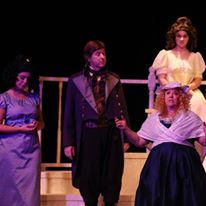
Jon Jory is best known as the artistic director who brought renown to the Humana Festival and the Actor’s Theatre of Louisville – and widely believed to have penned Keely and Du, Flaming Guns of the Purple Sage, and Anton in Show Business under the penname of Jane Martin. When it comes to adapting Jane Austen, whose Pride and Prejudice is currently on view at Pease Auditorium in a CPCC Theatre production, Jory is no dilettante. He has also adapted Sense and Sensibility and Emma.

Even if all the subtleties aren’t always pointed under Heather Wilson-Bowlby’s poised direction, it becomes obvious that Jory’s adaptation preserves the style and thrust of Austen’s liveliest masterwork. Most of the credit goes to Moriah Thomason as Austen’s prejudging heroine, Elizabeth Bennet, though it’s hard to deny she is amply counterbalanced by the hauteur of Brian Logsdon as Fitzwilliam Darcy. Thomason unveiled her elegance in the ATC production of Stick Fly back in February. Here she adds vivacity and wit, so I couldn’t get enough of her.

14639612_1592031587483096_6752582616922785572_n

We see where Elizabeth gets her wit from in Tony Wright’s slightly jaundiced portrait of her father, and Anne Lambert’s rendition of Mrs. Bennet has more than enough vanity, giddiness, and silliness to distribute among the younger Bennet sibs. My chief disappointment was the hoarseness that afflicted Lexie Simerly as Liz’s elder sister Jane. If only she could have borrowed some extra decibels from Iris DeWitt, whose towering presence made the imperious Lady Catherine De Bourgh a perfect victim of Elizabeth’s punctiliously polite sass.

Jane Shall Have Jill in DC’s Hip-Hop “Midsummer Night’s Dream”

Theater Review: A Midsummer Night’s Dream

dsc_0523

By Perry Tannenbaum

If you have the notion that America’s liberal arts colleges are hidebound guardians of the past, mired in fossilizing traditions, you may wish to check out Davidson College’s production of A Midsummer Night’s Dream. Unorthodox thinking was already obvious when I looked at the cover of the playbill. Instead of the Grecian colonnades or laurel wreathes you might expect for a lyrical Shakespearean comedy that mostly transpires within 25 miles of Athens, the cameo portrait of Fairy Queen Titania and the bewitched Bottom is done in comic strip style. All of the basic info – title, playwright, director, dates – is set in that impossibly perfect hand-lettering that worshipers of Superman and Batman grew up with. Furthermore, entering Duke Family Performance Hall, I was already tipped off to the fact that director Ann Marie Costa would be infusing the Bard’s text with plenty of hip-hop rhythms and dance, thanks to the ministrations of beatmaker Mighty DJ DR and spoken word artists Boris “Bluz” Rogers and Carlos Robson.

Given the problematical acoustics of the Duke, I was fairly anxious about what I might need to contend with in the style – and the beat – of this production concept. But there was more. In the opening scene, when Egeus petitions the heroic Duke Theseus in hopes that he will force his daughter Hermia to marry Demetrius, the groom he intends for her, there were a couple of radical switches. Hermia’s father was nowhere to be found, replaced by Egeia, a heartless mother. Perhaps more shocking, Hermia’s true love, Lysander, had also disappeared, replaced by Lydia. If Joe Gardner’s elegantly simple set design and Martha Making’s contemporary costumes weren’t enough, Lydia’s plan to elope with Hermia and marry her assured me that we weren’t in ancient Athens anymore.

I would have been dizzy with disorientation if these alterations had been delivered with hip-hop embroidering, but the lovers’ couplets and the mechanicals’ prosaic rehearsal scene afterwards were plainly spoken. As so often happens, the uniqueness of a Midsummer Night’s Dream production becomes manifest when we leave Athens behind and plunge into the nearby woods. Back in 1987, when NC Shakespeare was still alive and touring, Hermia and Lysander traipsed into the forest carrying their own Samsonite luggage. In 2003, deposed Charlotte Repertory Theatre founder Steve Umberger found refuge at Theatre Charlotte, bringing Cirque du Soleil acrobat Karl Baumann with him – to go where no Puck had gone before. Costa says in her director’s notes that she was inspired by a recent visit to New York City, where she saw spontaneous performances by street musicians, beatmakers, and break dancers in the city’s public parks. The nocturnal woods is exactly the right place for disorientation to be encouraged.

So as soon as we first saw Puck conversing with the First Fairy, we got a steady flow of hip-hop movement, choreographed Emily Hunter – with plenty of urban attitude – accompanying the hip-hop reaffirmations that most of the fairy dialogue is rhymed. Tatiana Pless was so vivacious as the Fairy that I presumed she was Puck for a few moments, but not to worry, Pless got more play and multiple costume changes as Mustardseed and Moonshine. Graham Marema was quite engaging as Puck after her comparatively subdued arrival, but it was Colin Bye’s bravura exploits as Puck’s master, King Oberon, that enabled the whole hip-hop concept to click. His tall frame topped with a pom knit hat, Bye became a living breathing testimonial to the efficacy of YouTube hip-hop tutorials. He rarely moved from one spot onstage to another without a lithe moonwalking glide – nearly on point, increasing the impact of his lanky height. The sensation Bye made as Oberon was only enhanced by the starchy, stiff, and proper impression he made in his other role as Theseus in the opening scene.dsc_0758

While discord between Hermia and her mom unsettles Athens, there is parallel discord in the fairy kingdom, where the proud Queen Titania is denying custody of an adorable kidnapped boy – and conjugal visitations! – to King Oberon. To bring peace to both kingdoms, Oberon must teach Titania a lesson and restore Demetrius to his previous fiancée, Helena. Oberon dispatches Puck to retrieve a faraway flower whose juice can be made into a love potion that can be applied to a sleeper’s eyes. When the sleeper awakes, he or she will fall in love with the first person or animal that comes into sight. Oberon himself applies the potion to Titania, but fortunately, he deputizes Puck to find Demetrius and apply that same potion so that he’ll become enamored with Helena again when he awakes. Half of the fun we experience in the woods results from Puck messing up and applying the potion to Lydia instead of Demetrius. The other half comes from what Puck gets right, transforming the incorrigible Nick Bottom into a man with a donkey’s head in the middle of the mechanicals’ inept rehearsal. That’s who – or what – Titania sees when she first awakes.

After seeing Midsummer numerous times before, I found Kanise Thompson a little less shrewish than most Titanias because of the boogie in her movement and the hip-hop delights of her fairy entourage. Arrayed in the funky garments of the hip-hop culture, this entourage combined to make the queen’s bedtime the most regal event of the evening. Thompson did reappear later in the evening as Hippolyta, whose nuptials with Theseus were another regal event, but her best moments came when she heaped love on the repellent Bottom and when she sensuously reconciled with Oberon. Although he couldn’t compete with the most commanding Bottoms that I’ve seen, Sam Giberga had some bodacious moments as Nick, particularly when he was vaunting his versatility as an actor and getting vamped by the queen. Louder braying, please!dsc_1063

The whole hip-hop concept went so well for me that acclimating to the gender and sexuality alterations presented more of a challenge. Sarah Kostoryz as Helena may have more reason to be offended by Lydia’s advances, but the text offers no guidance, and she reacted as if a Lysander were still pursuing her. I’ve also seen more vicious taunting of her shorter rival Hermia when their antipathy heats up. As Hermia, Izem Ustun could give the most conventional performance among the lovers, for it made no difference who her admirers were when both of them abandoned her. Uztun swam bravely against the handicap of her relative conventionality, no more sensitive to Hermia’s shortness than Kostoryz’s provocations warranted.

Soft-pedaling her altered sexuality, Blaire Ebert was a very courtly and principled Lydia, and she tore after Demetrius fearlessly. Now when Lydia’s conflict with Demetrius escalated from verbal to physical, I could perceive some difficulties in the audience. As Lydia and Demetrius rolled over one another on the forest floor, there seemed to be a mixture of shocked silence, nervous laughter, and redoubled laughter from various sections of the house. There was no avoiding it: the lesbian Lydia’s attack on the straight Demetrius often had the look of lovemaking as they lingered on the floor. Similar to Ebert, Ed Pritchard portrayed Demetrius as if nothing had changed, a problematical proposition when your fiancée turns out to be gay or bisexual, but the text offers no more guidance to our Demetrius than it does for Helena or Lydia. I would have expected all four of the lovers – especially during the taunting and fighting – to have more fun with the newly hatched absurdities.

The cuts that Costa applied to the script may have shortened the mortals’ time onstage more than the fairies’, or maybe the extra juice from the hip-hop idiom just made the fairies more exciting and accessible. I’m sure that I’ve seen Midsummer productions where the mechanicals don’t perform their Bergamask after their travesty of a tragedy, and I’ve also seen productions where the fairy king and queen don’t return. Returning both of these to the final scene added to the sense of revelry, merriment, and magic. When the last huge exits went to King Oberon and Queen Titania instead of the three newly wedded Athenian couples, the sudden hush when Puck was left all alone onstage was all the more poignant and dramatic. After such an unusual, energetic staging, Merema had no difficulty at all in coaxing us to give her our hands.

Opera Carolina’s “Barber of Seville” Sharpens the Comedy

161020_ope_sev_0886

Review : The Barber of Seville

By Perry Tannenbaum

Poor Beaumarchais. A crucial friend of the American Revolution, French playwright Pierre Beaumarchais’s great Figaro comedies have been both favored and scorned by history. Just two years after The Marriage of Figaro premiered in Paris, Mozart’s 1786 adaptation eclipsed the theater version, remaining one of opera’s supreme masterworks to this day. And the Rossini version of the first Figaro play, The Barber of Seville, has a been an operagoer’s favorite ever since its Rome premiere in 1816.

Hardly a month goes by without one of these operas being produced somewhere around the globe. The original Beaumarchais comedies? Not so much. They endure through the operas they inspired.

Rossini was the fifth or sixth composer to adapt The Barber, and undoubtedly the best, for the profusion of memorable melodies in this score has hardly been equaled by any other opera. But popularity can pay a price. Two hundred years after Barber’s triumphant premiere, there are indications that both producers and audiences are wearying of the longtime favorite.

Up in New York, director Bartlett Sher had the opera and the libretto by Cesare Sterbini sliced, diced, and freshly translated for a new family-friendly version at the Metropolitan Opera during the holidays last season. Obviously, the calculus included the notion that the hit parade packaged in a compressed Barber could serve as a gateway to other operas and/or Rossini, for the composer’s Lady of the Lake was among the other operas that I found in the Met’s rotation last December.

Yet there seemed to be some uneasiness from Sher about presenting the classic in the usual way. As a result, baritone Elliot Madore was more of an action hero as Figaro than a razor-stropping conniver, and tenor David Portillo was almost a purely romantic hero as the barber’s co-conspirator, Count Almaviva, further draining the comedy from the evening.

No such trimming, miscalculating, uneasiness, or distortion occurs in Opera Carolina’s current production at Belk Theater. Stage director Bernard Uzan, who directed a delicious Opera Carolina-Piedmont Opera co-production of Barber in 2002, both in Charlotte and Winston-Salem, helps the singers to wed Rossini’s music with Beaumarchais’s comedy even more delightfully this time around.

You can bet that OC general director James Meena, conducting the Charlotte Symphony, is also in on the comedy conspiracy, for his alertness with dynamics and tempo consistently sharpens Rossini’s musical joking. From the orchestra pit up to the stage, with its pitch-perfect scenery and costuming, everybody seems jazzed by the concept of this revival.

No, all the Rossini fatigue in Charlotte seems to be out in the hall, where empty seats gradually dominated the rear of the orchestra section on opening night. At intermission, I looked up at the top balcony, shocked to find that none of the seats up yonder had been sold. Ushers up there enjoying the show could have any seat they wished. Three performances shouldn’t satisfy audience hunger for an outstanding production like this, but unfortunately, hundreds have already missed out on the fun.unspecified

It starts with tenor Victor Ryan Robertson, who was so slick and rascally as Sportin’ Life earlier this year in Charleston at Spoleto Festival USA’s production of Porgy and Bess. Disguised as the student Lindoro, Robertson torches Count Almaviva’s lovesick “Ecco ridente in cielo” serenade in the opening scene. The strength of Robertson’s singing promises that he will be as noble and ardent as Portillo was in New York.

But to spirit his sweetheart Rosina away from the decrepit and perverted fingers of her guardian, Dr. Bartolo, Count Almaviva dons two disguises within his Lindoro disguise, first a drunken soldier to be quartered in Bartolo’s home and later a singing teacher to tutor Rosina. Aided by the zany handiwork of wig-and-makeup designer Martha Ruskai, Roberston’s comic stints far excel what I witnessed at the Met, actually upstaging our clever Figaro. In particular, the nasal whine of the tutor, compounded by the dopey look of his coke-bottle eyeglasses, is magnificent overkill if their intent is to calm the rabid jealousies of the vigilant Bartolo.

Of course, it’s Figaro who upstages Almaviva in the opening scene, and Hyung Yun registers a resounding triumph with the most familiar patter song in all opera, the “Largo al factotum.” Yun was not only up to the increasing speed of the aria, he refused to hide behind the language barrier, sounding like he was saying something rather than zipping through an advertising jingle. Sher’s impulse to turn the title character into an action hero was understandable given the tendency for him to devolve into a lovable clown, but Yun’s Figaro remains a clever and resourceful rogue.

No, Figaro doesn’t have to beg like a silly slave when Almaviva and Rosina delay their escape from Bartolo’s home late in Act 2, nor does he need to counsel haste and quiet to the lovers like a sensible big brother. Yun takes a neat middle way, preserving the comedy that Gilbert and Sullivan must have cherished (see the denouement in The Pirates of Penzance). I also appreciated how Yun held up his end of the “Fortunati affeti mei” duet with Rosina in Act 1, Scene 2, earnestly expressing his admiration for women’s aptitude for deceit without becoming – as we usually hear – a mere background drone.

With her crazy Queen of the Night range, soprano Kathryn Lewek was certainly worthy of all the admiration that came her way as Rosina, topping her own Op Carolina debut as Lucia di Lammermoor 18 months ago and topping what I saw and heard from mezzo Isabel Leonard in New York last December. In some respects, she even surpassed the scintillating work of mezzo Vivica Genaux when she sang Rosina here in 2002.

Not only did Lewek reach higher notes in her coloratura flights, she also conspired to deliver more comedy. From the moment she launched into the famed “Una voce poco fa,” proclaiming Rosina’s devilish tendencies, it was obvious the Lewek was capable of meeting the pyrotechnical demands of this showpiece. Uzan was clearly her accomplice in taking Rosina’s coloratura beyond showmanship.

161020_ope_sev_0575

Early on, we get indications from Lewek of what would become deliciously explicit later on – when she and Lindoro, disguised as her tutor, are carrying on in the same room where the hoodwinked Bartolo is getting ready for his shave. Those coloratura flights aren’t merely the showy warblings of a songbird, they are manifestations of uncontrollable sensual delight, triggered each time Almaviva caresses Rosina’s arm. Lewek delivers these passages with sudden surges in volume to enhance the effect. Sensational and comically seductive at the same time.

Stephen Condy as Dr. Bartolo and Kevin Langan as Don Basilio turn in fine performances as the dupes of all this connivance. Bartolo is the dopier dupe, more often in the spotlight, but bass Langan upstages him musically with Basilio’s “La calumnia,” urging a vicious campaign of rumor to drive Almaviva out of town. Condy, a baritone of imposing pomposity, listens stolidly as Langan’s fulminations rise to a stormy peak. Then he responds with a simple no, rounding off a polished comedy gem.

Uzan sprinkles the staging with other comedy nuggets, making sure Basilio’s endless exit is milked as thoroughly in the middle of Act 2 as the lovers’ aborted escape is afterwards. More singular is the slow motion and stop motion that gets layered onto the chaotic ensemble that ends Act 1, built up to pandemonium from a hushed staccato. The same shtick worked well in the 2002 production that Uzan directed here in 2002, so why not bring it back?

After attending a Charlotte Symphony concert just eight days earlier, when I sat up in the grand tier, I found the orchestral sound comparatively muffled as Meena struck up the overture down in the pit. I’d already acclimated to the altered dynamics by the time the curtain rose on pre-dawn Seville. When Meena summoned the music that covers the transition from afternoon to midnight at Bartholo’s home midway into Act 2, it really carried the shocking snap and crackle of an unforeseen lightning storm.

Sure enough, Beaumarchais called for the sound of a terrible storm in the interval between Acts 3 and 4 of his original playscript, sparking more than two centuries of conjecture that he intended his work to be an opera all along. With its exceptional singing and mirth-making, I’d say the current Opera Carolina production of The Barber of Seville fulfills Rossini’s and Beaumarchais’s intentions in equal measure.

The Electoral College in Elementary School

Reviews of Grace for President and Fall Works

By Perry Tannenbaum

We’ve been favored with a couple of Grace shows from Children’s Theatre over the years. There were two productions of Amazing Grace, a charming but trifling little piece, in 1999 and 2005. Before the encore, there was the incomparably richer Boundless Grace, deeply infused with African rhythms and culture, that won Creative Loafing’s Show of the Year laurels in 2000.

grace-index

So for those of you who recall those pre-ImaginOn productions, it may be important to emphasize that there’s no kinship between them and the current world premiere of Grace for President through November 6. Mary Hoffman created the previous Grace, of Gambian descent, in a series of books that depicted her heroine with playacting impulses rather than political ambitions. Grace Campbell is a more recent brainchild by Kelly DiPucchio, slightly browner in LeUyen Pham’s illustrations than her Woodrow Wilson Elementary teacher, Mrs. Barrington, but never assigned to an ethnic group.

From the first page on, DiPucchio’s Grace is more about feminism than racial pride. Mrs. Barrington brings a poster to class at the start of the school year with all the US presidents on it, and Grace asks, “Where are the GIRLS?” After getting the lowdown, Grace stews at her desk momentarily before announcing that she would like to be president. Despite the snickers from several of Grace’s classmates, Mrs. Barrington deems this impromptu ambition to be a “star-spangled idea” – clear proof that DiPucchio intended her story as a musical all along.

Clocking in at 57 minutes, Joan Cushing’s adaptation actually expands upon DiPucchio’s slender volume, with a robust – and resourceful – song list. When Grace starts campaigning against Thomas Cobb, the nominee from Mr. Waller’s class, Grace and Thomas sing in debate-like counterpoint, not harmony, each candidate spouting a separate line. And while it’s doubly lamentable that a two-party system is axiomatic in this story and that genders represent the party lines, when the guys sing “Boys Boys Boys,” it rings like a barbershop quartet.

Cushing does churn out some pabulum along the way in explaining what elections are, but she bravely follows in DiPucchio’s footsteps in trying to explicate that grim Founding Fathers albatross, the Electoral College. We skim over some fairly muddy waters when Barrington and Waller establish a system where each of their students represents one of the states, unevenly weighting their votes.

index

The outcome partly redresses the inequity. Cobb seems to have a lock on the election because the boys hold the majority of the electoral votes. Our intrepid heroine therefore comes up with a platform designed to change some minds, listening to her classmates while Cobb mainly coasts. Party lines have held fast when we reach the end of the roll call of states, so the election is still up for grabs as Sam, representing Wyoming, gets set to cast his measly three electoral votes.

“My vote counts!” Sam sings out, an epiphany yet to be reached by millions of unlikely American voters.

I won’t tip the results of this suspenseful election, but I’ll credit set designer Anita J. Tripathi with heightening the tension by dropping down an electronic scoreboard over her gallery of presidents to give us a running total of electoral votes until the confetti moment when the shunned wallflower Sam makes his decision. We’re supposed to greet the result with jubilation, but overall, the students of Woodrow Wilson Elementary are even more set in their voting patterns than adult Americans.

Although director Michelle Long pilots the most polished production I can remember at Wells Fargo Playhouse (the smaller ImaginOn theater), I found myself fighting the notion that this wasn’t really a Charlotte production. Most of the seven-member cast is new to the Charlotte scene, all except one are making their first 2016 appearance, and all the designers seem to be making their Uptown debuts.

Youngsters shouldn’t have any problem warming up to Talia Robinson as Grace. Her sunny optimism in launching her campaign is only slightly clouded by the prospect of opposition, and Robinson’s attitude toward her classmates usefully blends the callings of public service and leadership. After starring last December in the title role of another Cushing world premiere, Ella’s Big Chance,  Margaret Dalton as Mrs. Barrington is the most familiar face we encounter. She gives us that ideal teacher we never had, not only radiating energy and encouragement but also drawing inspiration from her pupils’ ideas.

The other Ella alum in the cast, Sean Powell, infuses Thomas Cobb with a patrician smugness as he initially intimidates Grace, singing his own praises in “My Accomplishments.” Until the denouement, Powell keeps the concept of doing for others totally alien to Thomas. Shivam Patel’s debut as the outcast Sam is as impressive as Robinson’s, for suffering often has deeper roots than righteous indignation. While Grace is affirming that girls can now win as never before, Patel makes Sam’s discovery that he matters just as heartfelt and liberating.

While the script is intended to remain serviceable for election years to come, there was one aspect of this world premiere bears the fresh fingerprint of 2016. A couple of errors that were noted in the Observer review on Friday morning had been expunged from the script by the time I attended the Saturday afternoon performance. Politicians may resent fact-checking during their hotly contested 2016 races, but playwrights and theatre directors evidently don’t.


chlt-ballet-fall-works-300x300-7e095b7b3d

As Charlotte Ballet launched its 2016-17 season, the final season for Jean-Pierre Bonnefoux as president and artistic director, one thing became very evident during the Fall Works program: Bonnefoux’s successor won’t need to do any rebuilding. I’m not sure I’ve ever seen so much energy expended by so many dancers so brilliantly. Five of the 18 dancers we saw are new to the troupe this year, and one – a soloist! – was recruited from Charlotte Ballet II, the company’s apprentice ensemble.

dancephoto2

When we first saw Dwight Rhoden’s rousing paean to 80s club culture, The Groove, kicking off the 2012-13 season at Knight Theater, it was almost exhausting to watch at the end of that program. This year, it led off the evening in the you-ain’t-seen-nothin’-yet slot, no less astonishing in its unflagging exuberance than it was before. Surely newcomers to Charlotte Ballet performances must have been wondering how they could follow such a barrage of fast-paced bravura.

Those of us who had seen Ohad Naharin’s Minus 16 at Spoleto Festival USA had no such worries. Part of the wildly varied suite came to Charleston when Naharin’s Batsheva Dance Company made its Spoleto debut in 2007. Alvin Ailey American Dance Theater brought the full suite to Spoleto in 2012 – shortly after their stopover at Knight Theater!

14680555_10154598885387170_2437162458183624318_n

The spectacular core of the work is Naharin’s setting for the traditional Passover seder song, “Echad Mi Yode’a,” in a frenzied recording by The Tractor’s Revenge. It’s a song that cycles to 13 in much the same way that stanzas to “The 12 Days of Christmas” expand. Instead of ending with a “partridge in a pear tree,” each of the Hebrew stanzas concludes with “our One God in the heavens and the earth.”

Naharin sits 18 dancers in semi-circle before us, all of them clad in black suits, white shirts, and black fedoras, emblematic of Israel’s ultra-orthodox Jews. Each time we reach the end of a stanza, 17 of the dancers rise to their feet in a prayerful wave that sweeps the group from left to right. The eighteenth dancer catapults himself to the floor in an epic flop, as if shot from a cannon – or flung from the explosion of a terrorist bomb.

Each number draws a new signature movement from Naharin as the stanzas grow longer. Each stanza ends with the same wave and explosion as we proceed toward 13, all the dancers returning to their chairs to start each stanza. What I called the “regimented hysteria” of Naharin’s choreography is compounded as we draw closer toward the end, for the “black hat” Hasidim do the unthinkable: they begin throwing more and more of their clothing into the air until all their outer garments – from hats to shoes – lie in a chaotic pile in front of them. Unforgettable.

One of my grandfathers was a Hasid. I’m certain that if I’d seen him in his underwear, I would have been cast straight down into Gehenna.

14650064_10154597284587170_1183638509565827188_n

Yet the suite began innocuously – and comically – with Maurice Mouzon Jr. from Ballet II standing in front of the stage at intermission, morphing from motionlessness to tentative dancing to bodacious acrobatics before the ensemble’s prelude to the core ritual. Things lightened up immediately after the mass rending of garments, with a bouquet of Harold Arlen songs and some truly hilarious – and spontaneous – hijinks with Dean Martin’s “Sway” as the prime backdrop.

All of the troupe came out into the audience and chose partners whom they led onto the Knight stage. A block party broke out with a cornucopia of delights: sensuousness, grace, shyness, awkwardness, and hambone scene-stealing were all abundantly on display. Nor was the fun finished when patrons were sent back to their seats and the dancers took their bows. The crimson curtain kept rising and falling, each blackout hatching a new zany tableau.

Not all of the hambone came from the amateurs, that’s for sure.

Not Your Same Old Vampire

Reviews: She Who Watches and Charlotte Symphony

By Perry Tannenbaum

Performances of She Who Watches run through Oct. 30 at Frock Shop.


When J. Sheridan Le Fanu serialized Carmilla in 1871-72, Count Dracula wasn’t even a gleam in Bram Stoker’s eye. Yet a quarter of a century later, when Dracula became the paradigm for modern vampire literature, Stoker himself acknowledged that Le Fanu’s most famous novella was a part of that gleam. So after a steady sprinkling of October visitations from the undead lord of Transylvania — no less than seven Metrolina Dracula productions since 2002 — it’s nice to see a change of pace in the form of a new PaperHouse Theatre adaptation of Le Fanu’s spellbinding horror classic.

Eerie echoes are a key motif in the storytelling, which co-directors Nicia Carla and Chester Shepherd have retitled She Who Watches in their adaptation. The narrator of the story, Laura, is haunted by a nightmarish experience from her childhood, when she awoke to find a teen-aged girl in her bedroom. That girl seemed to fall into a slumber on Laura’s chest, but when she awoke the second time, what the girl was doing made her shriek in terror. And then, before her governess could come to the rescue, the girl vanished into thin air!

It would be cruel to divulge much of what happens 12 years after this creepy prologue, but you’re correct in assuming that the beautiful face indelibly etched in Laura’s memory is Carmilla. How Carmilla returns to Laura’s home — and ultimately, her bed — took just under 69 minutes to deliciously unfold on opening night, with neat surprises and more eerie echoes along the way. That’s about the same amount of time you might spend in your family car getting from the I-277 overpass to the dubious thrills of Scarowinds.

It’s a shorter, more enjoyable evening at PaperHouse’s customary haunt, The Frock Shop. Le Fanu’s story placed the action at a lonely Austrian castle in a place called Styria, but the parlor of the Frock Shop cottage on Central Avenue seems to suit Carla and Shepherd quite dandily. The antique atmosphere is built in, augmented by a gallery of starchy, frilly, diaphanous, and full-length costumes designed by Magda Guichard.

Lighting designer Chaz Pofahl, strategically potting the illumination levels, is certainly a part of the spooky conspiracy, but our stage directors also utilize the windows lining two of the parlor’s walls to pique the suspense and ambiance. Perhaps emboldened by the numerous film, stage and TV adaptations of Carmilla that have come before, Carla and Sheperd have done some character shuffling as well. Instead of a kindly father, Laura’s lone parent is a coolish mom, and instead of a distressed friend of her father, General Spielsdorf, we get a more down-to-earth and frazzled Aunt Jean.

The core protagonists remain the same, and we’re very fortunate there. After two strong outings in Theatre Charlotte’s Miracle Worker and PaperHouse’s Much Ado About Nothing, Sarah Woldum is probably the busiest actress in town this year, taking on the role of Carmilla. She seems to revel in the menace of this role, seething with a mysterious intensity when she isn’t softening her prey with endearments. The whole chemistry of her is different from Dracula’s, seemingly resistant to daylight, but you wonder whether her episodes of weakness are symptoms of a gnawing blood hunger or simply playacting to draw sympathy. When Woldum becomes the predator, Carmilla’s rapacity is as much sexual as it is animal.

Racquel Nadhiri spoke too softly at the outset, compounding my difficulties with her Jamaican accent, so I won’t give her top marks as our Narrator. But Nadhiri beautifully captures the mixture of attraction and repulsion that is the essence of Laura’s reaction to Carmilla. Our empathy for Laura’s victimhood is that much stronger because it stems from her sunny heroism.

The ending that Carla and Shepherd have devised for her — distinctly different from Le Fanu’s — fits Nadhiri like a glove, and you might say that the word “bloodcurdling” was specially cooked up to describe her screams.

Two interludes punctuate the action, so you can get refills on the beverages that were served on the front lawn as you first entered, or you might nosh on cream puffs and sausage balls. When we reached the denouement, the audience was split in two, half of us ascending the staircase to witness the climactic encounter between Laura and Carmilla in the bedroom, half of us remaining downstairs to hear the disclosures that Laura’s mom receives from Aunt Jean.

You’ll have a better appreciation of the synchronicity of the two scenes from the downstairs vantage point, but everyone gets the chance to see both scenes — because, we realize, they actually occur simultaneously.

As I’ve already hinted, the cold and clueless Mother isn’t the plum role here, so you won’t be seeing Andrea King at her best, though she’s very good, of course. Most of the scene stealing comes from Rebecca Costas, busily changing costumes and characters throughout the show. Maybe her most comical turn is as the Doctor who says she’ll return so nervously that you can be absolutely sure she won’t, but she’s also pretty funny as Hunch-Hag, dispensing some fairly toxic marital insight to audience members.

Costas also gets a couple of serious cameos, first as the mysterious and malevolent Countess, Carmilla’s aunt. More urgent — and earnest — is Aunt Jean as the action comes to a boil.

Since her stint as she-devil Abigail Williams in CPCC Theatre’s 2001 production of The Crucible, Costas has only emerged briefly and intermittently on the local scene. It’s a kick to see her shining 15 years later in such a versatile performance, her devilish fire not only intact but several degrees hotter.

Charlotte Symphony’s 85th season is off to an exciting start, and Mary A. Deissler, the new president and CEO, is already making her impact. She has things to say, both onstage at Belk Theater when the orchestra plays and in the CSO program booklet, which isn’t as staid and stagnant as it used to be. Sitting down to last week’s Beethoven Symphony No. 2 concert, I found new artwork, festooned with pumpkins, on the cover.

Image result for picture of benedetto lupo playing piano

The two artworks I’ve seen on the booklet covers, through two 2016-17 Classics concerts, already doubles the number I’ve seen in previous seasons. More importantly, Deissler has kept an inside page, opposite the page where you find tonight’s composers and compositions listed, reserved for herself. So instead of some generic remarks designed to linger more or more inanely as the season wore on, Deissler did a reset on page 17A.

The Welcome Page addressed the divisiveness that has fractured our community in recent weeks, the unifying power of music, and Deissler’s gratitude that we were back at a time when healing is needed. Rang true.

Switching from music director Christopher Warren-Green to guest conductor Michael Christie, the Beethoven offerings were more varied and adventurous than the All-Tchaikovsky season opener, veering off into Franz Liszt’s Piano Concerto No. 1 and his Totentanz before we jackknifed into György Ligeti’s folksier and funkier Concert Românesc.

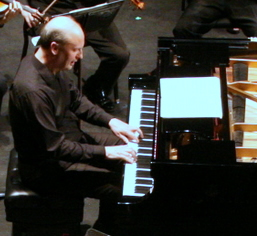
Guest soloist Benedetto Lupo and the CSO brass were a bit overeager and brutish in the opening section of the concerto, but after the pianist navigated through his first softer, lyrical passages, everyone seemed to settle into a more relaxed groove. A fresh production wrinkle further enlivened the concert: a projection screen descended over the Belk stage so an overhead camera could transmit a bird’s eye view of the hurtin’ that Lupo was delivering to a defenseless Steinway Model D.

Van Cliburn himself might have winced.

Memorable Evening at EMF Includes an Adolphe World Premiere

Review: Eastern Music Festival – Greensboro, NC

By Perry Tannenbaum

2016emf_0006


If you haven’t heard about her before, expect to hear more about Julia Adolphe soon. The 27-year-old composer is the 2016 winner of the Lincoln Center Emerging Artist Award, and her Viola Concerto was commissioned by the New York Philharmonic for Cynthia Phelps, their principal violist. Come November, when Jaap van Zweden will lead his first concert at David Geffen Hall since becoming the music director designate for the 2017-18 season, the Adolphe concerto will gets its premiere performance with the NY Phil.

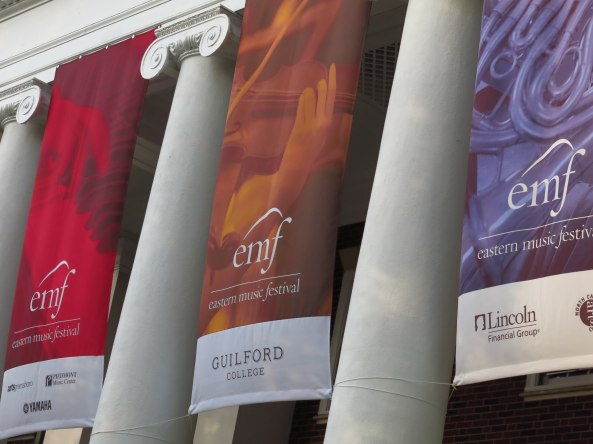
But Phelps has already played the world premiere performance – in Greensboro, NC, on the Guilford College Campus at the 2016 Eastern Music Festival. Van Zweden plans to surround his premiere with works by Wagner and Tchaikovsky. With Gerard Schwarz conducting the Eastern Festival Orchestra, the new Adolphe Violin Concerto fit very well into a program that included an adventurous 20th century sampler: Maurice Ravel’s Alborada del gracioso, Leoš Janáček’s Sinfonietta, and Joaquin Rodrigo’s Fantasia para un Gentilhombre, featuring a second guest soloist, guitarist Jason Vieaux.

Three interacting orchestras keep EMF humming, presenting 45 concerts over the space of 34 days, idle only on July 4, presumably in deference to the holiday and the evening’s fireworks. Two of the ensembles are Young Artists Orchestras made up of promising student musicians, aged 14-23, who perform four programs apiece with resident conductors Grant Cooper and José-Luis Novo.

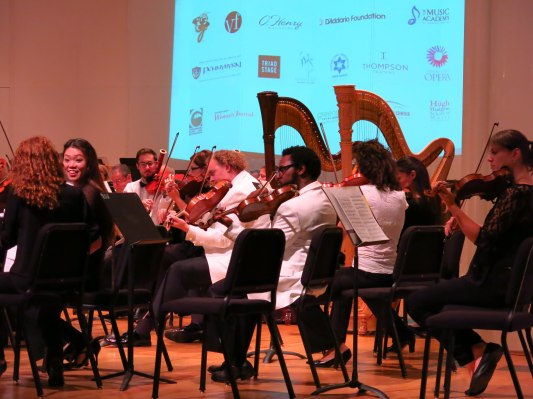
2016emf_0004_edited-1Like the students, the professional 64-member Eastern Festival Orchestra hails from around the country, mostly on furlough from symphony and university posts during the regular season. They double as the students’ mentors, for the Young Orchestras not only rehearse six times a week on a professional regimen, they also get one-on-one individual instruction from a faculty member every week, 3-4 chamber music rehearsals each week, and one sectional meet-up.
I’d be hard-pressed to think of anyone better equipped to pilot EMF’s mission than its music director Schwarz. Before joining EMF in 2005, Schwarz had previously built the Seattle Symphony into a powerhouse, launched scores of new American orchestral compositions, many preserved in unsurpassed recordings.

Only a fraction of the daily campus bustle is evident when you attend an evening concert at Dana Auditorium. As you walk from the nearby parking lot, music wafts toward you from a practice room, and as you reach the top stairs of the Dana’s pillared entrance, a brass quintet of students greets you.

2016emf_0015

The white acoustic shell at Dana was as ugly as I had remembered from the last time I visited EMF during its 50th anniversary in 2011 – or perhaps the better word is incongruous, for the white shell is a like an interior of 2001: A Space Odyssey plopped down into the royal palace of The Lion in Winter. Mitigating the stark contrast, projections appear on the back wall, promoting future events and blazoning sponsor logos.

When Schwarz and the Eastern Festival Orchestra struck up the Alborada del gracioso, the value of the acoustic shell instantly manifested itself. Pizzicatos maintained their crispness at the start, and the mellow sound of the single oboe didn’t struggle to reach me in Row L. The first big orchestral sforzando leaped from the stage with a rousing wallop, so the soft interlude that followed had a luxuriant repose. I was barely satisfied by the bassoon, the clarinets, and the muted trumpets setting up the closing, but the onset of percussion and brass at the end was very convincing in the final tutti, reminding me of the concluding roar of Ravel’s Bolero.

Adolphe’s Viola Concerto will undoubtedly draw better notations when it arrives at Lincoln Center, for there were no markings in the EMF program book to confirm that the piece is in three movements, and the program notes were merely a condensed version of the Adolphe bio that preceded it. Unearth, Release was already given at the NYPhil.org website as the work’s title when I looked in a week after the performance, but apparently the composer hadn’t divulged that info before the EMF program book – 124 glossy pages –had gone to press.

If you heard Adolphe’s Dark Sand, Sifting Light at the NY Phil Biennial 2014 – or on the recording you can download from the orchestra or stream on Spotify – then you’ve heard the textures and the moods Adolphe likes to work with. The swirling eeriness at the start of the Viola Concerto isn’t as soft and subdued as Dark Sand, and Phelps’ first two entrances plunged the piece into darkness, urgency, and anguish much sooner. Both the orchestra and concertmaster Jeffrey Multer had answers for Phelps after her agitated cadenza. Cellos dominated the orchestral palette until drums, cymbals, violins, and brass swelled into a majestic cacophony, dissolving into a calm dominated by the high woodwinds. A tinkling piano under a harmonics-infused outburst from Phelps closed the movement after a volley of timpani.

In contrast to the dense and spooky outer movements, the second movement was less brooding, more scherzo-like, with a bright flute, jaunty brass, woodblocks, and thin harp passages leading up to a flurry of trumpets. The concluding movement started with sweet sounds of the second violins over eerie flutes. Multer had a chance to shine on some harmonics-laced passages before soft trumpets signaled more bravura from Phelps. There was more delicacy here as bass clarinet, chimes, and oboe glistened in the texture before the final fadeout of the viola.

Adolphe’s concluding “release” was more of a weary escape than a celebratory triumph, yet it came in the wake of substantial struggle and suffering, so I could detect a glimmer of sublimity in the outcome. Van Zweden will need to be at the top of his game to equal this performance, and I suspect that both he and Schwarz will want to record the piece.

The Festival Orchestra thinned out noticeably during intermission, yet I still worried how well Vieaux would be heard over the ensemble. Fantasia para un Gentilhombre generally plays second fiddle to Rodrigo’s famed Aranjuez on recordings that anthologize the composer or the guitar. Although the piece is familiar, I’d never heard it in live concert before.

For the most part, Rodrigo deftly avoids clashes between the soloist and the orchestra. When the orchestra swells, the guitar part usually diminishes to rhythmic strums or simple arpeggios, and when the soloist takes the spotlight, the orchestra is often hushed.

2016emf_0023

When that didn’t happen, Schwarz was discreet without being self-effacing. The effect was very natural in the opening “Villano y Ricarcare” as warm strings and softly strident winds preceded Vieaux’s entry. As the winds began chirping more assertively, Vieaux took to strumming, his muted presence still counting underneath in accompaniment until he emerged gracefully at the close.

There was a festive feeling from both the soloist and the orchestra throughout – and a couple of noticeable affinities with the more often programmed Concierto de Aranjuez. Very briefly in the penultimate “Dance of the Axes,” there was some interplay between Vieaux and the oboe that echoed the Adagio in Aranjuez, and the final “Canario” evoking the Canary Islands, had a frolicksome quality akin to Allegro gentile that closes Aranjuez, dancing a little livelier. Vieaux almost sounded like he was playing electric bass just before some nice bits of trumpet introduced his final cadenza.

Over the years, I’ve seen more of Janáček in operatic productions than I have in concert halls, so it was a treat to find his Sinfonietta anchoring this evening of enterprising choices. Inspired by the sounds of a brass band heard in Brno after Czechoslovakia declared its independence on October 28, 1918, the five-movement piece is astonishing, teeming with trumpets and fanfares. Schwarz obviously reveled in its colors and its American-like brashness, so plenty of intricate variety emerged amid the military, wartime thrust.

Plenty of orchestra members returned to the stage from their Rodrigo exile. There were rich sounds from the French horns over a snare drum complementing the brass in the opening “Fanfare,” before Janáček evokes various parts of Brno in subsequent movements. Activity from the flute, piccolo, and clarinet swirled around “The Castle,” and “The Queen’s Monastery” actually sounded quiet and monastic with chaste violins before turning brassy and scherzo-like.

Violins cast a tone of anxiety over the quieted trumpets’ dance on “The Street Leading to the Castle,” and the “Town Hall” was steeped in tragic sorrow when we arrived. Timpani and pulsating brass weren’t sculpted to simulate joy and jubilation as I might have wished, settling into a more bellicose battlefield tattoo, but I was pleased – and consoled – when Schwarz and the Festival orchestra captured the majesty and grandeur of the ending.

“1776” Still Preaches Compromise to a Skeptical Electorate

Musical Review: 1776 The Musical

By Perry Tannenbaum

2c12d4d82-b764-cbe5-a645e52c8298150f

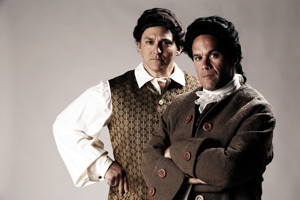
Firebrand and future president John Adams couldn’t declare independence by himself. Not only did he need to recruit Thomas Jefferson to write our foundational document, he needed to get all 13 colonies represented at the Continental Congress – including his own Massachusetts – to come over to his side. As 1776 The Musical, currently running at Central Piedmont Community College, reminds us, Adams was too headstrong, combative, irritating, and off-putting to sow the seeds that would blossom into our republic.

With George Washington and his army further north, already engaging the British Crown on the battlefield, Adams couldn’t even count on his staunchest sympathizers, Jefferson from Virginia and Ben Franklin from Pennsylvania, to deliver their states’ votes. In fact, it would be an uphill battle for Adams to even get the matter of independence considered at the Congress in Philadelphia – over a year after the first shots had been fired at Lexington and Concord.

So in a climate and an election year where cooperation, compromise, and consensus are so widely despised, 1776 comes along propitiously to remind us how fundamental these things were in forming our national DNA and how essential they remain if we are to make big changes in our democracy. With inevitable sacrifices to detail and accuracy, Peter Stone‘s book presents the story with surprising nuance, depth, and even tragedy.

For a musical clocking in at 2:35 plus intermission, 1776 also has a surprisingly spare songlist, perhaps because composer Sherman Edwards had the original concept. There is also a gratifying self-awareness we can detect in the storytelling at Pease Auditorium in this CPCC Theatre production. We’re not seeing all white men all the time.

Edwards gracefully works in Adams’ wife Abigail through an ongoing exchange of letters that twice become duets. At a clandestine location away from the Congressional Hall, we peep in on an episode that Franklin has contrived to help Jefferson in his struggles to craft the Declaration, sending for Jefferson’s wife Martha. It’s already a conjugal visit by the time Franklin and Adams come calling.

CP director Tom Hollis stirs the pot a little more with a modest infusion of colorblind casting, while costume designers Robert Croghan and Jamey Varnadore offer us what diversity they can, making the chasm between a New Jersey reverend and a South Carolina plantation owner as wide as possible.

Adams is rather lonely and hopeless before Franklin helps him form a cogent strategy to get things rolling. They send Richard Henry Lee of Virginia back home to convince his state legislature to back an initiative for independence. The jubilation of concocting this stratagem is celebrated by Adams, Franklin, and Lee in “The Lees of Virginia,” a song whose toxicity extends beyond its jaw-dropping silliness. I can only hope that its parade of dopey adverbs doesn’t lodge in your memory as an earworm.

Once we’ve crossed that jingling Delaware, we sail smoothly and convincingly through the labors that culminated in our nation’s birth. Virginia’s support leads to a majority vote approving consideration of an independence initiative, the formation of a committee to articulate the reasons and objectives for this action, with the proviso that the vote for adoption of this initiative must be unanimous. Every colony had veto power over the move for independence, adding tension to a drama whose outcome we already know, and leading to the compromise that stands as the Original Sin of our nation.

At the conclusion of his grievances against Britain, Jefferson penned two blistering paragraphs excoriating the Crown’s cultivation of the slave trade and – conveniently omitted from Stone’s book – their incitement of those slaves to rise up against their masters. After a devastating attack on Yankee hypocrisy in “Molasses to Rum,” future South Carolina governor Edward Rutledge demands that the section on slavery, effectively abolishing the institution, be stricken from the Declaration and walks out on the Continental Congress until he gets his way.

There is certainly no trivialization of that haunting but necessary compromise, and the hauteur of Josh Logsdon as Rutledge, along with his resounding singing voice, are among the chief reasons why 1776 will linger in your thoughts. Eric Johnston really is nettlesome and curmudgeonly as Adams, biting in his patriotic vocals yet petulantly tender when he’s interacting with his dear Abigail. Exorcising the clownish look that bedeviled Franklin in Theatre Charlotte’s 1995 production, James K. Flynn plausibly takes on America’s fount of aphorisms and brilliantly balances his avuncular practicality with his comical tendency to doze off.

Depicted as quiet, contemplative, and artistic, Jefferson is a romantic lead in Stone’s narrative who has almost been demoted to a supporting role. While George DeMott isn’t nearly the dreamboat Patrick Ratchford was when he sang the role in 1995, there comes a time when we’re supposed to be wondering what his sex appeal actually is. In giving weight to that question, DeMott is very appropriate. Nor could you hope for a more charming answer than “He Plays the Violin” from Emily Witte as Martha.

Witte is so graceful and charming that I could hardly imagine omitting her “Violin” when this musical was last revived on Broadway in 1997, more than 28 years after its original premiere. By coincidence, it is omitted from the songlists of 1776 on both the IBDB.com listing for the 1997 revival and in CP’s playbill. But Amazon assures me that it’s still on the 1997 cast album.

In real life there was an age difference of 29 years between John and AbiGail Adams, but Hollis dispenses with that gulf in casting Megan Postle as AbiGail Adams. As you’ll find, it’s a very unique role since Hollis insists on preserving the Adamses’ separation when they converse by mail, yet Postle warms wonderfully to the task. At the comical end of the spectrum, Alan Morgan can be commended for delivering the deadly Lee with all his giddy gleefulness, while choreographer Ron Chisholm doesn’t stint on the energy and dopiness of our Founding Fathers’ dances, fearlessly risking the charge of sacrilege.

Conspicuously missing from the Philadelphia deliberations is General Washington, but we periodically get gloomy dispatches from him in the field, delivered by Trey Thomason as the Courier. After a few of these, lights dim unexpectedly on Thomason, who sings grimly to us in “Mama, Look Sharp” about the realities of fighting and dying for your country.

Sobering moments like that are why 1776 remains relevant nearly 50 years after its original Broadway opening. Recounting how we reached our landmark July Fourth, this lively evening occasionally packs the power to explode our drum-and-fife expectations.