Tag Archives: Zendyn Duellman

Physical Comedy Reigns Supreme in “The Actress”

Review: The Actress

By Perry Tannenbaum

You can certainly find subtler, more poetic titles than The Actress, a bittersweet comedy by Peter Quilter – with judicious snatches of Chekhov – now at Spirit Square. We follow storied actress Lydia Martin into her dressing room as she gives her farewell performance in The Cherry Orchard, electing to retire from the stage while makeup can still mask her flaws and she can still remember her lines.

With two dips into Lydia’s onstage performance and an intermission sandwiched in between, all framed by her arrival at the theater and an impromptu post-performance celebration in her dressing room, we have a neatly symmetrical five-part structure. Quilter adds a nice little wrinkle at the end as Lydia and her ex-husband adjourn to the darkened stage for a final communion. In Ryan Maloney’s set design, about a third of the Duke Energy Theatre is set aside for the Chekhov action, but I could easily imagine how beautifully this last scene would flow on a revolving set. Maloney’s lighting design recovers some of that magic.

Until that point, I found a curious lack of theatre magic and specificity. Although the Three Bone Theatre playbill specifies 1933 as the time of the action, the script doesn’t seem to help director Charles LaBorde to establish a time or a place for Lydia’s farewell. Oddly, the backstage action isn’t theatrical enough to convince me that this is a particularly momentous show. There are no acting colleagues or mentors slipping in to send her off, no reporters or photographers, not even Cherry Orchard castmates before or after the performance.

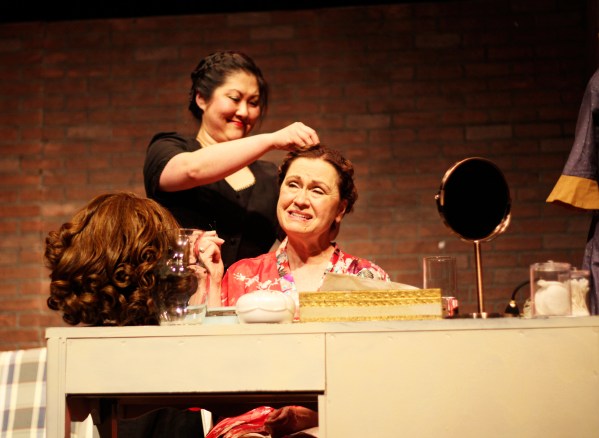
The only other person involved in the production is the director’s sedulous emissary, Margaret, who relays the unseen director’s notes to Lydia – a patently needless exercise, since it’s doubly impossible that the star will ever make use of them. Yes, there are congratulatory flowers all over the place, some from colleagues and others from admirers, but her dresser, Katherine, still finds it necessary to mist the room with perfume before Lydia enters. Amy Wada digs into Katherine’s uncertainty about whether she means anything to Lydia after a long, long business relationship, but Corlis Hayes seems to accept Margaret as a royal waste of time, mostly motivated by the prospect of leaving with a collectible memento.
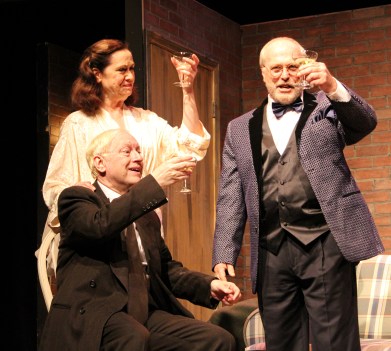
Everyone else is a visitor, except perhaps for Harriet, Lydia’s agent. With Lydia retiring, Harriet doesn’t have any business with her client but she does have something to say. When Harriet is persistently shushed and ignored at the little afterparty – while drinking more and more of Lydia’s best brandy, not the swill that she presented as a token gift – whatever she had intended to say is horribly twisted, one of the most dramatic spots in this production. Zendyn Duellman, consistently irritating with her high sycophantic energy as Harriet, becomes even more memorable here.

The rest of the backstage story is largely comedy. Lugging an industrial-strength decrepitude up the stairs to Lydia’s door, Hank West is able to unleash a mighty volley of coughs and wheezes when he gets there as Lydia’s rich fiancé, Charles. Whisking Lydia off to his native Switzerland seems laughably ambitious for someone so old and easily winded, but amid his bodacious wheezing, West endows Charles with a forbearance and determination that ultimately make him a bit endearing.
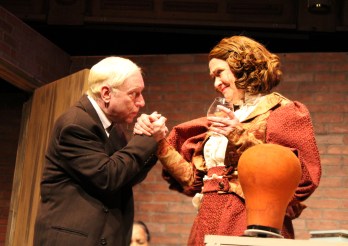
Ex-husband Paul has considerably more energy behind his persistence, and neither verbal rebuffs nor physical slaps from Lydia discourage his overtures. Bob Paolino definitely tunes into the love-hate relationship between these former intimates, and despite his conspicuous lack of appreciation for the theatre and Lydia’s artistry, brings us a redeeming softness and fatherliness when her career officially ends.

I wasn’t convinced that Paula Baldwin could wholeheartedly throw herself into Lydia’s ambivalent reaction to Paul’s forcible advances. When he called for a 1933 setting, LaBorde may have had those Hollywood films in mind where a leading man might respond, “you can hit harder than that,” to a slap in the face and manfully take it as a woman’s encouragement. That’s definitely the drift here as both Lydia and Paul get mussed up in a physical comedy interlude while the actress keeps her audience waiting.

Trouble is, when Lydia’s daughter Nicole walks through the door, Lydia has an aversion to her smoking – and a guilt about sneaking a cig for herself – that are 60 years ahead of their time. So the demands on Baldwin go beyond ambivalence. She’s actually best in Act 2, when her past faults as a wife, mother, and person come into clearer focus and a warmer, more down-to-earth side of her surfaces. She also manages to convince us that it’s not all about money with Charles.

Nicole isn’t severely messed up or resentful in Robin Tynes’ perky portrayal. We get the idea from Tynes that Nicole is a gentle reminder of Lydia’s past lapses as a wife and parent – also a counterweight against those plans to flit off to Switzerland. But once he puts her before us, Quilter doesn’t invest nearly enough into Nicole. I didn’t detect the English accent that might make her objections to Mom’s proposed move to Switzerland seem petulant and selfish. Sounding totally American, Tynes gave me the impression that Mom’s displacement would be transoceanic. Sure, she seems unsettled, but not enough to be profoundly unhappy.

More substance to Nicole would add more definition to her ambivalence – and Quilter’s serpentine script does wind up being very much about ambivalence. Ultimately, Lydia finds herself choosing between career and domestic comforts, between love and sex, and between familiar family and a new kind of life. So Quilter’s title is subtler than he probably intended. Notwithstanding its setting and the sterling Three Bone Theatre performances that make it come alive, The Actress is hardly about theatre at all.

Wacky Magrath Sisters Still Deliver Southern-Fried Hilarity

Theater Review: Charlotte’s Theatre Crimes of the Heart

By Perry Tannenbaum

image1

It’s been a long time – nearly 15 years as far as I can tell – since I’ve spent an evening with Beth Henley’s lovable Mississippi Magrath Sisters. Looking in on them at Theatre Charlotte’s revival of CRIMES OF THE HEART affirms how vividly these deftly differentiated sibs stick in a theatergoer’s memory. First and foremost, you’ll remember kooky Babe, who doubts her own sanity after shooting her husband. Carefree temptress Meg seems to be the enviable paragon, looking down on her sibs as she waltzes back to the home sod with her Left Coast cool, but she’s beginning to doubt her own specialness now that her stab at stardom has come up empty. Lastly, that dear and dutiful doormat, Lenny, with her shriveled ovary and low self-esteem.

If the 1981 Pulitzer Prize winner is beginning to show its age, I couldn’t tell it by the audience reaction at the Queens Road barn. The quirkiness and the comedy still work, but at a distance of 35 years, we can begin to appreciate what made CRIMES OF THE HEART so unique when it burst upon the scene.

Prize-winning plays and novels set in Dixie had invariably been about elegant, decayed, and tragic folk, following the Southern archetypes embraced by William Faulkner, Tennessee Williams, and Harper Lee. Henley showed us once and for all that the eccentricities celebrated in You Can’t Take It With You could play just as well down in Mississippi – even when peppered with dark Arsenic and Old Lace humor.

Yet Henley’s comedy is notably more realistic than Kaufman’s crowdpleaser and both lighter and saner than Arsenic. That’s because the Magrath sisters are quirky rather than balmy – and because no significant antagonist appears onstage. When Cousin Chick drops by to chide or alarm the sisters, she is more of an irritant than an antagonist, her exits usually comical hasty retreats. She’s more like the recurring meanie from a TV sitcom than a force to reckoned with. The only real threat is State Senator Zachery Bottrelle, convalescing offstage somewhere with the bullet hole in his gut that Babe put there.

The Magrath Sisters came equipped with leavening agents that had usually been absent from American comedies: sorrows and regrets. You could easily presume that these were Southern heirlooms from Williams’ iconic dramas, but I wouldn’t dismiss the possibility that this quality in Henley’s heroines may have had its roots in the novels of Jane Austen. Like Gentle Jane, Henley doesn’t presume to show us how men speak to each other when ladies aren’t in the room.

Directing for the first time at Theatre Charlotte, Christian Casper isn’t trying to reimagine our leading characters. Nor is set designer Chris Timmons trying to depict the Hazelhurst, Missisippi, home as any more luxurious or squalid than you might expect. We’re in a bland, slightly cheesy smalltown home, and its only discordant element is the dwarf fridge in the kitchen.

One of the ways that Henley binds her comedy together and makes it memorable is with the pair of ceremonies framing the action in celebration of Lenny’s 30th birthday. As you’ll see in the final moments, budgetary constraints are a bit more exposed than strictly necessary – cakewise and candlewise. But if Casper isn’t sufficiently savvy about the technical strategies to make the final scene truly shine, he certainly doesn’t mess up the opening.

Lenny’s clandestine celebrations get us off to a charming start with Meredith Westbrooks Owen as the pitiful birthday girl, repeatedly hunched over her wee little cupcake, singing to herself. Comedy – and the big news about the crime – burst in with Zendyn Duellman feasting on the role of Chick. Catty, gossipy, and fault-finding don’t completely describe Chick, for she’s also vulgar and trashy, richly deserving the Magraths’ scorn. Picking up a pair of pantyhose that Lenny has obligingly bought for her at the store, Chick begins squirming into them before our very eyes.

Henley meant Chick’s struggles to appear “slightly grotesque” in her stage directions, but Casper has Duellman going way beyond that. Like Lenny, we don’t care whether Chick remembers her cousin’s landmark birthday or not, but the same lapses from her younger sisters clearly hurt. Lenny’s clandestine candle-lighting lingers as an subliminal rebuke, underscoring her siblings’ tendency to be insensitive, neglectful, and self-absorbed. Beyond that, they expect Lenny to perform all the family’s mop-up chores, chiefly the onerous task of caring for bedridden Old Granddaddy.

From the moment that Jennifer Barnette enters as Meg, there are conflicting airs about her of regality and rebelliousness, elegance and uncouth. One minute, she’s lighting up a cigarette to vex Chick, the next she’s disconcerting Lenny by cracking pecans with her shoe. What a fascinating character arc for Barnette as she careens from Coca-Cola and stolen candy crèmes to bourbon and birthday cake. But of course, Barnette’s physical comedy – or even Chick’s, for that matter – will pale in comparison to Babe’s prodigies.

Emily Klingman performed them on opening night with a neurotic edge that eventually won me over. She repeatedly convinces us that Babe is the youngest, most immature person onstage, quite capable of obsessing morbidly over why her mom killed the family cat when she committed suicide. And hey, when a kitchen oven and a chandelier are among your props, you will get laughs.

Self-sacrifice is enough to win our affection for Lenny, but Henley calls upon two good men to help in sealing our fondness for her more self-centered sibs. Allen Eby is Doc Porter, surprisingly mellow for a man whom Meg left drenched and limping after a spectacular breakup during Hurricane Camille. On the other hand, Cole Long as dorky Barnette Lloyd, the legal eagle who is trying to keep Babe out of jail, seems uncannily capable of homing in on his client’s ditzy wavelength.