Tag Archives: Megan Postle

Break Out the Mindless Nostalgia With CP’s Re-Engineered “Grease”

Review: Grease

By Perry Tannenbaum

People forget that Grease was a huge smash on Broadway for over eight years, the incubator for such hunks as Patrick Swayze, Richard Gere, Barry Bostwick, Peter Gallagher, Treat Williams, and that John Travolta guy. The 1978 film starring Travolta and Olivia Newton-John not only eclipsed the 1972 original, it radically altered the Jim Jacobs and Warren Jacobs book and score. By 2007, the last time it was revived on Broadway, Grease couldn’t be Grease without the two hit songs created for the movie, “You’re the One That I Want,” one of numerous #1 hits that John Farrar wrote for Newton-John, and Barry Gibbs’ “Grease (Is the Word).”

The result at CPCC Summer Theatre, with Carey Kugler directing that 2007 version, will often play like a blurred – or cut – version of the movie. Our summer romance at the beach with its poignant farewells, the second beginning devised for the show, now gives way to a third. Sandy Dumbrowski’s nemesis, Rizzo, is more like a spider lady than a tough punk. Stockard Channing delivered. Sandy’s quest to become part of the Pink Lady clique is forgotten, and there’s no climactic drag race when Danny Zuko reasserts his heroism behind the wheel of Kenickie’s Greased Lightnin’.

With one of the actors absent for the Sunday matinee, confusions compounded. Justin Austin smoothly replaced Aaron Coulson as Teen Angel, singing “Beauty School Dropout” to the disconsolate Frenchy, Sandy’s staunchest ally. But Coulson was also supposed to portray deejay Vince Fontaine at the high school sock hop. Touchy situation. Megan Postle, who terrorized one of Danny’s T-Bird chums as Miss Lynch, his English teacher, had to reappear as the fulsome emcee of the hop, and Ashton Guthrie, who was just learning the rudiments of guitar at the top of Act 1 as Doody (a pretty lame “Those Magic Changes”), now gets to sing Vince’s “Born to Hand Jive,” one of the best numbers in Act 2.

Unless you had recalculated based on CP Theatre Dept. chair Tom Hollis’s pre-show announcements, these were additional head-scratching moments.

Perhaps the most charitable way of looking at the Jacobs-Casey book, substantially overhauled by Allan Carr and Bronte Woodard for the film, is to presume that they were trying to flip Manhattan’s West Side Story into a vaguely Chicago comedy – if they had any idea of what they were doing at all. Otherwise, it’s hard to explain the botched, crisscrossed contretemps at the prom and the abruptly scheduled rumble between the T-Birds and the Scorpions that never happens.

Kugler never seems compelled to plug up any of the plot holes, so Philip Stock as Danny acts like a jerk without any qualms or hesitation. Stopping one time while making your exit doesn’t quite cut it. Robin Dunavant gets more to work with in baring Sandy’s heart – including twice as many songs – but with Danny wavering so capriciously in his affections, her “Hopelessly Devoted to You” feelings seem downright stupid. While Jason Estrada’s costume designs could be more rugged for the T-Birds, the megawatt blond wig he saddles Sandy with throughout her pre-makeover scenes (I’m not sure a single hair moves) made me wonder whether or not a beautiful teen lurked underneath.

Despite these teetering foundations, Stock does project a hard James Dean-like edge and – keeping in mind that this is Rydell High – a lean, sneering arrogance that recalls Bobby Rydell. There really are sparks when Dunavant finally crosses over from Sandra Dee-land to the leather-clad tramp that Danny wants, but the gulf between the two Sandys is so wide that it’s hard to shake the notion that her latter-day self is her creators’ wet dream. The masculinity takeaways from GREASE, that gangster toughness gets you girls and that unprotected sex is cool, are pure ‘50s bull, never questioned.

Amid Danny’s vacillations and Sandy’s pathological primness, the bitchy, predatory Betty Rizzo stands taller with the steadfast power of her slutty convictions. Don’t you dare feel sorry for her! Lindsey Schroeder further accents Rizzo’s outlaw chic with a self-assured swagger that gives her dominion over every scene she appears in, singing or not. The astonishing dancing jolts that Treston Henderson brings to Kenickie’s “Greased Lightnin’” are totally worthy of this spitfire Rizzo, his usual girlfriend. But the garbled speaking parts? Not so much.

Coupling and uncoupling are so unmotivated that the remaining T-Birds and the Pink Ladies threaten to devolve into stock characters. Among the guys, Guthrie as Doody is the only other gang member to leave an impression. Ava Smith as Frenchy is the only Pink aside from Rizzo that I could care a little about, but a beauty school dropout warrants a far more frightful wig. Outside the Pink clique we do better, with Alexis Harder showing some flair as Cha-Cha DiGregorio, the outsider dancing ace that Kenickie brings to the sock hop to spite Rizzo. Patty Simcox is no more scheming or manipulative than Rizzo, but Susannah Upchurch manages to make us dislike her chiefly for her wholesome veneer – and because she doesn’t seem to be enjoying her own wickedness nearly as much.

Fun-loving mindlessness is as much the word at CP as GREASE is. At Rydell High, you are so uncool if you can’t sustain enthusiasm through all the many ram-a-lam-a-ding-dong nonsense phrases that “We Go Together” provides for the ensemble at the end of Acts 1 and 2. The old folk at Halton Theater on Sunday, bobbing their heads to the beats until the lights came up, weren’t looking for any meaning at all in GREASE. They were looking for the sheer joy of youth, and they were finding it.

 

Strong CP Cast Unleashes Newfound Power of “Ragtime”

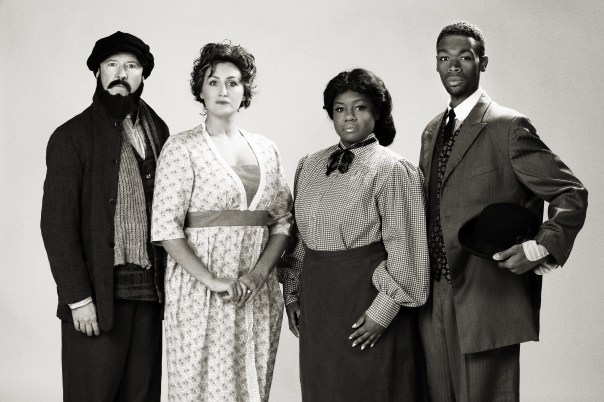
Ragtime Promo Photos

Review: Ragtime The Musical

By Perry Tannenbaum

Like Fiddler on the Roof, another musical with wide vistas, Ragtime The Musical begins its voyage back to 1906 by introducing us to groups of people. The stage begins to fill with comfortable, well-mannered white folk. Oppressed black folk, struggling for dignity and survival, form a crowd at the opposite side of the stage. Immigrants, disoriented and bewildered in the Promised Land, fill in the divide. Social activists Booker T. Washington and Emma Goldman flank the groups, along with the celebrities who tower above them all, including Harry Houdini, Henry Ford, J.P. Morgan, and Evelyn Nesbit.

But while shtetl life in Czarist Russia remains quaint, picturesque, and old-fashioned with each new revival of Fiddler, the issues revisited in Ragtime – racial prejudice, women’s second-class citizenship, and intolerance toward immigrants – have bounced back in our faces with frightful new life. The superiority we could feel toward the injustice suffered by Coalhouse Walker Jr. has evaporated since the days when Ragtime was published by novelist E.L. Doctorow in 1975 and adapted by Terrence McNally for the 1998 musical. Trayvon Martin, Ferguson… the list goes on.

Women’s rights and the welcoming attitude symbolized by Lady Liberty are also threatened by the reactionary sentiments unleashed by the 2016 election, the odious barrage of anti-Muslim rhetoric, and the post-inauguration travel ban. So the current CPCC Theatre production of Ragtime is not only timely, but thanks to one of the best casts ever assembled on the Halton Theater stage, it’s also newly powerful.

Tyler Smith delivers the most scorching performance as Coalhouse, particularly in the ragtime pianist’s valedictory solo, “Make Them Hear You,” when he’s on the brink of martyrdom. It’s as devastating a Coalhouse as I’ve ever seen, including the original Broadway production and the first national tour. But the taunting and race-baiting that come at Coalhouse from Josh Logsdon as New Rochelle fire chief Will Conklin no longer seem to be clichéd. Where Brian Stokes Mitchell on Broadway might have asked himself “how would I have felt 90 years ago?” Smith is merely tapping into how he feels – and it’s very fierce and raw.

The voice and delivery are Broadway-worthy, so it’s not at all a slight when I say that Smith’s partner, Brittany Harrington, nearly reaches the same lofty level as Sarah. When they reconcile and introduce “Wheels of a Dream,” seated in front of their Model T roadster, Harrington reminds us that this dream belongs to them both. It’s a tribute to their combined power that director Tom Hollis nearly empties the stage of the entire ensemble when the song is reprised at the end as an anthem. Together, as the happy-ending segment of the cast strolls into the horizon, Smith and Harrington sing them off.

What struck me by surprise was how much more forcefully the peaceful Mother’s story resonates. It’s quite natural to think of Mother as one of the handy junctions in this artfully interlaced tale. She welcomes Sarah and her newborn baby into her New Rochelle home, drawing the abandoned Coalhouse in pursuit – before he even realizes that he is the father of her child. Younger Brother, a member of the same well-to-do household, has a string of idols, including Nesbit and Goldman, before joining Coalhouse after the bold seeker of justice has taken over J.P. Morgan’s Manhattan library.

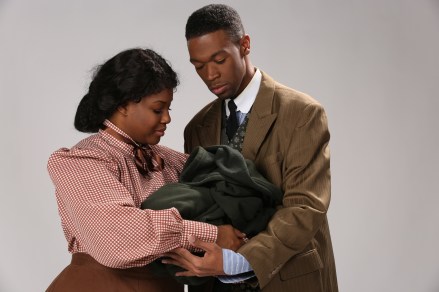
Ragtime Promo PhotosWhile all this spectacle rages around her, Mother has begun to evolve, almost from the moment that Father sails off with Admiral Peary on his expedition to the North Pole. After welcoming Sarah and the newborn into the household, her empathy widens to Coalhouse. Smith exudes a Nat “King” Cole kind of savoir-faire at the keyboard, so we’re not surprised. Yet Grandfather (Brian Holloway) is horrified and, after he returns from his explorations, so is Father.

But in the intervening year after her audacious decision to open her doors to Sarah, Mother has discovered that she has a voice. Not a small revelation when it comes more than three presidential elections before she will get the vote.

So while Andy Faulkenberry has a fine revolutionary zeal as Younger Brother, while Megan Postle breathes Mosaic fire as Emma Goldman, and Patrick Ratchford is extraordinarily patrician and privileged as Father – one of his best-ever outings – it was Lucia Stetson as Mother who truly bowled me over. The arc of Stetson’s journey, from “What Kind of Woman” when she first meets Sarah to “Back to Before” when she realizes she cannot continue under Father’s restrictions, is stunning and inspiring. This is how much a person can evolve. To his credit, Ratchford lets us know that Father has also budged slightly from his bigotry when his brave stint as a hostage is done.

In a way, Billy Ensley personifies all immigrants as Tateh, who arrives at Ellis Island at precisely the moment when Father is embarking on his polar adventure. J.P. Morgan, Goldman, and Houdini are all wrapped into Tatah’s dreams of “Success” and disillusionment, but neither Doctorow nor McNally soft-pedal his Jewish heritage. Right before his wide-ranging fantasia, Ensley sings “A Shtetl Iz Amereke” in his first song, faring better with the Yiddish than the chorus of immigrants behind him.

Houdini, a circus-like attraction in Tim Eldred’s portrayal, likens achieving success to escaping from a cage, but it’s Goldman, a fellow Jew, who speaks home truths. When Tateh wraps his daughter (Annabel Lamm) in a prayer shawl to combat the cruel cold, Emma says his rabbi would approve. Tateh is indeed a role of Houdini tricksiness as he begins by cutting out silhouettes of celebrities, later toils and goes on strike at a Massachusetts textile mill, and finally becomes the quintessential American success story when he reinvents himself as an Atlantic City filmmaker, Baron Ashkenazy.

Against the sunniness that Ensley brings to this epic musical, Keith Logan as Booker T. Washington and John DeMicco as J.P. Morgan help to shape the dark tragedy at the Morgan Library. It seems so much more inevitable to me now than it did when I first saw the denouement in 1998. If we can’t trust policemen to hold fire in 2017 when a black man surrenders with his hands up, how could we expect that they’d behave otherwise before World War I?

“We are all Coalhouse,” the ensemble sings in the somber aftermath – with a fresh sting. These words now ring as true as yesterday’s headlines. Much more in this CP revival of Ragtime may strike you that way.


American Reset Brings New Relevance to “Ragtime”

Ragtime Promo Photos

Preview: Ragtime

By Perry Tannenbaum

Things were so different in 1906, when E.L. Doctorow’s Ragtime begins. Theodore Roosevelt, a conservationist Republican, was in his second term at the White House. The wave of immigrant Jewish refugees, fleeing pogroms in Russia, was at its peak.

American women would have to wait three more presidential elections before they could vote, but the charismatic Emma Goldman was one of the strong voices agitating on the streets. Jazz had yet to be born in New Orleans, and the African-American superstars who sparked its popularity were still children, but Scott Joplin had already codified the architecture of ragtime.

When Terrence McNally adapted Doctorow’s 1975 novel for the musical that opened on Broadway in 1998, costumes worn by Goldman, by Tateh the Jewish immigrant, and by ragtime piano player Coalhouse Walker added to my impression that Ragtime was so yesterday. Women had already ascended to high elective offices and had figured prominently in presidential politics. Jewish immigrants and their descendants had crafted the very framework of Hollywood’s studios and Broadway’s musical theatre. Satchmo and the Duke were far in the rearview mirror of American cultural history, and Michael Jackson was deep into his reign as the King of Pop.

Surely we had matured as a nation since those primitive days Doctorow and McNally chronicled. Each time I saw Ragtime again, in 2001, 2005, and especially in 2011 – when Barack Obama was President, and Hillary Clinton, his most formidable opponent in the 2008 election, was Secretary of State – my sense of our superiority and progress as a nation continued to grow.

Then came 2016. The shocking election result. The inauguration. The women’s demonstrations across America and across the ocean. The opening assault on immigration.

Or how about Trayvon Martin, Ferguson, and the cavalcade of atrocities posted to social media since early 2012? When Ragtime arrives this weekend at Halton Theater in a new production by CPCC Theatre, it won’t seem as quaint and primitive as it did five years ago. In so many ways, we’ve punched the reset button.

When I saw Brian Stokes Mitchell as Coalhouse, the rousing song he introduced, “Wheels of a Dream,” seemed to be dreaming of today – or 1999, when I saw Mitchell at the Ford Theatre on 42nd Street, and the whole ensemble transformed “Wheels of a Dream” into an anthem at the end of the show. This week, when Charlotte powerhouse Tyler Smith takes on Coalhouse, I’ll have to humbly concede that his anthem is still envisioning a better tomorrow that hasn’t come.

Ragtime Promo Photos

Smith was never under any illusions. “This country was founded on principles that were never all-inclusive,” he says. “Our recent presidential results showed the world how much racial hatred still looms here.”

After a couple of lightweight roles at CP in last winter’s Irving Berlin revue and last summer’s Sister Act, Megan Postle is eager to show some range – and depth – as Goldman. “I have a personal attachment to Ragtime,” Postle reveals. “It was my first Broadway show. My aunt took me to see the original cast.”

One of the fascinating things about Ragtime is its mix of historical and fictional characters. Doctorow also gives cameos of varying lengths to J.P. Morgan, Booker T. Washington, Harry Houdini, Henry Ford, Admiral Peary, and Evelyn Nesbit.

But none of the historical characters is altered more in trafficking with Doctorow’s fictional characters than Emma, who sheds her anarchist and assassin tendencies. “Goldman is the Greek chorus for Ragtime,” says Postle. “She speaks for all members of the human race who feel there is inequality.”

Emma also helps to stitch the various strands of the plot together. Coalhouse and Tateh head two of the three families that anchor this story. They are the outsiders while the third family, prosperous inhabitants of New Rochelle, complete the New York triangle of the story. Sailing off to join Admiral Peary’s polar expedition as we begin, the Father waves to Tateh, who is on a raggedy ship that has nearly completed its voyage across the Atlantic to Ellis Island.

From that point, the story forms an epic arc that resolves gracefully as the full company delivers its epilogue. Along the way, we glide past a labor strike by exploited millworkers in Massachusetts, Goldman’s galvanizing oratory, horrid police brutality, and audacious, explosive, vengeful responses from Coalhouse.

Smith admits that racial issues have heated up since the most recent 2009 revival of Ragtime on Broadway and the end of the Obama presidency.

“Today’s Coalhouse is every father, husband, brother and son killed without proper justice being served,” he said. “Every wife, sister, mother and daughter who have to feel the grief and bear the weight of losing a lost one while nobody seems to care. People like Eric Gardner, Trayvon Martin, Keith Lamont Scott, the mothers of all those murdered in Chicago. There is a line sung in the show saying ‘we’re all Coalhouse.’ It hits home because it is true.”

Tom Hollis, CP’s drama chair, chose Ragtime for the 2016-17 season back in the spring of 2015, around the time when the announcement of Donald Trump’s candidacy was greeted with more laughter than alarm. Hollis considered it then in the vein of 1776, the musical that was already set to run last September, just before the first presidential debate.

He still does. “When we were doing 1776 in the fall of 2016, we were constantly being struck by the parallels to life today,” Hollis says. “Each generation of Americans has had to face coming up with an answer to these issues because they are woven into the fabric of our country. That we haven’t been able to find a permanent solution is the sad irony of our history.”

A hard, tragic compromise on slavery clouded the happy ending of 1776, and what happens to Coalhouse clouds the ending of Ragtime. A member of the New Rochelle family who was inspired by Goldman ultimately vows to keep Coalhouse’s story alive, while Tateh achieves the American dream.

Billy Ensley, a mainstay of the CPCC Theatre for decades, will play Tateh at the Halton. It’s just the latest in a series of Jewish roles that he has played over the course of his acting career, including Eugene in Neil Simon’s Broadway Bound and two ill-fated historical figures, San Francisco activist Harvey Milk and Atlanta’s Leo Frank. Wrongly convicted of the 1913 murder of Mary Phagan in Atlanta – and subsequently lynched – Frank was the tragic hero of Alfred Uhry’s Parade, presented at the Halton in 2006.

So for Ensley, it’s a journey back to the same period with a similar rueful takeaway, even if Tateh does end happily.

“Current events regarding immigration have only strengthened the way I have always felt about those that are marginalized, forgotten, discriminated against,” Ensley says. “We all deserve a chance to live fulfilling, safe and happy lives, and those of us that have that already should do what we can to see to it that others less fortunate can as well. Our country was built by immigrants.”

Ensley offers advice for immigration opponents: “For those today in favor of a closed-off America, I suggest a trip to Ellis Island and a little research on where the people came from that made this country the wonderful and rich country that it is.”

Travel advisory: Ellis Island is just a short boat ride away from the Statue of Liberty, depicted on the cover of numerous editions and translations of Ragtime.

“1776” Still Preaches Compromise to a Skeptical Electorate

Musical Review: 1776 The Musical

By Perry Tannenbaum

2c12d4d82-b764-cbe5-a645e52c8298150f

Firebrand and future president John Adams couldn’t declare independence by himself. Not only did he need to recruit Thomas Jefferson to write our foundational document, he needed to get all 13 colonies represented at the Continental Congress – including his own Massachusetts – to come over to his side. As 1776 The Musical, currently running at Central Piedmont Community College, reminds us, Adams was too headstrong, combative, irritating, and off-putting to sow the seeds that would blossom into our republic.

With George Washington and his army further north, already engaging the British Crown on the battlefield, Adams couldn’t even count on his staunchest sympathizers, Jefferson from Virginia and Ben Franklin from Pennsylvania, to deliver their states’ votes. In fact, it would be an uphill battle for Adams to even get the matter of independence considered at the Congress in Philadelphia – over a year after the first shots had been fired at Lexington and Concord.

So in a climate and an election year where cooperation, compromise, and consensus are so widely despised, 1776 comes along propitiously to remind us how fundamental these things were in forming our national DNA and how essential they remain if we are to make big changes in our democracy. With inevitable sacrifices to detail and accuracy, Peter Stone‘s book presents the story with surprising nuance, depth, and even tragedy.

For a musical clocking in at 2:35 plus intermission, 1776 also has a surprisingly spare songlist, perhaps because composer Sherman Edwards had the original concept. There is also a gratifying self-awareness we can detect in the storytelling at Pease Auditorium in this CPCC Theatre production. We’re not seeing all white men all the time.

Edwards gracefully works in Adams’ wife Abigail through an ongoing exchange of letters that twice become duets. At a clandestine location away from the Congressional Hall, we peep in on an episode that Franklin has contrived to help Jefferson in his struggles to craft the Declaration, sending for Jefferson’s wife Martha. It’s already a conjugal visit by the time Franklin and Adams come calling.

CP director Tom Hollis stirs the pot a little more with a modest infusion of colorblind casting, while costume designers Robert Croghan and Jamey Varnadore offer us what diversity they can, making the chasm between a New Jersey reverend and a South Carolina plantation owner as wide as possible.

Adams is rather lonely and hopeless before Franklin helps him form a cogent strategy to get things rolling. They send Richard Henry Lee of Virginia back home to convince his state legislature to back an initiative for independence. The jubilation of concocting this stratagem is celebrated by Adams, Franklin, and Lee in “The Lees of Virginia,” a song whose toxicity extends beyond its jaw-dropping silliness. I can only hope that its parade of dopey adverbs doesn’t lodge in your memory as an earworm.

Once we’ve crossed that jingling Delaware, we sail smoothly and convincingly through the labors that culminated in our nation’s birth. Virginia’s support leads to a majority vote approving consideration of an independence initiative, the formation of a committee to articulate the reasons and objectives for this action, with the proviso that the vote for adoption of this initiative must be unanimous. Every colony had veto power over the move for independence, adding tension to a drama whose outcome we already know, and leading to the compromise that stands as the Original Sin of our nation.

At the conclusion of his grievances against Britain, Jefferson penned two blistering paragraphs excoriating the Crown’s cultivation of the slave trade and – conveniently omitted from Stone’s book – their incitement of those slaves to rise up against their masters. After a devastating attack on Yankee hypocrisy in “Molasses to Rum,” future South Carolina governor Edward Rutledge demands that the section on slavery, effectively abolishing the institution, be stricken from the Declaration and walks out on the Continental Congress until he gets his way.

There is certainly no trivialization of that haunting but necessary compromise, and the hauteur of Josh Logsdon as Rutledge, along with his resounding singing voice, are among the chief reasons why 1776 will linger in your thoughts. Eric Johnston really is nettlesome and curmudgeonly as Adams, biting in his patriotic vocals yet petulantly tender when he’s interacting with his dear Abigail. Exorcising the clownish look that bedeviled Franklin in Theatre Charlotte’s 1995 production, James K. Flynn plausibly takes on America’s fount of aphorisms and brilliantly balances his avuncular practicality with his comical tendency to doze off.

Depicted as quiet, contemplative, and artistic, Jefferson is a romantic lead in Stone’s narrative who has almost been demoted to a supporting role. While George DeMott isn’t nearly the dreamboat Patrick Ratchford was when he sang the role in 1995, there comes a time when we’re supposed to be wondering what his sex appeal actually is. In giving weight to that question, DeMott is very appropriate. Nor could you hope for a more charming answer than “He Plays the Violin” from Emily Witte as Martha.

Witte is so graceful and charming that I could hardly imagine omitting her “Violin” when this musical was last revived on Broadway in 1997, more than 28 years after its original premiere. By coincidence, it is omitted from the songlists of 1776 on both the IBDB.com listing for the 1997 revival and in CP’s playbill. But Amazon assures me that it’s still on the 1997 cast album.

In real life there was an age difference of 29 years between John and AbiGail Adams, but Hollis dispenses with that gulf in casting Megan Postle as AbiGail Adams. As you’ll find, it’s a very unique role since Hollis insists on preserving the Adamses’ separation when they converse by mail, yet Postle warms wonderfully to the task. At the comical end of the spectrum, Alan Morgan can be commended for delivering the deadly Lee with all his giddy gleefulness, while choreographer Ron Chisholm doesn’t stint on the energy and dopiness of our Founding Fathers’ dances, fearlessly risking the charge of sacrilege.

Conspicuously missing from the Philadelphia deliberations is General Washington, but we periodically get gloomy dispatches from him in the field, delivered by Trey Thomason as the Courier. After a few of these, lights dim unexpectedly on Thomason, who sings grimly to us in “Mama, Look Sharp” about the realities of fighting and dying for your country.

Sobering moments like that are why 1776 remains relevant nearly 50 years after its original Broadway opening. Recounting how we reached our landmark July Fourth, this lively evening occasionally packs the power to explode our drum-and-fife expectations.