Tag Archives: Jamey Varnadore

“1776” Still Preaches Compromise to a Skeptical Electorate

Musical Review: 1776 The Musical

By Perry Tannenbaum
2c12d4d82-b764-cbe5-a645e52c8298150f

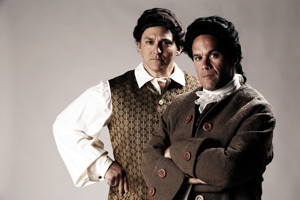
Firebrand and future president John Adams couldn’t declare independence by himself. Not only did he need to recruit Thomas Jefferson to write our foundational document, he needed to get all 13 colonies represented at the Continental Congress – including his own Massachusetts – to come over to his side. As 1776 The Musical, currently running at Central Piedmont Community College, reminds us, Adams was too headstrong, combative, irritating, and off-putting to sow the seeds that would blossom into our republic.

With George Washington and his army further north, already engaging the British Crown on the battlefield, Adams couldn’t even count on his staunchest sympathizers, Jefferson from Virginia and Ben Franklin from Pennsylvania, to deliver their states’ votes. In fact, it would be an uphill battle for Adams to even get the matter of independence considered at the Congress in Philadelphia – over a year after the first shots had been fired at Lexington and Concord.

So in a climate and an election year where cooperation, compromise, and consensus are so widely despised, 1776 comes along propitiously to remind us how fundamental these things were in forming our national DNA and how essential they remain if we are to make big changes in our democracy. With inevitable sacrifices to detail and accuracy, Peter Stone‘s book presents the story with surprising nuance, depth, and even tragedy.

For a musical clocking in at 2:35 plus intermission, 1776 also has a surprisingly spare songlist, perhaps because composer Sherman Edwards had the original concept. There is also a gratifying self-awareness we can detect in the storytelling at Pease Auditorium in this CPCC Theatre production. We’re not seeing all white men all the time.

Edwards gracefully works in Adams’ wife Abigail through an ongoing exchange of letters that twice become duets. At a clandestine location away from the Congressional Hall, we peep in on an episode that Franklin has contrived to help Jefferson in his struggles to craft the Declaration, sending for Jefferson’s wife Martha. It’s already a conjugal visit by the time Franklin and Adams come calling.

CP director Tom Hollis stirs the pot a little more with a modest infusion of colorblind casting, while costume designers Robert Croghan and Jamey Varnadore offer us what diversity they can, making the chasm between a New Jersey reverend and a South Carolina plantation owner as wide as possible.

Adams is rather lonely and hopeless before Franklin helps him form a cogent strategy to get things rolling. They send Richard Henry Lee of Virginia back home to convince his state legislature to back an initiative for independence. The jubilation of concocting this stratagem is celebrated by Adams, Franklin, and Lee in “The Lees of Virginia,” a song whose toxicity extends beyond its jaw-dropping silliness. I can only hope that its parade of dopey adverbs doesn’t lodge in your memory as an earworm.

Once we’ve crossed that jingling Delaware, we sail smoothly and convincingly through the labors that culminated in our nation’s birth. Virginia’s support leads to a majority vote approving consideration of an independence initiative, the formation of a committee to articulate the reasons and objectives for this action, with the proviso that the vote for adoption of this initiative must be unanimous. Every colony had veto power over the move for independence, adding tension to a drama whose outcome we already know, and leading to the compromise that stands as the Original Sin of our nation.

At the conclusion of his grievances against Britain, Jefferson penned two blistering paragraphs excoriating the Crown’s cultivation of the slave trade and – conveniently omitted from Stone’s book – their incitement of those slaves to rise up against their masters. After a devastating attack on Yankee hypocrisy in “Molasses to Rum,” future South Carolina governor Edward Rutledge demands that the section on slavery, effectively abolishing the institution, be stricken from the Declaration and walks out on the Continental Congress until he gets his way.

There is certainly no trivialization of that haunting but necessary compromise, and the hauteur of Josh Logsdon as Rutledge, along with his resounding singing voice, are among the chief reasons why 1776 will linger in your thoughts. Eric Johnston really is nettlesome and curmudgeonly as Adams, biting in his patriotic vocals yet petulantly tender when he’s interacting with his dear Abigail. Exorcising the clownish look that bedeviled Franklin in Theatre Charlotte’s 1995 production, James K. Flynn plausibly takes on America’s fount of aphorisms and brilliantly balances his avuncular practicality with his comical tendency to doze off.

Depicted as quiet, contemplative, and artistic, Jefferson is a romantic lead in Stone’s narrative who has almost been demoted to a supporting role. While George DeMott isn’t nearly the dreamboat Patrick Ratchford was when he sang the role in 1995, there comes a time when we’re supposed to be wondering what his sex appeal actually is. In giving weight to that question, DeMott is very appropriate. Nor could you hope for a more charming answer than “He Plays the Violin” from Emily Witte as Martha.

Witte is so graceful and charming that I could hardly imagine omitting her “Violin” when this musical was last revived on Broadway in 1997, more than 28 years after its original premiere. By coincidence, it is omitted from the songlists of 1776 on both the IBDB.com listing for the 1997 revival and in CP’s playbill. But Amazon assures me that it’s still on the 1997 cast album.

In real life there was an age difference of 29 years between John and AbiGail Adams, but Hollis dispenses with that gulf in casting Megan Postle as AbiGail Adams. As you’ll find, it’s a very unique role since Hollis insists on preserving the Adamses’ separation when they converse by mail, yet Postle warms wonderfully to the task. At the comical end of the spectrum, Alan Morgan can be commended for delivering the deadly Lee with all his giddy gleefulness, while choreographer Ron Chisholm doesn’t stint on the energy and dopiness of our Founding Fathers’ dances, fearlessly risking the charge of sacrilege.

Conspicuously missing from the Philadelphia deliberations is General Washington, but we periodically get gloomy dispatches from him in the field, delivered by Trey Thomason as the Courier. After a few of these, lights dim unexpectedly on Thomason, who sings grimly to us in “Mama, Look Sharp” about the realities of fighting and dying for your country.

Sobering moments like that are why 1776 remains relevant nearly 50 years after its original Broadway opening. Recounting how we reached our landmark July Fourth, this lively evening occasionally packs the power to explode our drum-and-fife expectations.

The Bee Gees Lose Their Falsettos

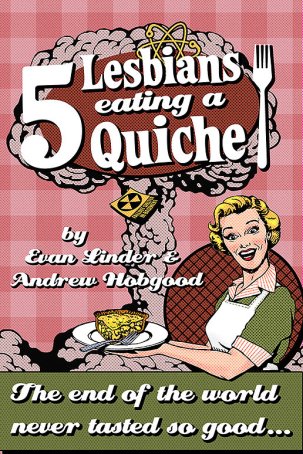
Theater Reviews: Saturday Night Fever and 5 Lesbians Eating a Quiche

By Perry Tannenbaum


img_4913

(Photo by Chris Timmons)

John Travolta at his peak: has there ever been anyone like him? The ruggedness, the grace, the strut, the conceit, and the boyish charisma — all of these studmuffin assets uniquely tinged with a robust Brooklynese vulgarity that took America by storm from the moment Welcome Back, Kotter hit the airwaves in 1975. But the full bloom of Travolta-mania didn’t happen until 1977, when Saturday Night Fever hit the big screen.

Surely the music of the Bee Gees was a prime component in the mystique of that breakthrough film. Yet the Bee Gees’ film score underpinning Travolta’s disco exploits was exquisitely subordinated to the heart of Tony Manero’s halting, confusing, and sometimes comical progress toward manhood in Norman Wexler’s screenplay. Bring the song hits more to the fore, as the Broadway musical version of 1999 attempted to do, and the narrow emotional range of disco is cruelly exposed.

“More Than a Woman” is unquestionably less than a woman to me, “Tragedy” is barely morose, and the answer to “How Deep Is Your Love?” is not very deep at all. I’d say that the Gibbs Brothers chose wisely in never attempting to write music for the Broadway stage.

We can only guess why director Ron Law, kicking off Theatre Charlotte’s 89th season, passed on the original Broadway adaptation by Nan Knighton in favor of a newer 2015 adaptation by Sean Cercone and David Abbinanti that has never been on Broadway — or even a national tour. Either way, Law faced an uphill battle with his core of teenage performers.

After playing the somewhat delicate boy protagonist in Caroline, or Change earlier this year in the Theatre Charlotte lobby, Rixey Terry attempts a huge leap forward from that concert production in tackling the iconic Travolta role of Tony. While the welter of tunes launched at us — the worst are those newly penned by Abbinanti — dilute the impact of the drama, they don’t obscure the complexity of Tony’s character or his double lives.

By day, Tony works a dead-end job at a Brooklyn paint store, coming home to parents who adulate his older brother Frank, a priest, while belittling his talents. A huge chunk of Tony’s paint store paycheck — and some elaborate rehearsals and primping rituals — go into Saturday nights, when he reigns as king of the dance floor at the 2001 Odyssey club. Local girls long to be his partner, thrilling to the privilege of even mopping his brow after a dance.

So at work and at home, Tony is meek, querulous, and downtrodden, but out on the street or at the club among his friends and admirers, he’s self-absorbed, arrogant, and cruel. He ignores and snaps at his good friend Bobby, who leans on him for advice, and he forcefully rejects all advances from Annette, the best dancing partner in the neighborhood.

From the moment he first sees Stephanie Mangano at the club, Tony’s world turns upside-down. Classically trained, Stephanie’s moves are easily a match for Tony’s — and her savoir-faire is miles ahead. She has a job in Manhattan! Suddenly, Tony is the supplicant and the pursuer, hoping Stephanie will be his partner for an upcoming prize competition. Yeah, the story has been slightly altered.

Terry wraps his arms around the meek, downtrodden, and needy aspects of Tony a lot more readily than his imperial arrogance. Terry’s ordinariness carries over to Tony’s first few turns on the dance floor, where he just doesn’t look masterful. So the true turning point on opening night last week came when we reached Terry’s solo on “You Should Be Dancing” at the end of Act 1. Adding acrobatic break dancing moves never seen in the iconic film, choreographer Lisa Blanton unleashed the beast in Terry.

In less than a minute, Rixey proved that, even among triple-threats, he possesses unique gifts.

img_4851

Whether or not Stephanie is intended to have more confidence and dancing polish than Tony, Susannah Upchurch definitely brings it. The way things are between Tony and his groupies doesn’t always come off precisely as they should, but when Upchurch is around, Tony’s shortcomings and vulnerabilities snap sharply into focus. Her Stephanie is almost unattainable, not quite.

Meanwhile Ava Smith is acting up a frenetic whirlwind as Annette, almost convincing us that Tony is the dreamboat we never quite see. Vic Sayegh and Mara Rosenberg make Tony’s parents a rather squalid couple, contributing mightily to the Brooklyn ambiance, and Jay Masanotti brings out all of the older brother’s cryptic contradictions.

The fabled three-piece suit from the film isn’t quite equaled by costume designer Jamey Varnadore, whose budget was likely too strict for all the clotheshorses and wannabes he’s called upon to outfit. Zachary Tarlton leads a tight five-piece band, but the real heat is mostly generated by Blanton’s choreography — and Dani Burke’s solos as Candy, the 2001 chanteuse. Burke’s “Dance Inferno,” not a Bee Gees song, is the chief showstopper among the vocals. With so many three-part harmonies discarded, it’s hard to pick a lowlight among the songs that the Gibbs Brothers made famous. Not one falsetto all evening long!

I’ll go with “Stayin’ Alive” as the nadir. For decades, I’ve despaired of explaining how tone-deaf most renditions of “If I Were a Rich Man” sound to Yiddish-speaking Jews when Christian singers navigate the vocalise, non-verbal sections of the lyrics. Now I can finally point to an equivalent.


4cab0c_8e61596cf00f4ad2a25425910884a614mv2

At first, I could hardly believe how over-the-top director Sarah Provencal was wanting her cast to act in 5 Lesbians Eating a Quiche, currently at the Warehouse Performing Arts Center in Cornelius. This was the customarily sophisticated Lane Morris as Wren, one of our five quiche bake-off hostesses? The effusive audience interaction, from the time we enter the Westmoreland Road storefront, makes Pump Boys and Dinettes seem funereal by comparison.

But after a while we realize just how strange this script by Evan Linder and Andrew Hobgood truly is. For this egg-worshipping black comedy takes us back to a 1950s dystopia in an alternate universe. Only the desperation of our hostesses’ plight can prod them into coming proudly out of the closet, a delicious juxtaposition with their ’50s primness.

Actually, Morris with her “victory curls” looks more like a throwback to the ’40s and the Andrews Sisters (yes, these Daughters of Susan B. Anthony and Gertrude Stein have a club song). It’s Joanna Gerdy as Vern who’s the outright lesbian of this quiche quintet from the start, flinging away her customary sophistication even further from the norm in a comedy performance to relish.

Ginny, played by Stephanie DiPaolo, is a diffident Brit who almost seems catatonic at times. Vying with her for the distinction of being the most repressed in the house is Nikki Stepanek as Dale, who hasn’t spoken to a man since the age of three. She’s definitely the youngest, which is why she becomes the chosen vessel — for a while, anyway — to save mankind.

Every one of us in the audience must come out and admit that, yes, we are also lesbians, a quite unique moment in the annals of theatre. The only remaining holdout is Pam Coble Coffman as club president Lulie, a veritable Betty Crocker of propriety and discipline. Lulie hits us with the startling revelation that sends this 73-minute production into its unnecessary break. My wife Sue balked at this intermission, but the folks taking hits from the boxes of wine on the buffet seemed to be okay with it.

So real men and real women don’t eat quiche? Please forget I said that.