Tag Archives: Nicia Carla

Ludlam’s “Reverse Psychology” Proves Devilishly Ridiculous

Review: Reverse Psychology at VisArt Video

By Perry Tannenbaum

Best known for his international comedy hit, The Mystery of Irma Vep, Charles Ludlam and his Ridiculous Theatre Company struggled for 17 years before his 1984 breakthrough brought him financial security. But AIDS took him down, so he couldn’t enjoy his celebrity and notoriety for long. Ludlam was gone less than two months after my first reviews and features appeared on the Charlotte theatre scene in 1987.

Vep wasn’t too long in finding me. Following up on previous drag triumphs in Psycho Beach Party and Vampire Lesbians of Sodom at the storied Pterodactyl Club, Alan Poindexter and innovative Theatre Company introduced the crowning Ridiculous Theatre glory to the Queen City in 1993. Poindexter was only partially mincing in Ludlam’s flamboyant footsteps, for the Long Island native not only wrote a large chunk of his Ridiculous rep but also starred and frequently directed.

In all, Ludlam’s Complete Plays runs to over 900 pages, including such promising titles as Turds in Hell, Eunuchs of the Forbidden City, Isle of the Hermaphrodites, Secret Lives of the Sexists, and Der Ring Gott Farblongett. Despite these temptations, we’ve waited over 30 years to dip further into the Ridiculous oeuvre.

But it’s not surprising that PaperHouse Theatre is the perpetrator. After all, they exhumed Irma Vep two summers ago at VisArt Video’s clubby setting at the rear of their alley. It’s also rather discerning of them to ignore Ludlam’s more sensational titles in favor of Reverse Psychology.

The original 1980 production drew one of the strangest reproaches ever seen in a review. Writing for the New York Times, Frank Rich declared that Ludlam’s new farce did not live up to the playwright’s Ridiculous brand: “Silly? Perhaps. Clever? Certainly. Funny? Absolutely,” he conceded. “But ridiculous? When a play is as well-crafted and sharply written as Mr. Ludlam’s, honest-to-God respect must be paid.”

Rich wasn’t done, citing Ludlam’s production for selling his own play short.

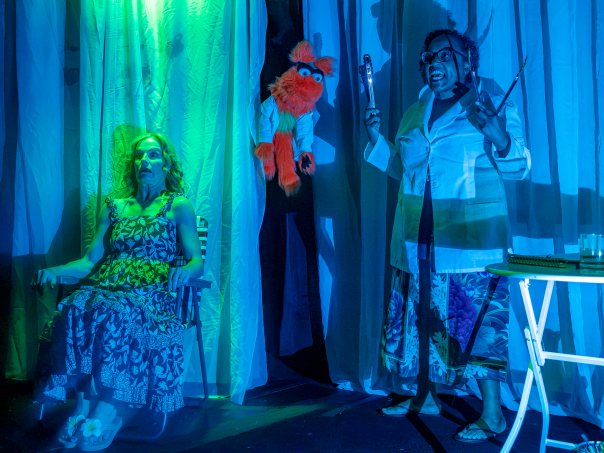
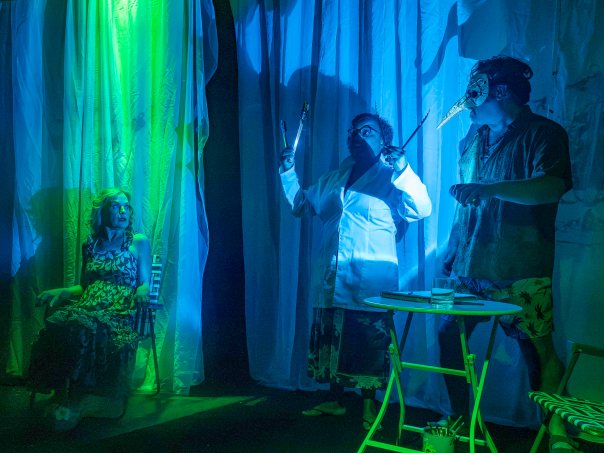
PaperHouse doesn’t make the same mistake – or any others, for that matter. Shrewdly in charge, PaperHouse founder and artistic director Nicia Carla gives her players free rein to go with the freaky flow of the action and to underscore their quirks and hypocrisies, even if they trespass the borderlines of caricature. But they keep their mischief within the two psychiatrists and their two patients, never breaking character or milking an easy laugh.

That approach enriches the ironies Ludlam explores and sharpens the satirical points he scores with his four intertwined adulterers.

Leonard Silver and his wife, Karen Gold, are the psychiatrists who begin secret affairs at the beginning of Act 1, neither of them aware that their new paramours, Silver’s Eleanor and Gold’s Freddie, are also patients of their spouses. Ludlam is showing us all this gradually in a series of two-handed scenes between Silver and Eleanor, Silver and Freddie, Freddie and Eleanor – yes, they’re married – and Silver and Gold.

So the accumulation of deliciously absurd discovery adds fuel to the comedy as we piece together the big secret that this unfaithful quartet doesn’t, that they’re all being cheated on. Yet the business end of this farce, juxtaposed with the couples’ home lives, compounds the comedy long before their intertwined deceits unravel.

For the most absurd thing you’ll notice is that the psychiatrists’ marital relationship is far more hostile and acrimonious than their patients’! They’re the ones who need therapy!

Nevertheless, Gold is making Freddie, a struggling artist, feel guilty because she can lavish all the money she receives from Eleanor and her other clientele on a new gallery where Freddie can paint and exhibit. Silver, meanwhile, is wowing Eleanor on her own dime, if we presume that Freddie can’t really afford his therapy on his own.

Ludlam will keep leaning into this point even after the farcical climax in Act 2, where all four of his sex-driven cheaters are found out in a frantic scene at a beachside resort. The upshot of all these blasted deceptions is a double fake-out epilogue that serves to magnify Ludlum’s exploitation theme to the magnitude of horror.

And yes, Rich may have missed what Ludlam saw as the most ridiculous aspect of his satirical tale. A specter of promiscuity hovers over it all. All the wicked stealth and hurried cover-ups are driven by axiomatic beliefs in the sanctity of marriage, fidelity, and monogamy. Each of these pieties may have seemed supremely ridiculous to Ludlam – inside the box – before he was diagnosed with AIDS a mere two months before his death.

Carla and her cast make it clear that the psychiatrists are definitely among the loonies that we see. The most promiscuous of these is Ashby Blakely as the ravenously omnivorous Dr. Leonard Silver, madly attracted to all the other people onstage except his wife. Brilliantly layered on in the epilogue is an eerie touch that would have been unavailable to Ludlam when he originated this role: a spot-on evocation of Anthony Hopkins as Hannibal Lecter.

It’s pretty obvious that Carla and Lisa Schacher, in her yummiest role yet, see Eleanor as the polar opposite of Silver, the least guilt-ridden by promiscuity and the most horribly victimized. Partly due to her sunny histrionics and partly due to Ludlam’s portraiture, we find Eleanor the most artless and appealing of these risk-takers. Her most extreme travails begin midway through Act 2 when she is visited by a quasi-nightmare.

This is when Rasheeda Moore comes to the fore as Dr. Karen Gold and begins to seize her rightful place as the cunning and evil of the bunch. Blakely as Silver offers keen competition, shamelessly wooing Freddie during multiple therapy sessions and shredding his Hippocratic oath when his dear patient forsakes him. Moore is merely cruel and unscrupulous with Eleanor, taking multiple phone calls in the middle of their session and then brusquely shutting her down mid-question when time is up.

How does Chaz Pofahl as Freddie manage to keep paying Silver if the starving artist cannot sell even one of his paintings? Supreme poseur and part-time sponge, the stylish and cavalier Pofahl charmingly shows us that our Freddie cares nothing for such mundane matters, slickly picking up Gold at a museum when only one of them can pay the cab fare to his humble abode.

On your ride home, with your impressions of Reverse Psychology still fresh, you may consider the notion that Eleanor and Freddie have somehow cured their therapists.

That may be the last of multiple meanings that you’ll find in Ludlam’s title. It’s the last of his ironies, for sure, and devilishly ridiculous.

Or it was the last irony in this farce. Grimmer ironies surfaced when Ludlam’s death was front page news in the New York Times. Public Theatre’s legendary Joseph Papp, with whom Ludlam was engaging in contract talks, put it bluntly, as he always did: “We lost an extraordinary artist who was just on his way to a tremendous breakthrough in the theater and opera.”

“Irma Vep” Brings Giddiness to VisArt

Review: The Mystery of Irma Vep – A Penny Dreadful at VisArt Video

By Perry Tannenbaum

My first hints that PaperHouse Theatre’s new production of The Mystery of Irma Vep would be truly unique came when I glanced at a hidden nook of the set and saw a little half-hidden bar napkin that read “Homo Sweet Home.” Shortly before or afterwards, my first peep at the playbill revealed that there were more directors on this project than players. Two more.

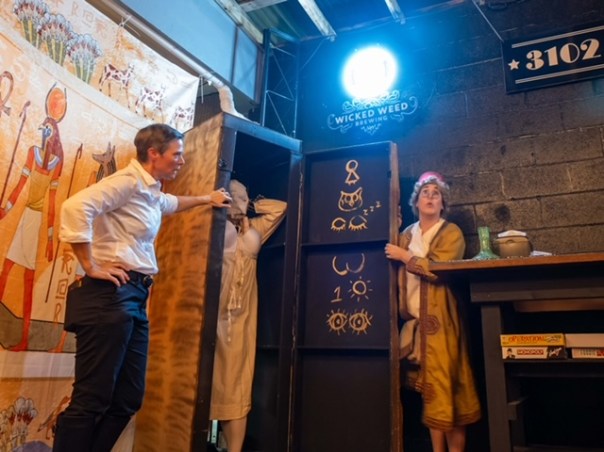
Then before intermission, the aluminum loading dock closure at VisArt Video was raised by the entire cast of two, Nicia Carla and Andrea King, while we joined them on the other side, exiting through the front door to the outside alleyway – the al fresco part of the store. The final Egyptian scene was played out on a second stage, facing out to a few seats, under the shadow of a Wicked Weed Brewing sign. With a nifty little Egyptian tapestry and a fairly gaudy, full-sized sarcophagus.

What really clinched it for me was rolling pin in Act 2 – deployed for a purpose you’d never dream of. That settled it: the new Irma Vep, a Charles Ludlum gem not seen in Charlotte since 1993, is far more than a loving revival. Far more than a couple of hambone actors led by an unusually comical director.

No, this is pure out-of-this-world madness, a starburst of hysteria fueled by a team of four directors feverishly brainstorming in the merciless grip of writer’s room giddiness. Who can possibly care about a three-inch square napkin? Who would conceive of taking the one underground scene in Vep outdoors? And the rolling pin: I can barely imagine the uproarious laughter when that touch was unveiled. Perfect.

Some of the zaniest futzing could have happened spontaneously during rehearsals, since Carla and King, splitting eight roles between them, are also part of the directorial team, joined by Kevin Lorms and Chaz Pofahl. So scenic designer Kel Wright may have lavished so much attention on her precious sarcophagus that she didn’t notice when that homo napkin got slipped into the wicker basket back at Mandacrest.

That’s where theatre legend Lady Enid Hillcrest, newly married to Lord Edgar Hillcrest, will feel oddly ill-at-ease in the library as a portrait of her predecessor, Milady Irma Hillcrest, stares down at her. Greeting her as maidservant Jane Twisden, King ought to be scornful and sepulchral, since she is replicating Judith Anderson’s role as Mrs. Danvers in Rebecca opposite Carla while she resurrects the Joan Fontaine naif.

Yet by the time Lady Enid sashays into view, numerous other parodies have already been set into motion in Ludlam’s wicked mockery of the “penny dreadful” style of Victorian England. Sleuthing, sarcophagi, werewolves, vampires, witches, and a Wuthering Heights heath are all mixed into this undeadly brew. Plus the obligatory mummy. So why not give King the freedom to jubilantly shatter the Dame Judith mold, sporting a bright red wig and occasionally breaking a smile?

Anderson may never have even slightly bared her teeth before she set Hitchcock’s Manderley ablaze.

Squinting her eyes like a savvy sleuth in the opening scene, Carla as the swineherd Nicodemus quickly references the nearby heath and his determination to hunt down the werewolf suspected in the death of Lord Edgar’s son. As the action speeds up and the creepy creatures proliferate (inspiring Carla’s more outré costume designs), we need to be watchful in keeping track, not only with who’s who but with who’s what. Once the thunder stops, the full moon will have its effect, so we can be on the lookout for the kindred of Lon Chaney, Bela Lugosi, Sir Laurence Olivier, Lady Macbeth, and Edgar Allen Poe.

Ludlam wrote all the roles that Carla plays in this quick-change romp for himself and the others for Everett Quinton, his partner in the Ridiculous Theatrical Company and in life. And Ludlam also directed the 1984 premiere. Small wonder, then, that legendary actor/director Alan Poindexter was actually dissatisfied with Innovative Theatre’s storied 1993 production at the fabled Pterodactyl Club – for he merely starred in that historic riot. He told me in 1995 that he was itching to revisit the script.

Where he didn’t say, but presumably, Poindexter yearned to act and direct next time around, the dual roles that both Carla and King are fulfilling now. The fun they’re having with it was unmistakable almost from the start last Friday. Those many costume changes certainly quicken the heartbeat and release the adrenalin when these gifted players are switching outfits backstage – often speaking lines of dialogue while they do.

It’s gotta be dark back there, so in a small space where so many costumes are parked, Lorms must be especially adept as he switches hats and takes on the stage managing. If there’s an additional person hanging up the hastily discarded clothes, it must really be mayhem back there!

While Carla is shuttling between her Nicodemus and Lady Enid costumes, King is shedding her maidservant uni – and that wig – whenever the Lord Edgar returns from his various adventures. Tortured soul! After losing his ex to a vampire and his son to a werewolf, noble Edgar tasks himself with tracking down both supernatural monsters, with only Nicodemus for backup. Poor choice.

Leaving a beautiful lady alone on a lonely manor; especially near moors, heaths, mists, and hail; is never a good idea, confirmed by even a smattering of familiarity with Hollywood horror. After discovering that an Intruder has left telltale teeth marks around his beloved’s jugular, Lord Edgar proves that he has learned his lesson by immediately traipsing off to Egypt to solve this mystery. Thoughtfully, he checks Lady Enid into a sanatorium.

While Milady convalesces, Carla can transform into two Egyptians, Lord Edgar’s turbaned guide and his royal quarry, the remarkably well-preserved Princess Pev Amri. More hilarity for us; more heartbreak for Lord E.

An easier mystery for us to solve was why the Egyptian scene was moved back from the beginning of Act 2 to the end of Act 1. That sarcophagus appears on both stages, so Carla and King can rely on outside help in schlepping it. In its wake, we’re left facing a handy cantina where we can line up for refreshment during intermission.

No doubt the respite is a godsend for Carla, King, and the hidden crew as they regroup, relax, and hydrate. Action is noticeably more frenetic after the break. Masks appear more frequently, and we’re treated to cameos by vampires and various werewolf body parts, far eclipsing the wolf’s carcass tossed into Act 1. In the hurly-burly, all the mysteries and who’s-whats are solved – but you’d better be alert if you want to catch all the solutions.

By then, you may have been laughing too hard to care.

Vampires and Trumpers

Reviews: Vampire Lesbians of Sodom and Thanksgiving: 2016

By Perry Tannenbaum

For devout upstanding citizens who had decided way back in the hippie ‘60s that Greenwich Village was an abominable den of sin, Charles Busch’s Vampire Lesbians of Sodom was a flaming and perverse poke in the eye. Or an argument clincher when it landed on Macdougal Street in 1985. The New York Times raved, the extravagant little trio of sketches became a cult obsession, and Vampire Lesbians had a five-year run.

Busch slipped away from his castmates when the review came out in the early morning after the Provincetown Playhouse premiere and had a good cry. Why did this diva desecrate his mascara? His career in theatre was now assured. He would write more outrageous comedies and send-ups that he, as the prima donna, could cross-dress and slay in, most famously Psycho Beach Party.

Vampire Lesbians made it to Charlotte at the Pterodactyl Club in 1991, after the slightly wholesomer Psycho Beach had paved the way during the previous year. George Brown directed this orgy of sacrilege with fiendish glee, while Innovative Theatre co-founder Alan Poindexter starred with Keith Bulla as the titular vamps.

With the Rev. Joe Chambers carrying the torch for fundamentalism in the wake of Jim Bakker’s disgrace, Banktown was still a very Christian place. It was my sacred duty to bring my daughter, not yet bat mitzvahed, to see Poindexter in all his counter-culture glory. After beholding the kinky wonders of Psycho Beach, my Ilana would have kissed Alan’s feet.

Flash forward to 2023. Poindexter is gone and the Pterodactyl Club, the one-time cultural capital of Freedom Drive, is goner. But thanks to Nicia Carla and her PaperHouse Theatre, Hollywood antagonists La Condesa and Madeleiné Astarté (a Succubus and a Virgin Sacrifice back in their Sodom days) are undead again!

Taking on Busch’s mantle, Carla directs and stars in this stunning revival at VisArt Video, tucked into the nether region of a strip mall on Eastway Drive – I’m trying to make this little suburban dive sound as risqué as the Pterodactyl! Walls are black as you walk inside, and hostesses in Goth attire and makeup are there to greet you. Whatever Google Maps has told you (it misled both me and my wife Sue on separate occasions), you can now be sure you’re in the right place.

Small as it is, the inner sanctum of VisArt is perfectly sized for Busch’s secret forbidden rites. The seats are soft enough to keep butt burnout at bay for 90 minutes, even if you don’t stretch for intermission and fall prey to the treats in the lobby. Yet sightlines are not ideal according to Sue’s scouting report.

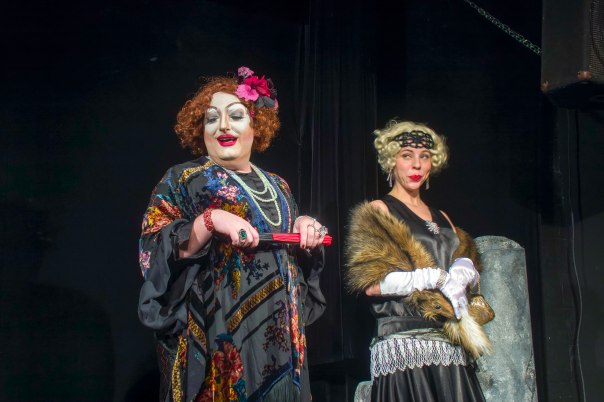
The PaperHouse cast multitasks even more than Busch’s original ensemble, just six players covering the 14 roles instead of seven. All six are battle-tested in madcap comedy, so this outrage is hardly outside their comfort zones. Nicia probably hasn’t had this much fun onstage since Poindexter directed her as The Witch in Hansel & Gretel. She minces and manipulates here as the Virgin Sacrifice, growing regal and stentorian as theatrical megastar Astarté as she assaults the Left Coast. Opposite her, Ashby Blakely is a steely, sneering diva bridging four millennia as The Succubus, aging gracefully into La Condesa and crossdressing in costume designer Beth Levine Chaitman’s most outré couture.

That isn’t to say that Josh Looney and Charlie Carla are anything less than visions of decadence as Sodomite musclemen Ali and Hujar in complementary S&M outfits and Wagnerian wigs. Nicia is already fairly slutty in the opening sketch despite her somewhat revealing white dress, willing to break her hymen with Ali or cut a deal with the cave monster Succubus. Subsequent scenes in Hollywood and Sin City climax in a couple of startling onstage costume changes, most improbably by Tanya McClellan who snoops into La Condesa’s boudoir as gossip columnist Oatsie Carewe.

Gosh, it’s good to see McClellan back onstage in manic comedy mode. Squinting her snoopiness, she sniffs out the ungodly acts performed by Nicia as Astarté on La Condessa’s protégée, luminous Sarah Molloy as flapper Renee Vain, and her meddlesome boy toy, Looney as matinee idol King Carlyle.

Hard times for a vampire? You’ll need to come back after intermission for Blakely’s final transformations. Andrea King’s choreography, on loan from Jane Fonda, elegantly shows off McClellan’s dancing prowess.

Anyone who reads advice columns or cruises social media at this time of year will have an accurate inkling of what Thanksgiving: 2016 might be about. Millions of Turkey Day hosts are wondering how they will keep opposing family factions from shouting their lungs out or coming to blows while the sharp cutlery is still on the table. Playwright Elaine Alexander smartly calculates that the situation is prime fuel for a dining room comedy – or tragedy – but the world premiere of Charlotte’s Off-Broadway production now at VAPA also reveals that the NC native had a tough time deciding which way to go.

Ground Zero for the annual onset of hosting panic was clearly in November 2016 when Hillary Rodham Clinton resoundingly won the popular vote for the US presidency while Donald Jefferson Trump won the Electoral College – and the White House – just as resoundingly. Liberals, Democrats, and rational folk are still in shock. Yet as Alexander deftly reminds us along the way, they are all blissfully unaware of the betrayals of good sense, rationality, rule of law, and democracy to come.

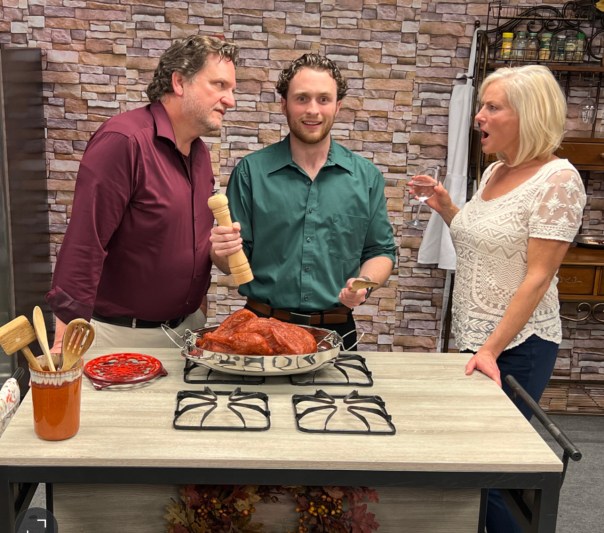
As the West family up in the liberal Northeast prepares to host young Eric’s girlfriend, riding up the highway from Alabama, the aroma of crisis already fills the suburban kitchen. Papa Harry, after diligently knocking on hundreds of doors crusading for Clinton, was hospitalized – either for a nervous breakdown or a heart attack – immediately after watching CNN declare Florida for Trump. The chief Turkey Day watchword from Harry’s physician is for wife and son to prevent the shell-shocked Hillary soldier from indulging his CNN addiction.

Taking to drink in the wake of her husband’s collapse, either out of worry or guilt, Renee has pretty much abandoned any serious intent to impress Brittany, the Southern belle she’ll be meeting for the first time. So it has fallen to young Eric to try to cook a luscious feast for his beloved, even though Mom hasn’t properly shopped for the occasion. Some improvising and substitution will need to be done. Worse, frozen will occasionally need to stand in for fresh.

Worst of all, Brittany voted for Trump, so Eric desperately hopes to keep talk of politics – the subject Dad is obsessed with and still agonizing over – away from the holiday dinner table. Harry has enough difficulty digesting that his son would date a girl from Alabama. Nor does Dad have enough self-awareness to realize that, in a reflexive action stemming from his years in community theatre, he mocks every Southern drawl he comes in contact with.

Finding out she’s a Trump voter could send him over the edge. Getting Dad to refrain from talking politics promises to be even tougher than steering him away from CNN. Finessing how to keep Brittany off the touchy subject is a bridge Eric hasn’t crossed yet.

As a director, Alexander casts father and son perfectly. Matthew Howie is a master of timorous anxiety as Eric. He can craft crescendos of panic and befuddlement while doing a hilariously awful job of warding off disaster with a shit-eating smile. Nor could we improve much on Tom Ollis as Harry. Since his 1997 debut at Theatre Charlotte in Arsenic and Old Lace, Ollis has grown into the most visible volcano on the Metrolina theatre landscape. Whether as Mr. Blonde in Reservoir Dogs, Sweeney Todd, or Titus Andronicus, Ollis is peerless at seething, suspecting, and erupting into towering, raving rages.

Since Harry is also a trial lawyer recently dismissed from his law firm because of his excessive zeal, Ollis can feast on numerous opportunities to cross-examine everyone in sight, bullying and browbeating every witness. Alexander’s women don’t get nearly as much scenery to chew, but her casting choices are nearly as impeccable.

Donna Norcross seemed to be battling opening night jitters early in Act 1 as Renee, but as Mom yielded to a multitude of wine refills, Norcross also relaxed, becoming quite powerful in the Act 2 denouement. Quite ripe for stereotyping, Michelle Strom as Renee entered the West home like a sudden ray of sunshine, without the preamble of a knock or a doorbell chime, her drawl as wide as the Mississippi. No, Dad could not restrain himself, nor could I blame him.

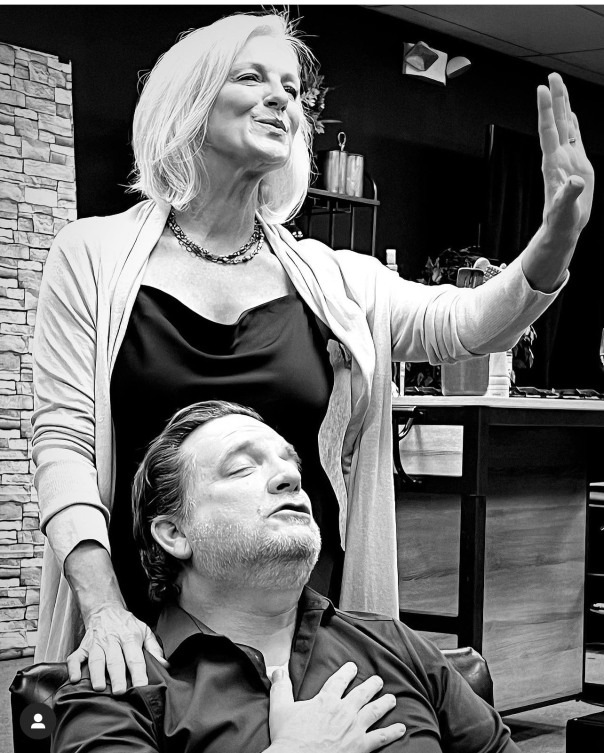
As you can imagine, the setup of Thanksgiving: 2016 is almost pure comedy – until the Trumper truth finally comes out, as an announcement rather than a shy confession, with the proud flourish of a cheerleader’s somersault. Looking from Strom to Ollis as we reach intermission, we can only wonder whether Dad will clutch his head or his heart.

But what can come afterward from our host, our hostess, and from poor Eric? Admirably enough, Alexander lets her characters carry her along across Act 2. But her impulse to bludgeon Harry with more secrets and uncomfortable turns this comedy upside-down. We transition, not very gradually, from a Neil Simon comedy of futile secret -eeping to an impactful series of revelations that conjures up Sophocles’ Oedipus, Strindberg’s The Father, or Albee’s Virginia Woolf. Those revelations are topped off by a  couple of increasingly jaw-dropping ideological rebukes to Harry’s smug liberalism that might shake you up a bit.

We seem to fall over a cliff here, with too little before intermission to prepare us for the high drama afterward. By the time the cast is taking their bows, Renee has radically transformed from a borderline bimbo into a pieta resembling Steinbeck’s Rose of Sharon on the final pages of The Grapes of Wrath. Instead of dumping us off a high cliff, I’d advise Alexander to lay down more track that would guide us around the mountain: a sudden dramatic swerve – not too sudden – would be more satisfying than this swan dive.

A visit to VAPA for Thanksgiving: 2016 is still worth it, delivering hearty laughs and a gasp or two. By all means, dig in!

Homespun “Barbecue Apocalypse” Improves With Age

Reviews: Barbecue Apocalypse, The Sherlock Project, Life Is a Dream, and Madagascar

By Perry Tannenbaum
IMG_5740

In a year that included Lucas Hnath’s The Christians, Robert Schenkkan’s The Great Society and Rebecca Gilman’s Luna Gale among the top contenders, I could only give Matt Lyle’s Barbecue Apocalypse a lukewarm endorsement for best new play of 2015, ranking it #13 among 27 eligibles that I read for that year’s Steinberg Awards. Nor did colleagues from the American Theatre Critics Association strongly disagree with my verdict, since Lyle’s dystopian comedy didn’t make the cut for the second ballot, when we considered our consensus top 10.

But before Charlotte’s Off-Broadway decided to stage this show at The Warehouse PAC up in Cornelius, they did some reading and balloting of their own. From January through March, the company offered monthly “Page to Stage” readings presenting two different plays on each occasion. Then they asked ticketholders to vote on which of the six plays they would like to see in a fully staged production. Less than two months after the votes were counted, Barbecue is back for my reconsideration as the audience favorite.

And on further consideration, I must credit director Anne Lambert and her professional cast for convincing me that Barbecue Apocalypse is even better than I thought it would be – far more to my liking than real barbecue.

IMG_5885

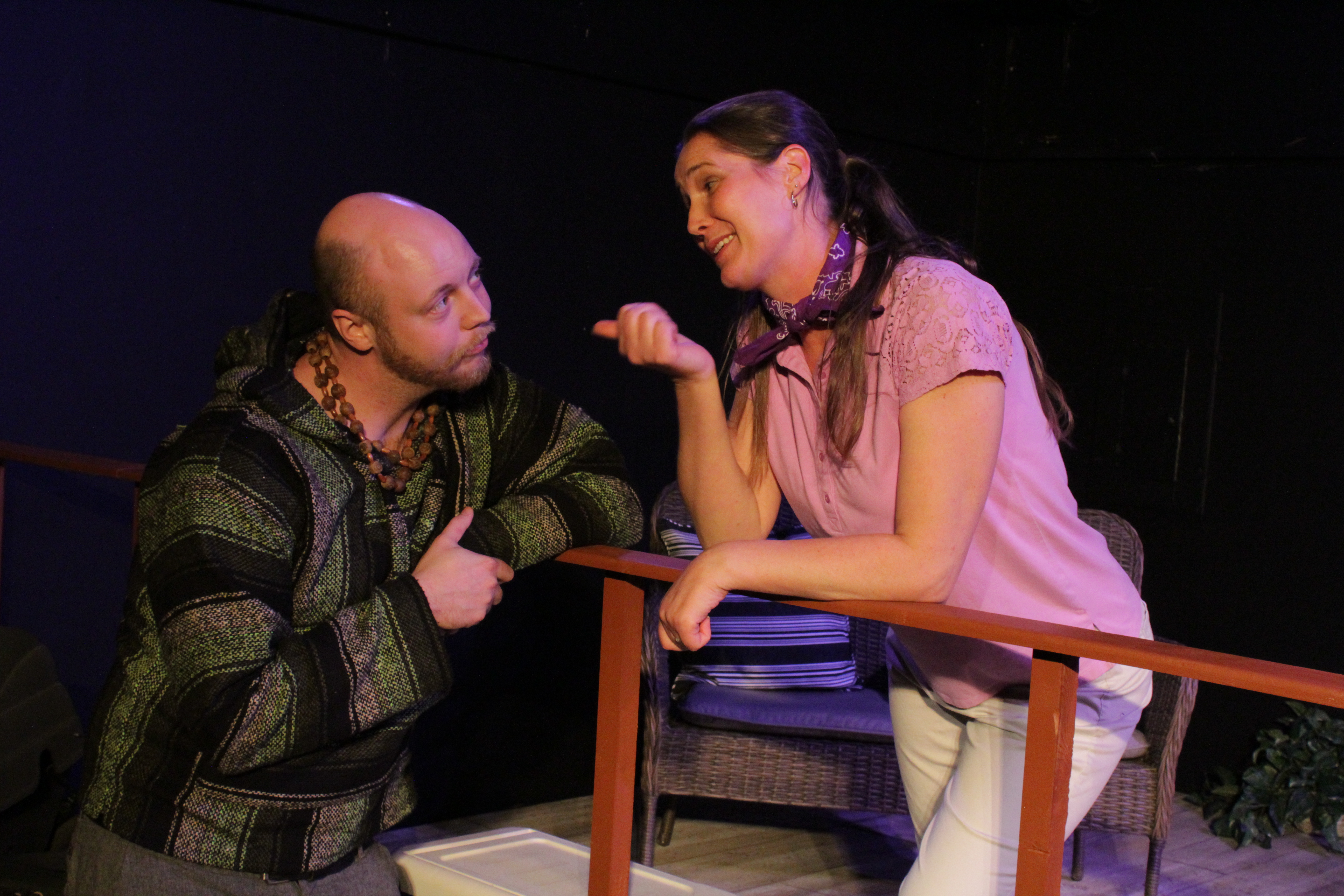
Lyle would probably concur, since his patio hosts, Deb and Mike, are only grilling and basting because they want to avoid the embarrassment of having their friends – who are more trendy, stylish, and successful – see the interior of their home, decorated with lame movie posters. Deb succinctly describes her strategy as lowering expectations for the cuisine and the ambiance. Outdoors, she can point with pride to the fact that Mike has built the rear deck himself. Yet the barbecue event has obligated Mike to buy a propane grill off Craig’s List, and he’s afraid to light it.

He would also like Deb not to mention that he’s a professional writer, for his career earnings, after one published short story, now total 50 bucks.

All four of the guests feed the hosts’ sense of inadequacy. Deb is a decorator, foodie, and gourmet cook who makes sure to bring her own organic meat, and her husband Ash is a gadget freak, armed with the best new smartphone equipped with the most awesome apps. Win pretty much embodies his name, a former high school QB, now a successful businessman with Republican views. He lives to put Mike down and can seemingly get any woman he wants. Even his bimbo of choice, Glory with her Astrodome boobs, can claim formidable accomplishments, arriving late to the barbecue after nailing her Rockette audition.

What ultimately happens to this insulated suburban group reminds me of The Admirable Crichton, the excellent James M. Barrie tragicomedy I came across a couple of times during TV’s golden age, when colleges had core curriculums. A perfect butler to the Earl of Loam in Mayfair, London, Crichton and his betters were shipwrecked on a desert island in the Pacific, where his natural superiority emerged.

There are two basic differences between Barrie’s back-to-nature tale and Lyle’s. The shipwreck situation was reversible with rescue. Apocalypse isn’t. More to the point, Barrie was clearly targeting the blind rigidity of class distinctions. Here if we consider the implications of Barbecue Apocalypse, Lyle seems to have modernity in his crosshairs – how our world warps our aspirations and our self-worth, how it channels us into modes of living that are far from our authentic selves.

In the cramped storefront confines of the Warehouse, Lambert doesn’t attempt to design a deck that lives up to Mike’s pretensions, and Donavynn Sandusky’s costume designs are similarly déclassé, especially for the nerdy Ash. This robs Lyle’s concept of much of its slickness, which for me turned out to be a good thing. Aside from the Craig’s List mention, Lambert also dropped in a couple of local references that added to the overall homespun flavor.IMG_6440

Becca Worthington and Conrad Harvey were nearly ideal as our hosts, keenly aware of each other’s limitations and their own, yet visibly crazy for one another. Worthington with her status-conscious rigidity and stressing was clearly the closest actor onstage to Lyle’s vision, beautifully flipping her “We suck” persona after intermission and the apocalypse, when a full year of roughing it has elapsed. Harvey was more than sufficiently cuddly and self-deprecating – but credulity is stretched when a man of such size and stature is repeatedly dominated by his adversaries.

If you can accept that Greg Paroff was ever on a football field, let alone as a QB, you’ll be quite pleased with how he handles Win’s asshole antics. He is confident, he is arrogant, and if he’s possibly past 40, that only increases the disconnect between Win and his limber Rockette. Julia Benfield is absolutely adorable as Glory, and I absolutely adore how she’s still mincing around in high heels when she makes her disheveled entrance in Act 2. We totally believe that her familiarity with Tom Wopat doesn’t extend to The Dukes of Hazard in the ‘80s.

Probably not the best moment for Lambert when she cast Cole Pedigo and Jenn Grabenstetter as Ash and Lulu. They should remember the ‘80s, but I needed to stifle my doubts. Wardrobe and just the way he’s absorbed in his iPhone might help Pedigo out – and make him less wholesome, winsome, and juvenile before the apocalypse. Grabenstetter overcomes all objections when free-range Lulu gets snockered on generic canned beer, and both Pedigo and his scene partner truly click when adversity brings Ash and Lulu to a new lease on life in Act 2. I believe that’s an antler dance.

I won’t disclose what happens when Maxwell Greger walks on for his cameo deep in Act 2, but I do respect how Lyle makes him earn his paycheck with a sizable monologue. Greger does the denouement with a slight manic edge, and the technical aspects of his departure are impressively handled.

So it’s fair to say that apologies are in order for rating Barbecue Apocalypse in the middle of the pack when I first read it. Or excuses, since a rational man resided at the White House in 2015, and apocalypse seemed so fantastical.

But hold on. Charlotte’s Off-Broadway has already programmed two other plays from their “Page to Stage” readings for two fully-staged productions in the near future, Susan Lambert Hatem’s Confidence (and The Speech) for September and Lauren Gunderson’s Exit, Pursued by a Bear for next February. Maybe when these runner-ups get fleshed out, supporters of Lyle’s winning script might reconsider their votes!

A Catch-All Catch-Up

Our recent travels to Greece, Israel, and Jordan compelled us to miss a bunch of high-profile openings after we reviewed the reinvented Rite of Spring at Knight Theatre on April 6 and CP’s On Golden Pond the following evening. Even before we left, we had to pass on the Charlotte Dance Festival and CP’s Elixir of Love so we could adequately prepare for our trip. To see the birthplace of theatre, the Holy Land, and Petra, we had to miss out on the BOOM Festival, the reprise of Beautiful: The Carol King Musical, and the opportunity to host a pre-show preview of The Marriage of Figaro for Opera Carolina.

New openings when we returned were a must, so we hit the ground running with Charlotte Ballet’s Spring Works and Symphony’s Brahms-and-Bartok program. But our need to catch up with Carolina Shakespeare’s Life Is a Dream made us put off seeing PaperHouse Theatre’s Sherlock Project until it second week. It gets complicated. But I’ve tried to get up to speed while working on more reviews and features. File these under gone but not forgotten:

The Sherlock Project So a dozen actors and writers collaborated on PaperHouse Theatre’s mash-up of Sir Arthur Conan Doyle’s short story gems, producing a script that follows three guiding principles: keep it funny, keep it moving, and don’t, don’t, don’t ever explain how the great Sherlock Holmes arrives at his incredible deductions. Going back to their roots at the Frock Shop on Central Avenue, PaperHouse and director Nicia Carla found a frilly complement to the Victorian chronicles of Dr. John Watson.

But the frame of the story was wholly new, telling us that the deadeye detective in the deerstalker cap is a woman. Watson protects the woman who should be credited with all the purported exploits of Scotland Yard’s Inspector Lestrade because he knows that Sherlock is right: The general public is even less prepared to believe a female is capable of such brilliancies than Watson is.

Besides all of the Sherlockian brilliance and nonchalant arrogance, Andrea King reveled in all of the detective’s eccentricities, whether it was shooting up a 7% solution of cocaine, tuning up a violin, or lighting up a calabash pipe. Opposite King’s insouciant self-confidence, Chaz Pofahl wrung maximum comedy from Watson’s wonder and timidity – a phenomenon compounded by the gender factor as Pofahl switched from paternal protectiveness to awe or terror while King wryly twinkled and smiled.

The two main supporting players slipped into multiple roles, Angie C as a cavalcade of damsels in distress and Berry Newkirk in the plumiest cameos, ranging from the dull-witted Lestrade to the razor-sharp Professor Moriarty, mythically uncatchable. Apart from directing behind the scenes, Carla conspired in the action as Mrs. Hudson, Holmes’s discreet housemaid. Carla not only ushered in Sherlock’s distraught clientele or evil adversaries, she also presided over scene changes, when audience members had to exit the Frock Shop’s parlor to a murder scene in the adjoining room or out on the porch when Sherlock was pursuing… something. Had to do with fire.

Or when it was intermission, time for little cucumber sandwiches.

The whole show was a wonderful diversion. PaperHouse had to add another performance to their run, which we caught last Wednesday, and the remaining nights were already sold out. Like the PaperHouse faithful, I couldn’t get enough of The Sherlock Project. I wanted lots more – beginning with how did Sherlock deduce that Watson had just come from Afghanistan when they first met?

Life Is a Dream – Convinced it was a comedy rather than a political melodrama, Shakespeare Carolina and director S. Wilson Lee kidnapped Pedro Calderón de la Barca’s classic, written during Spain’s Golden Age, and transported it more than three centuries forward from a mythical Poland to a mythical Las Vegas. There in a seedy club on the strip, the two factions with their eyes on the throne were Frank Sinatra’s Rat Pack and Marlon Brando’s Wild Bunch.

Lee’s wild conceit didn’t do nearly as much harm as I thought it would, mainly because ShakesCar didn’t have the budget to carry it too far at Duke Energy Theatre, and the strong cast mostly played their roles as the text, sensibly adapted by Jo Clifford, said they should. So much depended on the broad shoulders of David Hayes as Segismundo. Heir to the throne of Poland, Segismundo has been locked away Prometheus-like in a mountain dungeon for his whole life by his father, King Basilio, who is foolishly trying to ward off the dire destiny predicted by an astrologer.

A boiling rage seethes inside of Segismundo, and a less mightily built actor than Hayes might need to strain himself to encompass it. Hayes projected the mighty rage rather naturally, which made it easier for him to flow convincingly into Segismundo’s softer emotions when – before he has even suspected his royal lineage – he is handed the Polish throne and the power to act on his newly awakened sexual urges as he sees fit.

Called upon to give a far more nuanced performance as Basilio, Russell Rowe delivered. Yes, he was cruel, but also conflicted, with a lifelong dread deftly mixed into his forcefulness. Though I feared the convoluted plot might be abridged or simplified, the intrigue, the complexity, and the epic monologues were almost entirely intact. As the vengeful Rosaura, Teresa Abernethy brought forth the masculine-feminine blend that the transgendered Clifford was aiming for in her translation, and James Cartee, an actor who often keeps nothing in reserve, showed unusual probity and maturity as Clotaldo, even as he tried to figure out his long-lost child’s gender.

Nobody was more suavely dressed by costume designer Mandy Kendall than James Lee Walker II as Astolfo, the successor that Basilio wanted if the true heir didn’t pass his test. But if anybody was victimized by Lee’s Rat Pack concept, it was Walker. I have no idea why he persisted in speaking so rapidly and unintelligibly, unlike any work I’d seen from him before. Was he attempting a Sammy Davis Jr. imitation? Couldn’t figure out what accounted for this curious outing.
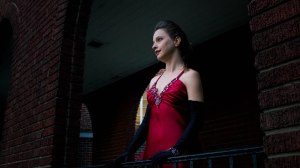
Betrothed to this strange hipster, Maggie Monahan beautifully brought out the agonies of queen-to-be Estrella. Maybe the most Shakespearean role in this ShakesCar production was Ted Patterson as Clarin, who tags after the disguised Rosaura from the opening scene, as either her companion or servant – but definitely our clown.

On the strength of this effort, theatergoers can be excited about ShakesCar’s next invasion of Spirit Square, The Tragical History of the Life and Death of Doctor Faustus at Duke Energy from June 28 to July 7.

DSC03442

Madagascar – Okay, so I’ll grant that the musical adaptation of the 2005 Dreamworks film didn’t have the gravitas of the greatest Children’s Theatre of Charlotte extravaganzas of the past like their Boundless Grace and The Lion, the Witch, and the Wardrobe – or the bite of Ramona Quimby and Tales of a Fourth-Grade Nothing. But this confection was nearly perfection. Under the direction of Michelle Long, Madagascar hit a family-friendly sweet spot, straddling the realms of cartoon silliness, cinematic adventure, and theatrical slapstick and dance. I just didn’t like the deejay, everybody-get-up-and-act-stupid thing.

Scenic design by Jeffrey D. Kmiec never lost its freshness thanks to a slick stage crew and the eye-popping lighting by Gordon W. Olson, while the animal costumes by Magda Guichard probably made the strongest case for live theatre against multiplex animation. Choreography by Tod A. Kubo chimed well with Long’s direction, which used areas of McColl Family Theatre that rarely come into play.
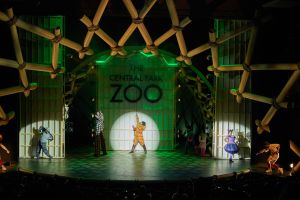
Centering around four animals that break out of Central Park Zoo, Madagascar introduced us to Marty the zebra and his wanderlust. We moved swiftly from there. Following the lead of four penguins bound for Antarctica, Marty escaped the zoo, seeking a weekend in Connecticut. Not only are police, animal control, and TV bulletins on his trail, so were his pals Gloria the hippo, Alex the lion, and Melman the giraffe. Embarking underground in the Manhattan subway, Marty hardly stretched credulity much further by winding up off Africa.

Deon Releford-Lee was a spectacular triple-threat as Marty, but what dazzled most was the multitude of gems in this supporting cast, beginning with an intimidating Alex from leonine Traven Harrington and – on stilts, of course – a timorous Melman from Caleb Sigmon. Dominique Atwater disappointed me as Gloria, but only because we didn’t get enough of our hippo after her first big splash. Olivia Edge, Allison Snow-Rhinehart, and Rahsheem Shabazz fared better, drawing multiple roles.

While the book by Kevin Del Aguila shone more brightly than the musical score by George Noriega and Joel Someillan, I was amazed that so much story and song could be squeezed into barely more than 60 minutes. Combined with last October’s Mary Poppins, the exploits of Madagascar prove that musical production is an enduring strength at Children’s Theatre. I can’t think of a season at ImaginOn that had sturdier bookends than these musicals that began and concluded 2017-18. The crowd that turned out for the final performance affirmed that the 7th Street fantasy palace has perfected the craft of producing family fare.

Not only that, it showed me that Charlotte families have spread the word.

Gunderson’s “Revolutionists” Reminds Us That 1793 Wasn’t a Very Good Year

Review : The Revolutionists

By Perry Tannenbaum

It’s easier to enjoy Lauren Gunderson’s The Revolutionists, a finely polished comedy gem from PaperHouse Theatre, than it is to find it. My GPS app resisted the 1776 Statesville Avenue address that was on my smartphone calendar, forcing me to choose between a Camp North End and a Goodyear Arts destination nearly 100 address numbers apart. Choosing the 1824 Statesville address got me to the Camp North End gate well enough after dark, and there was a PaperHouse emissary at the gate to tell us how to proceed. But as we navigated through a desolate concrete-and-asphalt landscape of vast warehouses, it was definitely an uh-oh episode for Milady GPS, who spun around from “Recalculating” to “Turn Right” in her instructions like a dog chasing its tail.

Following traffic wasn’t a reliable remedy, and I apologize to anyone who followed our lead on opening night and wound up parking a wilderness away from the PaperHouse performing space. Within sight of what looked like the building entrance – and another PaperHouse emissary – I still probably walked nearly a quarter of a mile after thinking I had sufficiently improved my parking spot. You walk through that building to another one.

Fortunately, PaperHouse is much better at producing plays than at getting you to them. (They will deploy more guides for future performances, I was assured.) Once you do arrive a the site of the action, with scenery by Jordan Ellis that strikes us as much with its simulated blood-spattered walls upstage as it does with the ascending scaffold in front of them, you can start to believe you’ve really reached the French Revolution during the Reign of Terror. You’re a bit of a pioneering revolutionary yourself if you’ve persevered and reached this secluded spot.

In the meta-world of her own – and history’s – making, The Revolutionists is Gunderson’s play, and it isn’t. We seem to be watching French feminist playwright Olympe de Gouges battling an onset of writer’s block as she ponders her next response to the rampaging Reign of Terror in the seclusion of her study. She is much in demand, for while Olympe is thrashing around, trying to settle on her message and her medium – shall it be another play? or perhaps a pamphlet? or a manifesto? – in walks Charlotte Corday, pressing the writer to compose a memorable line she can declaim when she assassinates the rabid revolutionary Jean-Paul Marat in his bathtub.

Olympe isn’t in advertising, so one-liners and slogans aren’t her forte. She hopes to come up with the right zinger during the course of composing a longer work, a plan that doesn’t jibe well with Charlotte’s mad impatience. Just when you think that the comedy will crest with the standoff between Charlotte’s insane homicidal urgency and Olympe’s many artistic hesitancies, in walks Marie Antoinette, dressed to the 17’s by costume designer Barbi Van Schaick. Her Highness wants a rewrite, a play by Olympe that will rebrand her tarnished reputation.

Everything seems to become absurd and almost surreal at this point – and likely stays that way with Marie’s queenly vanities and Olympe’s nervous vacillations. But if you go home and Google, you find that Olympe de Gouges really did embark on writing a play to rehab Marie Antoinette’s reputation, and that the playwright really did put herself in that work as an enlightened agent who reconciles the queen with the revolutionaries. If that weren’t enough, it’s also true that de Gouges wrote the courageously feminist Declaration of the Rights of Woman and the Female Citizen, thereby punching her ticket to the guillotine.

In the play, Olympe writes her manifesto in response to some principled prodding from Marianne Angelle, a Haitian revolutionary seeking independence from France, the one fictitious character in Gunderson’s script. In the real world, de Gouges seems to have had no problem standing up for herself – and against the Revolution’s bloodthirsty zealots.

So you might take the layered-on comedy a couple of ways. Gunderson may be telling us that she prefers her feminist heroes to be more fallible and true-to-life rather than impossibly glorified. Or she might be substituting herself for Olympe and showing us how far short of the French revolutionary’s greatness she falls.

Gunderson nudges us to that second, self-effacing hypothesis with little anachronisms that she occasionally drops into the dialogue, like Marie’s rebranding and rewrite ideas. PaperHouse artistic director Nicia Carla takes the anachronisms beyond what Gunderson specifies in her stage directions, and she doesn’t waste any time about it. Lydia Williamson makes her first entrance as Marianne carrying a garish, polka-dotted plastic suitcase, and when Shawna Pledger as Olympe begins writing at her escritoire, she quickly switches from a quill to a BIC ballpoint.

So Pledger is only superficially presiding over a play that Olympe has written for her queen with a plum role for herself. She is actually channeling Gunderson writing a dark comedy about herself, and if you saw Pledger last season as the fretful Sister Shelley who runs the soup kitchen in Grand Concourse, you already know that she excels at stressed-out indecisive women who are so eager to please. Surrounded by this madhouse, Williamson as Marianne doesn’t get as many comedy opportunities as the true historical figures, but she does loosen up from time to time, on temporary leave from her hectoring. Cumulatively, she leaves us with the impression that the French, whatever their politics, have no special call for commanding an empire.

Au contraire.

Sarah Woldum has now haunted PaperHouse productions for two consecutive Octobers, last year as Sheridan LeFanu’s vampire Carmilla and this year as the notorious Corday. This time, she can milk a laugh or two from the assassin’s irrational zeal and her PR impulses, but she’s unmistakably insane. I’m not sure she ever blinked.

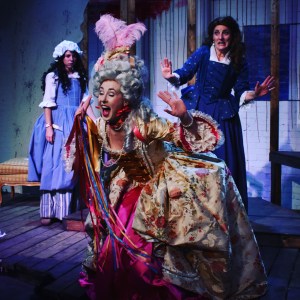
As for Caroline Bower, she does enter as an overdressed Barbi doll with some truly vain, insensitive, and bubbleheaded lines to delight us with. But Marie Antoinette’s grand gown, the ribbons she loves so frivolously, and the ridiculous piled-high wig and feathers all do come off as the Reign of Terror sweeps its scythe through our women, and its Bower’s humbling – still cohering with the incredibly spoiled brat we first saw – that brings home how monstrous the French Revolution turned out to be.

In the end, we might realize that our man’s world of today is hardly less bloody than it was in the fatal year of 1793 – and that Gunderson isn’t entirely playful or self-critical when hinting that she trembles in the face of such brutality.


Not Your Same Old Vampire

Reviews: She Who Watches and Charlotte Symphony

By Perry Tannenbaum

Performances of She Who Watches run through Oct. 30 at Frock Shop.


When J. Sheridan Le Fanu serialized Carmilla in 1871-72, Count Dracula wasn’t even a gleam in Bram Stoker’s eye. Yet a quarter of a century later, when Dracula became the paradigm for modern vampire literature, Stoker himself acknowledged that Le Fanu’s most famous novella was a part of that gleam. So after a steady sprinkling of October visitations from the undead lord of Transylvania — no less than seven Metrolina Dracula productions since 2002 — it’s nice to see a change of pace in the form of a new PaperHouse Theatre adaptation of Le Fanu’s spellbinding horror classic.

Eerie echoes are a key motif in the storytelling, which co-directors Nicia Carla and Chester Shepherd have retitled She Who Watches in their adaptation. The narrator of the story, Laura, is haunted by a nightmarish experience from her childhood, when she awoke to find a teen-aged girl in her bedroom. That girl seemed to fall into a slumber on Laura’s chest, but when she awoke the second time, what the girl was doing made her shriek in terror. And then, before her governess could come to the rescue, the girl vanished into thin air!

It would be cruel to divulge much of what happens 12 years after this creepy prologue, but you’re correct in assuming that the beautiful face indelibly etched in Laura’s memory is Carmilla. How Carmilla returns to Laura’s home — and ultimately, her bed — took just under 69 minutes to deliciously unfold on opening night, with neat surprises and more eerie echoes along the way. That’s about the same amount of time you might spend in your family car getting from the I-277 overpass to the dubious thrills of Scarowinds.

It’s a shorter, more enjoyable evening at PaperHouse’s customary haunt, The Frock Shop. Le Fanu’s story placed the action at a lonely Austrian castle in a place called Styria, but the parlor of the Frock Shop cottage on Central Avenue seems to suit Carla and Shepherd quite dandily. The antique atmosphere is built in, augmented by a gallery of starchy, frilly, diaphanous, and full-length costumes designed by Magda Guichard.

Lighting designer Chaz Pofahl, strategically potting the illumination levels, is certainly a part of the spooky conspiracy, but our stage directors also utilize the windows lining two of the parlor’s walls to pique the suspense and ambiance. Perhaps emboldened by the numerous film, stage and TV adaptations of Carmilla that have come before, Carla and Sheperd have done some character shuffling as well. Instead of a kindly father, Laura’s lone parent is a coolish mom, and instead of a distressed friend of her father, General Spielsdorf, we get a more down-to-earth and frazzled Aunt Jean.

The core protagonists remain the same, and we’re very fortunate there. After two strong outings in Theatre Charlotte’s Miracle Worker and PaperHouse’s Much Ado About Nothing, Sarah Woldum is probably the busiest actress in town this year, taking on the role of Carmilla. She seems to revel in the menace of this role, seething with a mysterious intensity when she isn’t softening her prey with endearments. The whole chemistry of her is different from Dracula’s, seemingly resistant to daylight, but you wonder whether her episodes of weakness are symptoms of a gnawing blood hunger or simply playacting to draw sympathy. When Woldum becomes the predator, Carmilla’s rapacity is as much sexual as it is animal.

Racquel Nadhiri spoke too softly at the outset, compounding my difficulties with her Jamaican accent, so I won’t give her top marks as our Narrator. But Nadhiri beautifully captures the mixture of attraction and repulsion that is the essence of Laura’s reaction to Carmilla. Our empathy for Laura’s victimhood is that much stronger because it stems from her sunny heroism.

The ending that Carla and Shepherd have devised for her — distinctly different from Le Fanu’s — fits Nadhiri like a glove, and you might say that the word “bloodcurdling” was specially cooked up to describe her screams.

Two interludes punctuate the action, so you can get refills on the beverages that were served on the front lawn as you first entered, or you might nosh on cream puffs and sausage balls. When we reached the denouement, the audience was split in two, half of us ascending the staircase to witness the climactic encounter between Laura and Carmilla in the bedroom, half of us remaining downstairs to hear the disclosures that Laura’s mom receives from Aunt Jean.

You’ll have a better appreciation of the synchronicity of the two scenes from the downstairs vantage point, but everyone gets the chance to see both scenes — because, we realize, they actually occur simultaneously.

As I’ve already hinted, the cold and clueless Mother isn’t the plum role here, so you won’t be seeing Andrea King at her best, though she’s very good, of course. Most of the scene stealing comes from Rebecca Costas, busily changing costumes and characters throughout the show. Maybe her most comical turn is as the Doctor who says she’ll return so nervously that you can be absolutely sure she won’t, but she’s also pretty funny as Hunch-Hag, dispensing some fairly toxic marital insight to audience members.

Costas also gets a couple of serious cameos, first as the mysterious and malevolent Countess, Carmilla’s aunt. More urgent — and earnest — is Aunt Jean as the action comes to a boil.

Since her stint as she-devil Abigail Williams in CPCC Theatre’s 2001 production of The Crucible, Costas has only emerged briefly and intermittently on the local scene. It’s a kick to see her shining 15 years later in such a versatile performance, her devilish fire not only intact but several degrees hotter.

Charlotte Symphony’s 85th season is off to an exciting start, and Mary A. Deissler, the new president and CEO, is already making her impact. She has things to say, both onstage at Belk Theater when the orchestra plays and in the CSO program booklet, which isn’t as staid and stagnant as it used to be. Sitting down to last week’s Beethoven Symphony No. 2 concert, I found new artwork, festooned with pumpkins, on the cover.

Image result for picture of benedetto lupo playing piano

The two artworks I’ve seen on the booklet covers, through two 2016-17 Classics concerts, already doubles the number I’ve seen in previous seasons. More importantly, Deissler has kept an inside page, opposite the page where you find tonight’s composers and compositions listed, reserved for herself. So instead of some generic remarks designed to linger more or more inanely as the season wore on, Deissler did a reset on page 17A.

The Welcome Page addressed the divisiveness that has fractured our community in recent weeks, the unifying power of music, and Deissler’s gratitude that we were back at a time when healing is needed. Rang true.

Switching from music director Christopher Warren-Green to guest conductor Michael Christie, the Beethoven offerings were more varied and adventurous than the All-Tchaikovsky season opener, veering off into Franz Liszt’s Piano Concerto No. 1 and his Totentanz before we jackknifed into György Ligeti’s folksier and funkier Concert Românesc.

Guest soloist Benedetto Lupo and the CSO brass were a bit overeager and brutish in the opening section of the concerto, but after the pianist navigated through his first softer, lyrical passages, everyone seemed to settle into a more relaxed groove. A fresh production wrinkle further enlivened the concert: a projection screen descended over the Belk stage so an overhead camera could transmit a bird’s eye view of the hurtin’ that Lupo was delivering to a defenseless Steinway Model D.

Van Cliburn himself might have winced.