Review: Don’t Dress for Dinner at Davidson
By Perry Tannenbaum

July 16, 2026, Davidson, NC – Thanks to its Gallic amorality, Marc Camoletti’s Don’t Dress for Dinner has aged rather gracefully. After its eager reception in Paris as Pyjama Pour Six in 1985, when cads and mistresses had to content themselves with landline communication if their affairs were about to be discovered, a London translation by Robin Hawdon opened to comparable success in 1991. We didn’t see this fast-paced farce in Charlotte until two months before Camoletti died in 2003, a decade after its American debut at Paper Mill Playhouse in New Jersey – and nine years before its Broadway premiere.
Since the BareBones production of ’03, the piece has been presented to Metrolina audiences exclusively in Davidson, by Davidson Community Players in 2005 and 2015, and currently by DCP’s offshoot, Matt Merrell Productions, founded by DCP’s former executive director. The latest edition returns to Duke Family Performance Hall, on the lovely Davidson College campus (currently disfigured by a massive construction project near the Student Union where the theater is housed), where DCP ran an astounding Evita less than a month ago. The quality of the playing, directed by Andy Rassler, reaches a level parallel with the Andrew Lloyd Webber musical. Sadly, though, all those accomplished players are off-mic.

The action is triggered by Bernard in the burbs of the Big Apple, where he has planned to wine and dine his mistress, a model named Suzanne, on her birthday while his wife Jacqueline is away from the summer home visiting her mother. Haste is built into the sleek machine of this farce from the outset, since Bernard needs to whisk his wife out the door before Suzanne walks in. Before this key objective can be met, Jackie intercepts a phone call from the caterer letting Bernard know that the cook, Suzette, is on her way. Somehow, Jackie is sufficiently acquainted with her husband’s foibles to have her suspicions aroused.
Bernard thinks he has come up with an alibi, but he’s disastrously wrong. He has also invited Robert over for this catered dinner, whom Jackie is sure to remember as the best man at their wedding. Trouble is, Jackie is Robert’s mistress – so the main reason Robert has accepted Bernard’s invite is that he might be able to shack up with Jackie. Similarly capable of adjusting on-the-fly and deceiving, Jackie finds a way to cancel her trip, presumably with romantic weekend plans that align with Robert’s.
While the wily Bernard triggers the action and the comedy, poor unsuspecting Robert is trapped at the center. Counting on their longtime friendship to keep his infidelity under wraps, Bernard asks Robert to pretend that Suzanne is his girlfriend when she arrives. Tough spot. As freely as Jackie and Bernard will both engage in infidelity, Robert must now make the impossible calculation on which of the two would be angrier upon discovering that she or he was betrayed.
The arrival of the two women, Suzanne and Suzette, compounds the complications. As much as their names sound alike, Camoletti intends their appearances to be radically different. Suzette, we’ll discover, is married to a human bulldozer, George, who is capable of intimidating – and manhandling – both of the other men at the same time. Nevertheless, when Suzette arrives before Suzanne (Bernard and Jacky are out food shopping for things to cook), Robert somehow presumes that it’s Bernard’s mistress ringing the doorbell.
The ensuing get-acquainted conversation, based on wild mutual misunderstandings, is classic, easily worth all of Camoletti’s contrivances. Robert, thinking that sleeping in the same bedroom with Bernard’s mistress is a small part of his assignment, is a bit shocked when Suzette starts off by asking him to show her “where everything is.” Meanwhile, the cook is almost equally alarmed that the strangely rattled Robert needs to know more about her before showing her the kitchen so she can get to work.
Robert’s mistake only assures that more difficult challenges lie ahead when Bernard returns, Suzanne arrives, and new deceits must be devised. How will Jacky’s wrath be averted if Robert sticks with his girlfriend pretense? How will Bernard and Suzanne react when they learn that the slot reserved for Robert’s girlfriend has been filled? How will that fancy dinner get cooked?
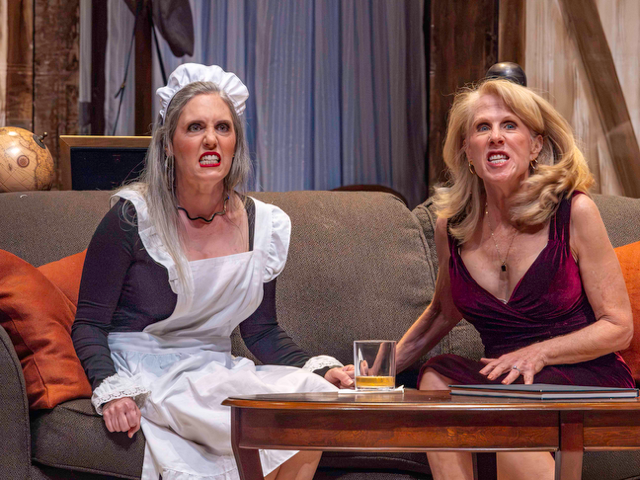
Once Robert initiates his mixed-up girlfriend charade, we can be sure that a placid evening does not lie ahead. How happy will Suzanne’s birthday be if she must now don Suzette’s cook uniform and confine herself to the kitchen? If Jacky’s rage veers out of control, how will his secret keep safe from Bernard’s discovery?
In real time, all the misperceptions, panicked changes of plans, and raging discoveries are more than dizzying enough to keep an audience leaning forward to keep pace. It’s also hard for Camonetti’s characters to adjust sometimes: often the barrage of comedy emanates from somebody reflexively blurting out the truth – or a lie that has been superseded by circumstances and changes in plans.
On opening night at Duke Performance Hall, most of the audience couldn’t lean forward enough because the players were often inaudible, short on energy and lacking amplification. Though Rassler’s directing and Della Knowles’s costume design made it clear enough that Lacy Camp was not the knockout model Bernard had foretold, my wife Sue and I didn’t know who or what she was when she arrived. That’s how much of the dialogue we had missed in Row H. My own initial surmises ranged from masseuse to physical therapist until I caught on.
Merrill absorbed most of the assaults as Bernard when the comedy mayhem got physical, obliging him to be the first to climb into his pajamas. He probably sustained the most energy vocally until Brian Rassler arrived late in Act 2 as George, the husband who will have gripes with both of the other guys. But Merrill’s physical energy was fine, enabling us to track Bernard’s ebbs, flows, and on-the-fly calculations as they twisted the plot.
Lou Dalessandro, who has played the high and mighty right up to Macbeth, comes off surprisingly well as the hapless victim, Robert. You almost had to adore him when he reacted with such obvious shock to Camp’s appearance and proceeded to go with the flow – after objecting so vehemently minutes before to Bernard’s scheme.
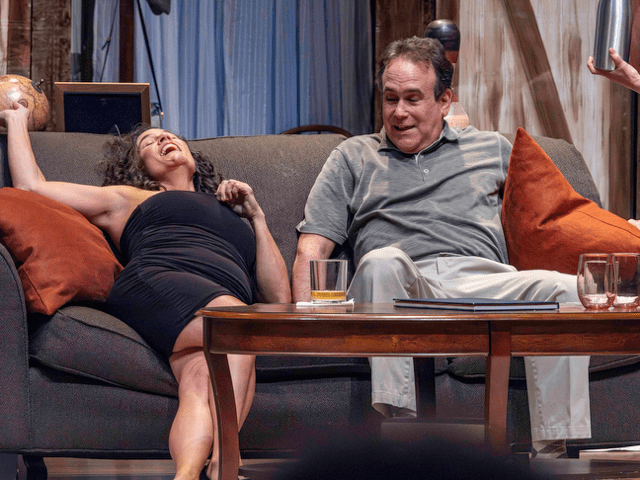
Camp is not only the most inscrutable of the players as Suzette. She is also the most frequently inaudible. She does transform handsomely from dumpy cook to a plausible, jealousy-worthy girlfriend, relishing that slinky physicality. Camp also logged maximum mileage demanding and receiving extra cash for services beyond the culinary, a zestful working-class opportunist.
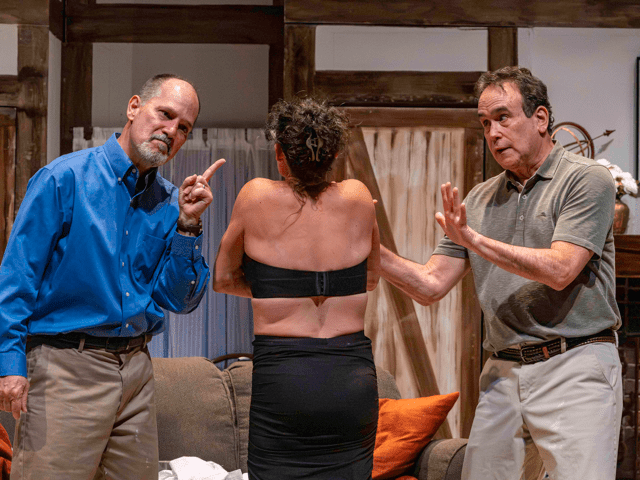
All the ages of the principals have been discreetly adjusted upwards, both from the script and the 2003 BareBones premiere, yet Karen Christensen is still a marvel in tossing off the role of Suzanne a full 30 summers after first appearing on my radar. It wasn’t age that Christensen added to Suzanne’s glamor as much as a patrician elegance. There was a bit of goofball poutiness to Christensen as Suzanne sulked off to the kitchen, but she somehow managed to mix in an air of condescension.
No doubt about it, Jacky remains the she-who-must-be-fooled adversary through most of the evening – until the action suddenly flips and Bernard’s fury is kindled. So Cat Rutledge perhaps had the most reason from start to finish to keep her energy blazing hot, whether in suspicion, jealousy, or amorous passion. She actually performed rather well, but because she had a head start on drawing our ill will, she likely drew the most frustration when the audience struggled to hear the verbal barbs and nuggets in the script – or failed to follow what was going on. Just a half dozen well-deployed microphones would have made opening night so much more enjoyable, possibly sparking the standing ovation that didn’t happen when the cast took their bows.


