Tag Archives: Emily Jarrell Urbanek

Three Women Empathize Historically With “Stabat Mater” on a Historic Night

Review: Pergolesi’s Stabat Mater at The Mint Museum

By Perry Tannenbaum

September 11, 2025, Charlotte, NC – With its stained-glass windows, high ceiling, and resonant wooden flooring, the Uptown Mint Museum proved to be an unexpectedly apt venue for Opera Carolina and Charlotte Symphony to join in commemorating mournful, horrific events with sacred music. Reflexively, we look to the past – and to religion – to express our feelings amid present woes, but neither of the musical organizations could have anticipated the extra layers of calamity earlier in the week that would pile onto their memorial to the victims and heroes of 9/11 on its 24th anniversary. The work they performed, Giovanni Battista Pergolesi’s Stabat Mater, has always had a tragical tinge. Pergolesi composed his most-performed work near the end of his life, all too suddenly ended in 1736 by the onset of tuberculosis at the age of 26.

The Italian was casting his eyes across the centuries in scoring his Latin text, which had already existed for four or five hundred years, depending on whether it was written by Jacopone da Todi, a Franciscan friar, or by Lotario de’ Conti di Segni, better known as Pope Innocent III. The “Stabat mater dolorósa” poem, 20 three-line stanzas written in trochaic tetrameter, meditates on the sorrows and sufferings of Jesus’ mother, more than a millennium further back in time, standing by her son during the agonies of crucifixion. While the Oxford Dictionary of Music describes the piece as originally written for male soprano, male alto, and orchestra, most of the vocalists on the 60 or so recordings of the work have been female sopranos and mezzos.

Marie Van Rhijn was the first woman to conduct a recording of Pergolesi’s chef d’oeuvre in 2021 on the Chateau de Versailles label, so Emily Jarrell Urbanek was almost a pioneer in adding her special empathy toward the grieving Virgin Mary as she stood on the podium leading the Charlotte Symphony Orchestra Ensemble. But wait: the Van Rhijn recording was done with two male vocalists! Samuel Mariño and Filippo Mineccia, listed on the album cover as the “deux costrats,” also perform the Vivaldi Stabat Mater on that release with Van Rhijn conducting. So together, Urbanek, soprano Corey Raquel Lovelace, and mezzo Leyla Martinucci may have been making feminist history after all.
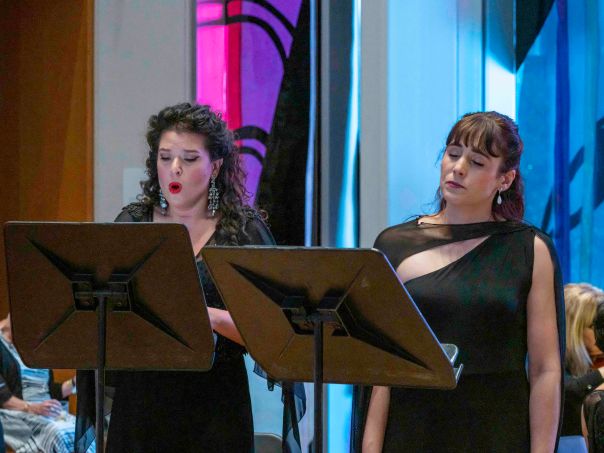
Of course, the Van Rhijn recording remains a great place to begin if you’re wishing to hear how Pergolesi’s Stabat Mater actually sounded at its premiere in Naples. Yet it didn’t take long for the first all-female version ever led by a woman in Charlotte – and the first Symphony concert we’ve heard at The Mint – to impress. Pergolesi divided the twenty-stanza text into 12 compositions, and the opening “Stabat Mater dolorosa” duet is by far the most beloved. While the orchestral intro was engaging enough, though recordings with an organ yield more heft, the blending of Martinucci’s voice with Lovelace’s was sublime.

The first five sections of Pergolesi’s Stabat Mater fully demonstrate the composer’s strengths in solo and duet writing, his lithe capacity for transitioning back and forth between those modes, and his perverse disregard for the stanza couplings of the text’s rhyme scheme. After hearing Lovelace and Martinucci, I sampled Van Rhijn’s recording, then a starry version with Anna Netrebko and Magdelena Kožená, and finally ancient music specialist Christopher Hogwood’s prestigious recording with Emma Kirkby and James Bowman. My admiration only grew for both Lovelace and Martinucci’s approach to the music. Less vibrato and ornamentation seemed more in keeping with the sacred music and the solemn occasion.

Martinucci was the more unique find overall because of the creamy richness of her sound, though Lovelace sang equally well and matched her purity. Not long after Martinucci’s luscious and revelatory “Quae moerebat et dolebat,” Lovelace’s most affecting solo was the “Vidi suum dulcem natum,” two sections later. Between them came Pergolesi’s fifth section, “Quis est homo qui non fleret,” perhaps the apex of the concert. Lovelace launched into this section at some length, so it briefly seemed like this was a solo and Martinucci had neglected to take her seat. But Martinucci had an equally gorgeous solo afterwards and Lovelace didn’t return to her seat, either. We would be ascending heavenwards once more when the two voices soon intertwined.

The tone of the special occasion was nicely prefaced with words from OpCarolina general director Shanté Williams and Profit Insight senior advisor Duncan MacNichol, who a tolled a bell for each of the four planes that crashed in 2001 when the Twin Towers fell. The only discernible shortcoming at the Mint Museum was the lack of supertitles keeping track of where we were in the text. Though Lovelace was often difficult to follow, Martinucci usually lost me. Better to luxuriate in her voice than to decode her Latin.

“The Falling and the Rising” Offers a Kaleidoscopic View of the Military Experience

Review: Opera Carolina Presents The Falling and the Rising

 By Perry Tannenbaum

2022~Falling and Rising-24

March 11, 2022, Charlotte, NC – Four men give their lives to save just one woman soldier, a woman so severely injured that she must be placed in an induced coma to give her any chance of continued survival or even partial recovery. The math and the logic may not seem to add up unless you’ve served in the military or you’ve witnessed The Falling and the Rising, a fairly new opera by Zach Redler and Jerre Dye that may impact Opera Carolina audiences more freshly today than when it premiered in 2018.

Before COVID and Ukraine, when the White House was occupied by a grifter who labeled people who signed up for battlefield duty as “suckers,” the mentality passionately advocated by The Soldier protagonist – that military service is not only a commitment to give your life for your country but also a commitment to give your life for your soldiering comrades – may have seemed rabid, over-the-top, or naively gung-ho. After witnessing the bravery of so many healthcare workers routinely facing the perils of a deadly transmissible disease for the past two years and, more recently, the inspiring popular resistance of so many outgunned Ukrainians, we can likely view that military mentality – and those four soldiers’ sacrifice – as making more sense.2022~Falling and Rising-07

This brash Opera Carolina production, conducted by Emily Jarrell Urbanek and stage directed by Sam Mungo, brings the company to a new venue, the Sandra Levine Theatre in the gorgeously renovated Sarah Belk Gambrell Center, while it brings subscribers a radically different experience. Once the female Soldier is comatose, we’re carried along with her for the bulk of the opera on a kaleidoscopic cavalcade of dream sequences, so the military experience is conveyed to us not only by soldiers in battle and trauma, but also by dedicated doctors and anxious family.

The immersion begins in the Gambrell lobby, where you can pick up info on the Montford Point Marine Association and the Blue Star Mothers of Charlotte. You can also peep in on artworks and obtain a comprehensive coffee table book produced by Bullets & Bandaids, a non-profit veteran and civilian art project. Immersion couples with education at the Gambrell, so it’s fitting that the complex is on the Queens University campus, for the world premiere of The Falling and the Rising was also on academic soil at Texas Christian University, one of seven organizations that commissioned the piece.

A new work set in wartime might trigger a couple of red flags for traditional opera lovers averse to chaos and cacophony. But you’ll find that Redler’s score is comfortably tonal and melodic when soprano Melinda Whittington begins singing a birthday video into a laptop computer for her daughter’s upcoming thirteenth, apologizing and commiserating because they will not be together to celebrate. In fact, when Redler has Whittington pivoting to a shuffle beat, you might briefly wonder whether the composer has crafted a score that’s too casual and accessible.

The roadside IED explosion, with a striking video montage by designer Michael Baumgarten (lights/scenery/video), puts that worry permanently to rest. After the hospital huddle of doctors and a ZOOM consultation where the induced coma is prescribed, the opera is largely a series of extended arias and duets until we reach a closing paean to the men and women who serve, joined by a pre-chosen brigade of vets parading up to the stage from the audience.2022~Falling and Rising-23

Sound at the Levine is noticeably more resonant than the Belk Theater and marginally warmer than Knight Theater, halls where we normally hear Opera Carolina and Charlotte Symphony. Although directors might be tempted to mic student plays and musicals in this 1000-seat space, all of the soloists projected quite easily on opening night to Row M, where we were seated. Redler’s orchestration for 11 musicians balanced well with the singers, and Urbanek had no difficulty in coaxing a hearty variety of colors from her band, which included a French horn, clarinet, guitar, piano, two percussionists, and strings. There is an orchestra pit at the Levine, but it doesn’t protrude far – or impinge on the bond between audience and performer. When baritone Kenneth Overton as the Homecoming Soldier concluded his church sermon, seated in a wheelchair in front of a large wooden crucifix, it didn’t feel like he was calling across a wide gulf when he asked us for an “Amen!”2022~Falling and Rising-11

Gathered from interviews at Fort Myer, Fort Meade, and the famed Walter Reade Military Medical Center, Dye’s libretto was suffused with authenticity and often riveting. Mezzo-soprano Audrey Babcock exuded intensity as Staff Sergeant First Class Toledo, steely and tough as her nickname, which figures into the boot camp segment of her aria. Dominic Armstrong took us to the skies with his heroic tenor voice as Jumper, a First Sergeant who mixes hard-nosed honesty with patriotism as he readies Soldier for her first parachute jump. Parting words: “Don’t forget to pull the string!” After that uplift, bass-baritone Peter Morgan brought us back down to earth as Colonel, seen in civvies in his living room, hoping that his military wife will survive.2022~Falling and Rising-17

Each of these monologues was substantial enough to give Whittington a chance to rest her voice before she joined in duet, a mercy when you consider the extra decibels she can pour out. The most brutally honest testimony in this cavalcade came from Overton in his wheelchair as the Homecoming Soldier, ideally placed by Dye at the juncture of his libretto between the last of personal testimonies and our protagonist’s emergence from her coma. Also artful were the spins that Dye put on his title, for we quickly learned that The Falling and the Rising wasn’t simply, as we expected, about the traumas and dramas of battlefield injury and recovery. We first encountered “The falling and the rising” in the Soldier’s memories of her daughter, back when she was an infant and Soldier was simply a mom watching her baby’s breathing as she slept. Later it was the impending leap from an airplane, with all of its danger and exhalation.

So there is music and drama in this latest Opera Carolina production – and poetry as well.

Originally published on 3/13 at CVNC.org