Review: God of Carnage @ Theatre Charlotte
By Perry Tannenbaum
Human masterworks and monstrosities cover the globe, fly through the air, and reconfigure the sky, bringing breathtaking changes to land, sea, and climate. So it’s rather quaint to spend an evening with a playwright who has built her reputation on the notion that civilization is a thin veneer clothing our innate selfishness and savagery.
Morals, ideals, aesthetics, and manners were all shown to be shams in Yasmina Reza’s Art, her 1994 breakout sensation. Trading in her sharper scalpel for a blunter instrument – a wrecking ball – Reza gleefully bludgeoned the veneers of sophistication, liberalism, reason, consensus, and even adulthood in God of Carnage, an even more smashing Tony Award-winning success in 2009.
It’s an unabashedly macro takedown of humanity and the progress of the race. Yet it’s deeply rooted in the soul of art and in the tradition of drama. For Sophocles and the Greeks, the tragic joke was that, no matter how mighty or regal we might be, or even how brilliant, we were all the playthings of the gods. Modern science reframed the picture, grimly enslaving us to our inner demons while liberating us from external forces. For O’Neill, Albee, and other moderns, the prospects were no less grim.

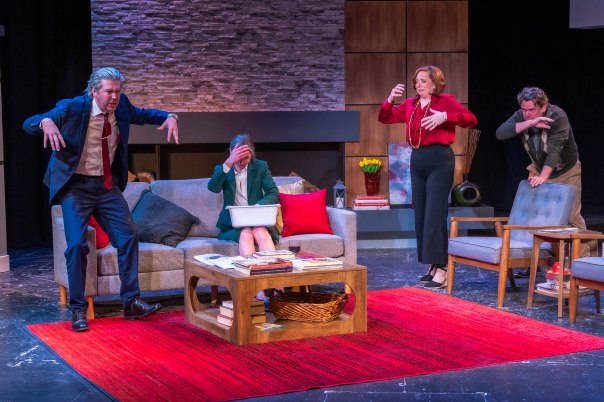
What’s especially disarming about the new Theatre Charlotte revival is just how lightly this heavy Carnage can play. To say that director Brian Lafontaine takes an impish approach to this adult powwow between parents of two schoolkids would be a grossly misleading understatement. Once disagreements between the two couples, the two genders, and the two husbands and wives escalate, no holds, shticks, or slapstick are barred.
If I had to apportion the hijinks at the Queens Road Barn to Reza’s script and Lafontaine’s embellishment, I’d give a decided edge to Lafontaine’s frou-frou. The recent altercation that precipitated the comedy action, between Henry Novak and Benjamin Raleigh about 30 minutes after sundown at Cobble Hill Park in Brooklyn, NY, was surely more violent than what we will witness onstage, with two of Henry’s teeth broken by Benjamin’s bamboo rod.
But the hostilities that break out between the adults are more epic in length, malice, and pettiness. Outbreaks of empathy, conciliation, appreciation, and apology only compound the impacts of their childishness and breaches of decorum.
So does the sleek neatness of Chris Timmons’ set design, where not a single hair or tulip seems out of place. Our hostess, Veronica Novak, writes about Ethiopian culture and civilization while working part-time at an art history bookshop. Not the expected match for Michael, her husband, a wholesaler who traffics in doorknobs, saucepans, and toilet fittings.
We rightly presume that the neatness, the stylishness, and the tulips emanate from her. On the other hand, both Reza and Lafontaine appreciate the special comedy spark that hostile women can ignite more readily than men. That’s why Reza has Veronica and Benjamin’s mother, wealth manager Annette Raleigh, initiating the most startling fireworks. Lafontaine delights in piling on additional aggressions from his women, Jenn Grabenstetter feasting on Veronica with serial hurler Aimee Thomas on the counterattack as Annette.
The menfolk are mostly on the receiving end of attacks, so Reza fiendishly contrives to make them as supremely irritating as their wives are judgmental. Most outré and obnoxious is Paul Riley as Benjamin’s dad, Alan. Like Veronica, Alan has also spent quality time in Africa – with a radically different, primal takeaway.
Lafontaine has special affinities and insights into Alan Raleigh, since he played the role in the 2012 Charlotte premiere at Actor’s Theatre.
We can only guess that Lafontaine yearned to be even meaner, obnoxious, and amoral than he was. That was my takeaway from Riley’s Alan, as he pokes among the objects in the Novaks’ bookcase and allows himself peeks at the upstairs. Mostly, he infuriates everyone by rudely answering his cellphone every time it buzzes, no matter how involved he should be in deliberations with his wife and hosts.
Unless you find it more irritating that, aside from frankly admitting that he has fathered a savage, he is spearheading damage control for his client, a big pharma company responsible for a widely available drug newly found to cause hearing loss and ataxia. That insider info hits home when Brandon Samples, as Michael, is obliged to take a phone call from his hospitalized mom.

One of the people Alan and Pharma are victimizing is now on the line. The same drug has just been prescribed for Mom.
So maybe Riley is most obnoxious when he arrogantly declares that his hosts shouldn’t be eavesdropping on his privileged attorney-client conversations. There’s a lot to choose from with Alan.
And a blizzard of suffering that the Novaks must endure, especially when Annette barfs all over her hosts’ coffee table and their precious art books. You might say that we’re a bit out of control at this point, belly-laughing at the panic and queasiness that ensues from the phlegmatic deluge. What an odd thing to unite these families in damage control!
Lafontaine decrees that Samples shall be the queasiest of them all, likely taking his cue from Reza, who makes this dealer in doorknobs and toilet fittings surprisingly skittish about handling his daughter’s pet hamster. Quite a different sample of Samples than we saw last October when he portrayed Hercule Poirot.
What makes Michael irritating is subtler than what we readily see in Alan. He seems at first to be the resurrection of Yvan, the conciliator in Art who tries so valiantly to agree with both Serge and Marc despite their wildly differing views on modern art and Yvan’s impending marriage. Similarly, everybody seems to be making a good point in Michael’s view.
Such pliability and ambivalence, under Reza’s merciless scrutiny, prove to be as fundamentally amoral and uncaring as Alan’s jaded pragmatism. That’s what opens the floodgates of Veronica’s fury when the compliant Michael breaks rank with her. Grabenstetter, notwithstanding all her sophistication and empathy for “the tragedy in Darfur,” snaps like an alligator, pursuing her husband around their living room like a rabid wolf. Serves him right after Samples’ scene-stealing response to the massive vomiting.

Aided by some very fine Antigua rum, Thomas also gets a marvelous character arc to track with Annette, overcoming her nausea, attacking her spouse, and avenging herself on Veronica. That pleasure, sad to say, did not quite allow me to forget my earlier difficulties hearing Thomas when she was still in her diffident cocoon.
God of Carnage doesn’t exactly match Hamlet for length and power, but its captivating turbulence stems from the same source: the push-and-pull of visceral urges struggling against societal norms. The Novaks and the Raleighs do lose control like their savage sons, but they lose it like adults rather than 11-year-olds.
So there’s hope for us. That amazing restraint is the heart and conscience of this singularly chaotic comedy. Maybe that’s why we have so much fun. Get ye to the Queens Road Barn!


