Monthly Archives: July 2026

Evita’s “New Argentina” Suddenly Reeks of MAGA USA

Review: Evita at Duke Performance Hall

By Perry Tannenbaum
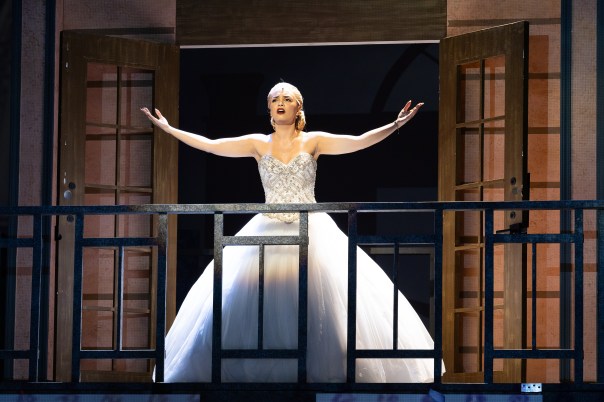
As women and as films, Evita and Melania will never be viewed as two of a kind. Yet in recent years, as Ms. Trump’s husband becomes more ceremonial, militaristic, and authoritarian, a mild kinship and a certain sisterhood have emerged between the two first ladies. There are only a few moments when the current Davidson Community Players’ production of the revered Andrew Lloyd Webber musical, directed with surprising ferocity by Steve Kaliski, seems to reference that kinship.

But there are many more instances when Eva Perón’s “New Argentina” brings present-day USA to mind in all its vulgar MAGA glory. Those happen whenever fervent religious enthusiasm is misdirected. Or when working-class people are talked up so they can be more easily exploited.

By juxtaposing Evita’s glamor, pragmatism, and humble origins with the mixture of street-smart cynicism, working-class empathy, and grudging admiration for homegrown “star quality” that we hear from Che, our narrator, Tim Rice’s libretto has always radiated a reasoned objectivity.

So Kaliski and his principals, Melissa Lozada and Neifert Enrique, aren’t reversing the political lean of Evita. They’re giving the music, the recitative, and the main characters a firm shove in a more malevolent direction.
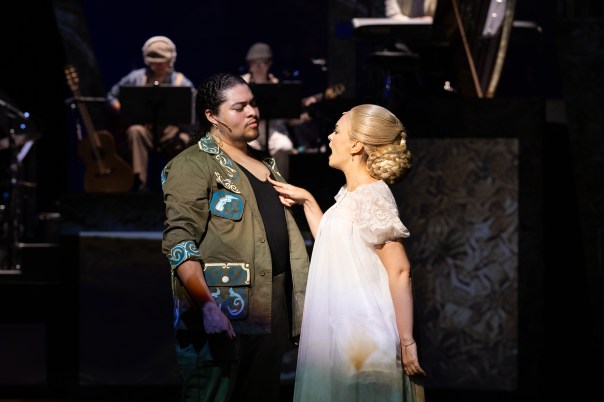
Enrique is particularly startling, easily the most dominant Che we’ve had in the QC. This is a rock tenor who can produce piercingly strong falsetto treble and, minutes later, invade the bass clef so deeply that you wonder where that voice is coming from – and Enrique never makes the mistake of yielding to Lloyd Webber’s singsong to the extent that it dulls Che’s subversive edge.

In sum, Enrique is often powerful enough to make us see the charismatic Evita through his eyes. If you wanted to see the icon as a calculating seductress, who may or may not have gotten religion through her good fortune or failing health, Whitney Drury was perfection in Queen City Theatre Company’s 2010 production, both in the sexual predation that catapulted Evita to celebrity and in her terminal suffering.

On the other hand, if you wanted to be fascinated by an enigmatic Evita, one gifted with so much natural charm and regality that she refuted the whole concept of aristocracy, Lucia Stetson was ideal at Central Piedmont in 2018 – with no shortage of Evita vanity.
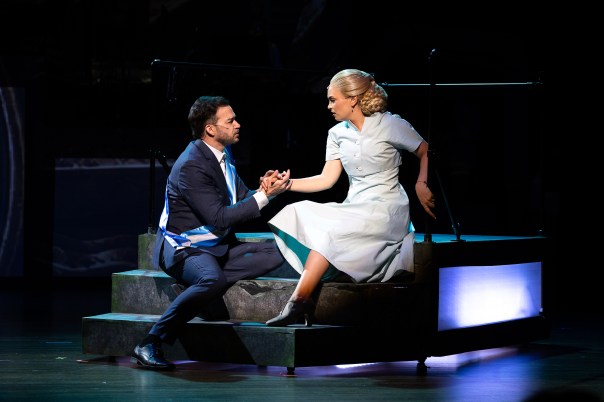
At Duke Performance Hall, on the Davidson College campus, Lozada is simply the meanest and most malignant Eva Perón you’ll likely ever see. Even her “star quality” has a punkish edge as she never quite sheds her peasant roots. There’s a somewhat ghoulish tinge that lingers softly on her final prideful declaration that she has brought her people closer “to the heart of Perón,” her autocratic husband, the nation’s president.

In that moment especially, our clueless Melania pales next to her. We must revert to the golden-haired Trump for a parallel.

Of course, if you saw Lozada in the title role of Electricidad last August, you may already be altering your plans for the final weekend of Evita.Or, if you witnessed Enrique in his most recent title-role triumph down in Matthews as The Prince of Egypt, you may be astonished to hear that his Che is as potent as his Moses.

They aren’t the only reasons why word-of-mouth touting Evita is spreading like a Lake Norman wildfire. Kaliski’s design team has also risen to the challenge of creating a spectacle to match the dimensions of the Duke. Most notable of these are costume designer Sarah Deutsch, lighting designer Kaylin Gess, choreographer Tod A. Kubo, and – perched high in the stratosphere behind the stage’s second scrim – the 10-piece band directed by Matthew Primm.

Upstaging and outsizing them all are the projections designed by Caleb Sigmon, beginning with what may be an actual Eva Perón film! Rice and Lloyd Webber wanted to simulate us all being gathered at a movie theater at the start of their musical when the flick is suddenly interrupted by the announcement of the beloved Evita’s death.
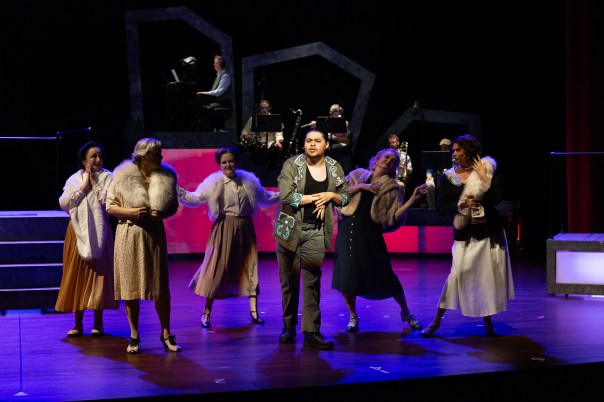
For the first time, this opening scene with its operatic choral requiem seemed prophetic, previewing the wailing and grief that is sure to engulf our streets, churches, and national monuments when 45/47’s number is up. The Amazing Tangerine tries so hard to alienate and disillusion his cult following. In vain, it seems.

Victimized by the wayward Halton Theater sound system when he portrayed Che in 2018, Ron Turner Diaz ages gracefully in the role of the militantly urbane Perón. Effortlessly, he conjures up the personality of a chieftain who will either succumb to Evita’s charm and chutzpah or slay her instantly. There’s a nice tension to their “I’d Be Surprisingly Good for You,” spiced with a tango tang of violence.
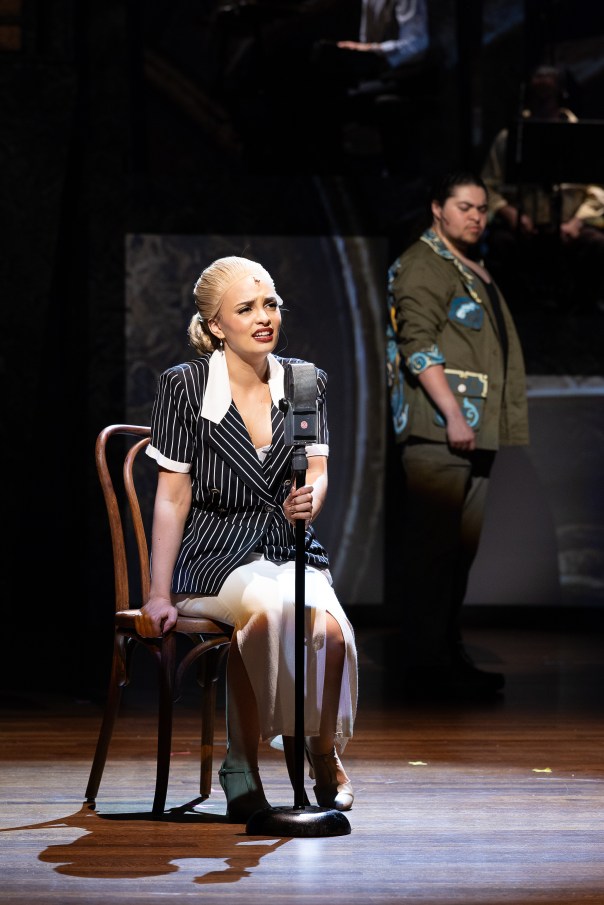
Lastly – except for dozens of aristocrats, lovers, family, military, children, and the citizen ensemble – there’s Tristan Nogueira, rounding out an all-Latino cast of major characters, conclusively answering the question of whether we have enough Hispanic talent in Charlotte to deliver a truly authentic Evita. If you saw Nogueira as the surprisingly skeptical Aaron in The Prince of Egypt, you’ll be pleasantly surprised by his transformation from the future High Priest into lounge lizard Agustin Magaldi, Evita’s first discard.

Extra bonus: Lindsay Litka-Montes sings “Another Suitcase in Another Hall” with a quiet, simmering bitterness as Juan’ s discarded Mistress.

More significant extra bonus: due to popular demand, an extra performance of Evita has been added to its closing weekend. This coming Sunday at 7pm.

Beginning at the Beginning at Cunningham Theatre Center
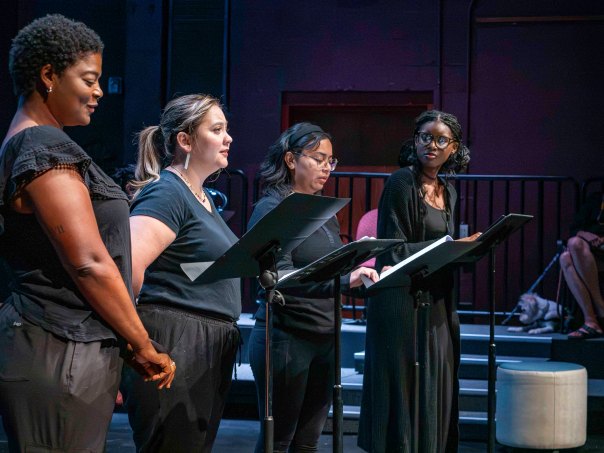
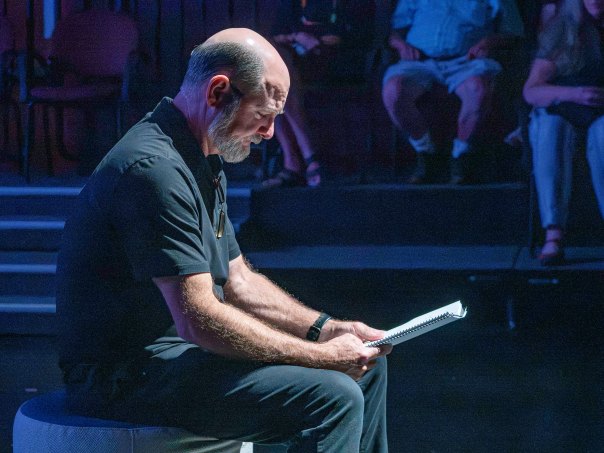
Before the news broke about the extra Evita performance, we returned to the Wildcats campus to usher in the summer – and celebrate Father’s Day – with Common Thread Theatre Company’s Beginning at the Beginning. Staged at the Cunningham Theatre Center, B @ the B was a miniature new play festival showcasing two works-in-progress with an intermission in between and a talkback with playwrights Brian Daye and David Scheonfeld afterwards.

This time, the trip up I-77 wasn’t quite as rewarding. Daye’s one-act, The Race, directed by Eric J. Little, was the better of the two pieces: more compelling action, fuller characterizations, and high-energy performances. Shawn Halliday portrayed the overtly racist Lavell Anderson, on death row as a convicted murderer awaiting execution, while Vanecia Boone was cast as his eleventh-hour appeals attorney, African American cub lawyer Cory Williams, understandably reluctant to take the case.
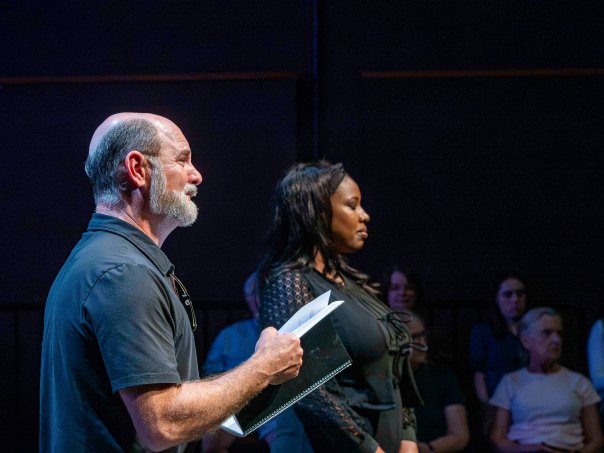
The two shrunken timeframes, the impending execution and the brevity of Daye’s script, short-circuited any racial animosities that may have clouded the budding attorney-client relationship between Cory and Lavell. He had undergone a religious transformation, and she, with even greater speed, is convinced of his innocence.
Worse, the case against Lavell, whether 19 years or three months old, is so laughably flimsy that it should never have been brought to court – unless the charge had been armed robbery. Lavell maintains that his accomplice, Vern McCluskey, was the trigger man and that he never fired his gun. Criminology or Forensics 101 are not prerequisites to knowing how Lavell’s assertion can be confirmed: anyone who has read a Perry Mason novel – the series began over 90 years ago – is aware of scientific tests that match a bullet with a gun and determine whether a person has recently used a firearm.

Open and shut. We also liked Isaac Hampton as the big, bigoted prison guard.

Scheonfeld’s Massage Group Therapy was even less fully developed and, consequently, less satisfying. Aside from a creep named John who bedevils at least half of the four masseuses, none of the playwright’s people were sufficiently fleshed out. It was a little awkward to see Justin Peoples as John upstaging the exploited women we’re intended to care about.

Even if Scheonfeld had made his massage parlor workers more distinctive, there would have been another tall obstacle to overcome for me. Switching roles from female lead to director, Boone did not insist that her players – or the dude reading stage directions – speak loudly enough to be heard.

B @ the B hits the road for its concluding weekend, resurfacing at North Carolina A&T University on June 27 and 28, up in Winston-Salem. For the time being, the more rewarding trip is to Davidson for the resumption of the Community Players’ Evita.

As for Winston, best to wait for the International Black Theatre Festival, July 27 through August 1. Charlotte’s own BNS Productions will be among the many fine Black companies there, presenting four performances of August Wilson’s Joe Turner’s Come and Gone, afternoons and evenings on July 31 and August 1.

“Flip” Is Charlotte Ballet’s New Lab and Launching Pad

By Perry Tannenbaum

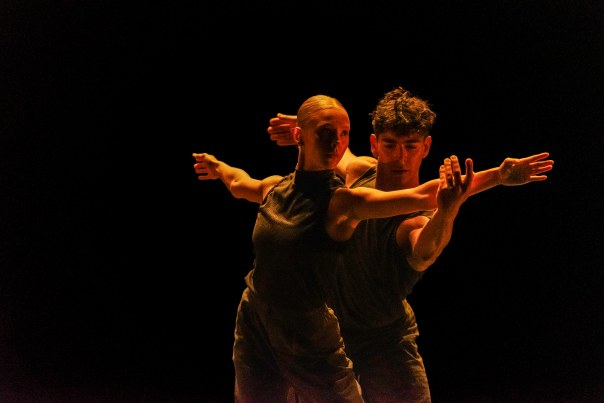
Whenever you see a Charlotte Ballet performance at Knight Theater or the mighty Belk, you’re going to see talent, grace, athleticism, imagination, and dancers in abundance. At the McBride-Bonnefoux Center for Dance, however, only the first three of those wondrous plenitudes are guaranteed. Formality is loosened. Scale is often reduced. And over the past few years, Charlotte Ballet’s season has concluded with evenings of homegrown choreographies by members of the troupe, many of them new to the art.

The title of these venturous, experimental evenings has evolved from Choreographic Lab, when Hope Muir established them in 2018, to the current Flip – as in flipping the script – when Alejandro Cerrudo took over as artistic director. Moving from the big venues to the double-studio layout of the McBride-Bonnefoux, one studio accommodating the audience and the adjacent studio (partition opened) serving as the dancers’ stage, you feel like you’ve abandoned Broadway for a black box.

But without sacrificing the swank factor: the façade and lobby of the Center for Dance are more like a modern museum than a ballet school. So there’s an elegant patina layered onto the funky ambiance of briefer, smaller budget pieces, often reduced to solo performances or pas-de-deuxs. You might expect two or three pieces at most before an intermission at the Knight or Belk Theater. This year at Flip, there were nine, with five more in the lineup after the break.

So you can conclude that, among the 20 dancers in the Charlotte Ballet troupe, 70% can now affix the profession of choreographer to their résumés. Not quite. At this year’s Flip, members of the secondary Charlotte Ballet II troupe also participated in performing and choreographing the program. Six of the eight CB2 members profiled at the charlotteballet.org website danced in the program, with David Anthony Scheuerman-Saucedo also among the choreographers.

What happens behind the scenes must be a fascinating process, as the dancers choreograph for their comrades, teaming up by preference, negotiation, or random assignment. Two lighting designers, Jenni Propst and Rick Moll, split the 14 pieces between them, another negotiation or lottery.

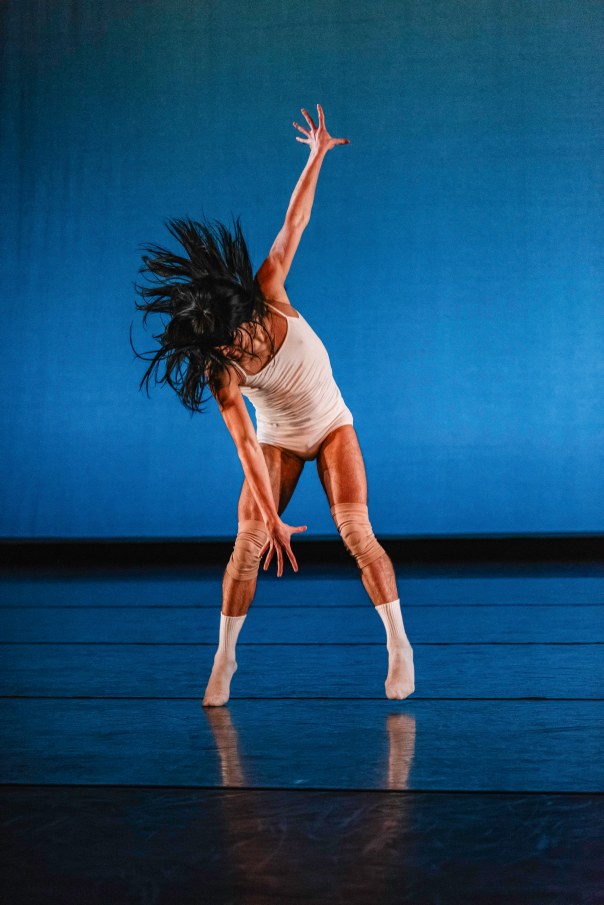
Normally, two solo dances would be two too many for me. But at Flip, Raven Barkley’s “Groove” and Clay Houston’s “Nuit tombante” both transcended the norm. Set to Jackie Wilson’s cover of “(Your Love Keeps Lifting Me) Higher & Higher,” Barkley’s choreography put little demand on her athleticism and was hardly unique. She was: lithe and charismatic in a vivid red dress.

In a sense, Houston’s piece wasn’t a solo at all. When night fell, he not only switched soundtracks, he also switched genders, discarding a wig and assorted paraphernalia and becoming more himself. At first, the transformation hit me as surprising and comical, but the mood – and the choreography – deepened and became touching.

Between these two solos, two of the best duets were programmed: Anna Owens’ “That’s all” and Adriana Wagenveld’s “Tethered.” Owens’ piece, set to a couple of non-Tiny Tim versions of “Tip Toe Thru the Tulips,” actually offered a rather comical reason for all the tiptoeing. At the climax, Owens in the female role gets Oliver Oguma to assist her in reaching a tulip that dangles temptingly from above. That’s when the “That’s all” came into play, as Owens departed instantly afterwards, without according Oguma the thanks he deserved.

Oguma, in the comical spirit of the music, looked more bewildered than pissed by the brush-off.

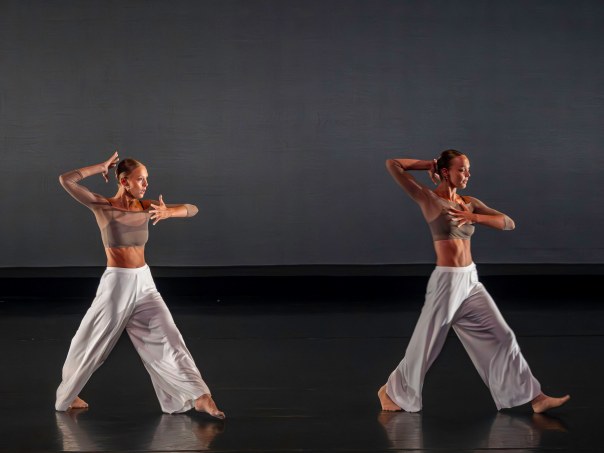
Wagenveld spliced two favorite Sebastian Plano tracks together for her soundtrack, recruiting her sister from CB2, Serafina Wagenveld, to join her in the project. Fortunately, Adriana’s tethering concept isn’t carried out literally. Though neither of their bios suggests that the siblings are twins, the matching costumes for the piece only encouraged that conjecture.

At times, Plano’s minimalist style seemed mated with the Wagenvelds’ walk-like-an-Egyptian grace and their stolid serenity. The sisters’ intertwinings, beautifully timed and carefully composed, might also take on a hieroglyphic look. Their costumes were sleek and timeless, sheer taupe tops with tight half-sleeves – think nylons – over flowing white slacks.

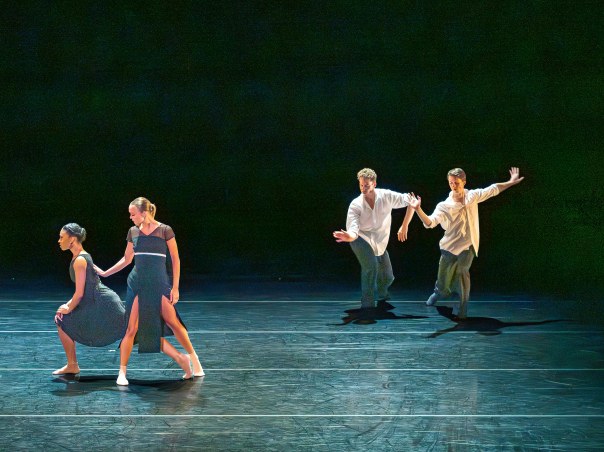
Two other duets stood out for me. Rees Launer’s “Kinetikos” was appropriately pulsating and percussive in opening the evening, set to a mashup of a couple of Aphex Twin tracks for Scheuerman-Saucedo and Serafina Wagenveld, growing more lyrical and nostalgic when the music transitioned to an Emile Mosseri piece. Most unique of all, perhaps, was Isaac Aoki’s “Topaz,” set for himself and Remi Okamoto to Mark Izu’s “Mermaid in a Silent Sea.”

With Aoki’s videography, we were taken more explicitly to desert lands in “Topaz” than we were by “Tethered.” The torrid climate fit hauntingly with the plodding tempo of the music, caravan-like when the whining Japanese shakuhachi dominated. Or the flute. Or the bass clarinet. The loneliness of the dark-clad Asians contrasted starkly with the sun-drenched hilly terrain, justifying that whining sound. Unlike “Tethered,” there was little connection at first between the two dancers. The piece was the antithesis of festive – until the tabla began to bubble underneath, gradually emerging and quickening the pace.

Of the remaining pieces, I found that the love-triangle narrative shape of Scheuerman-Saucedo’s “you and me and me and you” overcame my misgivings about listening to yet another setting to Jules Massenet’s “Meditation from Thaïs.” Although Part 1 of Mario Gonzalez’ “Fever Dream” struck me as a generic piece for four dancers, never once reminding me of Geppetto’s search for Pinocchio (let alone “Chapter 35”), Part 2, “25%,” enabled Stephen Myers to deliver one of the most vivacious solos of the evening, set to “Orchestra” by Labrinth.

Both his costume and charisma rivaled Raven’s. Nor was “Chapter 35” a waste, for it prodded me to investigate the insane “Big Hammer” video by James Blake. A cinematic masterwork!

You may disagree, but discovering new music is a key part of the adventure that Charlotte Ballet’s labs or Flips has to offer me. That was not the case with the closing offering of the evening, Maurice Mouzon Jr.’s “Ne Me Quitte Pas,” set to the Nina Simone recording. It’s been done before – and before that.

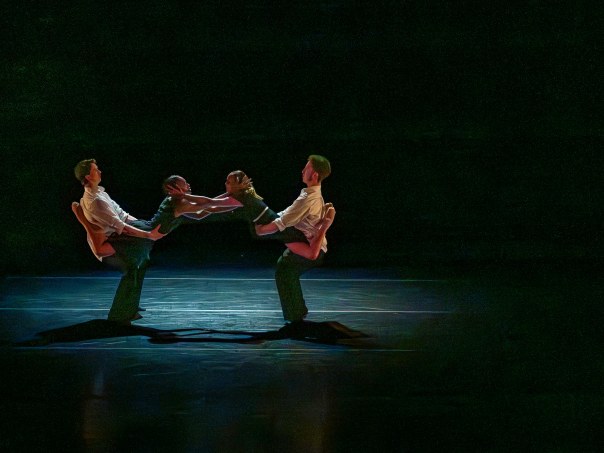
Mouzon’s setting, for four dancers, doesn’t stop at the threat of separation. It crosses over into the agony of it when it happens. So two couples is the right choreographic choice, for Mouzon allows ample opportunities for the two women, Barkley and Adriana Wagenveld, and the two men, Launer and Luke Csordas, to suffer and commiserate with one another in alternating segments.

Nor does Mouzon send the women off, an annoying choreographic tic, when the spotlight shifts to the men. Instead, he freezes them in a sad attitude while Moll dims their light. Why should they be out of sight if they’re not out of mind? Since the Simone track peters out in pitiful pleas, seemingly repeated after being irrevocably denied, Mouzon can only offer us a wan hope of reconciliation.

Hugged from the rear by their partners, their legs bent and suspended in air, Barkley and Wagenveld reached across the void between them and embraced with their arms fully extended, forming a poignant bridge. What a wonderful closing tableau.

Newsflash: Printedprograms for Flip and Charlotte Ballet’s previous show, One Thousand Pieces back in early May, contained announcements of the company’s 2026-27 season and a slate of touring engagements, an exciting new dimension for the troupe. A couple of new developments since Flip concluded its run on June 20.

The company has already appeared at the American Dance Festival in Durham for the first time since 2017, bringing with them a work by Israeli choreographer Ohad Naharin once again later in June. Then, less than a week ago, they fulfilled their promise to add to their announced touring dates.

Newly augmented, here’s the slate:

  • Sept. 25-26, 2026: Ballet Bend – Fall Dance Festival (Bend, OR)
  • Oct. 29-30, 2026: Brooks Center for the Performing Arts at Clemson University (Clemson, SC)
  • Nov. 7, 2026: Dance Cleveland (Cleveland, OH)
  • Jan. 27-31, 2027: The Joyce Theater (New York, NY)

The 2027 rendezvous at The Joyce Theater will be the first time Cerrudo has brought them there during his tenure. Jean-Pierre Bonnefoux, who died in the spring of 2025 at age 82, was still the artistic director when the company last wowed New York audiences at The Joyce in 2004. Ten years later, he would rebrand his troupe, but back then, they were known as the North Carolina Dance Theatre.