Review: The Revolutionists @ Warehouse PAC
By Perry Tannenbaum
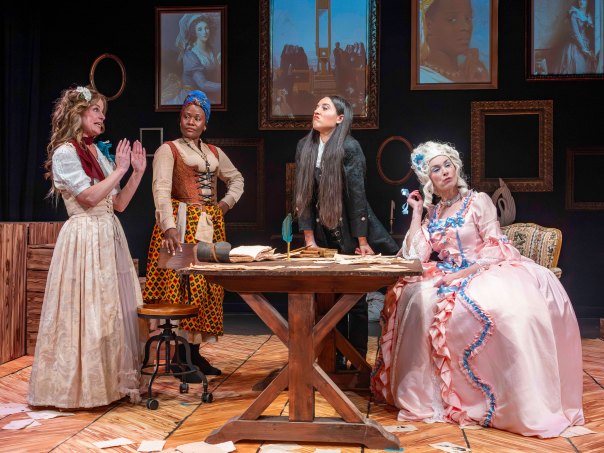
Badass. That’s how Lauren Gunderson describes all the women in her feminist fantasia, The Revolutionists. On the heels, high and low, of the touring edition of Suffs that premiered at Belk Theater, the Warehouse production of Gunderson’s 2016 script – with a second all-female cast in the same week – underscored one of the subtler achievements of the suffragists who aided the passage of the 19th Amendment 96 years earlier.
Men and women now openly admire all these badasses and cheer them on!
Cheers and laughter were high among Shaina Taub’s aims when she wrote and starred in Suffs as revered feminist Alice Paul. Gunderson feels compelled to diligently remind directors and actresses who bring her historical script to life that this is a comedy. Since all of her women are living during the apocalyptic Reign of Terror in 1793, midway through the French Revolution, the shadow of the fearsome guillotine looms large.
None of them supports that notoriously bloody revolution.
Charlotte Corday, the most badass, actually embraces the guillotine, the likely consequence of her intent to assassinate Citizen Marat, the radical newspaper influencer. Calling for the same liberté and égalité in her native Caribbean that have toppled the monarchy in Paris, Marianne Angelle, a free black spy, hopes to skirt the guillotine while opening the eyes of the Revolution to the hypocrisies of slaveholding and continued colonial power. And Marie Antoinette, “less badass” than the others, is desperately fleeing the chopping block, hoping to rebrand her clueless, free-spending, and heartless reputation on the fly.
They all converge on the feminist playwright of the day, Olympe de Gouges, in urgent need of her eloquence. Corday has the simplest need: a memorable exit line to proclaim at the scaffold, one that will resound for eons to come. Marianne could use a sharply worded manifesto – with a soft touch – that furthers the cause of her homeland. Marie merely needs a total rewrite and makeover: redemption, whether or not she deserves it.
What a godsend de Gouges is! When we first saw the comedy in 2018, produced at Camp North End by PaperHouse Theatre, it was easy enough to see Olympe as a rather transparent surrogate for Gunderson, shaping the comedy she ostensibly tailors for Marie. Directing that production, Nicia Carla decreed that her Olympe discard her quill in favor of an anachronistic BIC ballpoint, letting us perceive Gunderson’s guiding hand throughout.
Historically, it’s even more complicated: de Gouge really wrote a comedy in which she, a character in her own play, taught the downfallen Queen Marie a lesson. She also penned a manifesto, the courageously feminist Declaration of the Rights of Woman and the Female Citizen, punching her ticket to the scaffold. From that perspective, it’s possible to see her, quivering and quailing here as she crafts her Reign of Terror comedy, as the inspirational fountainhead of Gunderson’s fantasia.
With no less than four subtitles: A Comedy, A Quartet, A Revolutionary Dream Fugue, and A True Story.
At the Warehouse Performing Arts Center up in Cornelius, director Reneé Welsh-Noel mutes the anachronisms and the wink-wink meta approach until late in the second act, when Gunderson explicitly decrees that the fourth wall must be broken. Welsh-Noel and scenic designer Chris Tyer utilize the larger space and richer theatre resources at the PAC to offer the playwright’s quartet multiple platforms to declaim, orate, stab, and achieve martyrdom.
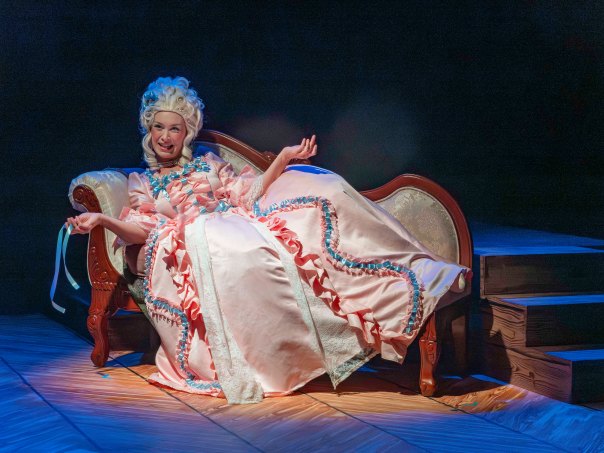
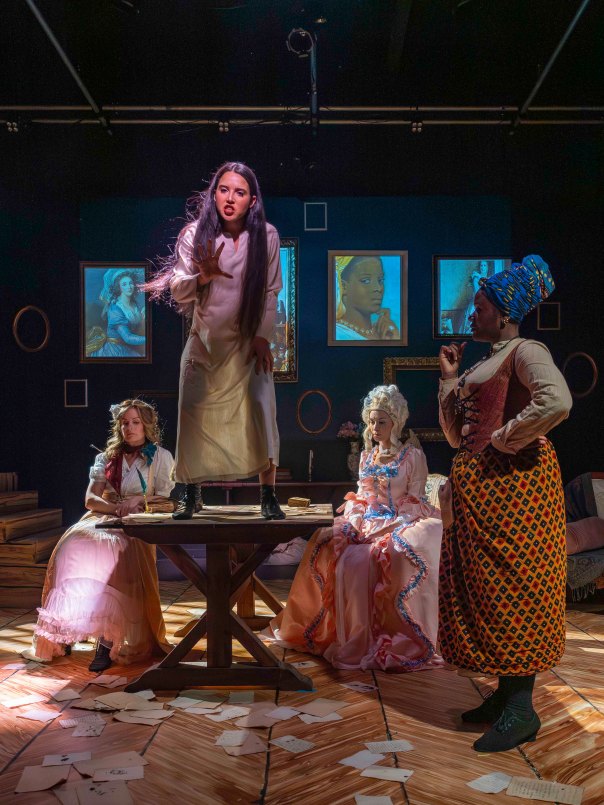
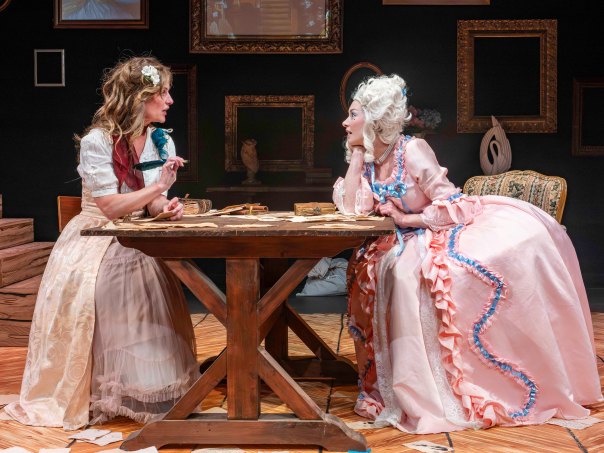
One of these doubles as de Gouge’s desk or, if you will, the table in her salon. A glorified picnic table, to be honest. Even her highness deigns to sit herself at this humble furnishing, but a legit settee looms further upstage for Marie’s more regal lounging. Assuring fluidity between scenes, the remaining scenery is sparse: a jut of a snub mantle on the back wall, with a scattering of ornate picture frames.
Except four projections from Jessica Zingher, most of the other frames are blank. They all seem to float apart from the action, though they are preternaturally relevant – like a gallery of images in Gunderson’s mind or her surrogate playwright’s. Making the space more emphatically Olympe’s, sheets of writing paper litter the high-concept floor, a multitude of testimonials to her pathological writer’s block.
Maybe Tyer’s concept mystically correlates the excess of strewn paper below with all the jet blackness inside the empty frames above.
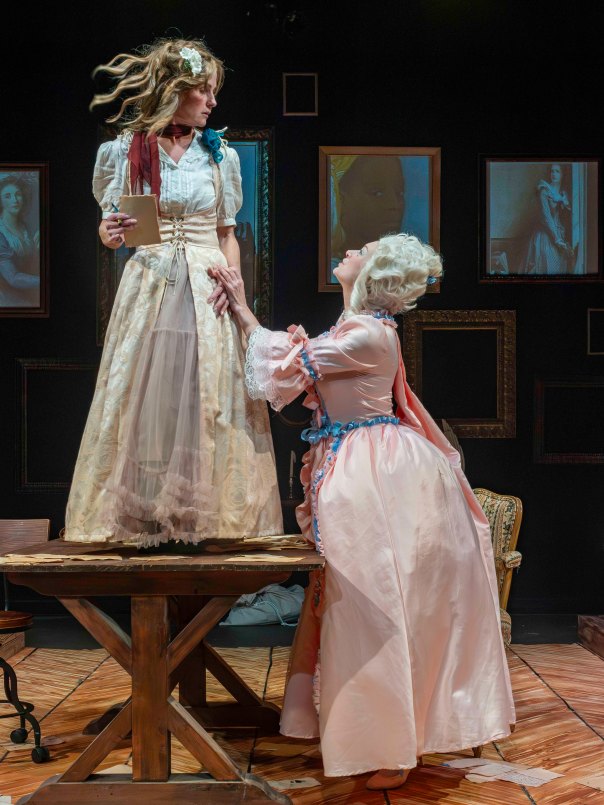
It certainly testifies to the intensity of action from Olympe that yields such a welter of messy futility: the frenzy of the times. Welsh-Noel seeks to keep a vortex of swiftly paced action swirling throughout the evening, spreading her actors across the wide space, amplifying confrontations, with them threatening and lunging at each other. Tension and urgency remain ridiculously high under the shadow of the guillotine. Like a comedy.
Costumes from Welsh-Noel and Zingher add spice and flair, flouncy and beribboned for Marie and continental ninja for Corday. By contrast, Angelle’s outfit pops with Afro-Caribbean color and style, an equally bold statement.
Brave as Olympe may have been in real life in her attempts to champion women’s rights and to reconcile the radicals with the royals, Gunderson infuses her inspiration with her own trepidations over putting your life on the line with your plume. So it’s an ambivalent and bumpy ride for Lisa Schacher as Olympe, one that alternately accentuates the comedy and drama, both of which would suffer if Gunderson’s concoction were more sure of herself.
Jennifer Adams is mostly at the comedy end of the spectrum as the deposed, soon-to-be decapitated Marie: too vain to skulk through the streets in disguise, she materializes in Olympe’s parlor, announcing her own entrance and assuming everybody is talking about her. Yet Gunderson allows her dopiness to vanish at times, giving way to clairvoyance at her brilliant moments and allowing Adams to display maternal feelings – to Marianne, of all people.
Her most charming moments perhaps come when Adams puts aside Marie’s regality and snobbery to become rather childish in her candid enthusiasm, the glue in the quartet’s sisterhood. Sororité!
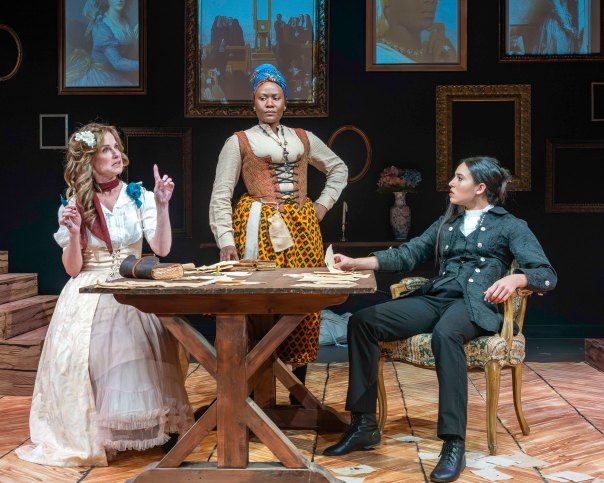
My chief difficulties with this production came from the eternally serious women, Jane Elvire as Marianne and Marissa Dibilio as Charlotte – though each of them lands a barb or two at the lighter women’s expense. Likely because of her authentic Haitian roots, it took me a few minutes to attune myself to Elvire’s lilting accent, with a couple of relapses later as Marianne’s actions and words become more urgent.
With her bounty of natural dignity and presence, Elvire is exactly what Gunderson had in mind when she described her as “the sanest of them all.” Whether through instinct or through diligent research into Marianne’s historical parallels, Gunderson burdens the free Caribbean black woman with the most adversity to deal with. Ultimately, her sufferings help the playwright pierce Marie’s silly, frilly façade in some of the quietest, most human moments of the evening.
From a dramaturgical standpoint, Dibilio’s dashing outfit may be Welsh-Noel’s most audacious decision. Dressed like that, you multiply your chances of not being admitted to Marat’s bath by his servants and bodyguards. But it helps Dibilio look the part, though paintings of the famed assassin, in action or brooding at the Bastille, opt for more conservative clothes.
At times, Dibilio falls into the trap of sounding too natural in her gripping performance, lowering her voice when she gets really close to other players. When we can hear her, she’s quite compelling.
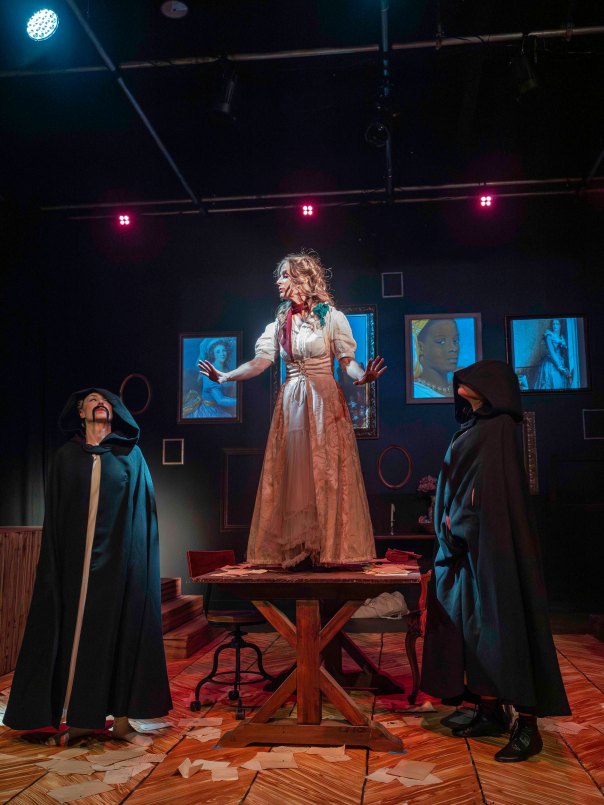
From the opening, when we hear a falling guillotine and Olympe’s first words are “Well, that’s not a way to start a comedy,” we’re clued in to Gunderson’s aim to mess with us. Talk about audacity, she’s serving us notice that she’s presenting a comedy that writes and rewrites itself before our eyes.
That’s not really possible, is it? But what The Revolutionists accomplishes is nearly as impossible: reminding us that, in horrendously troubled times, the noble words and actions of our finest writers and activists will certainly outlast tyrants, bigots, and bullies. While making us laugh between bloody plunges of the guillotine.

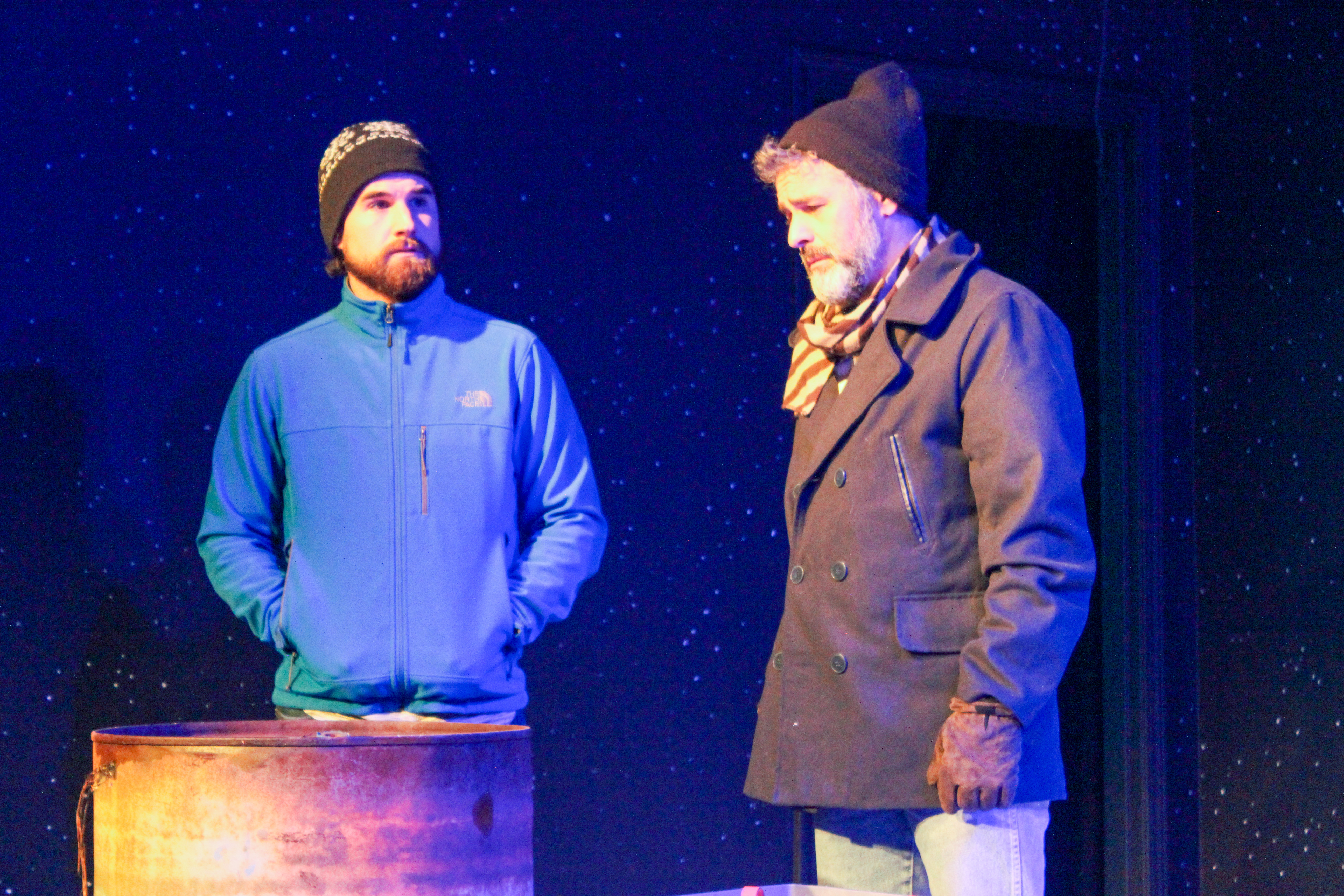
 They are also pathologically serious, intense, and straightforward. Late in the action, Betty will take great satisfaction in bursting Tor’s “irony cherry.” Nor is there homespun solidarity between the carnivores that Betty has recommended to Olive. Every now and then, Tor will throw the fact that Gus is only half-Norwegian in his face.