Review: Gershwin & Bernstein @ Belk Theater
By Perry Tannenbaum
April 24, 2026, Charlotte, NC – An evening of music by George Gershwin or Leonard Bernstein can be many things: pop, opera, orchestral, cinema, or a good old Broadway musical. Gershwin wrote a staggering 18 musicals, though he only lived 38 years, twice as many as Bernstein, and most of them are forgotten. Programming these giants at Charlotte Symphony, with musical director Kwamé Ryan at the podium, certainly narrows the options, especially for Gershwin, since Ryan usually confines himself to Symphony’s Classics series and special events. Bernstein is credited with more than twice as many orchestral works as Gershwin, and among his choral works, a genre Gershwin never touched, are numerous sacred options for Ryan and the Charlotte Master Chorale to choose from.
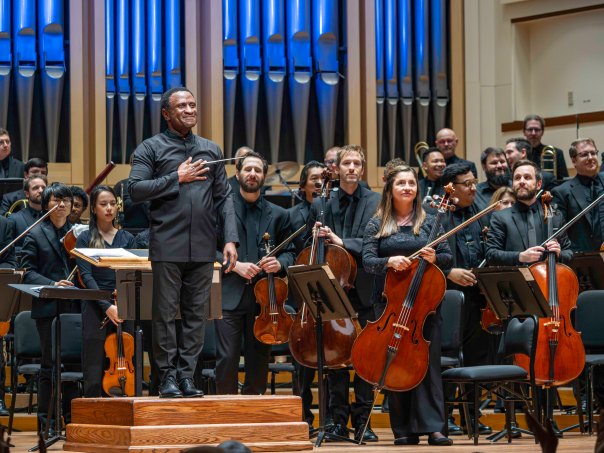
The unifying theme Ryan chose at Belk Theater for his Gershwin-Bernstein pairing was star-crossed lovers, allowing Symphony to dig into the composers’ most-acclaimed works, Porgy and Bess and West Side Story, respectively, at a deeper level than a greatest-hits medley. But first, Symphony set the theme in a most intriguing manner, with a Fantasia for Orchestra, Romeo and Juliet, by Johan Severin Svendsen (1840-1911), a Norwegian composer I’d never heard of. Editions of NPR’s and Gramophone Magazine’s guides to classical music on my shelves omit him, while three others – Oxford, Penguin, the DK Eyewitness, and my ancient International Cyclopedia of Music and Musicians – all give him a paragraph.
Finding this piece would have been a waste if Ryan and his ensemble hadn’t given it such punctilious rehearsal. The prep to me was as impressive as the performance. Not only were there sudden or gradual shifts in dynamics as the piece flowed between lyrical and turbulent episodes, but there were numerous gradual shifts within the turbulent episodes where both the string and woodwind sections remained tightly in sync. There were at least four quiet sections, which didn’t seem to be sketching a narrative concept.
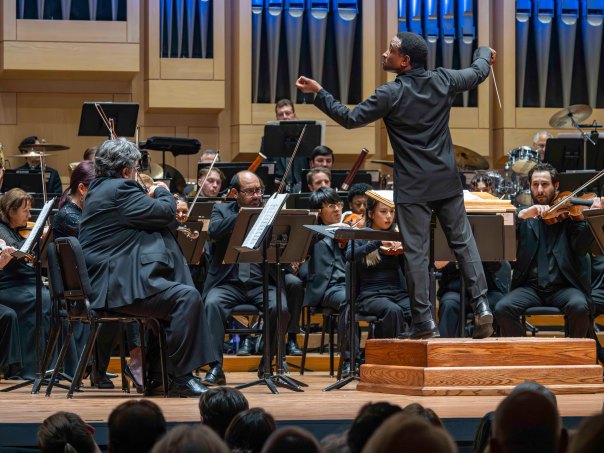
Was the end of the dreamy, opaque first episode, a gentle series of pizzicatos, an evocation of the famed balcony scene? As the slow-fast shuttling continued, with turbulent episodes marked by a sudden braking with a brief French horn lament, a repeated whimpering of strings, and finally a weary bleat of pizzicatos from the double basses, it was possible to entertain the idea that Svendsen was offering a dialogue between his protagonists, or back-and-forth character sketches.
The mournful edge to the concluding section swayed me back toward hearing Svendsen’s intentions as narrative, but we would need to hear the whole piece again to appreciate how well the last turbulent section had evoked the climactic double suicide of the newlyweds. By comparison, the Porgy and Bess: A Symphonic Picture, arranged by Robert Russell Bennett, is easily perceived as an extended overture in medley form. Depending on how well you know the opera, you will likely be able to identify the next song as it clears the distant horizon. These include “Summertime,” “I Got Plenty o’ Nothin’,” “Bess, You Is My Woman Now,” “Oh Lord, I’m on My Way,” “There’s a Boat That’s Leaving Soon for New York,” and “It Ain’t Necessarily So.”
For those already familiar with Gershwin’s own P&B suite, Catfish Row, you may be doubly reassured. It was unquestionably Bennet’s starting point, recycling the percussive opening and preserving a winsome banjo interlude. The piano cadenza, likely reserved for the composer’s hands, is gone, but Bennett is more conscientious in including audience faves, though “I Loves You Porgy,” “A Woman Is a Sometime Thing,” “It Takes a Long Pull to Get There,” “A Red-Headed Woman,” and “My Man’s Gone Now” are still MIA.
Like many others in the house, I presumed that the Porgy and Bess would be the evening’s highlight, since so many jazz greats have covered both the entire opera and the golden songs embedded within. But even though Bernstein put even fewer of his hits in his Symphonic Dances from West Side Story, it seemed that Ryan and the Symphony, no doubt buoyed by the phalanx of six percussionists across the upstage wall, played the Spanish Harlem classic with even more zest than the music rooted in the Carolinas.
Of course, with the opportunities for finger snaps, the whole orchestra could join in on the percussion orgy, and in the Suite’s fourth movement, “Mambo,” they got to shout out the title on multiple occasions. The ration of signature melodies was severely restricted, leaving “America,” “Tonight,” “I Feel Pretty,” “Something’s Coming,” and “A Boy Like That” off the menu. “Somewhere,” a little ballet to begin with, and the finger-popping “Cool,” promoted here to a Fugue, got fuller treatments to make up for the omissions. And the glorious “Maria”! We got to hear a full rhapsodic version and the deliciously delicate Cha-Cha version. With softer finger snaps.
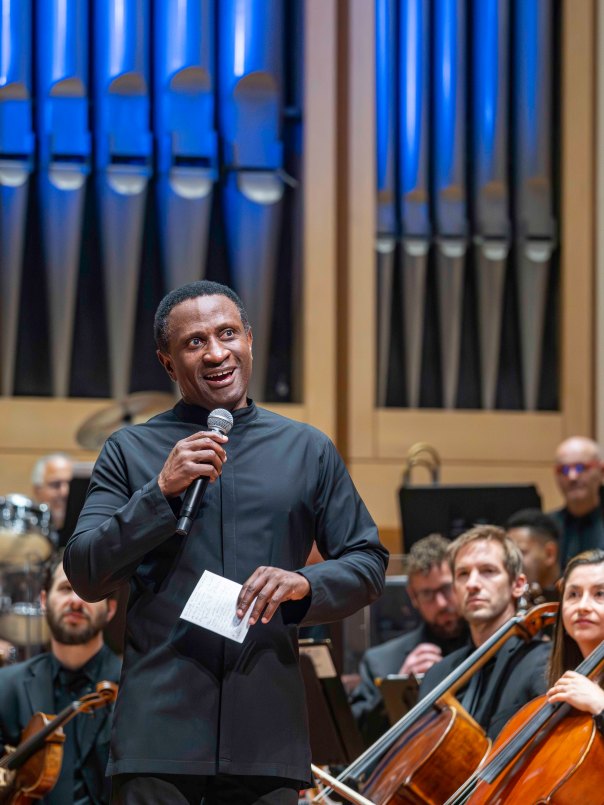
Then the surprise from our maestro, who had every right to be fatigued after busting out so many moves leading the Bernstein. Reasoning that a funeral isn’t a good way to send us home, even at the tail end of an evening devoted to tragic lovers, Ryan announced a more festive Jamaican encore. Eleanor Alberga’s “Celebration Dance” from Snow White and the Seven Dwarfs was a danceable dessert.


