Even if you’re as forgetful as I am, certain signature moments of an immortal classic will stick with you for a half century or longer once you’ve read them. In F. Scott Fitzgerald’s The Great Gatsby, it’s the indelible image of Jay gazing across Long Island Sound from his mansion to the distant estate of Tom and Daisy Buchanan on the opposite shore. Then there’s the last line of the novel, “So we beat on, boats against the current…,” mercifully quoted in erudite discourse less often than the opening lines of Moby-Dick or Pride and Prejudice – but often enough for it to linger in memory.
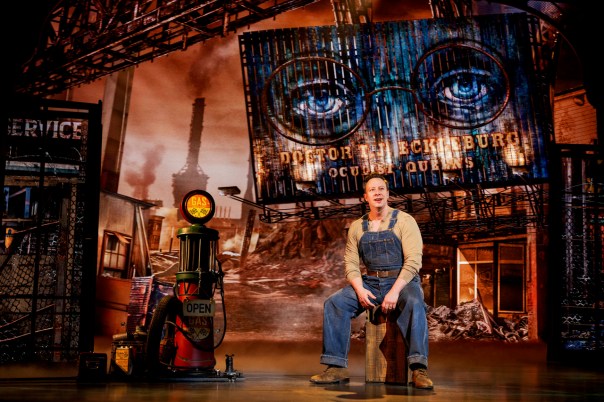
Most pleasurable, perhaps, are the buried treasures: moments you’ve totally forgotten until they are resurrected by the first mention or evocation in decades. There’s the great optometrist billboard looming over George Wilson’s grubby gas station. Another such diamond lies hidden until narrator Nick Carraway shouts out what becomes his farewell tribute to Gatsby, “You’re worth the whole damn bunch put together.”
Sadly, what is so profoundly wrong with Kait Kerrigan’s adaptation of Gatsby, not salvaged by Jason Howland’s score or Nathan Tysen’s lyrics, crystallized for me in that suddenly familiar moment. At Charlotte’s Belk Theater, where the touring show lingers through Sunday, it is so painfully obvious that Gatsby outclasses the Buchanans from the beginning of Act 1 that he hardly needs to appear.
Nor were there compelling reasons to remain interested in the Buchanans. Will Branner as Tom is so nasty, negative, and noxious that you wonder why Daisy hasn’t run from him screaming years ago. For her part, Senzel Ahmady sings too many high notes on too many moribund power ballads without projecting more than an intensely vague anguish.
Yes, her dear Tom is an asshole, but life in her little palace, waited on by a private maid who frees her from the annoyance of parenting, is far from a horror. That’s about all you can say about this Daisy. As for Leanne Robinson as her bestie Jordan, you’ll be hard-pressed to discover whether she’s a champion golfer or a dreary duffer. Her stylish skepticism is certainly up to par. We seem to be shown this whole damn bunch with the assumption that we already know them.
With Paul Tate dePoo III’s mix of scenery and projection design, and Linda Cho’s costumes, the look of this Gatsby is always stylish, able to withstand Cory Pattak’s lighting excesses, which have a bit of a Vegas lean. In fact, the opening tableau, an epic view across the water, with its distant shore dotted by the lone green light at the end of Daisy’s dock, yields intriguing foreshadowings of the orchestrations to follow.
Cued by the gilt flavors reminiscent of Sunset Boulevard and Grand Hotel, we’re likely expecting a moody, bluesy decadence. But Kerrigan and Howland give such impulses little more than a passing nod. The blizzard of high notes from the upper set is only punctuated by the elevation of Meyer Wolfsheim, reputed fixer of the Black Sox World Series, into a semi-awesome sinister force.
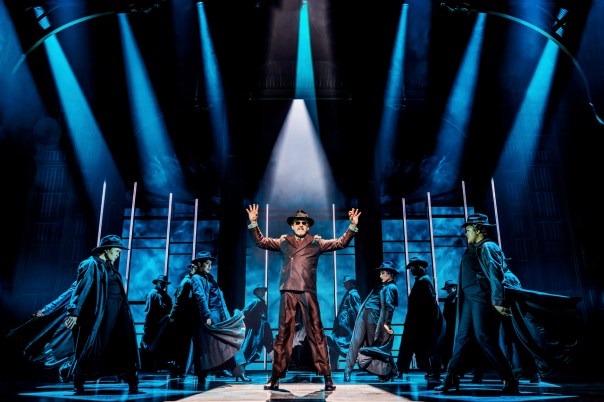
This notorious bootlegger gets the satanic majesty treatment at the top of Act 2 when Edward Stautenmayer and company launch into an overwrought “Shady,” seemingly staged in Vegas or a parallel Art Nouveau netherworld. When Wolfsheim reappears at Wilson’s filling station, overseeing a shipment of bootleg booze, Stautenmayer suddenly diminishes into a rather humdrum mob boss, though he can wield an ostentatious cigar at a Gatsby soiree during his leisure hours.
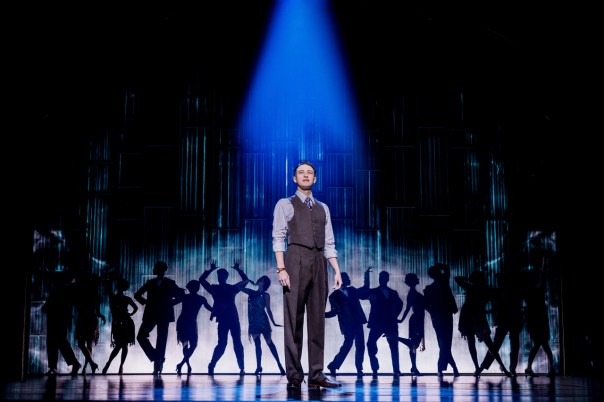
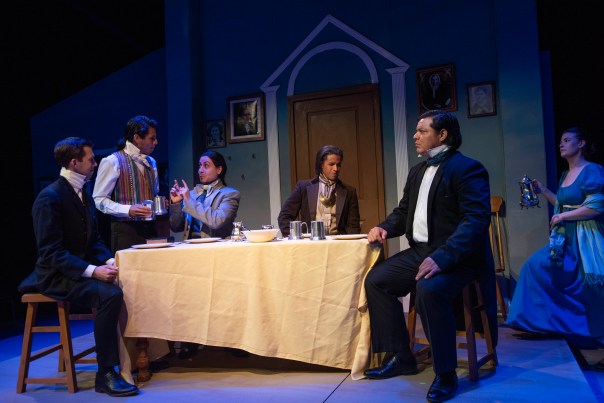
Effortlessly, Jake David Smith as Jay and Joshua Grosso as Nick rise above the crooks, the lowlifes, and the filthy rich – though Gatsby’s riches may not be driven snow. Without any patrician airs beyond his habit of calling people “old sport,” Jay’s role is not conspicuously plumier than Nick’s. Or it wouldn’t be if Grosso’s “Roaring On” didn’t quickly devolve from its bluesy beginning into a mess of storytelling and Broadway spectacle.
By the end of that opening song, Nick has arrived in Manhattan from Minnesota, lucked out on an $80-a-month cottage on the Island, seen his mysterious neighbor reaching toward the opposite shore in iconic silhouette, and received an invite to Gatsby’s next “little party.” So much for moodiness and atmosphere: the whole world seems to be a party.
In reality, it’s Smith who lucks out, since Gatsby draws the two most memorable and focused songs in the show, “For Her” and “My Green Light.” He also gets to ham up the best comic bit, stressing out as Gatsby readies to ambush Daisy during her upcoming visit to Nick’s cottage. All the decorations and the servants scurrying around are too much, yet so cute. Smith’s preadolescent panic is cuter.
The whinings of the Wilsons are somewhat better scored by Howland. The slime-pit scenery by DP3 paired with Choo’s costumes – grubby for Tally Sessions as George, squalid for Lila Coogan as Myrtle – supply the Buchanans with cringeworthy depths they have risen above. It’s also the best lens for viewing the residents of East Egg with admiration. From his balcony at West Egg, Gatsby can only look across the water toward a solitary green light with a futile longing.
It should be easier to emphasize with Jay than it was at Belk Theater. Wednesday’s night muddy’s sound – and a fifteen minute pause for technical difficulties – further impeded the flow.
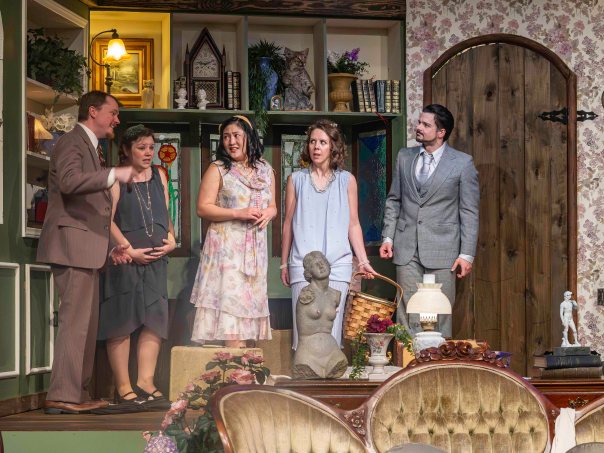
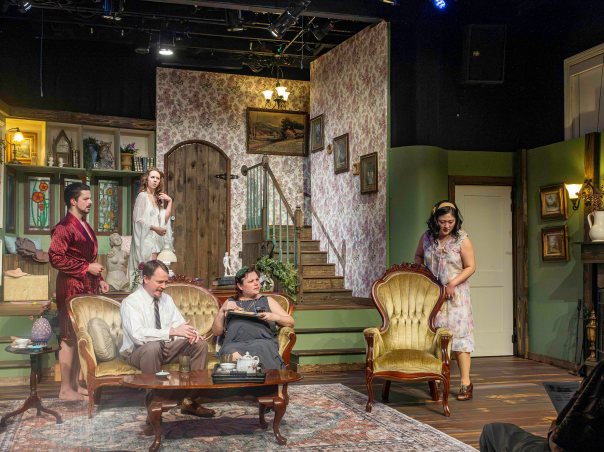
Davidson, NC – One of my late mother’s favorite Yiddish words, ongepotchket, sprang immediately to mind as soon as we walked into the Armour Street Theatre for the local premiere of Sandy Rustin’s The Cottage. Our first glimpses of Kate Baker’s scenic design had that unique tang. Gaudy. Cluttered. Colorful. Ornate. Massively overdone. Impossibly baroque.
That impression only magnified at the other end of the hallway when more of the rusticated clutter of this latest Davidson Community Players production came into view. It deepens further once the farce begins, for in addition to a stairway, two downstairs exits, and an upstage front door, Baker has crafted an invisible entrance that will eventually come into play – and cunning little crevices where Rustin’s characters, all but one of them acquainted with the cottage, will reach in and fob cigarettes.
It’s Monday, June 4, 1923, some 90 minutes from London by train, and this countryside retreat is the perfect place to be naughty. By the end of the show, I wasn’t sure whether half the budget was being frittered away on faux cigarettes.
Nor could I rid myself of the idea, driving home, that this cottage – which takes on a decisive cameo role in the denouement – was an apt metaphor for this whole amorous mismatched group of Brits.
We likely think at the outset that we should be emotionally invested in Beau, who is carrying out his yearly love orgy with Sylvia, his brother’s wife, and juggling multiple illicit affairs. We’re used to seeing such farces written by men, after all. But Rustin’s brand of farce has different beats, a conviction that women should get equal portions of the cake, and sympathies toward Sylvia, who is clearly getting the short end of the stick.
More than reversing our perspective, Rustin explores love: its levels, vacillations, and simultaneities. You may sour on a partner in her bucolic world, but it is not at all axiomatic that you transition to hating them. Throughout all the crossfire of who’s cheating on who, who’s been keeping secrets from who, who’s been wronged by who, and who’s underappreciated by who, none of the six characters rises to a moral high ground or plummets far below.
Except perhaps the monster in the group, who is arguably the most deceitful.
In a rather amazing coup for DCP, their Cottage is directed by Hanley Smith, who originated the role of Deirdre in 2013 at the Astoria PAC in Queens, NYC, before moving up to the triggering role of Sylvia at Florida Studio Theatre in Sarasota, four years ahead of the Broadway premiere in 2023. Not a far-flung coup, to be sure, since Smith is a Davidson College grad who starred in Actor’s Theatre of Charlotte’s production of The Vibrator Play in 2011.
So whether or not she has directed anywhere else before her DCP debut, Smith quickly establishes that she has a sure feel for this script. From the outset, Julia Howard’s performance as Sylvia was at least as extravagant as the scenery that surrounded her – and the sofa where she rehearsed her most alluring poses. This has been her one-time-a-year sex-capade, and it was obvious that she wasn’t planning for it to end, though Beau’s work week was set to begin.
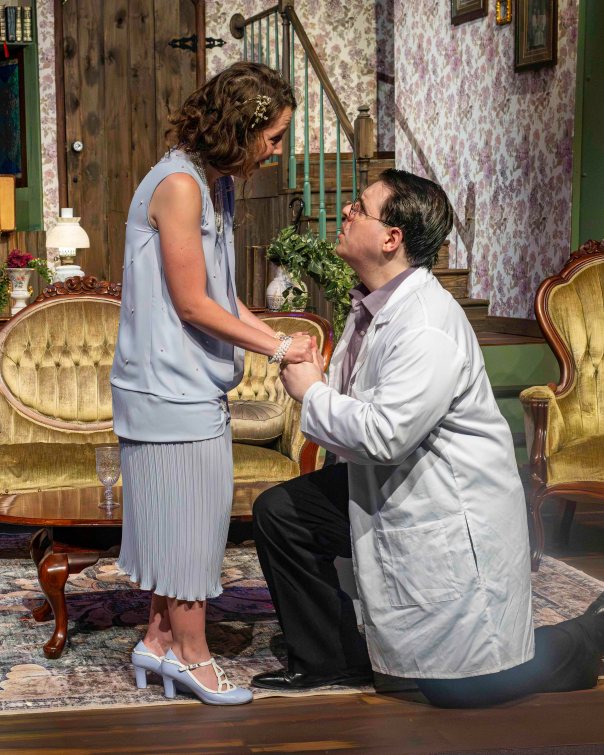
No, no, no. Her plans, executed yesterday evening with a couple of telegrams, are to leave her husband Clark and marry Beau. Thoughtfully, the second wire was sent to Beau’s wife, Marjorie. Part of Sylvia’s kooky charm comes from her not being steadfast in her beliefs or resolutions – a trait that is contagious among Rustin’s creations – for she regrets sending her liberating telegrams as soon as she hears a loud knock on the front door.
Sylvia’s miscalculations will greatly increase Howard’s chances to shine, and still clad in her negligee, she’ll continue to stand out from the parade of visitors. As already hinted, Beau has been busier at the game of love than she anticipated. Ben Allen must merely be “Perhaps the best-looking man in Britain” to match the playwright’s description, so a certain amount of vanity must be coupled with his sexual rascality and his savoir-faire as a deceiver.
When Beau is celebrated repeatedly instead for the beauty of his flaming robe, should Allen act upset? Perhaps not, for Rustin consistently sets aside perfect moments, on the brink of upset or disturbance, for Beau to suggest a cigarette or a spot of tea. Good manners and posture were must-have accessories for Allen’s geniality in the early moments of this unpredictable morning at the cottage. On the spectrum of flappability, he seemed to be permanently perched at the opposite end from Sylvia.
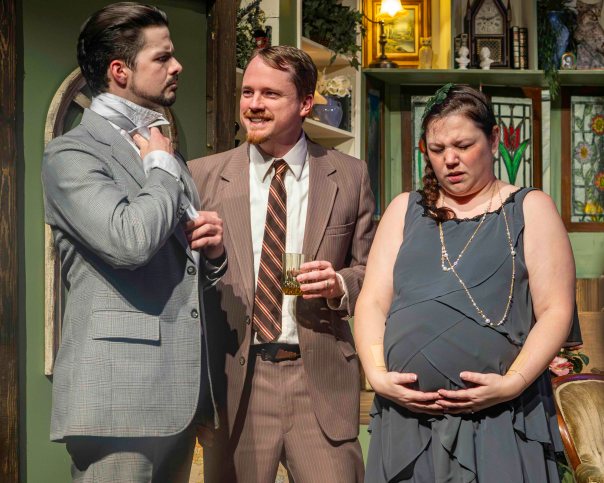
Until he opened the front door, first to his visibly pregnant wife Marjorie and then to brother Clark. Their suspicions have been eradicated by Sylvia’s batch of telegrams. So while it’s unseemly to disclose her hiding place before you see this farce, it’s also unnecessary for Beau to maintain his charade and keep her there.
Sadly, for Amanda Pippin as Marjorie and Andrew Pippin as Clark, neither had the histrionic opportunity to rev up to a towering jealous rage. They have a couple of surprises of their own to reveal. After Sylvia fully digests them, she’s probably correct in thinking that she has more right than Beau to be miffed. Regardless, it was so much fun watching Howard come to that realization and then watching Allen nearly catch up.
The Pippins neatly pull off the trick of being humdrum, wholesome, and deliciously wicked at the same time as their insouciance confounds their fellow adulterers. Nor are they the ones to be ruffled when, one after another, a third couple comes knocking at the door: Cate Jo as the déclassé Deirdre and Andrew Williams as the reputedly murderous Richard.
Like Marjorie, dear Deirdre will have good news and bad news. But nobody seems to react to any news at the cottage in the way the teller anticipates. Howard takes honors as the most thoroughly cheated person onstage as Sylvia, while Allen as Beau, the target of Richard’s wrath, takes cover like all the others. Jo makes for a loopy Deirdre, loopier after guzzling from a gin bottle, and hers turns out to be a rather physical role, what with all the hiding and staggering she must do in varying states of sobriety.
Williams, as Deirdre’s ex, has a past that’s as chequered as Deirdre’s, but all of that came since he and Sylvia last met many years ago. In everyday life, when not boasting of murdering Deirdre’s lovers, he passes for an everyday pharmacist, so the role offers a delicious range for Williams in spite of his late arrival.
To her credit, Sarah Deutsch’s costume designs are only slightly upstaged by the set. If you know who Stanley Baldwin was and his political affiliation, identifying the era of Rustin’s lively farce won’t be a formidable challenge. Otherwise, Hanley doesn’t orient us in either the printed or the digital program. The gorgeous Victrola must be your guide.
But only Rustin is to blame for Richard’s lame excuse for his false beard and mustache, so I’m not blaming anybody at DCP for making these disguises glaringly clumsy. Let the moment pass and richly enjoy the rest. This production is definitely worthy of its pedigree.
When you’re served a verbal soup instead of songs, when smooshed syllables largely replace dialogue, it’s hard to recommend a musical. But when you’re sitting at Belk Theater on opening night as a critic who has covered the beat for nearly 40 years, you just shake your head when Alicia Keys’ Hell’s Kitchen rolls into town and becomes the latest touring show to be sabotaged by an unruly sound system at Charlotte’s marquee venue.
Often after a jukebox musical, I turn to Spotify, today’s most ubiquitous jukebox, to dig further into a spotlit artist’s work during the ride home. It can be Tina Turner if you live in the Queen City, Carole King, Cher, ABBA, MJ, the Million-Dollar Quartet, Frankie Valley, or – looming on the horizon – Neil Diamond. The jukeboxers whet your appetite to revisit the original recordings if you know them or to seek out more if you don’t.
Sadly, the sound booth settings rarely dial in on opening night with the pristine perfection of MJ. So it’s an aspect of production that stands out all too clearly when it does happen. Keys was so ill-served at her QC opening that summoning her on Spotify on the highway served multiple purposes that should be needless: to confirm that original recordings of her hits were more intelligible than what we’d heard live and to learn, besides the notes, exactly what she had written.
The comparative clarity of Keys’ recordings was a relief rather than a surprise. If it weren’t for the stellar performances by Roz White and Desmond Sean Ellington on Keys’ bluesier songs, we could say that more lyrics were clearer on my car’s speaker within my first 10 minutes on the road than were intelligible all evening long at the Belk.
Even if the sound crew got their act together, I had a far more substantial and meaningful revelation as my wheels hummed down I-77 South. Without exception, every song that we heard live that evening sounded better than the hits they covered. Part of the difference was the quality of White’s and Ellington’s voices, as well as those of Kennedy Caughell and JonAvery Worrell, all of whom spectacularly support Maya Drake as Ali, whose story significantly parallels Keys’ hardscrabble upbringing without exactly replicating it.
For me, the bigger parts of the musical’s upgrade are the arrangements by Keys and Adam Blackstone, further elevated by the Tony Award-winning orchestrations layered on by Blackstone and the legendary Tom Kitt. Clear as they may be, Keys’ original recordings struck me as thin and pallid by comparison. Now, 1.7 billion players of “Empire State of Mind” on Spotify and nearly the same following for “If I Ain’t Got You” can’t be dead wrong – nor can the smaller number of voters who won Keys 17 GRAMMY Awards (and counting) – but I’d invite them all to give this touring cast a hearing.
All except Drake are sensational, whose vocals are lithe enough – almost on par with Keys’ – with a quality that might actually be a notch above when she’s not emulating her model. The real problem with Drake on opening night was that, even when she wasn’t tethered to the tempo of Keys’ raps, she still delivered her dialogue at a panicked pace that would have likely remained problematic even if the sound system were optimal.
Disagreements between Drake and Caughell as her white mom, Jersey, looked heated enough, but what they were about was mostly conveyed by listening to mom’s paranoia rather than Ali’s teenage angst. The contours of Kristoffer Diaz’s book never gave me a feeling that its ambitions rose far above furnishing Keys’ songlist with a recognizable framework.
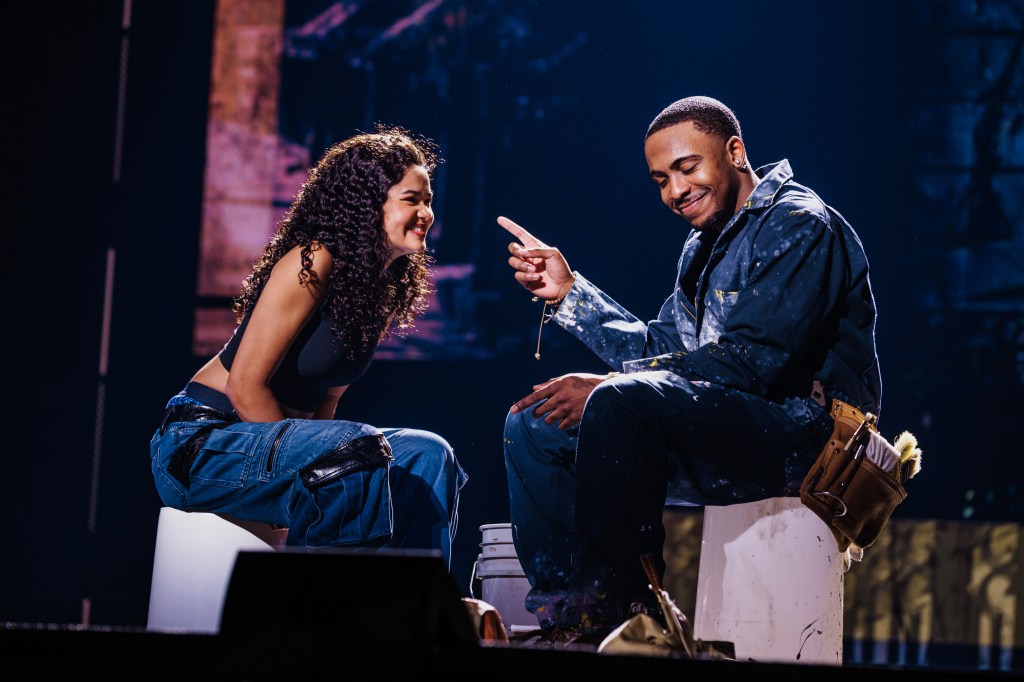
Ali has fallen hard for Knuck, a construction worker by day and a mean street percussionist after dark when the whole Hell’s Kitchen neighborhood seems to pulsate to a driving beat. She takes to following him to work, shedding the company of her pals after introducing herself, verging on stalking as she wears down his resistance – enough that Mom comes home to her apartment and finds them in heat. Poor Knuck is under the impression that Ali is of age.
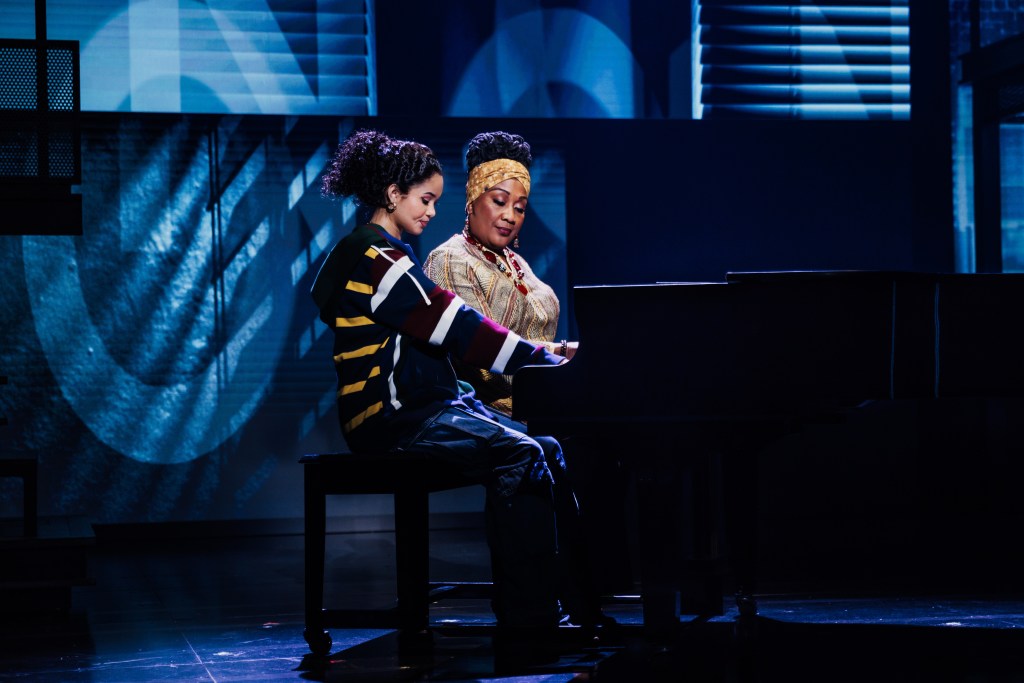
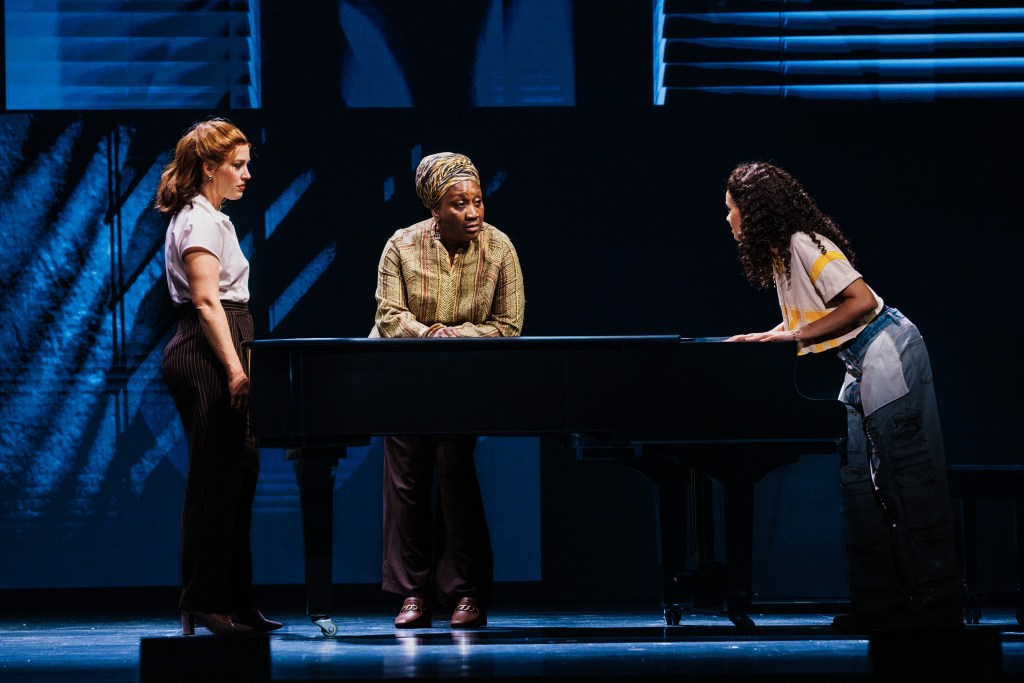
It’s possible to come away thinking Worrell brings more individuality to Knuck than Caughell brings to Jersey – but only if you manage to ignore the force of nature that Caughell becomes when she sings, evolving into one of Miss Liza Jane’s acolytes. White is even more stately than she is bluesy as Liza, the calm and grounded antithesis of both Jersey and Ali. She presumably teaches Jersey less about parenting than she teaches Ali about music.
White’s regal bearing is a wonderful prelude to her anthemic “Authors of Forever,” making Act 2 as much of an ascent from Act 1 as it is a continuation. For it’s obvious we are on a loftier plane when Ellington, as Jersey’s wayward husband, follows with “Fallin’” and – as Ali’s dad, Davis – the imposing architecture of his fatherly “If I Ain’t Got You.” Musically, then, Liza and Davis are Ali’s artistic parents, both as pianists as well as singers.
The brief or near-reconciliation between Jersey and Davis, until he has to hit the road for his livelihood, humbles Mom a bit, reminding her of what it is to be young and in love. Her epiphany, “Pawn It All,” enabled Caughell to rock the Richter Scale almost as much as White had before.
So Jersey seeks reconciliation with Ali, but the blossoming teen isn’t having it right away. One of Drake’s very best moments comes with the concluding “Empire State,” done up by director Michael Grief, choreographer Camille A. Brown, projection designer Peter Nigrini, lighting designer Natasha Katz, the orchestrators, and the arrangers with enough epic flair to remind Keys’ fans of the “Empire State” video sung with JAŸ-Z. Judge for yourselves which is better.
The live version is a tough act to follow. Tempo helps slow Drake down; repetition helps us understand her.
As for any frustrations that came with not hearing Keys’ words clearly, these were later allayed by looking past the frontispiece of the playbill to the back of the program booklet. There, in small print taking up more than a column with no indentations, the listing of music credits voluminously belies the idea that all the melodies and words are Keys’. For “Empire State (Part II)” alone, six other writers join Keys in the byline.
Roll those credits down with all the black space of Hollywood film credits, and you realize that a whole community wrote and produced this quasi-bio without ever having Hell’s Kitchen in mind. Another village did envision this show and did a damn good job. Too bad a sound system let them all down.
Cornelius, NC – When Hollywood studios look for hot new stories for their next blockbusters, the bestseller lists, whether New York Times or Amazon, are among their top go-tos, even if it ignites a bidding war. But if you’re an aspiring playwright out in Concord, looking for a prime property after a 30-year career in secondary theatre education, pickings and budgets are slimmer.
By chance or by design, Andrea Rassler came upon the perfect formula. Ranked a lowly 231,578th in Kindle Store popularity and 2,027th in Women’s Psychological Fiction, Vicky Zimmerman’s Miss Cecily’s Recipes for Exceptional Ladies is temptingly obscure for anybody seeking to obtain adaptation rights on the cheap. First published in the UK in 2019 with a far more moribund title, Zimmerman apparently crafted a laudable gem, boasting a 4.5-star average from nearly a thousand Amazon readers of the American edition, 90% of them four stars and above.
Premiered at the Warehouse Performing Center as Thought for Food, three years after getting a public reading at Charlotte’s CAPA Center, Rassler’s adaptation skillfully distills and compresses Zimmerman’s 427-page novel. In the process, with a kind of Steel Magnolias sway from laughter to tears, our emerging local playwright arguably intensifies the chick-lit flavor of the original.
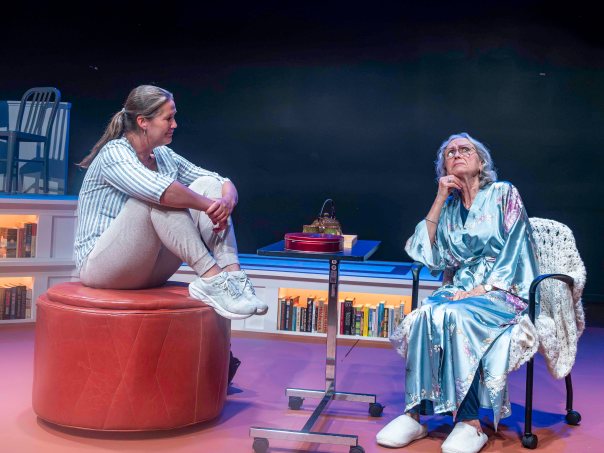
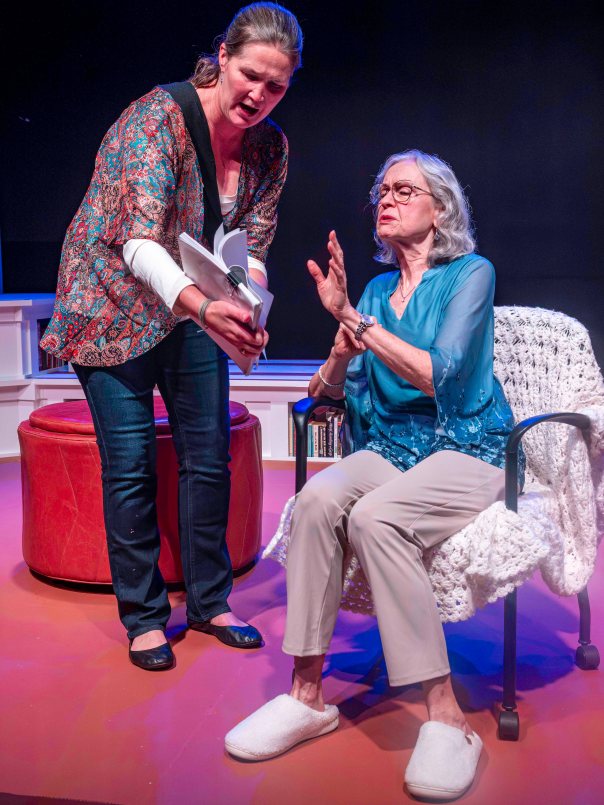
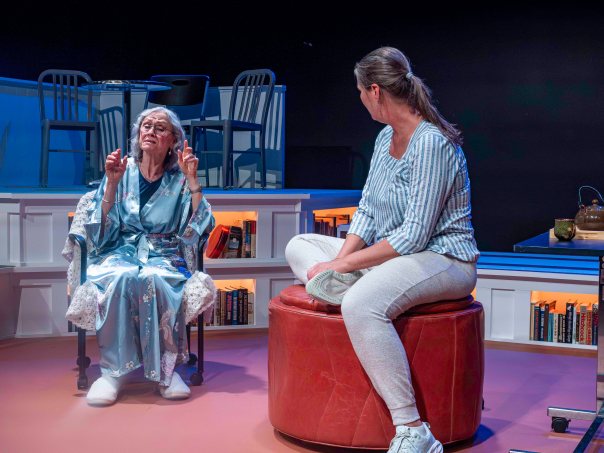
Nor will they mind that Nick, Kate’s “intimacy anorexic” boyfriend, has been stripped of the opportunity to appear onstage and say a single word on his own behalf. This cast, like Magnolias, is all-women, but two of them, Kate’s mom and crotchety 97-year-old Cecily, were so quirky and nutsy that I didn’t mind.
Who wanted the first-hand experience of hearing Nick alternately gushing his fitful adoration for our protagonist and then venting all his anxieties, trepidations, self-doubts, and frustrations? Enough stage time already falls to Kate for those purposes. And she’s right here. We can judge for ourselves and recalibrate as the story unfolds.
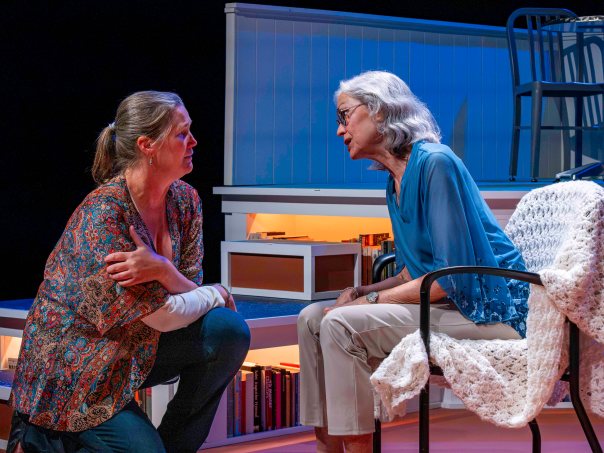
Better to have Cecily scalding Kate with her no-holds-barred tough love and Rita, Kate’s mom, bombarding her with unsolicited advice. From a comedy standpoint, the best decision Kate will ever make in life is to move back in with her mom. Though there were no mentions of Kate’s biological clock (maybe universal recognition that it was her own damn business?), the lady is undoubtedly behind the curve in establishing her independence and developing a backbone.
Men can quietly see that Cecily, who can ultimately tell Kate not to darken her door at the old folks’ home unless she can report some progress, is actually the father figure Kate needs in disguise. Cranky? Absolutely. Add in bullying and demanding. But able to impart the rigid standards that are the foundations of self-regard.
Women, meanwhile, can see Cecily as the tough old bird that saves Kate’s life.
These traits are normally in Becca Worthington’s wheelhouse, but here we had the pleasure of experiencing her playing against her usual type as the needy, befuddled, and irresolute Kate. One or two of the barbs and zingers hurled at her didn’t seem to hurt as much as they should. But mostly, the toughness we saw from Worthington in The Lehman Trilogy and the savagery at the forefront of Misery had vanished into Kate’s vulnerability, unrewarded patience, her wide streak of cluelessness, and her occasional wit.
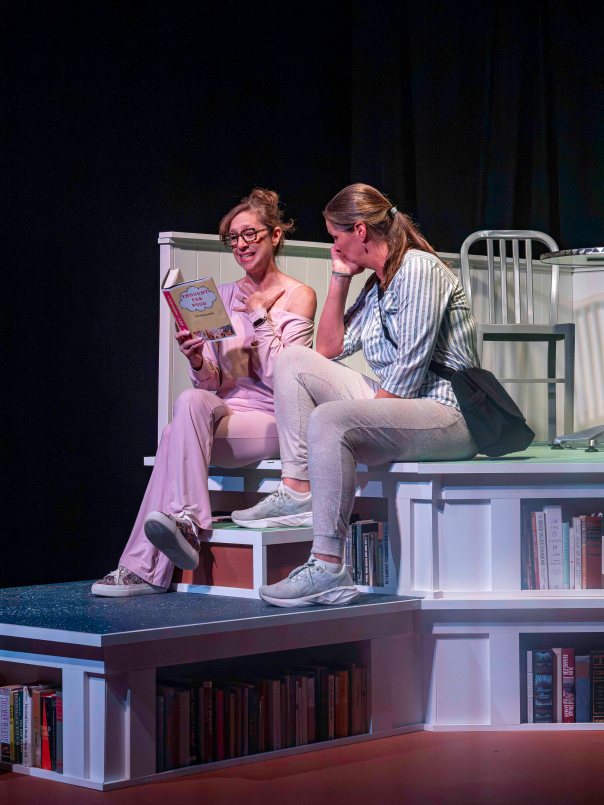
Even without Kate’s dubious beau on the scene, her female tormentors found ample means of rattling, angering, and humiliating her. Amid that fertile forest of comedy gold, Kate had to glean whatever kernels of encouragement and sound advice that she could. Helping her out – when not piling on well-meant advice of her own – was her best friend, Bailey.
At times, Allison Graham’s chief comedy value as Bailey was in helping Kate fend off her mom’s chirruping criticisms and ill-judged suggestions – or in helping Worthington to convey the prodigiousness of Rita’s bad parenting. Just by the fussy and officious way she walked in on her first arrival, Stephanie Dipaolo signaled that there wasn’t a nurturing bone in Rita’s body. All of her recommendations tended to aim Kate toward fulfilling her vision of what her daughter should be, without the slightest recognition or consideration of who Kate is.
She only hits paydirt when those two visions accidentally coincide. Luckily, Bailey is on the scene to help Kate recognize this cosmic event.
Dipaolo’s sprightly energy underscores how much delight she’s taking in blithely inflicting so much suffering, and her quick, snippy exits assure us that numerous other opportunities urgently await her elsewhere. A busy bee, she is, with multiple stingers.
That makes for a fabulous contrast with Paula Baldwin as the memorable Cecily Finn, who reigns at the Lauderdale House from a throne that doubles as a walker. Indeed, Baldwin frequently reminded me of my own mum, oozing superiority at the Carriage Club past her 103rd birthday, especially after she lost her determination to regularly get her hair done.
So, on a couple of occasions in Act 2 as her tutelage neared an end, I expected Kate to make her weekly pilgrimage to Lauderdale only to find her mentor’s room empty. There was a bit of sugar mixed into Cecily’s saltiness that would make an acolyte wish to return, stray drops of sympathy and empathy mixed into her contempt for Kate, and a grain of self-interest at the center of her impatience.
Baldwin has done many more celebrated roles on stage, but she still appreciates the measure of this one.
As for Rassler, she hasn’t yet poured enough into all of her characters just yet. Bailey’s ultimate function in her storyline sticks out all too clearly because she draws too little opportunity to divert us, and Lesi Jonap is similarly shortchanged as Jackie Gaffney, the director of care at Lauderdale. As the administrator who guided Kate into Cecily’s austere presence, there was danger that we would see her as mere courtier. I would have appreciated more insight from Jackie, maybe a choice cut or two of what she knows about Cecily’s background.
That would certainly enhance her regal aura even more.
Ultimately, Food for Thought transcended its title without those finishing touches, delivering profundities beyond what it seemed to promise.
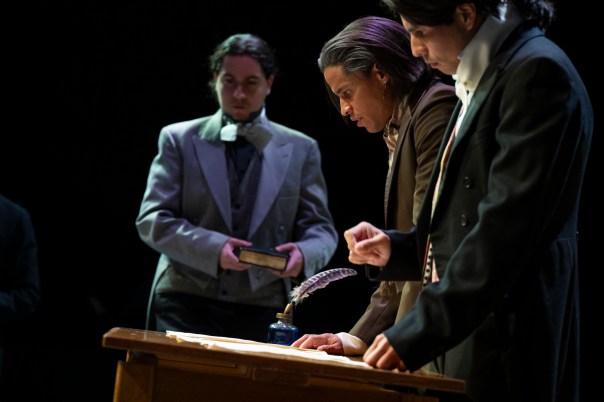
An impromptu survey of four people, myself among them, after the Charlotte premiere of Mary Kathryn Nagle’s Sovereignty at The Arts Factory, confirmed what I had strongly come to suspect during a long, sometimes difficult, and immensely rewarding evening of theatre. More people have heard of the 1838 Trail of Tears than have heard of VAWA, the acronym given to the Violence Against Women Act passed by Congress in 2013 (with Native Provisions attached).
We get to see how both of these events have impacted the Cherokee Nation in a groundbreaking Three Bone Theatre production directed by Carolyn Dunn. Thanks partly to a grant from the Cherokee Preservation Foundation, the production will pull up stakes when its Charlotte run is done on September 6, and sojourn for the next six days in Cherokee, NC, offering free theatre workshops to Cherokee High School students on the weekdays and two special performances at the Qualla Boundary on September 11 and 12.
The Cherokee largesse is also evident in the casting and production team, since all the actors portraying Nagle’s Cherokee characters can claim Native American descent, converging on this labor of love from near and far. Admirably bolstering this ethnic authenticity are Dunn, costume designer Lorna Bowen, cultural consultant Yona Wade, and language coach David Jumper.
Quite audacious. Three Bone is already fairly unique among local companies in acknowledging – on their website and in all their digital playbills – that they rehearse and perform on the traditional, ancestral, stolen territory of the Catawba Indian Nation, including the Catawba and Sugaree tribes.
So they haven’t stopped there. They’re walking the walk and touring the tour.
With respect to the Trail of Tears, we are taken very much to the center of the agonizing preamble, both at the White House and back on tribal land in Georgia, where an impossible ultimatum begins to break the Cherokee Nation apart into a devastating ideological fracture. Written in 2015 and premiered three years later, the depiction of President Andrew Jackson already foreshadowed the current monster in the Oval Office.
It reaches us now in a 2020 edition, which likely makes Sovereignty even more pointed and relevant. There’s more wallop to this history than ever.
Nagle knows how to personalize both of her stories. The first begins in the 1820’s and climaxes in the signing of the Treaty of New Echota in 1835. The second begins in the “Future” – 2019, four years after the original script was completed – and stretches up to a decade afterwards. Or as long as it takes for a couple to meet, fall in love, have a child, dramatically break up, and create legal disputes that are not resolved until the US Supreme Court issues its judgment.
So each of Nagle’s crisscrossing timelines has enough breathing room for their lawyer protagonists to grow into their history-making roles. In 1835, we first see John Ridge as an effete invalid, convalescing somewhere in Connecticut, proposing to a local schoolmaster’s daughter. Transitioning to 2019, we encounter the betrothed couple’s future descendant, Sarah Ridge Polson, a Yale Law School graduate returning to her Cherokee Nation home in Oklahoma, visiting her ancestors’ graves at Polson Cemetery.
We’re talking about what is likely the most radical jump-cut this reviewer has ever seen onstage. Since John’s bride-to-be is also named Sarah, when her mom calls to her offstage in Cornwall, Connecticut, the overlap between the two scenes has Flora, Polson’s cousin, greeting her as she returns to her homeland and pays homage to the lovebirds who are exiting. In a split second, 184 years have elapsed, and we’ve traveled 1370 miles westward.
Dunn doesn’t bother explicating these transitions – nor even specifying that we’re time-traveling to a freely imagined future – any more than Nagle’s dialogue provides, a source of bewilderment and disorientation throughout the evening. While I’d be happy to see such guideposts flashed somewhere as projected visuals, or in the printed and digital programs, it’s pretty clear that Dunn is taking her cue from the circumspection of Nagle’s manuscript.
Unless you already know that Tahlequah is the capital of Cherokee Nation, you may not be any surer that Polson is back on Native American soil than you will be about VAWA when it is offhandedly mentioned a few times. Anyone who emerges from Sovereignty thinking that Nagle’s script is didactic would probably be layering on the helpful info on VAWA and the historic timeline that Three Bone has posted on the wall of the corridor as you enter the theatre space.
We’re more firmly grounded when Nagle takes us to the White House and to Georgia Before Removal. Multitudes of chilling lessons – or reminders – bombard us as soon as we’re in the presence of President Andrew Jackson.
He is charming and candid to the Cherokee delegation, including Major Ridge, who fought by his side in the Creek and Seminole wars. Casually horrifying: “I say this as your friend. You find yourselves established in the midst of a superior race, and although you do not appreciate the cause of your inferiority, if you do not yield to the force and progress of civilization and move West, you will disappear.”
Affable and chilling. When Americans lecture Israel on how they treat Arab citizens and residents of Gaza, they might look to their own history as this so-civilized atrocity unfolds with the zealous assistance of John Forsyth, Governor of Georgia. What Jackson and Forsyth are cooking up (after encouraging the rape of Cherokee women) is a startling pair of alternatives that flout the Supreme Court judgment of 1832, in Worcester v. Georgia, ruling that Georgia’s unilateral extension of its laws over Cherokee territory was illegal and unconstitutional.
Cherokee Nation had sovereign status, true nationhood, so only the Federal Government could legitimately deal with them. To John Ridge’s claim that Jackson must enforce the law of the land, our President, with a heartlessness that would not be duplicated in the Oval Office for nearly two centuries, curtly replies:
“[Chief Justice] John Marshall made his decision. Let him enforce it.”
Bang. With malignant lines like that, it’s no wonder that Kyle Riggs as Jackson often upstages our Cherokee protagonists. He’s no less shocking when, in a matter of seconds, he first transforms from Sarah’s genial 2019 fiancé, Ben, into the sourpuss “Old Hickory” of yore, simply by turning his back to us, donning a formal overcoat, and changing his expression.
Yet Lance Claymore as John must face up to Jackson’s perfidy and decide what’s best for his family and his people. He can be pragmatic and abandon his ancestral home in Georgia, signing away his people’s heritage in the Treaty of New Echota with the consolation of being allowed to relocate to a specified territory in Oklahoma, which wouldn’t achieve statehood for over 70 years. Or he can stand on principle and the decided law of the land and watch Jackson & Co. take their homeland by force and drive away its people.
Without any consolation at all.
Cherokee Nation had been a democracy since 1827, with a constitution, a court, and elected governmental leaders, so John wouldn’t be making this decision alone – or signing any treaty alone. He finds himself united with his father in the pragmatic “Treaty Party” while the opposition National Party, headed by Chief John Ross, stands by principle and refuses to sign.
The political fracture ensured a deep-set antagonism between the Ridges and the Rosses that still lasts – and it made a horrible emigration mess inevitable. Whichever party you were affiliated with, you were leaving the sovereign Cherokee Nation, willingly or by force. Obviously, if you were among the majority who re-elected Ross, in Georgia and Oklahoma up to the middle of the Civil War, you were brutally forced of your home and likely blaming the Ridges for your ensuing sufferings.
That’s why Polson, applying for a job in the attorney general’s office in Tahlequah, controlled by the Ross family, is being so careful not to mention her Ridge ancestry. As Cousin Flora tells her – with genuine historical precedent – “The day you trust a Ross is the day they kill you.”
So while Billie D. Merritt as Sarah Ridge is quickly on the receiving end of Ben’s goofball marriage proposal, she is also a supplicant when she appears for her job interview. As you’ll see, Sarah is a long way from fully asserting herself both professionally and in her mixed-race relationship. Much like John before her, she’ll need to make a weighty, risky decision before she can make a positive difference.
On opening night, it was unfortunate to find Sarah’s personal growth coinciding with Merritt’s progress from the threshold of audibility to full authority after intermission, when she argues her case to tomorrow’s Supreme Court. Whether she wins or not does not diminish the fact that Nagle, in her conclusion, is envisioning a long overdue reconciliation between the Rosses and the Ridges. Hopefully, Merritt has turned up the volume and the Three Bones’ run continues.
Of course, the power of Nagle’s reconciliation depends on Mvnte July’s portrayal of both Chief John Ross back in Georgia and his descendant, Jim Ross, in the Tahlequah attorney general’s office. He is pivotal in creating the breach with the Ridges and, in the near future, in healing the rift. As a proud Cherokee citizen of Tulsa, it must be beyond a dream for July to be playing such a prominent historical figure, and as a past performer in Unto These Hills, no less a kick to be circling back to Cherokee, NC, with this production.
With opposition coming from July at home and Riggs from the White House, two powerhouse performers, Claymore’s softness and resilience as John Ridge come across all the more poignantly. Toughening the challenge for Marco Fuller as Ross’s most formidable opponent, Major Ridge, he must speak most of his lines in Cherokee, without any transliterated assistance from our playwright.
Josh Orsi helps Nagle to make a couple of key points on Cherokee sovereignty and free speech. Assaulted by a white drunk on Cherokee soil as Watie, Sarah Ridge’s brother, he has no power to arrest or prosecute, even though he’s a police officer. As Elias Boudinot, Major Ridge’s brother and founder of The Cherokee Phoenix, that nation’s first newspaper, he must face down threats from Chief Ross when their political opinions clash.
Along with Keely Kidwell as Sarah Northrup and Flora Ridge, Nathan Ahlgrim can exude a nice splash of goodwill and rectitude from non-natives. As Mitch, he’s a credulous modern-day lawyer, and as Samuel Worcester, he’s a soft-spoken – but iconoclastic – preacher who gets arrested for settling on Cherokee soil. Governor Forsyth and a redneck sheriff are Ryan Dunn’s chief cameos, but he also gets to play a good guy or two.
There is more than enough forgotten history here to richly educate most Charlotte theatergoers, and the posted materials, the digital program, and the discussion guide are fine accoutrements. If Sovereignty is greeted as warmly as we can expect, then it may linger in Cherokee as required reading for schoolchildren. Assuming that those kids to our west are as ignorant of their true heritage as ours, an annotated edition would be quite valuable. Nor would it be bad if Attorney Mary Kathryn Nagle’s future fan
Review: Million Dollar Quartet at Cain Center for the Arts
By Perry Tannenbaum
By some cosmic coincidence, the publication of Rolling Stone’s special edition listing of The 500 Greatest Songs of All Time in late 2004 anticipated the great flowering of jukebox musicals on Broadway almost immediately afterwards – with hardly a hiccup since. A good 40 years after my last look at Billboard and Cashbox’s weekly Top 100s, the idea of collecting chart-topping hits recorded by the great kings, queens, and groups of pop or rock for live theatre must have been in the air.
Suddenly it gained new traction as a bankable concept. Songlists associated with Elvis Presley, John Lennon, The Beach Boys, and Frankie Valli and the Four Seasons all got the Broadway treatment in 2005. Bob Dylan, Johnnie Cash, Dusty Springfield, and Earth, Wind & Fire were among those basking in the lights of the Great White Way the following year.
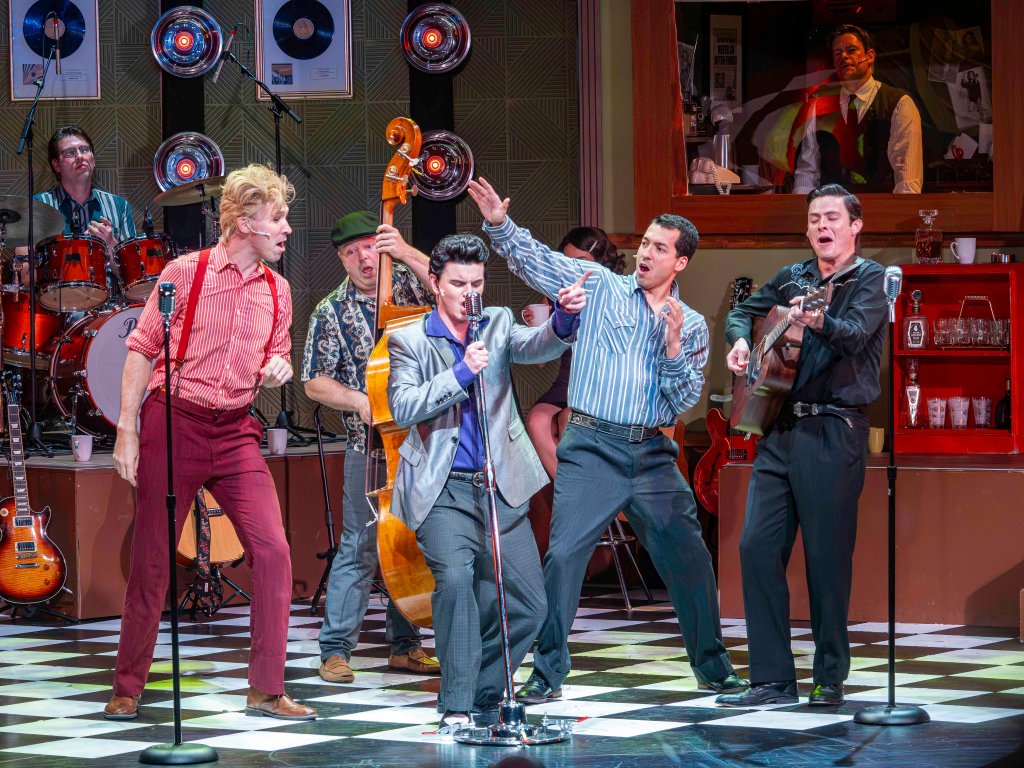
So it was hardly a surprise that Cain Center for the Arts, up in Cornelius, was sold on Million Dollar Quartet for their first co-production with neighboring Davidson Community Playhouse. After all, the original concept and book were inspired by hitmakers Elvis Presley, Jerry Lee Lewis, Carl Perkins, and Johnny Cash – all of whom are enshrined in the top 100 of the Rolling Stone 500 list.
The new Cain-DCP collaboration is making history with history: the four rock legends actually did converge in Memphis, at Sam Phillips’ Sun Records studio, spontaneously jammin’ together for one magical evening in December 1956. Phillips wasn’t sure people would believe it, so he snapped a photo of the quartet. Meanwhile, some rascal in the soundbooth rolled the tape.
Was Million Dollar Quartet inevitable by the time it premiered at the Nederlander Theatre in 2010? Maybe it was nudged a little by the Rolling Stone list or the efflorescence of jukebox musicals in 2005, since the Mutrux concept was first put on its feet in Daytona Beach the following year.
The Complete Million Dollar Quartet album, 47 tracks compressed into 78 minutes, had been available commercially in the US since 1988, after gathering bootleg-edition cache for more than three decades. And the whole scenario of the Sun Records session remained the subject of fevered speculation; if anything, boosted by the commercial release, years after the best tracks – and then the complete session – had been kosher in Europe.
About the only logical argument against memorializing the historic Memphis summit meeting was the lukewarm music captured on tape.
Rolling Stone gave it three stars out of five.
Some might find even that middling rating overly generous. Aside from the wretched sonic setup, the fragmentary and impromptu song list was hardly formidable. “Brown-Eyed Handsome Man,” “Peace in the Valley,” and “Down by the Riverside” were readily available from the 1956 tape, but Mutrux nixed other staples such as “When the Saints Go Marchin’ In,” “Black Bottom Stomp,” and “Just a Little Talk With Jesus.”
Apparently, Mutrux had to tread softly among The King’s hits, for “Don’t Be Cruel” and “Love Me Tender,” both on the Complete Million Dollar album, are MIA in the musical, though both were approved for All Shook Up in 2005. So were “Hound Dog,” “That’s All Right,” and “Blue Suede Shoes,” which thankfully – and with full propriety for 1956 – were made available once again.
“Blue Suede Shoes,” a bone of contention between Perkins and Presley – Carl made the big hit recording, but Elvis made his big national live TV splash with it on the Ed Sullivan Show – was an absolute must for Mutrux and co-writer Colin Escott. It was the sort of historic tidbit that could add edge to a chance meeting whether or not it actually came up for conversation, but the writing team had grander plans.
Cleverly sidestepping the question of which of the two disputants would sing the song in their musical, Mutrux has all of the Quartet members on vocals – at the top of the show before Phillips’ narrative unfolds. It’s a perfect fit, beginning with an anthemic cry: Carl sings, Well it’s one for the money, making his entrance. The stop time after that cry allows Johnny to materialize beside a second mic for his Two for the show.
No contest about who makes the biggest entrance after Three to get ready. It’s Elvis, kicking “Blue Suede Shoes” into its 4/4 locomotive gear. Jerry Lee will get his chance, late in Act 2, for a barbaric yawp of his own, his You shake my nerves and you rattle my brain from his iconic “Great Balls of Fire,” when this session reaches full blast.
Now it’s fair to say, even though they aren’t on the Memphis tapes – and didn’t get released until 1957 – that Lewis’s monster hits, “Whole Lotta Shakin’ Goin’ On,” and maybe even “Great Balls” were already in the oven getting baked. Chronology for Johnny Cash’s Sun Records hits, “Folsom Prison Blues” and “I Walk the Line,” is indisputable; they aren’t on the Million Dollar album, either.
Cash’s borrowings are shrewdly selected, stealing “Sixteen Tons” from Tennessee Ernie Ford, a hot hit in ’56, and “Riders in the Sky” from Burl Ives and Vaughan Monroe, already seven years old. Likewise, Perkins is only flashing back a little when he pilfers Bo Diddley’s “Who Do You Love” and Bill Haley and the Comets’ “See You Later, Alligator,” both of them ’56 hits.
Even truthier than Perkins’ dispute with Presley, the singer-guitarist actually did record his forthcoming single, “Matchbox,” in December 1956 – but a day before the Million-Dollar bootleg. And Jerry Lee, still months away from his first Sun release, was an unknown sideman for Perkins at that session. So the script is almost accurate in setting up the Sun Studio get-together as Elvis and Johnny crashing Carl’s recording date.
And Elvis did bring his current girlfriend to the party, though here the writers change her name. They give their Dyanne two sexy songs her real-life counterpart never sang, “Fever” and “I Hear You Knockin’,” again authentically from that era. No less importantly, they have her standing by to console Phillips when his grand plan for the evening falls through.
Inside and out, Cain Center can be viewed as a somewhat downsized Knight Theater, beautifully accommodating around 400, about a third of the Knight’s (and the Nederlander’s) capacity. With its rousing opening, Million Dollar Quartet instantly proved to fit perfectly at the new Cornelius arthouse. Sound was perfectly potted for these ears, and not a single word was lost in our back-row seats on the sold-out opening night.
The same can rarely be said of touring shows at Belk Theater. Or at Theatre Charlotte, which sports half of the Cain’s capacity.
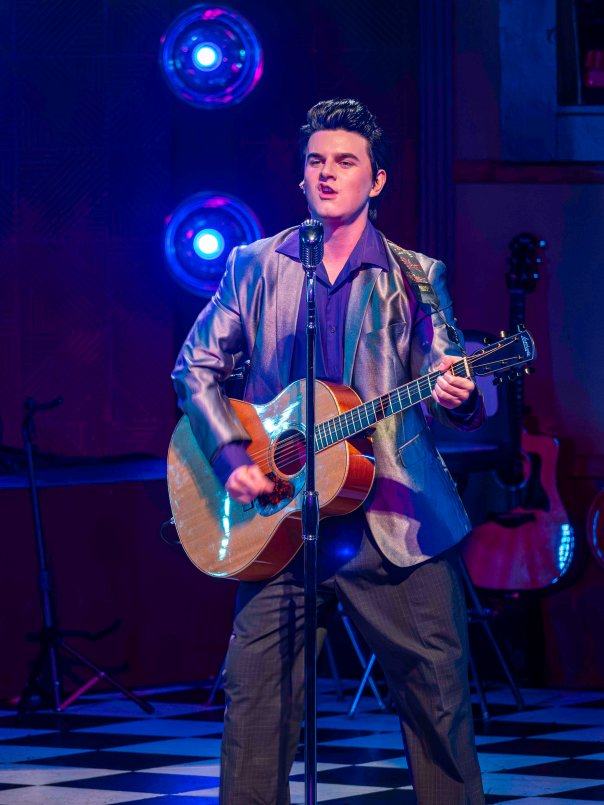
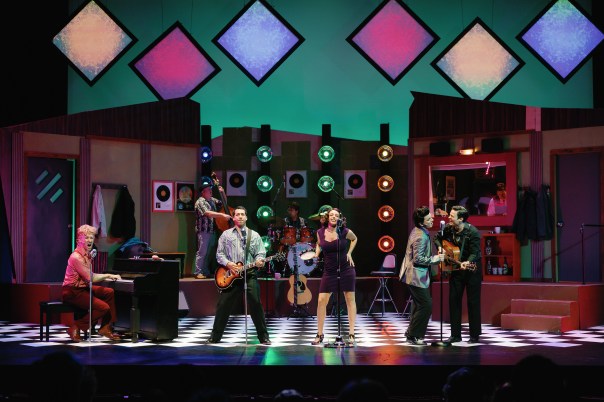
And we liked what we heard as much as what we saw, thanks to director Scott Albert and his cast, costume designer Beth Killion, scenic designer Chip Decker, and lighting designer Gordon Olson. Nor was it surprising to learn that Matty Montes, who portrays Carl Perkins, was also our music director. He plays a mean ax.
Nearly forty years after first discovering the Queen City/Metrolina theatre scene, I found it fairly groundbreaking for DCP artistic director Steve Kaliski to assert in his curtain speech, on a stage so grand, what my first Creative Loafing front-page feature pointed out then: people here greatly underestimate our local theatre talent pool. We can cast all four of these iconic rock giants with local actors, even if they are tasked with accompanying themselves and each other instrumentally as they perform.
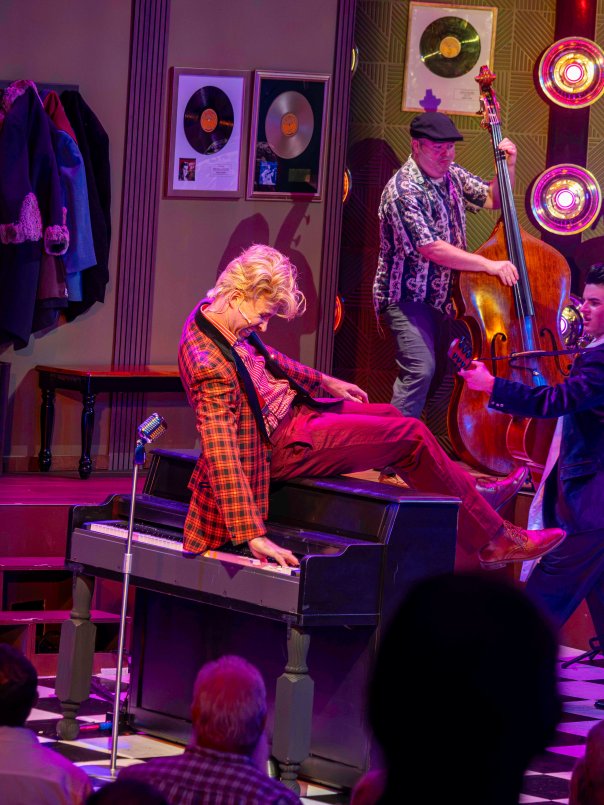
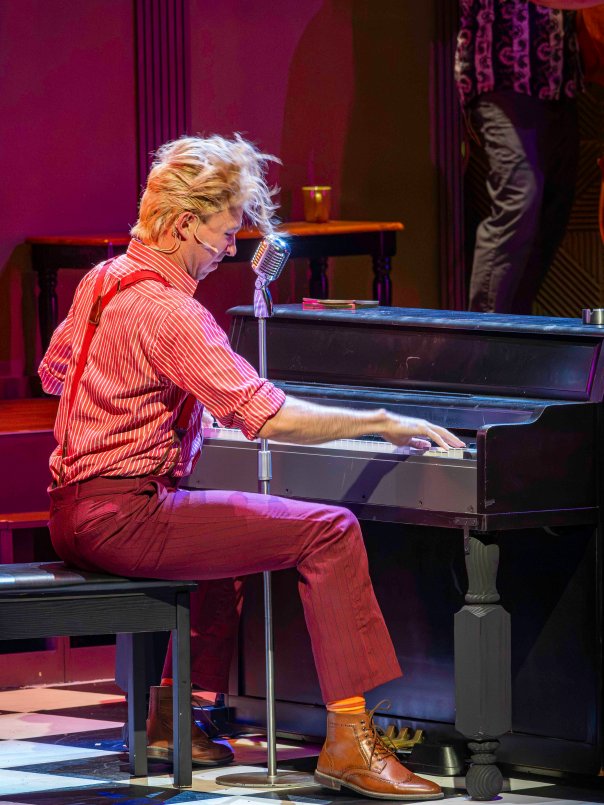
All four pairs of blue suede shoes were filled very handsomely, thank you very much. You could actually look forward to a Montes’s instrumental licks as avidly as his vocals. Same can be said even more prodigiously for Ian Benjamin as Jerry Lee, the role that catapulted Levi Kraus to a Tony Award.
Kicking away his piano bench in the flamboyant style of The Killer would oblige Cain Center to take out some serious insurance, yet Benjamin had most of Lewis’s other wild antics covered. He lacked the finely tuned right heel in Jerry Lee’s arsenal, but he had the signature pumping piano action and zigzag runs securely in hand, as well as his outré mic handling. After bringing down the house with “Great Balls of Fire,” Benjamin also proved he could work the crowd he had rattled so triumphantly with his so-predictable “Shakin’” encore.
If you know Jerry Lee’s Sun catalog – or his sensational marital history – you’ll understand why Benjamin gets to be the most sensuous and bawdy member of the quartet. If not, you’ll be reminded. Although there were no photos of The Killer wearing suspenders for me to find with Google, Killion follows in the Broadway production’s footsteps by outfitting Benjamin with a pair.
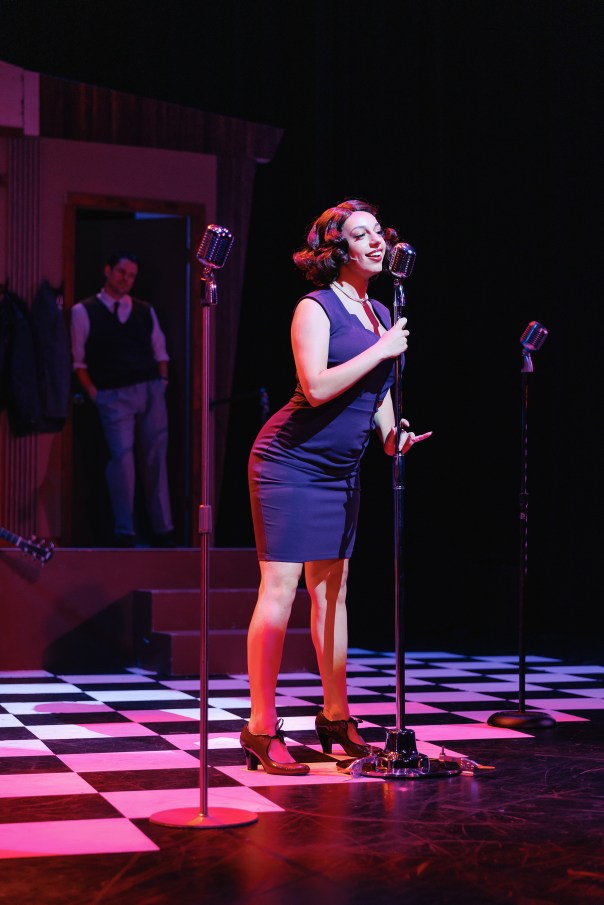
We see why after Lewis leers at Dyanne in a way that risks Elvis’s rage and his girlfriend’s rejection. But Julia Freeman as Dyanne will not be intimidated. Au contraire. With her “Fever” and her “Hear You Knockin’,” she gives Lewis and then Presley the vamping of their lives.
But it’s with Lewis that she leans suggestively over Jerry Lee’s piano and tugs at those suspenders. Fever, indeed!
For their respective partisans, Eli Fischer as Elvis or Connor Nielsen as Cash may emerge as the apex among the vocalists. Though his bass register doesn’t reach as richly down to San Antone as Johnny’s, there’s an uncanny sameness between Nielsen and The Man in Black up higher in his mid and upper range, conveying the penetration and distinctive off-key astringency of that voice as well or better than I’ve ever heard it before.
Sometimes the visual resemblance was also uncanny. With Elvis or Johnny, just listening obviously wasn’t enough to satisfy Albert in his director’s chair. Most audience members wouldn’t require any actor playing Cash to be as true to his look as you have to be to either the look of Elvis or the less universally imitated Jerry Lee. Nielsen, we can suspect, put in that extra film study.
Fischer may have had the most daunting task as Elvis, considering the charisma he must live up to. Even if this is pre-Army Elvis, Mutrux conscientiously points out that Presley has already played Vegas. That’s more than sufficient excuse for Fischer to layer on all of the signature moves we associate with The King, from his scandalous Ed Sullivan days to his polished King of Vegas years.
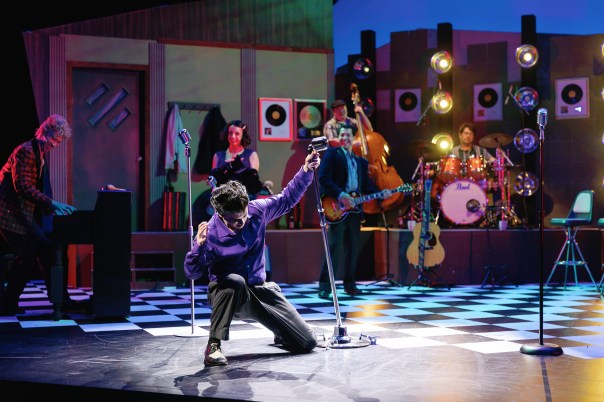
So Fischer’s mic handling and stage movement must be on a par with Benjamin’s. We’ve seen enough sliding on two knees to celebrate World Cup goals for that onstage move to strike us now with the same excitement it packed back in the ‘50s. With that move masterfully conquered, this Elvis doesn’t need to sing better than this Jerry Lee, but he does. And anachronistically, when he tosses his scarf and sweat hanky into the front rows, he slays better than The Killer as well.
To say that Fischer’s “That’s All Right” and “Hound Dog” are electrifying is more than fair. But to say that they steal the thunder from Benjamin’s prime Jerry Lee exploits would be very presumptuous. Things get very hot at the Cain.
Best known for his international comedy hit, The Mystery of Irma Vep, Charles Ludlam and his Ridiculous Theatre Company struggled for 17 years before his 1984 breakthrough brought him financial security. But AIDS took him down, so he couldn’t enjoy his celebrity and notoriety for long. Ludlam was gone less than two months after my first reviews and features appeared on the Charlotte theatre scene in 1987.
Vep wasn’t too long in finding me. Following up on previous drag triumphs in Psycho Beach Party and Vampire Lesbians of Sodom at the storied Pterodactyl Club, Alan Poindexter and innovative Theatre Company introduced the crowning Ridiculous Theatre glory to the Queen City in 1993. Poindexter was only partially mincing in Ludlam’s flamboyant footsteps, for the Long Island native not only wrote a large chunk of his Ridiculous rep but also starred and frequently directed.
In all, Ludlam’s Complete Plays runs to over 900 pages, including such promising titles as Turds in Hell, Eunuchs of the Forbidden City, Isle of the Hermaphrodites, Secret Lives of the Sexists, and Der Ring Gott Farblongett. Despite these temptations, we’ve waited over 30 years to dip further into the Ridiculous oeuvre.
But it’s not surprising that PaperHouse Theatre is the perpetrator. After all, they exhumed Irma Vep two summers ago at VisArt Video’s clubby setting at the rear of their alley. It’s also rather discerning of them to ignore Ludlam’s more sensational titles in favor of Reverse Psychology.
The original 1980 production drew one of the strangest reproaches ever seen in a review. Writing for the New York Times, Frank Rich declared that Ludlam’s new farce did not live up to the playwright’s Ridiculous brand: “Silly? Perhaps. Clever? Certainly. Funny? Absolutely,” he conceded. “But ridiculous? When a play is as well-crafted and sharply written as Mr. Ludlam’s, honest-to-God respect must be paid.”
Rich wasn’t done, citing Ludlam’s production for selling his own play short.
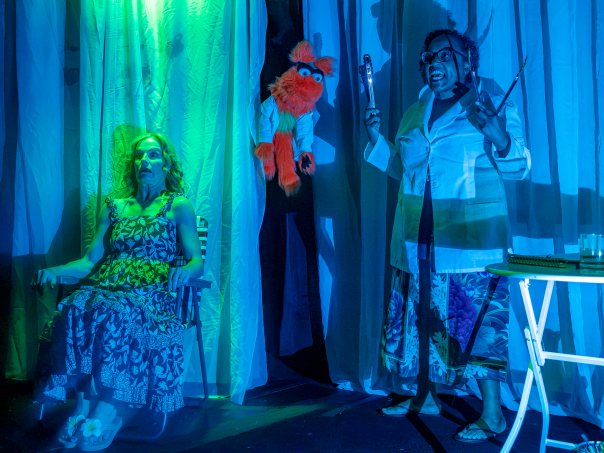
PaperHouse doesn’t make the same mistake – or any others, for that matter. Shrewdly in charge, PaperHouse founder and artistic director Nicia Carla gives her players free rein to go with the freaky flow of the action and to underscore their quirks and hypocrisies, even if they trespass the borderlines of caricature. But they keep their mischief within the two psychiatrists and their two patients, never breaking character or milking an easy laugh.
That approach enriches the ironies Ludlam explores and sharpens the satirical points he scores with his four intertwined adulterers.
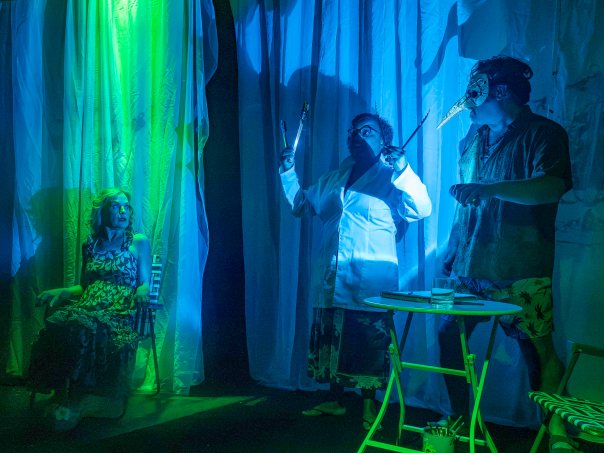
Leonard Silver and his wife, Karen Gold, are the psychiatrists who begin secret affairs at the beginning of Act 1, neither of them aware that their new paramours, Silver’s Eleanor and Gold’s Freddie, are also patients of their spouses. Ludlam is showing us all this gradually in a series of two-handed scenes between Silver and Eleanor, Silver and Freddie, Freddie and Eleanor – yes, they’re married – and Silver and Gold.
So the accumulation of deliciously absurd discovery adds fuel to the comedy as we piece together the big secret that this unfaithful quartet doesn’t, that they’re all being cheated on. Yet the business end of this farce, juxtaposed with the couples’ home lives, compounds the comedy long before their intertwined deceits unravel.
For the most absurd thing you’ll notice is that the psychiatrists’ marital relationship is far more hostile and acrimonious than their patients’! They’re the ones who need therapy!
Nevertheless, Gold is making Freddie, a struggling artist, feel guilty because she can lavish all the money she receives from Eleanor and her other clientele on a new gallery where Freddie can paint and exhibit. Silver, meanwhile, is wowing Eleanor on her own dime, if we presume that Freddie can’t really afford his therapy on his own.
Ludlam will keep leaning into this point even after the farcical climax in Act 2, where all four of his sex-driven cheaters are found out in a frantic scene at a beachside resort. The upshot of all these blasted deceptions is a double fake-out epilogue that serves to magnify Ludlum’s exploitation theme to the magnitude of horror.
And yes, Rich may have missed what Ludlam saw as the most ridiculous aspect of his satirical tale. A specter of promiscuity hovers over it all. All the wicked stealth and hurried cover-ups are driven by axiomatic beliefs in the sanctity of marriage, fidelity, and monogamy. Each of these pieties may have seemed supremely ridiculous to Ludlam – inside the box – before he was diagnosed with AIDS a mere two months before his death.
Carla and her cast make it clear that the psychiatrists are definitely among the loonies that we see. The most promiscuous of these is Ashby Blakely as the ravenously omnivorous Dr. Leonard Silver, madly attracted to all the other people onstage except his wife. Brilliantly layered on in the epilogue is an eerie touch that would have been unavailable to Ludlam when he originated this role: a spot-on evocation of Anthony Hopkins as Hannibal Lecter.
It’s pretty obvious that Carla and Lisa Schacher, in her yummiest role yet, see Eleanor as the polar opposite of Silver, the least guilt-ridden by promiscuity and the most horribly victimized. Partly due to her sunny histrionics and partly due to Ludlam’s portraiture, we find Eleanor the most artless and appealing of these risk-takers. Her most extreme travails begin midway through Act 2 when she is visited by a quasi-nightmare.
This is when Rasheeda Moore comes to the fore as Dr. Karen Gold and begins to seize her rightful place as the cunning and evil of the bunch. Blakely as Silver offers keen competition, shamelessly wooing Freddie during multiple therapy sessions and shredding his Hippocratic oath when his dear patient forsakes him. Moore is merely cruel and unscrupulous with Eleanor, taking multiple phone calls in the middle of their session and then brusquely shutting her down mid-question when time is up.
How does Chaz Pofahl as Freddie manage to keep paying Silver if the starving artist cannot sell even one of his paintings? Supreme poseur and part-time sponge, the stylish and cavalier Pofahl charmingly shows us that our Freddie cares nothing for such mundane matters, slickly picking up Gold at a museum when only one of them can pay the cab fare to his humble abode.
On your ride home, with your impressions of Reverse Psychology still fresh, you may consider the notion that Eleanor and Freddie have somehow cured their therapists.
That may be the last of multiple meanings that you’ll find in Ludlam’s title. It’s the last of his ironies, for sure, and devilishly ridiculous.
Or it was the last irony in this farce. Grimmer ironies surfaced when Ludlam’s death was front page news in the New York Times. Public Theatre’s legendary Joseph Papp, with whom Ludlam was engaging in contract talks, put it bluntly, as he always did: “We lost an extraordinary artist who was just on his way to a tremendous breakthrough in the theater and opera.”
Review: Dracula: A Comedy of Terrors at Booth Playhouse
By Perry Tannenbaum
Even before he became a Muppet or a General Mills breakfast cereal, Bram Stoker’s Dracula regularly took on a comical tinge that the novelist could not have foreseen when his masterwork was published in 1897. You can probably place the blame on Bela Lugosi, the first actor to portray the vampire in a talkie, released in 1931. Not only did numerous comedians, impressionists, gameshow hosts, and late-night TV celebs take stabs at imitating Bela’s Transylvanian bloodsucker, so did many of my classmates and kids on the block.
Extra points went to those who flicked their tongues out saying “blod,” the fang-tastic villain’s favorite elixir.
Lugosi himself was in on the joke, reprising the undead Count in an Abbott & Costello flick, but he always remained in character, a mesmerizing, dimly-lit creature of the night. Later films, in the wake of numerous cartoon desecrations, inflicted comical cracks in the mold.
In Love at First Bite (1979), George Hamilton became a New York playboy, still deadly serious but younger, more lustful, more fashionable. He even turned the silky collar of his tux down. And he loved to boogie. Compared to the white-haired Leslie Nielsen in Mel Brooks’ Dracula: Dead and Loving It (1995), however, Hamilton was orthodox. Brooks freed Dracula to be bumbling and accident-prone.
Worst of all, the Nielsen Drac could almost crack a smile. “It’s good to be dead!” he crows.
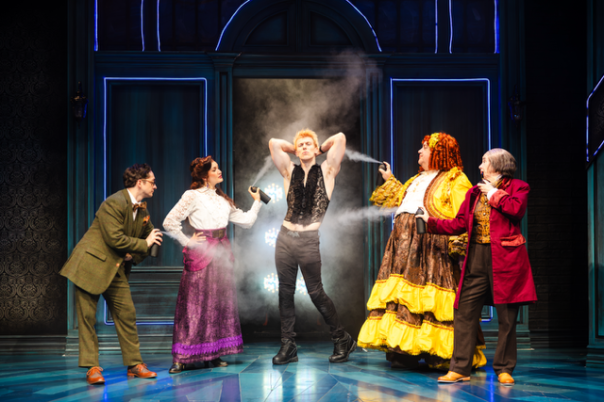
As their title tells you, Gordon Greenberg and Steve Rosen’s Dracula: A Comedy of Terrors is even more brazen. With primeval Transylvanian fogs and mists sprayed from aerosol cans, cute neighing hobby horses terrified by Dracula’s name, and puppet rivals for Lucy Westveldt’s hand, gasps of surprise stem more from mirth than terror. Even flipping the given names of Stoker’s Westveldt sisters is for the sake of getting a laugh.
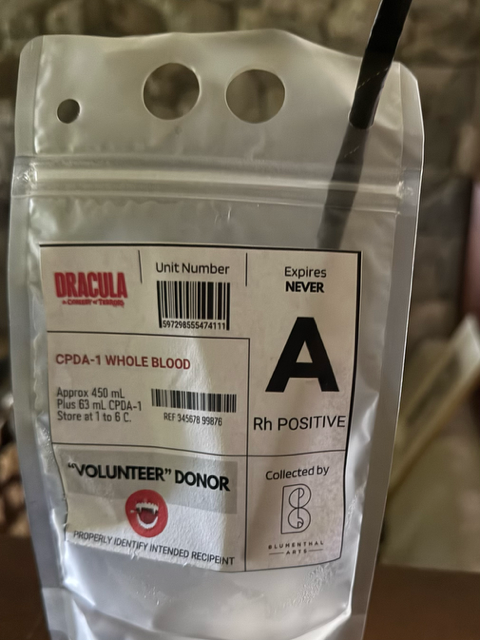
So it was under Greenberg’s direction on opening night at Booth Playhouse last week, where Blumenthal Arts is presenting the show through August 9. When it came to comedy, there was no suspense at all. Fanged marquees front the lobby off Founders Hall and over the Booth’s proscenium. Themed cocktails are among the sweets and beverages available at the bar, including the lurid “Type A,” served up in a blood bag with a straw. And of course, a swag stand at the other end of the lobby and selfie backgrounds in the middle.
It’s decades too late to accuse the Blumenthal and other tour backers of commercializing Dracula, don’t you think? Just enjoy.
A huge part of Greenberg’s comedy, from the aerosol and hobby horses onwards, is the cheap flim-flam of his theatrics. Skimping on scenery and realism isn’t all. This Dracula also skimps on players. No, our scenery budget cannot accommodate a real spiral staircase. Nor can our cast fill all the roles in our story without most of them doubling, tripling, or quadrupling the characters they portray.
They soldier on, patching the cracks with lame shtick, shameless mugging, cheap props, hurried costume changes, and – when all else fails – pure chutzpah. The flimsier the patchwork, the funnier it gets.
Skimpy is a better word for the outfit that Christopher James Stevens arrives in as the studly Count. No coat, no sleeves, and no shirt – but production photos do reveal a bit of a collar at the top of his sheer, elaborately woven David Bowie vest. The blonde Nordic hair is as sexualized as Dracula’s black jeans and studded belt.
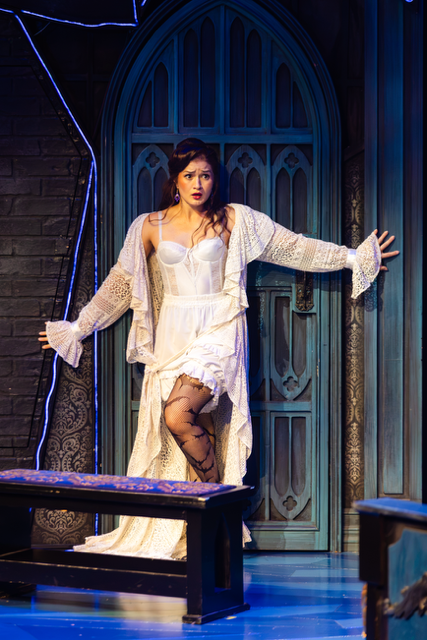
This old man looks really young. And his luscious, toothsome Lucy! What a Victoria’s Secret morsel she becomes when we see Adriane Leigh Robinson (through July 19) in her Victorian boudoir, besieged by a thirsty vampire who has never been so aroused.
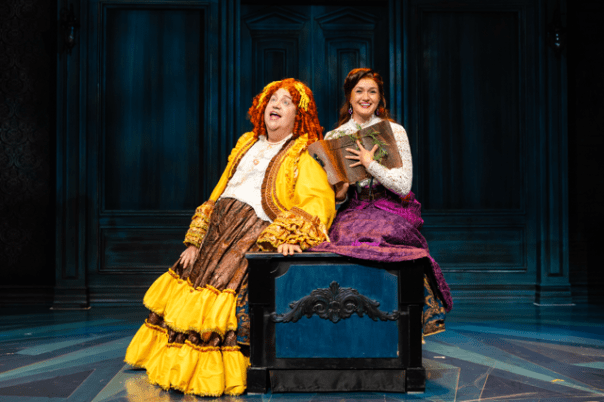
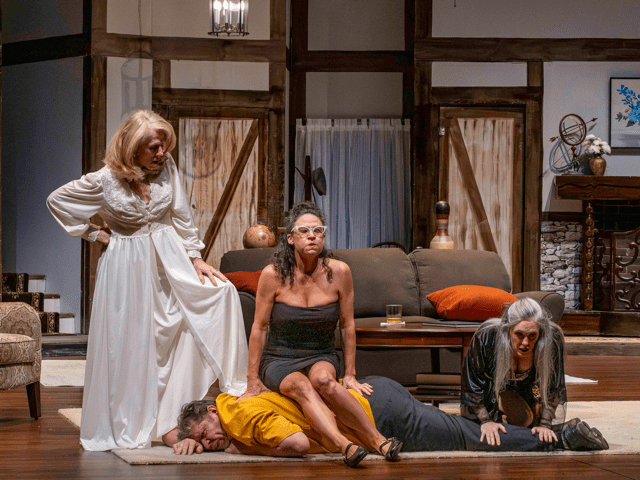
With so much excess and kinkiness already on demand, Greenberg compounds it by leaning enthusiastically into crossdressing. Not only do we get a bounty of elaborate outfits for Lucy and her Transylvanian worshiper, but costume designer Tristan Raines lavishes outrageously ornate dresses for , to cross-dress into as Mina – before and after Lucy’s ugly sister is bitten and undead – and out of as he transforms into a bustling female Dr. Van Helsing.
Crossdressing goes the other way for Kelly Bashar, who mainly fails to protect the siblings as their daddy, Dr. Westfeldt, when she isn’t moonlighting as the insane, insect-eating Renfield. Her costume changes are among the swiftest, especially funny when they’re on the run.
Though not as detailed, intricate, scenically sumptuous, or crammed with characters as the Brooks spoof, Greenberg and Rosen arguably skim Stoker’s storyline more faithfully. A couple of times, in letters from Jonathan Harker and Dr. Westfeldt, Greenberg and Rosen remind us that Stoker’s Dracula was often an epistolary novel when it wasn’t huge chunks of Harker’s and Mina’s journals.
So we begin with Jonathan as he travels to Castle Dracula, where his time is spent more on business, securing multiple properties for the Count in the London area, and not at all on being terrorized by bad dreams and ravenous vampiresses. As Bashar advises us, before transforming into a Man-Eating Wolf and later Dr. W, our presentation will be significantly shorter than the book’s 418 pages.
Harker is significantly different from Stoker’s vision of him – or anyone else’s. It’s almost so fine a runway for James Romney, this wonderful character arc of his, that he nearly steals scenes from Stevens’ flaming bisexuality and Robinson’s voluptuousness. He is no Indiana Jones in Transylvania, nor even a Brad from Rocky Horror. He’s a bit tremulous like Gene Wilder was as a leading man in horror films if he were played by Woody Allen, a nebishy weakling.
You begin to wonder what Lucy sees in him – and Lucy herself begins to harbor doubts. Compared with Lucy’s and Dracula’s wild animal libidos, Jonathan’s is a clam. But there is a delicious irony embedded in this Comedy of Terrors storyline, for Harker is startlingly transformed from the moment he is ravaged by his Transylvanian rival. He discovers the animal lurking within him, a midlife onrush of hormonal chaos and libido.
Suddenly, he is capable of fighting for Lucy’s love – and dressing in leather! With all the critical commentary that has been lavished on Stoker’s dark sexual themes, there’s little discussion of the possibility that Dracula is subconsciously crafting his own doom, fulfilling a secret death wish.
Comedy of Terrors brings that notion explicitly to the surface, a wild twist that might actually be a deep and discerning reading of the book. To stage that kind of welcoming of death, of course, Greenberg and Rosen violate all the rules of vampire invincibility by night and vulnerability by day. It’s a climax that audaciously challenges logic, physics, philosophy, and settled pseudo-science.
But it’s just so nutty and hilarious that we go with it. Especially if we’ve drained two Type A blood bags during the show.
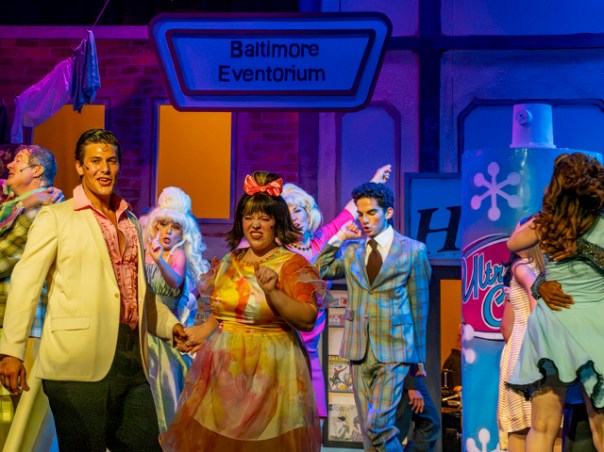
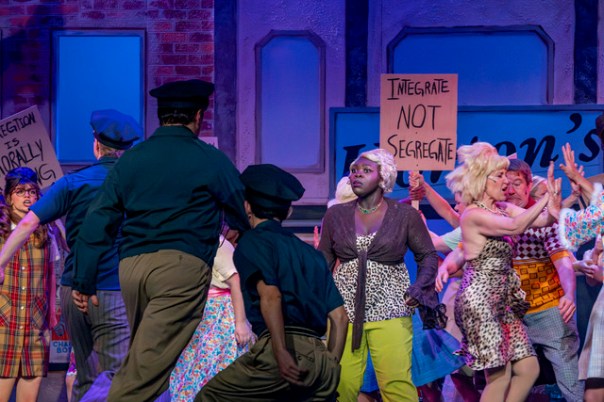
July 10, 2026, Matthews, NC – One of the most confounding things humans ask themselves and each other is “When are things going to change?” Too many things are changing all the time for that generalized question to be taken seriously – and too many people asking that question seriously have too little inclination to make change happen. In Hairspray, adapted from John Waters’ 1988 film, change comes to Baltimore in 1962, a year before Bob Dylan declared that “the answer, my friend, is blowing in the wind,” and two years before LBJ signed the Civil Rights Act into law.
Waters’ script was a rewrite of history that stuck, given new life by the Tony Award musical adaptation. Because you not only can change things with a winning strategy and sufficient effort; when you do, and you’re one of history’s winners, you get to rewrite history as you see fit and invent new heroes. Watching Tracy Turnblad spark change in 1962 Baltimore, you just set aside the need for JFK, Dylan, MLK, and LBJ for a couple of hours. Leave it to Tracy, supported by her dad, to rally a whole city and overturn segregation at a teen dance show on local TV.
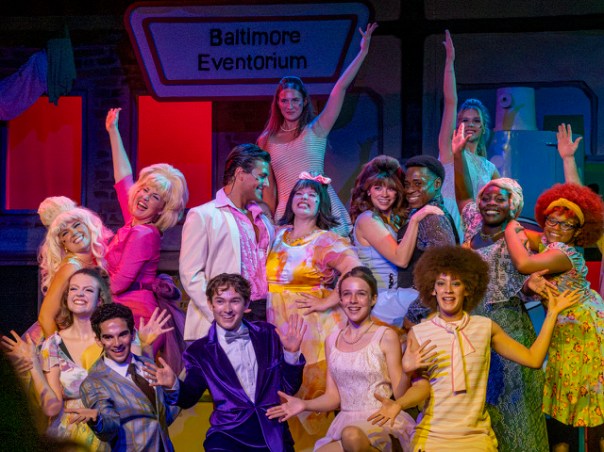
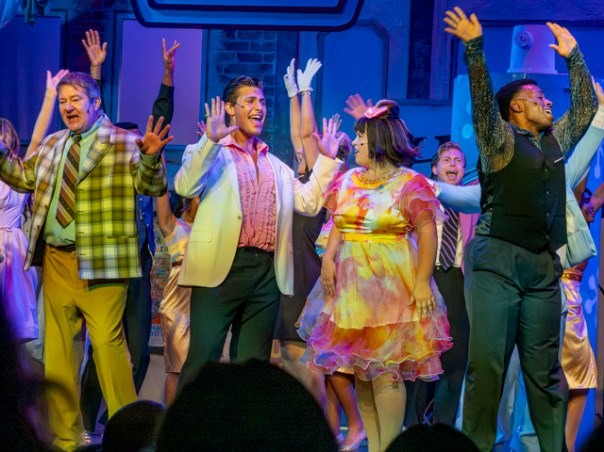
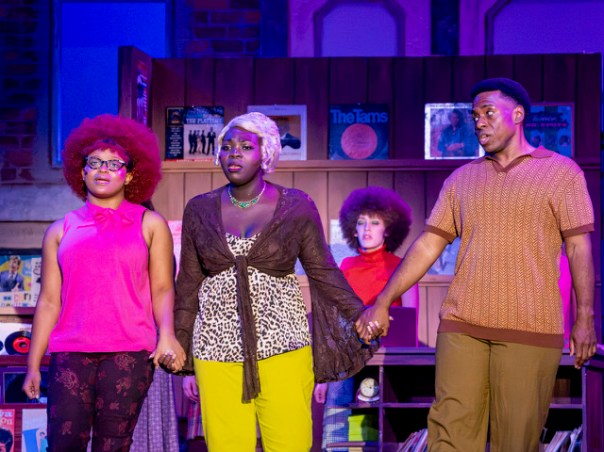
The current Matthews Playhouse production, directed by Sidney Horton, reminds us why Hairspray not only won Best Musical in 2003, but seven additional Tonys. These included Thomas Meehan and Mark O’Donnell for best script and statuettes for Marc Shaiman and Scott Wittman honoring their best musical score. When Horton put out the casting call, the Metrolina talent pool could eyeball four different roles that were juicy enough to deliver Tony nominations to the original Broadway cast. All three Turnblads won the prize, led by Harvey Fierstein as Edna, who undergoes a personal makeover, inspired by her plucky daughter.
Watching Horton’s players at the Matthews Playhouse, you may find yourself surprised that only four original cast members won Tony nominations. What about Corny Collins, the deejay who fronts the afternoon TV dance-a-thon, receptive to the new grooves on the airwaves and open to featuring Blacks more often than on the current once-a-month “Negro Day”? Or Motormouth Maybelle, Corny’s counterpart when the Afro-Americans get their brief chances to shine? Or Link Larkin, the dreamboat teen idol Tracy craves, pragmatic about his career, yet open to developing as a musician and a person?
All three of these prove to be plum roles for Johnny Hohenstein, so charismatic last July as the iconic baddie in Peter and the Starcatcher, and two newcomers, Carter Poulson and Olivia Greene. Corny’s pragmatism allows Hohenstein to be different characters when he’s on-air holding a mic, behind the scenes sparring with his station manager or the show’s sponsor, and out in the wild scouting talent. It’s a less outré ride than Black Stache, but there’s a wider range of phoniness to savor.
At first, Poulson appears to be the trophy boyfriend of fellow Corny Collins regular Amber Von Tussle, the daughter of WZZT station manager – and former Miss Baltimore Crab – Velma. But when Corny suggests that he croon his new song, “It Takes Two,” as a serenade to Tracy, newly installed on the show over the Van Tussles’ objections, he addresses only his opening overtures to Amber. With both lasses vying for his attention, Tracy nearly drooling, Poulson’s appeal swells the more he croons and swivels his guitar from back to front. Then he comes on to Tracy with a cinematic zeal that would make any girlfriend jealous. A dreamboat’s dream kiss ends the song.
Thematically, Maybelle may be pre-eminent in Hairspray, the mother that Tracy, her bestie Penny, and Amber should have had in their earlier years. Off-air, she’s the den mother to all the talented Afros on TheCorny Collins Show who have been relegated to second-class status. Her own brood includes Seaweed, the Afro stud who teaches Tracy and Link some slick moves, and Little Inez, whose audition for the open slot on Corny’s show is doomed by her race. As this living rebuke to Velma, Greene needed to be a big personality from the start. She must grow bigger when she and Tracy lead a street demonstration outside WZZT, demanding desegregation. By the end of the show, Greene must sing “I Know Where I’ve Been,” the anthemic peak of Hairspray.
In her auspicious Matthews debut, Greene showed us that her role in the doo-wop trio in Theatre Charlotte’s Little Shop of Horrors was a mere foretaste of her capabilities. True, she seemed a bit small for Motormouth’s shoes when we first saw her, yet she was more than ample for her climactic showstopper, her crusading gospel spirit getting by far the loudest roar from the opening night audience prior to the big crowning of Miss Teenage Hairspray and the spectacular Edna Turnblad reveal.
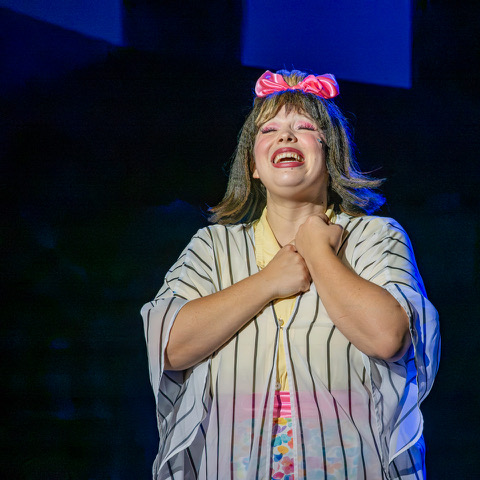
So at various times, the Turnblad clan was gloriously upstaged at Matthews’ Fullwood Theatre. When they’re all professionals or seasoned community performers, that’s not a problem at all. Although I’d never seen her in performance before, Logan Cosper took command of the full Fullwood stage as Tracy from the moment we woke up with her in “Good Morning Baltimore.” Not really your ideal candidate for body shaming, Cosper’s only truly plus-sized aspects were her energy and her smile. As the stage fills up around her, making her way through the city to her high school, those two ingredients are perfect: she needs that sunny cheer so the comedy will click when she passes a drunken derelict on the street. And make no mistake: she’s not merely one of Link’s admirers; she’s his most fanatical. We see significant personal growth from there.
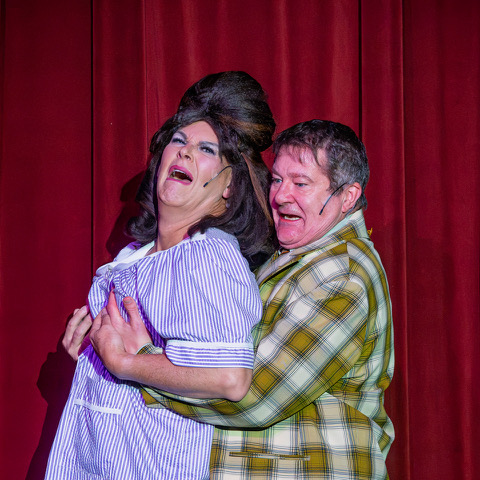
If you spotted Leopard at Booth Playhouse a couple of months ago in his leather motorcycle outlaw outfit in Queen City Concerts’ We Will Rock You, you likely emerged with the impression that he’s way tall and rail thin, not the best fit for Edna. But if you’ve caught him at Theater Charlotte in either Something Rotten! or The Producers, where he formally cross-dressed as the Chrysler Building,you would also realize that sashaying and drag are right up his alley. God and costume designer Beth Levine-Chaitman only know what garments and appliances may lurk under Edna’s housecoat and subsequent makeovers to transform Leopard into the Turnblads’ plus-sized fashion plate.
Yet I was a wee bit disappointed to see him so controlled and disciplined. Leopard’s voice could have been an octave lower at key moments for the fullest plus-sized Edna experience. Nor were the constraints strictly directorial. The kitchen or laundry room that scenic designer Chris Morgan provided for Tracy’s mom and dad was woefully minus-sized, barely allowing breathing, let alone stateliness or flamboyance. For the novelty showstopper, Edna’s “You’re Timeless to Me” duet with Wilbur, Horton wisely closed the curtains on the entire set. The effect was very vaudevillian, drawing lusty ovations before and after the couple’s reprise.
That duet was probably the best hook-up between Horton and choreographer Rachel Peterson – or one of the turning points. Through most of Act 1, dancers often moved in place rather than zipping around, so the tableaus lacked depth until the climactic chaos of the protest riot at WZZT. Seemed to me that the onrush of cops and Billy clubs was what transformed the righteous protest into a riot. You can be the judge whether Horton is making that point.
Honoring (or disregarding) the script, Horton allows Mike Carroll, in one of Levine-Chaitman’s tackiest costumes, to attend the big integration protest as Wilbur. Yet somehow, he isn’t arrested along with his family, the Von Tussles, and the Black folk. Overnight during intermission, he is able to sell his store and raise bail for everybody – except Tracy, specially targeted by the malign Velma. So despite his seeming subservience, Wilbur is a mover and shaker, a chief driver in the changes dramatized in Hairspray.Not only is he a struggling store owner, but also a believer in Tracy’s ambitions, in Edna’s dormant dreams, a liberator of jailed protestors, and a supporter of Tracy’s adopted Black community. Along with Tracy, Maybelle, and Corny, truly one of the chief engines of change.
Yet at times, Carroll makes Wilbur cuddly if not diminutive. You may recognize a Buddy Hackett impishness to him in his “You’re Timeless to Me” serenade, before and after Edna warms to it. Apparently, he isn’t Jewish. His best quip, “Shabbat Shalom!” was mangled beyond recognition on opening night, with none of the requisite gusto. OK, Horton does not have the right DNA to make the correction by himself, but where were you, Levine-Chaitman, when we needed you?
On the other hand, we can probably credit L-C for the horrid wigs that crowned the VanTussles’ toxicity, so we can partially commute whatever punishment she deserves for not supplying Carroll with the necessary Hebrew. Keenan Tabor as Velma was far more repellent as Velma when the spotlight was on her for “Miss Baltimore Crabs” in Act 1, but the apple didn’t fall far from the tree when Layne Harder seized center stage for her “Cooties” showpiece. Most of the bug motif that infested the original Waters movie has been fumigated in this Meehan-O’Donnell adaptation. Mercifully so, but Harder’s opportunities to be singularly noxious are curtailed and muted by this cleansing.
Who to single out among all the other players? Todd Burnette as Seeweed Stubbs was likely the coolest, hippest sight on stage, and Eve Monroe as Little Inez – the standout WZZT auditioner spurned for her race – also springs instantly to mind. As Tracy’s best friend, Penny Pingleton, Corinn Bordelon doesn’t gush over Burnette as Cosper does over Poulsen, but she’s ready enough for love in her shy way. In the breakout double-duet, “Without Love,” where both of the young couples exult over their newfound bliss, it’s a shame that the volume of the eight-piece band, so zestfully led by Ellen Robison, threatened to drown out Bordelon’s most hilarious lyric.
That budding romance Waters filmed in the late 80s wasn’t quite daring enough to say, “now I’ve tasted chocolate and I’m never going back.” So our journey back to the twist and shout and the Madison of the 60s has a sprinkling of the new millennium. Change is good.
July 16, 2026, Davidson, NC – Thanks to its Gallic amorality, Marc Camoletti’s Don’t Dress for Dinner has aged rather gracefully. After its eager reception in Paris as Pyjama Pour Six in 1985, when cads and mistresses had to content themselves with landline communication if their affairs were about to be discovered, a London translation by Robin Hawdon opened to comparable success in 1991. We didn’t see this fast-paced farce in Charlotte until two months before Camoletti died in 2003, a decade after its American debut at Paper Mill Playhouse in New Jersey – and nine years before its Broadway premiere.
Since the BareBones production of ’03, the piece has been presented to Metrolina audiences exclusively in Davidson, by Davidson Community Players in 2005 and 2015, and currently by DCP’s offshoot, Matt Merrell Productions, founded by DCP’s former executive director. The latest edition returns to Duke Family Performance Hall, on the lovely Davidson College campus (currently disfigured by a massive construction project near the Student Union where the theater is housed), where DCP ran an astounding Evita less than a month ago. The quality of the playing, directed by Andy Rassler, reaches a level parallel with the Andrew Lloyd Webber musical. Sadly, though, all those accomplished players are off-mic.
The action is triggered by Bernard in the burbs of the Big Apple, where he has planned to wine and dine his mistress, a model named Suzanne, on her birthday while his wife Jacqueline is away from the summer home visiting her mother. Haste is built into the sleek machine of this farce from the outset, since Bernard needs to whisk his wife out the door before Suzanne walks in. Before this key objective can be met, Jackie intercepts a phone call from the caterer letting Bernard know that the cook, Suzette, is on her way. Somehow, Jackie is sufficiently acquainted with her husband’s foibles to have her suspicions aroused.
Bernard thinks he has come up with an alibi, but he’s disastrously wrong. He has also invited Robert over for this catered dinner, whom Jackie is sure to remember as the best man at their wedding. Trouble is, Jackie is Robert’s mistress – so the main reason Robert has accepted Bernard’s invite is that he might be able to shack up with Jackie. Similarly capable of adjusting on-the-fly and deceiving, Jackie finds a way to cancel her trip, presumably with romantic weekend plans that align with Robert’s.
While the wily Bernard triggers the action and the comedy, poor unsuspecting Robert is trapped at the center. Counting on their longtime friendship to keep his infidelity under wraps, Bernard asks Robert to pretend that Suzanne is his girlfriend when she arrives. Tough spot. As freely as Jackie and Bernard will both engage in infidelity, Robert must now make the impossible calculation on which of the two would be angrier upon discovering that she or he was betrayed.
The arrival of the two women, Suzanne and Suzette, compounds the complications. As much as their names sound alike, Camoletti intends their appearances to be radically different. Suzette, we’ll discover, is married to a human bulldozer, George, who is capable of intimidating – and manhandling – both of the other men at the same time. Nevertheless, when Suzette arrives before Suzanne (Bernard and Jacky are out food shopping for things to cook), Robert somehow presumes that it’s Bernard’s mistress ringing the doorbell.
The ensuing get-acquainted conversation, based on wild mutual misunderstandings, is classic, easily worth all of Camoletti’s contrivances. Robert, thinking that sleeping in the same bedroom with Bernard’s mistress is a small part of his assignment, is a bit shocked when Suzette starts off by asking him to show her “where everything is.” Meanwhile, the cook is almost equally alarmed that the strangely rattled Robert needs to know more about her before showing her the kitchen so she can get to work.
Robert’s mistake only assures that more difficult challenges lie ahead when Bernard returns, Suzanne arrives, and new deceits must be devised. How will Jacky’s wrath be averted if Robert sticks with his girlfriend pretense? How will Bernard and Suzanne react when they learn that the slot reserved for Robert’s girlfriend has been filled? How will that fancy dinner get cooked?
Once Robert initiates his mixed-up girlfriend charade, we can be sure that a placid evening does not lie ahead. How happy will Suzanne’s birthday be if she must now don Suzette’s cook uniform and confine herself to the kitchen? If Jacky’s rage veers out of control, how will his secret keep safe from Bernard’s discovery?
In real time, all the misperceptions, panicked changes of plans, and raging discoveries are more than dizzying enough to keep an audience leaning forward to keep pace. It’s also hard for Camonetti’s characters to adjust sometimes: often the barrage of comedy emanates from somebody reflexively blurting out the truth – or a lie that has been superseded by circumstances and changes in plans.
On opening night at Duke Performance Hall, most of the audience couldn’t lean forward enough because the players were often inaudible, short on energy and lacking amplification. Though Rassler’s directing and Della Knowles’s costume design made it clear enough that Lacy Camp was not the knockout model Bernard had foretold, my wife Sue and I didn’t know who or what she was when she arrived. That’s how much of the dialogue we had missed in Row H. My own initial surmises ranged from masseuse to physical therapist until I caught on.
Merrill absorbed most of the assaults as Bernard when the comedy mayhem got physical, obliging him to be the first to climb into his pajamas. He probably sustained the most energy vocally until Brian Rassler arrived late in Act 2 as George, the husband who will have gripes with both of the other guys. But Merrill’s physical energy was fine, enabling us to track Bernard’s ebbs, flows, and on-the-fly calculations as they twisted the plot.
Lou Dalessandro, who has played the high and mighty right up to Macbeth, comes off surprisingly well as the hapless victim, Robert. You almost had to adore him when he reacted with such obvious shock to Camp’s appearance and proceeded to go with the flow – after objecting so vehemently minutes before to Bernard’s scheme.
Camp is not only the most inscrutable of the players as Suzette. She is also the most frequently inaudible. She does transform handsomely from dumpy cook to a plausible, jealousy-worthy girlfriend, relishing that slinky physicality. Camp also logged maximum mileage demanding and receiving extra cash for services beyond the culinary, a zestful working-class opportunist.
All the ages of the principals have been discreetly adjusted upwards, both from the script and the 2003 BareBones premiere, yet Karen Christensen is still a marvel in tossing off the role of Suzanne a full 30 summers after first appearing on my radar. It wasn’t age that Christensen added to Suzanne’s glamor as much as a patrician elegance. There was a bit of goofball poutiness to Christensen as Suzanne sulked off to the kitchen, but she somehow managed to mix in an air of condescension.
No doubt about it, Jacky remains the she-who-must-be-fooled adversary through most of the evening – until the action suddenly flips and Bernard’s fury is kindled. So Cat Rutledge perhaps had the most reason from start to finish to keep her energy blazing hot, whether in suspicion, jealousy, or amorous passion. She actually performed rather well, but because she had a head start on drawing our ill will, she likely drew the most frustration when the audience struggled to hear the verbal barbs and nuggets in the script – or failed to follow what was going on. Just a half dozen well-deployed microphones would have made opening night so much more enjoyable, possibly sparking the standing ovation that didn’t happen when the cast took their bows.