Review: One Thousand Pieces at Knight Theater
By Perry Tannenbaum
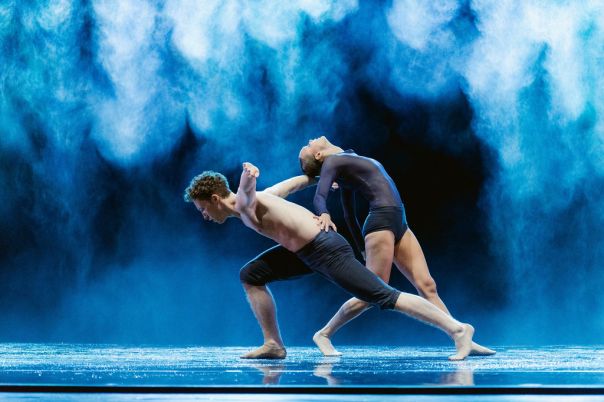
May 7, 2026, Charlotte, NC – Amid the war and surging gasoline prices, you’ve probably heard: it’s time to celebrate! Our semi-quincentennial is just around the corner, and when Charlotte Ballet artistic director Alejandro Cerrudo went about crafting his troupe’s 2025-26 season, he had no idea that his quite appropriate celebration – and his first evening-length choreography to be presented in the Queen City – would be clouded by blood, smoke, anguish, and official federal lies and hypocrisies. Or maybe he had a brilliant premonition about the eerie July 4th now looming before us, to be glorified by a leader who openly flouts the US Constitution. For Cerrudo’s One Thousand Pieces, first unveiled in Chicago when the Spanish-American artist was the resident choreographer at the prestigious Hubbard Street Dance in 2012,is unexpectedly dark, monochromatic, and hypnotic.
Credit the darkness and monochromaticity to Thomas Mika’s costume design, and to the dark background of his scenic design, which, at its liveliest, obscures or reflects the 24 dancers shuttling on and offstage, with numerous 8-foot-tall mirrored windows sliding along the floor. Redeployed after a curtain drop, three of these windows are suspended in air, gently swaying and revolving. All of this moving glass is eminently suited to the minimalist music of Philip Glass, whose famously repetitive arpeggios produce the hypnotic effect, though Cerrudo has curated his choices discerningly into a delicious mixtape of what sounded like a couple of dozen different Glassworks.
But it wasn’t a tape. We were treated to the Charlotte Symphony performing live, led by resident conductor Christopher James Lee, who mirrored Cerrudo’s enthusiasm for Glass through the zest of his players. Whether or not Glass grabs you, his music definitely attacks in Lee’s hands. Nor was the texture unflaggingly orchestral as guest pianist Phillip Bush fronted a string quartet of Symphony worthies, including first violinist Kari Giles, second violinist Kathleen Jarrell, violist Benjamin Geller, and cellist Jon Lewis.
Glass will be celebrating his 90th birthday next January, so One Thousand Pieces is nearly as appropriate as a celebration of his music as it is of America. Maybe more so, depending on how successfully you feel Cerrudo’s choreography evokes his original inspiration, Marc Chagall’s America Windows. The 2012 debut of One Thousand Pieces coincided with the 25th anniversary of Chagall’s work, unveiled a year after America’s bicentennial as a gift to the Art Institute of Chicago. Though there is dispute about exactly how to interpret the windows, AIC’s official description says that the three window panels, measuring a total of 258 square feet, “merge symbols of US history, the Chicago skyline, and the arts; read from left to right, the panels represent music, painting, literature, architecture, theater, and dance.”
If Cerrudo’s choreography seems surprisingly dark, so do Chagall’s Windows, notwithstanding their Chicago skyline, New York’s Statue of Liberty, assorted birds, musical instruments, and flying people. It was a must-see for me and my wife, Sue, when we visited Chicago, coincidentally in 2012.We were not disappointed, but we were certainly not overwhelmed. In terms of brightness, cheer, and scale, Claude Monet’s epic Water Lilies painting at MOMA is brighter-hued and marginally larger, while each of Chagall’s two murals at opposite ends of the Met Opera lobby, one in rosy red and the other in sunny yellow, is more than four times the size of his America, visible across the Lincoln Center campus from distant Columbus Avenue.
Celebrating a stained-glass masterwork with music by Philip Glass seems like a natural impulse, no matter how dark the original and the tribute may be. Yet there are unforgettable moments of whimsy, joy, and wonder lurking within Cerrudo’s staging and choreography that break free of the prevalent darkness and monochrome.The first of these comes promptly at curtain rise when the lower lip of the curtain lifts one of the dancers off the floor. He lets go before Charlotte Ballet needs to worry about hiking their insurance payments, destined to reappear from an even loftier perch between Scene 1 and Scene 2 before intermission. Lowered from the ceiling of the orchestra section of the hall, he will tell us a brief tale of eternal love – wearing a harness that enables him to float without worry.
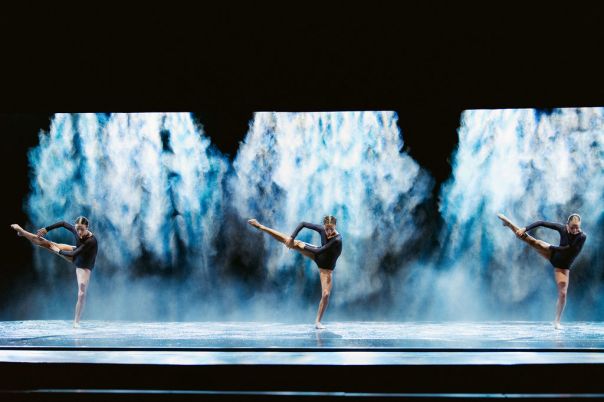
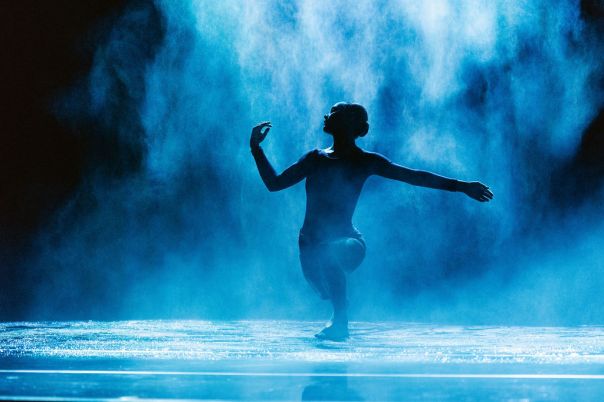
The last curtain rise before intermission revealed Cerrudo’s most joyous scene as three sections of streaming mists formed behind the dancers, lit in multiple shades of green, blue, purple, and white, merging and remixing in midair as they fell to the floor. Matching this sudden shower of color, the style of the choreography also perked up. Until now, the default mode of partnering lowered the dancers’ bodies toward the floor as they tugged at each other or slinged one another, without jumps or lifts. Adding the water to the stage floor, Cerrudo certainly didn’t risk sending his dancers airborne over the damp, but he freed his troupers to frolic in the water, sending gleaming dewdrops merrily into the air as they splashed around the floor. Occasional kicking motions jubilantly affirmed that there was nothing incidental or accidental about the waterdrops flying across the stage.
It could have been my imagination, but Glass’s music grew jazzier here, especially when played by Bush and his quintet. The catchy curlicues of melody that erupted here were certainly not a mirage.


