Tag Archives: Emily Hunter

“Young Frankenstein” Delivers Excess, Glitz, and Glorious Shtick

Review: Young Frankenstein at Matthews Playhouse

By Perry Tannenbaum

July 12, 2024, Matthews, NC – Just turned 98, Mel Brooks has overachieved in every way possible, including longevity. Yes, he wrote the music and lyrics in adapting his own Oscar-winning script, The Producers, into a Broadway musical. If that 2001 megahit was the most prodigious and successful transformation of his career – already past 50 years as a writer, comedian, and actor – then his 2007 follow-up, Young Frankenstein, was the most natural.

Mel had already stolen Irving Berlin’s “Puttin’ on the Ritz” and Victor Herbert’s “Ah, Sweet Mystery of Life” to gild two of the most shining moments of the original film, shot in retro black-and-white. Composing his musical adaptation, Brooks stole some more, changing the ardent lyrics of “One Song” from Disney’s Snow White into a deliciously salacious “Deep Love” after the Broadway edition’s third coital climax.

There are some rather filthy connotations strewn throughout our horrific romp through Transylvania, enough for Matthews Playhouse to caution parents against bringing youngsters under 13 to the current production. But stage director Jill Bloede presents each granule of this glorious filth with bawdy, bodacious, and childish glee at Fullwood Theater. Scenic designer Marty Wolff, costume designer Yvette Moten, lighting designer Jeffrey Childs, and choreographer Emily Hunter are all let loose to fashion fresh layers of excess and glitz.

A whole second stage opens up behind the teeming downtown Transylvania downstage when we reach Victor Frankenstein’s secret laboratory hidden behind the mad scientist’s library – an installation that permits special effects designer Roy Schumacher to make the moments of creation and coition inside the lab more spectacular.

Brooks’s venerated comedy reputation and Bloede’s every-shtick-in-the-book approach have drawn a bounty of professional grade talent to this cast. Wearing a frizzy Gene Wilder hairdo, Neifert Enrique cements his elite credentials as Dr. Frederick Frankenstein, grandson of Mary Shelley’s “Modern Prometheus,” bringing a youthful wonderment to the role that makes all the lead women’s roles a little plumier. If you missed Nick Culp’s outdoor exploits as Columbia in The Rocky Horror Picture Show during the pandemic, one of Actor’s Theatre’s valedictory efforts, his Matthews debut as Igor will likely come as a revelation, though he looked way closer to Fester Addams than to a hump-backed Marty Feldman. Lungs of steel and a wicked comedy flair.
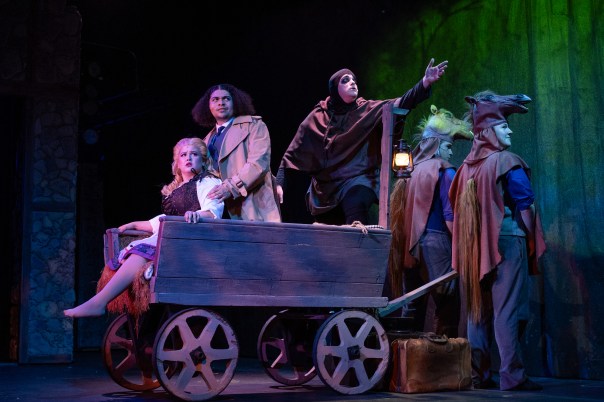
With Mary Lynn Bain as noli-me-tangere New York socialite Elizabeth Benning and Gabriella Gonzalez as Inga, the cheery and buxom Transylvania peasant, the contrast between “Please Don’t Touch Me” and “Roll in the Hay” is as radical as any horny Frankenstein could wish. Bridging this chasm is The Monster, endowed by Brooks with a super-virility that surely would have drawn a polite giggle from Ms. Shelley. Hulking Matthew Corbett, roaring and bellowing with the best, makes Elizabeth’s deflowering a special joy, for while he is melting Bain’s ice maiden inhibitions, Brooks cooly has him overcoming his fear of fire.

Now we easily can find on YouTube that Peter Boyle actually danced in the Hollywood version, but the “Ritz” extravaganza concocted by Hunter is arguably more demanding, with Moten outfitting a good chunk of the Transylvanian peasantry in white tuxes. Top hats and canes for all the gents! We can’t call him Bojangles just yet, but Corbett contributes handsomely to the tap segments.

With leading roles in The Producers, La Cage aux Folles, Cabaret, and Ruthless! over the past 30 years, the charismatic Steve Bryan is a bit of overkill for his cameo as the Hermit. Decked out like a medieval monk, with a wig worthy of Joan Crawford in her dotage, Bryan is perfection as The Monster’s blind and bumbling host, not a trace of a smirk as he scalds his starving guest with soup – a comical affirmation of the beast’s docility as we delight in Corbett’s bellowing. Typical of his elegance, Bryan didn’t milk the last drop of deathless pathos out “Please Send Me Someone” before Corbett’s on-cue arrival answered his lonely prayers. True, Bryan got down on his knees begging, but he never once cried out for his mammy. Maybe next week.

Taking Down a Classic Thriller, Lateral Lisp and All

Review: Silence! The Musical

By Perry Tannenbaum


SILENCE 11

From God of Carnage to Hand to God to The Toxic Avenger and beyond, I’ve seen many of the original Broadway and Off-Broadway shows that Actor’s Theatre of Charlotte has gone on to present in their Queen City premieres. What is singular about Silence! The Musical, perhaps unprecedented, is the fact that the original New York production at PS122 was unquestionably smaller, shabbier and more low-budget than the one currently playing at Hadley Theater on the Queens University campus.

This Charlotte debut is seven years more distant from Silence of the Lambs, the Academy Award winning thriller that Hunter Bell and his musical cronies, Jon and Al Kaplan, targeted with their satiric mischief and malice. Back in 2012, I was already bemoaning my failure to refresh my memories of the 1991 film with a full viewing before I went to see this nasty sendup.

Oops! I neglected my own warning last week, allowing my aging VHS tape to gather seven more years of dust before heading out to see what director Chip Decker and his cast would do in their assaults on Jodie Foster and Anthony Hopkins. I must confess that my perspective was more than a little skewed, for by August 2019, I found myself remembering the Bell/Kaplans musical at least as well as the Jonathan Demme film.

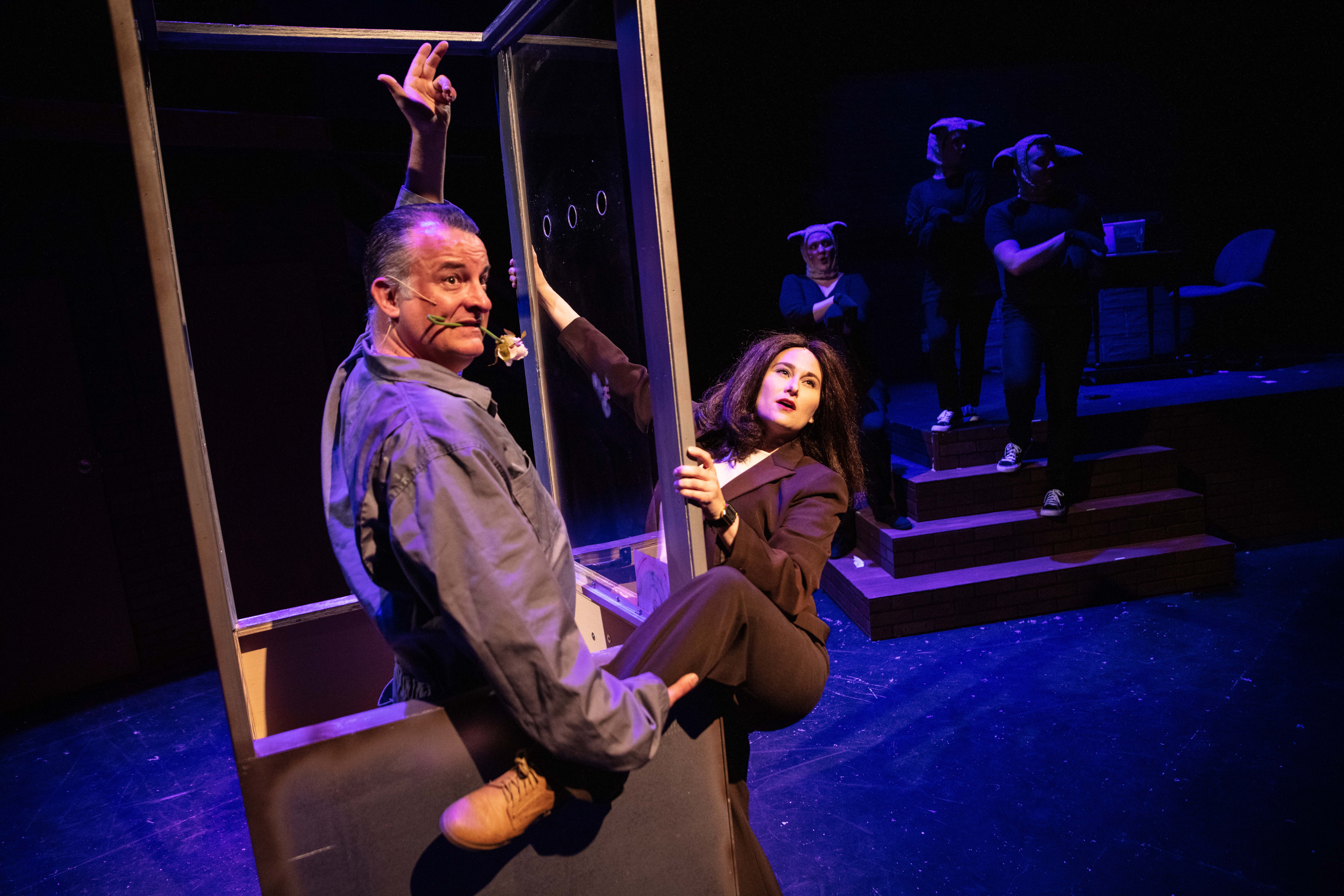
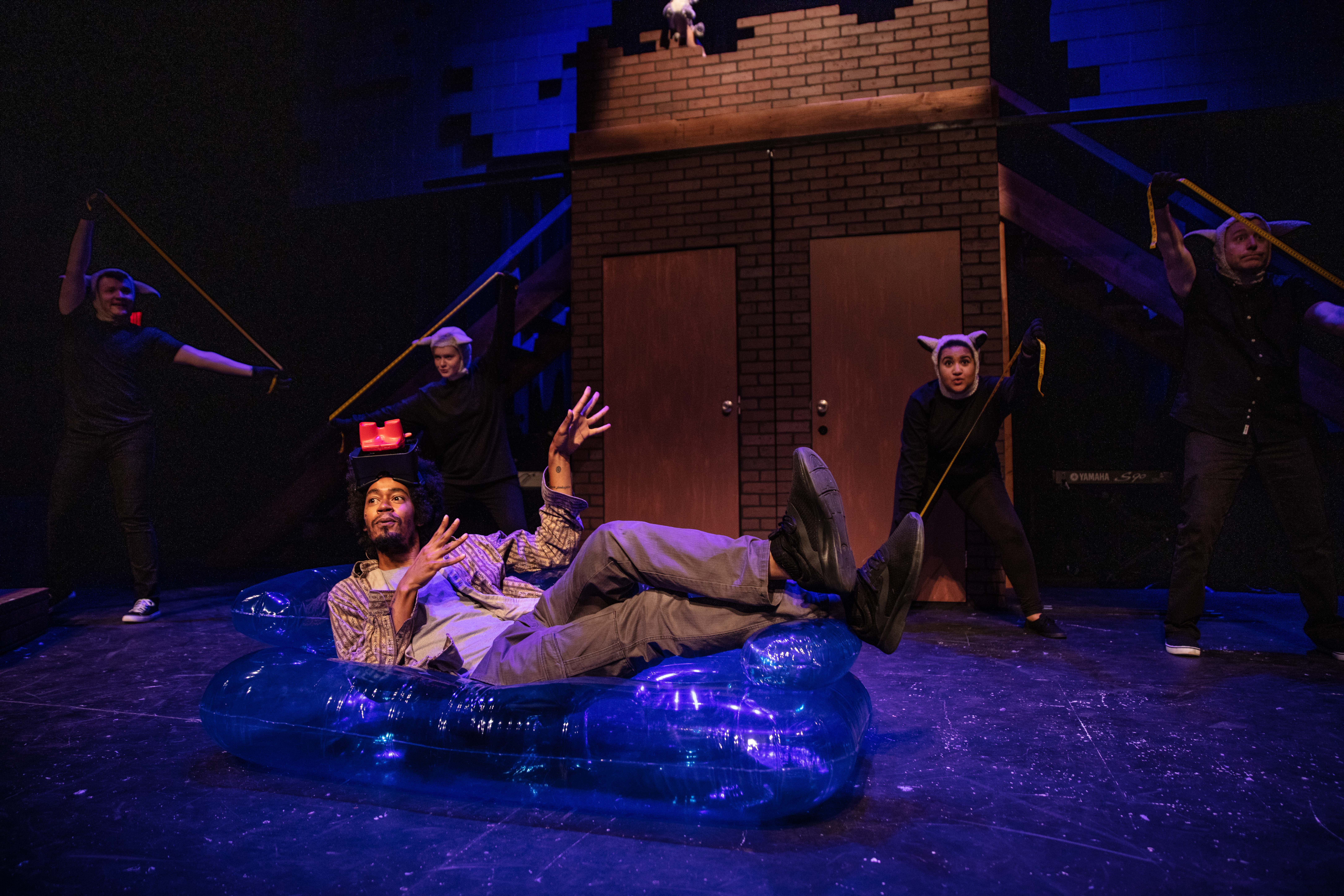
What I remember most about the PS122 show, besides its fundamental crassness and cheapness, was its dimly-lit, wicked cult ritual ambiance. Reasonably enough, Decker and his design team are going for something different: a musical! Evan Kinsley’s set design spans the Hadley stage and so does Emily Hunter’s choreography, with a gamboling chorus of Lambs in a matched set of wooly white ears by Carrie Cranford.

Where Actor’s Theatre, Off-Broadway, and Demme intersect best are in the takeoffs on Foster and Hopkins. Leslie Giles has a veritable feasht exaggerating FBI trainee Clarice Starling’s lateral lishp, surely enough to convulse audiences seeing this Foster takedown for the first time, but not as mean and relentless as the mockery Jenn Harris dished out in New York. What will further delight Charlotte audiences, however, is the sweet bless-her-heart drawl that Giles lavishes on Clarice’s entreaties and interrogations – and her expletive explosion when her sexist boss slights her is a comedy shocker.

There was plenty of seediness in the original Lambs for the Kaplans and Bell to build on. Clarice’s confrontation with Hannibal the Cannibal results from her boss’s unsavory idea of sending Starling down into the bowels of a criminal madhouse to pick Lecter’s brain – hoping that the psychiatric insights of one serial killer can help the FBI catch another. Maybe some kind of natural attraction will coax Dr. Lecter into opening up. Clarice’s descent into the Baltimore loony bin confirms that a rare visit from a woman will indeed rouse the snakes in the pit as the trainee walks the gauntlet of cells leading to Lecter.

SILENCE 1

A couple of the arousals fuel the most memorable moments of ejaculation and rapture. After the best spurt of physical comedy, we reach the innermost sanctum where the Cannibal is caged, and the shoddy cheapness of his protective enclosure becomes one of the show’s numerous running gags. At the climax of the first Lecter-Starling tête-a-tête, Rob Addison gets to deliver Hannibal’s deathless love ballad, “If I Could Smell Her Cunt.”

Addison’s rhapsody mushrooms into a ballet fantasia centering around Ashton Guthrie and Lizzie Medlin’s pas-de-deux as Dream Lecter and Dream Clarice. While Hunter’s choreography is more than sufficiently purple and passionate, we fall short on crotch crudity from Giles, and Cranford’s costuming muffs the opportunity for the Lambs to deliver a labial flowering. Yet it’s here that Addison is surpassingly effective, for his creepy drone as Lecter not only replicates the familiar Hopkins bouquet, but his singing voice is robust and raspy. We stay firmly in an Off-Broadway joint during Addison’s rhapsodizing instead of detouring, as PS122 did, into Broadway spectacular.

SILENCE 5

Other than the equine Mr. Ed, I couldn’t fathom what Jeremy DeCarlos was going for in his portrayal of the at-large crossdressing serial killer Jame Gumb, alias Buffalo Bill. To make things worse, production values reach their zenith when DeCarlos sings his showstopper, “Put the Fucking Lotion in the Basket,” to his latest captive, Senator Martin’s suitably plump (“Are You About a Size 14”) daughter Catherine. If Kinsley hadn’t troubled to elevate his sadistic serial killer to such a commanding height on his impressive set, flimsier security arrangements similar to the Cannibal’s would have played funnier.

Rest assured that verisimilitude isn’t a top priority elsewhere in Decker’s scheme. Kacy Connon excels as both Senator Martin and her daughter Catherine while Ryan Dunn shapeshifts from Clarice’s dad to agent-in-charge Jack Crawford, all without discarding their Lambketeer ears. Dunn’s eyeglasses shtick worked every time with the opening night crowd, and in welcoming Clarice to the institutional home of Hannibal, Nick Culp sleazily Clarice set the tone for the unfettered lechery to come.

SILENCE 4

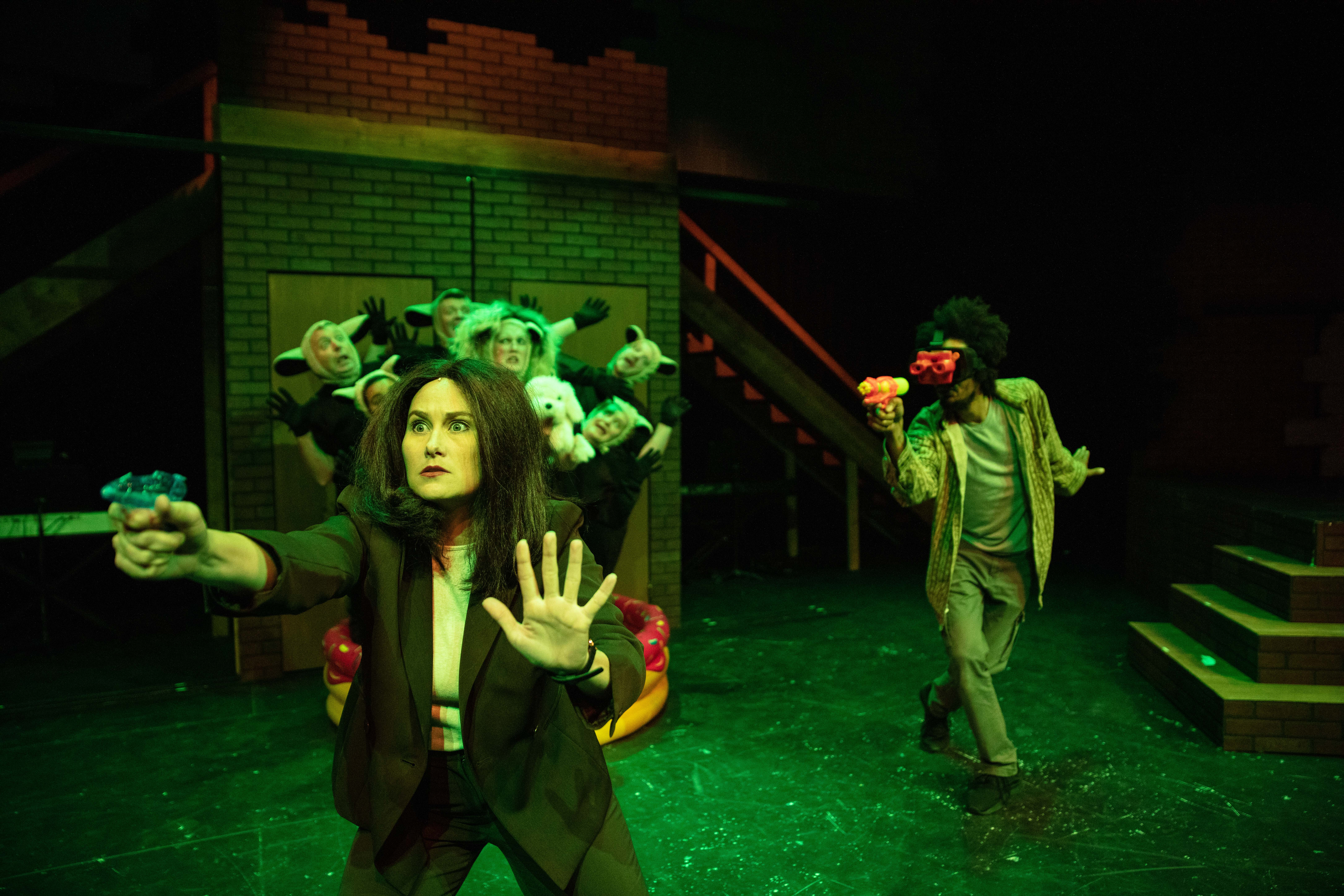
Clarice lucks out when Crawford cruelly reassigns her, but she shows up unawares and unprepared at Buffalo Bill’s lair. That disadvantage results in the last of the three scenes we remember best from the screen thriller, the duel to the death on Bill’s home turf in pitch darkness, Clarice armed with her automatic pistol and the psychopath wearing night vision glasses. Peppered with song (“In the Dark With a Maniac”), this parody comes off as winningly as the great prison sequence where we first encountered Lecter – and better than the previous climax when the Cannibal escapes.

Hallie Gray’s lighting design is a valuable asset when tensions intensify, and Kinsley’s tall scenery isn’t a total waste. At times, it adds to the absurdity of the Lamb chorus, but it pays off most handsomely at the end in Hannibal’s demonic farewell, adding a dimension that even Hollywood couldn’t boast.


“Lizzie” Whacks the Bordens in a Creepy, Hard-Rock Witches’ Brew

Review:  Lizzie

By Perry Tannenbaum

It’s amazing what murdering your mom and dad can do for your outlook, for your self-esteem, and especially for your fashion sense. Back in a radically revisionist 1892, Lizzie Borden took an axe and, in a vigorous aerobic workout totaling 81 whacks, achieved all of these wholesome objectives. Or so Lizzie, a rock musical playing at Queens University in a devoutly raucous Actor’s Theatre of Charlotte production, insists on telling us, piling onto the lurid Lizzie urban legend and her bloody skip-rope rhyme. Steven Cheslik-DeMeyer and Tim Maner began work on this musical a couple of years before the centennial of the infamous axe murders, and between 1990 and 2013, the enterprise grew from four songs to a smallish full-sized rock melodrama, taking in Alan Stevens Hewitt along the way to add in new music, lyrics, and orchestrations.

Victims Andrew and Abby Borden do not appear in this rock retelling. Concepts of calibrated punishment, let alone penance, are righteously bludgeoned here. The stage belongs to Lizzie, her elder sister Emma, the Bordens’ housemaid Bridget Sullivan, and Lizzie’s neighbor friend, Alice Russell. Emma also emerges as homicidally inclined, her animus mostly directed at her stepmom because Abby may be scheming to rob the sibs of their inheritance. That threat layers onto Lizzie’s resentment against her dad: there’s no doubt anymore that he molested Lizzie repeatedly. Similarly, suspicions that Alice was deeply in love with Lizzie are confirmed. Perhaps the most startling character makeover here is Bridget, who takes on Miss Danvers-like malevolence, goading Lizzie to the breaking point and slyly pocketing payoffs along the way.

If all this sounds like the lyricist/composers are leaning towards feminism, anarchy, and decadence, then you should also know that director Joanna Gerdy hasn’t pushed back. The writers haven’t mandated that musicians, directors, and designers all be women. That’s Gerdy’s idea, apparanetly. With the possible exception of set construction personnel, she has kept this production cordoned off as an exclusively Women-at-Work zone. Yet it would be a mistake to suggest that the earmarks of testosterone have been banished. Emily Hunter’s choreography, unmistakably suggesting the Weird Sisters of Macbeth when the time comes to burn Lizzie’s bloodstained dress, at other times evokes the strut of heavy metal rockers. Carrie Cranford’s costume designs, prim and Victorian for the principals throughout Act 1, takes on a definite S&M edge after intermission. From the outset, the musicians’ costumes, hairdos, and makeup telegraphed where we were heading. Nor was there anything lacy or dainty about Kaylin Gess’s tabloid set design and how it synergized with Hallie Gray’s creepy, diabolical lighting.

Gerdy and musical director Jessica Borgnis have skillfully interwoven their respective primary goals, creeping us out and rocking our faces off. The thrust of the creepshow began before Actor’s Theatre executive director Chip Decker welcomed us to the company’s 30th season. Added on to the specified core group of players, Gerdy had Emma Lippiner darting around the mysteriously lit Hadley Theater as Young Lizzie, disappearing into the wings and then returning with a skip-rope. We also watched her ascend to the upper level of the Borden home where, flanked by Mom and Dad’s rooms, she ominously swung on a swing. Lippiner had not been instructed to portray a happy child, that was certain. Turn of the Screw or Stephen King were more likely what Gerdy was going for.

There’s certainly an affinity between Lizzie and the repressed teens of Spring Awakening in terms of the period and the style of the Actor’s Theatre production, which stakes its claim to freewheeling anachronisms with Young Lizzie’s plastic skiprope and continues with microphone stands and hand mikes for the ladies. What separates Lizzie from achieving similar greatness is the writers’ failure, despite all the juicy historical sources and suppositions available to them, to fully embrace the concept of a script – and their resolute insistence on developing only their title character.

Credit Gerdy and her cast with finding ways to close the gap. Even with her hair up and confined by a full-length dress, Katy Shepherd remained volatile and spellbinding throughout Act 1, a seething cauldron of sexual and homicidal impulses. The pathologically buttoned-down Kristin Jann-Fischer seemed even more likely to snap in the early going as Emma, but Shepherd suddenly leapfrogged her when Emma left Lizzie alone with her parents. Previous productions of Lizzie have established splatter zones in the theaters where they have played – and a patch of comic relief as melons or pumpkins were hacked. Gerdy doesn’t go for that kind of gore, but when we saw Shepherd’s face smeared and spattered red, a radical change had come over her. It was impossible to say whether that change had led to the violence or whether taking in the spectacle of what she had done had triggered that change. Shepherd seemed equally stunned and liberated by the crime.

By the time we returned from the break, Lizzie had let down her hair and totally changed her look, lounging lasciviously on the only stick of furniture that Gerdy allowed on the floor of the set. With the Weird Sisters episode, we realized that bacchanalian delight and wicked diablerie could reach maximum depth. The shaken demeanor that Shepherd switched on toward the end of Act 1 morphed into evil leers and insane eyerolls in Act 2. While some might find Shepherd’s vocal exploits on par with her acting, I’d say they come fairly close, which is high praise.

My reference to Miss Danvers will be clear enough to anybody who has read Daphne du Maurier’s Rebecca or seen the Oscar-winning Hitchcock film. Yes, there was a Judith Anderson dimension to Shea’s performance as Bridget Sullivan as she prodded Lizzie toward catastrophe, and Shea seemed to haunt the Borden house far more than take care of it. She may have the best voice onstage, even if it doesn’t reach Shepherd’s stratospheric heights. Though she doesn’t evolve, she occasionally dominates. My suspicion about Alice Russell is that the writers didn’t consider changing her with the times. CiCi Kromah’s sweet, sweet performance might have seemed more satisfying back in 1990 – or certainly 1892 – when simply being an open lesbian could stamp you as a kind of small town outlaw. Today, Alice’s sincere love for Lizzie just struck me as a sentimental strain in the story, necessary as part of the sequence that triggered Lizzie’s homicidal rage but discarded afterwards during the crime investigation and Lizzie’s court trial.

Piloting from an electric keyboard, Borgnis drew searing vocals from the true lady outlaws onstage and the requisite smashing and slaying from her tight instrumental quintet, which unexpectedly includes a cello for those unexpected mellow moments. Best of the raucous vocal quartets was “Somebody Will Do Something” bringing us to intermission, but there were three or four of nearly equal power after we returned, including “Burn the Old Thing Up” and “Thirteen Days in Taunton.” Yes, it was noisy when everybody onstage was wailing and rocking, but Actor’s Theatre has always been savvy in measuring the difference between loud and deafening. Once again, they have it dialed in just right.