Review: Reverse Psychology at VisArt Video
By Perry Tannenbaum

Best known for his international comedy hit, The Mystery of Irma Vep, Charles Ludlam and his Ridiculous Theatre Company struggled for 17 years before his 1984 breakthrough brought him financial security. But AIDS took him down, so he couldn’t enjoy his celebrity and notoriety for long. Ludlam was gone less than two months after my first reviews and features appeared on the Charlotte theatre scene in 1987.
Vep wasn’t too long in finding me. Following up on previous drag triumphs in Psycho Beach Party and Vampire Lesbians of Sodom at the storied Pterodactyl Club, Alan Poindexter and innovative Theatre Company introduced the crowning Ridiculous Theatre glory to the Queen City in 1993. Poindexter was only partially mincing in Ludlam’s flamboyant footsteps, for the Long Island native not only wrote a large chunk of his Ridiculous rep but also starred and frequently directed.
In all, Ludlam’s Complete Plays runs to over 900 pages, including such promising titles as Turds in Hell, Eunuchs of the Forbidden City, Isle of the Hermaphrodites, Secret Lives of the Sexists, and Der Ring Gott Farblongett. Despite these temptations, we’ve waited over 30 years to dip further into the Ridiculous oeuvre.
But it’s not surprising that PaperHouse Theatre is the perpetrator. After all, they exhumed Irma Vep two summers ago at VisArt Video’s clubby setting at the rear of their alley. It’s also rather discerning of them to ignore Ludlam’s more sensational titles in favor of Reverse Psychology.
The original 1980 production drew one of the strangest reproaches ever seen in a review. Writing for the New York Times, Frank Rich declared that Ludlam’s new farce did not live up to the playwright’s Ridiculous brand: “Silly? Perhaps. Clever? Certainly. Funny? Absolutely,” he conceded. “But ridiculous? When a play is as well-crafted and sharply written as Mr. Ludlam’s, honest-to-God respect must be paid.”
Rich wasn’t done, citing Ludlam’s production for selling his own play short.
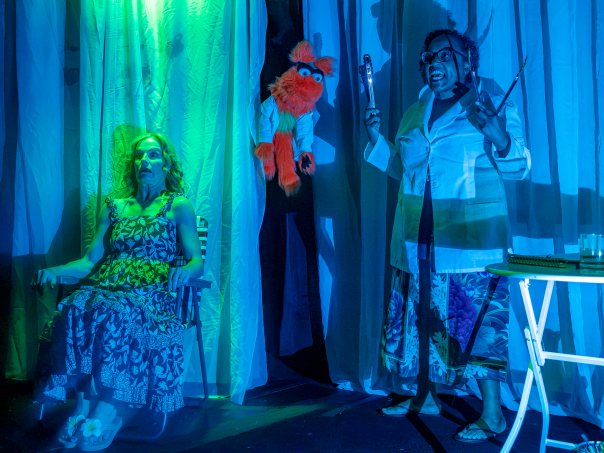
PaperHouse doesn’t make the same mistake – or any others, for that matter. Shrewdly in charge, PaperHouse founder and artistic director Nicia Carla gives her players free rein to go with the freaky flow of the action and to underscore their quirks and hypocrisies, even if they trespass the borderlines of caricature. But they keep their mischief within the two psychiatrists and their two patients, never breaking character or milking an easy laugh.
That approach enriches the ironies Ludlam explores and sharpens the satirical points he scores with his four intertwined adulterers.
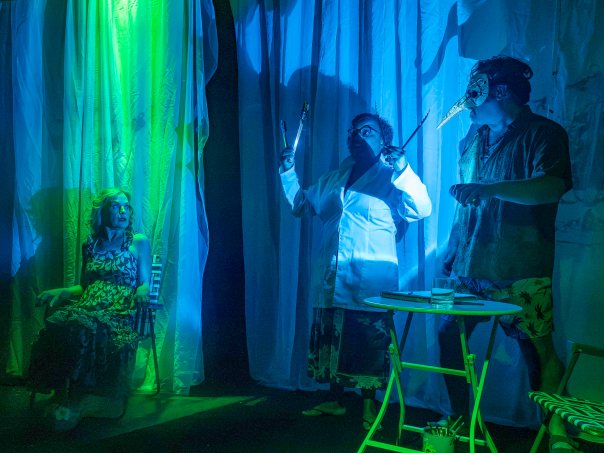
Leonard Silver and his wife, Karen Gold, are the psychiatrists who begin secret affairs at the beginning of Act 1, neither of them aware that their new paramours, Silver’s Eleanor and Gold’s Freddie, are also patients of their spouses. Ludlam is showing us all this gradually in a series of two-handed scenes between Silver and Eleanor, Silver and Freddie, Freddie and Eleanor – yes, they’re married – and Silver and Gold.
So the accumulation of deliciously absurd discovery adds fuel to the comedy as we piece together the big secret that this unfaithful quartet doesn’t, that they’re all being cheated on. Yet the business end of this farce, juxtaposed with the couples’ home lives, compounds the comedy long before their intertwined deceits unravel.
For the most absurd thing you’ll notice is that the psychiatrists’ marital relationship is far more hostile and acrimonious than their patients’! They’re the ones who need therapy!

Nevertheless, Gold is making Freddie, a struggling artist, feel guilty because she can lavish all the money she receives from Eleanor and her other clientele on a new gallery where Freddie can paint and exhibit. Silver, meanwhile, is wowing Eleanor on her own dime, if we presume that Freddie can’t really afford his therapy on his own.
Ludlam will keep leaning into this point even after the farcical climax in Act 2, where all four of his sex-driven cheaters are found out in a frantic scene at a beachside resort. The upshot of all these blasted deceptions is a double fake-out epilogue that serves to magnify Ludlum’s exploitation theme to the magnitude of horror.
And yes, Rich may have missed what Ludlam saw as the most ridiculous aspect of his satirical tale. A specter of promiscuity hovers over it all. All the wicked stealth and hurried cover-ups are driven by axiomatic beliefs in the sanctity of marriage, fidelity, and monogamy. Each of these pieties may have seemed supremely ridiculous to Ludlam – inside the box – before he was diagnosed with AIDS a mere two months before his death.
Carla and her cast make it clear that the psychiatrists are definitely among the loonies that we see. The most promiscuous of these is Ashby Blakely as the ravenously omnivorous Dr. Leonard Silver, madly attracted to all the other people onstage except his wife. Brilliantly layered on in the epilogue is an eerie touch that would have been unavailable to Ludlam when he originated this role: a spot-on evocation of Anthony Hopkins as Hannibal Lecter.
It’s pretty obvious that Carla and Lisa Schacher, in her yummiest role yet, see Eleanor as the polar opposite of Silver, the least guilt-ridden by promiscuity and the most horribly victimized. Partly due to her sunny histrionics and partly due to Ludlam’s portraiture, we find Eleanor the most artless and appealing of these risk-takers. Her most extreme travails begin midway through Act 2 when she is visited by a quasi-nightmare.

This is when Rasheeda Moore comes to the fore as Dr. Karen Gold and begins to seize her rightful place as the cunning and evil of the bunch. Blakely as Silver offers keen competition, shamelessly wooing Freddie during multiple therapy sessions and shredding his Hippocratic oath when his dear patient forsakes him. Moore is merely cruel and unscrupulous with Eleanor, taking multiple phone calls in the middle of their session and then brusquely shutting her down mid-question when time is up.
How does Chaz Pofahl as Freddie manage to keep paying Silver if the starving artist cannot sell even one of his paintings? Supreme poseur and part-time sponge, the stylish and cavalier Pofahl charmingly shows us that our Freddie cares nothing for such mundane matters, slickly picking up Gold at a museum when only one of them can pay the cab fare to his humble abode.

On your ride home, with your impressions of Reverse Psychology still fresh, you may consider the notion that Eleanor and Freddie have somehow cured their therapists.
That may be the last of multiple meanings that you’ll find in Ludlam’s title. It’s the last of his ironies, for sure, and devilishly ridiculous.
Or it was the last irony in this farce. Grimmer ironies surfaced when Ludlam’s death was front page news in the New York Times. Public Theatre’s legendary Joseph Papp, with whom Ludlam was engaging in contract talks, put it bluntly, as he always did: “We lost an extraordinary artist who was just on his way to a tremendous breakthrough in the theater and opera.”


