Review: The Color Purple at Theatre Charlotte
By Perry Tannenbaum
Across the span of nearly 40 years of reviewing, reporting, and pontificating on the performing arts, quite a few events and performances have etched themselves into my mind. On rarer instances, an audience response will be equally unforgettable, such as press night on April 10, 2008, at Ovens Auditorium, the first time Wicked came to town, greeted by a series of deafening ovations that have never been matched.
Every time my Apple Watch notifies me that an audience topped the 100dB mark the previous evening, I wish I’d had one at Ovens that night to know what the high-water mark is.
Even more unique was the night of September 15, 2012, at Dale F. Halton Theater. There, the student actors and musicians of Northwest School of the Arts performed The Color Purple. My wife Sue and I went with a bit of trepidation.
We had already seen this musical on Broadway and in its touring reincarnation at Belk Theater. More to the point, we knew the pitfalls of an all-youth cast colliding with roles that demanded fully mature players. At the Halton, we were already reminded of how wrong that could go when the recent college grads who recruited for CPCC Summer Theatre clashed with the likes of Fiddler or Spamalot.
Of course, we had already built up considerable trust in Corey Mitchell as a stage director nearly three years before he snagged the first Tony Award given to a theatre educator. But there are tough hombres in Alice Walker’s Purple, including poor Celie’s abusive father and husband, Pa and Mister.
And if you remember either the film or the Oprah-produced musical, there are two certifiable divas besides Celie, our tormented protagonist: the hard-headed Sofia and the glamorous Shug Avery. Could Mitchell find all the outsized talents he needed enrolled at Northwest to fill all these roles?
Sure did. And he had more: scenery on loan from the original Broadway production.
But the audience! When Northwest junior Keston Steele, starring as Celie, had finished singing her “What About Love?” solo, Sue turned to me and asked, “Have you ever seen anything like this?”
For the entire audience, it seemed, had sprung to its feet – a standing ovation in the middle of a show! And the answer to Sue’s question is still no.
So you can imagine that when we walked into the old Queens Road Barn on opening night of the current Purple and received my playbill, I was pre-sold. Our Tony Award winner was back directing Theatre Charlotte’s new version, and the name of Keston Gary topped his cast list as Celie.
Had to be the same Keston, right? That’s honestly the only name I had remembered.
While I wasn’t the only person in the Queens Road Barn who remembered Gary’s pre-marital, pre-motherhood exploits at CP, it’s unlikely that anyone else in the crowd was in the same suspense: would history repeat itself?
So there was that unique suspense for me, especially when Gary belted out “What About Love?” as zestfully as Steele. Would the audience rise? Would the Barn’s roof blow off? That same silly suspense struck me once again when Gary followed up with the musical’s supreme affirmation, “I’m Here.”
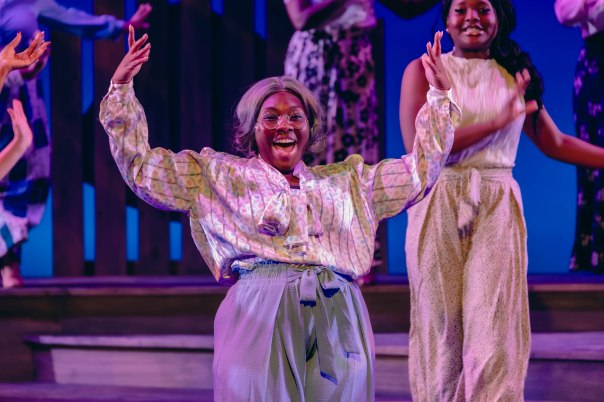
While Gary’s singing merely equaled Steele’s, her acting – seasoned by marriage and multiple motherhoods – markedly surpasses it. At their depths, Gary’s servility and submissiveness as Celie are borderline cringeworthy. Maybe a few notches beyond what a white director would dare.
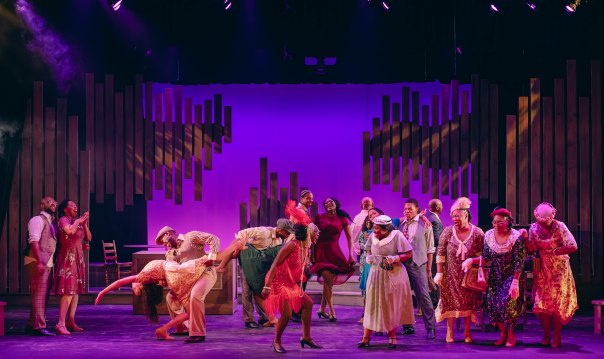
It’s a grim reminder, to be sure, that feminism was a more central concern for Walker here than racism, which only affects Sofia’s story. As a result, we can revel more in the light and inspiration that Shug and Sofia bring to Celie with their special brands of savvy and sass. This Celie needed to travel a longer road, in my eyes, to straighten up her hunched shoulders and stand up for herself.
Twenty years after I saw The Color Purple on Broadway, it’s nice to see Mitchell leaning harder into the story’s demeaning subjugation. But it’s harder for me to be sure whether Mitchell is seeing Celie’s sexual awakening as more overtly lesbian than ever before, or if I am.
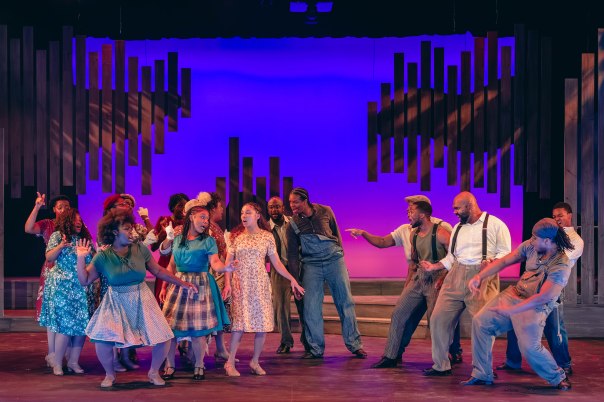
The rousing “Miss Celie’s Pants” certainly hadn’t landed on me in nearly the same way as it did on Queens Road. Sung by Gary with her mentor Shug, Sofia, and a bevy of other women, you can take this eye-popping number partly as a gay pride celebration or as a proto-Hillary rally.
K. Alana Jones as Shug sports a free-thinking saloon singer’s confidence, seemingly at home with anybody’s body of her choosing. In that respect, Shug’s bisexuality aligned more closely with Walker’s. Shug always got the kind of delayed runway entrance traditionally reserved for Broadway legends, so costume designer Justin Hall, with assistant Beth Killion, needed to be sure that Shug’s rigs radiated class.
With all the fine tunes crafted by Brenda Russell, Allee Willis, and Stephen Bray, the book by Marsha Norman doesn’t get enough space to make the connection between Shug’s fashion sense and Celie’s eventual emergence as a dressmaker. At Theatre Charlotte, we can infer that Shug is Celie’s dressmaking muse.
Once Jones does enter as the blues singer, she scores well in the uplifting “Too Beautiful for Words” and the raunchy “Push Da Button.” One can only smile at the thought of high schoolers rehearsing that latter gem.

As Sofia, Germôna Sharp gives Celie – and any other wallflower in town – a more militant brand of inspiration with her “Hell No!” [my italics]. Fortunately, I had somehow forgotten the battered Sofia’s marvelous dinner-table reawakening, so I could take fresh delight in Sharp’s hallelujah suddenness. Not long afterwards, Sharp gets to team up with Nehemiah Lawson as Harpo, her genially clueless husband, in their raunchy “Any Little Thing” reconciliation.
After his bravura psycho dentist in Little Shop of Horrors, it was nice to see Lawson less crazy and cocksure. Harps is more befuddled and human, actually evolving with the times. Watching this character arc, from “Brown Betty” to “Any Little Thing,” amid more toxic excesses of testosterone was a nice reassurance that not all men are monsters. Or at least, beyond redemption.
You could say Harpo’s leavening presence gives Arnold Grevious as Pa and
as Mister more license to be as monstrous as possible. Yes, there are moments at the beginning of Purple when Walker seems to be taunting us: “You think white patriarchy and misogyny are bad? Come over to my place!”

Neither Grevious nor Williams gives any hint of mellowing toward Celie for a long time. Meanwhile, Mister needs to be appealing to Shug in some way that might surface in his bossy “Big Dog” showcase with his field hands. More to the point, he ought to appreciate Shug’s strength as well as her beauty and talent, so Williams can give promise of evolving as he lays out Walker’s red carpet for her diva in “Shug Avery Comin’ to Town.”
Williams also gets the luxury of penitence, beginning with “Celie’s Curse.” No such epiphanies happen for Pa: we just watch Grevious becoming older and feebler. So don’t give that old rattlesnake a single vocal and see if I care!
No, Tim Parati’s scenic design for Purple, the first we’ve had in Charlotte that was totally missing its Broadway lineage, won’t floor anyone, though J.P. Woodey’s lighting helps us not to mind. But Keston Gary is far from the only onstage luminary capable of knocking you onto your butt.
Apart from Chicago and New York, I’ve been maintaining for years that Charlotte has the vastest store of Black theatre talent around. Purple at the Barn proves me right once again. Call yourself fortunate if there are still seats available.


