Daily Archives: August 9, 2026

“Dracula” Transforms from Bela to Bowie in “A Comedy of Terrors”

Review: Dracula: A Comedy of Terrors at Booth Playhouse
By Perry Tannenbaum

Even before he became a Muppet or a General Mills breakfast cereal, Bram Stoker’s Dracula regularly took on a comical tinge that the novelist could not have foreseen when his masterwork was published in 1897. You can probably place the blame on Bela Lugosi, the first actor to portray the vampire in a talkie, released in 1931. Not only did numerous comedians, impressionists, gameshow hosts, and late-night TV celebs take stabs at imitating Bela’s Transylvanian bloodsucker, so did many of my classmates and kids on the block.

Extra points went to those who flicked their tongues out saying “blod,” the fang-tastic villain’s favorite elixir.

Lugosi himself was in on the joke, reprising the undead Count in an Abbott & Costello flick, but he always remained in character, a mesmerizing, dimly-lit creature of the night. Later films, in the wake of numerous cartoon desecrations, inflicted comical cracks in the mold.

In Love at First Bite (1979), George Hamilton became a New York playboy, still deadly serious but younger, more lustful, more fashionable. He even turned the silky collar of his tux down. And he loved to boogie. Compared to the white-haired Leslie Nielsen in Mel Brooks’ Dracula: Dead and Loving It (1995), however, Hamilton was orthodox. Brooks freed Dracula to be bumbling and accident-prone.

Worst of all, the Nielsen Drac could almost crack a smile. “It’s good to be dead!” he crows.

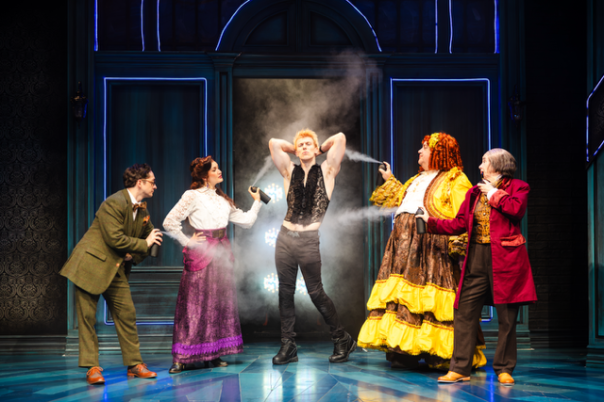
As their title tells you, Gordon Greenberg and Steve Rosen’s Dracula: A Comedy of Terrors is even more brazen. With primeval Transylvanian fogs and mists sprayed from aerosol cans, cute neighing hobby horses terrified by Dracula’s name, and puppet rivals for Lucy Westveldt’s hand, gasps of surprise stem more from mirth than terror. Even flipping the given names of Stoker’s Westveldt sisters is for the sake of getting a laugh.

So it was under Greenberg’s direction on opening night at Booth Playhouse last week, where Blumenthal Arts is presenting the show through August 9. When it came to comedy, there was no suspense at all. Fanged marquees front the lobby off Founders Hall and over the Booth’s proscenium. Themed cocktails are among the sweets and beverages available at the bar, including the lurid “Type A,” served up in a blood bag with a straw. And of course, a swag stand at the other end of the lobby and selfie backgrounds in the middle.
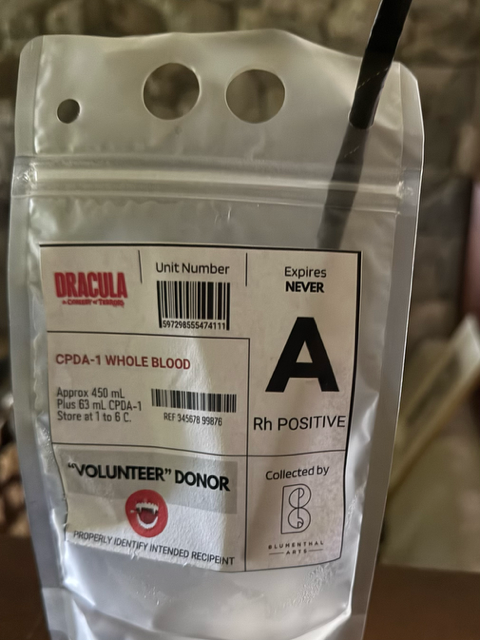
It’s decades too late to accuse the Blumenthal and other tour backers of commercializing Dracula, don’t you think? Just enjoy.

A huge part of Greenberg’s comedy, from the aerosol and hobby horses onwards, is the cheap flim-flam of his theatrics. Skimping on scenery and realism isn’t all. This Dracula also skimps on players. No, our scenery budget cannot accommodate a real spiral staircase. Nor can our cast fill all the roles in our story without most of them doubling, tripling, or quadrupling the characters they portray.

They soldier on, patching the cracks with lame shtick, shameless mugging, cheap props, hurried costume changes, and – when all else fails – pure chutzpah. The flimsier the patchwork, the funnier it gets.

Skimpy is a better word for the outfit that Christopher James Stevens arrives in as the studly Count. No coat, no sleeves, and no shirt – but production photos do reveal a bit of a collar at the top of his sheer, elaborately woven David Bowie vest. The blonde Nordic hair is as sexualized as Dracula’s black jeans and studded belt.
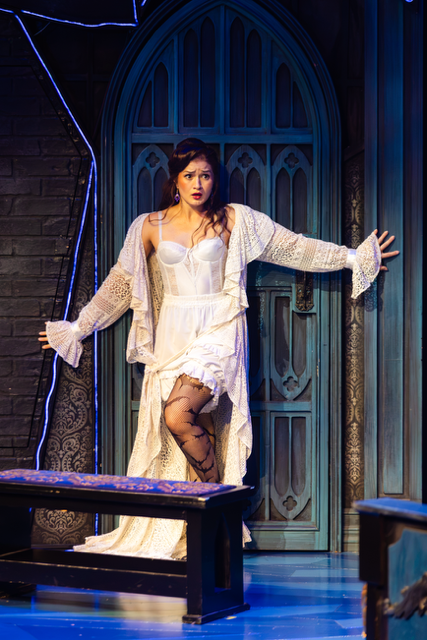
This old man looks really young. And his luscious, toothsome Lucy! What a Victoria’s Secret morsel she becomes when we see Adriane Leigh Robinson (through July 19) in her Victorian boudoir, besieged by a thirsty vampire who has never been so aroused.

With so much excess and kinkiness already on demand, Greenberg compounds it by leaning enthusiastically into crossdressing. Not only do we get a bounty of elaborate outfits for Lucy and her Transylvanian worshiper, but costume designer Tristan Raines lavishes outrageously ornate dresses for , to cross-dress into as Mina – before and after Lucy’s ugly sister is bitten and undead – and out of as he transforms into a bustling female Dr. Van Helsing.

Crossdressing goes the other way for Kelly Bashar, who mainly fails to protect the siblings as their daddy, Dr. Westfeldt, when she isn’t moonlighting as the insane, insect-eating Renfield. Her costume changes are among the swiftest, especially funny when they’re on the run.
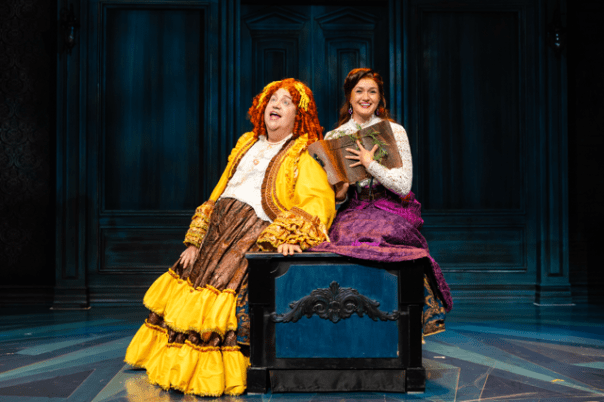
Though not as detailed, intricate, scenically sumptuous, or crammed with characters as the Brooks spoof, Greenberg and Rosen arguably skim Stoker’s storyline more faithfully. A couple of times, in letters from Jonathan Harker and Dr. Westfeldt, Greenberg and Rosen remind us that Stoker’s Dracula was often an epistolary novel when it wasn’t huge chunks of Harker’s and Mina’s journals.

So we begin with Jonathan as he travels to Castle Dracula, where his time is spent more on business, securing multiple properties for the Count in the London area, and not at all on being terrorized by bad dreams and ravenous vampiresses. As Bashar advises us, before transforming into a Man-Eating Wolf and later Dr. W, our presentation will be significantly shorter than the book’s 418 pages.
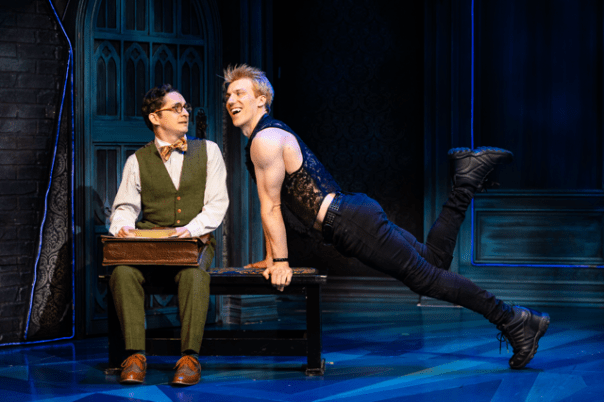
Harker is significantly different from Stoker’s vision of him – or anyone else’s. It’s almost so fine a runway for James Romney, this wonderful character arc of his, that he nearly steals scenes from Stevens’ flaming bisexuality and Robinson’s voluptuousness. He is no Indiana Jones in Transylvania, nor even a Brad from Rocky Horror. He’s a bit tremulous like Gene Wilder was as a leading man in horror films if he were played by Woody Allen, a nebishy weakling.

You begin to wonder what Lucy sees in him – and Lucy herself begins to harbor doubts. Compared with Lucy’s and Dracula’s wild animal libidos, Jonathan’s is a clam. But there is a delicious irony embedded in this Comedy of Terrors storyline, for Harker is startlingly transformed from the moment he is ravaged by his Transylvanian rival. He discovers the animal lurking within him, a midlife onrush of hormonal chaos and libido.

Suddenly, he is capable of fighting for Lucy’s love – and dressing in leather! With all the critical commentary that has been lavished on Stoker’s dark sexual themes, there’s little discussion of the possibility that Dracula is subconsciously crafting his own doom, fulfilling a secret death wish.

Comedy of Terrors brings that notion explicitly to the surface, a wild twist that might actually be a deep and discerning reading of the book. To stage that kind of welcoming of death, of course, Greenberg and Rosen violate all the rules of vampire invincibility by night and vulnerability by day. It’s a climax that audaciously challenges logic, physics, philosophy, and settled pseudo-science.

But it’s just so nutty and hilarious that we go with it. Especially if we’ve drained two Type A blood bags during the show.

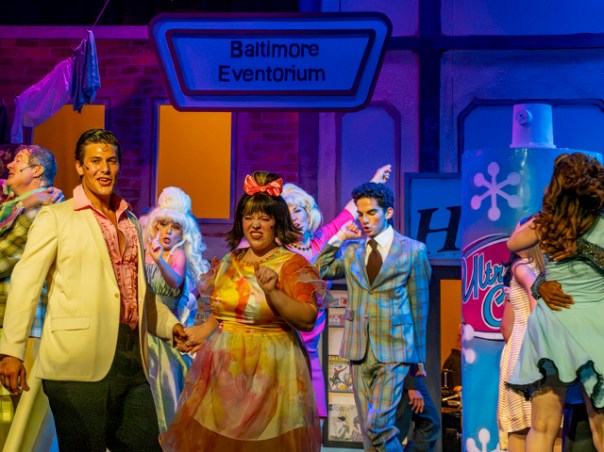
Change Comes to Sixties Baltimore in a Rockin’ Good Way at Matthews Playhouse With “Hairspray”

Review: Hairspray at Matthews Playhouse

By Perry Tannenbaum

July 10, 2026, Matthews, NC – One of the most confounding things humans ask themselves and each other is “When are things going to change?” Too many things are changing all the time for that generalized question to be taken seriously – and too many people asking that question seriously have too little inclination to make change happen. In Hairspray, adapted from John Waters’ 1988 film, change comes to Baltimore in 1962, a year before Bob Dylan declared that “the answer, my friend, is blowing in the wind,” and two years before LBJ signed the Civil Rights Act into law.

Waters’ script was a rewrite of history that stuck, given new life by the Tony Award musical adaptation. Because you not only can change things with a winning strategy and sufficient effort; when you do, and you’re one of history’s winners, you get to rewrite history as you see fit and invent new heroes. Watching Tracy Turnblad spark change in 1962 Baltimore, you just set aside the need for JFK, Dylan, MLK, and LBJ for a couple of hours. Leave it to Tracy, supported by her dad, to rally a whole city and overturn segregation at a teen dance show on local TV.

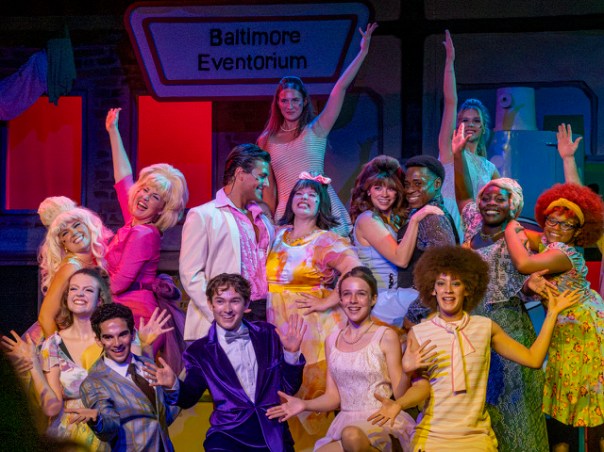
The current Matthews Playhouse production, directed by Sidney Horton, reminds us why Hairspray not only won Best Musical in 2003, but seven additional Tonys. These included Thomas Meehan and Mark O’Donnell for best script and statuettes for Marc Shaiman and Scott Wittman honoring their best musical score. When Horton put out the casting call, the Metrolina talent pool could eyeball four different roles that were juicy enough to deliver Tony nominations to the original Broadway cast. All three Turnblads won the prize, led by Harvey Fierstein as Edna, who undergoes a personal makeover, inspired by her plucky daughter.

Watching Horton’s players at the Matthews Playhouse, you may find yourself surprised that only four original cast members won Tony nominations. What about Corny Collins, the deejay who fronts the afternoon TV dance-a-thon, receptive to the new grooves on the airwaves and open to featuring Blacks more often than on the current once-a-month “Negro Day”? Or Motormouth Maybelle, Corny’s counterpart when the Afro-Americans get their brief chances to shine? Or Link Larkin, the dreamboat teen idol Tracy craves, pragmatic about his career, yet open to developing as a musician and a person?

All three of these prove to be plum roles for Johnny Hohenstein, so charismatic last July as the iconic baddie in Peter and the Starcatcher, and two newcomers, Carter Poulson and Olivia Greene. Corny’s pragmatism allows Hohenstein to be different characters when he’s on-air holding a mic, behind the scenes sparring with his station manager or the show’s sponsor, and out in the wild scouting talent. It’s a less outré ride than Black Stache, but there’s a wider range of phoniness to savor.

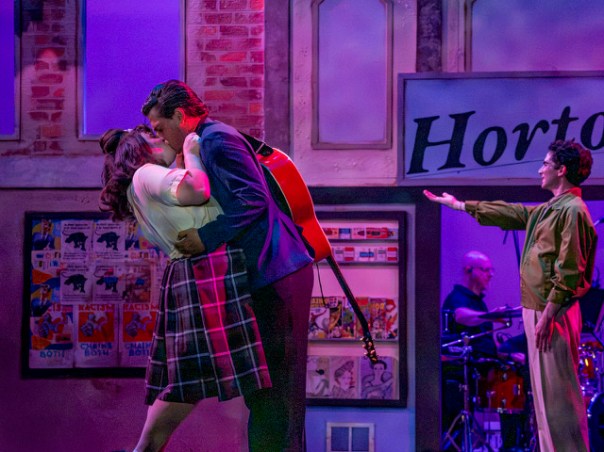
At first, Poulson appears to be the trophy boyfriend of fellow Corny Collins regular Amber Von Tussle, the daughter of WZZT station manager – and former Miss Baltimore Crab – Velma. But when Corny suggests that he croon his new song, “It Takes Two,” as a serenade to Tracy, newly installed on the show over the Van Tussles’ objections, he addresses only his opening overtures to Amber. With both lasses vying for his attention, Tracy nearly drooling, Poulson’s appeal swells the more he croons and swivels his guitar from back to front. Then he comes on to Tracy with a cinematic zeal that would make any girlfriend jealous. A dreamboat’s dream kiss ends the song.

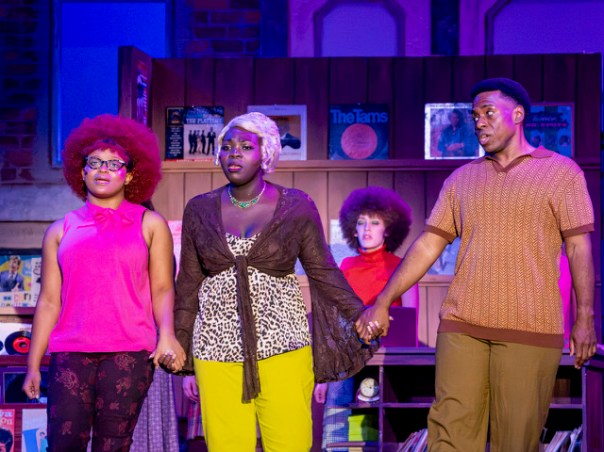
Thematically, Maybelle may be pre-eminent in Hairspray, the mother that Tracy, her bestie Penny, and Amber should have had in their earlier years. Off-air, she’s the den mother to all the talented Afros on The Corny Collins Show who have been relegated to second-class status. Her own brood includes Seaweed, the Afro stud who teaches Tracy and Link some slick moves, and Little Inez, whose audition for the open slot on Corny’s show is doomed by her race. As this living rebuke to Velma, Greene needed to be a big personality from the start. She must grow bigger when she and Tracy lead a street demonstration outside WZZT, demanding desegregation. By the end of the show, Greene must sing “I Know Where I’ve Been,” the anthemic peak of Hairspray.

In her auspicious Matthews debut, Greene showed us that her role in the doo-wop trio in Theatre Charlotte’s Little Shop of Horrors was a mere foretaste of her capabilities. True, she seemed a bit small for Motormouth’s shoes when we first saw her, yet she was more than ample for her climactic showstopper, her crusading gospel spirit getting by far the loudest roar from the opening night audience prior to the big crowning of Miss Teenage Hairspray and the spectacular Edna Turnblad reveal.

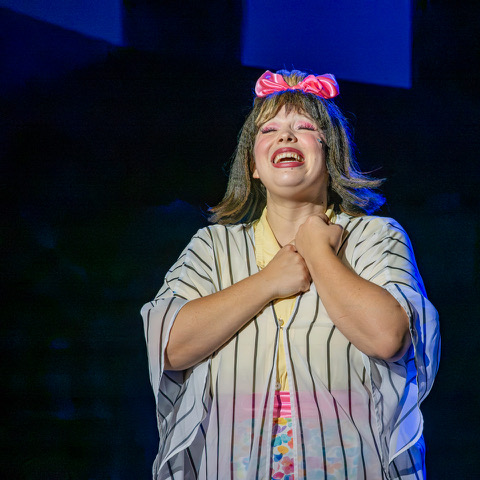
So at various times, the Turnblad clan was gloriously upstaged at Matthews’ Fullwood Theatre. When they’re all professionals or seasoned community performers, that’s not a problem at all. Although I’d never seen her in performance before, Logan Cosper took command of the full Fullwood stage as Tracy from the moment we woke up with her in “Good Morning Baltimore.” Not really your ideal candidate for body shaming, Cosper’s only truly plus-sized aspects were her energy and her smile. As the stage fills up around her, making her way through the city to her high school, those two ingredients are perfect: she needs that sunny cheer so the comedy will click when she passes a drunken derelict on the street. And make no mistake: she’s not merely one of Link’s admirers; she’s his most fanatical. We see significant personal growth from there.

If you spotted Leopard at Booth Playhouse a couple of months ago in his leather motorcycle outlaw outfit in Queen City Concerts’ We Will Rock You, you likely emerged with the impression that he’s way tall and rail thin, not the best fit for Edna. But if you’ve caught him at Theater Charlotte in either Something Rotten! or The Producers, where he formally cross-dressed as the Chrysler Building,you would also realize that sashaying and drag are right up his alley. God and costume designer Beth Levine-Chaitman only know what garments and appliances may lurk under Edna’s housecoat and subsequent makeovers to transform Leopard into the Turnblads’ plus-sized fashion plate.

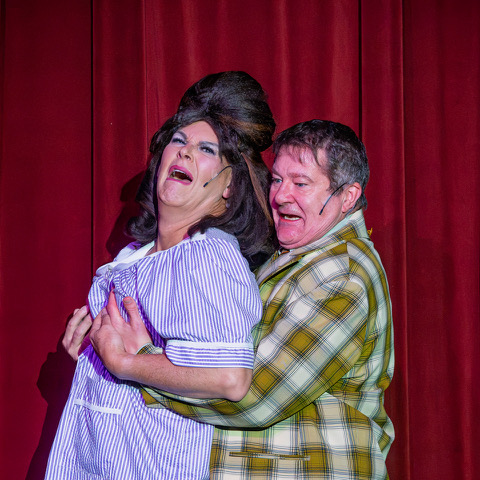
Yet I was a wee bit disappointed to see him so controlled and disciplined. Leopard’s voice could have been an octave lower at key moments for the fullest plus-sized Edna experience. Nor were the constraints strictly directorial. The kitchen or laundry room that scenic designer Chris Morgan provided for Tracy’s mom and dad was woefully minus-sized, barely allowing breathing, let alone stateliness or flamboyance. For the novelty showstopper, Edna’s “You’re Timeless to Me” duet with Wilbur, Horton wisely closed the curtains on the entire set. The effect was very vaudevillian, drawing lusty ovations before and after the couple’s reprise.

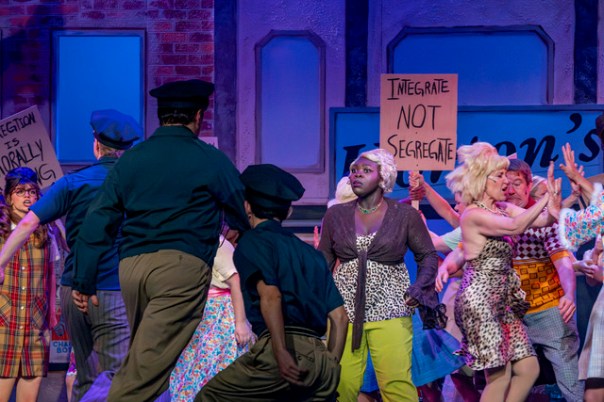
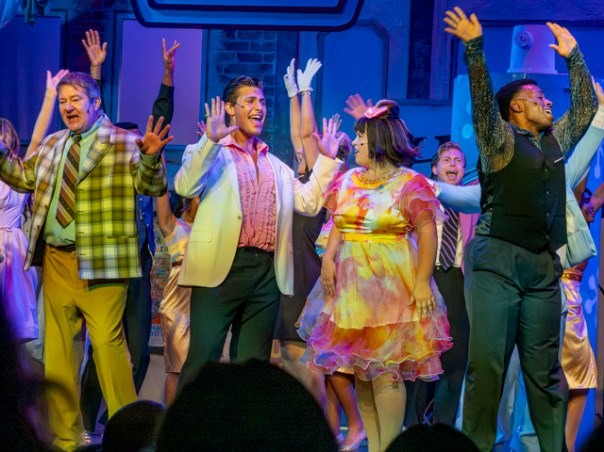
That duet was probably the best hook-up between Horton and choreographer Rachel Peterson – or one of the turning points. Through most of Act 1, dancers often moved in place rather than zipping around, so the tableaus lacked depth until the climactic chaos of the protest riot at WZZT. Seemed to me that the onrush of cops and Billy clubs was what transformed the righteous protest into a riot. You can be the judge whether Horton is making that point.

Honoring (or disregarding) the script, Horton allows Mike Carroll, in one of Levine-Chaitman’s tackiest costumes, to attend the big integration protest as Wilbur. Yet somehow, he isn’t arrested along with his family, the Von Tussles, and the Black folk. Overnight during intermission, he is able to sell his store and raise bail for everybody – except Tracy, specially targeted by the malign Velma. So despite his seeming subservience, Wilbur is a mover and shaker, a chief driver in the changes dramatized in Hairspray.Not only is he a struggling store owner, but also a believer in Tracy’s ambitions, in Edna’s dormant dreams, a liberator of jailed protestors, and a supporter of Tracy’s adopted Black community. Along with Tracy, Maybelle, and Corny, truly one of the chief engines of change.

Yet at times, Carroll makes Wilbur cuddly if not diminutive. You may recognize a Buddy Hackett impishness to him in his “You’re Timeless to Me” serenade, before and after Edna warms to it. Apparently, he isn’t Jewish. His best quip, “Shabbat Shalom!” was mangled beyond recognition on opening night, with none of the requisite gusto. OK, Horton does not have the right DNA to make the correction by himself, but where were you, Levine-Chaitman, when we needed you?

On the other hand, we can probably credit L-C for the horrid wigs that crowned the VanTussles’ toxicity, so we can partially commute whatever punishment she deserves for not supplying Carroll with the necessary Hebrew. Keenan Tabor as Velma was far more repellent as Velma when the spotlight was on her for “Miss Baltimore Crabs” in Act 1, but the apple didn’t fall far from the tree when Layne Harder seized center stage for her “Cooties” showpiece. Most of the bug motif that infested the original Waters movie has been fumigated in this Meehan-O’Donnell adaptation. Mercifully so, but Harder’s opportunities to be singularly noxious are curtailed and muted by this cleansing.

Who to single out among all the other players? Todd Burnette as Seeweed Stubbs was likely the coolest, hippest sight on stage, and Eve Monroe as Little Inez – the standout WZZT auditioner spurned for her race – also springs instantly to mind. As Tracy’s best friend, Penny Pingleton, Corinn Bordelon doesn’t gush over Burnette as Cosper does over Poulsen, but she’s ready enough for love in her shy way. In the breakout double-duet, “Without Love,” where both of the young couples exult over their newfound bliss, it’s a shame that the volume of the eight-piece band, so zestfully led by Ellen Robison, threatened to drown out Bordelon’s most hilarious lyric.

That budding romance Waters filmed in the late 80s wasn’t quite daring enough to say, “now I’ve tasted chocolate and I’m never going back.” So our journey back to the twist and shout and the Madison of the 60s has a sprinkling of the new millennium. Change is good.

What a Web Is Woven by the Adulterers of Don’t Dress for Dinner, but They’re Both Off-Mic

Review: Don’t Dress for Dinner at Davidson

By Perry Tannenbaum

July 16, 2026, Davidson, NC – Thanks to its Gallic amorality, Marc Camoletti’s Don’t Dress for Dinner has aged rather gracefully. After its eager reception in Paris as Pyjama Pour Six in 1985, when cads and mistresses had to content themselves with landline communication if their affairs were about to be discovered, a London translation by Robin Hawdon opened to comparable success in 1991. We didn’t see this fast-paced farce in Charlotte until two months before Camoletti died in 2003, a decade after its American debut at Paper Mill Playhouse in New Jersey – and nine years before its Broadway premiere.

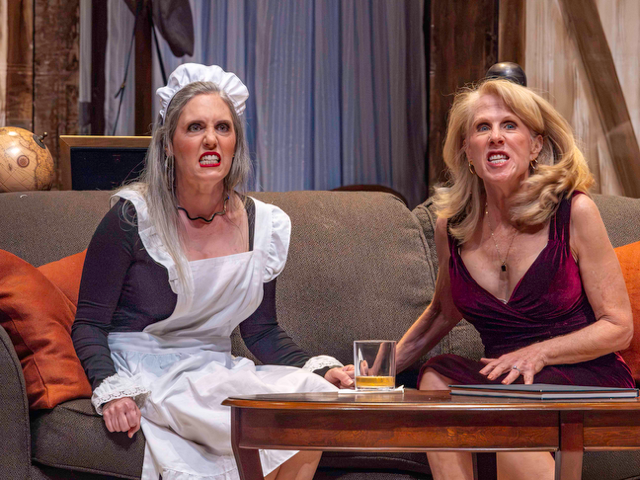
Since the BareBones production of ’03, the piece has been presented to Metrolina audiences exclusively in Davidson, by Davidson Community Players in 2005 and 2015, and currently by DCP’s offshoot, Matt Merrell Productions, founded by DCP’s former executive director. The latest edition returns to Duke Family Performance Hall, on the lovely Davidson College campus (currently disfigured by a massive construction project near the Student Union where the theater is housed), where DCP ran an astounding Evita less than a month ago. The quality of the playing, directed by Andy Rassler, reaches a level parallel with the Andrew Lloyd Webber musical. Sadly, though, all those accomplished players are off-mic.

The action is triggered by Bernard in the burbs of the Big Apple, where he has planned to wine and dine his mistress, a model named Suzanne, on her birthday while his wife Jacqueline is away from the summer home visiting her mother. Haste is built into the sleek machine of this farce from the outset, since Bernard needs to whisk his wife out the door before Suzanne walks in. Before this key objective can be met, Jackie intercepts a phone call from the caterer letting Bernard know that the cook, Suzette, is on her way. Somehow, Jackie is sufficiently acquainted with her husband’s foibles to have her suspicions aroused.

Bernard thinks he has come up with an alibi, but he’s disastrously wrong. He has also invited Robert over for this catered dinner, whom Jackie is sure to remember as the best man at their wedding. Trouble is, Jackie is Robert’s mistress – so the main reason Robert has accepted Bernard’s invite is that he might be able to shack up with Jackie. Similarly capable of adjusting on-the-fly and deceiving, Jackie finds a way to cancel her trip, presumably with romantic weekend plans that align with Robert’s.

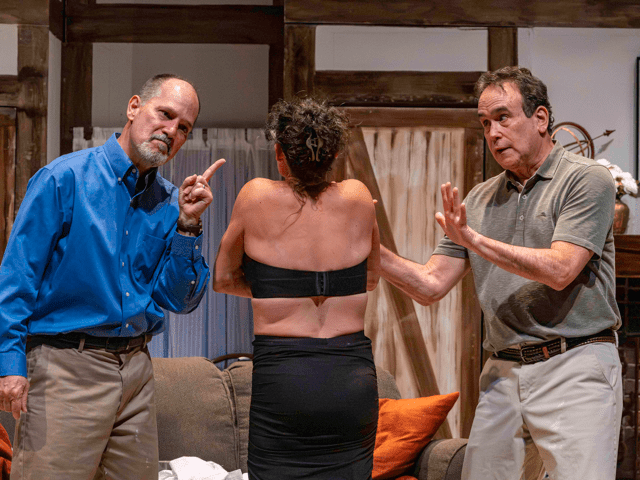
While the wily Bernard triggers the action and the comedy, poor unsuspecting Robert is trapped at the center. Counting on their longtime friendship to keep his infidelity under wraps, Bernard asks Robert to pretend that Suzanne is his girlfriend when she arrives. Tough spot. As freely as Jackie and Bernard will both engage in infidelity, Robert must now make the impossible calculation on which of the two would be angrier upon discovering that she or he was betrayed.

The arrival of the two women, Suzanne and Suzette, compounds the complications. As much as their names sound alike, Camoletti intends their appearances to be radically different. Suzette, we’ll discover, is married to a human bulldozer, George, who is capable of intimidating – and manhandling – both of the other men at the same time. Nevertheless, when Suzette arrives before Suzanne (Bernard and Jacky are out food shopping for things to cook), Robert somehow presumes that it’s Bernard’s mistress ringing the doorbell.

The ensuing get-acquainted conversation, based on wild mutual misunderstandings, is classic, easily worth all of Camoletti’s contrivances. Robert, thinking that sleeping in the same bedroom with Bernard’s mistress is a small part of his assignment, is a bit shocked when Suzette starts off by asking him to show her “where everything is.” Meanwhile, the cook is almost equally alarmed that the strangely rattled Robert needs to know more about her before showing her the kitchen so she can get to work.

Robert’s mistake only assures that more difficult challenges lie ahead when Bernard returns, Suzanne arrives, and new deceits must be devised. How will Jacky’s wrath be averted if Robert sticks with his girlfriend pretense? How will Bernard and Suzanne react when they learn that the slot reserved for Robert’s girlfriend has been filled? How will that fancy dinner get cooked?

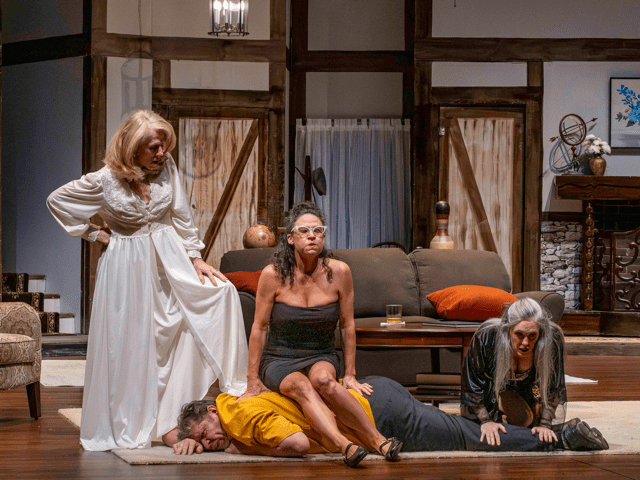
Once Robert initiates his mixed-up girlfriend charade, we can be sure that a placid evening does not lie ahead. How happy will Suzanne’s birthday be if she must now don Suzette’s cook uniform and confine herself to the kitchen? If Jacky’s rage veers out of control, how will his secret keep safe from Bernard’s discovery?

In real time, all the misperceptions, panicked changes of plans, and raging discoveries are more than dizzying enough to keep an audience leaning forward to keep pace. It’s also hard for Camonetti’s characters to adjust sometimes: often the barrage of comedy emanates from somebody reflexively blurting out the truth – or a lie that has been superseded by circumstances and changes in plans.

On opening night at Duke Performance Hall, most of the audience couldn’t lean forward enough because the players were often inaudible, short on energy and lacking amplification. Though Rassler’s directing and Della Knowles’s costume design made it clear enough that Lacy Camp was not the knockout model Bernard had foretold, my wife Sue and I didn’t know who or what she was when she arrived. That’s how much of the dialogue we had missed in Row H. My own initial surmises ranged from masseuse to physical therapist until I caught on.

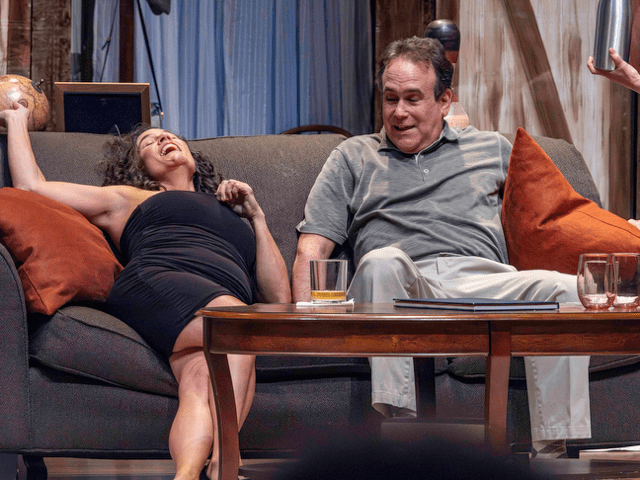
Merrill absorbed most of the assaults as Bernard when the comedy mayhem got physical, obliging him to be the first to climb into his pajamas. He probably sustained the most energy vocally until Brian Rassler arrived late in Act 2 as George, the husband who will have gripes with both of the other guys. But Merrill’s physical energy was fine, enabling us to track Bernard’s ebbs, flows, and on-the-fly calculations as they twisted the plot.

Lou Dalessandro, who has played the high and mighty right up to Macbeth, comes off surprisingly well as the hapless victim, Robert. You almost had to adore him when he reacted with such obvious shock to Camp’s appearance and proceeded to go with the flow – after objecting so vehemently minutes before to Bernard’s scheme.

Camp is not only the most inscrutable of the players as Suzette. She is also the most frequently inaudible. She does transform handsomely from dumpy cook to a plausible, jealousy-worthy girlfriend, relishing that slinky physicality. Camp also logged maximum mileage demanding and receiving extra cash for services beyond the culinary, a zestful working-class opportunist.

All the ages of the principals have been discreetly adjusted upwards, both from the script and the 2003 BareBones premiere, yet Karen Christensen is still a marvel in tossing off the role of Suzanne a full 30 summers after first appearing on my radar. It wasn’t age that Christensen added to Suzanne’s glamor as much as a patrician elegance. There was a bit of goofball poutiness to Christensen as Suzanne sulked off to the kitchen, but she somehow managed to mix in an air of condescension.

No doubt about it, Jacky remains the she-who-must-be-fooled adversary through most of the evening – until the action suddenly flips and Bernard’s fury is kindled. So Cat Rutledge perhaps had the most reason from start to finish to keep her energy blazing hot, whether in suspicion, jealousy, or amorous passion. She actually performed rather well, but because she had a head start on drawing our ill will, she likely drew the most frustration when the audience struggled to hear the verbal barbs and nuggets in the script – or failed to follow what was going on. Just a half dozen well-deployed microphones would have made opening night so much more enjoyable, possibly sparking the standing ovation that didn’t happen when the cast took their bows.