Tag Archives: Margaret Dalton

New Techni-Colorful “Velveteen Rabbit” Struggles to Retain Its Aching Soul

Review: The Velveteen Rabbit at ImaginOn

 By Perry Tannenbaum

2122 The Velveteen Rabbit

Beginning with a musical version in 1992, I’ve now seen at least eight productions of The Velveteen Rabbit at Children’s Theatre of Charlotte, four at their former location on Morehead Street and four at their pioneering ImaginOn facility near Seventh Street Station. Scott Davidson’s dramatic adaptation of Margery Williams’ classic 1922 book, long a mainstay at Children’s Theatre after the musical version was discreetly discarded, was actually the first show staged in the smaller theater, now named the Wells Fargo Playhouse, when ImaginOn opened in 2005.

The company’s 2021 edition of the story, arguably more relevant for children in the midst of a pandemic, takes us in new directions – with a new stage adaptation by Michelle Hoppe-Long, CTC’s director of education. Hoppe-Long’s Rabbit hopped from page to screen last December with a different cast, a worldwide debut that was still viewable online back in March. Now it’s in its premiere live run.

Over the years, CTC’s Rabbit is likely the company’s most widely-known piece, since it has often travelled across the state in pint-sized portable productions with its travelling troupe, known once upon a time as the Tarradiddle Players. So perhaps the biggest shift between the former Rabbit and the new one is only becoming obvious now, as the ImaginOn staging leaps from the Wells Fargo to the larger McColl Family Theatre. Logically enough, Andrew Gibbon’s scenic design concept has discarded the simple, drab, intimate, and pastel look of the vagabond Rabbit in favor of a sweeping, eye-popping, and technically dazzling spectacle, abetted by Robyn Warfield’s bold lighting design. These flamboyant Disney fantasy elements are offset by Magda Guichard’s earthbound costume and puppet designs.2122 The Velveteen Rabbit

That same tension between imaginative extravagance and minimalist simplicity is evident in Hoppe-Long’s script and Melissa Ohlman-Roberge’s stage direction. These discordant elements may be viewed as indecision, but it seemed to me that this new hourlong Velveteen Rabbit was consistently plagued with wrong, illogical, and perverse decisions. Most incomprehensible and disastrous was the transformation of the title character from a woman in an outsized bunny suit into a puppet, visibly wielded by an actress bravely striving to deflect attention away from herself.

Why reduce the size, expressiveness, personality, and lovability of your lead character in transit from a small venue to a larger one? Portraying the Rabbit by proxy, Margaret Dalton never gets the chance to equal the exploits of Claire Whitworth-Helm, Lesley Giles, and Nikki Adkins, past greats in the role. And Dalton must also moonlight, without changing her costume, as the household Nana! Occasionally, Dalton’s double duties became awkward and confusing, if not cringeworthy.2122 The Velveteen Rabbit
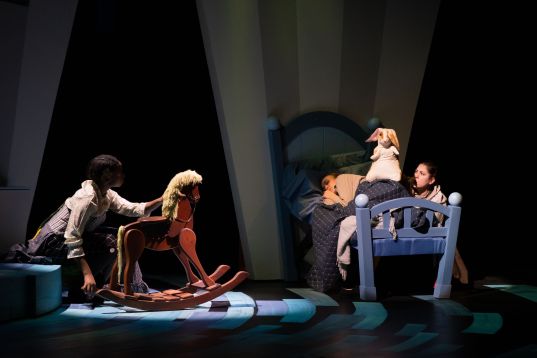
In a story about a boy’s toy aspiring to become real, all of this wrongheaded simplification makes it more difficult for toddlers to see that the Velveteen Rabbit is real – and for them to empathize with its aspirations. A whole franchise of Toy Story films is descended from Williams’ story, but Hoppe-Long and Ohlman-Roberge not only change the Old Skin Horse to a less cuddly Rocking Horse, they eliminate or downgrade all the toys and real rabbits that torment our protagonist. These abridgements of the Velveteen Rabbit’s world seemed to compound the audience’s struggle to empathize with her – it certainly compounded mine – because we never felt her pain keenly. And when the family Doctor was also removed from the cast, the Boy’s tribulations were also muted at the dramatic climax when he fell sick. Yes, even the size of the cast was smaller at this bigger venue.2122 The Velveteen Rabbit

Ironically, simplifying and purifying the Boy also diverts our attention away from the Rabbit. More human stupidity and callousness from Lexie Wolfe as the Boy would have reminded us that the Rabbit should be our primary concern, though she does underscore those moments when the Boy disregards his cherished toy. Surrounded by such Technicolor splendor, it’s hard for Wolfe to break through and impress upon us that the Boy is not completely wholesome – and that his life before he falls ill is not totally idyllic. Instead, Wolfe diverts us with her charm as the Boy roams about with the Rabbit, pretending to be a warrior and pirate while immersing his cuddly toy in his fantasies.

This is the most vivid magic we get, yet Hoppe-Long has contrived to add a little more magic to the Williams yarn, expanding the role of the nursery magic Fairy. The sudden blooming of her presence in the midst of the Velveteen Rabbit’s most extreme desolation is beautifully conceived and splendidly staged, with Reneé Welsh-Noel’s lithe dancing skills adding to the wonder. Yet this new adaptation drops the Fairy into the beginning and middle of the story, where she has never appeared before, somewhat blunting the surprise of her climactic deus ex machina appearance at the end.2122 The Velveteen Rabbit

Welsh-Noel also moonlights as the Rocking Horse and the Boy’s distant but understanding Mom. There’s a delightful surprise cameo at the end of the show, buried in the playbill credits, when stunt rabbit Brambles replaces the puppet protagonist. Parents and toddlers can decide for themselves whether a live rabbit that must be protectively caged at odd intervals – to prevent it from romping around forever in the audience – enhances or diminishes the nursery magic. For me, it was cute at first, but the benefits didn’t last.

Originally published on 12/6 at CVNC.org

“Tropical Secrets” Presents a Bittersweet Wartime Escape from Genocide

Review: Tropical Secrets: Holocaust Refugees in Cuba

By Perry Tannenbaum

2021~Tropical Secrets-16

Havana has never been the homeland of the Jewish people. Yet as we quickly learn in Tropical Secrets: Holocaust Refugees in Cuba, now streaming from Children’s Theatre of Charlotte, it was often more hospitable to Jewish refugees fleeing Nazi oppression, terror and genocide than most other nations – including the USA. If that surprises you, imagine how 11-year-old Daniel felt when he made this discovery in 1940.

In the wake of the infamous Kristallnacht terror across Germany, Daniel’s parents rush him onto an ocean liner bound for New York, promising to meet him there. The ship isn’t allowed into the harbor. They sail north. Knowing there are Jews on board, the Canadians also turn them away. Young Daniel, who was holding his grandfather’s hand when rioters shot him down on Kristallnacht in the middle of the street, is learning some of the cruelest lessons of the world on his own, cast adrift from his family.

Interestingly enough, Margarita Engle’s story, adapted for the stage by L M Feldman, is almost equally about the 10-year-old Paloma, nee Maria Dolorosa. From the outset, her problems are paralleled with Daniel’s. Paloma’s mom abruptly decides to leave Cuba for Europe. Needing to become closer to her dad in the wake of Mom’s abandonment, Paloma finds herself turned away. Seems like an unfair comparison at first, but Engle constantly asks us throughout this new 75-minute drama to re-examine our perspectives and our sense of proportion.

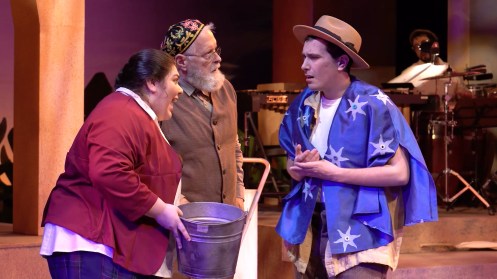
Moral certitudes are questioned during the turmoil of World War II as we watch Daniel acclimate to Cuba while still holding out hope that his parents will find him – or that he will find a way to New York. A huge flip in sentiment and loyalty happens across Havana when news reaches the island that Pearl Harbor has been bombed. Instead of marking him as fodder for the horrific Nazi deathcamps, the Yellow Star that Daniel had been forced to pin on his shirt back in Munich now becomes the badge that prevents him from being arrested as a German spy.2021~Tropical Secrets-37

As with many children’s classics, kids perceive basic truths more readily than their elders. Paloma’s father, known across the island as El Gordo, is the decider when it comes to which ships are allowed to dock in Havana and which are turned away. He tries to explain to little Paloma that he makes his decisions pragmatically rather than on principle. “The world runs on business!” he proclaims with conviction. Paloma looks her dad straight in the eye and tells him, “The world runs on kindness!” Engle’s kids also have depth, as when Daniel informs Paloma, “In Germany, you have to wear a star on your shirt, so everyone can know what you are and hate you for it.”2021~Tropical Secrets-65

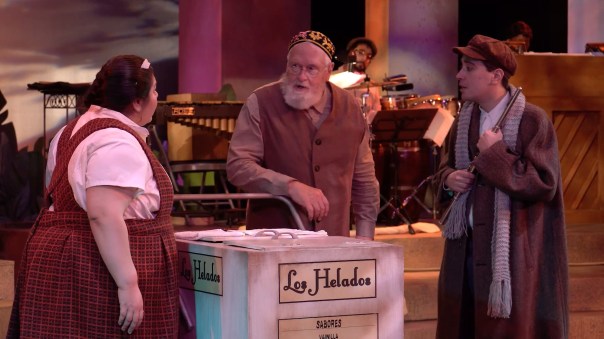
Adults here aren’t perfect role models chiefly because of their practical struggles to survive and thrive. With most of the world turning the Jews away, El Gordo naturally feels pressure not to open the floodgates. Yup, immigration issues! And though Daniel’s mentor, David, staunchly wears a brightly embroidered yarmulke with pride, he also bends to practicality, peddling his ice cream in his little pushcart on the Sabbath. When Jews are suddenly perceived as friends and Germans suddenly become loathsome, suspicious, and targeted for arrest, David abruptly veers to the other end of the spectrum, opposed to allowing any foreign ship to dock in Havana until the war is over – even if Daniel’s parents happen to be on board. El Gordo, on the other hand, stands fairly firm – except for raising the price of entry.

In the shifting mists of these patriarchs’ outlooks, blown by the winds of war, Engle’s Havana takes on some of the ambiguities of Casablanca. We aren’t on the same exalted levels of politics, decadence, or romance, but you may find yourself identifying more deeply with the everyday humanity of her people. You may also experience more keenly the anguish of survivors who are left in suspense for months and years about whether those dearest to them are still alive – and empathize more keenly with those who are wracked with memories of those who have died.

Most poignant, the kids rise to heroism in acting out their natural beliefs when, after the universe flips with Pearl Harbor, they encounter a Jewish mother on the run. Why would Miriam, a German Jew, be so terrified now? Because her only living relative, daughter-in-law Marta, is a Christian. For Daniel and Paloma, it is axiomatic that both are equally entitled to live in peace. Marta and Miriam, on the other hand, wrestle with the question of how fully they should describe to their rescuers the full details of the horrors they have left behind.

Thankfully for parents wondering whether Tropical Secrets might become to heavy for their youngest, Engle takes us to precipice without jumping over. There’s plenty for her to show us about kids conquering the language barrier and bonding, and there’s plenty for the kids and their elders to teach us about Judaism, Yiddish, and carnival. Helping Feldman transform Engle’s poetry into engrossing drama, stage director David Winitsky has made a welcome return to Charlotte after a year’s absence, having hosted the Charlotte Jewish Playwriting Contest at Shalom Park for the previous three seasons.2021~Tropical Secrets-28

Two dramaturges, Carmen Pelaez and Wendy Bable, helped him and his cast get the history and the cultures across accurately. Anita J. Tripathi’s scenic design radiates hacienda elegance, but it was Robyn Warfield’s lighting that filled out the atmosphere and took us beyond the city when the story needed to travel, while Magda Guichard’s costumes deftly differentiated between the nationalities and the social classes.

Most gratifying after so many months of deprivation, isolation, and lockdown was watching such a professional all-adult cast captured so well in immaculately recorded audio and video. Because this world premiere was immediately headed for film, where kids are always kids, Adrian Thornburg and Isabel Gonzalez had the steepest obstacles to overcome as Daniel and Paloma. Thornburg’s path was to shrivel himself inwards with Daniel’s sullenness when we first see him, though Winitsky might have eased off a little on all our hero’s resentful turning away. Gonzalez’ regression moved in the opposite direction, outwards with an excess of energy and often with open arms. In less than a minute, I found myself returning to a familiar theatre world, where adults can pass as kids and be as tall – or taller than – their parents.

In Europe, on the ocean liner, and in Cuba, four other actors played multiple roles, at least one of them memorable for each player. Tom Scott as David had the dignity, tenacity, and flexibility of a time-tested Jewish survivalist, stretching himself more than usual to immerse himself in the ice cream peddler, while Frank Dominguez was stubbornly set in his ways as El Gordo, professionally urbane, gradually realizing how off-putting his pomposity has become. Paula Baldwin and Margaret Dalton complemented each other nicely as two different tandems, first as border guards who stole Daniel’s boots and broke his flute, later as the fugitives, Miriam and Marta. Baldwin as the suffering Miriam could be the most fearful, grieving, and overprotective, but Dalton as Marta delivered the best retort: “When things are ugly, you cannot help but speak it ugly.”2021~Tropical Secrets-79

Maybe the best secret in Feldman’s adaptation is the time taken to breath in the tropical air. Percussionist Raphael Torn and pianist Charlene Thomas bring the tang of rhythm and music to the street a couple of times. When Paloma takes Daniel to the festival, when she takes him to the beach at night, and when she brings him back to music again and again, fresh air infuses our hero’s life as he accepts the kindness of a friend. He tacitly acknowledges that after the bombs of world war and Kristallnacht, there is balm in Cuba – in the oranges, the coconuts, the drums, the Afro-Cuban beat, and in carnival.