Category Archives: Theatre

Not Your Same Old Vampire

Reviews: She Who Watches and Charlotte Symphony

By Perry Tannenbaum

Performances of She Who Watches run through Oct. 30 at Frock Shop.


When J. Sheridan Le Fanu serialized Carmilla in 1871-72, Count Dracula wasn’t even a gleam in Bram Stoker’s eye. Yet a quarter of a century later, when Dracula became the paradigm for modern vampire literature, Stoker himself acknowledged that Le Fanu’s most famous novella was a part of that gleam. So after a steady sprinkling of October visitations from the undead lord of Transylvania — no less than seven Metrolina Dracula productions since 2002 — it’s nice to see a change of pace in the form of a new PaperHouse Theatre adaptation of Le Fanu’s spellbinding horror classic.

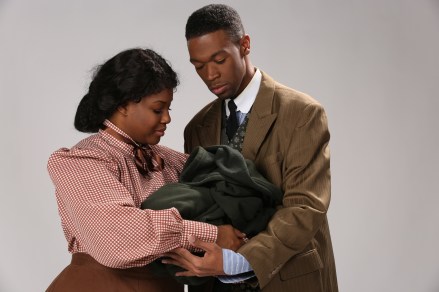
Eerie echoes are a key motif in the storytelling, which co-directors Nicia Carla and Chester Shepherd have retitled She Who Watches in their adaptation. The narrator of the story, Laura, is haunted by a nightmarish experience from her childhood, when she awoke to find a teen-aged girl in her bedroom. That girl seemed to fall into a slumber on Laura’s chest, but when she awoke the second time, what the girl was doing made her shriek in terror. And then, before her governess could come to the rescue, the girl vanished into thin air!

It would be cruel to divulge much of what happens 12 years after this creepy prologue, but you’re correct in assuming that the beautiful face indelibly etched in Laura’s memory is Carmilla. How Carmilla returns to Laura’s home — and ultimately, her bed — took just under 69 minutes to deliciously unfold on opening night, with neat surprises and more eerie echoes along the way. That’s about the same amount of time you might spend in your family car getting from the I-277 overpass to the dubious thrills of Scarowinds.

It’s a shorter, more enjoyable evening at PaperHouse’s customary haunt, The Frock Shop. Le Fanu’s story placed the action at a lonely Austrian castle in a place called Styria, but the parlor of the Frock Shop cottage on Central Avenue seems to suit Carla and Shepherd quite dandily. The antique atmosphere is built in, augmented by a gallery of starchy, frilly, diaphanous, and full-length costumes designed by Magda Guichard.

Lighting designer Chaz Pofahl, strategically potting the illumination levels, is certainly a part of the spooky conspiracy, but our stage directors also utilize the windows lining two of the parlor’s walls to pique the suspense and ambiance. Perhaps emboldened by the numerous film, stage and TV adaptations of Carmilla that have come before, Carla and Sheperd have done some character shuffling as well. Instead of a kindly father, Laura’s lone parent is a coolish mom, and instead of a distressed friend of her father, General Spielsdorf, we get a more down-to-earth and frazzled Aunt Jean.

The core protagonists remain the same, and we’re very fortunate there. After two strong outings in Theatre Charlotte’s Miracle Worker and PaperHouse’s Much Ado About Nothing, Sarah Woldum is probably the busiest actress in town this year, taking on the role of Carmilla. She seems to revel in the menace of this role, seething with a mysterious intensity when she isn’t softening her prey with endearments. The whole chemistry of her is different from Dracula’s, seemingly resistant to daylight, but you wonder whether her episodes of weakness are symptoms of a gnawing blood hunger or simply playacting to draw sympathy. When Woldum becomes the predator, Carmilla’s rapacity is as much sexual as it is animal.

Racquel Nadhiri spoke too softly at the outset, compounding my difficulties with her Jamaican accent, so I won’t give her top marks as our Narrator. But Nadhiri beautifully captures the mixture of attraction and repulsion that is the essence of Laura’s reaction to Carmilla. Our empathy for Laura’s victimhood is that much stronger because it stems from her sunny heroism.

The ending that Carla and Shepherd have devised for her — distinctly different from Le Fanu’s — fits Nadhiri like a glove, and you might say that the word “bloodcurdling” was specially cooked up to describe her screams.

Two interludes punctuate the action, so you can get refills on the beverages that were served on the front lawn as you first entered, or you might nosh on cream puffs and sausage balls. When we reached the denouement, the audience was split in two, half of us ascending the staircase to witness the climactic encounter between Laura and Carmilla in the bedroom, half of us remaining downstairs to hear the disclosures that Laura’s mom receives from Aunt Jean.

You’ll have a better appreciation of the synchronicity of the two scenes from the downstairs vantage point, but everyone gets the chance to see both scenes — because, we realize, they actually occur simultaneously.

As I’ve already hinted, the cold and clueless Mother isn’t the plum role here, so you won’t be seeing Andrea King at her best, though she’s very good, of course. Most of the scene stealing comes from Rebecca Costas, busily changing costumes and characters throughout the show. Maybe her most comical turn is as the Doctor who says she’ll return so nervously that you can be absolutely sure she won’t, but she’s also pretty funny as Hunch-Hag, dispensing some fairly toxic marital insight to audience members.

Costas also gets a couple of serious cameos, first as the mysterious and malevolent Countess, Carmilla’s aunt. More urgent — and earnest — is Aunt Jean as the action comes to a boil.

Since her stint as she-devil Abigail Williams in CPCC Theatre’s 2001 production of The Crucible, Costas has only emerged briefly and intermittently on the local scene. It’s a kick to see her shining 15 years later in such a versatile performance, her devilish fire not only intact but several degrees hotter.

Charlotte Symphony’s 85th season is off to an exciting start, and Mary A. Deissler, the new president and CEO, is already making her impact. She has things to say, both onstage at Belk Theater when the orchestra plays and in the CSO program booklet, which isn’t as staid and stagnant as it used to be. Sitting down to last week’s Beethoven Symphony No. 2 concert, I found new artwork, festooned with pumpkins, on the cover.

Image result for picture of benedetto lupo playing piano

The two artworks I’ve seen on the booklet covers, through two 2016-17 Classics concerts, already doubles the number I’ve seen in previous seasons. More importantly, Deissler has kept an inside page, opposite the page where you find tonight’s composers and compositions listed, reserved for herself. So instead of some generic remarks designed to linger more or more inanely as the season wore on, Deissler did a reset on page 17A.

The Welcome Page addressed the divisiveness that has fractured our community in recent weeks, the unifying power of music, and Deissler’s gratitude that we were back at a time when healing is needed. Rang true.

Switching from music director Christopher Warren-Green to guest conductor Michael Christie, the Beethoven offerings were more varied and adventurous than the All-Tchaikovsky season opener, veering off into Franz Liszt’s Piano Concerto No. 1 and his Totentanz before we jackknifed into György Ligeti’s folksier and funkier Concert Românesc.

Guest soloist Benedetto Lupo and the CSO brass were a bit overeager and brutish in the opening section of the concerto, but after the pianist navigated through his first softer, lyrical passages, everyone seemed to settle into a more relaxed groove. A fresh production wrinkle further enlivened the concert: a projection screen descended over the Belk stage so an overhead camera could transmit a bird’s eye view of the hurtin’ that Lupo was delivering to a defenseless Steinway Model D.

Van Cliburn himself might have winced.

“1776” Still Preaches Compromise to a Skeptical Electorate

Musical Review: 1776 The Musical

By Perry Tannenbaum

2c12d4d82-b764-cbe5-a645e52c8298150f

Firebrand and future president John Adams couldn’t declare independence by himself. Not only did he need to recruit Thomas Jefferson to write our foundational document, he needed to get all 13 colonies represented at the Continental Congress – including his own Massachusetts – to come over to his side. As 1776 The Musical, currently running at Central Piedmont Community College, reminds us, Adams was too headstrong, combative, irritating, and off-putting to sow the seeds that would blossom into our republic.

With George Washington and his army further north, already engaging the British Crown on the battlefield, Adams couldn’t even count on his staunchest sympathizers, Jefferson from Virginia and Ben Franklin from Pennsylvania, to deliver their states’ votes. In fact, it would be an uphill battle for Adams to even get the matter of independence considered at the Congress in Philadelphia – over a year after the first shots had been fired at Lexington and Concord.

So in a climate and an election year where cooperation, compromise, and consensus are so widely despised, 1776 comes along propitiously to remind us how fundamental these things were in forming our national DNA and how essential they remain if we are to make big changes in our democracy. With inevitable sacrifices to detail and accuracy, Peter Stone‘s book presents the story with surprising nuance, depth, and even tragedy.

For a musical clocking in at 2:35 plus intermission, 1776 also has a surprisingly spare songlist, perhaps because composer Sherman Edwards had the original concept. There is also a gratifying self-awareness we can detect in the storytelling at Pease Auditorium in this CPCC Theatre production. We’re not seeing all white men all the time.

Edwards gracefully works in Adams’ wife Abigail through an ongoing exchange of letters that twice become duets. At a clandestine location away from the Congressional Hall, we peep in on an episode that Franklin has contrived to help Jefferson in his struggles to craft the Declaration, sending for Jefferson’s wife Martha. It’s already a conjugal visit by the time Franklin and Adams come calling.

CP director Tom Hollis stirs the pot a little more with a modest infusion of colorblind casting, while costume designers Robert Croghan and Jamey Varnadore offer us what diversity they can, making the chasm between a New Jersey reverend and a South Carolina plantation owner as wide as possible.

Adams is rather lonely and hopeless before Franklin helps him form a cogent strategy to get things rolling. They send Richard Henry Lee of Virginia back home to convince his state legislature to back an initiative for independence. The jubilation of concocting this stratagem is celebrated by Adams, Franklin, and Lee in “The Lees of Virginia,” a song whose toxicity extends beyond its jaw-dropping silliness. I can only hope that its parade of dopey adverbs doesn’t lodge in your memory as an earworm.

Once we’ve crossed that jingling Delaware, we sail smoothly and convincingly through the labors that culminated in our nation’s birth. Virginia’s support leads to a majority vote approving consideration of an independence initiative, the formation of a committee to articulate the reasons and objectives for this action, with the proviso that the vote for adoption of this initiative must be unanimous. Every colony had veto power over the move for independence, adding tension to a drama whose outcome we already know, and leading to the compromise that stands as the Original Sin of our nation.

At the conclusion of his grievances against Britain, Jefferson penned two blistering paragraphs excoriating the Crown’s cultivation of the slave trade and – conveniently omitted from Stone’s book – their incitement of those slaves to rise up against their masters. After a devastating attack on Yankee hypocrisy in “Molasses to Rum,” future South Carolina governor Edward Rutledge demands that the section on slavery, effectively abolishing the institution, be stricken from the Declaration and walks out on the Continental Congress until he gets his way.

There is certainly no trivialization of that haunting but necessary compromise, and the hauteur of Josh Logsdon as Rutledge, along with his resounding singing voice, are among the chief reasons why 1776 will linger in your thoughts. Eric Johnston really is nettlesome and curmudgeonly as Adams, biting in his patriotic vocals yet petulantly tender when he’s interacting with his dear Abigail. Exorcising the clownish look that bedeviled Franklin in Theatre Charlotte’s 1995 production, James K. Flynn plausibly takes on America’s fount of aphorisms and brilliantly balances his avuncular practicality with his comical tendency to doze off.

Depicted as quiet, contemplative, and artistic, Jefferson is a romantic lead in Stone’s narrative who has almost been demoted to a supporting role. While George DeMott isn’t nearly the dreamboat Patrick Ratchford was when he sang the role in 1995, there comes a time when we’re supposed to be wondering what his sex appeal actually is. In giving weight to that question, DeMott is very appropriate. Nor could you hope for a more charming answer than “He Plays the Violin” from Emily Witte as Martha.

Witte is so graceful and charming that I could hardly imagine omitting her “Violin” when this musical was last revived on Broadway in 1997, more than 28 years after its original premiere. By coincidence, it is omitted from the songlists of 1776 on both the IBDB.com listing for the 1997 revival and in CP’s playbill. But Amazon assures me that it’s still on the 1997 cast album.

In real life there was an age difference of 29 years between John and AbiGail Adams, but Hollis dispenses with that gulf in casting Megan Postle as AbiGail Adams. As you’ll find, it’s a very unique role since Hollis insists on preserving the Adamses’ separation when they converse by mail, yet Postle warms wonderfully to the task. At the comical end of the spectrum, Alan Morgan can be commended for delivering the deadly Lee with all his giddy gleefulness, while choreographer Ron Chisholm doesn’t stint on the energy and dopiness of our Founding Fathers’ dances, fearlessly risking the charge of sacrilege.

Conspicuously missing from the Philadelphia deliberations is General Washington, but we periodically get gloomy dispatches from him in the field, delivered by Trey Thomason as the Courier. After a few of these, lights dim unexpectedly on Thomason, who sings grimly to us in “Mama, Look Sharp” about the realities of fighting and dying for your country.

Sobering moments like that are why 1776 remains relevant nearly 50 years after its original Broadway opening. Recounting how we reached our landmark July Fourth, this lively evening occasionally packs the power to explode our drum-and-fife expectations.

“First Date” Gets a Second Chance

Reviews:  First Date, Breakin’ Convention, A Year With Frog & Toad, Charlotte Symphony

By Perry Tannenbaum

When it hit Broadway three years ago, First Date wasn’t exactly a critical or box office triumph. Starring Zachary Levi (TV’s Chuck) and Krysta Rodriguez (from Smash), the pocket-sized musical — six actors and 90 minutes — drew jaundiced eyes from the theater press. Though the critics generally liked what they saw from Levi and Rodriguez, they focused far less charitably on the script by Austin Winsberg and the score by Alan Zachary and Michael Weiner. The most positive reviews conceded that mediocrity was in sight for the sitcom script and the pop rock score, yet when a few of those jaundiced eyes deigned to look around and observe others in the house, they had to admit that the audience was having a rollicking time. After the notices came out, attendance began to tumble, never to recover until the announced closing week less than five months later.

To give First Date a second chance on the road, its creators needed to think makeover. In a new Blumenthal Performing Arts presentation, now at Booth Playhouse through Nov. 20, it’s obvious that Charlotte’s backers and new director/choreographer Dan Knechtges have sparked a lot of rethinking.

Aaron is still a buttoned-down, slightly nerdy, risk-averse guy who is in a steady job without any self-fulfillment on the horizon. Mutual friends have set him up with Casey, an artsy Bohemian who keeps good guys like Aaron at arm’s length. Her weakness for bad boys has littered her past with a string of relationships that never worked out.

At the point where those bad boys come into play, Zachary and Weiner have gone to work on their songlist. Edgy British Guy and Edgy Rocker Guy are replaced by British Artist and Stoner Guy while their song, “Can’t Help but Love Me,” is similarly altered. Before that, we have a revamp of “Forever Online,” a song that was cut from the Broadway production soon after the opening. Now a new character, Google Girl, joins Casey and Aaron for “The World Wide Web Is Forever,” and this song — about Googling prospective dates before you meet them — may be the freshest, most delicious segment that First Date has to offer.

Transplanting the show from the 1100-seat Longacre Theatre in New York to the 434-seat Booth, Knechtges has implemented far more fundamental changes. Not only has he reduced the cast from six to five, he has brought members of the audience onstage, seating them around the bar and at tables at the restaurant where Aaron and Casey meet. These customers don’t sit around idly during the action.

Katerina Papacostas and Matthew Schatz in First Date. - DANIEL COSTON


Critics reviewing this remake can’t ignore the audience because they’re part of it. The main responsibility for getting patrons involved falls to Paul Ianniello as our Bartender/Waiter. Though we’ve relocated from Manhattan to Uptown Charlotte, this Waiter fits the New York stereotype of waiters biding their time until that magical day when they nail an audition. He’s super gregarious, marking Aaron as a dude on a blind date as soon as he enters, telling him to lose the tie and unbutton the shirt if he plans to reach first base.

He’ll also chat up the diners and drinkers, prevail upon them to switch tables, move to the bar, or even kick up their heels. Or he might reappear on the roof of the building or re-enter the restaurant from the street. Most memorable among his thought-cloud characters, Ianniello dons a tallit and enters as Aaron’s disapproving grandfather when he discovers that Casey is a shiksa.

Gretchen Wylder is Grandma Ida in this Jewish guignol number inspired by the Fruma-Sarah haunting from Fiddler on the Roof, getting the cheap laugh when she sings “I will break your matzo balls.” Tapering off just a smidge on her madcap energy, she also pops up at odd moments from behind the bar as Aaron’s former bipolar fiancée. Wielding a cocktail glass or a frying pan out in the box seats, Wylder is also Casey’s older and wiser sister, Lauren, reminding the prodigal that her biological clock is ticking or — more to the point — busting her on her self-defeating defensiveness with good guys.

As you’ve already divined, Aaron and Casey’s first date is littered with real and imagined interventions. In multiple incarnations, Kevin Zak as Man #2 completes the unholy trinity. Wearing a Luke Kuechly jersey and toting a “brewski,” Zak is most often Aaron’s best bud Gabe, telling the newbie to blind dating whether or not he’s straying from the golden path to Fuck County. Or he might change costumes and resurface from behind the bar as Reggie, a dimwitted ex-boyfriend who gets enraged when Casey doesn’t answer his repeated bailout calls to her cellphone.

At the eye of this cyclone of eccentricity, Matthew Schatz can be fairly nebbishy as Aaron without coming close to relinquishing his hold on comparative wholesomeness. Likewise, Katerina Papacostas doesn’t need to softpeddle Casey’s practical joking and hostility to sustain her desirability. Together, they rock “First Impressions” almost immediately after they meet, building up a pile of appeal they can squander.

Schatz’s take on Aaron makes him somewhat less cartoonish than Brad in Rocky Horror, while Papacostas’ Casey is slightly more wholesome than the most mainstream member of The Addams Family. Oh, wait a second: Rodriguez was Wednesday Addams, originating that role on Broadway before originating Casey. Pure coincidence, I’m sure.

Papacostas’ foxiness drew extra play on press night when our Waiter asked a customer to move over to the bar so Casey and Aaron could be seated. The audience member shot back a counterproposal, suggesting that Casey be seated right there next to him!

In this more informal format, it becomes more obvious that the very idea of first dates is a powerful draw for audiences, stirring up old memories, tingling feelings of anticipation, and long-dormant hormones. Perhaps the best alteration Winsberg has made to his script is making sure that some of the comedy at every performance will be unscripted.

breakin16_1000-835fa156f7

Proximity of last week’s openings in Charlotte to the police shooting of Keith Lamont Scott — and its tumultuous aftermath — seemed to tamp down turnout at Booth Playhouse on Thursday. Crowds outside for Friday evening’s Breakin’ Convention pre-shows, the spoken word slammers outdoors on the Levine Center for the Arts Plaza and the b-boys working the cypher in the Knight Theater lobby, were about the same anemic size as last year, when bad weather curtailed attendance.

14500226_10153753452641790_1232033451017722626_o-3833b8ed

But when the sun shone so brightly and beautifully on Saturday afternoon, I could tell just by driving past the Spirit Square parking lot that Breakin’ Convention’s all-day Street Jam was bigger and better. Around the corner on 7th Street, another robust crowd of parents and kids were lapping up the Children’s Theatre of Charlotte revival of A Year With Frog & Toad, which is every bit as delightful as the 2008 version at ImaginOn — and more completely polished.

esther_yoo045

Charlotte Symphony subscribers kept the good vibe going on Saturday night, thronging to the All Tchaikovsky concert at Belk Theater. Guest soloist  gave them more than ample artistry with her fire, precision, and honeyed tone in the Violin Concerto, drawing a standing ovation after the opening movement. Music director Christopher Warren-Green and the orchestra were vibrant and dynamic in their accompaniment, so I had no qualms about joining the cheers and the ovation when Yoo’s performance reached its triumphant end.

“Dirty Dancing” Turns up the Heat on Tour — but Not the Singing

Theater Review:  Dirty Dancing

unspecified

By Perry Tannenbaum

Last year, when I passed up my first opportunity to see Dirty Dancing at Belk Theater, I had this naïve idea that it would be a musical adaptation of the 1987 film starring Patrick Swayze and Jennifer Grey. With the return of the national tour Charlotte, this time at cavernous Ovens Auditorium, I persisted in my folly long after the curtain rose. Silly me, I overlooked the fine print in my playbill under the florid romance novel italics of the Dirty Dancing logo: “the classic story on stage.”

So as the action unfolded, with a live eight-piece band perched above the scene at a Catskills country club, months before the JFK assassination, I was expecting Bronwyn Reed and Christopher Tierney to sing. Reed is “Baby” Houseman, a privileged lass on vacation with her parents and sister. The eponymous club owner of Kellerman’s wants to match Baby up with his grandson, Neil, who professes to have activist sympathies that are in tune with hers. Nevertheless, it is Tierney as Johnny Castle, the dance star of the Kellerman’s floorshows, who dazzles her.

All of the women – including some of the wives – are drooling over Johnny, but he seems to be the property of his dance partner, Penny. Not so. What clears the way for Baby to get closer to Johnny is a Penny catastrophe. As a result of a recent indiscretion – and the clandestine surgery required to fix it – Baby has three days to replace Penny as Johnny’s partner for a gig at a nearby hotel.

index

So there are opportunities here for plenty of music and singing as Baby trespasses into the world of the déclassé entertainment staffers, empathizes with Penny’s plight, and endures the grind of intensive rehearsals with Johnny, maybe the hardest honest work of her whole life. Body heat is amped up on the live stage to a level that celluloid can’t compete with as Johnny and Baby slither closer and closer, inevitably intertwining, and music from up in the bandstand is more constantly in the background. But despite the heat and the beat, these dancers never sing.

I expected Reed to sing because the curly Jennifer Grey hairdo (or wig) wasn’t especially becoming for her and her dancing, which is supposed to be stiff and tentative at the start, never evolved to spectacular, lingering at merely proficient. Why cast this Baby if she couldn’t belt?

Yet I was far more eager to hear Tierney. Not only does he have a rugged, muscular, sensitive, and sensual stage presence, his speaking voice has the rich, deep grain of a finely polished briar pipe, promising a liquescent baritone. Instead of our leads, Jordan Edwin André as Billy, an incidental character, shares the live singing chores with Chante Carmel as Elizabeth, an add-on character.

Less awkward than these musical shifts are Eleanor Bergstein‘s dramatic add-ons to her screenplay. Her stage adaptation inserts some friction by between Baby’s dad (Jon Edward Powell), the physician who actually saves Penny from the quack, and her mom (Hannah Jane McMurray), who sees similarities between Johnny and her husband that the good doctor misses. The resolution of that conflict enriches the reconciliation at the end.

index

So does watching it live. The sequence, first on a log and later on a lake, where Johnny spends their last day of rehearsal teaching Baby their lifts, pales on stage in front of some clunky projections compared to location shots crafted on film. But when they finally achieve those lifts, center stage and live without retakes or a net, it was not only breathtaking but also unexpectedly moving, wiping out the bathos of those earlier projections.

Yet it has to be said that part of why the closing scene is so surprisingly moving is the absence of any comparable emotional peak before then – the kind of peaks that heartfelt singing duets can help to create. The best comic relief comes from Alyssa Brizzi as the younger sister, giving us a heftier chunk of her cheesy Hawaiian number at the final soiree. Otherwise, the only other standout was Jennifer Mealani Jones as Penny. It hardly takes five seconds to realize that she’s an ace dancer.

Shakespeare Pens a Sitcom

Theater Review: The Comedy of Errors

By Perry Tannenbaum

unnamed-8

Up on North Tryon Street at NoDa Brewing Company, Chickspeare is flipping the script again.

Founded upon the principle that Shakespeare’s works, originally performed by all-male companies in Merrie Olde England, can also be performed by all-female companies in Modern America, Chickspeare now propounds a new heresy. Although the Bard’s first great work, The Comedy of Errors, has its roots in Ancient Rome, why can’t we equate this trusty old farce with our own dopey TV sitcoms?

Executing this audacious concept, Chickspeare director Andrea King decrees a modicum of pruning and reshaping upon the script, along with hefty helpings of mugging, styling, and profiling from her hambone cast. If that weren’t enough to win us over — and it definitely was last Saturday night — then there’s the prepaid cupful of NoDa Brewing’s draft beer to further lubricate our receptivity. Four different brews were flowing from the kegs.

As the old story unfolds in modern dress, linkage to American sitcoms comes largely through familiar theme songs. When the luckless Egeon tells how his twin sons, both named Antipholus, were separated during infancy along with their parents, the fateful sea voyage is evoked by the familiar shipwreck of The Minnow immortalized in the ballad of Gilligan’s Island — plus an extremely cheesy scene change. Later when Antipholus of Syracuse marvels at the fact that everyone recognizes him in Ephesus, where he has never been before, his astonishment is punctuated by the theme song from Cheers, that Boston pub where everybody knows your name.

Action comes fast and quick in this Shakespeare in the Park(ing Lot) production, so I didn’t keep track of all the sitcom and game-show themes that zoomed by, or whether references to The Jeffersons, Mission Impossible, Laverne and Shirley, and The Beverly Hillbillies were linked quite as cunningly to the text. These “Chicksbeer” shows are all outdoors, with a nearby food truck supplementing the brewery offerings, but the evening performances beginning at 7 p.m. make some extra buffoonery possible as the Ephesian nitwits take multiple stabs at pointing to the setting sun.

Two sets of identical twins scurry about during this carnival of confusion, for the two Antipholuses are served by two Dromios who were also separated during infancy. Their befuddlement can only be sustained if they don’t meet, so it isn’t until deep in act five that all four of our protagonists must appear simultaneously before us. Historically, directors have relied upon actors’ height, costumes, and grooming to bridge the inevitable gap in physical appearances. Only recently have I seen or heard of directors who explore the comic possibilities of radically mismatching the identical twins.

King adopts yet another strategy. Perhaps inspired by her own recent experience in PaperHouse Theatre’s Much Ado About Nothing, where she was briefly Dogberry and Leonato simultaneously, King has cast Caroline Renfro as both Antipholuses and Tania Kelly as both Dromios. Talk about flipping the script! In most productions of Comedy of Errors, we’re challenged to perceive the twins as identical in spite of their obvious physical differences. At the NoDa Brewing Company parking lot, we’re challenged to keep track of which identical twin is which.

A couple of visual aids are helpful. When Kelly is the Dromio who dwells in Ephesus, she dons a dopey floppy hat, and when Renfro appears as the Syracusan Antipholus, she flips out a Clark Kent set of eyeglass frames. As you’ll see in the zany staging of her nativity, this Antipholus was actually born with eyeglasses. Additionally, the philandering Antipholus of Ephesus seems to be tipsy for nearly the whole evening.

Chickspeare (Photo by Weldon Weaver)

That extra degree of differentiation for Renfro seems justified. With all the thankless errands, unjust castigations, and slapstick beatings that Kelly absorbs as the two Dromios, it eventually ceases to matter which whipping boy is drawing the belly laughs. Except when Dromio of Syracuse is pursued by the amply padded Carmen Bartlett as Nell, Antipholus of Ephesus’ kitchen maid — and his manservant’s massive wife.

Kelly works up a delightful lather as she gets most of the shtick, but Renfro generates her share of zaniness, perhaps most memorably when she picks up a mic-like prop and hosts an impromptu segment of … let’s call it The Dating Game. Antipholus of Syracuse is less hotly pursued by his twin’s wife, but the scantily clad Alexandria White definitively stamps herself as the hottie of the house as Adriana, spurned though she might be by the look-alike Antipholus while her real husband is cheating on her.

Theme music from Bewitched may have been cued up when the alluring Adriana invited her Syracuse brother-in-law to her home for dinner. Not only can’t Antipholus believe his good fortune, he is smitten by Adriana’s sister, Luciana. Some of the juice seems to be drained from this faux love triangle to trim this production to its desired running time, so we miss some of the sisters’ consternation when the Syracusan obeys his instincts and speaks his heart. Likewise, Dromio of Syracuse’s eventual relief seemed to overshadow his master’s delight in the denouement.

So Kacy Southerland didn’t get the fullest opportunity to explore the virtues of Luciana — or their ultimate reward. But she moonlights as Amelia, the local abbess, so she can lavish additional virtue on Egeon’s long-lost wife and gush forth the bliss of her reunion with her children and her husband.

Arrested in the opening scene for being a Syracusan on Ephesian soil, Amanda Liles isn’t seen much as Egeon after narrating the hilarious sea saga that sets up the plot. Not to fear, she resurfaces as the frustrated goldsmith, Angelo, who can’t get paid for the necklace he fashions for the philandering Antipholus — and as the courtesan he’s two-timing with. Of course, Egeon must be there for the sentimental reunions, so Liles has her schizoid moment, splitting into Angelo as all is settled.

Cara Wood is the Duke of Ephesus, who — mercifully? — grants Egeon 24 hours to raise the ransom money that will enable him to avoid execution for his trespass. We need more Duke at the end when the terrified Antipholus of Syracuse and his Dromio take refuge at the Abbey and the implacable Adriana wants her husband back. Wood tosses off the Duke — and an arresting officer in the necklace affair — with far more distinction than we usually see, never detracting from the merry mood.

Chickspeare has a knack for broadly entertaining while duly honoring the Bard, making the texts accessible to common folk four centuries after they played to the groundlings.

Symptomatic of the troupe’s sure touch here is how they treat the often intimidating soliloquies. Instead of making them occasions for declamatory orations, they’re prerecorded and presented as interior monologues, brought down to the level of cartoonish thought bubbles that pop with crass and delicious effervescence.

Yeah, the Chix banditas understand what contemporary audiences crave, and their Chicksbeer series deftly taps in.

The Bee Gees Lose Their Falsettos

Theater Reviews: Saturday Night Fever and 5 Lesbians Eating a Quiche

By Perry Tannenbaum


img_4913

(Photo by Chris Timmons)

John Travolta at his peak: has there ever been anyone like him? The ruggedness, the grace, the strut, the conceit, and the boyish charisma — all of these studmuffin assets uniquely tinged with a robust Brooklynese vulgarity that took America by storm from the moment Welcome Back, Kotter hit the airwaves in 1975. But the full bloom of Travolta-mania didn’t happen until 1977, when Saturday Night Fever hit the big screen.

Surely the music of the Bee Gees was a prime component in the mystique of that breakthrough film. Yet the Bee Gees’ film score underpinning Travolta’s disco exploits was exquisitely subordinated to the heart of Tony Manero’s halting, confusing, and sometimes comical progress toward manhood in Norman Wexler’s screenplay. Bring the song hits more to the fore, as the Broadway musical version of 1999 attempted to do, and the narrow emotional range of disco is cruelly exposed.

“More Than a Woman” is unquestionably less than a woman to me, “Tragedy” is barely morose, and the answer to “How Deep Is Your Love?” is not very deep at all. I’d say that the Gibbs Brothers chose wisely in never attempting to write music for the Broadway stage.

We can only guess why director Ron Law, kicking off Theatre Charlotte’s 89th season, passed on the original Broadway adaptation by Nan Knighton in favor of a newer 2015 adaptation by Sean Cercone and David Abbinanti that has never been on Broadway — or even a national tour. Either way, Law faced an uphill battle with his core of teenage performers.

After playing the somewhat delicate boy protagonist in Caroline, or Change earlier this year in the Theatre Charlotte lobby, Rixey Terry attempts a huge leap forward from that concert production in tackling the iconic Travolta role of Tony. While the welter of tunes launched at us — the worst are those newly penned by Abbinanti — dilute the impact of the drama, they don’t obscure the complexity of Tony’s character or his double lives.

By day, Tony works a dead-end job at a Brooklyn paint store, coming home to parents who adulate his older brother Frank, a priest, while belittling his talents. A huge chunk of Tony’s paint store paycheck — and some elaborate rehearsals and primping rituals — go into Saturday nights, when he reigns as king of the dance floor at the 2001 Odyssey club. Local girls long to be his partner, thrilling to the privilege of even mopping his brow after a dance.

So at work and at home, Tony is meek, querulous, and downtrodden, but out on the street or at the club among his friends and admirers, he’s self-absorbed, arrogant, and cruel. He ignores and snaps at his good friend Bobby, who leans on him for advice, and he forcefully rejects all advances from Annette, the best dancing partner in the neighborhood.

From the moment he first sees Stephanie Mangano at the club, Tony’s world turns upside-down. Classically trained, Stephanie’s moves are easily a match for Tony’s — and her savoir-faire is miles ahead. She has a job in Manhattan! Suddenly, Tony is the supplicant and the pursuer, hoping Stephanie will be his partner for an upcoming prize competition. Yeah, the story has been slightly altered.

Terry wraps his arms around the meek, downtrodden, and needy aspects of Tony a lot more readily than his imperial arrogance. Terry’s ordinariness carries over to Tony’s first few turns on the dance floor, where he just doesn’t look masterful. So the true turning point on opening night last week came when we reached Terry’s solo on “You Should Be Dancing” at the end of Act 1. Adding acrobatic break dancing moves never seen in the iconic film, choreographer Lisa Blanton unleashed the beast in Terry.

In less than a minute, Rixey proved that, even among triple-threats, he possesses unique gifts.

img_4851

Whether or not Stephanie is intended to have more confidence and dancing polish than Tony, Susannah Upchurch definitely brings it. The way things are between Tony and his groupies doesn’t always come off precisely as they should, but when Upchurch is around, Tony’s shortcomings and vulnerabilities snap sharply into focus. Her Stephanie is almost unattainable, not quite.

Meanwhile Ava Smith is acting up a frenetic whirlwind as Annette, almost convincing us that Tony is the dreamboat we never quite see. Vic Sayegh and Mara Rosenberg make Tony’s parents a rather squalid couple, contributing mightily to the Brooklyn ambiance, and Jay Masanotti brings out all of the older brother’s cryptic contradictions.

The fabled three-piece suit from the film isn’t quite equaled by costume designer Jamey Varnadore, whose budget was likely too strict for all the clotheshorses and wannabes he’s called upon to outfit. Zachary Tarlton leads a tight five-piece band, but the real heat is mostly generated by Blanton’s choreography — and Dani Burke’s solos as Candy, the 2001 chanteuse. Burke’s “Dance Inferno,” not a Bee Gees song, is the chief showstopper among the vocals. With so many three-part harmonies discarded, it’s hard to pick a lowlight among the songs that the Gibbs Brothers made famous. Not one falsetto all evening long!

I’ll go with “Stayin’ Alive” as the nadir. For decades, I’ve despaired of explaining how tone-deaf most renditions of “If I Were a Rich Man” sound to Yiddish-speaking Jews when Christian singers navigate the vocalise, non-verbal sections of the lyrics. Now I can finally point to an equivalent.


4cab0c_8e61596cf00f4ad2a25425910884a614mv2

At first, I could hardly believe how over-the-top director Sarah Provencal was wanting her cast to act in 5 Lesbians Eating a Quiche, currently at the Warehouse Performing Arts Center in Cornelius. This was the customarily sophisticated Lane Morris as Wren, one of our five quiche bake-off hostesses? The effusive audience interaction, from the time we enter the Westmoreland Road storefront, makes Pump Boys and Dinettes seem funereal by comparison.

But after a while we realize just how strange this script by Evan Linder and Andrew Hobgood truly is. For this egg-worshipping black comedy takes us back to a 1950s dystopia in an alternate universe. Only the desperation of our hostesses’ plight can prod them into coming proudly out of the closet, a delicious juxtaposition with their ’50s primness.

Actually, Morris with her “victory curls” looks more like a throwback to the ’40s and the Andrews Sisters (yes, these Daughters of Susan B. Anthony and Gertrude Stein have a club song). It’s Joanna Gerdy as Vern who’s the outright lesbian of this quiche quintet from the start, flinging away her customary sophistication even further from the norm in a comedy performance to relish.

Ginny, played by Stephanie DiPaolo, is a diffident Brit who almost seems catatonic at times. Vying with her for the distinction of being the most repressed in the house is Nikki Stepanek as Dale, who hasn’t spoken to a man since the age of three. She’s definitely the youngest, which is why she becomes the chosen vessel — for a while, anyway — to save mankind.

Every one of us in the audience must come out and admit that, yes, we are also lesbians, a quite unique moment in the annals of theatre. The only remaining holdout is Pam Coble Coffman as club president Lulie, a veritable Betty Crocker of propriety and discipline. Lulie hits us with the startling revelation that sends this 73-minute production into its unnecessary break. My wife Sue balked at this intermission, but the folks taking hits from the boxes of wine on the buffet seemed to be okay with it.

So real men and real women don’t eat quiche? Please forget I said that.


Writing Tips and Serial Seductions

Theater Review: Seminar @ Spirit Square

20160809166652467

By Perry Tannenbaum

We all know that politics, connections, and strategic socializing often figure into securing Hollywood production budgets and achieving Hollywood stardom. We’re apt to think of the proverbial casting couch as Tinseltown’s exclusive domain. But can the same tools also work in the literary world, where writers aspire to lucrative publication and enduring prestige?


You better believe it, playwright Theresa Rebeck tells us in Seminar, a surprisingly steamy — and sometimes dark — comedy that brings Three Bone Theatre to Spirit Square for the first time. The veneers of artistry, aesthetics, and collegiality rapidly disintegrate in successive encounters with a famed writer and his very exclusive fiction-writing class. Izzy, Douglas, Martin, and Kate all scrape together $5,000 apiece for the privilege of being praised, critiqued, berated, and mentored by Leonard in weekly sessions at Kate’s posh Upper West Side apartment.

Kate has been honing her story about a narrator obsessed with Jane Austen for so long that cleverness and craft are all that remain. Izzy’s writing, on the other hand, is so laced with sensuousness and sexuality that it rouses mighty urges in every man in the room — and she knows exactly what she’s doing. Douglas arrives with a fine literary pedigree, key connections, and a manuscript that is already under consideration by The New Yorker.

Martin has had the toughest time scraping up the necessary cash for tuition, so tough that he has been evicted from his apartment. He wouldn’t need to pay any rent if he could crash in one of Kate’s many extra bedrooms, but he’s oblivious to the possibility that Good Samaritan impulses might not be the primary reason why Kate says yes. There are more than a couple of things that Martin is oblivious to, and he’s very guarded about showing his writing to anyone, so he’s a useful person for Rebeck to have around for expositional purposes. So much must be explained to him until he becomes central to the story.

Meanwhile, it’s Izzy and her serial seductions that stir the pot and drive the plot. There’s actually an admirable amount of balance in Rebeck’s script, but in the Broadway production directed by Sam Gold, the important character seemed to be movie star Alan Rickman as Leonard, while the students often seemed to be mundane minnows swimming in his orbit.

Leonard is a revered writer who is still globetrotting on reporting assignments despite his literary decline, so Rickman’s aging celebrity was not amiss. And Rebeck delves so deeply into the mysteries of teaching and mentoring writers that our fluctuating assessment of Leonard’s efficacy emerges as more important than any other subject Seminar tackles. But Rickman’s aura, for better or worse, made Leonard appear above the politics, the exploitation, and the literary logrolling.

With Michael Harris in the role (and probably in the best form of his life), the fault lines in Leonard’s character — and his redeeming humanity — are more readily evident. Three Bone director Steven Levine doesn’t have the luxury of imposing a huge gulf between Leonard and his students from a celebrity standpoint, so we also discover who Leonard’s costar is a bit earlier in the game. Rickman’s fame — and stage presence — really didn’t allow for an equal in the Broadway production.

A subtler aspect of Rickman’s magisterial stature on Broadway was the stylish domain where Leonard held court. Ryan Maloney’s set design for Kate’s living room, flowing silk sheets for walls and simple furnishings, has an unmistakable elegance, not a word I’d apply to any of Three Bone’s previous efforts in NoDa over the past four years. But it’s Maloney’s evocation of a ratty artist’s apartment later in the action, complete with its telltale writer’s clutter, that had me flashing back to the Broadway production.

Outside of ivied university walls and politically correct quads, taboos against student-teacher hookups obviously don’t apply, but with Three Bone’s comparatively leveled playing field, it’s easier to see that Izzy is playing the guys to her advantage — and actually less apparent that Leonard is playing her. Karina Caparino augments the difference by emphasizing Izzy’s wantonness and her frolicsome spirit. The Asian who played Izzy on Broadway was a little brainier, cosmopolitan. This Izzy is Bohemian with more raw and exposed emotions.

That chimes well with Harris’s more vulnerable approach to Leonard. I found myself paying far closer attention to Leonard’s big monologue, where he addresses his past disgrace. For me, it was less of a rueful confession and more of a bitter outcry of victimhood this time around, accentuated by some deft lighting cues by designer Carley Walker. Unexpectedly, it’s the previously meek Martin who pushes the esteemed writer to open up.

Michael Harris and Scott Miller in Seminar.

So yes, I can declare that Martin, in his painful — at times, infuriating — evolution demands a performance on a par with Leonard’s, and Scott A. Miller certainly delivers. I’m sure it isn’t a coincidence that Levine elicits an outing from Miller that’s as extraordinary as what we see from Harris, arguably eclipsing Miller’s stellar work earlier this year at Children’s Theatre of Charlotte in the title role of Danny, King of the Basement.

I’m only wondering how Levine did it. It’s easy to suppose that Levine enabled Miller and Harris to look inside themselves and find things they had never discovered before. That’s a typical mythology applied to directors. But here I suspect that Levine opened up new depths in Rebeck’s text, for I must admit that I thought it was a far slicker piece when I left John Golden Theatre in 2012 than I did at last Thursday night’s opening.

Beth Killion’s costume designs for Douglas aren’t as loud as those I saw on Broadway, making the well-connected student less of an object of derision. I found that new twist as enjoyable as the others, but with three of Charlotte’s best actors bringing their A games to this local premiere, Paul Gibson’s shortcomings as Douglas were more glaring than they might be otherwise. To mesh better with this ace cast, Gibson’s cue pickup needs to be swifter and his delivery surer. When he settled down — conquered his opening night jitters? — Gibson offered us a nuanced rendering of Douglas’s sense of entitlement and his nonchalant insider’s knowledge, not cartoonish at all. But his difficulties had come when he needed to dominate.

Our hostess Kate has more complexities than Izzy, and she can be even more irritating than Martin with her stubbornness and preciousness. Becca Worthington is better at Kate’s priggishness than she is at projecting the embarrassment of her privileged wealth, but there are hidden dimensions to this Kerouac hater that go undetected by Martin until the scene changes — and Worthington is marvelously attuned to those devastating surprises.

Girls’ Night Out With Card Tricks and Beefcake

Theatre Review: The Naked Magic Show

TNM - Christopher Wayne & Mike Tyler 2

It turns out that the two Aussies, Chris Wayne and Mike Tyler, were almost totally in the buff during the latter moments The Naked Magic Show – except for their body mics and the handy top hats they kept over their genitalia. But my curiosity about how much nudity I would see at McGlohon Theater last Wednesday (and how long I would see it) was preceded by some tingling suspense about who would turn out for the 9:30 performance.

There’s a lot to clean up after a performance of The Naked Magic Show, which mixes magic, comedy, and as much audience participation as I’ve ever seen. There’s one trick that involves everyone in the audience littering the hall while shouting “Fuck it!” as they let their confetti fly, and the show ends with sustained cloudbursts of glitter as the naked magicians “come” for the audience. So while it seemed strange that the house hadn’t opened when 9:30 rolled around, we didn’t realize how much cleanup and setup was going on inside the hall after the earlier 7pm show.

With this delay, there was more than the usual amount of time to mingle with the crowd in the McGlohon lobby — and to determine they weren’t the usual theater bunch. After years on the road, Wayne and Tyler may have been feigning curiosity when they bluntly asked who was out there. Date nighters? Gay guys? No, they were far, far outnumbered by the girls-night-out throng, their absolute dominance augmented by the awesome volume of their shrieking response.

Even when they were clothed, the Aussies’ magic wasn’t in an up-the-sleeve vein, trending toward card tricks and mentalist miracles. One fellow out of the audience entrusted his cellphone to the duo, putting it in a manila envelope among four or five others, and watching with growing concern after the envelopes were shuffled. Chris smashed one hidden phone after another with a mallet. In the upshot of this shuffling, shattering mumbo jumbo, the guy’s phone wound up in the butt of an inflatable sex doll.

Before that episode, the guys brandished a pair of inflatable penises, and Chris featured his preternaturally long tongue. But perhaps uncannier than tongue-zilla or the five-phone monty was the trick that lodged in everyone’s pocket or purse in red envelopes that ushers handed to us when we first entered the hall. When we were instructed to open them, we found four wallet-sized photos inside that we were instructed to shuffle and tear, face-down. After taking the top slip of paper, there was a long regimen of cutting, rearranging, and “Fuck it!” tossing as we discarded six of the remaining seven halves of photos, including some elements of choice that seemed to lead to a random outcome.

It took me over four days to figure out why the last remaining half mated perfectly with the half that I’d put in my shirt pocket before the elimination process. Odds against that were 6-to-1, right?

The end of the show, leading up to the celebratory cum-bustion, had an elegant structure to it, for Mike and Chris had a little competition to determine which of them would be the first to strip. Two eager ladies were chosen out of the audience to buckle and tie the guys into straitjackets, and the magician who escaped last would have to strip first. Well, one of the ladies — I forget whether it was Amanda or Maddie — was really eager for this sadistic pleasure, insisting that she switch from Mike to Chris for her tying tasks.

TNM - Christopher Wayne & Mike Tyler 1

Adding to the comedy, Chris tore his arms free from bondage before Amanda and Maddie were settled back in their seats, calling on a nearly-as-eager gay guy to do the retying. Chris seemed to be the glibber of the two escape artists, but Mike had the better abs. All I’ll say about the naked tricks is knife, rope, scissors, and another deck of cards.

The whole dynamic seemed to change when all the guys’ cheeks were finally exposed and the last volunteers walked onstage. With just two more cities left in their 32-city tour across the US and Canada, Chris had remarked early in the show that they had forgotten how different it could be performing in the round. Looking up in the balcony, he observed that the folks seated up on the sides of the stage were getting more than their money’s worth.

That made it all the more important for the woman holding the top hat over Chris’s package to keep a steady hand while he performed his rope trick. Compounding her anxiety, other ladies in the audience were loudly urging her to let it drop. I wouldn’t be shocked to learn that some of those lust-enflamed ladies had imbibed a drink or three. Perfect preparation.

Chris and Mike have moved on to Louisville and Indianapolis, but the steam hasn’t stopped in Charlotte. Parks and Recreation stars Nick Offerman and Megan Mullally are promising to “yank the britches” off their real-life marriage in Summer of 69: No Apostrophe at Ovens Auditorium this week while Scorpio Nightclub hosts an epic three-day Miss Gay America Pageant on raunchy Freedom Drive. When those two sizzlers have come and gone, Charlotte’s supreme aerialists, Caroline Calouche & Company, will take over Booth Playhouse next weekend for three performances of Rouge, their cabaret-style presentation for mature audiences.

Nor are wholesome and serious shows in summer retreat. Disney’s least fantastical musical, Newsies, returns to Belk Theater with its inspirational ensemble of striking newsboys. Duke Energy Theatre gets two weekends of Seminar from Three Bone Theatre. Theresa Rebeck’s drama explores what happens in a writing class when the brilliant sought-after writer who is teaching this select group needs validation as much as his young students. Of course, there are different kinds of validation in this feast of seduction, manipulation, betrayal, and copulation — peppered with writing tips.

Perhaps this week’s most intriguing new show will open on Thursday at South End’s C3 Labs. Presented by TAPROOT in collaboration with Jeffrey Barninger of Union Shop Studios, Queenie’s Farewell Block Party is one part performance, one part art installation, and one part close-to-home history. During the interactive performance, the audience meets Queenie and her neighbors on the night before tenants of the South End Motel are evicted.

We don’t exactly live in a community that cherishes its heritage or the integrity of its neighborhoods. So even if Queenie’s party views the pros and cons of urban renewal objectively, it will call attention to the bull component of Charlotte’s ongoing bulldozing — a component that often seems forgotten by city boosters, developers, politicos, and craven journalists.

Midsummer Night’s Catastrophe

Theatre review: Miss Julie

By Perry Tannenbaum

There is danger beneath the summer moon in August Strindberg’s Miss Julie as a spoiled, wanton, and impulsive heiress toys with daddy’s dutiful and ambitious valet. But there are ambiguities about Miss Julie – a fairly wide latitude in how she can be portrayed – and the echoes of Strindberg’s 1889 script reverberate into Oscar Wilde’s Salome and a bunch of Tennessee Williams dramas, further complicating our response.

varwwwclientsclient1web2tmpphp5srz96.jpg

Shakespeare Carolina is giving us the opportunity to view Strindberg’s classic up close in a new production at the fine Johnson Hall black box on the Winthrop University campus. Up close, we can easily see that director S. Wilson Lee has skewed his casting a little younger than the 25 prescribed by the playwright for his title character and the 30 advised for Jean, her valet. Caitlin Byrne seems a little more innocent as Julie than Strindberg perhaps intends, a little less stung and desperate because her recent fiancée has broken it off.

Still we can see her kinship with Salome in her awareness of her allure, her earthy wantonness, her expertise at manipulation, and her seething desire to command the men who desire her – leading to Julie’s contempt for all of them. She’s just not as evil and cruel as Wilde’s wicked temptress. Nor does she completely enjoy the upper hand with Jean.

When he’s a few years older, David Hensley will be able to mix more of Jean’s worldliness in with his youthful confidence and ambition. Right now, when the master’s bell startles him, Hensley’s reaction looks inbred where his reflexive response should be at odds with his better judgment. But there’s enough self-assurance in this Jean for us to see that Strindberg considers him to be the Darwinian winner in his on-again-off-again romance with Julie.

If Hensley were a little more commanding, we’d see the parallels between Jean-Julie and Stanley Kowalski-Blanche DuBois more readily, but you’ll likely leave Johnson Hall perceiving the template. You really can’t miss the affinity between Julie and so many toxic women in heat that have proliferated since the days of Strindberg and Wilde.

She comes into the servants’ quarters from a Swedish Midsummer Eve celebration, exhilarated and maybe tipsy. We’ve already heard about the break-up of her engagement, her bold improprieties during the Midsummer revels, and it isn’t long after she arrives that Julie expresses her admiration for Jean’s dance moves. Kristin, the cook who believes Jean’s future domestic bliss will be with her, quickly senses the threat of Julie’s impulsiveness and caprice.

Gayle Taggart has Kristin beautifully measured. She’s prim and proper in her apron, equally alarmed by Jean’s gropings above his station and Julie’s dips below hers. Strindberg actually sets her age five years above Jean’s, in a region where marriage and family have become more urgent for Kristin than for Julie. With Taggart, that biological urgency pretty much disappears, subordinated to her fear of losing Jean. You could imagine her as older than Hensley, but I doubt it. What comes to the fore with Taggart is that Kristin is more of a woman than Julie, an element that spices up the drama.

With her conventional attitudes and pieties, you don’t think Kristin is going to matter, but in the denouement, she does.

Smokey and the Epic Hero

Theatre Review: O Brother

O Brother

By Perry Tannenbaum

In Greek legend, Odysseus was a man of many ways who sacked the sacred citadels of Troy, traveled widely, struggled valiantly, and suffered greatly. But even if this Homeric catalogue of achievements pales in comparison to the praise lavished upon presidential candidates at our quadrennial conventions, there’s something about the guy that continues to spark admiration – despite the fact that he was once captured and imprisoned.

Latterday tributes from Lord Tennyson and James Joyce to Ulysses (O’s Roman name) gradually humanized the Ithacan warlord and brought him down to life-size. Ethan and Joel Coen decided that wasn’t quite enough indignity to heap upon the mythic hero. The Coen Brothers’ O Brother, Where Art Thou not only presented Ulysses Everett McGill as an escaped jailbird, they made him a Mississippi hayseed. If any role George Clooney plays can be considered a hayseed.

On a ridiculously limited budget, Citizens of the Universe bring Odysseus down the social ladder a few more rungs with O Brother, for the costumes and backdrops by Mandy Kendall aren’t Hollywood. On the other hand, the newly unveiled performance space at NoDa Brewing Company – on North Tryon Street – can’t be accused of being Mississippi.

Trailblazing yet another new venue, COTU embraces an outdoor ambiance that is more picnic theatre than dinner theatre. Beer flows from the interior of the spacious new NoDa tavern, and grub is rustled up from a food truck you can’t miss on your way in from the parking lot. There’s a bluegrass trio at the side of the modest playing area: the Hashbrown Belly Boys, who start up before the odyssey begins. Very relaxed and homespun.

Energy amps up as soon as director Courtney Varnum, perky and pigtailed, steps forward to introduce the show. O Brother is only loosely based on Homer’s epic – and loose only faintly describes its trashy, Southern-fried, slapstick style. These are not realms usually explored by James Cartee and his COTU, but Varnum has been able to round up more than a couple of the usual suspects from past COTU navigations.

Tom Ollis is the one Citizen you would expect to fit in well in this new rusticated universe, playing “Pappy” O’Daniel, the gregariously corrupt Miss’sippi guvnah seeking re-election while hosting a Grand Ole Opry-style radio show on the side. Sort of a cross between Tennessee Williams’ Big Daddy, Huey Long, and Yosemite Sam the way Ollis plays him – mythologically, he’s Menelaus in the scheme of things.

Most surprising is Shane Brayton as our hero Ulysses, after playing opposite Ollis as an arrogant Richard the Lion-Hearted in The Lion in Winter. Down in the Delta, Brayton taps into hillbilly pluck, energy, optimism, and rascality in a way that I’d likely find irresistible if part of the audience weren’t partying and oblivious. Of course, persisting in the face of such loud inattention adds to the pluck factor, but I found the entire cast up to that challenge.

We need to listen all the more attentively because some of the actors’ names are flip-flopped with the names of the folk they play in the playbill. The most obvious of these is “Sheriff Cooley as Stephen West-Rogers.” While he isn’t quite as megalomaniacal as he was in Fight Club or as violently vehement as he was in Trainspotting, West-Rogers is more than sufficiently implacable and clueless as the Sheriff.

Make no mistake, all of these principals are surrounded by sidekicks or underlings that make them look like sages. “Pappy” has Michael Haynes as Junior O’Daniel and Jeremy Bryant as Pap’s political opponent, Homer Stokes, who turns out to have clout in the KKK. Sheriff Cooley has Justin Mulcahy as his standard-issue deputy, and Ulysses is saddled with Michael Anderson as Delmar O’Donnell and Josh Elicker as Pete Hogwallop – Varnum and Charlie Napier extend the deep-down hayseediness of the Hogwallop family.

Not counting the vocal trio of Ulysses’ daughters that doubles as the Sirens, three of the actors zip through multiple roles. Napier stands out as the aforementioned Wash Hogwallop, as a Blind Seer modeled on Teiresias, and as a marauding gangster with a chip on his shoulder, George Nelson, because he’s not the more infamous Babyface. All the great menaces of The Odyssey don’t appear in this hashbrown mashup, but we do get Scotland Gallo as “Big Dan” Teague, certainly Polyphemus with his eyepatch, and Kendall as Penny, Ulysses’ wife.

All of Penelope’s famed suitors coalesce into one Vernon T. Waldrip (Napier again) and, with this Ulysses, Kendall’s infidelity doesn’t play as sluttiness so much as cold pragmatism. A ne’er-do-well jailbird – as opposed to an MIA hero – should cause a sensible wife to make new plans, even in the backwoods. Calypso’s shtick in the journey gets merged into the three singing Sirens – Becca Whitesmith, MoMo Hughes, and Laura M Lee.

As you’ve no doubt divined, Odysseus’ sea voyage and his epic struggle to return home after the Trojan War have been downsized to a comical chase triggered by Ulysses’ jailbreak. Toss in the bluegrass music and it shouldn’t be surprising if O Brother sometimes reminds you of Smokey and the Bandit – without the same Hollywood charisma from the lead rascal. Igniting the chase, Ulysses cons Delmar and Pete into joining him in the escape by enlisting them in a quest for a treasure that he has hidden at the bottom of a valley soon to be flooded to create a dam. Echoes of Deliverance, another bluegrass bromance.

Only here, the music is more deeply woven into the storyline. For along the way, the three escaped white men hook up with Tommy Johnson, a black musician who claims to have gotten his phenomenal skills in a deal with the devil, a la Robert Johnson. On one of their stops before they break up, the quartet cuts a record as the Soggy Bottom Boys. It’s at these key musical moments – and subsequently at his KKK lynching – that we encounter yet one more familiar COTU personality, James Lee Walker II, best remembered for his one-man presentation of Karl Marx.

Walker is a bit humbler this time around. Everybody is. Sifting through the distractions, I’d say that Koly McBride’s O Brother tribute/arrangement of the Coen Brothers’ film is among the very best adaptations COTU has ever done. If the ratio of audience to partyers can be boosted significantly this weekend, the experience will be even better.