Review: The Chinese Lady at The Arts Factory
By Perry Tannenbaum

Somewhere in China, either forgotten in the innards of a few cellphones and computer hard drives or hanging up proudly framed on living room walls, are photos of my wife Sue and me taken in front of the fabled Great Wall, posing with a couple of families who had never seen Westerners before. For a few fleeting moments during our 2016 travels, we could have empathized – a little – with Afong Moy, the teenager imported from Canton City in 1834 by traders Nathaniel and Frederick Carne and put on display. “To be stared at, for half a dollar a head,” according to a disapproving New York Mirror editorial.
But we hadn’t heard of Afong Moy, and our ignorance remained intact until last Friday evening when Lloyd Suh’s The Chinese Lady had its local premiere at The Arts Factory in an affecting Three Bone Theatre production. Directed by Three Bone co-founder Robin Tynes-Miller and starring Amy Wada, Suh’s 2018 script repeatedly reminds us that we’re merely witnessing a performance – not really hearing Moy’s voice or even her words and not really seeing her body.
For in the great tradition of American aggrandizement, the original Moy’s body wasn’t her own, either. It was purportedly on loan to the Carne Brothers from Moy’s dad for two years, a deal that the Americans found easy enough to break, setting the precedent for Madame Butterfly and other dealings Uncle Sam and her upright citizens have had with the Far East. As for the absurdity of it all, we can easily perceive sweet revenge for Moy as Wada introduces us to such exotic fundamentals as brewing tea, holding chopsticks, and actually managing to walk with her tiny bound feet.
We can almost hear that lusty voice of P.T. Barnum himself proclaiming, “Ladies and Gentlemen, you are being patronized!” Yes, after the novelty began to wear off, the exhibition at Peale’s Museum in Philadelphia and an ensuing national tour having run their course, Moy becomes a sideshow at Barnum’s traveling circus. Running parallel to that deepening degradation, Stephen West-Rogers is Atung, Afong’s translator. Since Moy never speaks a word of Cantonese to us, the modern surrogates for The Chinese Lady’s actual audiences, Atung is stoically aware of his irrelevance from the start.
West-Rogers bickers with Wada when he isn’t serving her or bossing her, no need for his translation services except in one climactic scene. At the height of her celebrity, Moy gets to see “America’s emperor,” President Andrew Jackson, at the White House. Suddenly, Atung is the only person in the room who can tell us everything that was said. It’s a feast for West-Rogers who gets to play the lascivious Old Hickory with a thick cowboy drawl only to spring out of his regal easy chair to portray Atung cunningly and diplomatically mistranslating key parts of the conversation – if that’s the proper word.

Wada plays a more nuanced set of multiple roles. At times, she’s channeling Moy and at other moments she has become Suh’s mouthpiece, for Moy is merely Exhibit A in an extensive list of atrocities, prohibitions, and indignities inflicted by Americans upon Asians since she arrived here as a tender 14-year-old – and the playwright is not letting them slide. Nor should he, since our widespread ignorance of Chinese and Asian travails in the US goes far beyond not knowing about Afong Moy.
More than likely, the players who deliver Suh’s sad drama are also learning and digesting some of this history. There’s still another dimension to Afong in her early years here, for her purposes were not strictly educational. The Carne Brothers had merch to sell to their captivated audiences via their exotic spokeswoman: maybe the chopsticks Moy was eating with for starters, maybe the quaint tea sets and trays that Atung officiously carries in from the wings.
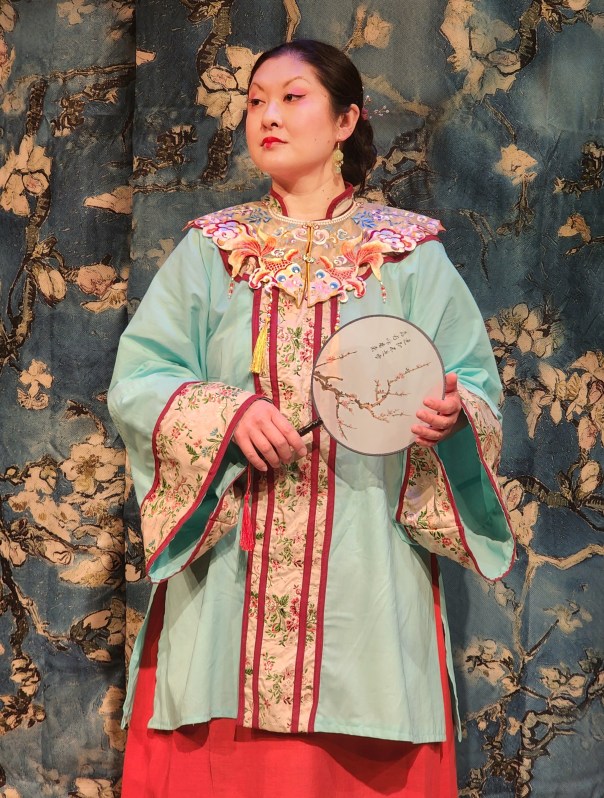
Afong is surrounded, of course, by decorative furnishings, vases, fabrics, draperies, and – at the whim of set designer Chip Davis – an elegant wooden birdcage that may have been unloaded from the same ship she sailed in on. Our Chinese Lady simply models many of these items without saying a word, the Carne Brothers merely scripting her actions. But at other times, Moy was an actress dutifully mouthing words that were not her own, words of gratitude to her benefactors and words directing our attention to the Carne Brothers’ merch on sale nearby.
It’s bittersweet, then, when Barnum has relieved her of her commercial obligations and transformed her into one of many sideshow attractions. As she becomes more authentically herself and gradually learns the language of her new homeland, Afong becomes less unique, less celebrated, less valuable to her employer, and more degraded and disposable.
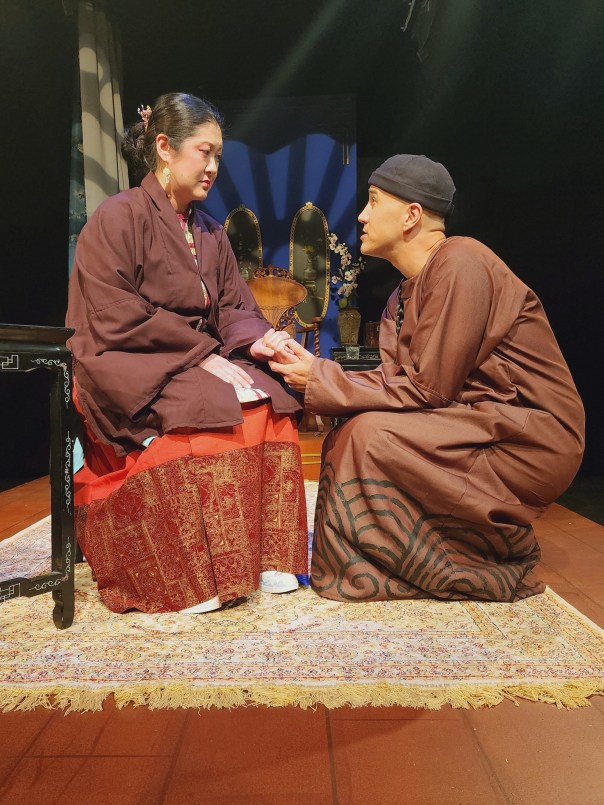
Just one altercation between Afong and Atung, when he attempts to draw the curtain closed around her little performing space, is enough to remind us that her comings and goings are not voluntary. Each closing of the curtain propels the action at last a year closer to our time. While Suh doesn’t spend much effort in dramatizing Moy’s increased mastery of her second language during those years – and partial forgetting of her first – he diligently opens her eyes to how we proceeded to exploit the influx of Chinese immigrants that came after her.
It wouldn’t have been a pretty sight even if Moy had lived past 1850, when history loses track of her. The first great wave of Chinese immigration was triggered by the California Gold Rush of 1849. By the time the Golden Spike completed Transcontinental Railroad in 1869, there were 12,000 Chinese in the construction crew that completed its western leg, working for the Central Pacific Railroad.
Sketching our great nation’s appreciation for Chinese labor, Suh’s Afong catalogs a few of the hideous slaughters of miners and laborers that Asians were treated to. Then in 1882, our US House of Representatives had their first opportunity to express their gratitude to the immigrants by voting down the Chinese Exclusion Act, which would stop immigration in its tracks for the next 10 years. But guess what. Our Congress passed the heinous restrictions overwhelmingly, the first such action Congress had taken against any nation, and 10 years later, they passed an extension of the Exclusion Act for another 10 years.
Then in 1902, our wise and magnanimous Congress said enough is enough. This time, they made the law permanent.
Now I can’t recall learning any of this back in my school days, no doubt a comfort to many framers of school curricula today who worry so devoutly about disturbing their fragile offspring. Lucky for them, The Chinese Lady was written before the COVID-19 pandemic rekindled widespread hatred and violence toward Asians. Tynes-Miller refrains from layering on any additional references to the re-emergence of this ugly bigotry, a kindness that was not granted by last year’s New York revival at the Public Theatre.
Still, Suh’s play won’t appeal to the haters or the educational censors who redline uncomfortable highlights of American history. Big green light, though, for those of you who feel like we should all know our history as fully and fairly as possible. You will be rewarded with new insights and an extraordinary pair of performances by both Wada and West-Rogers.


