Review: Grease
By Perry Tannenbaum
People forget that Grease was a huge smash on Broadway for over eight years, the incubator for such hunks as Patrick Swayze, Richard Gere, Barry Bostwick, Peter Gallagher, Treat Williams, and that John Travolta guy. The 1978 film starring Travolta and Olivia Newton-John not only eclipsed the 1972 original, it radically altered the Jim Jacobs and Warren Jacobs book and score. By 2007, the last time it was revived on Broadway, Grease couldn’t be Grease without the two hit songs created for the movie, “You’re the One That I Want,” one of numerous #1 hits that John Farrar wrote for Newton-John, and Barry Gibbs’ “Grease (Is the Word).”

The result at CPCC Summer Theatre, with Carey Kugler directing that 2007 version, will often play like a blurred – or cut – version of the movie. Our summer romance at the beach with its poignant farewells, the second beginning devised for the show, now gives way to a third. Sandy Dumbrowski’s nemesis, Rizzo, is more like a spider lady than a tough punk. Stockard Channing delivered. Sandy’s quest to become part of the Pink Lady clique is forgotten, and there’s no climactic drag race when Danny Zuko reasserts his heroism behind the wheel of Kenickie’s Greased Lightnin’.
With one of the actors absent for the Sunday matinee, confusions compounded. Justin Austin smoothly replaced Aaron Coulson as Teen Angel, singing “Beauty School Dropout” to the disconsolate Frenchy, Sandy’s staunchest ally. But Coulson was also supposed to portray deejay Vince Fontaine at the high school sock hop. Touchy situation. Megan Postle, who terrorized one of Danny’s T-Bird chums as Miss Lynch, his English teacher, had to reappear as the fulsome emcee of the hop, and Ashton Guthrie, who was just learning the rudiments of guitar at the top of Act 1 as Doody (a pretty lame “Those Magic Changes”), now gets to sing Vince’s “Born to Hand Jive,” one of the best numbers in Act 2.
Unless you had recalculated based on CP Theatre Dept. chair Tom Hollis’s pre-show announcements, these were additional head-scratching moments.
Perhaps the most charitable way of looking at the Jacobs-Casey book, substantially overhauled by Allan Carr and Bronte Woodard for the film, is to presume that they were trying to flip Manhattan’s West Side Story into a vaguely Chicago comedy – if they had any idea of what they were doing at all. Otherwise, it’s hard to explain the botched, crisscrossed contretemps at the prom and the abruptly scheduled rumble between the T-Birds and the Scorpions that never happens.

Kugler never seems compelled to plug up any of the plot holes, so Philip Stock as Danny acts like a jerk without any qualms or hesitation. Stopping one time while making your exit doesn’t quite cut it. Robin Dunavant gets more to work with in baring Sandy’s heart – including twice as many songs – but with Danny wavering so capriciously in his affections, her “Hopelessly Devoted to You” feelings seem downright stupid. While Jason Estrada’s costume designs could be more rugged for the T-Birds, the megawatt blond wig he saddles Sandy with throughout her pre-makeover scenes (I’m not sure a single hair moves) made me wonder whether or not a beautiful teen lurked underneath.
Despite these teetering foundations, Stock does project a hard James Dean-like edge and – keeping in mind that this is Rydell High – a lean, sneering arrogance that recalls Bobby Rydell. There really are sparks when Dunavant finally crosses over from Sandra Dee-land to the leather-clad tramp that Danny wants, but the gulf between the two Sandys is so wide that it’s hard to shake the notion that her latter-day self is her creators’ wet dream. The masculinity takeaways from GREASE, that gangster toughness gets you girls and that unprotected sex is cool, are pure ‘50s bull, never questioned.
Amid Danny’s vacillations and Sandy’s pathological primness, the bitchy, predatory Betty Rizzo stands taller with the steadfast power of her slutty convictions. Don’t you dare feel sorry for her! Lindsey Schroeder further accents Rizzo’s outlaw chic with a self-assured swagger that gives her dominion over every scene she appears in, singing or not. The astonishing dancing jolts that Treston Henderson brings to Kenickie’s “Greased Lightnin’” are totally worthy of this spitfire Rizzo, his usual girlfriend. But the garbled speaking parts? Not so much.

Coupling and uncoupling are so unmotivated that the remaining T-Birds and the Pink Ladies threaten to devolve into stock characters. Among the guys, Guthrie as Doody is the only other gang member to leave an impression. Ava Smith as Frenchy is the only Pink aside from Rizzo that I could care a little about, but a beauty school dropout warrants a far more frightful wig. Outside the Pink clique we do better, with Alexis Harder showing some flair as Cha-Cha DiGregorio, the outsider dancing ace that Kenickie brings to the sock hop to spite Rizzo. Patty Simcox is no more scheming or manipulative than Rizzo, but Susannah Upchurch manages to make us dislike her chiefly for her wholesome veneer – and because she doesn’t seem to be enjoying her own wickedness nearly as much.
Fun-loving mindlessness is as much the word at CP as GREASE is. At Rydell High, you are so uncool if you can’t sustain enthusiasm through all the many ram-a-lam-a-ding-dong nonsense phrases that “We Go Together” provides for the ensemble at the end of Acts 1 and 2. The old folk at Halton Theater on Sunday, bobbing their heads to the beats until the lights came up, weren’t looking for any meaning at all in GREASE. They were looking for the sheer joy of youth, and they were finding it.


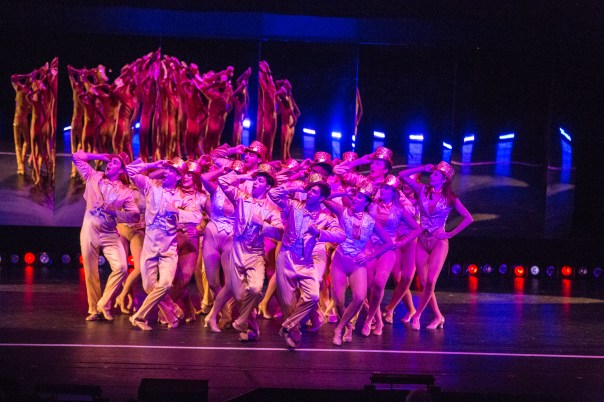

 Paul, another role that doesn’t draw a solo vocal, is the other finalist who brings the action forcefully into the present – thanks to Tyler Dema’s affecting vulnerability as he uncovers the reasons why Paul finds it impossible to open up in front of his fellow dancers. Zach’s private huddle with Paul is another highlight in Wright’s performance as well. Eleni Demos, new this season to CP, deserves a shout-out as Diana. Answering Zach’s most disturbing question, she ably leads “What I Did for Love” – the enduring anthem of A Chorus Line.

