Tag Archives: James Cartee

Ample Eloquence Thrusts Home Against Faulty Amplification

Review: Shakespeare Carolina’s Cyrano

2019~Cyrano-36

By Perry Tannenbaum

Not surprisingly, Edmond Rostand was a theatrical reactionary. His most famous drama, Cyrano de Bergerac, was the last play written in verse or poetry that is still widely revived. The verse plays of William Butler Yeats, Maxwell Anderson and Archibald MacLeish have long since fallen by the wayside, but Rostand’s throwback along with his more whimsical Les Romanesques, transmuted into the evergreen musical, The Fantasticks, still endure.

But lately, Rostand’s original French text has been buffeted by film and stage adaptations that take us far from the playwright’s classic Alexandrine couplets – and the Brian Hooker verse translation that Jose Ferrer immortalized playing the title role. My last brush with a traditional Cyrano was in 1997 in an Off-Broadway production, when Frank Langella heroically took the title role in an abridged rendering of the Hooker translation.

The Anthony Burgess version, performed in SouthEnd by Epic Arts Repertory Theatre in 2004, took some liberties with parts that the translator didn’t fancy – and Laura Depta took on the title role, liberating it from traditional menfolk. So it’s been awhile since Charlotte has seen a traditional Cyrano, though the opera composed by David DiChiera, presented here by Opera Carolina late in 2017, reminded us of the huge scale and tapestry that Rostand imagined.

2019~Cyrano-39

You won’t find comparable operatic grandeur in the SlimFast Cyrano adapted by Jason O’Connell and

Brenda Withers, presented outdoors at the Winthrop Amphitheater by Shakespeare Carolina. Among the 44 “persons” catalogued in the original cast list are groups of cadets, poets, pastrycooks, pages, and musicians. After all these, Rostand calls for citizens, musketeers, thieves, children, Spanish soldiers, intellectuals, academicians, nuns, etc. O’Connell and Withers distill these multitudes into a script that ShakesCar presents with a cast of five – fewer people than you’ll see onstage in any precious little revival of The Fantasticks.

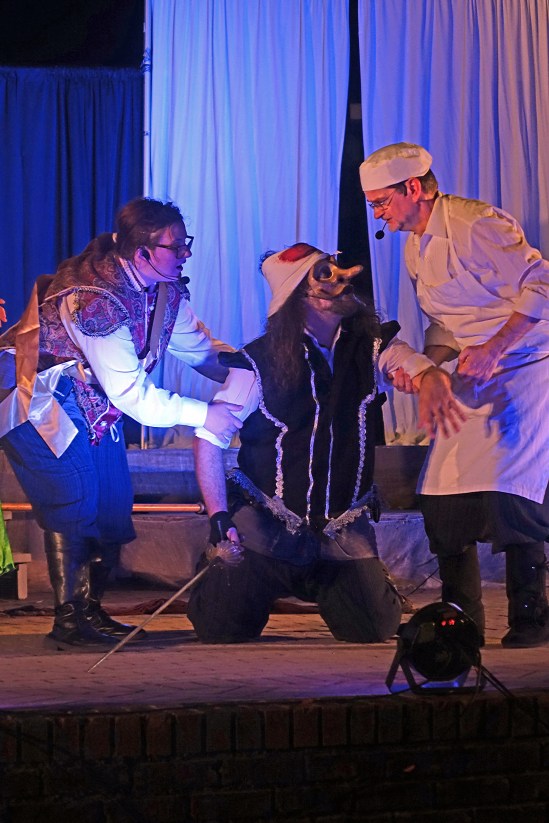
Naturally, O’Connell and Withers keep those five actors very busy in multiple roles. Even James Cartee, who will settle into the role of Cyrano, appears in a curiously updated prologue, falling off a ladder and setting off an ambulance-vs.-Uber debate on how to get him to a hospital. Stefani Cronley, off my radar since her debut in Fahrenheit 451 two years ago, must moonlight as a cadet when she isn’t Roxane, the beautiful lady of surprising depth and courage who absorbs Cyrano’s undeclared love and Christian’s inarticulate rapture.

Christian is fairly stunning himself, which may explain why Daniel Brown reappears as Sister Marthe when he has finished wooing Roxane. S. Wilson Lee also has an interesting array of roles; including Montfleury, a bogus poet whom Cyrano mocks; DeGuiche, a powerful noble who stalks Roxane; and Ragueneau, a friendly baker. The scenes we remember best from traditional productions, the moonlit scene in Roxane’s courtyard and the finale 15 years later at the Ladies of the Cross Convent, don’t really suffer dramatically from the O’Connell-Withers compression.

On the other hand, the remaining scenes were conceived on a grand scale. Cyrano heckles and denounces Montfleury at a theatrical presentation, he has an ill-fated triste with Roxane and meets Christian for the first time amid a hubbub of impoverished poets at Ragueneau’s bakery. And the unique love triangle climaxes at a besieged castle defended by Cyrano, Christian, and the cadets of Gascoyne. These are the scenes where Rostand’s multitudes are normally deployed.

2019~Cyrano-08

This Cyrano also applies the shears to our hero’s swordsmanship and literary prowess, so Monsieur De Bergerac doesn’t sensationally compose a ballade at Winthrop while outfencing and casually slaying a hapless enemy – and Cyrano’s gazette gets short shrift in the final scene. There is simply less reason here to admire and fear this dashing cavalier.

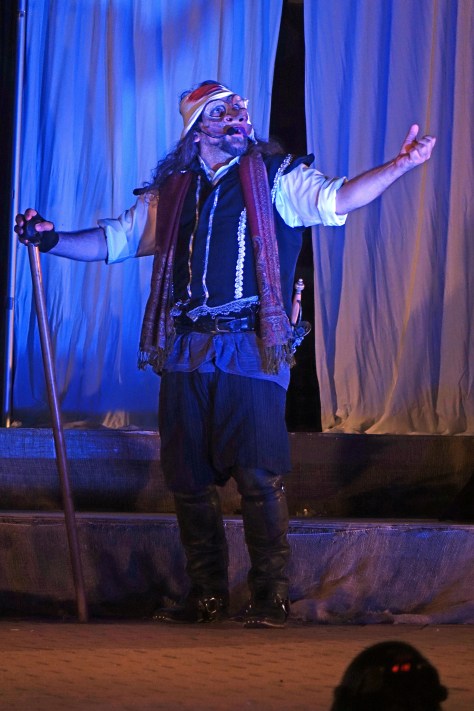
But the new script occasionally rhymes, and Cartee gives Cyrano ample eloquence. He wears a mask of his own design to underscore his ugliness, and his pacing is perfection when he verbally demolishes the simpleton who has the nerve to declare that Cyrano’s nose is outsized – with 20 or more elegant and witty self-deprecating descriptions he improvises on the spot. Confronting Roxane, he is timidity and deference, abashed by his own repulsiveness, yet with a touch of élan. He grows noticeably bolder under the cover of darkness when he woos his beloved on Christian’s behalf.

2019~Cyrano-43

Chris O’Neill’s costume and scenic design prove adequate for the more intimate scenes, largely because of the strength of his stage direction and Danny Wilt’s deft lighting. Until the end, when I felt that Cronley was a bit monochromatic in her weepiness, I was nicely swept into Roxane’s impetuous vigor. Dealing with Cyrano and Christian, Cronley’s eager energy dispelled any suspicion that Roxane was stupid, and the scenes with Christian were always pitch-perfect.

Of course, it’s Christian who readily strikes us as more dimwitted than Roxane at first, but Brown convincingly rides the tide of enlightenment that happens to this young buck as he becomes better and better acquainted with both Cyrano and Roxane. Montfleury and DeGuiche are akin in their foppishness and prissiness with Lee in both roles, which turns out to be quite fine, since De Guiche’s predatory lechery and his worldly power adequately supply sharp distinctions. Lee’s gentle geniality as Ragueneau also helps keeps things afloat and affecting at the end.

What may sink ShakesCar’s production for those less familiar with Rostand is the quirky performance of the sound system. Nearly all of the time, I could hear the players whether or not their microphones were working at that moment. But the in-and-out of the amplification, often in the space of a single line, gets to be annoying and distracting – a possible obstacle to understanding if this is your first encounter with this classic. I could only marvel how the entire cast soldiered through this adversity unfazed.

Hopefully, electronic glitches won’t mar the remainder of the run, for this compressed Cyrano certainly has plenty of panache.

ShakesCar’s Dystopia Is as Serious as a Cartoon

Review: Shakespeare Carolina’s production of Mr. Burns at Spirit Square

By:  Perry Tannenbaum

2019~Mr Burns-12.jpg

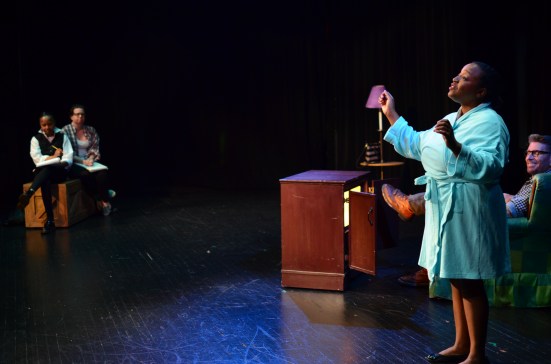
If your Simpsons erudition doesn’t extend far beyond Bart, Homer, and “D-oh!” you likely haven’t the foggiest notion about who the evil owner of the Springfield Nuclear Power Plant might be. Good reason for boning up on the 30-year-old animated TV series before you go and see Shakespeare Carolina’s production of Mr. Burns, Anne Washburn’s strangely imagined “Post-Electric Play,” at Spirit Square.

The Simpsons is very much at the heart of Washburn’s myopic dystopia, beginning not too long from now, somewhere south of devastated Boston – at a safe distance from obliterated Pennsylvania. Not an ardent lobbyist on behalf of nuclear power, Washburn doesn’t trigger her nuclear winter with weapons unleashed after treaty breaches, miscalculated escalations, or some jerk’s pudgy finger on the nuclear hot button.

Instead, we seem to have been decimated by a chain reaction of nuclear reactors.

2019~Mr Burns-03

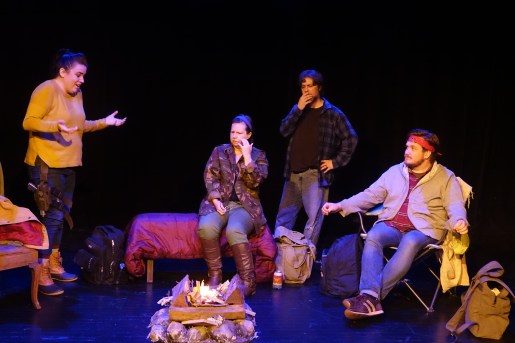
Certainly, the evil Mr. Burns has triumphed over humanity in Washburn’s scenario, but it’s unclear whether she views that as her ultimate horror. For as a few survivors sit around a campfire, we might gather that The Simpsons has outlived all other recognizable trappings of civilization. Matt, Jenny, Maria, and Sam aren’t preoccupied with reaching out to other clusters of survivors or isolated wanderers – or in re-establishing the nation’s electrical grid. Rather they’re engaged, sometimes excitedly, in piecing together an old episode of The Simpsons that they have all watched years ago.

Presumably a rerun, for the “Cape Feare” episode, the core of the reconstruction, first aired in 1993, twenty years before the off-Broadway premiere of Mr. Burns.

A newcomer named Gibson wanders into the campsite with the bad tidings from Boston. He is also familiar with this seminal episode of The Simpsons and contributes to the group reclamation. Aside from a ritual sharing of possible survivor info, that’s pretty much all of the Act 1 action.

Colleen 2.JPG

Not at all interested in adhering to established theatre traditions, Washburn gives us two intermissions instead of the usual one. And if you think the opening act was a bit impersonal, wait till you see the acts that follow. It’s seven years later and Colleen, recumbent and silent throughout Act 1, has become a post-electric TV director, and the company has grown to seven with the addition of Quincy.

We see the group rehearsing an odd amalgam of quick TV sitcom blackouts and commercial breaks, where “Cape Feare” has evolved and commercials are no less revered for their nostalgic content. Apparently, touring with such rudimentary fare has become a cutthroat industry. Lines, slogans, and episodes are licensed, and competition for rights to them is fierce – and perhaps more important than the quality factor.

Pret a Manger

Zoom ahead 75 years and, under Amanda Liles’ ritualistic direction, you’ll be able to visualize “Cape Feare” as either a solemn religious rite or as an eerie melodramatic opera, for most of the music written by Michael Friedman to Washburn’s lyrics resides here. Liles and the ShakesCar cast also leave the ending ambiguous. We’re either watching the near-revival of the electrical grid or a re-enactment of the original flameout.

Mr. B finally emerges emphatically during this savage spectacle, not as the evil and greedy capitalist of yore but as a demonic destroyer. Homer, Bart, and Marge are now as foundational as Abraham, Isaac, and Jacob – though their sacrificial fates bring in a New Testament flavor. Stray wisps of Washburn’s referential comedy still remain, though, as when the Simpsons make merry with new lyrics to The Flintstones’ theme song.

2019~Mr Burns-23.jpg

My suspicion is that enjoyment of Mr. Burns will be proportionate to how readily you can see yourself sharing in the opening bursts of enthusiasm that the nuclear holocaust survivors have in reconstructing “Cape Feare” on The Simpsons. Lacking more than rudimentary Simpsons erudition – Homer’s voice will send my hand flailing toward my remote a bit more quickly than Bart’s – I’ll have to admit that I struggled. My memories of Homer’s zenith had faded into forgetfulness long before 2013.

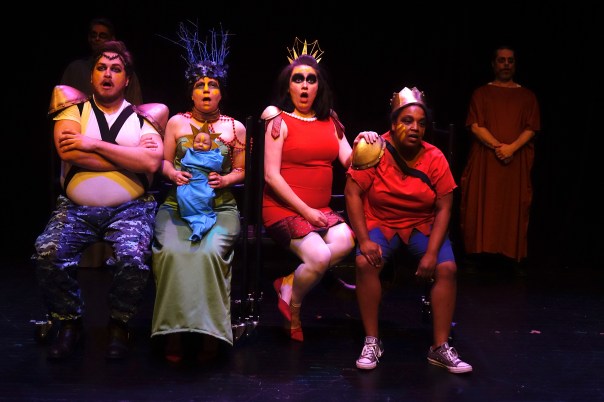
An apocalyptic landscape such as Washburn’s is obviously frill-averse, so if Jess Clapper’s costume designs look somewhat makeshift, no harm done. The cylindrical blue headdress that Jen Jamsky-Pollack wears as Marge works fine, recognizable in an instant for The Simpson faithful, while Rasheeda Moore’s get-up as Bart looks comparatively thrown together. Viking shoulder plates? Why not.

Nor does an outdoor campsite in the middle of the night – or the scenes to follow – require that Liles seek out a set designer, though the final flashes of zonked light presumably required some technical derring-do from James Cartee. The design and tech needs of Mr. Burns really do jibe well with ShakesCar and their fundamental Elizabethan fare.

Except that, in Mr. Burns, we never become more than superficially acquainted with anyone onstage. In Act 2, we can at least conclude that we’re watching a director with a company of actors, all of whom discuss the production they’re rehearsing and the biz. In the outer acts, Shakespearean ripeness is pretty much deep-sixed. The characters they’re portraying or debating are more important than who Matt, Jenny, Gibson, Colleen and the rest really are. By the time we’re 75+ years hence, when all these folks are sporting various configurations of face paint, they can’t really be the same people we were introduced to.

It’s not just a surrender to a debased pop culture that Washburn seems to be sketching – it’s a surrender of identity. Maybe that’s the point that the playwright wants to make, irrespective of nuclear threats, and maybe she was worried that we wouldn’t notice or be alarmed.

2019~Mr Burns-21.jpg

Most people who enter Duke Energy Theater for an evening with Mr. Burns – or the actor who plays the actor who eventually portrays Mr. Burns – will likely wish that Washburn were a little more worried about our perceptions of her script and a little more proactive. While I may need to evolve into a post-critic to properly evaluate Washburn’s post-characters, I’ll start with David Jamsky-Pollack as Matt, the geekiest Simpson preservationist in Act 1.

Although he lays relatively low in the middle act, Matt morphs into Mr. Burns, and more than anyone else, Jamsky-Pollack incorporates the pop-eyed essence of The Simpsons into his portrayal. That creates a credible bridge with Matt, whom Jamsky-Pollack makes the most hyper and paranoid of the people around the campfire. As Colleen, Corlis Hayes is another near-person we pay attention to, primarily in Act 2 while she is the company director and Matt is in eclipse. Hayes is moderately bossy, a bit yielding when her authority is challenged – everything her role demands.

Dervin Gilbert is arguably the nearest to a three-dimensional person as Gibson in the first two acts. With multiple guns pointed at him as he enters the campsite, we can empathize with his trepidations and attempts to ingratiate himself, and seven years later, Gibson is Colleen’s leading man, a temperamental artiste in an arts wasteland. Matt Kenyon as Sam/Homer, Melody McClellan as Maria/Lisa, and Jen Jamsky-Pollack as Jenny/Marge are most memorable during the sacred Simpsons rites, successfully achieving and slightly transcending cartoon reality.

2019~Mr Burns-17.jpg

Among the latter-day Simpsons, I was most taken with Moore, who doesn’t arrive until after the first intermission as Quincy, a singer with as much artistic pretension as Gibson. It does make sense that Quincy would get to chew nearly as much scenery as Matt when the Simpsons ritual becomes a life-or-death struggle between good and evil. Cartoon or not, Moore’s writhing, struggling, despairing, and rallying are key reasons why we see the horror in Mr. Burns, whatever it may mean.

Homespun “Barbecue Apocalypse” Improves With Age

Reviews: Barbecue Apocalypse, The Sherlock Project, Life Is a Dream, and Madagascar

By Perry Tannenbaum
IMG_5740

In a year that included Lucas Hnath’s The Christians, Robert Schenkkan’s The Great Society and Rebecca Gilman’s Luna Gale among the top contenders, I could only give Matt Lyle’s Barbecue Apocalypse a lukewarm endorsement for best new play of 2015, ranking it #13 among 27 eligibles that I read for that year’s Steinberg Awards. Nor did colleagues from the American Theatre Critics Association strongly disagree with my verdict, since Lyle’s dystopian comedy didn’t make the cut for the second ballot, when we considered our consensus top 10.

But before Charlotte’s Off-Broadway decided to stage this show at The Warehouse PAC up in Cornelius, they did some reading and balloting of their own. From January through March, the company offered monthly “Page to Stage” readings presenting two different plays on each occasion. Then they asked ticketholders to vote on which of the six plays they would like to see in a fully staged production. Less than two months after the votes were counted, Barbecue is back for my reconsideration as the audience favorite.

And on further consideration, I must credit director Anne Lambert and her professional cast for convincing me that Barbecue Apocalypse is even better than I thought it would be – far more to my liking than real barbecue.

IMG_5885

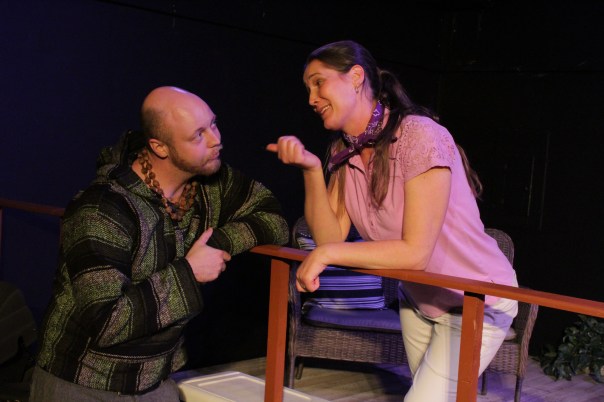
Lyle would probably concur, since his patio hosts, Deb and Mike, are only grilling and basting because they want to avoid the embarrassment of having their friends – who are more trendy, stylish, and successful – see the interior of their home, decorated with lame movie posters. Deb succinctly describes her strategy as lowering expectations for the cuisine and the ambiance. Outdoors, she can point with pride to the fact that Mike has built the rear deck himself. Yet the barbecue event has obligated Mike to buy a propane grill off Craig’s List, and he’s afraid to light it.

He would also like Deb not to mention that he’s a professional writer, for his career earnings, after one published short story, now total 50 bucks.

All four of the guests feed the hosts’ sense of inadequacy. Deb is a decorator, foodie, and gourmet cook who makes sure to bring her own organic meat, and her husband Ash is a gadget freak, armed with the best new smartphone equipped with the most awesome apps. Win pretty much embodies his name, a former high school QB, now a successful businessman with Republican views. He lives to put Mike down and can seemingly get any woman he wants. Even his bimbo of choice, Glory with her Astrodome boobs, can claim formidable accomplishments, arriving late to the barbecue after nailing her Rockette audition.

What ultimately happens to this insulated suburban group reminds me of The Admirable Crichton, the excellent James M. Barrie tragicomedy I came across a couple of times during TV’s golden age, when colleges had core curriculums. A perfect butler to the Earl of Loam in Mayfair, London, Crichton and his betters were shipwrecked on a desert island in the Pacific, where his natural superiority emerged.

There are two basic differences between Barrie’s back-to-nature tale and Lyle’s. The shipwreck situation was reversible with rescue. Apocalypse isn’t. More to the point, Barrie was clearly targeting the blind rigidity of class distinctions. Here if we consider the implications of Barbecue Apocalypse, Lyle seems to have modernity in his crosshairs – how our world warps our aspirations and our self-worth, how it channels us into modes of living that are far from our authentic selves.

In the cramped storefront confines of the Warehouse, Lambert doesn’t attempt to design a deck that lives up to Mike’s pretensions, and Donavynn Sandusky’s costume designs are similarly déclassé, especially for the nerdy Ash. This robs Lyle’s concept of much of its slickness, which for me turned out to be a good thing. Aside from the Craig’s List mention, Lambert also dropped in a couple of local references that added to the overall homespun flavor.IMG_6440

Becca Worthington and Conrad Harvey were nearly ideal as our hosts, keenly aware of each other’s limitations and their own, yet visibly crazy for one another. Worthington with her status-conscious rigidity and stressing was clearly the closest actor onstage to Lyle’s vision, beautifully flipping her “We suck” persona after intermission and the apocalypse, when a full year of roughing it has elapsed. Harvey was more than sufficiently cuddly and self-deprecating – but credulity is stretched when a man of such size and stature is repeatedly dominated by his adversaries.

If you can accept that Greg Paroff was ever on a football field, let alone as a QB, you’ll be quite pleased with how he handles Win’s asshole antics. He is confident, he is arrogant, and if he’s possibly past 40, that only increases the disconnect between Win and his limber Rockette. Julia Benfield is absolutely adorable as Glory, and I absolutely adore how she’s still mincing around in high heels when she makes her disheveled entrance in Act 2. We totally believe that her familiarity with Tom Wopat doesn’t extend to The Dukes of Hazard in the ‘80s.

Probably not the best moment for Lambert when she cast Cole Pedigo and Jenn Grabenstetter as Ash and Lulu. They should remember the ‘80s, but I needed to stifle my doubts. Wardrobe and just the way he’s absorbed in his iPhone might help Pedigo out – and make him less wholesome, winsome, and juvenile before the apocalypse. Grabenstetter overcomes all objections when free-range Lulu gets snockered on generic canned beer, and both Pedigo and his scene partner truly click when adversity brings Ash and Lulu to a new lease on life in Act 2. I believe that’s an antler dance.

I won’t disclose what happens when Maxwell Greger walks on for his cameo deep in Act 2, but I do respect how Lyle makes him earn his paycheck with a sizable monologue. Greger does the denouement with a slight manic edge, and the technical aspects of his departure are impressively handled.

So it’s fair to say that apologies are in order for rating Barbecue Apocalypse in the middle of the pack when I first read it. Or excuses, since a rational man resided at the White House in 2015, and apocalypse seemed so fantastical.

But hold on. Charlotte’s Off-Broadway has already programmed two other plays from their “Page to Stage” readings for two fully-staged productions in the near future, Susan Lambert Hatem’s Confidence (and The Speech) for September and Lauren Gunderson’s Exit, Pursued by a Bear for next February. Maybe when these runner-ups get fleshed out, supporters of Lyle’s winning script might reconsider their votes!

A Catch-All Catch-Up

Our recent travels to Greece, Israel, and Jordan compelled us to miss a bunch of high-profile openings after we reviewed the reinvented Rite of Spring at Knight Theatre on April 6 and CP’s On Golden Pond the following evening. Even before we left, we had to pass on the Charlotte Dance Festival and CP’s Elixir of Love so we could adequately prepare for our trip. To see the birthplace of theatre, the Holy Land, and Petra, we had to miss out on the BOOM Festival, the reprise of Beautiful: The Carol King Musical, and the opportunity to host a pre-show preview of The Marriage of Figaro for Opera Carolina.

New openings when we returned were a must, so we hit the ground running with Charlotte Ballet’s Spring Works and Symphony’s Brahms-and-Bartok program. But our need to catch up with Carolina Shakespeare’s Life Is a Dream made us put off seeing PaperHouse Theatre’s Sherlock Project until it second week. It gets complicated. But I’ve tried to get up to speed while working on more reviews and features. File these under gone but not forgotten:

The Sherlock Project – So a dozen actors and writers collaborated on PaperHouse Theatre’s mash-up of Sir Arthur Conan Doyle’s short story gems, producing a script that follows three guiding principles: keep it funny, keep it moving, and don’t, don’t, don’t ever explain how the great Sherlock Holmes arrives at his incredible deductions. Going back to their roots at the Frock Shop on Central Avenue, PaperHouse and director Nicia Carla found a frilly complement to the Victorian chronicles of Dr. John Watson.

But the frame of the story was wholly new, telling us that the deadeye detective in the deerstalker cap is a woman. Watson protects the woman who should be credited with all the purported exploits of Scotland Yard’s Inspector Lestrade because he knows that Sherlock is right: The general public is even less prepared to believe a female is capable of such brilliancies than Watson is.

Besides all of the Sherlockian brilliance and nonchalant arrogance, Andrea King reveled in all of the detective’s eccentricities, whether it was shooting up a 7% solution of cocaine, tuning up a violin, or lighting up a calabash pipe. Opposite King’s insouciant self-confidence, Chaz Pofahl wrung maximum comedy from Watson’s wonder and timidity – a phenomenon compounded by the gender factor as Pofahl switched from paternal protectiveness to awe or terror while King wryly twinkled and smiled.

The two main supporting players slipped into multiple roles, Angie C as a cavalcade of damsels in distress and Berry Newkirk in the plumiest cameos, ranging from the dull-witted Lestrade to the razor-sharp Professor Moriarty, mythically uncatchable. Apart from directing behind the scenes, Carla conspired in the action as Mrs. Hudson, Holmes’s discreet housemaid. Carla not only ushered in Sherlock’s distraught clientele or evil adversaries, she also presided over scene changes, when audience members had to exit the Frock Shop’s parlor to a murder scene in the adjoining room or out on the porch when Sherlock was pursuing… something. Had to do with fire.

Or when it was intermission, time for little cucumber sandwiches.

The whole show was a wonderful diversion. PaperHouse had to add another performance to their run, which we caught last Wednesday, and the remaining nights were already sold out. Like the PaperHouse faithful, I couldn’t get enough of The Sherlock Project. I wanted lots more – beginning with how did Sherlock deduce that Watson had just come from Afghanistan when they first met?

Life Is a Dream – Convinced it was a comedy rather than a political melodrama, Shakespeare Carolina and director S. Wilson Lee kidnapped Pedro Calderón de la Barca’s classic, written during Spain’s Golden Age, and transported it more than three centuries forward from a mythical Poland to a mythical Las Vegas. There in a seedy club on the strip, the two factions with their eyes on the throne were Frank Sinatra’s Rat Pack and Marlon Brando’s Wild Bunch.
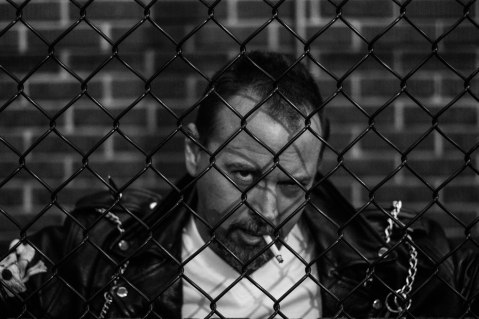
Lee’s wild conceit didn’t do nearly as much harm as I thought it would, mainly because ShakesCar didn’t have the budget to carry it too far at Duke Energy Theatre, and the strong cast mostly played their roles as the text, sensibly adapted by Jo Clifford, said they should. So much depended on the broad shoulders of David Hayes as Segismundo. Heir to the throne of Poland, Segismundo has been locked away Prometheus-like in a mountain dungeon for his whole life by his father, King Basilio, who is foolishly trying to ward off the dire destiny predicted by an astrologer.

A boiling rage seethes inside of Segismundo, and a less mightily built actor than Hayes might need to strain himself to encompass it. Hayes projected the mighty rage rather naturally, which made it easier for him to flow convincingly into Segismundo’s softer emotions when – before he has even suspected his royal lineage – he is handed the Polish throne and the power to act on his newly awakened sexual urges as he sees fit.

Called upon to give a far more nuanced performance as Basilio, Russell Rowe delivered. Yes, he was cruel, but also conflicted, with a lifelong dread deftly mixed into his forcefulness. Though I feared the convoluted plot might be abridged or simplified, the intrigue, the complexity, and the epic monologues were almost entirely intact. As the vengeful Rosaura, Teresa Abernethy brought forth the masculine-feminine blend that the transgendered Clifford was aiming for in her translation, and James Cartee, an actor who often keeps nothing in reserve, showed unusual probity and maturity as Clotaldo, even as he tried to figure out his long-lost child’s gender.

Nobody was more suavely dressed by costume designer Mandy Kendall than James Lee Walker II as Astolfo, the successor that Basilio wanted if the true heir didn’t pass his test. But if anybody was victimized by Lee’s Rat Pack concept, it was Walker. I have no idea why he persisted in speaking so rapidly and unintelligibly, unlike any work I’d seen from him before. Was he attempting a Sammy Davis Jr. imitation? Couldn’t figure out what accounted for this curious outing.

Betrothed to this strange hipster, Maggie Monahan beautifully brought out the agonies of queen-to-be Estrella. Maybe the most Shakespearean role in this ShakesCar production was Ted Patterson as Clarin, who tags after the disguised Rosaura from the opening scene, as either her companion or servant – but definitely our clown.

On the strength of this effort, theatergoers can be excited about ShakesCar’s next invasion of Spirit Square, The Tragical History of the Life and Death of Doctor Faustus at Duke Energy from June 28 to July 7.

DSC03442

Madagascar – Okay, so I’ll grant that the musical adaptation of the 2005 Dreamworks film didn’t have the gravitas of the greatest Children’s Theatre of Charlotte extravaganzas of the past like their Boundless Grace and The Lion, the Witch, and the Wardrobe – or the bite of Ramona Quimby and Tales of a Fourth-Grade Nothing. But this confection was nearly perfection. Under the direction of Michelle Long, Madagascar hit a family-friendly sweet spot, straddling the realms of cartoon silliness, cinematic adventure, and theatrical slapstick and dance. I just didn’t like the deejay, everybody-get-up-and-act-stupid thing.

Scenic design by Jeffrey D. Kmiec never lost its freshness thanks to a slick stage crew and the eye-popping lighting by Gordon W. Olson, while the animal costumes by Magda Guichard probably made the strongest case for live theatre against multiplex animation. Choreography by Tod A. Kubo chimed well with Long’s direction, which used areas of McColl Family Theatre that rarely come into play.

Centering around four animals that break out of Central Park Zoo, Madagascar introduced us to Marty the zebra and his wanderlust. We moved swiftly from there. Following the lead of four penguins bound for Antarctica, Marty escaped the zoo, seeking a weekend in Connecticut. Not only are police, animal control, and TV bulletins on his trail, so were his pals Gloria the hippo, Alex the lion, and Melman the giraffe. Embarking underground in the Manhattan subway, Marty hardly stretched credulity much further by winding up off Africa.

Deon Releford-Lee was a spectacular triple-threat as Marty, but what dazzled most was the multitude of gems in this supporting cast, beginning with an intimidating Alex from leonine Traven Harrington and – on stilts, of course – a timorous Melman from Caleb Sigmon. Dominique Atwater disappointed me as Gloria, but only because we didn’t get enough of our hippo after her first big splash. Olivia Edge, Allison Snow-Rhinehart, and Rahsheem Shabazz fared better, drawing multiple roles.

While the book by Kevin Del Aguila shone more brightly than the musical score by George Noriega and Joel Someillan, I was amazed that so much story and song could be squeezed into barely more than 60 minutes. Combined with last October’s Mary Poppins, the exploits of Madagascar prove that musical production is an enduring strength at Children’s Theatre. I can’t think of a season at ImaginOn that had sturdier bookends than these musicals that began and concluded 2017-18. The crowd that turned out for the final performance affirmed that the 7th Street fantasy palace has perfected the craft of producing family fare.

Not only that, it showed me that Charlotte families have spread the word.
Hit the Road, James, With a Mind-Boggling “Hitchhiker’s Guide”

trillbeer

Review:  The Hitchhiker’s Guide to the Galaxy

By Perry Tannenbaum

Can this really be the end? Citizens of the Universe and its indefatigable intergalactic peacekeeper, James Cartee, are leaving Charlotte, heading for Texas, and only possibly leaving an appendage behind them to carry on their mission. Closing with The Hitchhiker’s Guide to the Galaxy at the Unknown Brewing Company, their most lavish production since they adapted The Princess Bride at the now-defunct Breakfast Club in 2011, COTU is going out with a big bang.

Two parallel events trigger the sci-fi comedy as we meet the shambling, stiff-necked Arthur Dent, who never sheds his PJs and bathrobe throughout his mind-boggling travels. On the earthly plane, Arthur is battling to keep his Cottington home from demolition by the county to provide a pulverized right-of-way for a new thruway. He’s ready to lay down his life for his property, and he’s actually lying down in front of his Cottington cottage so that the county bulldozer can’t move further.

Meanwhile, on a more galactic plane, Vogon overlords who are constructing a hyperspace bypass have slated Earth for demolition. Why a perpetually moving planet in a perpetually expanding universe would be slated for demolition is beside the point, do you hear me?

By the most improbable coincidence, Arthur is singled out for rescue by Ford Prefect, an embedded alien who contributes to the Hitchhiker’s Guide as a roving travel writer. Yes, when Douglas Adams first conceived his sci-fi serial for BBC

zaphod

Radio in 1978, ebooks were already on his imaginary assembly line. Arthur frequently consults his pocket reader after hitchhiking aboard a new space cruise or during his downtime, but it is Mandy Kendall who brings The Book to life between stints as our narrator.

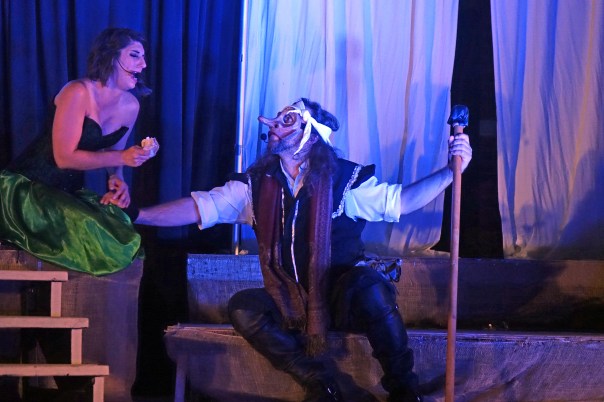
She’s also, as our costume designer, the person who makes COTU’s valedictory so outré sensational. Arthur may be a humdrum everyman, with Chris Freeman faithfully executing his shambling duties, but Tom Ollis and Billy Whalen, tethered together as two-headed galaxy prez Zaphod Beeblebrox, take us back past the disco ‘70s to the hippy ‘60s with their outfit. Loud colors, a florid headband, with brash tie-dyes clashing unapologetically against paisleys.

Of course, Beeblebrox doesn’t exhaust the weird phenomena Kendall must costume on Arthur’s odyssey. Other cameos range from Ravenous Bugbladder Beast of Traal (Greg Irwin), Marvin the morose robot (David G. Holland), Deep Thought the computer (Martin Barry), a Whale (Kevin Sario) swimming with a Bowl of Petunias, and the two life forms on our planet that are smarter than we are, mice and dolphins.

Freeman maintains a British diffidence that occasionally flares into puzzlement amid his haywire journeying, but Nathan Morris as Ford is the optimistic huckster forever urging Arthur onwards, almost oozing insincerity when the going gets tough. Like the brainy Trillian and the gregarious Book, Ford is occasionally incomprehensible when he uses jargon that is outside the ken of the BBC and the OED.

index

Both Ford and Kendall occasionally stumbled on their lines Saturday night when they wandered through this alien corn, less like the terminology of a botany catalogue than the brainchildren of Lewis Carroll. By comparison, Elisha Bryant skates through these lingual brambles effortlessly as the other earthling in our story, not merely assimilating into the galactic hierarchy after being kidnapped by Beeblebrox, but becoming his/its/their right-hand organism.

If you saw Bryant’s work recently in two of the plays at Children’s Theatre’s WonderFest, including the title role in The Commedia Snow White, her excellence at the Unknown Brewing Company will come as no surprise. Every time Bryant appears, it’s in a different costume. Trillian is adequate reason for Arthur to keep on traipsing across the galaxy.

Aside from their helter-skelter production style or their intriguing choices of classics and film adaptations, COTU is best known for pioneering new venues, going where no other theatre company has presented before. Surrounding the players with a wall of wooden casks and an armada of tall stainless steel brewing tanks, the Unknown was surprisingly apt for a sci-fi comedy.

Yes, the sound seal between the brewing room and the bustling taproom wasn’t perfect as the evening ripened, and the makeshift seating wasn’t cushy enough to prevent the onset of butt burnout at the end of the show. But you can settle into the general seating with your brewski in hand, and there was a convenient food truck parked outside last Saturday night on the corner of S. Mint and Lincoln Streets. I can vouch for the blackened salmon sandwich that I took into the theater, but once the lights went down, I couldn’t accurately describe all its green and crunchy contents.

Getting the answer to the meaning of life from Deep Thought is a profound reason for going, so I won’t be a spoiler. But the anthem near the close of Act 2 is such an emblematic goodbye that I can’t resist. After sitting behind the control board for most of the night, cuing projections that I suspect he devised and overseeing the excellent sound, Cartee strode forward to the stage and joined the action – as a dolphin. Somehow in time-honored comic book style, Adams had brought us back to Earth just before the wily dolphins threw off their domesticated disguises and fled the planet.

“So long,” they sang in a joyous, rudimentary production number, “and thanks for all the fish!” Goodbye to you, too, COTU. Thanks for sticking with it so long through so many challenges and hardships.