Category Archives: Theatre

Wacky Magrath Sisters Still Deliver Southern-Fried Hilarity

Theater Review: Charlotte’s Theatre Crimes of the Heart

By Perry Tannenbaum

image1

It’s been a long time – nearly 15 years as far as I can tell – since I’ve spent an evening with Beth Henley’s lovable Mississippi Magrath Sisters. Looking in on them at Theatre Charlotte’s revival of CRIMES OF THE HEART affirms how vividly these deftly differentiated sibs stick in a theatergoer’s memory. First and foremost, you’ll remember kooky Babe, who doubts her own sanity after shooting her husband. Carefree temptress Meg seems to be the enviable paragon, looking down on her sibs as she waltzes back to the home sod with her Left Coast cool, but she’s beginning to doubt her own specialness now that her stab at stardom has come up empty. Lastly, that dear and dutiful doormat, Lenny, with her shriveled ovary and low self-esteem.

If the 1981 Pulitzer Prize winner is beginning to show its age, I couldn’t tell it by the audience reaction at the Queens Road barn. The quirkiness and the comedy still work, but at a distance of 35 years, we can begin to appreciate what made CRIMES OF THE HEART so unique when it burst upon the scene.

Prize-winning plays and novels set in Dixie had invariably been about elegant, decayed, and tragic folk, following the Southern archetypes embraced by William Faulkner, Tennessee Williams, and Harper Lee. Henley showed us once and for all that the eccentricities celebrated in You Can’t Take It With You could play just as well down in Mississippi – even when peppered with dark Arsenic and Old Lace humor.

Yet Henley’s comedy is notably more realistic than Kaufman’s crowdpleaser and both lighter and saner than Arsenic. That’s because the Magrath sisters are quirky rather than balmy – and because no significant antagonist appears onstage. When Cousin Chick drops by to chide or alarm the sisters, she is more of an irritant than an antagonist, her exits usually comical hasty retreats. She’s more like the recurring meanie from a TV sitcom than a force to reckoned with. The only real threat is State Senator Zachery Bottrelle, convalescing offstage somewhere with the bullet hole in his gut that Babe put there.

The Magrath Sisters came equipped with leavening agents that had usually been absent from American comedies: sorrows and regrets. You could easily presume that these were Southern heirlooms from Williams’ iconic dramas, but I wouldn’t dismiss the possibility that this quality in Henley’s heroines may have had its roots in the novels of Jane Austen. Like Gentle Jane, Henley doesn’t presume to show us how men speak to each other when ladies aren’t in the room.

Directing for the first time at Theatre Charlotte, Christian Casper isn’t trying to reimagine our leading characters. Nor is set designer Chris Timmons trying to depict the Hazelhurst, Missisippi, home as any more luxurious or squalid than you might expect. We’re in a bland, slightly cheesy smalltown home, and its only discordant element is the dwarf fridge in the kitchen.

One of the ways that Henley binds her comedy together and makes it memorable is with the pair of ceremonies framing the action in celebration of Lenny’s 30th birthday. As you’ll see in the final moments, budgetary constraints are a bit more exposed than strictly necessary – cakewise and candlewise. But if Casper isn’t sufficiently savvy about the technical strategies to make the final scene truly shine, he certainly doesn’t mess up the opening.

Lenny’s clandestine celebrations get us off to a charming start with Meredith Westbrooks Owen as the pitiful birthday girl, repeatedly hunched over her wee little cupcake, singing to herself. Comedy – and the big news about the crime – burst in with Zendyn Duellman feasting on the role of Chick. Catty, gossipy, and fault-finding don’t completely describe Chick, for she’s also vulgar and trashy, richly deserving the Magraths’ scorn. Picking up a pair of pantyhose that Lenny has obligingly bought for her at the store, Chick begins squirming into them before our very eyes.

Henley meant Chick’s struggles to appear “slightly grotesque” in her stage directions, but Casper has Duellman going way beyond that. Like Lenny, we don’t care whether Chick remembers her cousin’s landmark birthday or not, but the same lapses from her younger sisters clearly hurt. Lenny’s clandestine candle-lighting lingers as an subliminal rebuke, underscoring her siblings’ tendency to be insensitive, neglectful, and self-absorbed. Beyond that, they expect Lenny to perform all the family’s mop-up chores, chiefly the onerous task of caring for bedridden Old Granddaddy.

From the moment that Jennifer Barnette enters as Meg, there are conflicting airs about her of regality and rebelliousness, elegance and uncouth. One minute, she’s lighting up a cigarette to vex Chick, the next she’s disconcerting Lenny by cracking pecans with her shoe. What a fascinating character arc for Barnette as she careens from Coca-Cola and stolen candy crèmes to bourbon and birthday cake. But of course, Barnette’s physical comedy – or even Chick’s, for that matter – will pale in comparison to Babe’s prodigies.

Emily Klingman performed them on opening night with a neurotic edge that eventually won me over. She repeatedly convinces us that Babe is the youngest, most immature person onstage, quite capable of obsessing morbidly over why her mom killed the family cat when she committed suicide. And hey, when a kitchen oven and a chandelier are among your props, you will get laughs.

Self-sacrifice is enough to win our affection for Lenny, but Henley calls upon two good men to help in sealing our fondness for her more self-centered sibs. Allen Eby is Doc Porter, surprisingly mellow for a man whom Meg left drenched and limping after a spectacular breakup during Hurricane Camille. On the other hand, Cole Long as dorky Barnette Lloyd, the legal eagle who is trying to keep Babe out of jail, seems uncannily capable of homing in on his client’s ditzy wavelength.

Less Bard and More Beer

Theater Reviews: Every Christmas Story Ever Told (and then some!) and The Great American Trailer Park Christmas Musical

everyxmasstoryphoto2

By Perry Tannenbaum

Four centuries after William Shakespeare’s death, Charlotte’s own Chickspeare inhabits a parallel universe. Or maybe it’s retribution: while all of the Bard’s works were performed by all-male theatre troupes, all of Chickspeare’s productions since 1998 have been “All women! All the time!” as originally promised. The “All Shakespeare” in the middle of that slogan was gradually blurred and dropped as the Chix added Reduced Shakespeare Company lampoons to their rep and then ventured father afield.

Written by Michael Carleton, James FitzGerald, and John K. Alvarez, Every Christmas Story Ever Told (and then some!) is very much in the spirit of Reduced Shakespeare’s original assault on the Elizabethan titan’s complete works. The parentheses in the title, the quickie romp through multiple classics by three actors playing multiple roles, and the devotion of all of Act 2 to a single extravagant lampoon all follow the Reduced template.

But gender only begins to describe the difference between Chickspeare’s version and the 2010 Actor’s Theatre Every Christmas. The new model is as much an event as it is a theatre production, an experience that begins and ends at the newer NoDa Brewery on N. Tryon Street. In between, there are a couple of shuttle bus rides back and forth from the original Brewery location on N. Davidson Street. You’ll find more brew choices on tap at North Tryon, but the enticement of lifting a mug and participating in the many “To beer!” toasts during the Chix performance at North Davidson is hard to resist.

Few did last Friday night. Besides the brewskis, we had Anne Lambert lubricating the experience with a steady feed of Christmas trivia challenges on the bus ride to the show and the conviviality of the Chix banditas – Sheila Snow Proctor, Lane Morris, and Tanya McClellan – during their performance. But mainly, it was the beer that induced the party atmosphere.

Directing the show, Joanna Gerdy and Andrea King had a healthy disregard for the script. The playwrights labored under a handicap that never afflicted the Reduced Shakespeare collaborators when they chose ancient targets like Hamlet, the Bible, and American history for their merry desecrations. Unlike your seasonal carols, most of our familiar Christmas stories aren’t free-range prey. Copyright law prevents satiric assaults upon Rudolph the Red-Nosed Reindeer, the Charlie Brown Christmas, and the Yuletide yarns of Truman Capote, Dylan Thomas, and Jean Sheperd.

When Carleton, FitzGerald, and Alvarez lashed out at these restrictions, the result was “Gustav, the Green-Nosed Rain-Goat,” not the funniest sketch you’ll ever see. Morris never plays the mutated venison as if it were comedy gold, so there’s never any deadly straining to make it funnier than it is. We’ll raise a glass, and then we’ll move on.

The premise of the show is that Proctor wishes to proceed traditionally with a presentation of Dickens’ A Christmas Carol, but Morris and McClellan are sick and tired of the same old stuff. Before they’ll allow Snow to read her Dickens and play her Scrooge, she must join them in a medley of other Christmas faves, including Frosty the Snowman, Macy’s Thanksgiving Parade, the Grinch, O’Henry’s “The Gift of the Magi,” and – maybe if there’s enough time – the inevitable It’s a Wonderful Life.

scrooge-and-mary2

There isn’t enough time, but that doesn’t deter Morris. While Proctor is on-task as Scrooge, with McClellan visiting her as all three ghosts, Morris keeps insisting that Proctor is George Bailey, inflicting on us a bevy of characters from New Bedford Falls, including George’s guardian angel, his brother, his banker nemesis, and his adoring wife. By the time Lane reaches the wife, it comes off oddly like a female impersonation.

Fortunately, Proctor is the ideal Scrooge in the face of these torments. There’s a bit of Oliver Hardy and Bud Abbott in her forbearance, but we somehow remain on her side throughout her ordeal. At the climax of Christmas Carol, Morris is still bedeviling her, so she finally submits to becoming George Bailey – in a schizophrenic frenzy that finds her shuttling between Scrooge and Bailey as both McClellan and Morris assail her.

In her surrender, Proctor produces a Jimmy Stewart impersonation that’s barely good enough to let you know what she’s doing. It will probably improve during the next couple of weekends as the run continues, but I’m not sure it should. Likewise, Proctor can be a mite slow changing costumes, but McClellan’s patience with her cast mate is so priceless, it would hardly pay for Proctor to hurry.

It’s been a rocky road for Actor’s Theatre of Charlotte since developers forced them out of their longtime home on Stonewall Street last summer. We thought they would resurface on Louise Avenue, but negotiations there collapsed, and the company tacked toward Freedom Drive. City and county paperwork delayed the opening, so their Toxic Avenger was redirected to a nearby church, and the current Great American Trailer Park Christmas Musical has been rerouted to the Patricia McBride and Jean-Pierre Bonnefoux Center for Dance, Charlotte Ballet’s HQ on N. Tryon Street.

I was curious to see how director Chip Decker and his design team would adapt to studios with so much space and such a high ceiling. With two fair-sized ramshackle trailers, topped by two jumbo projection screens, height isn’t a problem, and the design team fills out the stage with a fence, some Florida flamingo kitsch, an incongruous array of Star Wars memorabilia and, dead center of the stage between the two trailers, a half-decorated Christmas tree.

That odd tree, straddling the borderline between Rufus and Darleen’s properties, triggers Betsy Kelso’s plotline. Rufus loves Christmas and adores Darleen, but mean Darleen snarls “Bah” and “Humbug” to both. She will not decorate her trailer or even allow Rufus onto her property to decorate her side of the tree. That’s a source of huge consternation to Betty, the manager of Armadillo Acres, who has always wanted – but failed – to win the big prize awarded to the best-decorated trailer park. A vague curse plagues Armadillo Acres, and it too will to be exorcised before we reach a happy ending.

There’s a certain amount of respectability in Betty, so we’re fortunate that it is more than counterbalanced by the trashiness of her other tenants, Pickles and Lin (short for Linoleum). They also come in handy when ghosts are needed to populate Darleen’s Dickensian dream sequence. Rufus’s romantic fantasies and Betty’s hopes of nabbing top kitsch honors are revived when Darleen, in an effort to pull the plug on the park’s Christmas lights, gets electrocuted by Rufus’s déclassé cable-splitter and wakens with amnesia. That enables her to forget what a Scrooge she is and the fact that she belongs to Jackie, owner of a slutty pancake joint.

If you missed the first and second comings of this trashy romp, it’s good for you to know all the basics I’ve detailed. Although Actor’s Theatre has done well with the Charlotte Ballet space, they have thoroughly failed to conquer its acoustics. So the songs and lyrics by David Nehls are more crucial to your enjoyment than usual – but often unintelligible over the four-piece band led by music director Brad Fugate.

Tommy Foster isn’t as rednecky as Ryan Stamey was as Rufus, but he’s a tad more pathetic and lovable. Karen Christensen is more than sufficiently bitchy as Darleen, and we often forget that Matt Kenyon is in drag as Lin. (So does he, I suspect.) But Jon Parker Douglas nearly steals the show as Jackie when he is possessed during the climactic exorcism. It’s an epileptic farting fantasia that isn’t quickly forgotten – and the kind of broad physical comedy this acoustically-challenged show desperately needs.


Spirit of The Best Christmas Pageant Ever Peeps Through at Matthews Playhouse

Theater Review: Matthews Playhouse of the Performing Arts: The Best Christmas Pageant Ever

By Perry Tannenbaum

bcpe-300x300

A week after reviewing the world premiere of The Best Christmas Pageant Ever: The Musical, commissioned by Children’s Theatre of Charlotte and staged at ImaginOn, I found it easy to imagine that the Barbara Robinson stage play it was based upon could be headed toward oblivion. Driving along I-485 toward opening night of the current Matthews Playhouse production of the non-musical, I had a poignant realization that this could be the last time I’d see the infamous Herdman siblings – “the worst kids in the whole history of the world” – without the new music by Jahnna Beecham and Malcolm Hillgartner that accompanies their superb adaptation.

Directed by June Bayless with a cast of over 40 children and adults, the Matthews production mightily reinforced my impression that the Beecham/Hillgartner musical boasts more vivid storytelling than the 1982 playscript, adapted by Robinson from her own 1971 young adult novel. Not always embracing the challenges – and rewards – of dramatization, Robinson often delivers her story to us second-hand through her narrator, Beth Bradley, a young girl who has a great vantage point for the unfolding events but doesn’t play a key role.

Instead of seeing her younger brother, Charlie, getting in trouble for saying that the best thing about Sunday school is its welcome refuge from the Herdmans, Robinson is content to have Beth telling us about it. Where Beecham and Hillgartner show us how the six Herdmans terrorize Charlie and his schoolmates in the lunchroom – with a dynamically choreographed, hard-rocking “Take My Lunch” production number – Robinson carries out that chore by having Beth confide in us or by Charlie whining about it to his dad.

A huge turning point in the plot, triggering the complication of the marauders invading the church pageant, comes when Charlie claims not to care about surrendering his lunch to a bullying Herdman, because even more enticing goodies are doled out to him after Sunday school. In the musical, this happens in the midst of total lunchroom pandemonium. In the play, it’s merely a dialogue that Bayless can stage in front of the curtain to mask a scene change. Time after time, watching the Robinson version just five days after the new musical demonstrated how deftly upsized the new version is and how static the old one was.

The disparity was magnified, of course, by the intrinsic differences between a generously budgeted professional effort and a more modestly funded community theatre production. But watching less polished performers at a more rudimentary facility also offers insight into why this clunky script is so beloved, mounted at least a dozen times over the past 14 holiday seasons in the Charlotte metro region. Rambunctious and rowdy as they are, the Herdmans are hard roles to mess up. Even when the savagery of the roles goes visibly against the grain of the young actors, the result remains very entertaining. The climactic Christmas pageant, dominated by the kids, is even more foolproof. At a church or school play, stiffness and self-consciousness are the norm, so any glints of talent and naturalness are gravy.

14590302_1108111122558336_4617045513745016_n

I wasn’t always sure that Bayless really wanted to transcend the awkwardness of school theatricals. Every actor and actress under the age of 21 faced the audience directly at an angle of zero degrees throughout the 68-minute performance, assuring the same degree of spontaneity for much of the dialogue. When we reached the most chaotic scene, in fact, as firemen ran through the audience in response to an alarmist distress call, panicky children were herded into a circular cluster – and every single child was facing in the same direction, toward us!

The imaginativeness of the staging can be gauged by the beginnings of the two pageant rehearsal scenes. In the first, the kids were curiously quiet and inert before Grace Bradley arrived, but in the second, there were all kinds of noise and commotion. Why the difference? Very logical: in the second scene, the script calls for Mrs. Bradley to demand that the kids quiet down.

No doubt, this style of staging can be adorable. In the actual pageant, all of the heavenly angels came downstage and filled the space from wing to wing as they sang, the littlest angels on the outside flanking a perfectly symmetrical phalanx, with the tallest at the center – like a snowcapped mountaintop crowned with glittering haloes. Trouble was, this angelic row almost completely blocked our view of the Herdmans behind them, getting miraculously wrapped up in the spirit of the Nativity scene they were acting out.

Somehow the impulse to gratify parents and relatives in the audience – those whose kids were in the choir – took precedence over giving the story its maximum impact when it mattered most. The artistry of Evan Kinsley’s lighting design, isolated the Herdmans from the surrounding shepherds, villagers, and wise men, was largely wasted here, for the transformed kids emitting this unexpected glow were almost totally obscured from view. The three busybody gossips, Grace’s implacable detractors, entertainingly sat themselves among us to watch the pageant. They could pretend to have been amazed at the Herdmans when the holiest moment arrived, but I was frustrated by it.

Not having seen such a large cast of unpolished actors in a long while, I found myself tickled at the rich variety of shy, stiff, and promising performances, some of which were brimful of oddly channeled energy. It’s best to dwell on the standouts, I think. While there was a nice shambling quality to Michael Smith as Mr. Bradley, who would rather not see the pageant even if his wife and kids were going to be in it, Nicole Cardamone Cannon as Grace was easily the best of the adults, almost radiant in her forbearance as she dealt with the Herdmans and reassured their victims.

JJ Twer as Beth had a winsome personality as our narrator – and her mom’s prime defender – but Thomas Mink as little brother Charlie pleased me a little more, high-spirited despite all his grievances and more consistently intelligible. Among the Herdmans, the girls have the plumiest roles, and Bayless has cast well here. Ella Osborn as Imogene is a snarling wildcat until the role of the Virgin Mary domesticates her, and Grace Ivey remains implacably exuberant as Gladys, even after landing the role as the Herald Angel. A day after the show, Ivey’s “Shazzam!” is still ringing in my head.

Hey, Hey, We’re the Herdmans!

Theater Review: The Best Christmas Pageant Ever: The Musical

By Perry Tannenbaum

primary-pageant-1

So the holidays are here, and we know the live entertainment drill: inevitable revivals of A Christmas Carol, Nutcracker, and The Best Christmas Pageant Ever plus a few fresh novelties to liven the mix. This year, one of the novelties is also one of the inevitables. For while it’s possible to see the customary stage adaptation of Barbara Robinson’s Yuletide favorite at Matthews Playhouse starting on Thursday, Children’s Theatre of Charlotte unveiled the world premiere of The Best Christmas Pageant Ever: The Musical on Black Friday.

Robinson adapted her 1971 novel for the Seattle Children’s Theatre in 1982, and the proliferation of productions across America has arguably made the playscript more beloved than the book. So the team of Johanna Beecham and Malcolm Hilgartner, adding their lyrics and musical score, did the prudent thing in adapting Robinson’s stage version.

Nearly 34 years to the day since the story succeeded in Seattle, a whole generation of parents who saw Best Christmas Pageant onstage as children are bringing their offspring to ImaginOn to see The Musical. Our Children’s Theatre, which has grown to national renown during those intervening years, had to add five performances to the run before opening night – a tribute to their prestige as well as the bankable title.

Turns out that the Robinsons, the playwright (who died in 2013) and her daughters, were pretty prudent themselves in choosing Beecham and Hiltgartner. They seem to know what can be enlarged to musical proportions and how to get the job done. I’d also say that Best Christmas Pageant is easier to swallow than A Christmas Carol was when it morphed into Scrooge.

Big crowd scenes can be magnified most easily from stage to musical dimensions, but A Christmas Carol doesn’t really abound with them. Scrooge’s workplace and Cratchit’s home aren’t bustling places, and London is a cold, lonely, and forbidding city until Ebenezer’s reformation. So a couple of parties and a funeral were supersized, effervesced, and choreographed for Scrooge. We’re also more familiar with the older, more entrenched Dickens tale, so tampering is riskier, more jarring.


Recognizing that they’re primarily dealing with schoolkids, normal ones in fear of the notorious Herdmans, they make sure to create their biggest scenes when kids congregate, at church for Sunday school, at school during lunchtime, and at their rehearsal hall near the fateful church kitchen. The catastrophic rehearsal scene, causing Rev. Hopkins to cancel the pageant after the Herdman herd has stampeded it, is rockin’ pandemonium.

Beecham and Hiltgartner are more artful even before that in their depiction of the adult antagonists. What I labeled as the four Old Biddies, when Jill Bloede directed the play for Children’s Theatre in 1995, are now three parents of Beth and Charlie Bradley’s classmates. Luanne, Connie, and Betty start us off singing “Perfect Little Town,” as beautifully harmonized and sugary as the overdubbing Connie Francis cooing “My Happiness.” They are natural allies of the dictatorial Helen Armstrong, the rigid director who is usually in charge of the unchanging Christmas pageant year after year.

ladies

But Armstrong is hospitalized this year, so the vocal trio mobilizes with Helen to convince Grace Bradley, Beth and Charlie’s mom, to take over just before auditions. In the play version, all four women wielded old-fashioned phones in cajoling Grace. A musical allows for more fanciful, comical liberties. By the end of another pop rocker, “Counting on You,” the ladies have circled to the opposite side of McColl Family Theatre from Helen’s bedside to resume their vocal trio assault on Grace at the Bradley home, with the siblings and their father joining in on the hubbub.

If the ladies can be more ridiculous now – a big if, since Bloede had Alan Poindexter and Sidney Horton crossdressing as two of the hags in ’95 – then the Herdmans can be more fearsome and ferocious to counterbalance them. Augmenting their chaotic energy is the fiendish work of choreographer Ron Chisholm, who keeps the six Herdmans and their terrified victims spread across the stage in frenetic action. Even Rev. Hopkins must be convinced of their true menace.

ctc-bcpetm-4

We are far closer here to believing Beth’s famed opening pronouncement: “The Herdmans were the worst kids in the whole history of the world.” Where Bloede capitalized a bit on the fact that rather entertaining performances could come from kids who might be visibly reluctant to immerse themselves in the full barbarity of a Herdman, current Children’s Theatre artistic director Adam Burke will have no such laxity.

As Imogene, the Herdman who takes the role of Virgin Mary by the throat, Carlyn Head is an absolute she-wolf in her howling vocals, and there is only the slightest glint of cuteness in Charli Head as Gladys, the little sister who pounces on the role of Herald Angel. With all of this vocal artillery hurled at her from young and old, Ashley Goodson can be sweet and caring as Grace, but when those moments arrive for reasserting control and conviction, she also unveils a voice of steel.

So when the Herdmans come around to the spirit of the Nativity, Grace is a little more amazing than she was in the play version, but I’m more thankful for the fulminating comic relief from Allison Snow Rhinehart, thwarted each time she issues a demand or insists that the Herdmans must be thrown out of the pageant. As phlegmatic as Rhinehart is, Tiffany Bear as Connie, Olivia Edge as Luanne, and Tracie Frank as Luanne are purest plastic, aging Supremes wannabes.

Arella Flur is more than satisfying as Beth, but she’s usually upstaged by Bennett Harris as the bullied younger brother or Ryann Losee, the tattletale Alice who lets Imogene snatch the role of Mary from her without a struggle. Bobby Tyson’s comic timing is so sharp in the minor role of Mr. Bradley that it’s reassuring to see him get a duet with wife Grace late in the show, and Dan Brusnson is the kindliest, most Christian Rev. Hopkins that I can recall. Among the male Herdmans, Colin Samole as Ralph and Rixey Terry as Leroy impressed me the most, but I don’t think either is written fully enough.

At least not yet. Estimates of the running time that I’ve seen in the Children’s Theatre press releases and in their program booklet have ranged from 60 minutes, approximately the length of their 1995 production, to 80 minutes in the current playbill. My clocking of the Sunday matinee at under 67 minutes suggests that the piece I saw underwent feverish modifications in its final weeks of rehearsal.

I point that out for a couple of reasons. It illustrates that Burke and Children’s Theatre, who commissioned this world premiere, have taken significant ownership in intensively shaping the product. It also suggests to me that the process isn’t finished, that the 80-minute target that seems more sensible to me might be what we see the next time The Best Christmas Pageant Ever: The Musical opens at ImaginOn. Or even by the time it closes on December 23.

Maybe then I’ll be able to say that this is the best Best Christmas Pageant Ever ever. It’s pretty damn close right now – and a very gratifying achievement at Charlotte’s fantasy palace.

Gentleman’s Guide Brings New Balance to Love & Murder on Tour

Theater Review: A Gentleman’s Guide to Love & Murder

By Perry Tannenbaum

gentlemans

In its original form as a 1949 motion picture – adapted from a novel by Roy Horniman – Kind Hearts and Coronets hinted obliquely at its dualities. But when Robert L. Freedman took over the story for his musical collaboration with composer Steven Lutvak, nary a mention of the famed Alec Guinness comedy vehicle was on the title page on opening night in 2013. Instead, audience and critics encountered A Gentleman’s Guide to Love & Murder, a sharper description of the attractions to be found in Monty Navarro’s lurid confessions.

We seem to be hearing Navarro’s confessions on the eve of his march to the gallows. Short-circuiting any fears that we are about to see a grim tale of ruthless bloodlust and implacable retribution, the stage is ornately set up to replicate the style and era of vaudeville. On Broadway, everything in Monty’s narrative was reenacted on a proscenium stage within the proscenium of the Walter Kerr Theatre’s stage. Critics were charmed by the frank artificiality of this transformative concept, showering Gentleman’s Guide with both the Tony and Drama Desk awards for best musical. Audiences? Not so much: the show shuttered after a respectable 26-month run, hardly a smash.

It seemed to be a different story on opening night in Charlotte, where the touring version of Gentleman’s Guide is playing at Knight Theater, a cozier destination than Belk Theater, where most national tours are staged. A full house at the Knight, boxy though it might be, just feels more like a Broadway experience, and the audience’s reaction to the welcome novelty was noticeably electric. At the Knight, the cerebral nature of this story wasn’t at all off-putting.

Cut off by his grandpa from the status and riches of the D’Ysquith family, Monty only learns of his noble lineage after his mother’s funeral, thanks to the helpful gossip of Miss Shingle, a maidservant he has never met before. Papers discovered in mom’s humble flat confirm Shingle’s assertions, so Monty tries to reestablish his family ties. After all, despite being the son of a washwoman, he’s ninth in line to become the Earl of Highhurst.

The luscious Sibella Hallward is more than adequate incentive for Monty to murder the eight who are before him line, for she is disinclined to wed a pauper – and her looks open wide vistas of alternatives. So it is here that the dualities of this nifty plot conjoin. To rise in Sibella’s estimation, Monty is hormonally driven to murder his way to the top of the bunch.

14220_show_landscape_large_03

It won’t be a vulgar or brutish journey, for Monty’s murders are cunningly devised to evade detection. But along the way – say midway in his murderous exploits – Monty meets a D’Ysquith, namely young Phoebe, who appeals to his heart and mind as much as Sibella enchants his eyes and loins.

While Monty’s labors are mercifully condensed in number from Hercules’ mythical 12, the serial murders can become somewhat tedious and banal when performed within two prosceniums. What keeps us interested through two acts and a 2:09 playing time are the emerging love triangle, steadily intensifying toward a farcical climax, and the ripeness of most of the D’Ysquith victims for their colorful exterminations.

Nor does it hurt that all of the doomed D’Ysquiths are portrayed by the same actor, John Rapson, a Herculean feat that more than matches Monty’s. As the body count rises, so does the frequency of crossdressing, and the women nicely illustrate the range of worthiness that the D’Ysquiths actually have for extinction. Lady Salomé D’Ysquith Pumphrey, a totally wretched stage actress, is probably the easiest to dispatch with a clear conscience. But the mammoth Lady Hyacinth D’Ysquith undertakes beneficent projects all across the globe. She is also the toughest to extinguish, for Monty sends her off to various needy destinations where war, disease, or cannibals might act as his homicidal proxies.

14220_show_landscape_large_05

Ultimately, Monty is challenged to liquidate themost detestable of the D’Ysquiths, Lord Adalbert, the current Earl. To illustrate the prodigious odiousness of the man, he must be paired with a wife, Lady Eugenia, who is nearly as waspish and hideous as he. Lord and Lady D’Ysquith host a formal dinner, where Monty, Phoebe, and Sibella are the invited guests. Repeatedly, husband and wife snarl and hiss at each other like raging jungle cats before suddenly regaining their highborn composure.

Rapson takes on all his D’Ysquiths with satisfying gusto. His Lord Asquith D’Ysquith, the one truly benign member of the clan, is positively Dickensian. But at the dinner table, I did wish that the full house of Charlotte theatergoers could have been rewarded with the awesome flair – and phlegm – that Jefferson Mays brought to Lord Adalbert on Broadway. Kristen Mengelkock as Lady Eugenia was certainly sufficiently provoking.

gglam_1000_3_new-e6dc97c3cf

As fine as I thought Bryce Pinkham was on Broadway as Monty, I found a smidge more sparkle from Kevin Massey when he mingled with his women. Both ladies were up to the high Broadway standard in vying for his affections. Every movement by Kristen Beth Williams as Sibella was worthy of a Vogue magazine spread or a Victoria’s Secret brochure, and Kristen Hahn was the essence of wholesome refinement as Phoebe. Both Kristens teamed up beautifully with Massey in their farcical trio, though their door slamming was bit sloppy. You certainly won’t wonder why Linda Cho won the Tony for best costume design when these ladies are onstage.

With such a fine set of frontliners behind him, Rapson may not be a dominant as Mays, but the touring show comes off as more balanced, the Love and Murder more equally weighted. Some of the enthusiastic crowd may have been surprised because Guinness’s legendary screen performance shaped their expectations.

14220_show_landscape_large_02

Only two other players need to be mentioned, a testament to the compactness of A Gentleman’s Guide. Jennifer Smith insinuates herself beautifully into the beginning and ending of our story as Miss Shingle – and with “You’re a D’Ysquith,” she probably has the catchiest tune in the show. Off my radar since he appeared in a summertime musical revue at Theatre Charlotte in 2001, Ben Roseberry returns to town as Chief Inspector Pickney. Not only does he arrest our protagonist – for the one murder he didn’t commit! – he gets the opportunity to be seduced by Williams in a climactic tête-à-tête with Sibella.

Roseberry isn’t the first Broadway pro to make Charlotte’s community theatre proud, and he won’t be the last.

Stirring the Pot in a Bronx Soup Kitchen

Theater review: Three Bone Theatre’s Grand Concourse

groupphoto

By Perry Tannenbaum

Most people, particularly the homeless and the poor, don’t need to be told that soup kitchens are all about feeding the hungry who are beaten down – temporarily or permanently – by the harsh realities of our teeming cities. But to an unexpected degree, Heidi Schreck’s Grand Concourse, set in one of these missions of mercy at a Bronx church, struck me as a play about soup.

Not to worry, the current Three Bone Theatre production, at Spirit Square through Saturday, occasionally delves into the question of how to best serve the poor. Yet we aren’t out there among the hungry who are gratefully lapping up their free lunches. Instead, we’re behind the scenes – in the actual kitchen of the soup kitchen – so we’re mostly involved with the providers of the meals, not the recipients.

Sister Shelley runs the kitchen, a nun who has chosen to discard the traditional costume and struggles to sustain another habit: prayer. Setting the kitchen timer on her microwave to one minute, she can’t nearly fill it with 60 seconds of earnest supplications. A new volunteer, Emma, enters in the next scene, and it’s really her time at the kitchen – first as a volunteer and then as a salaried worker – that shapes the arc of our story.

About two-thirds through the action, which clocks in at 95 minutes, I had the feeling – can I admit it was a worry? – that we were watching one of those incubator stories about a flawed, wounded, immature young person who experiences growth and healing via the subtle balms of acceptance and friendship. We’ve seen a few of these, haven’t we?

Lovely Emma turns out to be a different kind of apprentice, partly warm-hearted and enterprising but also partly toxic. The two men in this tragicomedy, Oscar and Frog, help in sharply defining the best and worst of Emma. Among her initiatives, the boldest is to expand the mission of the soup kitchen into helping the regulars get on their feet and find jobs. Appropriately, the first beneficiary of these attentions is Frog, who has long disregarded the taboos against camping out by the church and fraternizing with the kitchen folk.

Her effect isn’t so benign in her various interactions with Oscar, the maintenance/muscle guy who regularly drops by for sandwiches kept in the fridge, usually lingering to lend the women a helping hand. Emma works on Oscar’s eyes with her good looks, then on his sympathies with her big lies. Everyone around Emma is hoodwinked as she spins plausible yarns to her mother, about her mother, and about herself.

There is more complexity with Sister Shelley, who is dealing with her crisis in faith and the oncoming death of her dad. Unlike most volunteers, Emma returns for a second day, becoming a standout simply by persevering. Continuing to volunteer, Emma introduces new variations to the daily soup – a whole eggplant one day, maybe a few pinches of fennel the next. But she’s stirring the pot at a deeper level when she starts helping Frog to hop out of hopelessness. Why haven’t the sisters thought of doing that before? It starts Shelley to wondering.

It also starts to make it obvious that Schreck isn’t primarily concerned about Emma’s apprenticeship. This playwright’s eyes are trained most diligently on how all the characters are affecting one another. What’s simmering up in the Bronx, workday after workday, is a human soup of interaction and influence – and this humble little soup kitchen is a microcosm for the Grand Concourse that is humanity. It’s a volatile stew without any pat or easy endings. It keeps on boiling along.

There are plenty of energies distributed among this unpredictable foursome, and director Robin Tynes does a fine job in making sure we see how different – and how unevenly distributed – these energies are. Shawna Pledger hasn’t been this wired onstage since she made her first Charlotte splash in the title role of Sylvia four years ago at CP. Here she’s rechanneling that restless energy into Shelley, a neurotic and indecisive nun whose ultimate crucible will be forgiveness when young Emma pushes her to her limits. Pledger’s is an intense energy pent up in a pressure cooker of religious tolerance and discipline. Even when she stumbled on a line on opening night, it came out like part of Sister’s high-strung struggles.

Emma’s confusions are on a more elemental, hormonal level than Shelley’s, and Callie Richards gives her a variety of erratic, moody, and sensitive shadings. Nothing about Richards’ demeanor suggests that Emma is a temptress. Nor are Jason Estrada’s costume designs spurring her in that direction. She’s sneaky, deceptive, and her conquest of Oscar is like a raccoon invading your attic in the middle of the night. Suddenly, she’s just there.

Watching things unravel, we don’t know exactly how to analyze Emma’s ultimate violence. It’s passive-aggressive, to be sure, and its effect is irreversible, but Richards is careful not to give away how intentional it may have been. Life is often messy precisely because we encounter chaotic, messed-up people like Emma behaving irresponsibly.

shelley-emma-oscar


As portrayed by Nicholas Enrique Pardo, it’s easy to come away thinking of Oscar as a genial sacrificial lamb, pounced upon by both Emma and Frog. But his victimhood is more complex and unique than that, for he had trained to be a dentist in the Dominican Republic before the process of immigrating to the US effectively stripped him of his credentials. Now he holds down a day job to survive and attends a community college to improve his employment prospects. Pardo just struck me as too young to have all that mileage and dentistry in his rearview mirror – but I didn’t detect much in Schreck’s script that exposed this shortfall.

Likewise, Bill Reilly may be a wee bit young to comfortably fit the aging hippy profile sketched for Frog, but he turns in such a compelling performance as this eccentric loose cannon that all incongruities quickly cease to matter. Reilly’s entrance at the dawning of his reclamation is delightful, largely because he himself seems shocked and disoriented by his new attire. The whole outing would have been even more extraordinary if Steven Levine’s fight choreography had been more meticulous.

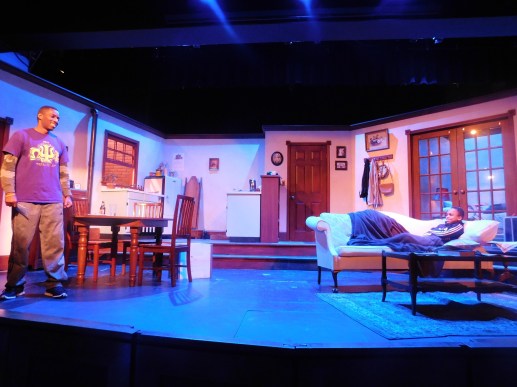
Notably more shabby – and less clinical – than the Playwrights Horizons’ off-Broadway production, Ryan Maloney’s set design jibes better with the way most out-of-towners think of the Bronx. This kitchen is more welcoming and, with Jackie and Peter Hohenstein’s prop designs, still richly detailed.

The carefully crafted clutter and slovenliness of the kitchen also accords with the episodic manner that Schreck relies on in telling her story. Watching the jagged sequence of scenes unfold, it seemed that the playwright may have pieced them together like journal entries, maybe shuffling the order, discarding numerous scenes, and cutting out minor characters – the mother, the head nun, and a pesky teen delinquent – along the way.

We sift through a cunningly calculated slovenliness to get at Schreck’s takeaway, with a few loose ends purposely left dangling. You won’t be as sure of what to make of Grand Concourse as the many tidier comedies and dramas you’ve seen before, but you’ll likely be more convinced of its authenticity.

Forget All That Money Stuff and Be Happy

Review:  You Can’t Take It With You

By Perry Tannenbaum

When it first came to Broadway, just after the 1936 election, Moss Hart and George S. Kaufman’s You Can’t Take It With You was steeped in the Great Depression – and a deep suspicion of the efficacy of government. Twenty elections later, as the audience favorite returns to Theatre Charlotte yet again in a truly sharp production directed by Mitzi Corrigan, the anti-government sentiments of the Sycamores and family patriarch Martin Vanderhof may strike some longtime subscribers as more virulently right wing than they remember.

Previous revivals of the show that I’ve seen tended to portray the whole extended family – except for Alice, who has ambitions and craves normality – as lovably eccentric, even borderline daffy. With the pandemonium that cuts loose at the end of the first two acts, that’s certainly a major part of the impression that Kaufman & Hart sought to convey.img_5635But the wonderfully avuncular Dennis Delamar as Grampa Vanderhof has a bit of an edge to him when an IRS agent comes calling about those income taxes he has never paid. There’s a “government of the people” tinge to his reaction as he demands to know how his money will be spent, but there’s also a saintly element of renunciation – for he has willfully abandoned the hustle-and-bustle of capitalism outside his home and devoted himself completely to doing as he pleases in and about his own roost.

Although there’s plenty of hustle-and-bustle inside the home, all except Alice fit the same mold: busy and industrious though they are, none of them has a job. How pleasant and agreeable such a bunch must have seemed to Depression Era Americans! Not only aren’t they competing with anybody in the jungle of a desperately shrunken job market, they’re genially and energetically coaxing us to toss aside all our anxieties about getting and spending. Forget all that stuff and be happy.

Corrigan softens the usual daffiness just enough for us to see the eccentricities of the Sycamore household winking at us as the sunny side of American individualism rather than principled silliness. This puts Alice in a somewhat different light, more akin to the disagreeable hetero son in La Cage aux Folles than we usually see. Cora Breakfield takes nicely to these fresh shadings of her role, subtly aided by costume designer Chelsea Retalic. The dresses she changes into for dates with her beau Tony Kirby are darkly elegant, but the clothes she wears coming home from work are less flattering.

Set design by Chris Timmons is uncommonly handsome, further discouraging our impulse to view the household as a clown car. Della Knowles is less outré as Essie, Alice’s hopelessly bad ballet dancing sister, and Stephen Peterson is mellower than most versions of their father Paul, the fireworks enthusiast. Johnny Hohenstein mostly lurks contentedly in the background as Paul’s lab assistant, Mr. De Pinna, briefly taking the spotlight when he models for Penny Sycamore’s long-unfinished painting of a Greek athlete.

These finely judged touchups allow Alice’s mom, Penny, and Russian dance teacher Boris Kolenkhov to emerge more emphatically from the general hullaballoo. When Tony’s parents unexpectedly arrive to meet their prospective daughter-in-law’s family, these emphases pay off. It’s Penny, after all, who scandalizes Mrs. Kirby by declaring spiritualism an obvious fake, shortly before Boris shocks Mr. Kirby by wrestling him to the ground.

Jill Bloede makes Penny a blithe short-attention-span spirit, while Frank Dominguez turns Boris into a spectacularly bellicose poseur – with some brash assistance from costumer Retalic. The Kirbys are nicely matched to absorb these indignities, John Price as the orchid-cultivating plutocrat and Corlis Hayes as the delicate Mrs. Kirby. Price especially traces a graceful character curve, ultimately receptive to Vanderhof’s soft sermon – and itching for a rematch with Boris! Armie Hicks cuts a fine figure as Tony, well mannered yet susceptible to the charms of both Alice and her family.

Standing out among the unwelcome intruders, Mike Carroll brings a starchy persistence to the IRS agent, while Rick Taylor layers on a New York vulgarity to the Head G-Man. The aging waifs that the Sycamores embrace during this farce are closer to caricature and more delectable. Zendyn Duellman has a regal tipsiness to her as the soused actress who wanders into the scene, and Suzanne Newsom is superbly compromised as the Russian royal, Olga Katarina, exiled to waiting tables at a Child’s restaurant.

I waited and bussed tables at multiple Child’s locations around Times Square during one memorable summer break. There were 45s by the Four Tops playing on the jukebox and no aristocrats sitting down for dinner. So I can personally vouch for Olga’s humiliation.

The Nerd Who Terrorized New Jersey

toxic-press-5

Theater Reviews:  The Toxic Avenger and Pride and Prejudice

By Perry Tannenbaum

I’m not sure how or when such epithets as “Armpit of the East” or “Scrotum of the Nation” rained down on New Jersey, but they were certainly commonplace before the onset of The Sopranos or Chris Christie. It’s also clear that when Lloyd Kaufman and Joe Ritter cooked up their 1984 screenplay for The Toxic Avenger, they weren’t intending to prettify the Garden State’s battered image. About the only love they showed for Jersey was shooting the film there.

A mere 24 years elapsed before Joe DiPietro and Bon Jovi keyboardist David Bryan, following their successful collaboration on Memphis, hooked up on a Toxic musical adaptation. The record-breaking reception of the show in New Brunswick, before its off-Broadway transfer in 2009, only underscored how highly Jerseyites cherish their notoriety.

DiPietro liberally refashions Kaufman’s original plot, but political corruption, organized crime, unconscionable pollution, and unchecked violence are still among its hallmarks. Actor’s Theatre of Charlotte, newly resurrected on Freedom Drive after its recent homelessness, embraces all of these horrors with the merry glee it applied to Evil Dead The Musical seven years ago. Billy Ensley directed that 2009 gorefest on Stonewall Street, but ATC artistic director Chip Decker takes the reins here, reminding us that crass sci-fi musical parodies are at the core of this company’s DNA.

toxic-press-1

Journeying from screen to stage, Melvin Ferd the Third has lost his signature janitorial mop, but he’s still a hopeless nerd and still smitten by the blind Sarah, who is now a librarian. The new Melvin is an environmental crusader from the get-go, and his plunge into an oozing drum of green toxic goo is far more malignant, ordered by corrupt Tromaville mayor Babs Belgoody. Where does Melvin find the goods on Mayor Belgoody’s polluting schemes? At the library, of course, cleverly filed away by Sarah where they are least likely to be found: among the important policy speeches of Michele Bachmann.

toxic-press-7

Something underhanded seems to have occurred here, since Bachmann didn’t achieve her peak infamy until the 2012 election cycle. Suspicion falls on the prankish Decker, who compounds his violations of DiPietro’s script by introducing the image of Donald Trump later in the evening. Hopefully, that glorified groper will be forgotten by the time the Avenger concludes his rampages on November 12.

Yes, if you didn’t already know, what doesn’t kill Melvin makes him Toxie, the avenging mutant monster. This is exactly where Actor’s Theatre upstages the off-Broadway production once again. In 2009, Ensley simply had the luxury of a better pool of actors to choose from for Evil Dead. This year, Decker enjoys no luxuries whatsoever. ATC and City Hall couldn’t dot all the i’s on permits for the new location at 2219 Freedom Drive in time for opening night last Wednesday, so Decker & Co. were obliged to move next door to Center City Church & The Movement Center at 2225 Freedom.

toxic-press-3

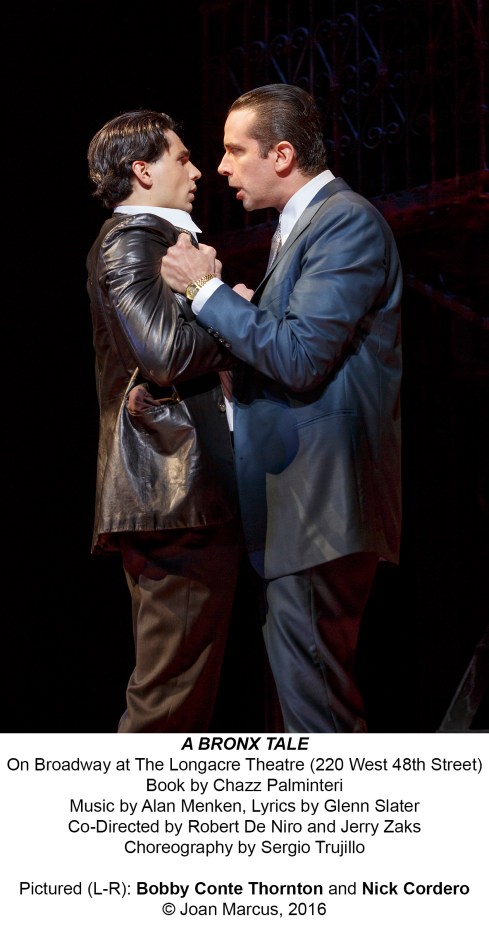
On very short notice. So the set designer is listed as Dire Circumstance in the playbill while other members of the design team have vanished altogether. Whether by accident or design, then, Decker doesn’t make the mistake that plagued the off-Broadway show: overproduction. In the New York version, when Melvin emerged from the chemical dumpsite as Toxie, the green carbuncled mask that covered his head was not only horrific, it robbed actor Nick Cordero of all further facial expression.

Jeremy DeCarlos doesn’t have to combat that handicap. As cool, graceful, and intelligent as DeCarlos has always seemed onstage, I expected both the nerdy Melvin and the homicidal Toxie to be difficult stretches for him. Clearly, I had no idea how well DeCarlos could channel the dopey sound and body language of Jerry Lewis as the socially inept earth scientist. When he emerged from the flimsy façade of chemical drums as Toxie, there were some wrappings on his arms to offer a semblance of might, but it was Decker at the soundboard who offered the more telling boost, amping up DeCarlos’ voice and synthesizing his monster roar.

No, the wrappings and the roars don’t close the gap between DeCarlos and fearsomeness – but that’s another reason why his Toxie is so much more hilarious than the more technically polished off-Broadway version, which often forgot it was a spoof. Leslie Giles certainly isn’t forgetting her spoofery as Sarah, helpless ingénue or aggressive vamp as the occasion demands – and her blind stick shtick with the hapless Melvin is a corny gift that keeps on giving. Sarah’s big number, “My Big French Boyfriend,” struck me as the best in the show.

toxic-press-4

Lisa Hugo, who was so precisely calibrated in the complex leading role of Stage Kiss earlier this year, the last ATC production at Stonewall Street, gets to loosen up in multiple roles. When she isn’t the melodramatic, megalomaniacal Mayor, she’s usually Melvin’s disapproving Mom. These two nasty women turn out to be old enemies from their school days, so their “Bitch/Slut/Liar/Whore” confrontation deep in Act 2 was a manic reminder of a similar duet in the Jekyll & Hyde musical. Ma Ferd also gets an effective “All Men Are Freaks” duet with Sarah.

Ryan Stamey and Dominique Atwater divvy up nearly all the remaining roles, more than I could keep track of, with Matthew Blake Johnson subbing for Atwater on opening night. Somebody needs to terrorize Sarah, toss Melvin into the toxic goo, get their asses kicked by Toxie, scurry around with missing limbs, and represent the hordes of Tromavillians who idolize the grotesque mutant. Stamey and Johnson performed every one of these worthy missions, and more, with the suave sophistication you would expect.

Yes, the middle school auditorium atmospherics of the Movement Center hall are somewhat against the grain of the gorey Toxic Avenger irreverence, but it served better than expected for what turns out to be a unique guerilla theatre project. If you arrive early for one of the remaining performances, you might get a brief tour of the new ATC space next door. What’s going on now on Freedom Drive bodes well for the company and the resourceful artists who make it go.

14657273_1592031430816445_6330787092415780744_n

Jon Jory is best known as the artistic director who brought renown to the Humana Festival and the Actor’s Theatre of Louisville – and widely believed to have penned Keely and Du, Flaming Guns of the Purple Sage, and Anton in Show Business under the penname of Jane Martin. When it comes to adapting Jane Austen, whose Pride and Prejudice is currently on view at Pease Auditorium in a CPCC Theatre production, Jory is no dilettante. He has also adapted Sense and Sensibility and Emma.

Even if all the subtleties aren’t always pointed under Heather Wilson-Bowlby’s poised direction, it becomes obvious that Jory’s adaptation preserves the style and thrust of Austen’s liveliest masterwork. Most of the credit goes to Moriah Thomason as Austen’s prejudging heroine, Elizabeth Bennet, though it’s hard to deny she is amply counterbalanced by the hauteur of Brian Logsdon as Fitzwilliam Darcy. Thomason unveiled her elegance in the ATC production of Stick Fly back in February. Here she adds vivacity and wit, so I couldn’t get enough of her.

14639612_1592031587483096_6752582616922785572_n

We see where Elizabeth gets her wit from in Tony Wright’s slightly jaundiced portrait of her father, and Anne Lambert’s rendition of Mrs. Bennet has more than enough vanity, giddiness, and silliness to distribute among the younger Bennet sibs. My chief disappointment was the hoarseness that afflicted Lexie Simerly as Liz’s elder sister Jane. If only she could have borrowed some extra decibels from Iris DeWitt, whose towering presence made the imperious Lady Catherine De Bourgh a perfect victim of Elizabeth’s punctiliously polite sass.

Jane Shall Have Jill in DC’s Hip-Hop “Midsummer Night’s Dream”

Theater Review: A Midsummer Night’s Dream

dsc_0523

By Perry Tannenbaum

If you have the notion that America’s liberal arts colleges are hidebound guardians of the past, mired in fossilizing traditions, you may wish to check out Davidson College’s production of A Midsummer Night’s Dream. Unorthodox thinking was already obvious when I looked at the cover of the playbill. Instead of the Grecian colonnades or laurel wreathes you might expect for a lyrical Shakespearean comedy that mostly transpires within 25 miles of Athens, the cameo portrait of Fairy Queen Titania and the bewitched Bottom is done in comic strip style. All of the basic info – title, playwright, director, dates – is set in that impossibly perfect hand-lettering that worshipers of Superman and Batman grew up with. Furthermore, entering Duke Family Performance Hall, I was already tipped off to the fact that director Ann Marie Costa would be infusing the Bard’s text with plenty of hip-hop rhythms and dance, thanks to the ministrations of beatmaker Mighty DJ DR and spoken word artists Boris “Bluz” Rogers and Carlos Robson.

Given the problematical acoustics of the Duke, I was fairly anxious about what I might need to contend with in the style – and the beat – of this production concept. But there was more. In the opening scene, when Egeus petitions the heroic Duke Theseus in hopes that he will force his daughter Hermia to marry Demetrius, the groom he intends for her, there were a couple of radical switches. Hermia’s father was nowhere to be found, replaced by Egeia, a heartless mother. Perhaps more shocking, Hermia’s true love, Lysander, had also disappeared, replaced by Lydia. If Joe Gardner’s elegantly simple set design and Martha Making’s contemporary costumes weren’t enough, Lydia’s plan to elope with Hermia and marry her assured me that we weren’t in ancient Athens anymore.

I would have been dizzy with disorientation if these alterations had been delivered with hip-hop embroidering, but the lovers’ couplets and the mechanicals’ prosaic rehearsal scene afterwards were plainly spoken. As so often happens, the uniqueness of a Midsummer Night’s Dream production becomes manifest when we leave Athens behind and plunge into the nearby woods. Back in 1987, when NC Shakespeare was still alive and touring, Hermia and Lysander traipsed into the forest carrying their own Samsonite luggage. In 2003, deposed Charlotte Repertory Theatre founder Steve Umberger found refuge at Theatre Charlotte, bringing Cirque du Soleil acrobat Karl Baumann with him – to go where no Puck had gone before. Costa says in her director’s notes that she was inspired by a recent visit to New York City, where she saw spontaneous performances by street musicians, beatmakers, and break dancers in the city’s public parks. The nocturnal woods is exactly the right place for disorientation to be encouraged.

So as soon as we first saw Puck conversing with the First Fairy, we got a steady flow of hip-hop movement, choreographed Emily Hunter – with plenty of urban attitude – accompanying the hip-hop reaffirmations that most of the fairy dialogue is rhymed. Tatiana Pless was so vivacious as the Fairy that I presumed she was Puck for a few moments, but not to worry, Pless got more play and multiple costume changes as Mustardseed and Moonshine. Graham Marema was quite engaging as Puck after her comparatively subdued arrival, but it was Colin Bye’s bravura exploits as Puck’s master, King Oberon, that enabled the whole hip-hop concept to click. His tall frame topped with a pom knit hat, Bye became a living breathing testimonial to the efficacy of YouTube hip-hop tutorials. He rarely moved from one spot onstage to another without a lithe moonwalking glide – nearly on point, increasing the impact of his lanky height. The sensation Bye made as Oberon was only enhanced by the starchy, stiff, and proper impression he made in his other role as Theseus in the opening scene.dsc_0758

While discord between Hermia and her mom unsettles Athens, there is parallel discord in the fairy kingdom, where the proud Queen Titania is denying custody of an adorable kidnapped boy – and conjugal visitations! – to King Oberon. To bring peace to both kingdoms, Oberon must teach Titania a lesson and restore Demetrius to his previous fiancée, Helena. Oberon dispatches Puck to retrieve a faraway flower whose juice can be made into a love potion that can be applied to a sleeper’s eyes. When the sleeper awakes, he or she will fall in love with the first person or animal that comes into sight. Oberon himself applies the potion to Titania, but fortunately, he deputizes Puck to find Demetrius and apply that same potion so that he’ll become enamored with Helena again when he awakes. Half of the fun we experience in the woods results from Puck messing up and applying the potion to Lydia instead of Demetrius. The other half comes from what Puck gets right, transforming the incorrigible Nick Bottom into a man with a donkey’s head in the middle of the mechanicals’ inept rehearsal. That’s who – or what – Titania sees when she first awakes.

After seeing Midsummer numerous times before, I found Kanise Thompson a little less shrewish than most Titanias because of the boogie in her movement and the hip-hop delights of her fairy entourage. Arrayed in the funky garments of the hip-hop culture, this entourage combined to make the queen’s bedtime the most regal event of the evening. Thompson did reappear later in the evening as Hippolyta, whose nuptials with Theseus were another regal event, but her best moments came when she heaped love on the repellent Bottom and when she sensuously reconciled with Oberon. Although he couldn’t compete with the most commanding Bottoms that I’ve seen, Sam Giberga had some bodacious moments as Nick, particularly when he was vaunting his versatility as an actor and getting vamped by the queen. Louder braying, please!dsc_1063

The whole hip-hop concept went so well for me that acclimating to the gender and sexuality alterations presented more of a challenge. Sarah Kostoryz as Helena may have more reason to be offended by Lydia’s advances, but the text offers no guidance, and she reacted as if a Lysander were still pursuing her. I’ve also seen more vicious taunting of her shorter rival Hermia when their antipathy heats up. As Hermia, Izem Ustun could give the most conventional performance among the lovers, for it made no difference who her admirers were when both of them abandoned her. Uztun swam bravely against the handicap of her relative conventionality, no more sensitive to Hermia’s shortness than Kostoryz’s provocations warranted.

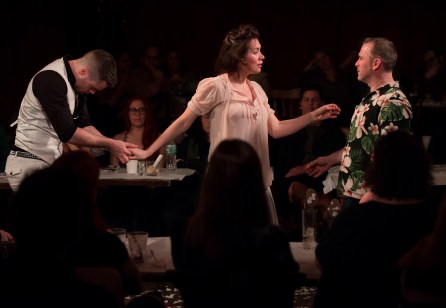
Soft-pedaling her altered sexuality, Blaire Ebert was a very courtly and principled Lydia, and she tore after Demetrius fearlessly. Now when Lydia’s conflict with Demetrius escalated from verbal to physical, I could perceive some difficulties in the audience. As Lydia and Demetrius rolled over one another on the forest floor, there seemed to be a mixture of shocked silence, nervous laughter, and redoubled laughter from various sections of the house. There was no avoiding it: the lesbian Lydia’s attack on the straight Demetrius often had the look of lovemaking as they lingered on the floor. Similar to Ebert, Ed Pritchard portrayed Demetrius as if nothing had changed, a problematical proposition when your fiancée turns out to be gay or bisexual, but the text offers no more guidance to our Demetrius than it does for Helena or Lydia. I would have expected all four of the lovers – especially during the taunting and fighting – to have more fun with the newly hatched absurdities.

The cuts that Costa applied to the script may have shortened the mortals’ time onstage more than the fairies’, or maybe the extra juice from the hip-hop idiom just made the fairies more exciting and accessible. I’m sure that I’ve seen Midsummer productions where the mechanicals don’t perform their Bergamask after their travesty of a tragedy, and I’ve also seen productions where the fairy king and queen don’t return. Returning both of these to the final scene added to the sense of revelry, merriment, and magic. When the last huge exits went to King Oberon and Queen Titania instead of the three newly wedded Athenian couples, the sudden hush when Puck was left all alone onstage was all the more poignant and dramatic. After such an unusual, energetic staging, Merema had no difficulty at all in coaxing us to give her our hands.

The Electoral College in Elementary School

Reviews of Grace for President and Fall Works

By Perry Tannenbaum

We’ve been favored with a couple of Grace shows from Children’s Theatre over the years. There were two productions of Amazing Grace, a charming but trifling little piece, in 1999 and 2005. Before the encore, there was the incomparably richer Boundless Grace, deeply infused with African rhythms and culture, that won Creative Loafing’s Show of the Year laurels in 2000.

grace-index

So for those of you who recall those pre-ImaginOn productions, it may be important to emphasize that there’s no kinship between them and the current world premiere of Grace for President through November 6. Mary Hoffman created the previous Grace, of Gambian descent, in a series of books that depicted her heroine with playacting impulses rather than political ambitions. Grace Campbell is a more recent brainchild by Kelly DiPucchio, slightly browner in LeUyen Pham’s illustrations than her Woodrow Wilson Elementary teacher, Mrs. Barrington, but never assigned to an ethnic group.

From the first page on, DiPucchio’s Grace is more about feminism than racial pride. Mrs. Barrington brings a poster to class at the start of the school year with all the US presidents on it, and Grace asks, “Where are the GIRLS?” After getting the lowdown, Grace stews at her desk momentarily before announcing that she would like to be president. Despite the snickers from several of Grace’s classmates, Mrs. Barrington deems this impromptu ambition to be a “star-spangled idea” – clear proof that DiPucchio intended her story as a musical all along.

Clocking in at 57 minutes, Joan Cushing’s adaptation actually expands upon DiPucchio’s slender volume, with a robust – and resourceful – song list. When Grace starts campaigning against Thomas Cobb, the nominee from Mr. Waller’s class, Grace and Thomas sing in debate-like counterpoint, not harmony, each candidate spouting a separate line. And while it’s doubly lamentable that a two-party system is axiomatic in this story and that genders represent the party lines, when the guys sing “Boys Boys Boys,” it rings like a barbershop quartet.

Cushing does churn out some pabulum along the way in explaining what elections are, but she bravely follows in DiPucchio’s footsteps in trying to explicate that grim Founding Fathers albatross, the Electoral College. We skim over some fairly muddy waters when Barrington and Waller establish a system where each of their students represents one of the states, unevenly weighting their votes.

index

The outcome partly redresses the inequity. Cobb seems to have a lock on the election because the boys hold the majority of the electoral votes. Our intrepid heroine therefore comes up with a platform designed to change some minds, listening to her classmates while Cobb mainly coasts. Party lines have held fast when we reach the end of the roll call of states, so the election is still up for grabs as Sam, representing Wyoming, gets set to cast his measly three electoral votes.

“My vote counts!” Sam sings out, an epiphany yet to be reached by millions of unlikely American voters.

I won’t tip the results of this suspenseful election, but I’ll credit set designer Anita J. Tripathi with heightening the tension by dropping down an electronic scoreboard over her gallery of presidents to give us a running total of electoral votes until the confetti moment when the shunned wallflower Sam makes his decision. We’re supposed to greet the result with jubilation, but overall, the students of Woodrow Wilson Elementary are even more set in their voting patterns than adult Americans.

Although director Michelle Long pilots the most polished production I can remember at Wells Fargo Playhouse (the smaller ImaginOn theater), I found myself fighting the notion that this wasn’t really a Charlotte production. Most of the seven-member cast is new to the Charlotte scene, all except one are making their first 2016 appearance, and all the designers seem to be making their Uptown debuts.

Youngsters shouldn’t have any problem warming up to Talia Robinson as Grace. Her sunny optimism in launching her campaign is only slightly clouded by the prospect of opposition, and Robinson’s attitude toward her classmates usefully blends the callings of public service and leadership. After starring last December in the title role of another Cushing world premiere, Ella’s Big Chance,  Margaret Dalton as Mrs. Barrington is the most familiar face we encounter. She gives us that ideal teacher we never had, not only radiating energy and encouragement but also drawing inspiration from her pupils’ ideas.

The other Ella alum in the cast, Sean Powell, infuses Thomas Cobb with a patrician smugness as he initially intimidates Grace, singing his own praises in “My Accomplishments.” Until the denouement, Powell keeps the concept of doing for others totally alien to Thomas. Shivam Patel’s debut as the outcast Sam is as impressive as Robinson’s, for suffering often has deeper roots than righteous indignation. While Grace is affirming that girls can now win as never before, Patel makes Sam’s discovery that he matters just as heartfelt and liberating.

While the script is intended to remain serviceable for election years to come, there was one aspect of this world premiere bears the fresh fingerprint of 2016. A couple of errors that were noted in the Observer review on Friday morning had been expunged from the script by the time I attended the Saturday afternoon performance. Politicians may resent fact-checking during their hotly contested 2016 races, but playwrights and theatre directors evidently don’t.


chlt-ballet-fall-works-300x300-7e095b7b3d

As Charlotte Ballet launched its 2016-17 season, the final season for Jean-Pierre Bonnefoux as president and artistic director, one thing became very evident during the Fall Works program: Bonnefoux’s successor won’t need to do any rebuilding. I’m not sure I’ve ever seen so much energy expended by so many dancers so brilliantly. Five of the 18 dancers we saw are new to the troupe this year, and one – a soloist! – was recruited from Charlotte Ballet II, the company’s apprentice ensemble.

dancephoto2

When we first saw Dwight Rhoden’s rousing paean to 80s club culture, The Groove, kicking off the 2012-13 season at Knight Theater, it was almost exhausting to watch at the end of that program. This year, it led off the evening in the you-ain’t-seen-nothin’-yet slot, no less astonishing in its unflagging exuberance than it was before. Surely newcomers to Charlotte Ballet performances must have been wondering how they could follow such a barrage of fast-paced bravura.

Those of us who had seen Ohad Naharin’s Minus 16 at Spoleto Festival USA had no such worries. Part of the wildly varied suite came to Charleston when Naharin’s Batsheva Dance Company made its Spoleto debut in 2007. Alvin Ailey American Dance Theater brought the full suite to Spoleto in 2012 – shortly after their stopover at Knight Theater!

14680555_10154598885387170_2437162458183624318_n

The spectacular core of the work is Naharin’s setting for the traditional Passover seder song, “Echad Mi Yode’a,” in a frenzied recording by The Tractor’s Revenge. It’s a song that cycles to 13 in much the same way that stanzas to “The 12 Days of Christmas” expand. Instead of ending with a “partridge in a pear tree,” each of the Hebrew stanzas concludes with “our One God in the heavens and the earth.”

Naharin sits 18 dancers in semi-circle before us, all of them clad in black suits, white shirts, and black fedoras, emblematic of Israel’s ultra-orthodox Jews. Each time we reach the end of a stanza, 17 of the dancers rise to their feet in a prayerful wave that sweeps the group from left to right. The eighteenth dancer catapults himself to the floor in an epic flop, as if shot from a cannon – or flung from the explosion of a terrorist bomb.

Each number draws a new signature movement from Naharin as the stanzas grow longer. Each stanza ends with the same wave and explosion as we proceed toward 13, all the dancers returning to their chairs to start each stanza. What I called the “regimented hysteria” of Naharin’s choreography is compounded as we draw closer toward the end, for the “black hat” Hasidim do the unthinkable: they begin throwing more and more of their clothing into the air until all their outer garments – from hats to shoes – lie in a chaotic pile in front of them. Unforgettable.

One of my grandfathers was a Hasid. I’m certain that if I’d seen him in his underwear, I would have been cast straight down into Gehenna.

14650064_10154597284587170_1183638509565827188_n

Yet the suite began innocuously – and comically – with Maurice Mouzon Jr. from Ballet II standing in front of the stage at intermission, morphing from motionlessness to tentative dancing to bodacious acrobatics before the ensemble’s prelude to the core ritual. Things lightened up immediately after the mass rending of garments, with a bouquet of Harold Arlen songs and some truly hilarious – and spontaneous – hijinks with Dean Martin’s “Sway” as the prime backdrop.

All of the troupe came out into the audience and chose partners whom they led onto the Knight stage. A block party broke out with a cornucopia of delights: sensuousness, grace, shyness, awkwardness, and hambone scene-stealing were all abundantly on display. Nor was the fun finished when patrons were sent back to their seats and the dancers took their bows. The crimson curtain kept rising and falling, each blackout hatching a new zany tableau.

Not all of the hambone came from the amateurs, that’s for sure.