Tag Archives: Michael Anderson

Actor’s Gym Unearths a Gem in “Fallen Angels”

Review: Fallen Angels

By Perry Tannenbaum

When a playwright puts the finishing touches on his or her latest comedy, it’s without any knowledge about how prevailing attitudes and expectations might change out in the audience over the next 93 years. No playwright has ever had the chance to look back that far, and that includes Noël Coward, whose Fallen Angels is playing at Duke Energy Theater in an Actor’s Gym production directed by Tony Wright.

Knowing Noël, I’d say he’d either gasp or laugh out loud. Opportunity knocks for Coward’s protagonists, Julia Sterroll and Jane Banbury, when their husbands head off on a golfing weekend just when an old flame of both ladies, Maurice Duclos, sends them billet-doux saying that he’ll be arriving back in London after an absence of many years –so many years that the husbands, Fred and Willy, have no idea of who Maurice is nor any knowledge of his torrid affairs with their wives.

After Fred’s departure, Julia is momentarily left alone with her new smarty-pants maid, Saunders. That’s when Jane arrives at the Sterrolls’, all aflutter with the news. Julia, who was just a few minutes earlier discussing with Fred exactly how much fire was left in their mellowing marriage, hadn’t yet read her note from Maurice. It quickly becomes evident, as the women discuss Maurice, that those flames still burn brightly, perhaps more brightly than ever. They’re a little scared.What will they do when he arrives?

Their first impulse is exactly what an audience would expect – in 1925: to flee as quickly as they can to protect their honor, which presumably cannot withstand Maurice’s irresistible charms. A mere 35 years after Oscar Wilde had declared, “The only way to get rid of temptation is to yield to it,” such an outlook was still wicked, irresponsible, and risqué.

Nowadays, coaxed by Madison Avenue, amoral leaders, social media, and longstanding American traditions of fierce individuality, we find ourselves – regardless of gender – inwardly urging Julia and Jane, Go for it! Whereas we’re taken aback in 2018 by the ladies’ knee-jerk-prissiness, their eventual decision to stay and face Maurice was immoral enough to give London’s censors pause before allowing Fallen Angels to be performed.
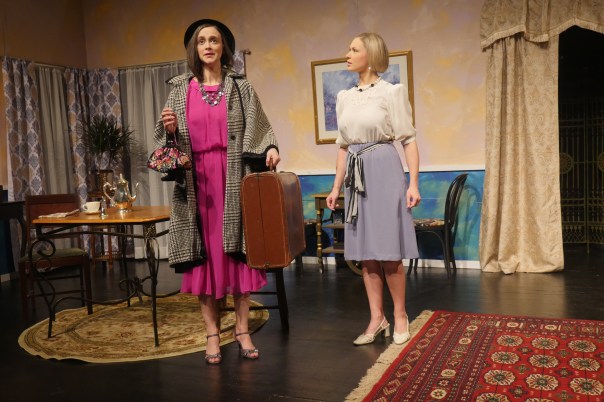
Once Julia and Jane have opted for what we perceive as the road-more-taken, you might expect that attitude adjustment becomes far less necessary. Yet in more subtle ways, the presumption of wickedness works its way deeply to the bones of Coward’s comedy. Instead of building his comedy upon Julia and Jane’s rekindled romances – and their wacky or delicious maneuverings to keep their husbands in the dark – we find an unexpected amount of time devoted to maintaining their wicked resolve. Here our complications arise from the women’s resorting to martinis and champagne to sustain their courage during their excited vigil.

So it’s helpful that Tony Wright and his design team keep reminding us that the people onstage are living indifferent times. While Tim Baxter-Ferguson’s set design isn’t the ultimate in elegance, the requirements of a British drawing room are met, including a baby grand where Saunders will upstage Julia. Davita Galloway’s costumes, particularly the flapper-flavored outfits for the partying ladies as they sip their martinis, stamp the era most decisively.

The women must dominate this comedy,and Wright has found a marvelously varied trio. Originally played by Tallulah Bankhead, Julia is the formidable serenity that is serially agitated by Saunders, Jane, and Maurice to comical effect. Jennifer Barnette takes that serenity to a loftier, more angelic plane, slightly muting her discomfiture and giving more space for the eccentricities of Saunders and Jane to shine. Karina Caporino pounces on her opportunity as Jane with frenetic energy, more brittle and midlife than we’ve ever seen her, which easily makes Jane the most screwball of her trademark neurotics.

Erin Darcy as Saunders is possibly the most vivid period trimming in this whole confection, a servant who is more knowledgeable, widely traveled, and skilled than the mistress she serves, aware of her superiority and maybe a little bit haughty about it. Saunders’ sophistication lays bare the delusion that the Sterrolls or the Banburys are living lives of consequence. Perhaps it’s Darcy’s aplomb at the piano that gives Barnette her best episode of humiliation.

In this context, Emmanuel Barbe is a perfect choice as Maurice. He is suave and self-assured, with a savoir-fair that is unmistakably French, yet he doesn’t quite have the polish and youth that would make knees buckle in high society. Barbe’s down-market elegance is still more than enough to make David Hensley as Fred and Michael Anderson as Willy seem gullible, dimwitted, and humdrum. Hensley as Fred seems to be the sort who feels like he’s fulfilling his destiny by opening a newspaper at the breakfast table, while Anderson, once he reconciles with Fred and Jane, gives Willy exactly the smiling insouciance that Wright wants for his ending.

I have to go back to 2005 and The Tempest to find the last Actor’s Gym production I reviewed. It’s great to have Wright and his Gym back on the scene, especially when the Gym unearths a gem like this.


Smokey and the Epic Hero

Theatre Review: O Brother

O Brother

By Perry Tannenbaum

In Greek legend, Odysseus was a man of many ways who sacked the sacred citadels of Troy, traveled widely, struggled valiantly, and suffered greatly. But even if this Homeric catalogue of achievements pales in comparison to the praise lavished upon presidential candidates at our quadrennial conventions, there’s something about the guy that continues to spark admiration – despite the fact that he was once captured and imprisoned.

Latterday tributes from Lord Tennyson and James Joyce to Ulysses (O’s Roman name) gradually humanized the Ithacan warlord and brought him down to life-size. Ethan and Joel Coen decided that wasn’t quite enough indignity to heap upon the mythic hero. The Coen Brothers’ O Brother, Where Art Thou not only presented Ulysses Everett McGill as an escaped jailbird, they made him a Mississippi hayseed. If any role George Clooney plays can be considered a hayseed.

On a ridiculously limited budget, Citizens of the Universe bring Odysseus down the social ladder a few more rungs with O Brother, for the costumes and backdrops by Mandy Kendall aren’t Hollywood. On the other hand, the newly unveiled performance space at NoDa Brewing Company – on North Tryon Street – can’t be accused of being Mississippi.

Trailblazing yet another new venue, COTU embraces an outdoor ambiance that is more picnic theatre than dinner theatre. Beer flows from the interior of the spacious new NoDa tavern, and grub is rustled up from a food truck you can’t miss on your way in from the parking lot. There’s a bluegrass trio at the side of the modest playing area: the Hashbrown Belly Boys, who start up before the odyssey begins. Very relaxed and homespun.

Energy amps up as soon as director Courtney Varnum, perky and pigtailed, steps forward to introduce the show. O Brother is only loosely based on Homer’s epic – and loose only faintly describes its trashy, Southern-fried, slapstick style. These are not realms usually explored by James Cartee and his COTU, but Varnum has been able to round up more than a couple of the usual suspects from past COTU navigations.

Tom Ollis is the one Citizen you would expect to fit in well in this new rusticated universe, playing “Pappy” O’Daniel, the gregariously corrupt Miss’sippi guvnah seeking re-election while hosting a Grand Ole Opry-style radio show on the side. Sort of a cross between Tennessee Williams’ Big Daddy, Huey Long, and Yosemite Sam the way Ollis plays him – mythologically, he’s Menelaus in the scheme of things.

Most surprising is Shane Brayton as our hero Ulysses, after playing opposite Ollis as an arrogant Richard the Lion-Hearted in The Lion in Winter. Down in the Delta, Brayton taps into hillbilly pluck, energy, optimism, and rascality in a way that I’d likely find irresistible if part of the audience weren’t partying and oblivious. Of course, persisting in the face of such loud inattention adds to the pluck factor, but I found the entire cast up to that challenge.

We need to listen all the more attentively because some of the actors’ names are flip-flopped with the names of the folk they play in the playbill. The most obvious of these is “Sheriff Cooley as Stephen West-Rogers.” While he isn’t quite as megalomaniacal as he was in Fight Club or as violently vehement as he was in Trainspotting, West-Rogers is more than sufficiently implacable and clueless as the Sheriff.

Make no mistake, all of these principals are surrounded by sidekicks or underlings that make them look like sages. “Pappy” has Michael Haynes as Junior O’Daniel and Jeremy Bryant as Pap’s political opponent, Homer Stokes, who turns out to have clout in the KKK. Sheriff Cooley has Justin Mulcahy as his standard-issue deputy, and Ulysses is saddled with Michael Anderson as Delmar O’Donnell and Josh Elicker as Pete Hogwallop – Varnum and Charlie Napier extend the deep-down hayseediness of the Hogwallop family.

Not counting the vocal trio of Ulysses’ daughters that doubles as the Sirens, three of the actors zip through multiple roles. Napier stands out as the aforementioned Wash Hogwallop, as a Blind Seer modeled on Teiresias, and as a marauding gangster with a chip on his shoulder, George Nelson, because he’s not the more infamous Babyface. All the great menaces of The Odyssey don’t appear in this hashbrown mashup, but we do get Scotland Gallo as “Big Dan” Teague, certainly Polyphemus with his eyepatch, and Kendall as Penny, Ulysses’ wife.

All of Penelope’s famed suitors coalesce into one Vernon T. Waldrip (Napier again) and, with this Ulysses, Kendall’s infidelity doesn’t play as sluttiness so much as cold pragmatism. A ne’er-do-well jailbird – as opposed to an MIA hero – should cause a sensible wife to make new plans, even in the backwoods. Calypso’s shtick in the journey gets merged into the three singing Sirens – Becca Whitesmith, MoMo Hughes, and Laura M Lee.

As you’ve no doubt divined, Odysseus’ sea voyage and his epic struggle to return home after the Trojan War have been downsized to a comical chase triggered by Ulysses’ jailbreak. Toss in the bluegrass music and it shouldn’t be surprising if O Brother sometimes reminds you of Smokey and the Bandit – without the same Hollywood charisma from the lead rascal. Igniting the chase, Ulysses cons Delmar and Pete into joining him in the escape by enlisting them in a quest for a treasure that he has hidden at the bottom of a valley soon to be flooded to create a dam. Echoes of Deliverance, another bluegrass bromance.

Only here, the music is more deeply woven into the storyline. For along the way, the three escaped white men hook up with Tommy Johnson, a black musician who claims to have gotten his phenomenal skills in a deal with the devil, a la Robert Johnson. On one of their stops before they break up, the quartet cuts a record as the Soggy Bottom Boys. It’s at these key musical moments – and subsequently at his KKK lynching – that we encounter yet one more familiar COTU personality, James Lee Walker II, best remembered for his one-man presentation of Karl Marx.

Walker is a bit humbler this time around. Everybody is. Sifting through the distractions, I’d say that Koly McBride’s O Brother tribute/arrangement of the Coen Brothers’ film is among the very best adaptations COTU has ever done. If the ratio of audience to partyers can be boosted significantly this weekend, the experience will be even better.