Monthly Archives: May 2026

After Tragedy in Verona, Catfish Row, and Spanish Harlem, Symphony’s Kwamé Ryan Adds a Jamaican Vacay

Review: Gershwin & Bernstein @ Belk Theater
By Perry Tannenbaum

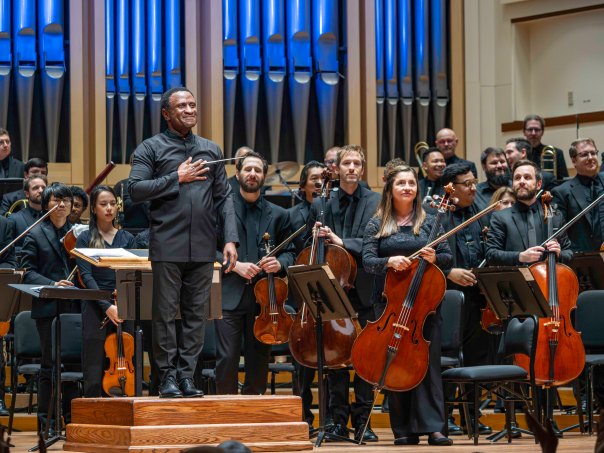
April 24, 2026, Charlotte, NC – An evening of music by George Gershwin or Leonard Bernstein can be many things: pop, opera, orchestral, cinema, or a good old Broadway musical. Gershwin wrote a staggering 18 musicals, though he only lived 38 years, twice as many as Bernstein, and most of them are forgotten. Programming these giants at Charlotte Symphony, with musical director Kwamé Ryan at the podium, certainly narrows the options, especially for Gershwin, since Ryan usually confines himself to Symphony’s Classics series and special events. Bernstein is credited with more than twice as many orchestral works as Gershwin, and among his choral works, a genre Gershwin never touched, are numerous sacred options for Ryan and the Charlotte Master Chorale to choose from.

The unifying theme Ryan chose at Belk Theater for his Gershwin-Bernstein pairing was star-crossed lovers, allowing Symphony to dig into the composers’ most-acclaimed works, Porgy and Bess and West Side Story, respectively, at a deeper level than a greatest-hits medley. But first, Symphony set the theme in a most intriguing manner, with a Fantasia for Orchestra, Romeo and Juliet, by Johan Severin Svendsen (1840-1911), a Norwegian composer I’d never heard of. Editions of NPR’s and Gramophone Magazine’s guides to classical music on my shelves omit him, while three others – Oxford, Penguin, the DK Eyewitness, and my ancient International Cyclopedia of Music and Musicians – all give him a paragraph.

Finding this piece would have been a waste if Ryan and his ensemble hadn’t given it such punctilious rehearsal. The prep to me was as impressive as the performance. Not only were there sudden or gradual shifts in dynamics as the piece flowed between lyrical and turbulent episodes, but there were numerous gradual shifts within the turbulent episodes where both the string and woodwind sections remained tightly in sync. There were at least four quiet sections, which didn’t seem to be sketching a narrative concept.
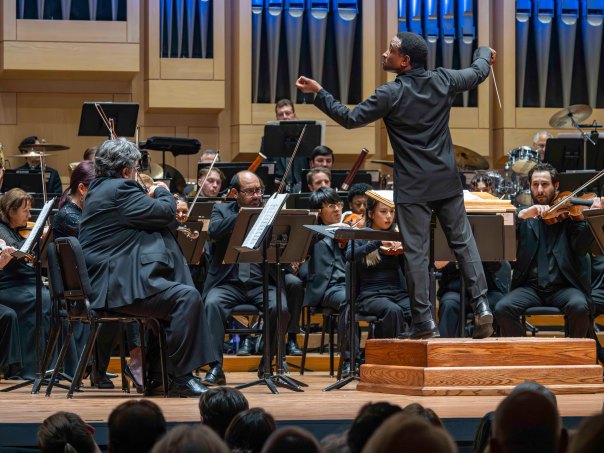
Was the end of the dreamy, opaque first episode, a gentle series of pizzicatos, an evocation of the famed balcony scene? As the slow-fast shuttling continued, with turbulent episodes marked by a sudden braking with a brief French horn lament, a repeated whimpering of strings, and finally a weary bleat of pizzicatos from the double basses, it was possible to entertain the idea that Svendsen was offering a dialogue between his protagonists, or back-and-forth character sketches.

The mournful edge to the concluding section swayed me back toward hearing Svendsen’s intentions as narrative, but we would need to hear the whole piece again to appreciate how well the last turbulent section had evoked the climactic double suicide of the newlyweds. By comparison, the Porgy and Bess: A Symphonic Picture, arranged by Robert Russell Bennett, is easily perceived as an extended overture in medley form.  Depending on how well you know the opera, you will likely be able to identify the next song as it clears the distant horizon. These include “Summertime,” “I Got Plenty o’ Nothin’,” “Bess, You Is My Woman Now,” “Oh Lord, I’m on My Way,” “There’s a Boat That’s Leaving Soon for New York,” and “It Ain’t Necessarily So.”

For those already familiar with Gershwin’s own P&B suite, Catfish Row, you may be doubly reassured. It was unquestionably Bennet’s starting point, recycling the percussive opening and preserving a winsome banjo interlude. The piano cadenza, likely reserved for the composer’s hands, is gone, but Bennett is more conscientious in including audience faves, though “I Loves You Porgy,” “A Woman Is a Sometime Thing,” “It Takes a Long Pull to Get There,” “A Red-Headed Woman,” and “My Man’s Gone Now” are still MIA.
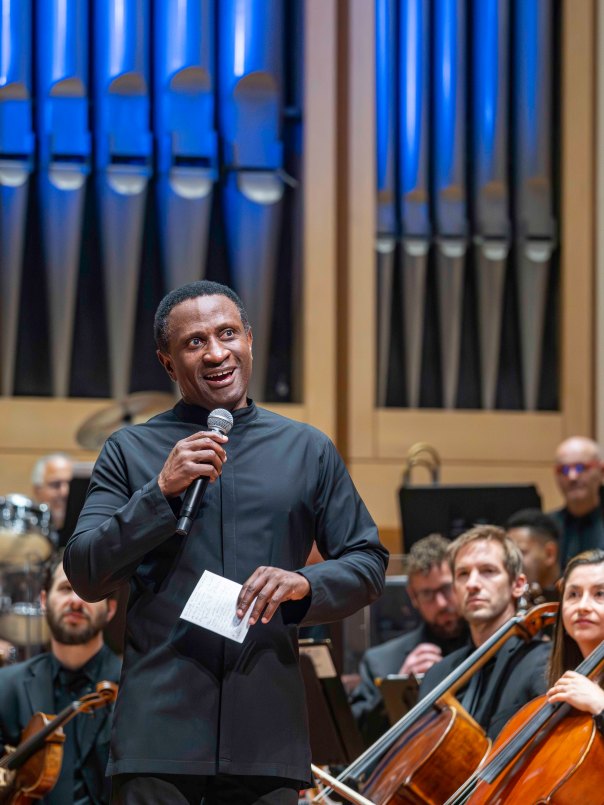
Like many others in the house, I presumed that the Porgy and Bess would be the evening’s highlight, since so many jazz greats have covered both the entire opera and the golden songs embedded within. But even though Bernstein put even fewer of his hits in his Symphonic Dances from West Side Story, it seemed that Ryan and the Symphony, no doubt buoyed by the phalanx of six percussionists across the upstage wall, played the Spanish Harlem classic with even more zest than the music rooted in the Carolinas.

Of course, with the opportunities for finger snaps, the whole orchestra could join in on the percussion orgy, and in the Suite’s fourth movement, “Mambo,” they got to shout out the title on multiple occasions. The ration of signature melodies was severely restricted, leaving “America,” “Tonight,” “I Feel Pretty,” “Something’s Coming,” and “A Boy Like That” off the menu. “Somewhere,” a little ballet to begin with, and the finger-popping “Cool,” promoted here to a Fugue, got fuller treatments to make up for the omissions. And the glorious “Maria”! We got to hear a full rhapsodic version and the deliciously delicate Cha-Cha version. With softer finger snaps.

Then the surprise from our maestro, who had every right to be fatigued after busting out so many moves leading the Bernstein. Reasoning that a funeral isn’t a good way to send us home, even at the tail end of an evening devoted to tragic lovers, Ryan announced a more festive Jamaican encore. Eleanor Alberga’s “Celebration Dance” from Snow White and the Seven Dwarfs was a danceable dessert.

Evolving Album and Rock Group Shape Stereophonic

Review: Stereophonic @ Knight Theater

By Perry Tannenbaum

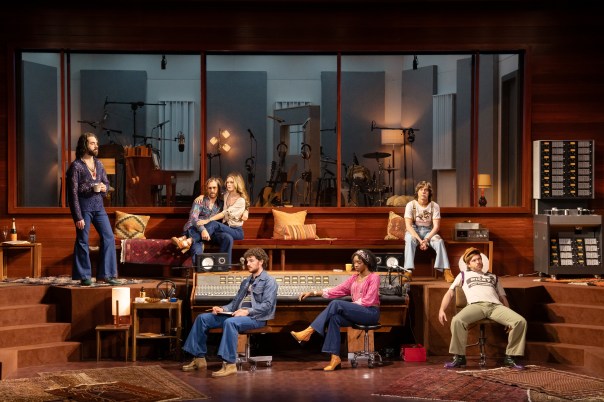
Pressure and deadlines are good for creatives. Or as Duke Ellington famously put it, “Necessity is the mother.” What David Adjmi’s Stereophonic explores – at excruciating length – are the consequences of no time pressure at all. Adjmi’s band, not named and not quite historical, closely tracks with Fleetwood Mac in the 1970s as they returned to their studio to cut what would become their megahit Rumours.

With music by Will Butler worthy of a supergroup, Stereophonic was a megahit in its own right, scoring a record number of Tony Award nominations and winning the top prize. For the ensuing national tour, now at Knight Theater for a rare second week, Adjmi and director Daniel Auken have cut into the show’s notorious four-act, four-hour bulk, so that the tourismo model arrives at a trim, but still overweight, 2:45 running time.

The group’s first album climbs to the top of the charts as they go deeper into hibernation, rehearsing, refining, composing, and crafting their more and more eagerly awaited sequel as expectations climb. But producer and lead singer Peter has no deadline to answer to, no set limit on whether the new release will be a single or double album, so new songs can be added on the fly while others, recorded earlier, can be shelved.

For the 1970’s, that was fairly outré. Such highly produced CTI jazz albums as Milt Jackson’s Sunflower, Airto’s Fingers, Ron Carter’s All Blues, and Hubert Laws’ In the Beginning (a double album), all recorded at the famed Van Gelder Studio, were produced in four days or less. Not enough time for an epic Fleetwood Mac soap opera, though no less music was released.

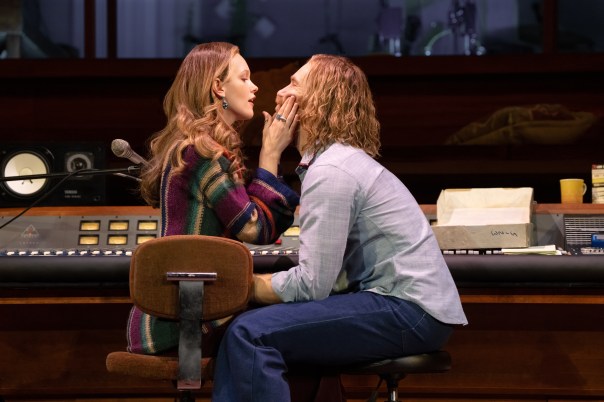
In line with the Sonny & Cher/Ike and Tina Turner/Lindsey Buckingham-Stevie Nicks template, lead singer – and Peter’s life partner – Diana is about to emerge as an industry supernova. That seems to fluster the not-so-subtly controlling Peter, a taskmaster and a perfectionist. Nor is perfectionism confined to the glamor couple. Band manager Simon can obsess for days over a phantom rattle in his drum kit after buck engineer Grover first detects it. And days more after Grover stops hearing it.

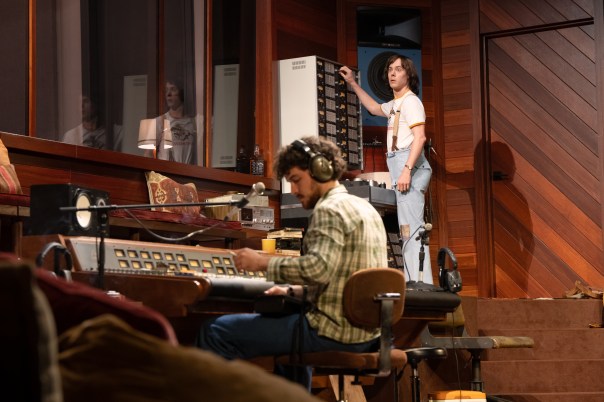
We can see that the claustrophobia of a group recording gig that goes on for over a year can wear on Diana and Peter’s already patched-up relationship. Naturally enough, Simon’s ongoing separation from his family pitches him gradually toward depression and moodiness. Less overtly, we can watch Grover’s growing confidence at the control board and his burgeoning influence over the band.

So yes, songs and takes can grow in polish and cohesion while they wane in energy and spontaneity. Compound that natural entropy with a souring romantic chemistry between two lead singers.

That’s when Grover’s new influence is crucial to the process. After numerous rehearsals and fine-tunings, the engineer at the control board notices that energy, spontaneity, and tempo have all sagged on one of the best tunes. Now Grover, previously a hanger-on who has falsified his resume to land this prestigious gig, grabs the driver’s seat and keeps prodding the band, through retake after retake, towards more authentic fire.

Animosity can be an obstacle or a creative trigger at this point.

By default, another lead singer composer, ace keyboardist Holly, becomes the most stable band member when Simon and his British cool unravel. Her emergence becomes all the more marked as she deals with her husband Reg’s increasing alcoholism, a drag to the whole band since he’s the bassist.

Holly’s relative stability enables Emilie Kouatchou to seize the dubious distinction of being the most consistently under-projecting actor on the Knight stage. Intimate conversations between the women, warmly spotlit by lighting designer Jiyoun Chang, were particularly difficult for me to decipher.

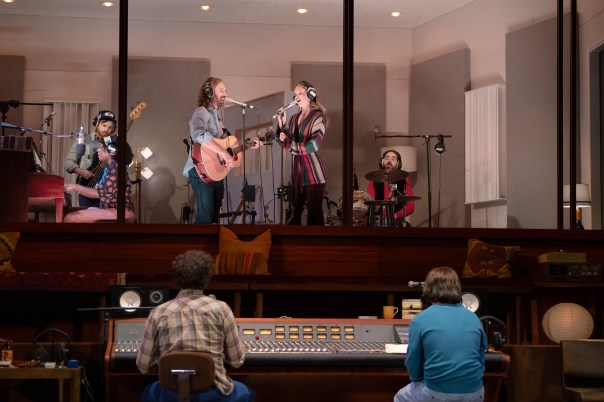
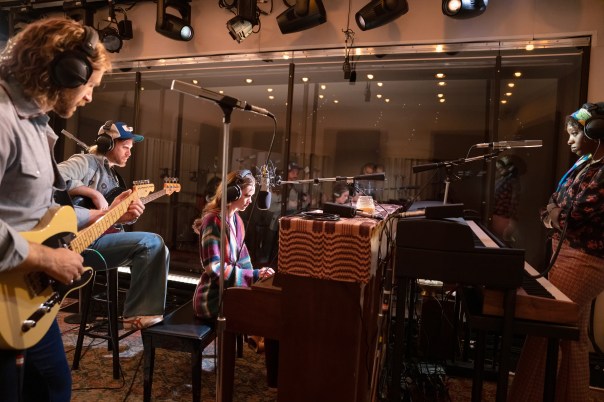
That sets up a bit of a paradox, for the control room/lounge area of the studio is closest to the audience, while the glassed-in recording studio is elevated a third of a flight up behind it. And of course, this actor band is really playing, simulating the 1976-1977 studio conditions, so the music is presumed to be recorded on real 3M reel tape, with multiple tracks mixed down to piddly two-track stereophonic.

Obviously, sound reaching us from that the more distant, highly-controlled electronic environment is cleaner – and more immediate – than the more mundane sound that’s closer to us downstage. You get the feel, since musicians gather there far less frequently than for their more casual, personal, technical, and candid conversations below, that dazzlingly brighter, hazier studio space is a loftier place in every way.

Foremost, because we sense that history is unfolding there.

Leaving the studio for a private argument offstage, Peter and Diana inadvertently demo the improved audibility of the hallowed ground when they leave their mikes on. Not only can Grover and fellow sound engineer Charlie hang on the power couple’s every word, so can we, adding a patina of hilarity to the backstage drama.

Drug use might be considered another bugbear threatening the group’s enterprise, but nobody in the band seems to be worried about the pigs busting in on a raid, despite the readily visible gallon-sized bag of cocaine. The dust makes it inside the studio, where Diana and her bandmates take a snort or three to perk themselves up, but no joints are lit up there. These are professionals.

We wait long enough for this supergroup-in-the-making to begin recording extensively in the studio to be starving for the serious rock we’ll hear – and that enhances the already rich gratification when we finally do. This is one very tight band, both vocally and instrumentally. A slight overlay of suspense when the women began their vocals. With both Kouatchou as Holly and Claire DeJean as Diane facing their respective studio mics in profile, I couldn’t detect whose solo led the take off.

I was more comfortable with the other key undetectables, knowing that virtually all other audience members were equally clueless: about cuts to the script and the playlist that happened in transit from Broadway to the road, and maybe along the road to Charlotte. Neither of the two scripts was available from Blumenthal Arts, so I couldn’t begin to weigh how much Adjmi and Butler’s “Radio Edit” strengthened or weakened the Broadway version that won five of the possible 10 Tony Awards it was up for.

No less than five members of that were nominated for the two Featured Actor laurels, so the record total of nominations was 13.

Sometimes, more is more. At no time would I agree with the NY Times assessment that Stereophonic is “a fiery family drama, as electrifying as any since Who’s Afraid of Virginia Woolf?” Ironic for a drama that dramatizes the pitfalls of an open-ended incubation process, Stereophonic may feel longer because, with so many microaggressions redlined, the “Radio Edit” may never have had the potential of rising to the heights – or rage – of Edward Albee’s masterwork. Or Tracey Letts’ more recent August: Osage County.

Other than their sonic dropouts, a serious matter for me, I couldn’t find any fault with the “Travelin’ Light” cast. They played and sang flawlessly, even on the outtakes. Maybe a blinking metronome, hidden from us, guides those oh-so-gradual increases in tempo. Only the enthusiasm level notches up noticeably when they find the true groove.

As Diana’s confidence, independence, and star power grew, it became more and more difficult to take my eyes off DeJean’s performance. Intermittently, thanks to costume designer Enver Chakartash’s alternating flair and reserve, Diana goes from fretting over the onset of her fame to wearing it. In the studio, there’s a parallel transformation (it may have been more correctly called an evolution in the longer version).

She seemed comparatively glued to the microphone during the first extended studio take. By Act 3 (after the only intermission), Diana roams the studio like the rock diva she has become, deigning to approach the microphone only when she sings. Ascending to rock royalty, she no longer asks Peter what she can do with her hands, no longer pleads with him to pick up a tambourine.

She just does it. From demure to diva, DeJean alluringly navigates all the curves and all the romantic bumps on the road to superstardom as the artistic flame within her burns more and more brightly and defiantly.

To be clear, Peter isn’t nearly as toxic as Ike Turner was in The Tina Turner Musical, so Denver Milord gets to play a far more nuanced role here. Yes, he is more than a little peacock-ish, but from the early moments, if you take notice of his reactions toward the debut album’s continued ascent on the pop charts, he is ambivalent about the band’s success.

This is partly to his credit, though we have more reason to detest Peter’s jealousy. Like Ike, we have to acknowledge that he’s a shrewd judge of talent who fiercely follows his instincts. So that male ambivalence that Milord plays, distasteful as it might be, also stems from his inability to even imagine resorting to Ike-like violence to keep Diana with him.

Ultimately, he sings like a god, she reigns like a goddess, and they produce a masterwork together. We are right to cut Peter some slack, particularly when Milord reveals his ability to earnestly apologize.

Extra kudos go to Milord and Kouatchou, both of whom understudied their touring roles on Broadway. It had to be brain-busting to unlearn so much of the original version while learning the new script and song arrangements.

Otherwise, it’s Christopher Mowod as Reg who garners the most attention, half amusing and half annoying. His pre- and post-alcoholic manifestations were remarkably balanced in drawing my delight and disdain, yet radically different. Even the concept of his character arc had a clever mirror-like reversal.

When he was most boisterous and boozy in the control room, Reg was literally self-effacing in the studio, devoutly facing away from his bandmates and the audience. Flip to the serene Reg 2, with a simplified wardrobe from Chakartash, he’s almost Maharishi-like outside the studio, but much more of a gregarious animal when he straps on his axe.

That’s another advantage of recording a new album within the time pressure of a single week: the same people play on all of it.

Blackhawk Quintet Celebrates the Great Thelonious

Review: The Blackhawk Quintet @ Middle C Jazz

By Perry Tannenbaum

April 8, 2026, Charlotte, NC – Wynton Marsalis has more than a couple of things in common with me. But two stand out. We both spent an ill-fated October evening in his dressing room at Belk Theater watching the 2001 Derek Jeter-Andy Pettitte-Jorge Posada-Roger Clemens-Mariano Rivera New York Yankees inexplicably lose the World Series to a team of Arizona snakes. More pleasurably, we both adore the quirky music of Thelonious Monk.

Our cult includes musicians and critics of all stripes. The 1984 tribute album, That’s the Way I Feel, issued two years after the pianist/composer’s death, not only featured usual jazz suspects such as saxophonists Charlie Rouse and Johnny Griffin, but also rockers and blues greats including Todd Rundgren, Donald Fagen, Peter Frampton, Dr. John, Was (Not Was), and NRBQ.

So when I saw Middle C Jazz’s listing of “Tim Scott Presents Thelonious Monk at the Village Vanguard,” it went straight to my April wish list, partly out of love and partly out of curiosity. I’d heard of Tom Scott, the jazz saxophonist who crossed over to Joni Mitchell and came back to the luxury Jazz Cruises, but Tim did not ring a bell. Nor did the Blackhawk Quintet, though I have more than a couple of CDs recorded in live performance at San Francisco’s famed Blackhawk jazz club – including groups led by Monk and Miles Davis. My suspicion, notwithstanding the Village Vanguard listing, was that the quintet had been named after the San Fran club, and my curiosity, sharpened by the reliable imprimatur of a booking at Middle C, centered on how these upstarts would handle Monk’s music.

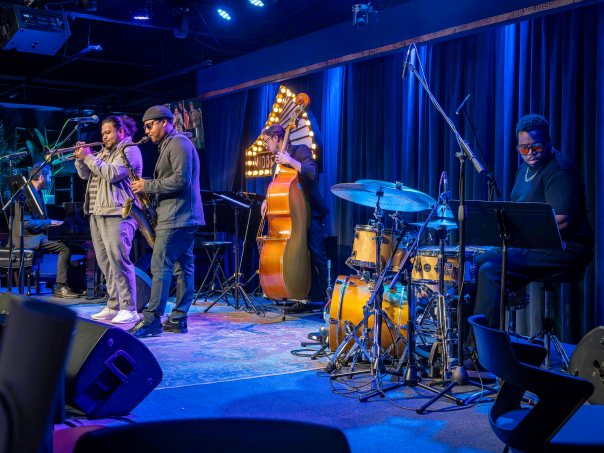
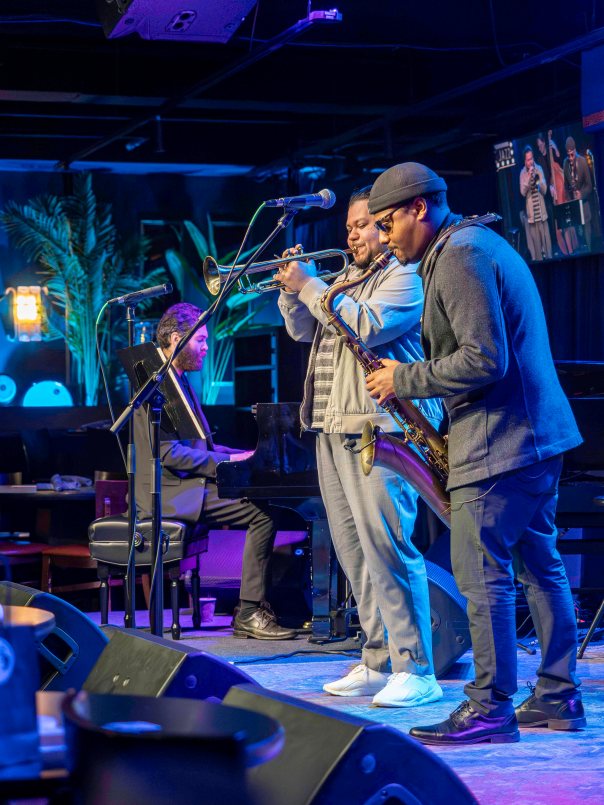
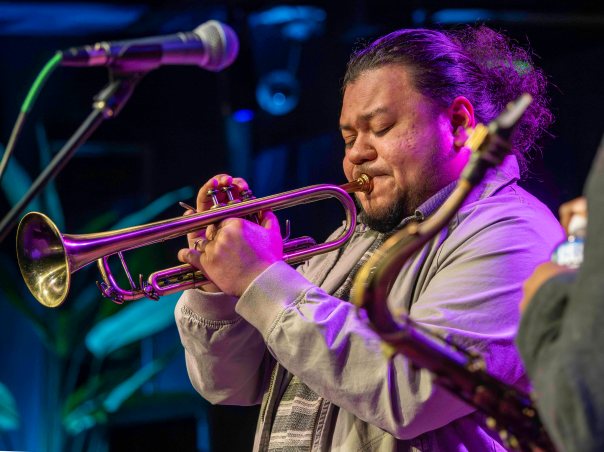
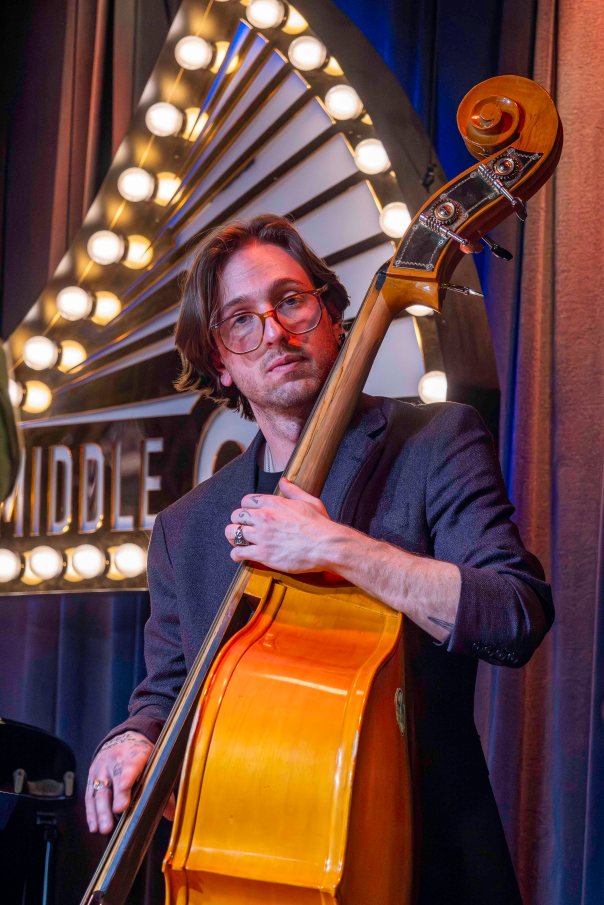
Very respectfully, as it turned out. Although the Vanguard was never referenced during the Quintet’s 6 o’clock set, both the West Coast club and Monk’s At the Blackhawk album drew frequent nods. In fact, the first two titles that the latter-day Blackhawks played, “Let’s Call This” and then “Four in One,” were the same as those that launched the 1960 recording. Combined, they provided fine showcases for all the band members, especially the frontliners: tenor saxophonist Elijah Freeman, trumpeter Ariel Mejia, and pianist Phillip Howe.

Appropriately enough, Howe played the intros on both of these pieces, not striving too much to emulate Monk’s signature style – he recalled asking at rehearsals, “How Monk do you want me to be?” – before the full ensemble reprised the themes. Mejia plunged into the release for his opening solo piercingly, sustaining his thrust with a rich tone before Freeman came powering in with his solo, his tenor tone sometimes a bit boozy like Rouse’s, at others defiant and declamatory like Monk’s most famous bandmate, fellow North Carolinian John Coltrane.

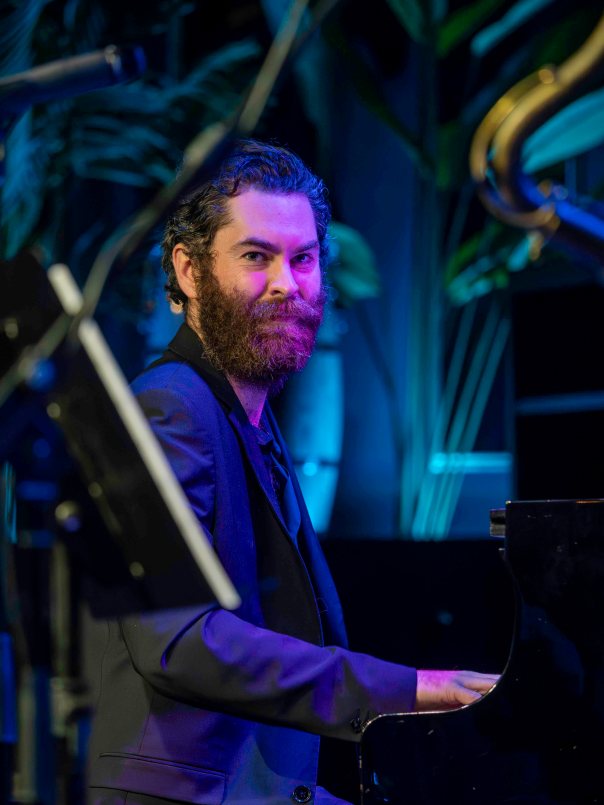
Howe’s creativity and touch were stellar when he weighed in with his solo, calming things down between expostulations, at times coaxing the Middle C’s Yamaha into sounding like an electric keyboard. Yet there was space left for bassist  Burns to show his mettle in a comparatively cameo role. Imagine if Symphony musicians were allowed to play on such bright, grainy, and colorful instruments!

As brilliant as before, Howe was more Monkish on the more familiar “Four in One,” second only to “Blue Monk” among my personal favorites, only holding back a little on punctuating the spiraling tune with Thelonious’s deliciously dissonant chords. Somehow, Howe managed to make the melody even weirder than normal, making up for his block chord omissions.

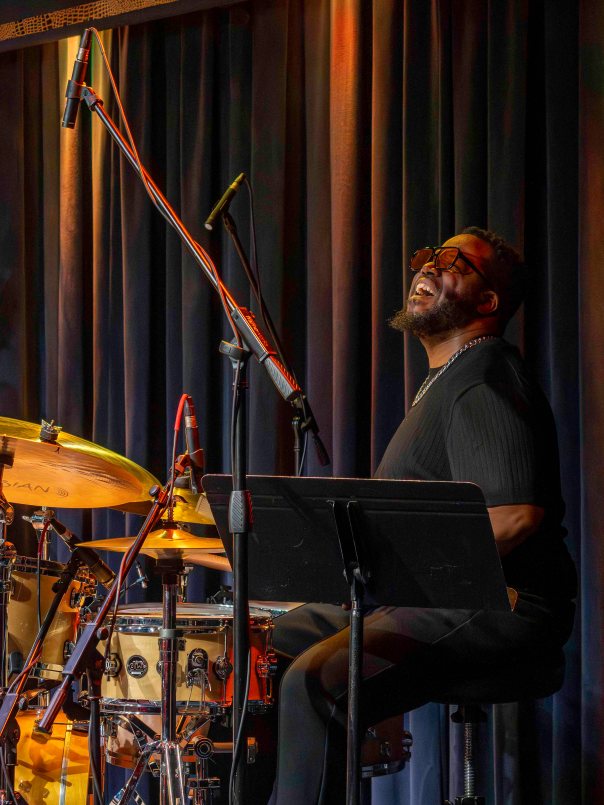
The melody’s spiraling sound invites more virtuosity, so Freeman’s work veered away more from Rouse toward Coltrane’s more swashbuckling approach, and Mejia followed with a solo that had emphatic flashes of Dizzy Gillespie splash and charisma, conjuring up one of Monk’s bebop mentors. Completing the arrangement with even more flair, drummer Tim Scott checked in thunderously, trading eight-bar solos with Mejia and Howe before Freeman fronted the outchorus.

Among the remaining five tunes in the Quintet’s set, two more were from Monk’s Blackhawk album, the beloved “’Round Midnight” and the inimitable pianist’s hypnotic theme song, “Epistrophy.” Not surprisingly, since the most famous arrangements of the tune are by trumpeters Gillespie and Davis, “’Round Midnight” became a showcase for Mejia, with Freeman sitting out and Howe limiting himself to a respectful half-chorus intro. Without referencing either of the trumpet immortals who have imprinted the piece, Mejia’s entrance at the bridge and his ensuing solo were impactful and lyrical.

Yet it’s necessary to mention that the Quintet’s most overt nod to a trumpeter was to my fellow Yankee fan, Marsalis: “Green Chimneys” from Wynton’s Live at the House of Tribes album from 2023, a mere 13 albums ago. Mejia led off with the melody and the first solo, and Freeman, Howe, and Burns all followed with their best playing so far, but perhaps the arrangement upstaged the playing. The first half of Mejia’s solo was unusually hushed until Scott, at the drumkit, pounced on the beginning of a new chorus while the trumpeter ignited to a higher intensity, a pattern that repeated in subsequent solos.

After sitting out “’Round Midnight,” Freeman took off his knitted cap and bestowed it on Howe so that he could more fully get into character and emulate Monk’s most famous eccentricities in the band’s “Epistrophy” tribute. Back in my college days, I could hardly believe that Monk stood up and away from the keyboard during performances and danced to the music while his bandmates soloed. Then he came to Queens College to play with his quartet and proved those reports to be true.

Howe also leaned over his piano bench, still standing, and began to play, a Monk shtick I had never witnessed live. Of course, Howe’s musical style here followed suit, and Freeman, perhaps aware that Monk danced most when Rouse was his chief sideman, veered toward that tenor – with a couple of glints of Griffin – and away from Coltrane.

Naturally, the last Monk piece, “Blue Monk,” was the most blissful for me. Howe’s approach, disdaining his prior Monk emulations, also pleased me greatly with hints of Bud Powell and Oscar Peterson. The set concluded with a tune from the band’s 2025 Englewood album, “Stretch,” with a nice intro from Scott. Freeman lavished his mellowest playing here before shifting into a full Coltrane rant.

When Blackhawk Quintet releases their next album, my radar will try to pick up on it. The group will be cutting it at the historic Rudy Van Gelder Studio in Englewood Cliffs, New Jersey. Freeman seemed quite proud of that, and rightly so.

Save Your No Kings Protests, King Hedley II Remains Defiant

Review: King Hedley II @ The Arts Factory

By Perry Tannenbaum

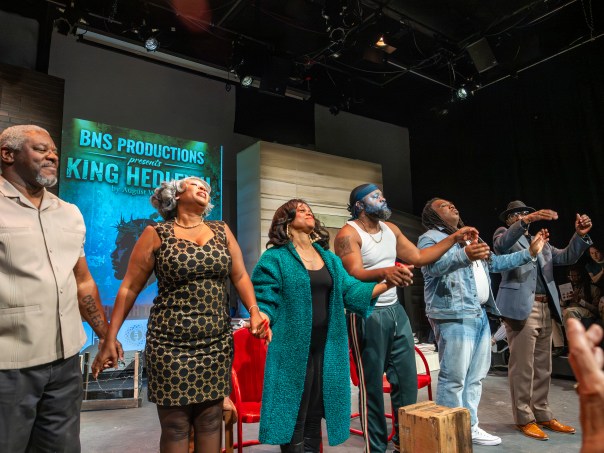
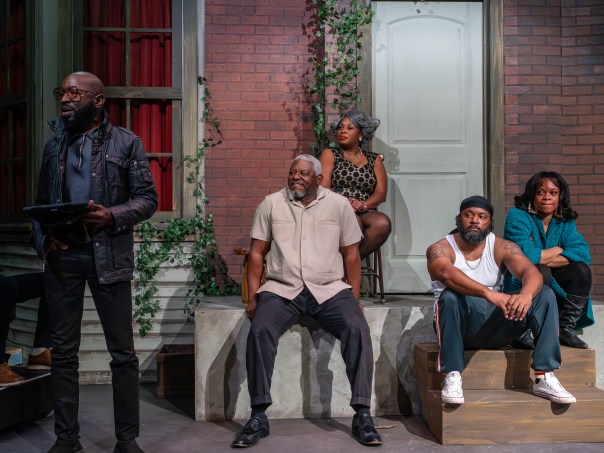
With over 3,300 No Kings protests popping up across the USA and on three other continents last weekend, you can go ahead and call BNS Productions’ local premiere of August Wilson’s King Hedley II an example of serendipitous or awkward timing. But you couldn’t deny that Wilson’s tragedy, the first BNS piece to be staged at the Arts Factory, was timely.

While a record eight million US citizens took to the streets, many reclaiming turf that was only recently terrorized by ICE G-Men chasing down an imaginary alien threat, basic living conditions of the 1980s, shown vividly by Wilson in all their wildness and squalor, still plague our inner cities. Religion, magic, and honest hard work offer no surer cure than guns, crime, and hopelessness.

Wilson’s clear vision and wisdom targeted the Hill District of Pittsburgh, illuminating each of the decades in the 20th century from a distinctively African-American perspective, forming an incomparably epic ten-play Century Cycle. In some ways, The Century (or Pittsburgh) Cycle is also incomparably complex. Some characters appear in multiple decades, while others mentioned in one of the dramas appear onstage in another.

In achieving his Cycle, to further complicate matters, Wilson did not move through the decades of his Century chronologically. Amid this seeming haphazardness, King Hedley II, commemorating the 1980s when it opened in 1999, anchors the most cohesive trio of plays in the whole series.

King’s father appears in Seven Guitars,the 1995 play that Wilson wrote immediately before Hedley II, along with Ruby and Elmore – but we see them four decades earlier in the 1940s, when King Jr is in embryo. Prominently mentioned in Hedley II, Aunt Ester will finally be seen, some 81 years younger, in Gem of the Ocean, the first play in the overall Cycle, premiering unforgettably on Broadway in 2003, starring Phylicia Rashad, depicting the 1900s decade.

If, as Wilson has said, Aunt Ester is a folk priestess who symbolizes the weighty history of African American tragedy and triumph, then her death at age 366 during Hedley II marks an unmistakable low point in the Cycle. The tempest of contention that breaks out at her home in Radio Golf, both the final play in the Pittsburgh Cycle (depicting the 1990s) and Wilson’s final work, can be viewed as piling insult onto injury or as a kind rebirth.

Like Hedley I, King would take it badly if anyone didn’t call him by his regal name. In fact, when we first see him, he is returning home from a seven-year stretch in prison for killing a man named Pernell, who not only slashed King’s face, leaving a permanent scar, but also insisted on calling him Champ. Hedley Sr. also committed murder for the same reason, so if you caught the Charlotte premiere of Seven Guitars in 2015, you would assume, like father, like son, that Hedley II has no regrets.

Not yet.

There’s another side to King that promises a fresh start, for he states concrete ambitions of opening a video store, a venture that cannot fail, and begins planting a garden in his front yard. Both Tonya and Ruby, the wife and mother who have held down this rundown fortress for seven years, are skeptical: they can’t believe King can follow a straight path to success. As sure as that bad dirt in their front yard won’t grow anything, King is bound to take the crooked way and land back in jail.

Hearkening back to Lorraine Hansberry’s A Raisin in the Sun, Wilson sets up a similar situation in the ‘80s to the one the Younger family encountered in the ‘50s. Only Wilson’s is a far bleaker view. Walter Younger held down a job, started a family, and his little sister had middle-class dreams and prospects.

King is more primal and dangerous than Walter, no less easily swayed and played. You’d better not stomp on those seeds King planted, though he sees the common sense of fencing off his little plot to prevent accidental incursions. Barbed wire, a bit aggressive, is his choice for fencing.

We can hope that the GE refrigerators that King and his best friend, Mister, are selling around town came from a legitimate source, but Tonya knows her man better than we do and presumes they’re stolen. An additional reason to trust Tonya’s misgivings comes when Mister proposes a heist at a jewelry store that he has cased.

Meanwhile, smooth-talking gambler Elmore is back in town with an eye toward reclaiming Ruby, getting married, and settling down. Proof of his wiliness comes after he talks King into letting him in on the GE scheme. Smooth operator, but he’s playing with fire. Even Mister knows better than to shoot dice with Elmore until he can bring a crooked set to the game.

Toi Aquila R.J., who also portrays Tonya, has a secure grasp of the costume designs that give each of the major characters his or her own distinctive style. There is black menace for King, a Sporting Life hipness for Elmore, and a diva flair for Ruby, the former big band vocalist. These core four are the strongest performers in director Rory Sheriff’s shrewdly chosen cast.

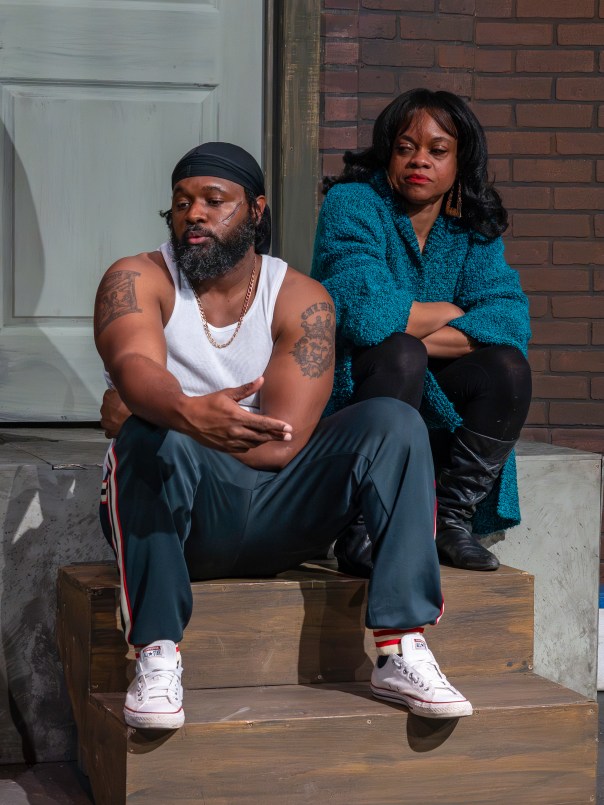
Much of the power that Jonathan Caldwell generates as King comes from those moments when he is open to reason, yet still seething somehow in these calmer moments. Explosions seem impending and inevitable. Tim Bradley as Elmore, on the other hand, sports a weaponized smile that conquers the ladies and confounds the men. As Ruby, Myneesha King gets to impress by belting a few bars, yet there’s no less sass in how her Ruby sees through both her son’s and her lover’s lies while succumbing to them.

For all that he packs into each of his plays, Wilson is anything but concise. Aquila’s anger as Tonya is as towering as her husband’s, and her monologue arguably encapsulates the passions and grievances that the playwright expresses most powerfully.

Yet there are ancient Greek elements artfully woven into Wilson’s script. Not knowing who you or your parents really are goes all the way back to Sophocles, most famously in Oedipus Rex, but the more overt thread in Hedley, the true prophet cursed with never being believed, goes back to Aeschylus and his pitiful Cassandra. Here in Pittsburgh this time, it’s Stool Pigeon, with Tone X laying heaps of Scripture on us all – and Wilson’s most delicious line:

“God’s a bad motherfucker.”

Now there’s some Greek attitude! Rounding out the cast is Andrew Monroe as Mister, appropriately the most inexperienced actor playing the most ordinary character. Not only does Mister bring King’s plight down to earth and help universalize it, but he also fails to move King with his pleadings – and to match his uncontrollable machismo when the heist goes down.

Deadly conflict between King and Elmore seems as foreordained as a dark storm first viewed on the far horizon. The best and zestiest view is at the Arts Factory through this weekend.

God of Carnage Bites but Merrily Refuses to Draw Blood

Review: God of Carnage @ Theatre Charlotte

By Perry Tannenbaum

Human masterworks and monstrosities cover the globe, fly through the air, and reconfigure the sky, bringing breathtaking changes to land, sea, and climate. So it’s rather quaint to spend an evening with a playwright who has built her reputation on the notion that civilization is a thin veneer clothing our innate selfishness and savagery.

Morals, ideals, aesthetics, and manners were all shown to be shams in Yasmina Reza’s Art, her 1994 breakout sensation. Trading in her sharper scalpel for a blunter instrument – a wrecking ball – Reza gleefully bludgeoned the veneers of sophistication, liberalism, reason, consensus, and even adulthood in God of Carnage, an even more smashing Tony Award-winning success in 2009.

It’s an unabashedly macro takedown of humanity and the progress of the race. Yet it’s deeply rooted in the soul of art and in the tradition of drama. For Sophocles and the Greeks, the tragic joke was that, no matter how mighty or regal we might be, or even how brilliant, we were all the playthings of the gods. Modern science reframed the picture, grimly enslaving us to our inner demons while liberating us from external forces. For O’Neill, Albee, and other moderns, the prospects were no less grim.

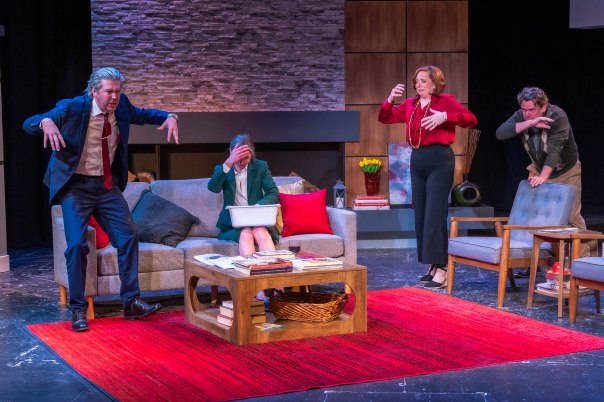
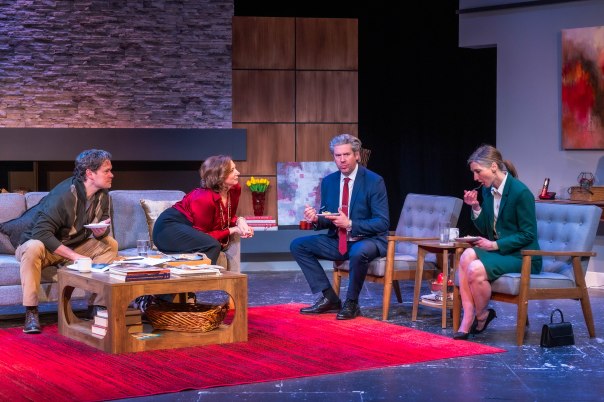
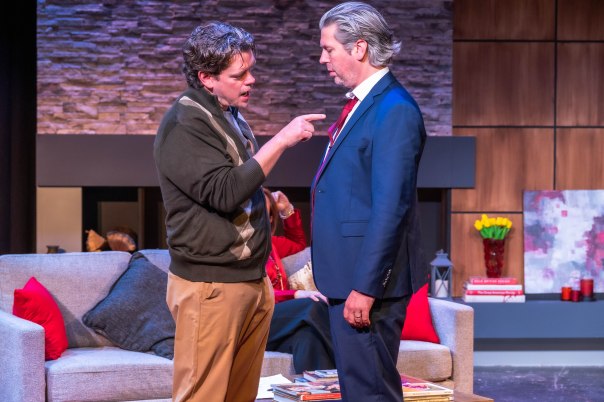
What’s especially disarming about the new Theatre Charlotte revival is just how lightly this heavy Carnage can play. To say that director Brian Lafontaine takes an impish approach to this adult powwow between parents of two schoolkids would be a grossly misleading understatement. Once disagreements between the two couples, the two genders, and the two husbands and wives escalate, no holds, shticks, or slapstick are barred.

If I had to apportion the hijinks at the Queens Road Barn to Reza’s script and Lafontaine’s embellishment, I’d give a decided edge to Lafontaine’s frou-frou. The recent altercation that precipitated the comedy action, between Henry Novak and Benjamin Raleigh about 30 minutes after sundown at Cobble Hill Park in Brooklyn, NY, was surely more violent than what we will witness onstage, with two of Henry’s teeth broken by Benjamin’s bamboo rod.

But the hostilities that break out between the adults are more epic in length, malice, and pettiness. Outbreaks of empathy, conciliation, appreciation, and apology only compound the impacts of their childishness and breaches of decorum.

So does the sleek neatness of Chris Timmons’ set design, where not a single hair or tulip seems out of place. Our hostess, Veronica Novak, writes about Ethiopian culture and civilization while working part-time at an art history bookshop. Not the expected match for Michael, her husband, a wholesaler who traffics in doorknobs, saucepans, and toilet fittings.

We rightly presume that the neatness, the stylishness, and the tulips emanate from her. On the other hand, both Reza and Lafontaine appreciate the special comedy spark that hostile women can ignite more readily than men. That’s why Reza has Veronica and Benjamin’s mother, wealth manager Annette Raleigh, initiating the most startling fireworks. Lafontaine delights in piling on additional aggressions from his women, Jenn Grabenstetter feasting on Veronica with serial hurler Aimee Thomas on the counterattack as Annette.

The menfolk are mostly on the receiving end of attacks, so Reza fiendishly contrives to make them as supremely irritating as their wives are judgmental. Most outré and obnoxious is Paul Riley as Benjamin’s dad, Alan. Like Veronica, Alan has also spent quality time in Africa – with a radically different, primal takeaway.

Lafontaine has special affinities and insights into Alan Raleigh, since he played the role in the 2012 Charlotte premiere at Actor’s Theatre.

We can only guess that Lafontaine yearned to be even meaner, obnoxious, and amoral than he was. That was my takeaway from Riley’s Alan, as he pokes among the objects in the Novaks’ bookcase and allows himself peeks at the upstairs. Mostly, he infuriates everyone by rudely answering his cellphone every time it buzzes, no matter how involved he should be in deliberations with his wife and hosts.

Unless you find it more irritating that, aside from frankly admitting that he has fathered a savage, he is spearheading damage control for his client, a big pharma company responsible for a widely available drug newly found to cause hearing loss and ataxia. That insider info hits home when Brandon Samples, as Michael, is obliged to take a phone call from his hospitalized mom.

One of the people Alan and Pharma are victimizing is now on the line. The same drug has just been prescribed for Mom.

So maybe Riley is most obnoxious when he arrogantly declares that his hosts shouldn’t be eavesdropping on his privileged attorney-client conversations. There’s a lot to choose from with Alan.

And a blizzard of suffering that the Novaks must endure, especially when Annette barfs all over her hosts’ coffee table and their precious art books. You might say that we’re a bit out of control at this point, belly-laughing at the panic and queasiness that ensues from the phlegmatic deluge. What an odd thing to unite these families in damage control!

Lafontaine decrees that Samples shall be the queasiest of them all, likely taking his cue from Reza, who makes this dealer in doorknobs and toilet fittings surprisingly skittish about handling his daughter’s pet hamster. Quite a different sample of Samples than we saw last October when he portrayed Hercule Poirot.

What makes Michael irritating is subtler than what we readily see in Alan. He seems at first to be the resurrection of Yvan, the conciliator in Art who tries so valiantly to agree with both Serge and Marc despite their wildly differing views on modern art and Yvan’s impending marriage. Similarly, everybody seems to be making a good point in Michael’s view.

Such pliability and ambivalence, under Reza’s merciless scrutiny, prove to be as fundamentally amoral and uncaring as Alan’s jaded pragmatism. That’s what opens the floodgates of Veronica’s fury when the compliant Michael breaks rank with her. Grabenstetter, notwithstanding all her sophistication and empathy for “the tragedy in Darfur,” snaps like an alligator, pursuing her husband around their living room like a rabid wolf. Serves him right after Samples’ scene-stealing response to the massive vomiting.

Aided by some very fine Antigua rum, Thomas also gets a marvelous character arc to track with Annette, overcoming her nausea, attacking her spouse, and avenging herself on Veronica. That pleasure, sad to say, did not quite allow me to forget my earlier difficulties hearing Thomas when she was still in her diffident cocoon.

God of Carnage doesn’t exactly match Hamlet for length and power, but its captivating turbulence stems from the same source: the push-and-pull of visceral urges struggling against societal norms. The Novaks and the Raleighs do lose control like their savage sons, but they lose it like adults rather than 11-year-olds.

So there’s hope for us. That amazing restraint is the heart and conscience of this singularly chaotic comedy. Maybe that’s why we have so much fun. Get ye to the Queens Road Barn!

NC Baroque’s A Musical Offering Merits Enthusiastic Acceptance

Review: A Musical Offering @ Davidson Bach Festival

By Perry Tannenbaum

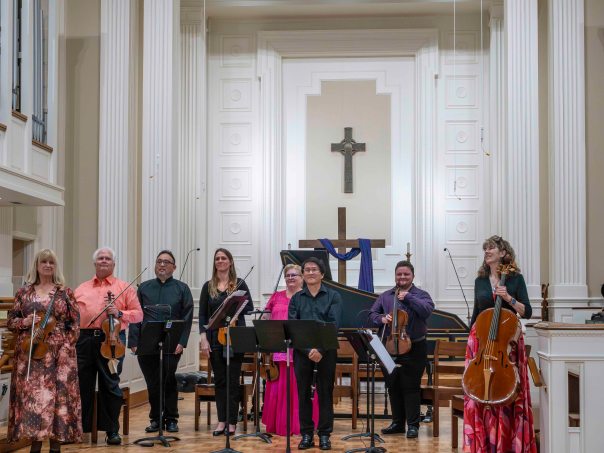
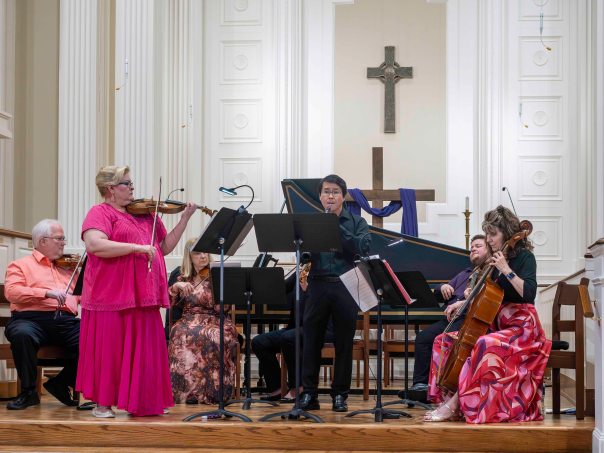
March 7, 2026, Charlotte, NC – Since I hadn’t reviewed a North Carolina Baroque Orchestra performance at Davidson College Presbyterian Church in over 10 years, you are welcome to conclude that my return trip this past weekend was also my first sampling of the Davidson Bach Festival, which launched its first season slightly less than a year ago. In some respects – age, size, duration, number of venues, and variety – the Davidson fest is like the Charlotte Bach Festival in miniature. They don’t import a world-class chorus or perform the mighty masses and oratorios, and they don’t offer noonday lecture concerts with choir, orchestra, AV presentations, and scholarly erudition.

Yet there are aspects of this relative simplicity that can be prized. Unlike the Charlotte fest or the Oregon Bach Festival, its regal template, Davidson hasn’t ventured beyond Bach so far. Nor has it hopscotched around the city or the college campus, cleaving exclusively to the Presbyterian. Upon reacquainting myself with that sanctuary, I found what many would consider an advantage. Although the organ at St. Peter’s Episcopal, in uptown Charlotte, can speak in earthshaking thunder, an organist performing a concert for over an hour at Davidson Presbyterian can be viewed far more comfortably. You have to turn around in your pew to even glimpse the organ and the organist at St. Peter’s. Even then, you’ll only see his back, often at a greater distance, and always in dimmer light.

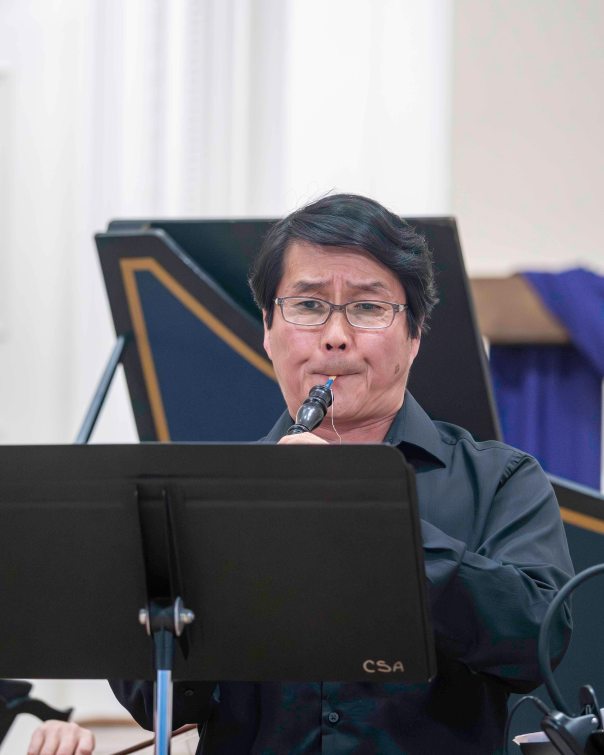
That was my only pang of regret when I opened the festival program and recalled that the “Bach Birthday Bash” with award-winning organist Chase Loomer was scheduled for the following afternoon. Meanwhile, “A Musical Offering,” with three Bach concertos (culminating in a Brandenburg) and a Trio Sonata from his Musikalisches Opfer, would provide ample consolation for missing tomorrow’s rumble. Playing lead oboe or flute on three of the four pieces, Sung Lee was certainly going to draw the most scrutiny.

On the other hand, harpsichordist Francis Yun seemed destined to lurk inconspicuously behind the other musicians until the opening movement of the treasurable Brandenburg Concerto No. 5. Unless you were already with the epic harpsichord cadenza in the opening Allegro, you had little idea how emphatically Yun would emerge.

The same can be said, of course, for the myriad Bach compositions known to us chiefly by their featured instruments and BWV numbers. Familiar melodies lurk in them that multitudes of music lovers will instantly remember, but only specialist musicians and musicologists can anticipate. For most of us, Bach’s delicious Easter eggs are only further scrambled by the multiple times he might repurpose his best melodies in various compositions.

The Concerto for Oboe and Violin in C minor, BWV 1060r, starting off BC Bach’s “Musical Offering,” is an apt example. Starting out as a concerto for two harpsichords and strings, it was recast into a Violin and Oboe version. Either way, there were sighs of satisfaction – and relaxation – when the melody of the opening Allegro was recognized with its delightful echo motif. Lee was partnered with violinist Jeanne Johnson for the main instrumental interplay, perhaps even more beautifully in the middle Adagio movement, because it sounded less familiar, with a more minor-key flavor. As one becomes more experienced as a listener, one appreciates the variety of Allegro that sensitive and discerning soloists bring to the stage. The closing Allegro here was brisker than the earlier one.

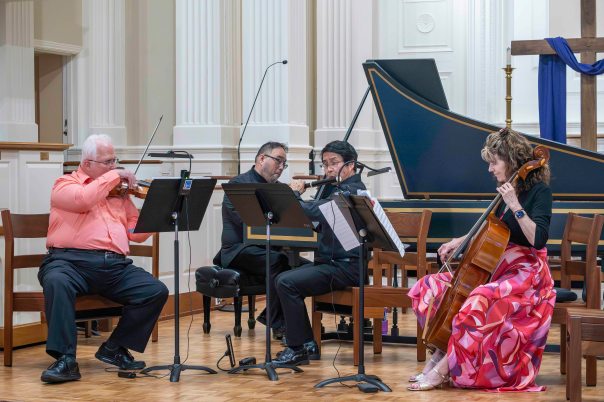
Even if you were sitting in the second row, as we were, the hall was part of the sound, softening it. Yet the second piece, the Trio from A Musical Offering, was more subdued in various ways. The ensemble was reduced by half to four players, and all were seated in a chamber music style. Compared with recent recordings we might sample on Spotify or Apple Classical, NC Baroque’s chamber ensemble played the second movement Allegro conspicuously slower after a perfectly judged Largo with gorgeous counterpoint.

Lee, Yun, violinist David Wilson, and cellist Barbara Krumdieck meshed beautifully throughout, rightly reveling in the sonority of the penultimate Andante, which is always slowed down – even on the Kujiken brothers’1994 recording, the best of the bunch. Less of an outlier than the earlier Allegro, the concluding movement was also a bit lethargic, better propelled by Krumdieck’s continuo. Overall, the interpretation aligned best with the 1974 recording by the Academy of St. Martin in the Fields, where the middle movements are marked Allegro Moderato and Andante Larghetto.

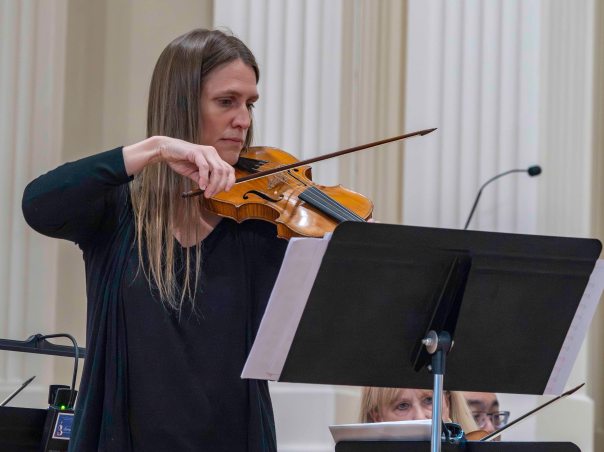
Everything about the E Major Violin Concerto No. 2 sounded wonderfully familiar to me, even the slow movement. Bach lovers could have come to the catchy melodies through this BWV 1042 violin version, almost perfectly judged at Davidson Presbyterian by soloist Janelle Davis, or a subsequent BWV 1054 harpsichord version, pitched a full step lower. Davis was very close to the speed that unlocks the opening Allegro’s full flair and immersed herself lyrically in the middle Adagio. But it was Davis’s joyful playing in the closing Allegro assai that made this Concerto such a tough act to follow.

In hindsight, Davis’s joyous tempo provided the perfect launching pad for Yun’s prodigious three-minute rampage, climaxing the opening Allegro of the Brandenburg 5. Tempo-wise, the whole movement was perfectly grooved. A little more ardor from Lee in the middle Affetuoso would not have been amiss, but we ascended to a far loftier plane when Bach’s harmonies flooded the music. Though a little less prayerful and sublime than the opening Allegro, the final movement of this immortal concerto – especially appealing with Lee sparkling jubilantly – is no less quintessentially Bach and baroque. Every time we recall these bookended gems, we realize that they’re living inside us all the time.

The Revolutionists Mixes Comedy and High Ambition

Review: The Revolutionists @ Warehouse PAC

By Perry Tannenbaum

Badass. That’s how Lauren Gunderson describes all the women in her feminist fantasia, The Revolutionists. On the heels, high and low, of the touring edition of Suffs that premiered at Belk Theater, the Warehouse production of Gunderson’s 2016 script – with a second all-female cast in the same week – underscored one of the subtler achievements of the suffragists who aided the passage of the 19th Amendment 96 years earlier.

Men and women now openly admire all these badasses and cheer them on!

Cheers and laughter were high among Shaina Taub’s aims when she wrote and starred in Suffs as revered feminist Alice Paul. Gunderson feels compelled to diligently remind directors and actresses who bring her historical script to life that this is a comedy. Since all of her women are living during the apocalyptic Reign of Terror in 1793, midway through the French Revolution, the shadow of the fearsome guillotine looms large.

None of them supports that notoriously bloody revolution.

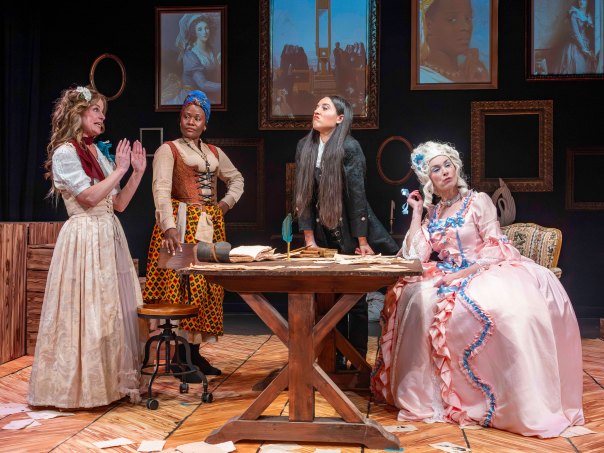
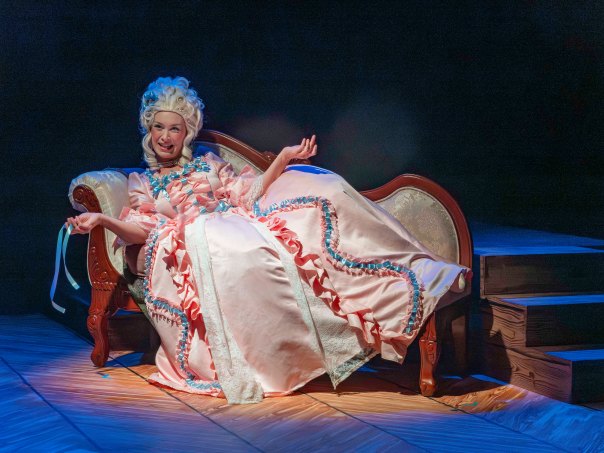
Charlotte Corday, the most badass, actually embraces the guillotine, the likely consequence of her intent to assassinate Citizen Marat, the radical newspaper influencer. Calling for the same liberté and égalité in her native Caribbean that have toppled the monarchy in Paris, Marianne Angelle, a free black spy, hopes to skirt the guillotine while opening the eyes of the Revolution to the hypocrisies of slaveholding and continued colonial power. And Marie Antoinette, “less badass” than the others, is desperately fleeing the chopping block, hoping to rebrand her clueless, free-spending, and heartless reputation on the fly.

They all converge on the feminist playwright of the day, Olympe de Gouges, in urgent need of her eloquence. Corday has the simplest need: a memorable exit line to proclaim at the scaffold, one that will resound for eons to come. Marianne could use a sharply worded manifesto – with a soft touch – that furthers the cause of her homeland. Marie merely needs a total rewrite and makeover: redemption, whether or not she deserves it.

What a godsend de Gouges is! When we first saw the comedy in 2018, produced at Camp North End by PaperHouse Theatre, it was easy enough to see Olympe as a rather transparent surrogate for Gunderson, shaping the comedy she ostensibly tailors for Marie. Directing that production, Nicia Carla decreed that her Olympe discard her quill in favor of an anachronistic BIC ballpoint, letting us perceive Gunderson’s guiding hand throughout.

Historically, it’s even more complicated: de Gouge really wrote a comedy in which she, a character in her own play, taught the downfallen Queen Marie a lesson. She also penned a manifesto, the courageously feminist Declaration of the Rights of Woman and the Female Citizen, punching her ticket to the scaffold. From that perspective, it’s possible to see her, quivering and quailing here as she crafts her Reign of Terror comedy, as the inspirational fountainhead of Gunderson’s fantasia.

With no less than four subtitles: A Comedy, A Quartet, A Revolutionary Dream Fugue, and A True Story.

At the Warehouse Performing Arts Center up in Cornelius, director Reneé Welsh-Noel mutes the anachronisms and the wink-wink meta approach until late in the second act, when Gunderson explicitly decrees that the fourth wall must be broken. Welsh-Noel and scenic designer Chris Tyer utilize the larger space and richer theatre resources at the PAC to offer the playwright’s quartet multiple platforms to declaim, orate, stab, and achieve martyrdom.

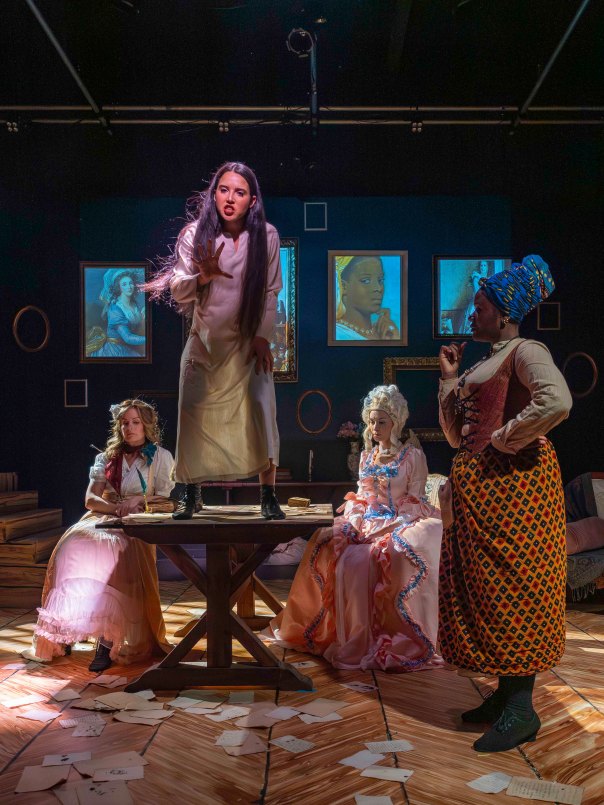
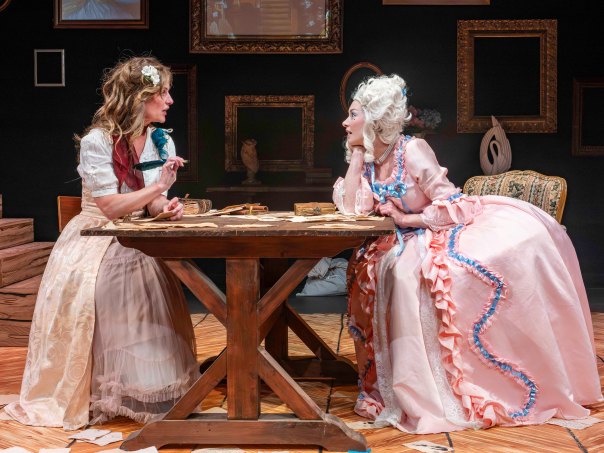
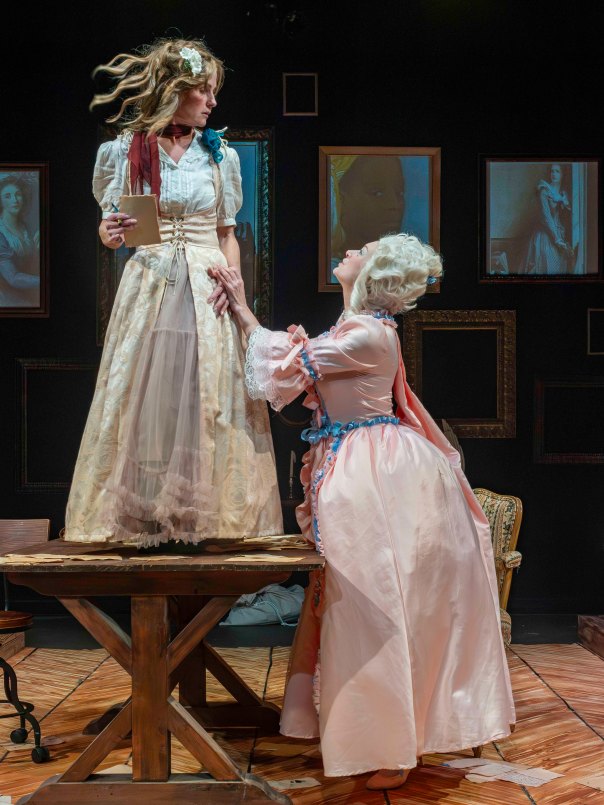
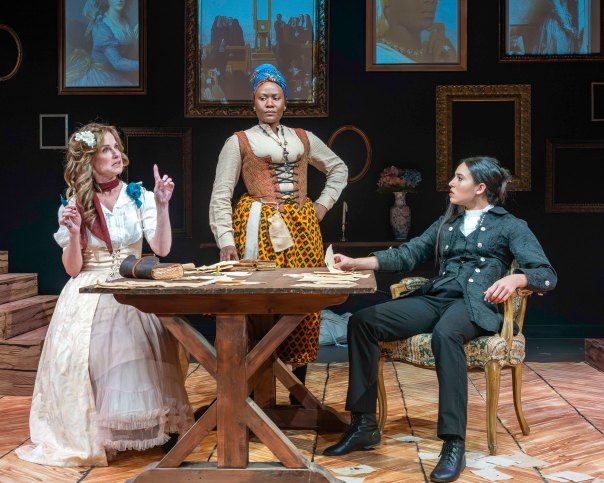
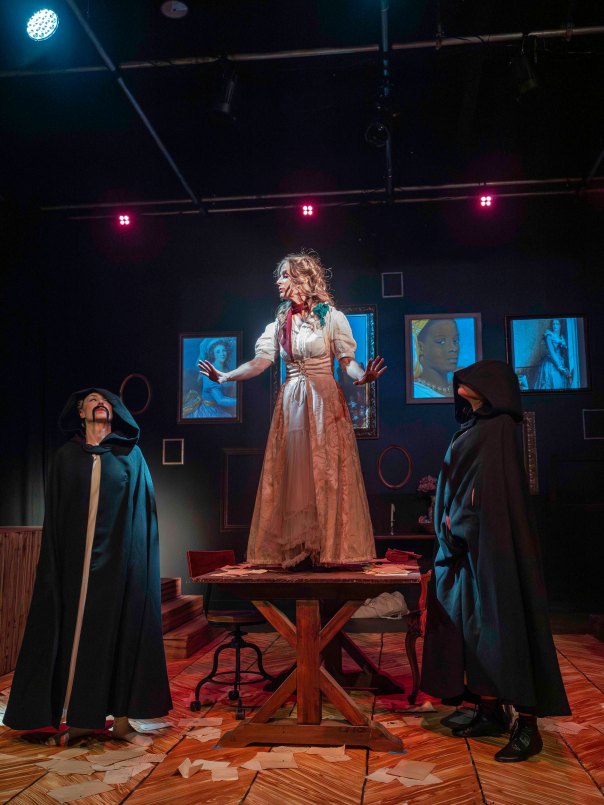
One of these doubles as de Gouge’s desk or, if you will, the table in her salon. A glorified picnic table, to be honest. Even her highness deigns to sit herself at this humble furnishing, but a legit settee looms further upstage for Marie’s more regal lounging. Assuring fluidity between scenes, the remaining scenery is sparse: a jut of a snub mantle on the back wall, with a scattering of ornate picture frames.

Except four projections from Jessica Zingher, most of the other frames are blank. They all seem to float apart from the action, though they are preternaturally relevant – like a gallery of images in Gunderson’s mind or her surrogate playwright’s. Making the space more emphatically Olympe’s, sheets of writing paper litter the high-concept floor, a multitude of testimonials to her pathological writer’s block.

Maybe Tyer’s concept mystically correlates the excess of strewn paper below with all the jet blackness inside the empty frames above.

It certainly testifies to the intensity of action from Olympe that yields such a welter of messy futility: the frenzy of the times. Welsh-Noel seeks to keep a vortex of swiftly paced action swirling throughout the evening, spreading her actors across the wide space, amplifying confrontations, with them threatening and lunging at each other. Tension and urgency remain ridiculously high under the shadow of the guillotine. Like a comedy.

Costumes from Welsh-Noel and Zingher add spice and flair, flouncy and beribboned for Marie and continental ninja for Corday. By contrast, Angelle’s outfit pops with Afro-Caribbean color and style, an equally bold statement.

Brave as Olympe may have been in real life in her attempts to champion women’s rights and to reconcile the radicals with the royals, Gunderson infuses her inspiration with her own trepidations over putting your life on the line with your plume. So it’s an ambivalent and bumpy ride for Lisa Schacher as Olympe, one that alternately accentuates the comedy and drama, both of which would suffer if Gunderson’s concoction were more sure of herself.

Jennifer Adams is mostly at the comedy end of the spectrum as the deposed, soon-to-be decapitated Marie: too vain to skulk through the streets in disguise, she materializes in Olympe’s parlor, announcing her own entrance and assuming everybody is talking about her. Yet Gunderson allows her dopiness to vanish at times, giving way to clairvoyance at her brilliant moments and allowing Adams to display maternal feelings – to Marianne, of all people.

Her most charming moments perhaps come when Adams puts aside Marie’s regality and snobbery to become rather childish in her candid enthusiasm, the glue in the quartet’s sisterhood. Sororité!

My chief difficulties with this production came from the eternally serious women, Jane Elvire as Marianne and Marissa Dibilio as Charlotte – though each of them lands a barb or two at the lighter women’s expense. Likely because of her authentic Haitian roots, it took me a few minutes to attune myself to Elvire’s lilting accent, with a couple of relapses later as Marianne’s actions and words become more urgent.

With her bounty of natural dignity and presence, Elvire is exactly what Gunderson had in mind when she described her as “the sanest of them all.” Whether through instinct or through diligent research into Marianne’s historical parallels, Gunderson burdens the free Caribbean black woman with the most adversity to deal with. Ultimately, her sufferings help the playwright pierce Marie’s silly, frilly façade in some of the quietest, most human moments of the evening.

From a dramaturgical standpoint, Dibilio’s dashing outfit may be Welsh-Noel’s most audacious decision. Dressed like that, you multiply your chances of not being admitted to Marat’s bath by his servants and bodyguards. But it helps Dibilio look the part, though paintings of the famed assassin, in action or brooding at the Bastille, opt for more conservative clothes.

At times, Dibilio falls into the trap of sounding too natural in her gripping performance, lowering her voice when she gets really close to other players. When we can hear her, she’s quite compelling.

From the opening, when we hear a falling guillotine and Olympe’s first words are “Well, that’s not a way to start a comedy,” we’re clued in to Gunderson’s aim to mess with us. Talk about audacity, she’s serving us notice that she’s presenting a comedy that writes and rewrites itself before our eyes.

That’s not really possible, is it? But what The Revolutionists accomplishes is nearly as impossible: reminding us that, in horrendously troubled times, the noble words and actions of our finest writers and activists will certainly outlast tyrants, bigots, and bullies. While making us laugh between bloody plunges of the guillotine.