Tag Archives: Lane Morris

Laugh Your Butt Off at “Meet & Greet”

Review: Meet and Greet at The VAPA Center

By Perry Tannenbaum

Auditions are a kind of interview, and interviews are a kind of audition. You enter, drop a résumé on somebody’s desk, and minutes or hours later, you exit elated or deflated. Instant drama. Singularly human. A paradigm of life.

At the VAPA Center, auditions and interviews are the entire evening for three weekends in Meet & Greet, a themed set of three one-act comedies produced by Charlotte’s Off-Broadway in the COB Black Box. Yeah, from the outside looking in on aspirants and applicants who have stressed for weeks preparing, strategizing, dressing, and grooming for the big moment or trial by ordeal, the denouement can be quite entertaining.

We can laugh our heads off at these overinvested humans and empathize at the same time. Imagining we were them or grateful that we are not.

Of course, there are perils for playwrights working within these familiar templates. Skirting predictability is the keenest, particularly if your audience has been exposed to sketch comedy over and over.

You can rest assured that each of the playwrights featured at VAPA contrives to make the familiar ritual different from what we expect, concealing at least one twist and surprise. Neither Susan Lambert Hatem’s Hamilton Audition nor Don Zolidis’s The Job Interview far exceeds the length of a typical TV sketch, so opinions will likely vary on whether they transcend the streaming standard.

Both of them have yummy roles for multiple players, so transcendence becomes less of a factor if you’re seeking comedy simply for escape in these dark days. The incontestable headliner of the evening is the finale, Meet & Greet by Stan Zimmerman and Christian McLaughlin – in terms of length, number of histrionic roles, and prestige. Zimmerman’s fame rests chiefly upon his extensive writing credits, most notably the beloved Gilmore Girls and The Golden Girls.

Meet & Greet clocks in at more than twice the length of most sitcom episodes. Between laughs or afterwards, you may catch yourself pondering why.
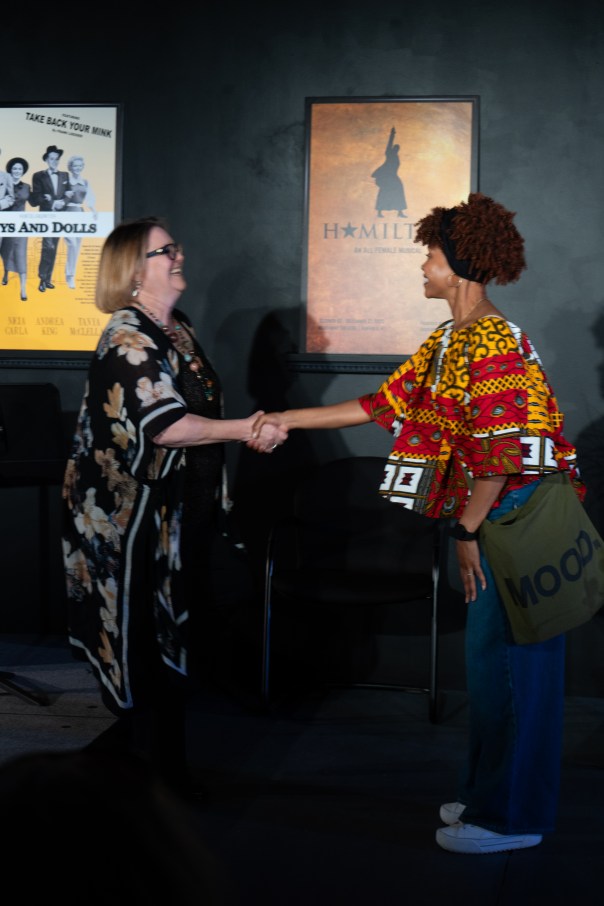
COB’s producing artistic director – and VAPA Center co-founder – Anne Lambert has her energetic hands all over this one-act hodgepodge, starring as The Director in her sister’s Hamilton Audition and (what else?) stage directing all that follows.

There may be an inside joke here. Do you really audition for the role of The Director in the play you have programmed by your sister at your own theatre? Do you think director Anna Montgomerie invited Lambert to play the role, or was the inviting done in the opposite… direction? Wouldn’t Lambert, not the shyest person on the Charlotte theatre scene, have leveraged some of her status – and experience – in determining how her character should be written and played?

We’ll never know, unless the saga of putting Hamilton Audition on its feet spawns another script. In the present instance, Lambert has invited the most prodigious voice in town to audition for the lead role in an all-female production of Hamilton, and the diva who has graciously consented is apparently the only person on the planet who has never heard of Lin-Manuel Miranda’s megahit.

More likely, people who come to see Hamilton Audition will not realize that Lambert was a co-founder of Chickspeare, which pioneered all-female productions of Shakespeare in the QC. It is not at all far-fetched to say that Lambert inspired the role she is playing as well as the play her sister has written. Posters on the rear wall touting fictional Chickspeare productions practically shout this in-joke out loud.

From appearances, you might conclude that Lambert is more out of her element directing a hip-hop musical than Nasha Shandri as Shondra Graves is auditioning for the role of Aaron Burr. Just you wait. Although she looks perfect for her dashing Founding Father role, Shondra gives a more atrocious hip-hop reading than you would dare to expect from The Director.

Comedy gold.

Amazingly, Shandri is supposed to be no less ignorant about rap than she is of Hamilton! Suddenly, the whole idea of a pioneering all-female version seems like a certain disaster… with fallout for females and minorities. It’s at this point that Graves and The Director probe the sexism that already lurks in the original gendered Hamilton. So yes, Hatem has put some meat on her hambone dialogue.

Whether or not Zolidis replicates that feat in The Job Interview is more open to question. The bio in the digital program, summoned by your QR code reader, states that Zolidis is one of the most prolific and produced playwrights in the world. Maybe the thuddingly generic blandness of this title explains why Zolidis was so previously unknown to me nonetheless.

Fortunately, his Job Interview playscript proves to be livelier and more imaginative. The basic premise, we will soon find, ensures that the sparks will fly. Both of the applicants waiting to be called into T.J.’s office, Chloe Shade as Marigold and Marla Brown as Emily, will be interviewed at the same time, adding the elements of confrontation and fierce female competition to the drama. For Emily, it’s already life-or-death.

If you’ve inferred that T.J. is eccentric and perhaps sadistic, you’re on the right track. Rahman Williams as T.J. doesn’t ask his applicants a scripted set of questions – or even the same questions. Deepening his aggression and moving us abruptly from interview to audition, he challenges Marigold and Emily to show him how they would handle specific on-the-job situations.

Not only might we say that the difficulty of the questions and roleplay challenges seems to be tipping the scales of fairness way off kilter, but we can also discern radical differences in the temperaments and preparedness of the two candidates. It would be impossible to find an aspect of Emily’s performance where she outscores her rival… aside from how desperately she needs this.

Now anybody interviewing for a job knows that he or she is already facing steep odds, but knowing that you’re outclassed during the interview is a special torture, one that permits Brown to go totally nuclear as Emily. On the other hand, Shade can play with the absurd and ballooning insult that Marigold, in all her perfection, is obliged to keep competing with this loser – and that the outcome still lies in the hands of this outrageous interviewer.

Rahman, in the meantime, gets to play with the disconnect between T.J.’s spit-and-polish military background and his high-level position at Build-a-Bear Toys. Three tasty roles, all well-done. During the run, Nicole Cunningham shares Shade’s chores.

Contrary to what you may be thinking while it plays out, Zimmerman & McLaughlin have aptly named their Meet & Greet. Take it in the same way that the four auditioning actresses do and ride the rollercoaster. To make it all tastier, two of the four have a history together, co-starring long ago during better days on a hit sitcom, Lane Morris as the embittered psycho Belinda and Stephanie DiPaolo as the bimbo Teri.

For my generation, I was thinking Joyce DeWitt and Suzanne Sommers from Three’s Company, but you might hear different echoes. Teri is the airhead who tends to spoil everything, or she is deeply misunderstood and cruelly typecast. Bubbling and pouting seem to be her main forms of expression. Also in the room before Teri’s majestic entrance is Marsha Perry as Desiree White, with some sort of acting experience as the star of the “Real Housekeepers of Palm Beach” reality show.

Contrasting nicely with Desiree and her leopard-skin bodysuit is Joanna Gerdy as the splendiferously monochromatic Margo Jane Mardsden, who has fallen from her regal perch as living Broadway legend due to a combo of drink and disgrace. Being among this gaggle, especially the déclassé Desiree, is already a devastating humiliation.

Yet as we can hear as they emerge from their auditions, both Desiree and Margo are spectacularly successful in their auditions for the role of Andrea, the leading lady of an upcoming series pilot. Leopard Skin draws uproarious laughter from the sanctum within before Diva Nun draws a thunderous ovation. Which one do the showrunners, producers, and writers inside actually prefer?

Every word that Tommy Prudenti utters as the Casting Assistant is a tantalizing clue to what the show and Angela will be, and there is a girlish coyness about him… and a deceptive servility. All through this epic catfight showdown, Zimmerman’s Golden Girls pedigree is on display in a blizzard of quips, taunts, and one-liners. We shall only divulge the maestro’s recipe for “sidewalk pizza” here: you jump out the window of a tall city building.

Newborn Charlotte Conservatory Conjures Theatre Magic – and Memories of Charlotte Rep – with “Witch”

Review: Witch from Charlotte Conservatory Theatre

By Perry Tannenbaum

Witch Photo

August 11, 2022, Charlotte, NC – Last April, when theatre was just beginning to emerge from its pandemic hibernation, would have the perfect moment for Charlotte Conservatory Theatre to spring to life with its first production, Jen Silverman’s Witch, now at Booth Playhouse. For the 2018 tragicomedy was based on The Witch of Edmonton, a lurid script written by William Rowley, Thomas Dekker and John Ford. All of that original play – all five acts, mostly in iambic pentameter – was written and readied for performance within the space of four months. That’s how long it had been since the true-life “witch” the play was based upon, Elizabeth Sawyer, was hanged for witchcraft on April 19, 1621. A year and four months after the quadricentennial of that execution, when our fears have shifted from death by COVID to inflation and monkeypox, the sardonic tear-it-all-down thrust of Silverman’s play may have blunted a little, but its fierce feminism remains intact.

Make no mistake, most of the gripping power of this evening at the Booth emanates from the white-hot Charlotte debut of Audrey Deitz as the lonely, defiant, and principled Elizabeth. But then there’s also the Charlotte debut of Stephen Kaliski as Scratch to bring out all of Dietz’s bewitching charisma, for his portrayal of the Devil has plenty of charisma to vie with Elizabeth’s. Kaliski was guileful, quick-witted, disarmingly frank, and surprisingly vulnerable on opening night. Here the Devil had met his match and more.

Such stunning simultaneous debuts of two experienced out-of-town actors with a local theatre company at Booth Playhouse are phenomena we haven’t enjoyed since the demise of Charlotte Repertory Theatre in early 2005. The regional professional aroma of that long-gone LORT company was sustained by the polish of the design team, led by scenic designer Tom Burch, whose previous local gigs I’ve praised at UNC Charlotte and Children’s Theatre. With their brushwork, scenic artist Lane Morris and portrait artist Eva Crawford clash a bit with Burch’s 17th century furnishings, echoing how Silverman pulls against the bygone era with her idiomatic dialogue. But Kellee Stall’s costume designs settle the matter, sort of. “Then-ish. But equally of our moment,” is Silverman’s dictate on the era of her work.

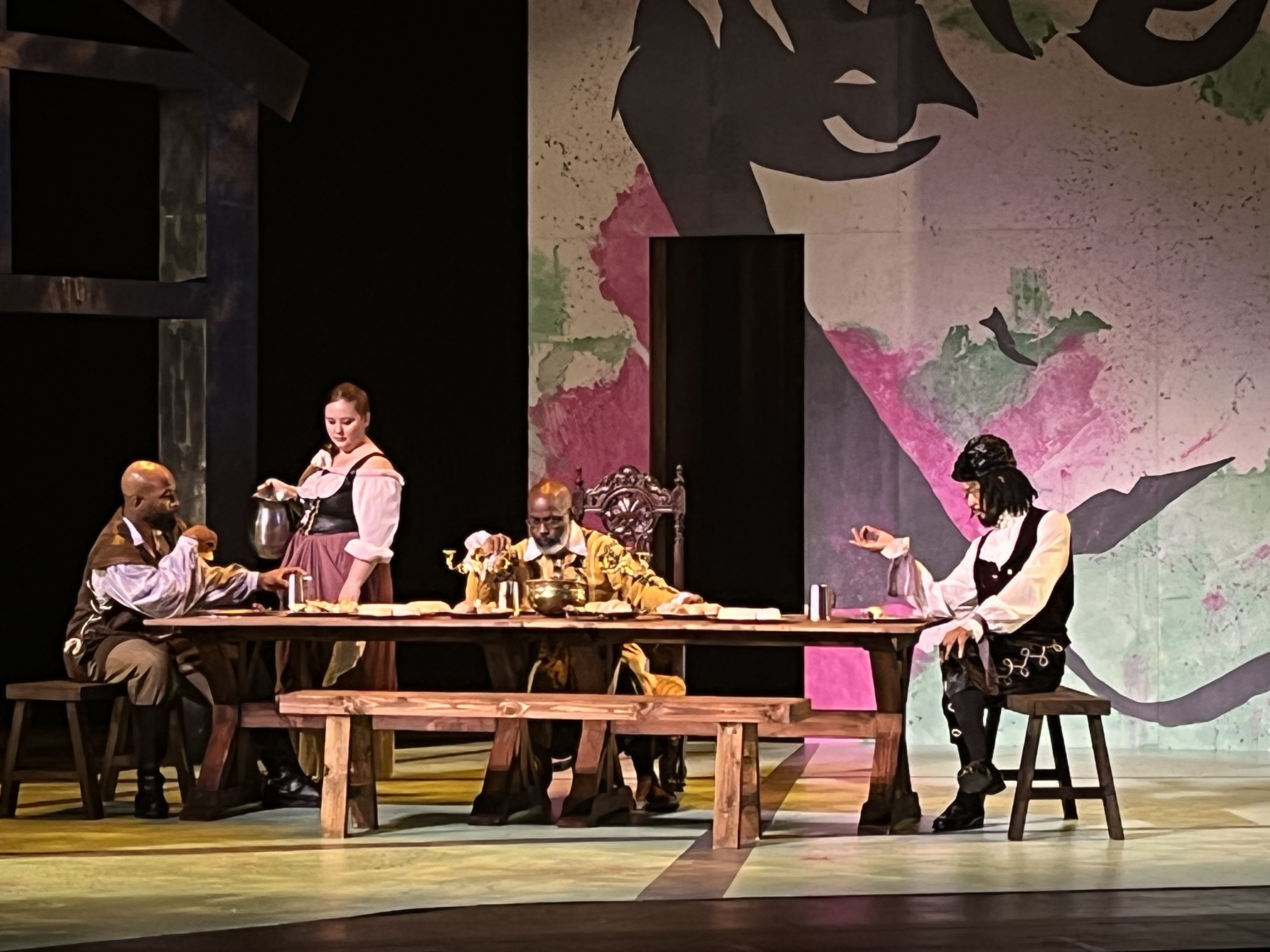
We see the “Then” most vividly in Stall’s costumes when we shuttle to Silverman’s other plotline at Sir Arthur Banks’s castle, which occupies most of the stage. After Elizabeth’s opening burn-it-all-down aria, delivered under a sharply brilliant spotlight, the other actors parade onstage, following the lead of Cuddy Banks, Sir Arthur’s foppish/effeminate son, who may be morris-dancing around Dad’s imposing dinner table. Anyway, he will soon tell Scratch that he performs in a morris-dancing troupe. What Silverman and Elizabeth seem to enjoy most about Scratch is that he’s selective.

So what Cuddy likes about Scratch, when he comes offering temptations in exchange for his soul, is that he’s coming to him before approaching either Elizabeth or the up-and-coming Frank Thorney. You see, Dad has taken Frank into his household and is now thinking about adopting the upstart, because Frank is clearly more likely to produce an heir. Robert Lutfy, who has been off our radar as a director for over a decade, makes an interesting alteration in how he sees Cuddy, pointing up his sexuality and discarding his shyness, handing a plum comical role to Jeremy DeCarlos, who feasts on it. What was easy to forget on opening night, amid DeCarlos’s prancing and his Percy Blakeney fopperies, was that Cuddy first considered asking for Winnifred, Dad’s servant, in exchange for his soul. Scratch short-circuits that request by pointing out that Winnifred is secretly married to Frank – a revelation that is doubly devastating to Cuddy. Even as he switches the bargain, exchanging his soul for Frank’s life, he is wildly in love with his manly, dashing nemesis.

If you’re scratching your head a little over Scratch’s objection to Winnifred, you will learn more intriguing details about Silverman’s concept of the tempter. He is not all to be confused with Satan or Lucifer – or with their supernatural omniscience. Instead, he’s like a traveling salesman, assigned to a specific territory, not exactly a rookie but lacking in past prestigious catches to boast of. Watching Witch at the Booth, I had the feeling that, after bagging Cuddy, Scratch moved on to Elizabeth and Frank because his bargaining with Cuddy yielded those leads. Dominic Weaver plays the confident and ambitious Frank with a hulking, self-assured swagger that contrasts perfectly with DeCarlos’s spindly fidgeting.

When Frank sets his price at becoming Sir Arthur’s heir, in exchange for his soul, Scratch’s answer is exactly the same as when Cuddy asked him to kill Frank: “I think we can make that work.” You might wonder how Satan’s Edmonton rep accommodates both rivals. Without explicitly answering, I’ll surmise that Silverman may have read Macbeth as profitably as she read The Witch of Edmonton. Fulfilling the devil’s work delivers some complications, of course, not the least of them are Winnifred’s flare-ups when she hears that her husband is yielding to Sir Arthur’s efforts to fix Frank up with a nobly-born wife.

It’s not just Elizabeth and Cuddy, then, who get their opportunities to sing their woes. From her multiple cares and troubles, Savannah Deal gets to deliver a fine aria – Silverman’s term for all the soliloquies she doles out to her players – touching us as she transcends her worldly status of peasant wench. Ron McClelland certainly gets multiple chances to humanize Sir Arthur, pouring his heart out to his deceased wife (the woman in the portrait) and agonizing over the future of his family name.

Witch Photo 2

Your only worry, as Silverman’s separate plotliness develop, is whether she will ever tie them together. It’s not a terrible concern, for Elizabeth’s destiny becomes as fascinating as the love triangle at the castle once Scratch becomes as besotted with Elizabeth as we are. Silverman offers the choice of casting the outcast witch as a woman from her 40s to her 60s, but after seeing the vibrancy of Dietz in the title role, I believed Lutfy made the ideal choice in going for the low end of that scale. Aside from one single bobbled line, the opening night performance was seamless, magical perfection. What an auspicious beginning for Charlotte Conservatory Theatre! May their future runs be longer than four days.

Common Thread Presents an Uncommonly Well-Constructed Racial Comedy

Review: Barbecue at Davidson College

 By Perry Tannenbaum

Common Thread Theatre Collective - Barbecue

July 15, 2022, Davidson, NC – There are plenty of questions to ask in Robert O’Hara’s Barbecue as two O’Mallery families – one white and one black – gather at the same park, both of them staging fake outdoor parties for the same kindly but devious purpose. These questions explode upon us as soon as the white O’Mallerys are replaced by the black O’Mallerys after the first blackout, wearing the same exact outfits we have just seen moments earlier, drinking the same beverages, and popping the same pills. Even their names are the same. Both Lillie Anns are prodding their reluctant kinfolk – husband James T. and sisters Adlean and Marie – to drape the same pavilion at the park in party decorations, to feign a joyous family celebration, and to confront family renegade Barbara and get her into a therapy program that Lillie Ann has specially chosen for her in faraway Alaska.

Mercifully, we gather that both of O’Hara’s O’Mallery families are on the same track because their scenes deftly overlap rather than tediously repeating. The checkerboard structure of the playwright’s comedy was a perfect vehicle for the new hybrid company that was presenting it at Barber Theatre on the Davidson College campus. Common Thread Theatre Collective is a joint venture between North Carolina A&T State University theatre faculty members and Davidson’s Department of Theatre. Established 131 years ago in Greensboro, A&T is the nation’s largest historically black university, with a student body that is currently less than 80% African American. Domestic students of color, according to Davidson’s website, are currently at 28% of the matriculated population – and an influx of 8% international students enhances the College’s diversity.Common Thread Theatre Collective - Barbecue

Predictably enough, the two O’Mallery families appear to be blissfully unaware of one another – until intermission. Directing the show, Donna Baldwin encourages skin color to make a difference in how James T’s Pabst-Blue-Ribbon trashiness, Adlean’s chain-smoking vulgarity, and Marie’s besotted Jack Daniel’s elegance play out onstage. Maybe I’m biased, but the trashiness, vulgarity, and besottedness of the white folk seemed more outsized to me than their counterparts’, which chimed well with O’Hara’s overall design. The two Lillie Anns were woefully lacking in vices as they masterminded their schemes and manipulated their interventions, but both were more controlling than they strictly needed to be, relishing their dominion. Here again, Joanna Gerdy gets to be just a little bit bossier, trashier, and more crotchety than Willa Bost, her black clone, even though she was basing her master scheme on some cliched TV series.

We began to understand what was going on with the abrupt break in the action that brought us to intermission. If that sudden jolt hadn’t made it all obvious, O’Hara double underlined his answer in a manner almost as surprising as his intermission reveal. For the first time, a black person and a white person spoke to one another – and it was the two Barbaras, Ava McAllister Smith and Jade Parker, who clarified the mysteries we had seen, two characters who had hardly spoken 10 words between them until now. Suddenly, what seemed to be a satirical dive into the crassness of American life, with subtle distinctions between the races, acquired new meta textures as the two Barbaras met at the park and negotiated. How this story should be told, who should tell it, and how much it should cost were all up for grabs as the Barbaras jousted over making a deal and setting a price.Common Thread Theatre Collective - Barbecue

Taking it all in, from the unseen moment when Lillie Ann was inspired by primetime TV to hatch her scheme, moving along to how one Barbara reshaped her rehab memoir before her counterpart Movie Star Barbara bought the rights, I came away with the following message from O’Hara: fueled by drugs, alcohol, and toxic righteousness, truth is what gets most thoroughly slaughtered and barbecued in American life. On the way home, another pleasant thought hit me. Thanks to an artful gap between scenes in Act 2, rehab Barbara may have actually lowballed the amount of money she was promised earlier from Movie Barbara when she confronted the other O’ Mallerys with Hollywood’s offer.

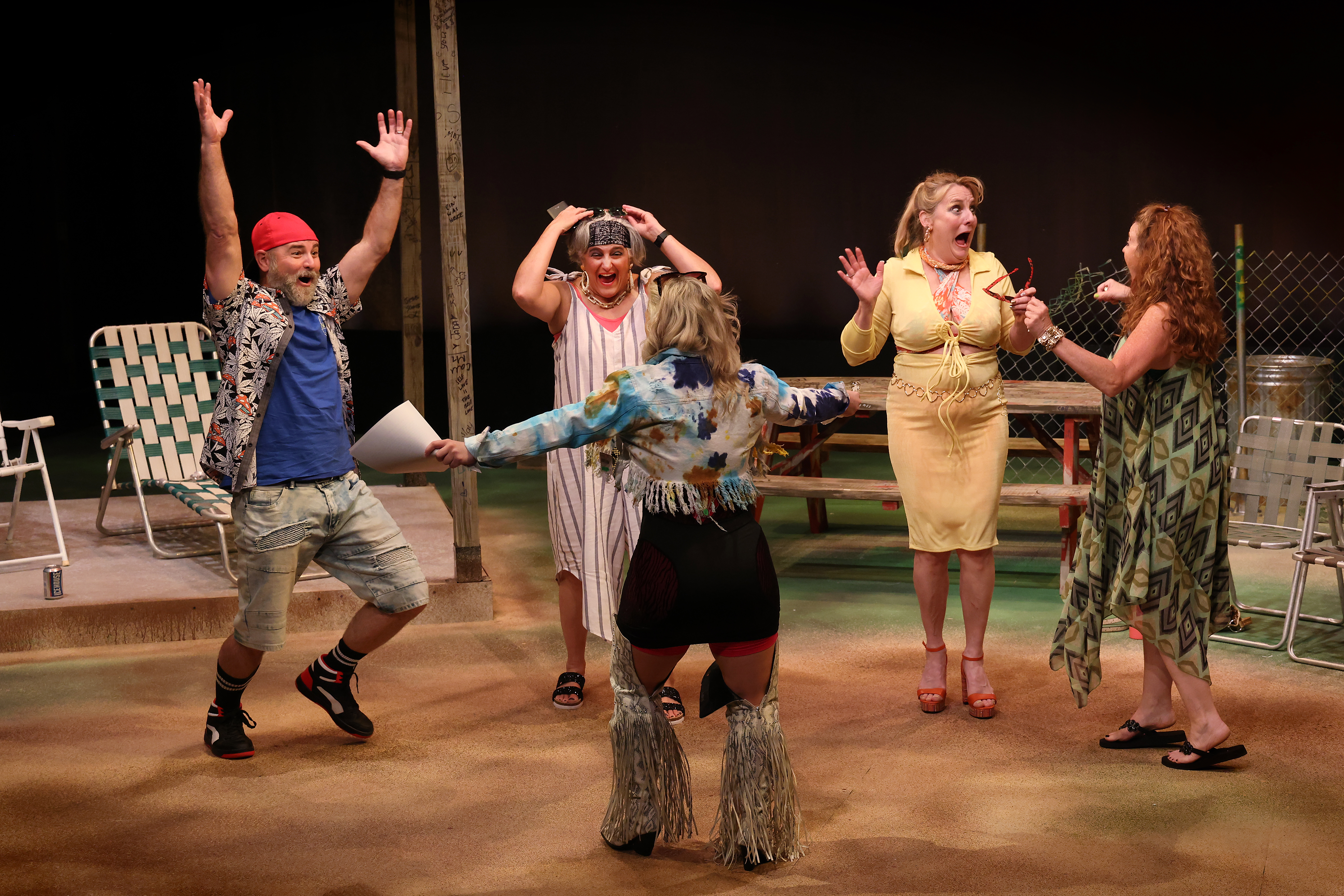
The presence of two Actors Equity performers, more than we see in most touring shows nowadays, testified to the professional-grade theatre that Common Thread has delivered, for neither of them stuck out uncomfortably among their local and intern castmates. Parker and Smith were nicely matched in the comedy’s one interracial faceoff, taking turns in holding the upper hand and smoldering nicely when they didn’t. As the only men we see before intermission, Shawn Halliday and Tyler Madden get to pop and stomp plenty of beer cans as the JT’s, taking heavy fire from the Lillie Anns all the while, but Halliday is the seedier of the two while Madden has the edge in timidity. La’Tonya R. Wiley was a formidable presence as Adlean no matter how many cigs she fired up or how many pills she gulped down, while Lane Morris made her Adlean more strung-out than anybody.

Gregory J. Horton has designed a set of costumes that likely inspired Baldwin-Bradby and her cast nearly as much as O’Hara’s canny script. At the opposite end of the spectrum from JT’s splashy mashup of baseball, soccer, and tennis outfits is the eye-popping elegance of the lemon dresses worn by our Maries. These citrus dresses are accessorized with high heels that are just as inappropriate for an outdoor barbecue, along with jugs of Jack Daniel’s large enough to sport handles for easy chugging and pouring. Of the two Maries, it was hard to say whether I most enjoyed the arc of Shawna Pledger taking Marie from swilling to passing out, or whether Xulee-Vanecia J subsequently surpassed her in Marie’s decorous revival.

Questions about Barbecue continued to assail me on the drive home. Foremost among these was how anyone could imagine a homespun, humdrum story like this winning an award. Sure enough, O’Hara had embedded an answer. You can bet it had nothing to do with honesty and everything to do with America.