Tag Archives: Ava Smith

Hollywood Superstars Who Graced the QC’s Park-N-Shop

Preview: QC Concerts’ Side Show at Booth Playhouse

By Perry Tannenbaum
When Louella Parsons, the undisputed queen of Hollywood gossip, saw the Hilton Sisters’ first movie in 1932, she proclaimed: “For pure sensationalism, Freaks tops any picture yet produced. It’s more fantastic and grotesque than any shocker ever written.” At the height of their fame, Daisy and Violet Hilton could fill a large stadium.

Or at least, they tried. On July 18, 1936, billboards all around Dallas – some as large as 60 feet tall – invited the public to the Centennial Exposition at the Texas State Fairgrounds. For just 25 cents, you could enter the Fair Park Stadium, newly rebranded as the Cotton Bowl, and attend Violet’s wedding, with twin sister Daisy as her maid of honor. Afterwards, the sibs would perform with their dance band.

How could it be otherwise? For Violet and Daisy were Siamese twins, joined at the hip. Superstars. During their careers, they performed with Bob Hope, Jack Benny, and Burns & Allen. Hope and Burns were the sisters’ most illustrious dance partners! But the Hiltons died in relative obscurity. When they hadn’t shown up for work at the Park-N-Shop on Wilkinson Boulevard for a few days, Charlotte Police found them dead in their nearby apartment on January 4, 1969 at the age 0f 60.

The Siamese twins – actually born in Brighton, England – had succumbed to the Hong Kong flu. Blame it all on the Asians, right?

There should be a soft spot in Charlotteans’ hearts for two of our own and for Bill Russell’s Side Show, the 1997 Broadway musical about the Hilton Twins’ rise to fame. But no matter how thoughtful and intriguing the original version and the revised 2014 revival were to reviewers, neither production gained box office traction in New York and neither toured here.

Until now, the only adult company to present Side Show in the Queen City was the Queen City Theatre Company at McLohon Theater in 2008. The McLohon was an ideal locale for the seedy, carnival ambiance of Side Show. Russell’s cast includes not just the Twins, after all, but also a Cannibal King, a Snake Woman, a Reptile Man, three Harem Girls, and – perhaps most monstrous of all – The Boss who employs, exploits, and abuses them.

Though pennies won’t get you into this show unless you have a huge jarful, the freaks return to Charlotte this week – with their startling welcome.

Come look at the freaks

come gape at the geeks

come examine these aberrations

their malformations

grotesque physiques

only pennies for peeks

Once again, The Boss will invite you into his “odditorium.” While the McGlohon and its Spirit Square cohort, Duke Energy Theater, remain in hibernation until 2027, undergoing their makeovers, Queen City Concerts is reviving Side Show at Booth Playhouse. It’s a more intimate Blumenthal Arts venue than the McGlohon, true enough, but not quite as creepy.

Chief chef directing this colorful cast – and leading a full orchestra playing Henry Krieger’s music in Harold Wheeler’s original orchestral arrangements – is QC founder Zachary Tarlton. Adoration of the original score is Tarlton’s specialty, but here he had the luxury of cherry-picking from two Broadway versions, maybe shuffling the songlist a little and restoring some of the 1997 tunes that had been dropped in crafting the more historically accurate 2014 revision.

“We chose to do the original 1997 Broadway version of Side Show,” says Tarlton, “because it is Side Show in its purest form. While the show closed quickly, it garnered several Tony nominations and launched the careers of its leading ladies: Alice Ripley and Emily Skinner. For those unfamiliar with the original show, the 2014 production seemed polished and pristine. For fans of the original, it was met with harsh criticism.”

Fans of the original, Tarlton will tell you, are a cult following. Whether the stars of the new QC Concerts production, Ava Smith as Daisy and Sierra Key as Violet, are members of that cult is an open question. But they are both fervid admirers of the show.

Before Tarlton saw her as his Daisy, Smith had portrayed Violet in a Teen City Stage presentation at CPCC’s Pease Auditorium in 2016 – while she was still a high schooler in Gastonia. Key was also in high school when she first met Smith in 2013, and they’ve been besties ever since their first show together.

Naturally, Key saw the 2016 show that starred her bestie. In a freakish reenactment of Side Show scheduled for later this year, Smith will be one of Key’s bridesmaids at her wedding.

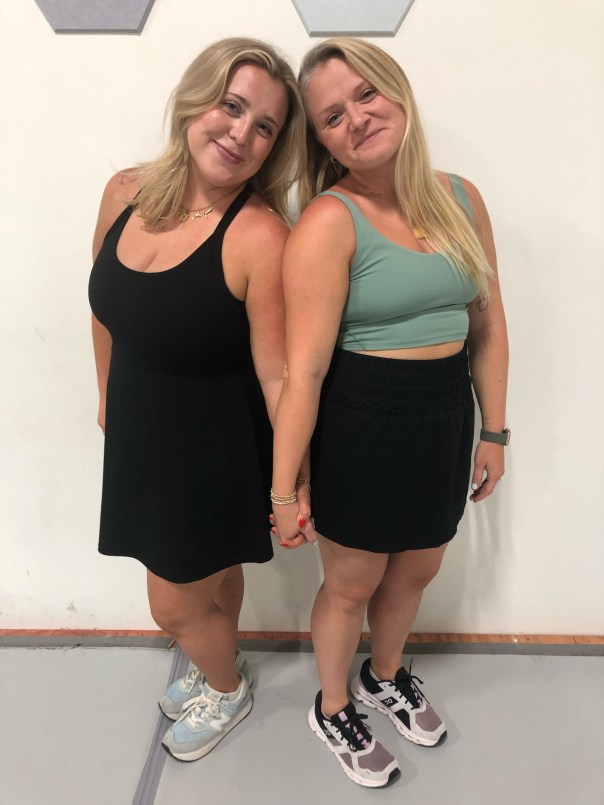
“A little fun fact,” Smith adds, “people often mistake us for sisters! Just like Daisy and Violet, we have stood by each other through the good and bad times. Our connection in real life makes the necessary onstage connection come naturally.”

Russell sharply differentiates Daisy from Violet early on in his script, while they’re still slaving on the midway. Two young men, Terry Connor and Buddy Foster, secure a private audience with the sibs after their freakshow. Buddy’s idea is that he could teach the Hilton Twins how to sing and dance while Terry can get them a shot in vaudeville as their booking agent.

Both of the women would jump at the chance to escape the side show, but until now, they haven’t been offered a feasible alternative. The Boss keeps them under lock-and-key as part of his freak collection.

It’s Terry, not quite on board with the vaudeville scheme, who asks what the sisters yearn for.

“Daisy is bold, outgoing, stubborn, and determined to be famous,” Smith says. “She loves performing and knows exactly what she wants. Violet is shy, sensitive, and just wants a simpler, quieter life. But even with those differences, they share such a deep love for each other and a longing to just be ‘Like Everyone Else.’ I believe Daisy and Violet really are two halves of a whole.”

As halves or opposites, they are both keenly and perpetually aware of how laughable their aspirations are to their captors and the people who pay to peep at them. Even if they are at odds, every choice they’ve made individually has been with the tacit agreement of their twin. Yes, the fiery Daisy can aspire to vengeance against the mockers and the detractors while Violet merely hopes to prove them wrong and be rid of them.

But they must move together, whatever they do, and cannot pretend they’re the same as everyone else. Daisy aims higher, fired by the full breadth of the American dream, but it’s Violet, no less American, who is more poignant and relatable.

“What’s so powerful about Side Show,” Key declares, “is that it tells the story of people who are seen as ‘different’ simply for existing in the world as they are. As someone who is part of the LGBTQ+ community, that resonates with me deeply – especially right now, in a time where identity and visibility are still so politicized and debated. Violet’s longing for love, acceptance, and belonging is incredibly human, and that’s what I focus on.

“The physical connection with another actor may be unusual, but it’s all in service of telling a story that challenges perceptions and invites empathy.”

Going back eight or nine decades, Russell can take us beyond empathy and show us quite bluntly how the Hiltons themselves had yet to evolve. Their strongest champion before Buddy and Terry arrive as deliverers is Jake. He’s not really a Cannibal King “from the inky jungles of the darkest continent,” as The Boss would have us think, nor a poster boy for his collection of “god’s mistakes.”

He’s simply a rather strong African-American man. With a very soft spot for Violet. His inability to say no to her becomes the ticket to the Hilton Twins’ freedom.

So yes, they are also capable of prejudice and exploitation.

“One of the darkest moments in the show comes late in Act Two,” Tarlton observes, “when Jake asks Violet why she will not accept his deformities when he accepts hers, acknowledging the color of his skin while he accepts her as a conjoined twin. While that was during the Great Depression, we realize this same conversation could just as easily have been today. It is a show that is challenging at the core.”

Amen. Two of my most unforgettable moments in a Broadway theater happened on the evening when I first laid eyes on Ripley and Skinner. They didn’t instantly appear as the two Hilton sisters. They converged from opposite sides of the Richard Rodgers Theatre, facing each other as they sang and, just seconds afterwards, facing us. Then they conjoined right there, magically becoming one and moving as one – as naturally as Daisy and Violet had presumably done all their lives – for the remainder of the evening until taking their bows.

This must have been exactly as Russell envisioned it. “In the Broadway production,” he wrote in his Production Note. “Daisy and Violet’s connection was created by the two actors standing side by side. They were never literally connected by corsets, Velcro or any other costume piece. This allowed the audience to participate in creating the twins’ connection with their collective imagination and made the actors’ achievement of appearing to be joined all the more impressive.”

Even more primal and gripping was The Boss’s follow-up introduction as we were led inside his side show tent alongside the other freak seekers who had paid their dimes. “Please remain in your seats,” he told us commandingly, “to experience our premiere attraction in its most revealing display.”

A dazzling blast of backlight assaulted us as the conjoined twins, standing together with their limbs splayed out, appeared in dark silhouette. The sight was shocking, like a gigantic black spider writhing before us, twice the size of a normal person.

Fascinating. Fearsome. And yet… hauntingly beautiful.

Waiting for Tina, Janis, and Aretha

Review:  Beehive The 60’s Musical

By Perry Tannenbaum

Beehive Dress Rehearsal; July 4th, 2019

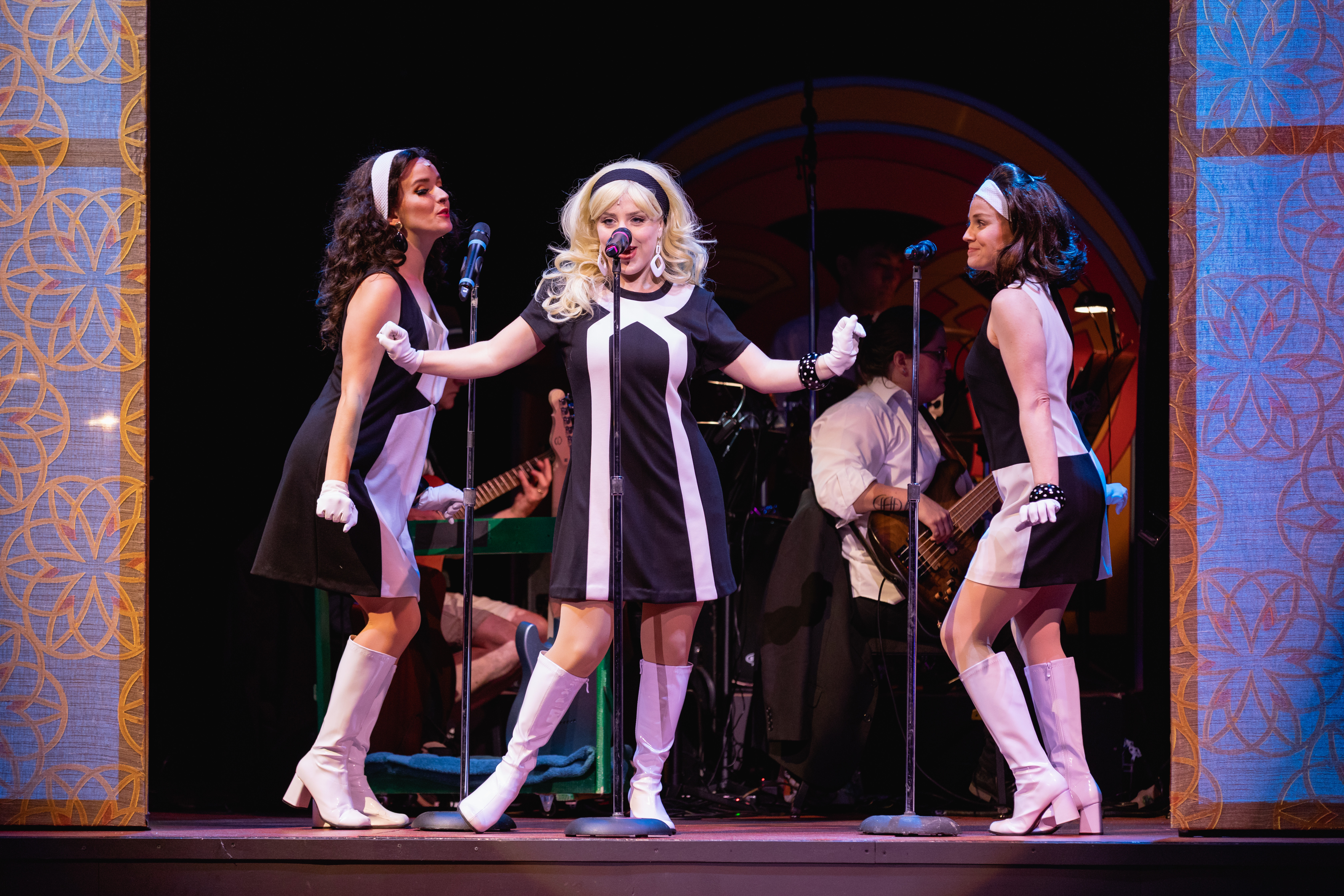
Lovers of The Chiffons, The Ronettes, Donna Loren, and Lesley Gore, rejoice! Or if you’ve never heard of The Chiffons and The Ronettes – or you’ve simply despised Lesley Gore for the past 50 years – have a little patience. Beehive The 60’s Musical, Larry Gallagher’s jukebox revue, has wended its way at long last to Halton Theater. The show has kicked around for over three decades since its New York debut at the Village Gate nightclub in 1986 (the show never ran on Broadway) and my Google searches of past productions – and the original cat album on Spotify – testify to a songlist that has been frequently in flux.

Like a jukebox.

I’ve found accounts of the show that report a full two hours of music, compared to the current CPCC Summer Theatre production that clocked in at a shade over 79 minutes plus a 16-minute intermission. Other reports indicate reprises of hits by the Shangri-Las, Shirley Bassey, Petula Clark, Janis Ian, Sonny & Cher, and Brenda Lee. Most of them opt for a different selection of hits by Janis Joplin.

Beehive Dress Rehearsal; July 4th, 2019

But the good news is that while we endure the Beach Blanket Bingo dross of Loren, Gore & Co. throughout Act 1, there are gems we remember from The Shirelles and The Supremes – and the kooky fun of Shirley Ellis’s “The Name Game” – mixed in with the insufferable pap that prevails. And the 40 minutes after intermission are much improved over the 39 before. We reach a Promised Land of singles originated by Dusty Springfield, Mama Cass, and Jefferson Airplane. We sojourn with the likes of Tina Turner, Janis, and Aretha.

Under the lively direction of Tod Kubo, who also choreographs, Beehive sustains the same high level of artistry and polish that lifted Jekyll & Hyde earlier in the CP Summer season. With wig designs from Barbi Van Schaick, hair reached heights you have to expect from Beehive. Costume designers Bob Croghan and Jennifer O’Kelly, held oddly in check at the outset, break free flamboyantly after intermission, especially when Tina and Janis strut the stage.

Beehive Dress Rehearsal; July 4th, 2019

Defying the Halton’s spacious stage, O’Neill’s scenic design strives to simulate a nightclub feel. Conspiring in the scheme, music director Amy Boger Morris and her band camp upstage, often in plain view and often under a funky “Beehive” logo that helps to fill in the vast expanse of drapery above them.

My apologies if you have not realized that Beehive is an all-woman show, sort of the partner to the all-male Forever Plaid, another jukebox revue that never made it to Broadway. The basic difference between the two, besides gender, is that Beehive has lost all pretenses of sporting a plot. Iris DeWitt as Wanda serves intermittently as our emcee, and the only discernable reason why the other women have character names is so they don’t have to look beyond the script when they introduce themselves in “The Name Game” as Pattie, Alison, Laura, Jasmine, and Gina.

They also go out into the audience and pick out more people to play. Got me on Saturday night! Sorry, no photos or recordings were allowed.

DeWitt, who was quite the authority figure in a 2016 production of Pride and Prejudice at CP, turns out to be a powerful vocalist as well, particularly in “Natural Woman,” her segment in the Aretha trilogy. Caryn Crye is no less revelatory as Laura, since I’ve only seen her in dramas before, most memorably at Theatre Charlotte as Mina Harker in Dracula and as Goody Proctor in The Crucible at CP. She’s stretched a little too far in her Janis Joplin trilogy in “Try (Just a Little Bit Harder),” but her “Me and Bobby McGee” – when she sheds her Pearl fur coat and lounges in her Woodstock gladrags – is a definite highlight.

Beehive Dress Rehearsal; July 4th, 2019

Making her Charlotte debut as Alison, Grace Bell doesn’t get much of a taste of Act 2, but she’s definitely a highlight in the early action, singing The Angels’ “My Boyfriend’s Back” and bringing more to Kubo’s choreography than anyone. Bell’s one spotlight after intermission is a dazzler as she shares the stage with Ava Smith on Jeff Airplane’s “Somebody to Love.” If you’ve seen Smith’s high-energy performances at CP as Frenchy in Grease or at Theatre Charlotte as Annette in Saturday Night Fever, expect more of the same now in Beehive, complementing Bell’s Rockstar moves, aggressively engaging with a guy in the front row, and doing a Pattie solo on Dusty Springfield’s “Son of a Preacher Man.” Sadly, she also draws two Lesley Gore clunkers, but that’s showbiz.

After playing second fiddle to Tyler Smith in Ragtime and Show Boat, Brittany Harrington Currie reminds us here that she also appeared in an Andrew Lloyd Webber revue at CP and is quite comfortable in that format. Currie reveals some truly awesome wheels in “Proud Mary” with her Tina Turner vocal and her frenetic moves. Her vocal on The Shirelles’ “Will You Still Love Me Tomorrow” is a bright spot before we descend into Connie Francis, and her “Never Loved a Man (The Way I Loved You)” keeps the Aretha heat smoldering.

Beehive Dress Rehearsal; July 4th, 2019

Coming over to CP after a series of scintillating outings at Children’s Theatre, including Mary Poppins and Three Little Birds, Janeta Jackson flies under the radar for most of the evening, drawing nothing better than The Chiffons’ “One Fine Day” before intermission. We get a better sampling afterwards, when Jackson leads off the Aretha set with “Chain of Fools,” but it wasn’t enough for me.

I could have said the same about the show if it were possible to restore some of the hits that are no longer available with the rights to perform Beehive. Aretha’s “Respect” and “Do Right Woman” from the cast album would top my list of restorations, making it worthwhile to linger longer at Halton Theater, along with Joplin’s “Piece of My Heart” and her “Ball and Chain.” Unerring with their tempos, Morris and her band squeeze more than 30 tunes into the evening. Sometimes that mitigates the irritants, and sometimes that abbreviates the pleasures.

Break Out the Mindless Nostalgia With CP’s Re-Engineered “Grease”

Review: Grease

By Perry Tannenbaum

People forget that Grease was a huge smash on Broadway for over eight years, the incubator for such hunks as Patrick Swayze, Richard Gere, Barry Bostwick, Peter Gallagher, Treat Williams, and that John Travolta guy. The 1978 film starring Travolta and Olivia Newton-John not only eclipsed the 1972 original, it radically altered the Jim Jacobs and Warren Jacobs book and score. By 2007, the last time it was revived on Broadway, Grease couldn’t be Grease without the two hit songs created for the movie, “You’re the One That I Want,” one of numerous #1 hits that John Farrar wrote for Newton-John, and Barry Gibbs’ “Grease (Is the Word).”

The result at CPCC Summer Theatre, with Carey Kugler directing that 2007 version, will often play like a blurred – or cut – version of the movie. Our summer romance at the beach with its poignant farewells, the second beginning devised for the show, now gives way to a third. Sandy Dumbrowski’s nemesis, Rizzo, is more like a spider lady than a tough punk. Stockard Channing delivered. Sandy’s quest to become part of the Pink Lady clique is forgotten, and there’s no climactic drag race when Danny Zuko reasserts his heroism behind the wheel of Kenickie’s Greased Lightnin’.

With one of the actors absent for the Sunday matinee, confusions compounded. Justin Austin smoothly replaced Aaron Coulson as Teen Angel, singing “Beauty School Dropout” to the disconsolate Frenchy, Sandy’s staunchest ally. But Coulson was also supposed to portray deejay Vince Fontaine at the high school sock hop. Touchy situation. Megan Postle, who terrorized one of Danny’s T-Bird chums as Miss Lynch, his English teacher, had to reappear as the fulsome emcee of the hop, and Ashton Guthrie, who was just learning the rudiments of guitar at the top of Act 1 as Doody (a pretty lame “Those Magic Changes”), now gets to sing Vince’s “Born to Hand Jive,” one of the best numbers in Act 2.

Unless you had recalculated based on CP Theatre Dept. chair Tom Hollis’s pre-show announcements, these were additional head-scratching moments.

Perhaps the most charitable way of looking at the Jacobs-Casey book, substantially overhauled by Allan Carr and Bronte Woodard for the film, is to presume that they were trying to flip Manhattan’s West Side Story into a vaguely Chicago comedy – if they had any idea of what they were doing at all. Otherwise, it’s hard to explain the botched, crisscrossed contretemps at the prom and the abruptly scheduled rumble between the T-Birds and the Scorpions that never happens.

Kugler never seems compelled to plug up any of the plot holes, so Philip Stock as Danny acts like a jerk without any qualms or hesitation. Stopping one time while making your exit doesn’t quite cut it. Robin Dunavant gets more to work with in baring Sandy’s heart – including twice as many songs – but with Danny wavering so capriciously in his affections, her “Hopelessly Devoted to You” feelings seem downright stupid. While Jason Estrada’s costume designs could be more rugged for the T-Birds, the megawatt blond wig he saddles Sandy with throughout her pre-makeover scenes (I’m not sure a single hair moves) made me wonder whether or not a beautiful teen lurked underneath.

Despite these teetering foundations, Stock does project a hard James Dean-like edge and – keeping in mind that this is Rydell High – a lean, sneering arrogance that recalls Bobby Rydell. There really are sparks when Dunavant finally crosses over from Sandra Dee-land to the leather-clad tramp that Danny wants, but the gulf between the two Sandys is so wide that it’s hard to shake the notion that her latter-day self is her creators’ wet dream. The masculinity takeaways from GREASE, that gangster toughness gets you girls and that unprotected sex is cool, are pure ‘50s bull, never questioned.

Amid Danny’s vacillations and Sandy’s pathological primness, the bitchy, predatory Betty Rizzo stands taller with the steadfast power of her slutty convictions. Don’t you dare feel sorry for her! Lindsey Schroeder further accents Rizzo’s outlaw chic with a self-assured swagger that gives her dominion over every scene she appears in, singing or not. The astonishing dancing jolts that Treston Henderson brings to Kenickie’s “Greased Lightnin’” are totally worthy of this spitfire Rizzo, his usual girlfriend. But the garbled speaking parts? Not so much.

Coupling and uncoupling are so unmotivated that the remaining T-Birds and the Pink Ladies threaten to devolve into stock characters. Among the guys, Guthrie as Doody is the only other gang member to leave an impression. Ava Smith as Frenchy is the only Pink aside from Rizzo that I could care a little about, but a beauty school dropout warrants a far more frightful wig. Outside the Pink clique we do better, with Alexis Harder showing some flair as Cha-Cha DiGregorio, the outsider dancing ace that Kenickie brings to the sock hop to spite Rizzo. Patty Simcox is no more scheming or manipulative than Rizzo, but Susannah Upchurch manages to make us dislike her chiefly for her wholesome veneer – and because she doesn’t seem to be enjoying her own wickedness nearly as much.

Fun-loving mindlessness is as much the word at CP as GREASE is. At Rydell High, you are so uncool if you can’t sustain enthusiasm through all the many ram-a-lam-a-ding-dong nonsense phrases that “We Go Together” provides for the ensemble at the end of Acts 1 and 2. The old folk at Halton Theater on Sunday, bobbing their heads to the beats until the lights came up, weren’t looking for any meaning at all in GREASE. They were looking for the sheer joy of youth, and they were finding it.