All posts by perryt77

Triumphant “Aïda” Cast Slogs Through Tedious Sir Elton Score

Review: Aïda

By Perry Tannenbaum

Strip away the triumphal march, the trumpets, and the whole processional parade – complete with elephants, if you’re lucky enough to see the famed outdoor productions in Verona – and we discover that Verdi’s Aïda is a rather compact story. The captured Ethiopian princess is at one corner of the love triangle, opposite her slavemistress, Princess Amneris. Both of them love Radamès, the dynamic Egyptian general who is ordained by the goddess Isis to lead the Pharaoh’s army against the forces led by King Amonasro, Aïda’s father.

Pulling against the strong Aïda-Radamès chemistry are their loyalties to their warring countries, the jealousy of Amneris, and the obedience that Aïda owes to her father. Sealing their fates, Pharoah rewards Radamès for capturing Amonasro in battle by promising his daughter’s hand in marriage to the victorious chieftain.

It’s fascinating to watch how Linda Woolverton modernizes the 1871 libretto in her book for the Disney version currently running at Theatre Charlotte – with a couple of deft feminist touches layered on.

Raised on soaps and romcoms, modern audiences could never abide a torrid relationship between romantic leads already established before the curtain rises. So Woolverton efficiently wedges a mini-courtship into her storyline, with Radamès giving Aïda to Amneris as a gift to lighten his beloved’s sufferings in captivity.

Verdi and librettist Antonio Ghislanzoni were perfectly content to portray Amneris as a cunning, vicious shrew from beginning to end. Not Woolverton. She gives the beautiful princess a slick character arc in a thorough makeover, starting her off as a vain and pampered clothes horse on loan from Legally Blonde. Amneris evolves into a peace-loving reformer who not only empathizes with the martyred lovers but also narrates their story, three or more millennia later, returning in mummified form, a shining presence in a gooey stew of museum mystery and reincarnation.

If composer Elton John and lyricist Tim Rice had done their jobs as well as Woolverton, Aïda would be a masterwork. It’s often amusing to see what John, Rice, and Theatre Charlotte do to compensate for the absence of Verdian spectacle – but it’s never thrilling, despite the collection of talent that director Corey Mitchell has assembled at the Queens Road barn. John’s parade of power ballads grows tedious as the evening wears on, and the longueurs are compounded by unnecessary outbreaks of dance that, notwithstanding choreographer Ashlyn Summer’s exertions, display little precision and less sensuality.

Mitchell previously directed this show for Northwest School of the Arts with a little more sparkle, orchestra, and budget – a production that ran briefly at Booth Playhouse in 2009. Maybe Sir Elton’s Aïda works better in the hands of high schoolers. The one holdover from the NWSA edition, Emily Witte as Amneris, is even more stunning this time around, most notably when she hits us with the full force of her arrogance in her “My Strongest Suit” showcase. It’s the kind of superficial villainy that will deeply satisfy fans of Wicked, Glee, and Kristin Chenoweth.

There is a slight country twang to Witte’s singing that would have added a bit of unique abrasiveness to Amneris, but music director Zachary Tarlton encourages the same style from Ron T. Diaz as Radamès, so that twang becomes an Egyptian trait – as if, in Disneyworld, everybody who hails from Memphis, whether it’s Egypt or Tennessee, sounds alike.

Further detracting from the gravitas Diaz should be aiming for is Radamès’ bizarre confrontation with his father, the evil priest Zoser. You wonder just how seriously we can take either adversary when costume designer Hali Hutchison seems to be mimicking Disney’s Aladdin in designing the mighty general’s costume and Zoser’s ministers brandish glowing fuchsia staves.

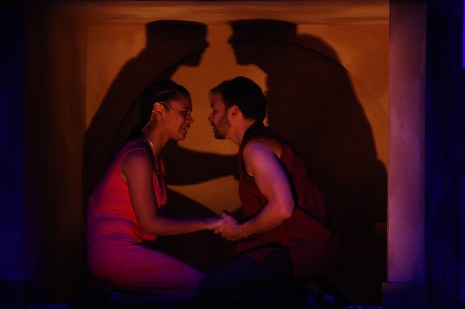
Diaz never gets a shot at a passionate solo, so he shines brightest in “Elaborate Lives,” sharing the best of the power ballads with his darling Aïda. They sing it full out, face-to-face, no frills, near the end of Act 1, Victoria Fisher’s lighting dimming around them to augment the drama. Maya Sistruck does nearly the whole evening as Aïda with a simple resolute dignity, allowing herself the luxury of discernable facial expressions only at peak moments when she is romantically consumed or royally pissed.

Other than taking radical precautions not to reveal her royal origins, I’m not sure what justifies Hutchison’s humble sackcloth design for a captive princess. We do upgrade to red in the palace, but why Amneris would tolerate such a plainly dressed servant is still baffling. Yet the illogic does pay off in an enduring dramatic contrast, first in the climactic tête-à-tête duet before intermission and shortly afterwards in the “Step Too Far” trio, the most self-consciously operatic moment in the John-Rice score.

Aïda is simply better and purer than these Egyptians are – not Memphis or Nashville at all! – and just knowing her ultimately makes them better and purer.

While Josh Webb’s set design is no more impressive than the costumes or the choreography, budgetary constraints may have been holding him back. The cut-rate budget and the lackluster score might obscure the fact that the excellence of the cast runs deep. Aside from most of the dancers, Howl Cooper makes the only inauspicious debut as Amonasro, though he definitely has a warrior’s demeanor.

Jason Hickerson makes a wonderfully scruffy Pharaoh, a Charlotte debut only slightly eclipsed by Carlos Jimenez’s usefully cheerful depiction of Mereb, the perfect Disney servant. Implausibly, Mereb draws more solo spotlight than Radamès, yet Jimenez is decisively upstaged among the supporting players by the steely-voiced Paul Leopard, fulminating melodramatically as the murderous, conniving Zoser.

Thank heaven for vampires, witches, and pagans. Otherwise, there would be no class of people left for all of us to wholeheartedly hate.

Fire, Fury, and Painful Memories Drive Wilson’s “Jitney”

Review: Jitney


By Perry Tannenbaum

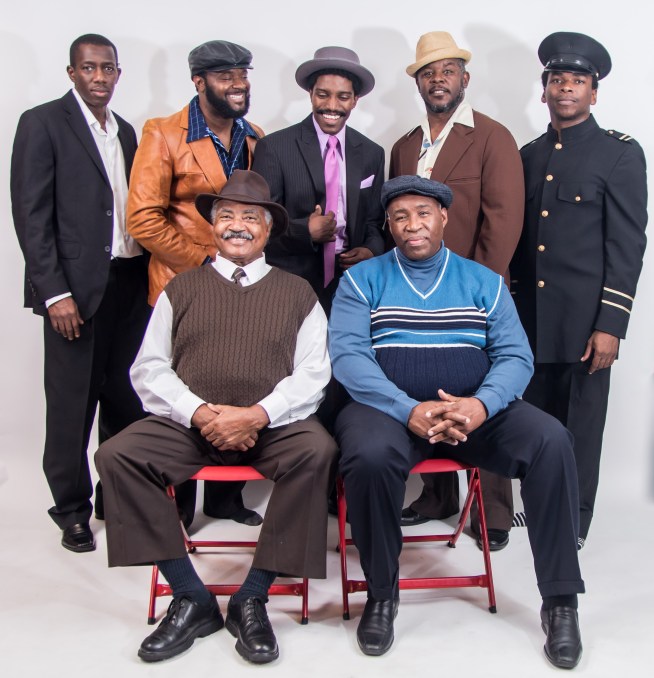
Allowing for inflation and cost-of-living increases since 1977, fares at Becker’s Car Service seem to be fiercely competitive – so competitive that the five cab drivers at the core of August Wilson’s Jitney all seem to be barely scraping by. The drivers’ lounge, adorned with a decaying Ali-Frazier poster, has a ramshackle look to it with a dust-colored couch held together by generous swaths of duct tape.

We never see whether the drivers’ jitneys (slang for gypsy cabs) are in any better repair than this crumbling HQ, but the idea seeps in that the struggling black customers in the Hill district of Pittsburgh are in no position to press the point. Early on in this fine BNS Productions effort at Spirit Square, director Corlis Hayes pushes the pace hard enough for us to assume that we’re in the midst of an urban rush hour.

These are men in a hurry – who aren’t necessarily getting anywhere. Pretty much the same can be said for Wilson’s story until Becker himself arrives. He takes off a fedora hat and lays down a satchel, signs that he’s better off than his employees, but he takes turns answering the phone – a pay phone – and giving rides. Still not rushing his story along in his flurry of driver entrances and exits, Wilson has Becker announcing two key strands of the plot.

After keeping it from his drivers a little longer than he should, Becker tells Doub, his steadiest driver, that the city has earmarked the property for urban renewal. The Car Service office will be boarded up in a matter of weeks. If that weren’t enough upheaval, Becker’s son Booster is getting out of the slammer after serving 20 years for murder. Becker never visited his son even once during his incarceration, so this does not figure to be a joyous reunion.

If you’ve seen Wilson’s Fences recently, you will likely find echoes of Troy Maxson in the elder Becker’s sternness and stubbornness. If anything, the father-son chemistry will prove even more important here. But Becker is more of a people person, as he would need to be in running a business, and he has a few soft spots beneath his tough hide.

We see one of those when he gives Fielding, a former tailor who has destroyed himself with drink, yet one more chance to come back on the job and straighten himself out. Becker also shows strength and courage defusing a heated confrontation between Vietnam War vet Youngblood and the gossipy Turnbo, who has meddled in the younger driver’s domestic affairs, frustrated at not stealing his girlfriend Rena.

There’s a fascinating range of personalities and back stories among the core quintet of drivers plus the boss’s son. Baring their souls – and their motives – everybody seems to get a monologue. Nor do Hayes and lighting designer Tony Wright veil the kinship between these monologues and long, lyrical jazz solos. Hayes usually directs her actors to blow their solos straight into the Duke Energy Theater audience, while Wright intensifies the light where they deliver.

During the passionate showdown between Youngblood and Rena, where both have been right and wrong, each of the combatants has a heartfelt monologue. Yet Wilson had even more pure audacity in a casual scene where the often-comical Fielding meets the tightly-wound Booster. The playwright brashly showcases his virtuosity by unleashing two consecutive monologues, one by the rueful Fielding recalling his better days when he tailored suits for Billy Eckstein and Count Basie, followed by Booster’s recollection of his first hard lesson in life when, as a child, he had a vivid dream about riding a red bicycle.

With so many monologues so evenly distributed, you need a cast that’s strong, deep and – when Wilson digresses – engaging. Hayes and producer Rory D. Sheriff have definitely produced with this ensemble. Though he isn’t given free enough rein in the opening scene as Fielding (we should be sure that the $4 he borrows from Doub will go toward refilling his whisky flask), Gerard Hazleton shoulders enough of the drunkard’s comedy without letting us lose our warm feelings toward him.

There’s a little more comedy squeezed from the gossipy Turnbo by Tim Bradley, probably because his sleaziness and nosiness are so outrageous, but he also forces us to take him seriously when he goes ballistic on Youngblood. More on the periphery, James Lee Walker II gives the local numbers runner, Shealy, a dandified flair though we still empathize with his romantic difficulties. On the other end of the cunning spectrum, Danius Jones makes Philmore a singularly quirky and clueless passenger, attaining full dopiness only when he returns in his bellhop uniform.

Partly because they subtly echo the central father-son relationship, Doub and Youngblood are closer to the heart of Wilson’s drama than the men who garnish it with comedy or the colorful aspects of city life. Both of them are war vets, but Youngblood – if not as senseless as Turnbo makes him out to be – has been slightly warped by his Vietnam experience. Doub, traumatized and shaken to his core in the Korean War, has retained a stone-cold outlook beneath his cheery, avuncular demeanor.

With Keith Logan delivering Doub’s Korea monologue, it becomes the warmest moment of the evening, transcending its payload of advice for Youngblood. In its tacit acknowledgement of Youngblood’s essential goodness – and his confidence in Youngblood’s ability to benefit from sound advice – he’s a perfect model of the parenting skills that Becker lacks. Ironically, there are times when Logan’s acting is similarly exemplary for Jonathan Caldwell. While Caldwell brilliantly projects Youngblood’s immaturity and confusion, he could use a tip or two on either quickening his cue pickup or timing his delayed reactions.

Caldwell’s occasional awkwardness may slightly mar Youngblood’s scenes with Doub and Turnbo, but it meshes very well with Juanita Green in the confrontations with Rena. Hayes decrees a more conciliatory rapport between the lovers when we last see them than you might find in other productions, but Green keeps this becalmed closure from becoming saccharine.

Although Becker isn’t quite the perfect boss, he deals empathetically with his drivers, so there needs to be a powerful reason why he is so cold and cruel toward his son. John W. Price provides it indelibly in the most electrifying monologue of the night. The fire and thunder from Price as he’s excoriating Booster are unlike anything I’ve seen or heard from him before, fueled by white-hot fury and pain.

It’s an earthquake, and you can see Jermaine Gamble as Booster trembling amid the seismic shock. We get the idea from Gamble that Becker’s boy has grown up, hardened by prison, a fully formed yet scarred individual. Booster does fire back at his dad, but Gamble acutely calibrates the restraint and the hope that are wrapped into his resentments, almost like he’s still an adolescent in his father’s presence. It’s simply respect – all the more moving for its futility.

Within the space of two weeks, we’ve heard from two playwrights, Jeff Talbott in The Submission and August Wilson in Jitney, who have ignited their peak moments with the N-word. This one is far more unexpected – and shattering.

Calouche and Crossroads Take Flight Outdoors

PeterZay151023CC-806_wide_trees

Preview: Crossroads Festival

By Perry Tannenbaum

A new dance festival is leaping into the QC, touching down at First Ward Park for the Labor Day weekend, September 1-3. Pretty interesting idea, right? But the new Crossroads Festival isn’t merely an outdoor dance festival. It’s free, it features aerial dance classes and performances, and the main event starts just after sundown.

Now that’s pretty wild.

Caroline Calouche has been the queen of aerial dance in Charlotte for more than a decade. Her usual haunts have been Booth Playhouse; where Caroline Calouche & Co. offers its annual Clara’s Trip, an aerial Nutcracker; and Spirit Square, where she organizes a festival in early spring.

So what lured Calouche to the great outdoors?

“I was inspired by many great outdoor shows like Boston’s Shakespeare in the Park and Montreal’s Annual Circus Festival,” Calouche says. “Creating an outdoor show for the Charlotte community that reflects who we are has been a dream of mine for quite some time. Thankfully, the Knight Foundation helped make this dream come true.”

Though there are precedents in San Francisco, Boulder, and Victoria, bringing aerial dance outdoors – along with the Cirque du Soleil flavorings Calouche sprinkles into her choreography – is a fairly unique undertaking. Even Cirque doesn’t go all the way, opting for a bigtop on its famous tours.

“I did look into a circus tent so we can have the show rain or shine, but – whew! – that was crazy expensive!” Calouche confides. “Plus I would like the performance to take place under the stars with Uptown Charlotte as the backdrop to connect more to the location.”

Connecting with Charlotte was clearly a major factor in Calouche & Co.’s winning support from the Knight Foundation. Buy-in from Charlotte Center City Partners was also key before moving on to Mecklenburg Parks and Recreation to secure the festival’s location. Calouche’s Crossroads concept digs deep into Charlotte’s historical DNA.

Long before Charlotte became the crossroads for America’s most corrupt megabanks, it was a crossroads of commerce. If the Cherokee or Chippewa had named our city instead of the British, that name would likely mean crossroads. While the Uptown’s main crossroad is on Trade Street, Calouche’s event and choreography will remind us how Charlotte has also evolved into a crossroads for culture as well.

Each of the festival’s three days will begin with a potpourri of free dance and fitness classes. You can browse the online schedule and choose from hour-long sessions in samba, salsa, tap, hip-hop, capoeira, or aerial silks. Fitness freaks can contort themselves into the yoga and Pilates they truly deserve.

At 6pm, the pre-shows begin, also with various lineups of performers each evening. Constants in the lineup will be the MILA Dance Team, Mrudani School of Performing Arts, and the CC&Co. Youth Ensemble. If you’re itching for the NC Brazilian Arts Project, No Limits Dance Company, Hope of Israel, Maha’s Dances of IndiaHope of Israel, MufukaWorks Dance Company, or the Jazz Arts Initiative TrioMufukaWorks Dance Company,, consult the same handy webpage to see who’s up Friday, Saturday, and Sunday.

All of those evenings will conclude with Crossroads, starting at 8pm. Yes, it’s also free, and Calouche promises that there will be no letup in variety when she and her company take to the air. On the contrary:

“The show includes contemporary dance, breakdancing, tap, zapeando, shag, capoeira, aerial silks, trapeze, bungee, partner acrobatics, aerial rope, Cyr wheel, and aerial hoop,” Calouche reveals. “My artistic idea is to either cross history with dance and/or circus arts or cross cultural dances that are represented in Charlotte’s community today. Crossroads is designed as an event for unity and the opportunity for people to learn about Charlotte’s history and culture.”

Guest unifiers will include artists from an exciting mix of disciplines, including actress Iesha Hoffman, percussionist Tim Scott, and slam poet extraordinaire Boris “Bluz” Rogers. Hoffman will narrate, knitting the various segments together and maybe providing cover during aerial apparatus changes.

Scott will be featured during the segment where tap meets zapeando dance and during what promises to be a wild breakdance battle on aerial rope. Rogers takes Calouche’s unifying fantasia to a whole new dimension with an original poem inspired by a great unifier, Thaddeus Tate. During Rogers’ spot, he’ll connect with the entire Crossroads cast on the floor.

Tate was an African American leader in Charlotte from the 1880’s to the 1940’s. Instrumental in establishing a library branch, an insurance company, and the Grace A.M.E. Zion Church – while rubbing elbows with the Uptown elite as owner of the Uptown Barber Shop – Tate is particularly pertinent because he resided on the block that is now First Ward Park. So Rogers’ tribute will definitely strike home.

With its unifying and educational components, Calouche tells us to expect a casual atmosphere rather than a carnival one, more like Symphony in the Park or Shakespeare on the Green than Speedweeks. There definitely will be food trucks, and D9 Brewery will be on the scene to help keep beer bellies properly bloated.

Like Clara’s Trip, which tends to shuffle its Nutcracker mix from year to year, Calouche expects to vary the content of Crossroads each time the festival rolls around. It’s not just a title – it’s a theme.Dominique jump color Michael Church

“Crossroads is the name of the event, and the theme will remain the same,” Calouche explains. “There might be some scenes that stay the same, but there is still more research I can do and other collaborators I would love to work with.”

Aerial dance is difficult enough to stage indoors, requiring a fly loft (ordinarily used to drop scenery from above) that’s sturdy enough to suspend up to four dancers on a dangling apparatus. Don’t try this at home. Or at Theatre Charlotte or Pease Auditorium.

So how exactly do you stage aerial dance outdoors? It sounds like CC&Co. will borrow from the big top concept and strip away the canvas.

“JHE is our production company who is building our stage, trussing, audio and lights,” Calouche says. “The stage will two feet from the ground on the grass near the 7th Street side of the park with four legs of truss crossing in the center at 25 feet high. Essentially we are building a theater in the round outside.”

Visualize a one-ring circus where 20 dancers, circus artists, musicians, and poets will perform under the stars – if the weather holds. So what happens if it rains?

“We wait it out and start when it passes,” Calouche replies.

Come to think of it, when most of your dancing is up in the air, you really don’t have to worry as much when the dance floor gets slick.

Playwright Imposter Goes Off-Script in “The Submission”

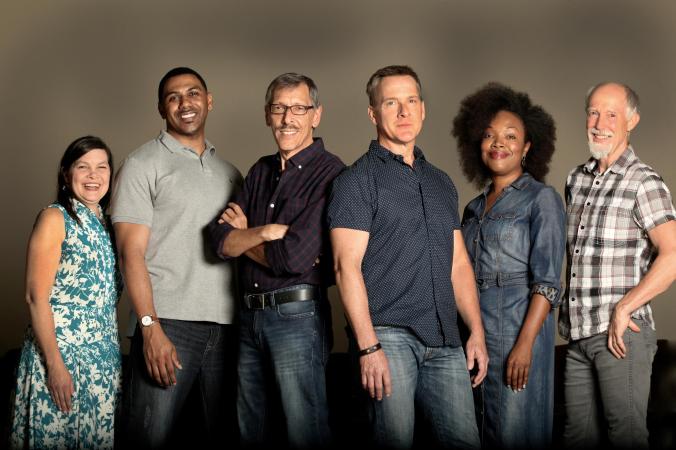
Group1_HiRes

Review: The Submission

By Perry Tannenbaum

A gay white playwright and a black actress walk into a bar… Not a promising lead-in to a joke, because nothing funny or violent should happen. Writers who pen scripts about racists or homophobes for theatre, film, and TV usually draw a free pass when we ask ourselves if they might be harboring prejudices of their own. Same with the actors who appear in such productions. Surely they are as progressive and tolerant as the authors who create their roles.

Maybe more progressive and tolerant than we are.

In Jeff Talbott’s The Submission, currently at Spirit Square in a Three Bone Theatre presentation, we can trash those presumptions – under circumstances that would ordinarily strengthen them. Talbott’s protagonist, white gay playwright Danny Larsen, has written a drama about a black alcoholic mom, her cardsharping son, and their struggles to escape the projects. Takes some empathy to do that, right?

Danny has never had a play of his produced before, but he thinks this one might be special. His best friend Trevor agrees, so Danny submits his street saga to the prestigious Humana Festival, hoping that he will be among the elite few whose work will be premiered at the annual New Play Festival in Louisville. But to make sure his whiteness doesn’t become an obstacle in recognizing the merits of a play with black leads, he invents the African name of Shaleeha G’ntamobi to become its author.

When Humana phones to tell Danny that his script has been selected for the New Play Festival, he could own up to his subterfuge right then. But – reasonably or not – Danny is afraid that the prize will be withdrawn of he comes clean. So he temporizes, saying the playwright isn’t at home, and hurries out to hire an actress to impersonate Shaleeha.

It takes a few moments before the chosen actress, Emilie, can grasp Danny’s intentions – and for Danny to convince her that there’s no kinkiness involved. Wile Danny has demonstrated considerable empathy toward black people, Emilie is honestly impressed with the play, despite the playwright’s fears that he has trespassed onto forbidden territory. Plenty of goodwill on both sides.

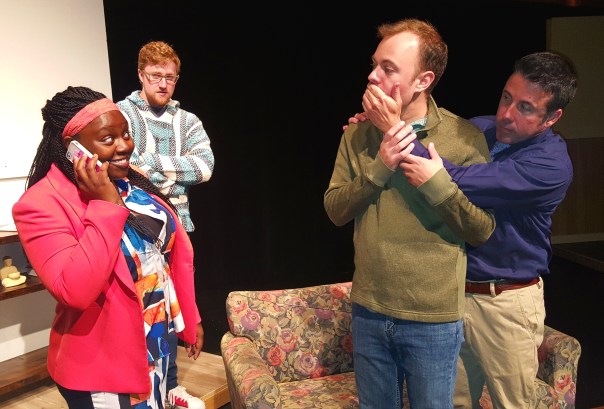
Yet things go badly after the first meeting. Danny has a number of personal insecurities, more than a little buyer’s remorse, but worst of all, casual prejudices against black artists that he hasn’t faced up to. They begin to pour out during a second meeting – at a coffee shop, not a bar – when Danny refers to black actors as “blactors” and the awards they win as “blawards.” The unsavoriness of that viewpoint is compounded for me by the signals I get from Danny that feels entitled to speak his mind so brusquely because he’s Emilie’s employer.

Emilie doesn’t listen to these slurs passively – unless you construe a response like “You’re so full of shit your eyes are brown” as deferential. What began as a mutually beneficial relationship has already degraded into an uneasy détente. As the pre-production process unfolds in Louisville, with Danny missing out on all the little perks of close contact and communication with the big-name artists converging on the festival, Danny’s resentments and jealousies heat up and his attitude toward Emilie becomes more toxic. Dropping the director’s nickname can set him off.

No doubt about it, the balance of my sympathies went out to Emilie as she kept drawing Danny’s scorn for merely doing what he hired her for. Even when some of Emilie’s anti-gay attitudes surfaced, things didn’t even out for me, because some rational thought verifiable observation was actually mixed in with her resentment – and because Danny goes nuclear in their final verbal faceoff.

If you can see this explosion coming, the venomous crossfire may feel a wee bit overlong, and I was not very convinced by the way Talbott has Danny handling the aftermath of his festival acclaim. But director Sidney Horton keeps the action as taut as possible, and Scott A. Miller keeps us fascinated with each new slimy twist of Danny’s personality. We can believe that the same insecurities inside Danny that produce such aberrant attitudes might also produce great art.

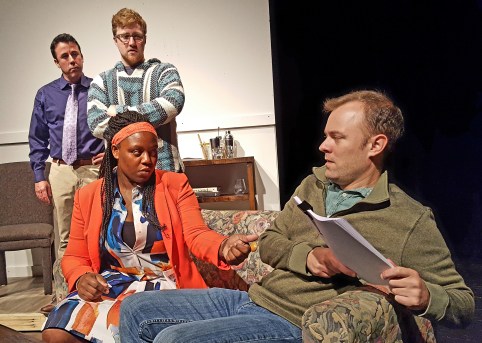
On the other hand, Talbott has incorporated some entertaining – and dramatic – complexities into Emilie. In her Charlotte debut, Lechetze D. Lewis captures all that’s engaging and spontaneous about Emilie and all that’s strong. Not only does she deliver a groupie’s euphoria while she’s mingling with theatre royalty, she adds an extra dollop of giddiness as romance blossoms between her and Trevor. You don’t really marvel that a free spirit like this would go off-script when she’s supposed to read Danny’s acceptance speech.

But is she more cunning and All-About-Eve than she first appears? That’s a big question Talbott keeps nicely float, helped by Lewis’s pugnacity.

Trevor is caught in the middle of the crossfire as he becomes more seriously involved with Emilie. He’s somebody who readily grasps Danny’s blind spots, and Daniel Henry perfectly calibrates his weakness as a right-minded peacemaker – so I completely bought his allowing himself to be told to shut up while the main battle raged.

I’m not sure that Talbott didn’t intend Pete, Danny’s CPA-like partner, to be more of a clueless hunk. Yet Horton’s somewhat outré casting choice, Dan Grogan, keeps things very real during the marital infighting. Though Pete remains a needless appendage in the plot, he’s a stuffy outsider who makes our badly behaving protagonists seem more palatable. There’s an intentional poetic justice when Grogan’s best moment happens while he’s offstage. He’s that untheatrical.

Talbott is appealing with his self-regarding cleverness, particularly when Danny’s play mirrors his own. But more often, he seems intent on wearing the David Mamet mantle for faithfully transcribing Generation X. Sentences from these 28-year-olds repeatedly proceed after multiple false starts and loose fragments, often getting tangled in multiple detours before reaching a period – particularly when Miller deftly navigates as Danny. Every person onstage, especially the artists, seems compelled to drop at least two f-bombs with every breath.

Peppered with fucks and the occasional shit, the dialogue at Duke Energy Theatre doesn’t shock me so much as irritate me as The Submission barrels along. If this tedium and annoying effect are the crux of Talbott’s point, he’s making it too obliquely. And if he’s trying to assert that effing Gen-Xers really effing talk this way, I do not effing agree.

But selfies of a hot actress’s boobs messaged to her boyfriend? In the age of Anthony Weiner (and Snapchat), I wouldn’t be shocked to learn it’s happening right now.

A Farce That Turns Fierce

Preview :  Three Bone Theatre’s The Submission

By Perry Tannenbaum

We’re right to be suspicious of leaders who loudly spout their righteous certitudes. Thoughtful people know that moral rectitude, ethnic traditions, civil liberties, and political correctness can often crisscross into bewildering tangles and conundrums.

Sidney Horton, who is directing Three Bone Theatre’s The Submission, puts it more bluntly: “We all are clumsy when we deal with race and sexual orientation.”

Opening at Spirit Square this Thursday, Jeff Talbott’s comedy drama goes one better than holding up a mirror to our clumsiness. The playwright turns his mirror back around from his audience and shows that the same clumsiness – and assorted prejudices – also afflict theatre artists.

Talbott’s protagonist, Danny Larsen, has written a play about an African American mother and her cardsharping son striving to escape the projects to build a better life. Trouble is, Danny is white, which could seriously hurt his chances of getting produced at the prestigious Humana Theatre Festival, where he submits his manuscript. At an ill-advised moment, Danny decides to overcome this liability by submitting his playscript under the very African name of Shaleeha G’ntamobi.

Getting selected for the festival compounds Danny’s woes, because he can’t come clean about his true race and gender. Instead, he decides to hire a black actress to bring Shaleeha to life. But Danny is in for a lot more blowback than he bargains for: Emilie isn’t buying Danny’s premise that, just because he’s gay, he can understand the challenges of growing up black in America.

Horton’s choice to play Danny isn’t exactly surprising. Tackling Talbott’s playwright, Scott Miller is playing his second writer in the past four months after his role as Trigorin in Stupid F@#%ing Bird, an Anton Chekhov knockoff staged by Actor’s Theatre. It’s also déjà vu for Miller with Three Bone at Duke Energy Theater, where he was Martin, the most promising writing student in the acerbic Seminar last August.

“Trigorin in Stupid F@#%ing Bird was a joy to play because he’s one of those characters that knows how sleazy he is and revels in it,” Miller says. “Danny is the most troubling to play, and the most challenging in many regards. He justifies his prejudices and thinks his self-appointed victimhood gives him license to do more-or-less whatever he wants.”

Standing up to such insidious entitlement is a formidable task, and Horton has made a bold choice in casting his Emilie. After returning to the Carolinas from Emerson College in Boston, where she earned a graduate degree in publishing, Lechetze D. Lewis has circled the QC in three previous outings – two in Concord, one in Mooresville – but her role in The Submission will mark her Charlotte debut.

“Lechetze had a fire about her in auditions,” Horton recalls. “I knew I had to have someone strong that could more than hold her own against Scott. I took a chance with Lechetze, and boy did it pay off.”

Needing to ensure that all four of his cast members felt comfortable with one another at rehearsals, Horton made sure there was plenty of discussion about the issues that Talbott’s script addresses. Yes, there were disagreements as the cast talked things out, but professionalism has prevailed.

“The play deals with LGBT rights, racism, discrimination, affirmative action, non-traditional casting and who has the right to say or do things when it comes to someone else’s identity or culture,” Horton declares. “All of these issues are pretty hot right now in America – we are more divided now that we have been in recent years. The thing that strikes me most, and one of the main reasons I wanted to do this play, is it deals with these issues in the arts community. We as artists like to think of ourselves as being all-accepting and non-judgmental. Are we really?”

With such questions floating in the air, rehearsals can be stressful. In the heat of the moment, hurtful comments hurled in your face by a fellow actor addressing your fictional character can still hurt. Identifying with Emilie as a black artist, as Lewis must, she can hardly be invulnerable when the conflict with Danny has so much relevance to her daily life and self-image.

“Something that really gets to me is his idea that black actors who win awards don’t deserve to win what was created for whites,” Lewis says. “As an artist, I hope that any awards I receive will be acknowledged as something that my hard work has earned… but Danny doesn’t see it that way. Scott is an amazing actor to work with and he definitely doesn’t hold these views, but he’s talented enough to make those words sting. I am so lucky to be working with an actor who takes the time to check in on how we’re both feeling and if we’re okay to move forward.”

Horton has also been helpful for Lewis, frequently reminding her that she does win in the end. Conversations with Miller and the other two cast members, Dan Grogan and Daniel Henry, about how the script has affected them personally have been doubly beneficial for Lewis – not only soothing her emotions but helping her to shape her performance.

Of course, Emilie also dishes out a harsh word or two.

“I will admit to having a bit of fear regarding how she’ll be perceived,” Lewis confides, “because so much of what she says is hypocritical. But it doesn’t mean that, in some aspects, she’s completely wrong.”

Horton has another succinct comment about the intensity of the crossfire in The Submission: “Thank God for the comedy in this show – it makes it palatable.”

Talbott doesn’t turn on the heat immediately. There’s a certain point, says Miller, when the tone begins to change. Even then, there’s a gradual crescendo leading up to the inevitable fireworks between Danny and Emilie. Along the way, we realize that Talbott’s farcical plotline isn’t going to play out strictly for laughs.

At the same time, the playwright is turning his telltale mirror toward us. There will likely be a recoil factor when we recognize ourselves.

“While watching The Submission,” Miller cautions, “many people will agree with some of the controversial things the characters say. I predict several lines will get a chuckle before the audience realizes the inappropriateness of the character’s comment. The play is not out to condemn or chastise anyone in the audience. But I think – or hope – it will make many think about their implicit and explicit biases.”


ShakesCar Puts Women Behind “The Iron Mask”

Review:  The Man in the Iron Mask

By:  Perry Tannenbaum

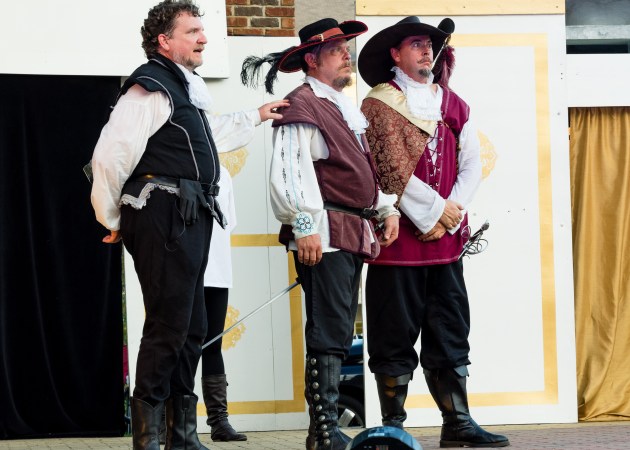
Hand it to Shakespeare Carolina and Amy Schiede. Producing their own adaptation of Alexandre Dumas’s The Man in the Iron Mask outdoors at the Winthrop University Amphitheatre, they haven’t stinted on the swordplay or the fighting. Even though two of the major swashbuckling roles – identical twins who take turns ruling France as Louis XIV – have been handed over to women (including Schiede herself), the hostile action sustains a high standard.

Better yet, in choosing the final installment of the epic Three Musketeers saga, they’ve also maximized the drama and the suspense. Some of our heroes didn’t survive when Dumas closed the book on Aramis, Porthos, Athos, and D’Artagnan. Like the film and TV series before it, Schiede’s adaptation takes a free-range approach in incorporating plot points, assigning actions to various characters, and determining their fates. Perhaps the most suspenseful element is Schiede’s choice of which identical twin, Louis or Phillipe, ultimately sits on the throne.

The 1937 Hollywood version had it differently than the novel, serialized between 1847 and 1850.

There’s no hurry in unveiling Aramis’s plot to unseat King Louis as he brings Athos to a tailor to be measured for evening attire worthy of a reception that superintendent of finances Fouquet is hosting at his home for the conceited monarch. Aramis will need both Athos and Porthos to help free Phillipe from the Bastille, where he has been imprisoned since birth, unaware of his own royal origins. But we won’t learn the motives for Aramis’s machinations until much later. Needless to say, only lofty ambitions would justify such risk.

Fellow musketeers, Athos and Porthos don’t question Aramis closely at the outset, After all, didn’t they originate the famous gung-ho “All for one, and one for all!” slogan? But Aramis is sly enough not to divulge his scheme to D’Artagnan, who is fiercely loyal to the king despite reservations about Louis’s character. So with finance minister Colbert intriguing against Fouquet, D’Artagnan protecting Louis, and Phillipe totally ignorant about all that reigning as the king of France entails, there is plenty of suspense surrounding the success of the three musketeers’ plot.

Obviously, the perils won’t be over if Phillipe is secreted onto the throne.

With straight-arrow D’Artagnan on the royalist side of the conflict, you might experience some ambivalence about whom to root for as the moon rises over this production. David Hensley is rather starchy and subdued as D’Artagnan at the outset, making it easier for us to lean toward Aramis and Philippe, but Hensley does perk up when his king imperils his pals.

Tom Ollis makes sure that we see Aramis as more rascally and duplicitous than noble, but Schiede epitomizes naïveté and nonchalant regality as Philippe. She is surely the more righteous and beneficent claimant to the throne, especially since Katie Bearden revels in Louis’s arrogance, even when the monarch is cast into the Bastille and encased in the iron mask.

Charles Holmes directs at a near-galloping pace, which accounted for some bobbled lines on opening night and some audibility dropouts, particularly from a couple of the women. Nobody will find Holmes’s set designs particularly lavish when Louis holds court, nor do we descend into dim dreariness when we shift to the Bastille. Yet I liked the overall concept, placing the kings’ dungeon up a flight of stairs and above the action rather than below or in a dingy corner. Homage is paid to the idea that royals are imprisoned in towers awaiting their fates – and angelic Phillipe’s early monologue about being content with the daily sight of the skies plays better there.

Holmes also lurks onstage as Athos, sufficiently lighthearted to be carried along in the perilous drift of the musketeers’ plot, yet tender enough to be broken by the death of his son. David Hayes is even more rightfully cast as Porthos, the Ajax among the musketeers. Unfortunately, the prop fashioned for him at a climactic moment – the barrel of dynamite that he hurls into a tunnel – doesn’t sufficiently emphasize his preternatural strength.

A richer script from Schiede would have given Chris O’Neill more to work with in evoking Fouquet’s corrupt tendencies, but that opens the door for Gina Belmont to come off all the more wicked as his rival, Colbert. More detail might have helped us determine whether Anne, the queen mother, was duped by Colbert or strategically taking his side. Amy Hillard is so icily imperious as Anne that she’s also mysterious. Watch her faint when she sees the two twins standing in front of her for the first time. You’ll never know whether she’s shocked to learn she has two sons – or shocked to find that her evil plot against one of them has failed.

Gaillard Grandeur and Dock Street Informality Shape a New Spoleto

Review: Spoleto Festival USA – 2017

By Perry Tannenbaum

For the past two years at Spoleto Festival USA, opera has been the bellwether of how this massive festiv

al of the performing arts – including theatre, jazz, dance, symphonic and chamber music – has been changing and evolving. In 2015, opera programming untethered itself from its customary balance of new works with outré offerings from recognized masters. The tandem of Paradise Interrupted in its world premiere and Veremonda in its American debut underscored the transformation of Spoleto into the world’s leading showcase for new and/or different classical music.

Last year, what seemed like a move toward more populist programming, with Porgy and Bess as the marquee opera and an increased presence of American jazz artists, did not affect a continuing drift toward more modernist music. What the Porgy and Bess celebration of the festival’s 40th season really signaled was that, with the radical facelift to the reopened Gaillard Center, truly grand productions of grand operas were now possible in Charleston, SC.

Even before the Gaillard closed down for its makeover after the 2012 season, it was clear that, from a technical standpoint, only lackluster stagings could be expected there. Gustave Charpentier’s Louise had been the last operatic attempt in 2009. During the renovations, you could be charmed by Spoleto’s productions of Kát’a Kabanová and Le Villi at Sottile Theatre, but you could hardly pretend they were on a grand scale.

With this year’s presentation of Tchaikovsky’s Eugene Onegin, grand lyric opera was emphatically enthroned at the festival, although I suspect there were budgetary constraints in the wake of last year’s anniversary extravagances. Now that might not explain why there was no bed, no window, and no writing desk – all mentioned in the libretto – for Tatyana’s famed letter scene. Why would stage director Chen Shi-Zheng’s austerity extend to depriving the poor woman of pen and paper until after she has finished writing?

Suspicions came unbidden when, after a snowbound video of a Russian forest ran over the overture, spindly trunks of wintry trees descended from the fly lofts and haunted nearly the entire production. The concept didn’t jibe with arrival of the family estate’s peasants heralding their completion of the harvest. More puzzling, the lovely trees were whisked to the wings prior to the scene where they might make the most sense, the duel between Onegin and the hotheaded poet Lensky.

Projections that replaced the trees for the duel and for the ultimate denouement, where he receives his richly deserved rejection from Tatyana, were actually darkly effective. But the best use of set designer Christopher Barreca’s trees came when, half-lifted into the flies and colorfully illuminated, they simulated chandeliers at the regal ball in Prince Gremin’s palace, where Onegin is thunderstruck by the transformation of Tatyana into a poised and polished aristocrat.

Whatever toll austerity might have taken on the scenery, it was not a factor in the singing. Taxed with delivering the letter scene with no props except a chair (those lingering tree trunks did fill up momentarily with projections of Tatyana’s handwriting), soprano Natalia Pavolova glowed with youthful longing in her American debut. She was hardly less impressive as a mature princess, bearing herself imperially in the ballroom, and her creamy voice thickened pleasingly with emotion in the final tête-à-tête with Onegin. Lacking the hauteur I saw from Dmitri Hvorostovsky when I saw him in the role opposite Renee Fleming, baritone Franco Pomponi was less of a cold-hearted jerk when Onegin rejected Tatyana and killed Lensky – and more pitiable when he comprehended his mistakes.

Solid as he was vocally, Pomponi was thoroughly upstaged by tenor Jamez McCorkle as Lensky. The pride and pathos that McCorkle brought to Lensky’s final pre-duel meditations were shattering. Nearly as touching – and as vocally powerful – baritone Peter Volpe’s weighty, twilit confessions to Onegin as Prince Gremin were the perfect prelude to the cad’s comeuppance.

Acoustics at the new 1,800-seat facility helped to keep the front-liners relaxed, unless they had the misfortune of singing from the rear half of the stage, which introduced a noticeable echo effect. Clarity and presence improve markedly for the Spoleto Festival USA Orchestra when it ascends from the pit to the stage, where it is wrapped in a tall, wood-grained shell and covered by a sloped and sculpted acoustic ceiling.

With the addition of the Westminster Choir conducted by Joe Miller, the worthy heir to Joseph Flummerfelt, orchestral concerts have also grown grander in recent years. Ramping up to the return of the Gaillard, Miller and the Westminsters presented the St. Matthew Passion at the Sottile in 2015 before helping to break in the new hall last year with Beethoven’s Mass in C and his Choral Fantasy. Once again mixing the sacred with the secular at the Gaillard, Miller programmed Mozart’s unfinished “Great” Mass in C Minor, preceded by two Ralph Vaughan Williams settings, one for Psalm 90 (“Lord, Thou Hast Been Our Refuge” and the other from the moonlit Act 5 love scene that punctuates the hurly-burly of Shakespeare’s Merchant of Venice (“Serenade to Music”).

Augmented by the Charleston Symphony Orchestra, the Westminster Choir sounded massive and sure, and the Festival Orchestra, culled from advanced conservatory students and young professionals through nationwide auditions, still strikes me as the best American orchestra of its kind. The bigger sound of the choir made the “Lord, Thou Hast Been Our Refuge” more soothing and cosmic, building to a majestic finish. An exquisite dialogue between orchestra and vocalists followed in the Shakespeare setting, as six of the Westminster choristers then came downstage and formed a mini-choir, joining the four guest artists who would sing in the Mozart.

It was gratifying to see McCorkle again after his fine Lensky, but once again, he didn’t draw a leading role in the Mass after shining briefly in the “Serenade.” Mozart began this liturgical piece as a showcase for his wife, Constanza, and soprano Sherezade Panthaki shone in much of the coloratura spotlight that he managed to finish, especially when powering the climax of the Credo. Soprano Clara Rottsolk ably complemented Panthaki in the Gloria, and bass André Courville rounded out the quartet of soloists in the concluding Benedictus.

Of course, there was nothing miniscule about the other orchestral concert, beginning with Anna Thorvaldsdottir’s icily atmospheric Dreaming and climaxing with Mahler’s Symphony No. 4. Following up brilliantly on her lustrous 2013 debut in the title role of Matsukaze, soprano Pureum Jo filled the folksy jollity of the Sehr behaglich (“Very comfortable”) finale with a heavenly purity.

Yet I found myself even more encouraged and excited by what’s happening in the chamber music sector of the festival. For the first time since taking over the reins of the daily chamber music series in 2010, violinist Geoff Nuttall had to acknowledge the absence of his mentor and predecessor, Charles Wadsworth, on the mend up in New York. As host and programmer of the lunchtime Dock Street Theatre concerts, Nuttall has come into his own, greatly increasing the amount of modern and contemporary music that is played while chipping away at the barrier that previously distinguished the genial, comical, and witty introductions to the music from the formality of the performances that followed.

There’s likely a connection between the two developments. When a percussionist provides the entire audience with pairs of rocks to bang together during a performance of new music, or a composer triggers video and sound cues with an iPhone, formality begins to break down. The effect spread to more antique music when countertenor Anthony Roth Costanzo called attention to the kinship between a Vivaldi aria and Elvis Presley’s “Don’t Be Cruel.”

Performances have sprouted a jocular dimension here and there, thanks to the deployment of clarinetist Todd Palmer as comedian-in-chief. After Nuttall spoke vividly of Giovanni Bottesini’s virtuosic displays on double bass during operas that he conducted in the mid-1800’s, appearing mid-performance to dazzle with improvised fantasias on tunes from that evening’s opera, Palmer joined double bassist Anthony Manzo and pianist Gilles Vonsattel in Bottesini’s Duetto for Clarinet and Double Bass with Piano. Between two of the fantasias, Palmer did a riff of his own on the diva aspects of the spoken intro, flashing some leg and modeling a sock that was more flamboyant than any I’ve seen on even Nuttall’s feet.

There was more later as Nuttall and his St. Lawrence String Quartet joined Manzo, flutist Tara Helen O’Connor, and pianist Pedja Muzijevic in a cunning reduction of Symphony No. 100 by Haydn, our host’s favorite composer. As Nuttall explained how this “Military” Symphony came by its nickname, you had to wonder where the hellish percussive roar would come from when the second movement started. The answer came during the interval between the opening Adagio-Allegro and the signature Allegretto: emerging from the wings, Palmer marched onstage – literally marched, mind you – harnessed into a big bass marching drum and brandishing two mallets.

It was actually a military parade, since cellist Joshua Roman with a pair of cymbals and violinist Benjamin Bellman with a wee triangle marched in right behind Palmer. Earlier in the concert, right after the Bottesini, these two accomplices had given an absolutely delicious account of Ravel’s Sonata for Violin and Cello. If anything, the exit after Haydn’s second movement, led again by Palmer, was even more ceremonial. Yet there were more surprises to come. Violinist Daniel Phillips (flutist O’Connor’s husband) heralded the opening passages of the Presto finale from the balcony, and Palmer’s percussion trio resurfaced at the rear of the hall to pound, clang, and clink the final measures.

Musically, Palmer’s shining moments came three programs earlier when he played the Beethoven Clarinet Trio with Muzijevic and Roman, while the best of Nuttall came when he led an inspired performance of the Mendelssohn Octet. Some of the inspiration no doubt came from the meet-up between Nuttall’s St. Lawrence Quartet and his newest Spoleto recruits, the Rolston String Quartet. They won the Banff International String Quartet Competition 24 years after the elder Canadian quartet won the same prize in 1992. There were moments when Rolston cellist Jonathan Lo and violist Hezekiah Leung gazed upon Nuttall’s rapt antics – his back-and-forth swaying on the first chair and his spasmodic knee-lifts – with undisguised, wide-eyed wonder, apparently unaware that he played with the same abandon, eccentricity, and charisma when he first came to Spoleto in 1995. Except that his hair was longer then.

Effects of Nuttall’s stewardship now extend beyond the Dock Street Theatre. Two of the chamber music pianists had concerts booked at other venues. Muzijevic, who also traveled to Hamburg to select the new Steinway for the Dock Street series, fashioned a set of “Haydn Dialogues” at the Simons Center Recital Hall – four Papa pieces interspersed with works by Jonathan Berger, Morton Feldman, and (with an alternate prepared piano) John Cage. Stephen Prutsman put on his composing hat at Woolfe Street Playhouse, plucking a string quartet from the Festival Orchestra to score three silent films, “Suspense,” “The Cameraman’s Revenge,” and “Mighty Like a Moose.”

For the past two years, Nuttall has performed at Gaillard Center in chamber music segments of Spoleto Celebration Concerts, further extending his presence. He and his spouse, violinist spouse Livia Sohn formed half of a quartet, including Muzijevic and St. Lawrence cellist Christopher Costanza, in a reduced adaptation from Vivaldi’s L’estro armonico concertos. Until 2013, when oboist James Austin Smith joined his chamber music stable, Nuttall was no more likely to program Vivaldi’s music than Wadsworth was, let alone play it.

What really brought Vivaldi to centerstage at Spoleto was the sensation that countertenor Anthony Roth Costanzo created last season in his first three programs at Dock Street. Costanzo didn’t sing Vivaldi then, ranging instead from Handel to Gershwin to Osvaldo Golijov, but it was obvious to he could sing the Red Priest’s rep with a vengeance. Having Costanzo on board to play the title role made it easy to green-light the American premiere of Vivaldi’s Farnace, the most popular of the composer’s operas during his lifetime.

You had to be able to accept the old-timey ethos of death before dishonor to the point of absurdity if you were to reach the end of Antonio Lucchini’s 1727 libretto without guffaws or derisive laughter. Dethroned from the kingdom of Pontus by invaders from Rome, Farnace orders his queen Tamiri to kill their son and herself to avoid the disgrace of captivity. Meanwhile Farnace and his captive sister Selinda separately plot to bring down their conquerors, Roman general Pompeo and his merciless ally, Queen Berenice of Cappadocia, a gargoyle who turns out to be Tamiri’s mom.

Somehow everything sorted out happily. More amazingly, Costanzo managed to bring down the house just before intermission – bemoaning the death of the angelic little son whom he himself condemned to death!

With Costanzo singing two additional Vivaldi arias at the lunchtime concerts and Smith fronting an oboe concerto, the Red Priest explosion was major theme in Spoleto’s 2017 classical music lineup. But the countertenor continued to show his wide range. What I most regretted about skipping the final weekend in Charleston was seeing Costanzo introduce and deliver Roy Orbison’s deathless “Crying!” An 11-piece ensemble, including Palmer and Nuttall, was weeping behind him. Or maybe not.

Lou Harrison and the Fab Four Spark 24 Rapidfire Miniatures at Charlotte New Music Festival

Review:  Charlotte New Music Festival

By Perry Tannenbaum

Partnering with UNC Charlotte and picking up prestigious sponsors such as the Knight Foundation and the NEA, the Charlotte New Music Festival continues to draw topnotch composers and musicians for an intriguing variety of workshops, concerts, and competitions. The sixth annual CNMF ran from June 19 through July 1, and I caught the last concert on the final day, which also turned out to be a competition of sorts. Hosted by festival founder and executive artistic director Elizabeth Kowalski, “Contest in the Concert of the Miniatures” presented 24 new pieces written within the space of a week. All of the pieces were performed by members of Pittsburgh’s Beo String Quartet in a wide variety of instrumental configurations, from solo to full quartet, with only two days for the players to learn the music. And just because there were no laptops, Wiimotes, Xboxes, tape loops, or pre-recorded sound, the feel of this concert was anything but retro. The event was staged behind the taproom at the Lenny Boy Brewing Co. in a warehouse ambiance further compromised by mechanical outbursts of brewing activity and spasms of a rainstorm pelting the roof.

Amid this din, I was unable to catch all of Kowalski’s introductory remarks. The audience was configured around the quartet in a roughly circular or octagonal formation two rows deep, providing seating for approximately 60 people. Wooden picnic tables supplied the octagonal component of the seating. What I did make out of Kowalski’s remarks – and from Drew Dolan, program director of the composers workshop, who spoke after the intermission – was that the audience would be voting for the winner of the Contest on their smartphones, with the announcement of the winner following shortly after the concert concluded. Whether this was exactly what happened is open to doubt, since I overheard the winning composer protesting his own victory – on the grounds that he had voted for himself 10 times. Nor could I say how diligently the 24 composers followed the suggestion that their music celebrate the centenary of Lou Harrison or the 50-year anniversary of The Beatles’ landmark album, Sgt. Pepper’s Lonely Hearts Club Band.

Opening the concert, Nathan Scalise’s “A Day in Lou Harrison’s Life” addressed both prompts – or at least the title did. A duo for violin and cello, the piece leaned toward Appalachia with its pizzicatos after opening with some weird and evocative cello glisses, clearly an early contender. Other pieces that seemed to address the prompts even obliquely included Ian Wiese’s “Hard Day,” Stephen Wiegel’s “Genesis, Gamelan, and Birth,” and – a solo for viola, and another contender – Zach Davis’s “On a Melody of Lou Harrison.” Writing a quiet piece became a risky strategy at Lenny Boy if you wanted to win. Swallowed up by brewing noises, I couldn’t fully hear or judge the latter stages of Yasha Hoffman’s “Exploration” for solo violin after a variety of bowing effects, but fortune smiled a few pieces later on when Lewis Ingham’s “A Sharper Breath” for two violins and viola premiered. Violinist Jason Neukom called us all together to stand around the trio as they played, helping us. I can’t recall any previous concert where I was close enough to a violinist to see the hairs on his bow arm.

After that unique powwow, notable for the pianissimo harmonics from the other violinist, Sandro Leal Santiesteban, I found Colin Payne’s “Sullivan in Song” for viola and cello to be equally enjoyable, purposeful in its counterpoint. Yet the piece afterwards, “Cogs” by Victor Zheng, won my smartphone vote. Written for violin, viola, and cello, the piece began with a minimalist backbeat from the cello and pizzicatos from the higher strings, coalescing into a wisp of melody, with a propulsive syncopation that reminded me of Bartók quartets. Slowing things down, Chelsea Williamson’s “Portrait of a Concerto” for violin and viola was a shrewd programming placement, a little like the Barber Adagio in its melancholy. No other composition impressed me quite as much before intermission, though cellist Ryan Ash was notably effective playing eerie harmonics, some below his instrument’s bridge, in Chase Jordan’s dark and brooding “Atlantic Opalescence I.”

That and a few other pieces fell short of winning my heartiest approval due to their brevity. To cite one example, Logan Rutledge’s “Problem Child” for violin, viola, and cello sported interesting pizzicatos but ultimately too little development. A fuller architecture could be discerned in Daniel Fawcett’s “ECHOING RISE” for two violins and viola, not unlike Vaughan Williams’ A Lark Ascending but with a more insect-like busyness. Written for the same instrumentation, Tyler Waters’ “The Center of the Circle” spotlighted violist Sean Neukom amid a mist of violin harmonics. Sean figured prominently in the next two compositions that I fancied, converging effectively with Ash in “a glimpse of something passed” after composer Tim Clay launched them on separate paths. Immediately afterwards, the violist brought a nice improvisatory energy to the Davis piece. Not to be outdone, Christopher Miller’s “Experiment 625” for violin and cello had all the kinetic energy of a mad scientist’s lab, harmonious pizzicatos bending toward melody, with the violin briefly taking on a banjo’s timbre.

Concluding the program, Maya Johnson’s “Turn Off Your Mind” was one of just two new pieces written for a full string quartet, with bluegrass flavorings from the violins and the first percussive burst from Ash’s cello all evening long. Together with Williamson’s dirge-like piece and Julie Mitchell’s “Phantasm” for violin and cello – very mainstream until its outbreak of violin pizzicatos – there was evidence that the women composers on the program more readily embraced traditional forms and sounds. But with new European and Asian composers returning toward tonality, it may be argued that these feminine composers are really more au courante, while the lingering iconoclasm, electronica, and academic nerdiness that still prevail across the USA are exactly what is isolating America from the new millennium of classical music.

Don’t get me wrong. There was a discernable difference overall between the four compositions by women and the more outré works I heard from the men, but not a radical one. More memorable, as the members of the Beo Quartet acknowledged the composers strewn among the audience, was sense of community. Seated in a circle as we were, it was impossible to ignore the expressions of joy on the faces of the composers as they listened to their new works being played for the first time. Those joyous expressions remained even when the compositions weren’t their own – even when those sounds were mostly swallowed by a sea of brewing suds and the clatter of falling rain.


Chicklet Is Back – All Five of Her!!

Preview: Psycho Beach Party @ The Warehouse PAC

PsychoBeachParty5[5]

By Perry Tannenbaum

Odd juxtapositions like ketchup and cantaloupe don’t always work on your taste buds. But in comedy, the results can be spectacular. Ranging far beyond the incongruities of The Odd Couple, actor/playwright Charles Busch created a sea of contrasts and hairpin turns for himself, bridging the gap between Gidget and Alfred Hitchcock in Psycho Beach Party.

Combining the sunny surfboard innocence of Gidget with the multiple personalities that marked Marnie, the title character of a Hitchcock thriller, Busch became Chicklet in 1987, tossing flamboyant cross-dressing into the mix. Four years later, Alan Poindexter brought the role to Charlotte at the Pterodactyl Club under the direction of George Brown, a prime reason why the future artistic director of Children’s Theatre took CL’s Actor of the Year honors for 1991.

Fast-forward to 2017 as The Warehouse brings Psycho Beach to Cornelius for a three-week run starting on Friday. The most recent sighting of a Busch lampoon in Charlotte was The Divine Sister in 2013, preceded by Queen City Theatre Company’s Die Mommie Die in 2008. Psycho Beach hasn’t washed ashore anywhere in the Metrolina region since BareBones Theatre Group produced it – for a second consecutive season – in 2005.

Busch pretty much surrendered his enfant terrible status when he crafted a Broadway hit, The Tale of the Allergist’s Wife, in 2002. In an age when importance is gauged by what’s on people’s tongues and in their tweets, Busch’s trusty Hollywood targets – Gidget, Hitchcock, Psycho, Joan Crawford – have also lost traction.

You have to explain a lot of the once-familiar references to today’s audiences. Same goes for today’s actors. Jesse Pritchard, who takes on the role of Chicklet, admits to a learning curve.

“I was not familiar at all with the play,” he says. “It seemed funny, and so I wanted to try it out. I did have a bit of a brain blast looking into all of the different cultural references that the play portrays, but other than that, it all came over pretty well.”

PsychoBeachParty2[13]

Chicklet is your basic beachcombing ingénue, innocent and wholesome, hoping to capture the eye of ace surfboarder Kanaka. Embedded within the demure Chicklet is the personality of dominatrix Ann Bowman, whose desires go far beyond The Great Kanaka, all the way to world dominance.

And there’s far more lurking inside of Chicklet, expanding the diva role.

“I don’t even think I know all her personalities yet,” Pritchard confides. “Tylene is a bit of a stretch, a strong black woman in a loving relationship. She may be the biggest stretch because it’s hard for me to embody her truthfully. Doctor Rose Mayer is like the mom of the group. The accent is a bit much, but I feel like I’ve made headway with her. Steve is also fun, the male model.”

Behind all this pathology? That’s where Joan Crawford gets layered on, channeled into Chicklet’s harpy mother, Mrs. Forrest. Two divas will dominate Warehouse’s diminutive storefront stage, with Mara Rosenberg taking on the Mommie Dearest allusions.

Presiding over the auditions, director Vito Abate liked Pritchard’s stage presence and his ability to capture Chicklet’s girlish innocence. But of course, the comedy needs to go nuclear.

“I was fortunate enough to have Mara and Jesse audition together,” Abate reveals, “and there were instant fireworks and a connection between them. I’ve had the pleasure of working with Mara before, as an actor and director. I knew she would be good fit for the role. She captured the passive-aggressive nature of Mrs. Forrest, and I knew she’d enjoy taking on the different ages and aspects of the character.”

A mainstay at Theatre Charlotte, where he originated the Just Do It series, Abate’s most recent wallow in trashiness came when he directed Sordid Lives at Spirit Square last fall. That production featured Ann Walker as LaVonda, reprising the role she played onscreen and in the TV series.

PsychoBeachParty3[14]

Both of those stages dwarf the storefront in Cornelius where Abate will be bringing his Beach. That suits him fine.

“The intimacy of the Warehouse really lends itself to the fluid nature of this show,” Abate insists. “Every time I see a production in this space, I have a sense of being part of something quite special happening between the actors and the audience, and it’s a unique theatre experience. The title of the play strongly suggests a party and that’s exactly what we plan on delivering!”

Abate got a taste of that intimacy as a performer when he appeared in Fuddy Meers three years ago. In the eight-year history of Warehouse Performing Arts Center, Fuddy Meers, along with Wonder of the World and Mr. Marmalade, has been as edgy as it gets. Red, Sylvia, Road to Mecca, Last of the Red Hot Lovers, and An Empty Plate at the Café du Grand Boeuf are the more customary style of wares at 9216-A Westmoreland Road.

Boomer nostalgia and the silly summer season may prove that the time – and the tide – are right for bringing the smuttiness and perversion of Psycho Beach to Cornelius. America has evolved so much in the 30 years since Busch introduced Chicklet & Co. that’s it’s likely politically incorrect to call anything in Psycho Beach smutty or perverted anymore.

“The first group sale [of tickets] was several weeks ago and it was from a senior community in Davidson!” says Abate. “It’s summertime and in my opinion it’s always time to laugh, and this is a perfect show for both. I’m sure many who come will be fans of the movie, some of Charles Busch, and others just out to see a comedy.”

Pritchard’s Charlotte debut back in February, as the Clybourne Park emissary in A Raisin in the Sun, didn’t exactly give him the chance to show off his comedic talents. But he feels like Chicklet is nearer to his wheelhouse than Karl Lindner. Down at Winthrop University, where he earned his Performing Arts degree, Pritchard did some cross-dressing as the sidekick in Leading Ladies, and he logged additional comic turns at Rock Hill Community Theatre, including Hillbilly Hankerin’.

He takes direction well, according to Abate. But there’s a reason for that: “Vito definitely has a vision and a keen eye to detail,” says Pritchard, “and so I’m working to make it just as he sees it.”

Abate has been very satisfied with his cast as opening night approaches, and he’s confident that his dueling divas will shine brighter afterwards. “I expect their chemistry to grow during the course of the run, with a mix of typical teenage mother-daughter relationship stuff with some severe psychological and behavioral problems thrown in.”

More Empathy for a Barbaric Monarch in the Touring “King and I”

Review: The King and I

Laura Michelle Kelly, Baylen Thomas and Graham Montgomery in Rodgers & Hammerstein's The King and I. Photo by Matthew Murphy

By: Perry Tannenbaum

When I saw The King and I presented on a thrust stage at the Stratford Festival of Canada in the summer of 2003, I struggled for superlatives, convinced that this was the best production of the Rodgers & Hammerstein classic that I’d ever see. While the Asian spectacle and the beloved R&H hit parade were given their due, both were subordinated under Susan Schulman’s direction to the conviction that this is a theatre classic, presented on a thrust stage at Stratford’s marvelous Festival Theatre.

Though I heard wonderful things about the recent Lincoln Center production at the Vivian Beaumont Theatre – another thrust stage – I was reluctant to risk disappointment in comparing Bartlett Sher’s direction to Schulman’s. Well, the touring version that has just touched down in Charlotte dispels my doubts. Leaning more toward spectacle and theatricality, unafraid of a cliché or two, Sher’s King and I took me by surprise with its emotional power.

Wonders begin early, with the prow of a large ship sailing onto the stage, surely astonishing when it docked at the Vivian Beaumont in New York and no less amazing as part of the touring production now at Belk Theater. A few minutes later, when Anna Leonowens and her young son Louis debark in Bangkok for their adventures in the royal palace of Siam, we realize that getting the ship off the stage gracefully is a feat that easily equals bringing it on. Doing it while simulating the bustle of Bangkok adds to the delight.

Laura Michelle Kelly as Anna and the Royal Children of Rodgers & Hammerstein's The King and I. Photo by Matthew Murphy

One of the enduring hallmarks of Hammerstein’s book is the culture clash between the starchy propriety of the British teacher, Anna, and the silky sensuality of the Siamese. Catherine Zuber resplendently represents the clash in her costume designs – whether it’s the eye-popping colors worn by the King’s wives and children or the frilly hoop skirts that give Anna her aura. Yet there’s a political undercurrent that widens the gulf: Anna hails from an empire ruled by a woman, Queen Victoria, while the King claims superiority over all his subjects and expects absolute submission from all his wives.

Laura Michelle Kelly and Jose Llana in Rodgers & Hammerstein's The King and I. Photo by Matthew Murphy

Constantly reminding him of his promise to house her outside the palace while she teaches his wives and children, Anna astounds the King with her uppity-ness and tenacity. Were it not for the efforts of the King’s chief wife, Lady Thiang, to hold things together, this doomed relationship would quickly disintegrate. Sher deftly underscores Thiang’s subterranean feminism, so Joan Almedilla’s “Something Wonderful,” usually sung as a desperate supplication, emphasizes Thiang’s nobility – easily the most emotionally shattering moment of the show.

Raw realism is at the heart of this appeal. You can guide him to self-fulfillment. I cannot.

The most dramatic moment occurs where the three main plotlines converge. Early on, Tuptim is presented to the King as a gift wife from the ruler of Burma – by Lun Tha, the Burmese emissary whom Tuptim actually loves. The third storyline, the King’s attempt to impress British officials and debunk reports that he is a barbarian, propels much of the action, elevating Anna’s usefulness to the King and hatching the famed “Small House of Uncle Thomas” play-within-the-play.

After this triumphant presentation, Tuptim is caught trying to run away with Lun Tha, and we get the most forceful denouement I’ve ever seen in any production of this musical. When chief minister Kralahome (a wonderfully stolid Brian Rivera) tells Anna, “You have destroyed the King,” we can believe it.

Jose Llana is stern and imperious enough as the King of Siam when he needs to be, but he infuses more hearty mischief into navigating his difficulties with Anna, adding to the notion that, yes, she could be a little more indulgent and understanding. Complementing that portrayal, Laura Michelle Kelly never stints on Anna’s primness, firmly distancing herself from intimacy and sexuality until the moments when the charming rapprochement between the schoolmarm and the King reach peak temperature in “Shall We Dance?”

Kelly’s “Hello, Young Lovers” reads as a matronly approval of love from someone who has renounced it for herself, so it’s delicious to discover that old friend Sir Edward Ramsey – a veddy British Baylen Thomas – perceives this renunciation so much more readily than the King. Deflecting the question of whether the King is a blindly driven barbarian in his lusts, Hammerstein skirted the tender issue of whether the Siamese monarch ever took advantage of Tuptim.

The cast of Rodgers & Hammerstein's The King and I. Photo by Matthew Murphy_edited-1That opens a path for Manna Nichols to sing her solos and duets as Tuptim with liberated strength, expanding upon the intelligence that was always hers when she presided over the “Uncle Thomas” ballet. Kavin Panmeechao adjusts beautifully as Lun Tha in the duets, not quite as regal as his lover but admirable in his steadfastness.

All the silky cutesiness of the small fry is retained in “The March of Siamese Children,” but the two prime youths both count as the story unfolds. Each in his own fashion, Graham Montgomery as Louis Leonowens and Anthony Chan as Prince Chulalongkorn, the heir to the throne, is modeling the aristocratic discipline we expect of a first-born. More than Montgomery, Chan gets to model the realization that our parents aren’t perfect – and that we must move on from there.

The lessons are more meaningful for the Prince, who is the last of Anna’s students to show his appreciation for the very best in her, her maternal love. It’s a key reason why this edition of The King and I ends up feeling so warm and satisfying when all the fundamental disagreements between the title characters have played out and the Prince sets forth on a new path.