Review: Lear by Free Reign Theatre Company
By Perry Tannenbaum
We’ve had more than a couple of productions of King Lear in the Metrolina area during the new millennium – plus a couple of offshoots like Lear ReLoaded and Lear Unplugged in Boiling Springs and Davidson. So it would be natural for you to suspect that Lear, from the young Free Reign Theatre Company, is some sort of mashup, modernization, or abridgement of William Shakespeare’s towering tragedy.
Not so. The title has been shortened for a different reason: old Lear is now a woman. The production at Spirit Square clocks in at about three hours and 15 minutes, including intermission, fairly consonant with the lengths of King Lear presentations by the Charlotte Shakespeare Festival in 2011 at McGlohon Theatre and the NC Shakespeare Lear of 2008 up in High Point, both starring Graham Smith. Free Reign’s edit actually provides more Lear than the 2006 Classic Theatre of Charlotte production in NoDa, when director Tony Wright performed deft surgery on the script.
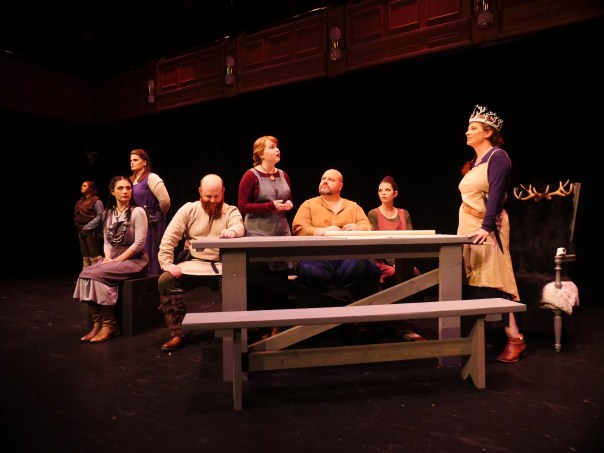
You don’t have to twist or contort your expectations to enjoy this Lear. Directed by Heather Bucsh, the Free Reign take on Shakespearean production is conspicuously low-budget, with respect to scenery, compared to the others I’ve mentioned. Yet Bucsh has also designed the Viking costumes – as pointedly as she directs – so we accustom ourselves to watching palace scenes, royal inhospitality, and eye gougings played out with little more than picnic tables.
The play and the players are the thing, beginning with Lisa Essex as Lear. Hitting the right note with this monarch in the Bard’s opening scene is a supreme test, both for a director and an actor tackling the title role for the first time. Questions already lurk in the playscript for them to grapple with. What kind of relationships has Lear established with his daughters? Why is he dividing his kingdom? And perhaps most puzzling of all, after calling upon his daughters to compete for their inherited portions on the basis of how much they love daddy, why does he decide the results of the competition while the daughters are still competing?
Maybe it’s useful, then, that Essex struggles to project the age, the command, and the explosive presence of the eccentric king. It doesn’t help that she is neither big nor tall – nor guarded by the 100, 50, or even 25 riotous knights that Shakespeare tells us are serving His Highness. We can gloss over questions of plausibility quite easily as we try getting used to the concept that this woman is truly master of all the lands she is divvying up.
As Lear diminishes in her worldly power, becomes more isolated and disrespected, finally losing her sanity, Essex steadily grows in dramatic power. By the time Lear is raving mad on the stormy heath, challenging winds and hurricanoes to do their worst, Essex is near her peak. But it’s when the storm is over that we see this Lear’s madness most vividly. Essex and Bucsh don’t pick up on every nuanced life lesson that the humbled queen is learning about “elemental man” from her Fool and Edgar (disguised as a crazed beggar), but I’ve never seen a Lear that’s more out of his mind than Essex looks out of hers.
There is a breathtaking depth to her downfall and disintegration, so when we move from the sin-and-punishment portion of her story to her grace-and-forgiveness reunion with Cordelia, the good daughter he has wronged, it’s as profoundly moving as any Lear I’ve seen.

Even in the grand opening, Bucsh and her cast impress me when we look away from the throne. For one thing, we don’t have to look far. Goneril and Regan, along with their husbands, the Dukes of Albany and Cornwall, are scrunched together at that picnic table. So we quickly get a sense of their evil conspiratorial kinship – with a hint of the mutual enmity and jealousy that will kill them both. It’s there when they speak and when they listen. Kristin Varnell looks mean and barbaric as Goneril, even as she sits closest to her dad at the table, and Rebecca Gossage is the essence of wantonness as Regan, more slyly concealed near the far end of the group.
There’s a more substantial contrast between Albany and Cornwall, where the good-natured cluelessness of Nathan Hall as Albany is markedly different from Mathew Schantz’s scowling distemper as Cornwall. But what impresses me most about Busch’s work is what she does in the parallel plot, where the Earl of Gloucester is as deceived in his valuation of his sons, Edgar and Edmund, as Lear is with her daughters. Here Free Reign’s gender switch actually improves Shakespeare’s fearful symmetry.
Robert Brafford beautifully handles the slimy cunning of the bastard Edmund, a villain who addresses us directly more than any other Shakespeare schemer this side of Iago. He gets a warrior look to his beard’s coiffure that sets him apart from all but Schantz as Cornwall, relishing the competing attentions of Goneril and Regan as much as cozening his father and brother. Russell Rowe mutes the foolishness of Gloucester, not making a banquet out of the Earl’s reliance on astrological portents. That only slightly abbreviates his learning curve when he’s blinded – while his pitifulness remains intact.
What will stand out most for me when I recall this Lear is the beautifully reimagined performance of Katie Bearden as Edgar – the best Edgar that I have seen. Anywhere. Her role unfolds in three stages: hoodwinked Edgar, the fugitive Tom of Bedlam beggar, and champion warrior Edgar. The first stage is unremarkable enough, with Bearden choosing to be naïve and credulous instead of bookish and trusting, the way we see him most often. Magic begins when Bearden transforms into the Bedlam beggar, a howling combination of ‘60s icons Janis Joplin and Tiny Tim that somehow combines savagery with vulnerability.
I won’t begin to describe the look of Bearden as the disguised Edgar who emerges from hiding to challenge brother Edmund to mortal combat, but I’ll say this: revenge in a Shakespearean production has never tasted sweeter to me. As a result, my focus shifted slightly as the multiple denouements played out in Lear. I found myself as invested in Edgar’s revenge upon his brother as I usually am in the vicious Edmund-Goneril-Regan love triangle – notwithstanding Charles Holmes’s mediocre fight choreography when the brother gladiators clashed.
Sadly, Essex’s real-life daughter, Madeleine Essex, didn’t rise to even that level on opening night. Bucsh had her looking sweet and pure compared to her sibs, and the younger Essex took her portrayal in a fine direction, toward modesty and shyness, with perhaps a pinch of trepidation.
If only Lear’s dying description of Cordelia’s voice as “soft, gentle, and low” hadn’t pushed her to the verge of whispering in the opening scene. And perhaps a livelier, more spontaneous “No cause, no cause” would have made my tears flow more freely in the luminous reunion. Yet there were moments – startling moments – when Essex showed us just how loud and emotional Cordelia can be.

No such inconsistencies dogged of Courtney Harris’s bluster as Kent, the loyal knight that Lear banishes with Cordelia, though she could register more chastening and enlightenment at the end of her journey. And I’ve been seeing excellent portrayals by women of Lear’s saucy, prickly Fool for so long that Amy Schiede Cheek’s winsome élan in the role comes as no shock, even with her ram’s horns and lyre. The suspense nowadays is whether productions will deal with the Bard’s failure to tell us the Fool’s ultimate fate. Bucsh and Cheek do tackle that matter decisively.
The best portent of the evening happened when I first walked into Duke Energy Theater and found the place nearly sold-out on opening night. Evidently, word-of-mouth about Free Reign has spread, unfazed by Lear in any form. The quality of this work ought to keep them coming, even if the actors come out for their bows at 11:15pm.
Just one point of order: since you’ve changed the gender of all her personal pronouns, could you please stop calling this queen “Sir”? I don’t think either Queen Elizabeth was addressed that way.

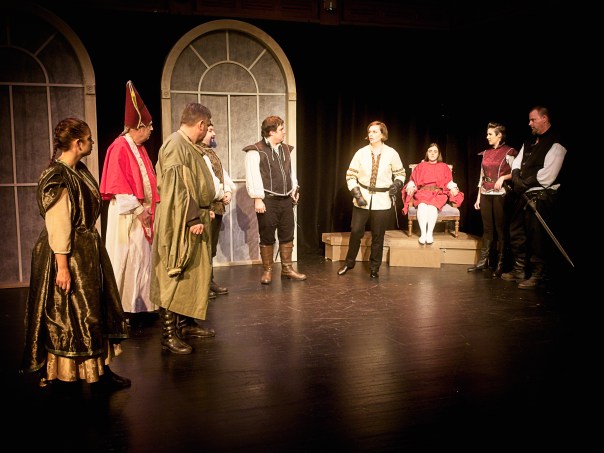
 Actor/director Eric Tucker and his Bedlam cast had a field day with the script, divvying up 25 roles among four actors. Shaw’s contention that there was no villain in the Maid of Orleans’ undoing came through vividly in an evening that mixed some fun into the high seriousness – but the evening was three hours long, hardly making a dent in GBS’s notorious loquacity. The new Free Reign Theatre production, currently at Spirit Square, brings Saint Joan more fully into the realm of accessibility. Director David Hensley noticeably shaves the Shavian discourse, and company founder Charles Holmes has free rein to ply his fight directing craft. Multiple episodes of spirited swordplay are sprinkled amid the wordplay.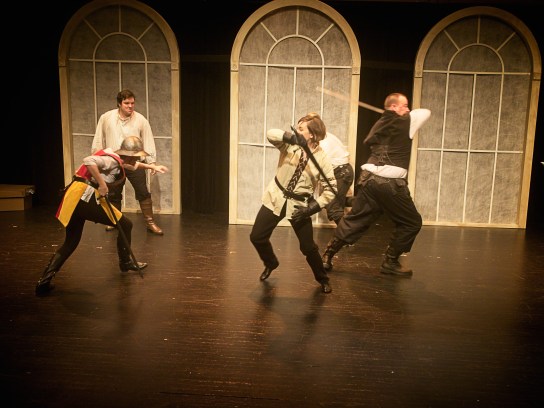
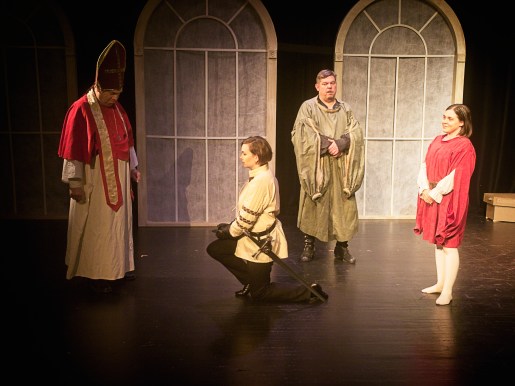 Creech can not only hide behind her courtiers when the Dauphin stages his first audience with Joan, she can nearly disappear. But Cheek also towers over this Dauphin – a little bit – so it’s a nifty tug of war for the future king’s favor. Holmes retains his bellicosity when he briefly appears at the English encampment as the Black Prince, but he becomes slightly more sympathetic at the trial as Peter Cauchon, somewhat doubtful that La Pucelle is a witch but absolutely certain that she is the worst of heretics.