Monthly Archives: September 2026

DCP’s “The Cottage” Is a Merry Hideaway for Secret Lovers and Cigarettes

Review: The Cottage at Armour Street Theatre

By Perry Tannenbaum
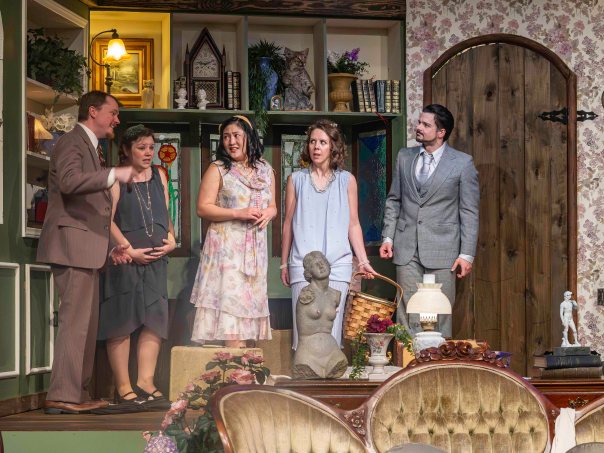
Davidson, NC – One of my late mother’s favorite Yiddish words, ongepotchket, sprang immediately to mind as soon as we walked into the Armour Street Theatre for the local premiere of Sandy Rustin’s The Cottage. Our first glimpses of Kate Baker’s scenic design had that unique tang. Gaudy. Cluttered. Colorful. Ornate. Massively overdone. Impossibly baroque.

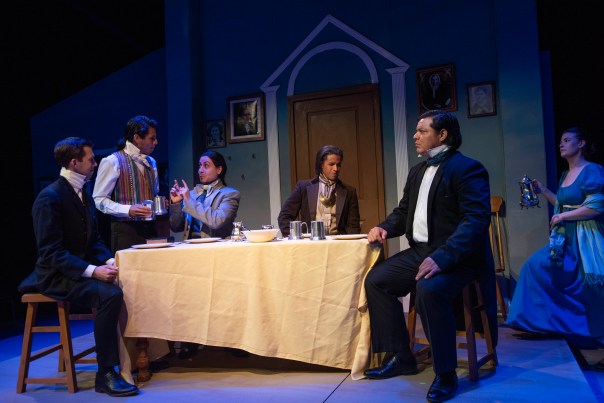
That impression only magnified at the other end of the hallway when more of the rusticated clutter of this latest Davidson Community Players production came into view. It deepens further once the farce begins, for in addition to a stairway, two downstairs exits, and an upstage front door, Baker has crafted an invisible entrance that will eventually come into play – and cunning little crevices where Rustin’s characters, all but one of them acquainted with the cottage, will reach in and fob cigarettes.

It’s Monday, June 4, 1923, some 90 minutes from London by train, and this countryside retreat is the perfect place to be naughty. By the end of the show, I wasn’t sure whether half the budget was being frittered away on faux cigarettes.

Nor could I rid myself of the idea, driving home, that this cottage – which takes on a decisive cameo role in the denouement – was an apt metaphor for this whole amorous mismatched group of Brits.

We likely think at the outset that we should be emotionally invested in Beau, who is carrying out his yearly love orgy with Sylvia, his brother’s wife, and juggling multiple illicit affairs. We’re used to seeing such farces written by men, after all. But Rustin’s brand of farce has different beats, a conviction that women should get equal portions of the cake, and sympathies toward Sylvia, who is clearly getting the short end of the stick.
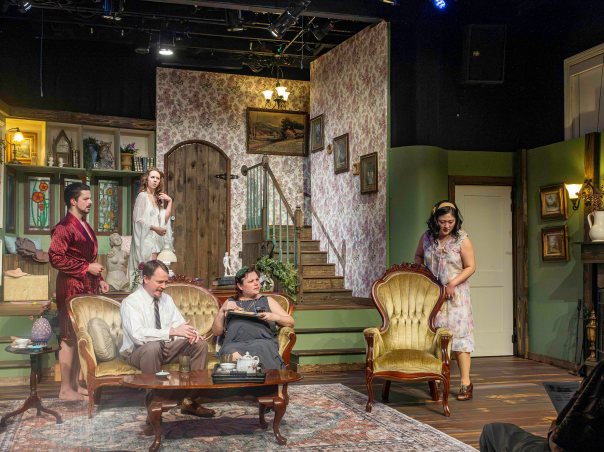
More than reversing our perspective, Rustin explores love: its levels, vacillations, and simultaneities. You may sour on a partner in her bucolic world, but it is not at all axiomatic that you transition to hating them. Throughout all the crossfire of who’s cheating on who, who’s been keeping secrets from who, who’s been wronged by who, and who’s underappreciated by who, none of the six characters rises to a moral high ground or plummets far below.

Except perhaps the monster in the group, who is arguably the most deceitful.

In a rather amazing coup for DCP, their Cottage is directed by Hanley Smith, who originated the role of Deirdre in 2013 at the Astoria PAC in Queens, NYC, before moving up to the triggering role of Sylvia at Florida Studio Theatre in Sarasota, four years ahead of the Broadway premiere in 2023. Not a far-flung coup, to be sure, since Smith is a Davidson College grad who starred in Actor’s Theatre of Charlotte’s production of The Vibrator Play in 2011.

So whether or not she has directed anywhere else before her DCP debut, Smith quickly establishes that she has a sure feel for this script. From the outset, Julia Howard’s performance as Sylvia was at least as extravagant as the scenery that surrounded her – and the sofa where she rehearsed her most alluring poses. This has been her one-time-a-year sex-capade, and it was obvious that she wasn’t planning for it to end, though Beau’s work week was set to begin.

No, no, no. Her plans, executed yesterday evening with a couple of telegrams, are to leave her husband Clark and marry Beau. Thoughtfully, the second wire was sent to Beau’s wife, Marjorie. Part of Sylvia’s kooky charm comes from her not being steadfast in her beliefs or resolutions – a trait that is contagious among Rustin’s creations – for she regrets sending her liberating telegrams as soon as she hears a loud knock on the front door.

Sylvia’s miscalculations will greatly increase Howard’s chances to shine, and still clad in her negligee, she’ll continue to stand out from the parade of visitors. As already hinted, Beau has been busier at the game of love than she anticipated. Ben Allen must merely be “Perhaps the best-looking man in Britain” to match the playwright’s description, so a certain amount of vanity must be coupled with his sexual rascality and his savoir-faire as a deceiver.

When Beau is celebrated repeatedly instead for the beauty of his flaming robe, should Allen act upset? Perhaps not, for Rustin consistently sets aside perfect moments, on the brink of upset or disturbance, for Beau to suggest a cigarette or a spot of tea. Good manners and posture were must-have accessories for Allen’s geniality in the early moments of this unpredictable morning at the cottage. On the spectrum of flappability, he seemed to be permanently perched at the opposite end from Sylvia.
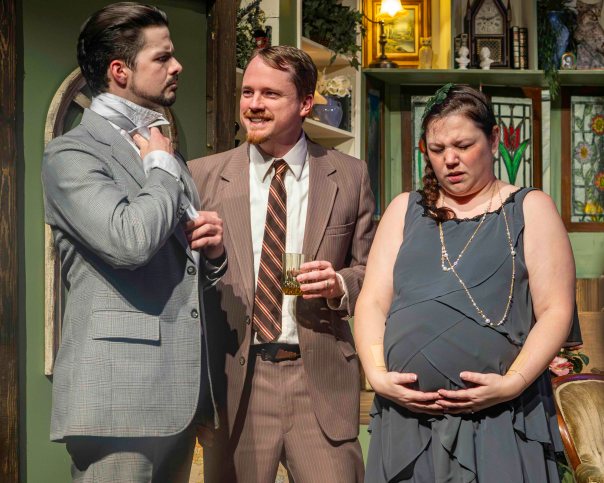
Until he opened the front door, first to his visibly pregnant wife Marjorie and then to brother Clark. Their suspicions have been eradicated by Sylvia’s batch of telegrams. So while it’s unseemly to disclose her hiding place before you see this farce, it’s also unnecessary for Beau to maintain his charade and keep her there.

Sadly, for Amanda Pippin as Marjorie and Andrew Pippin as Clark, neither had the histrionic opportunity to rev up to a towering jealous rage. They have a couple of surprises of their own to reveal. After Sylvia fully digests them, she’s probably correct in thinking that she has more right than Beau to be miffed. Regardless, it was so much fun watching Howard come to that realization and then watching Allen nearly catch up.

The Pippins neatly pull off the trick of being humdrum, wholesome, and deliciously wicked at the same time as their insouciance confounds their fellow adulterers. Nor are they the ones to be ruffled when, one after another, a third couple comes knocking at the door: Cate Jo as the déclassé Deirdre and Andrew Williams as the reputedly murderous Richard.

Like Marjorie, dear Deirdre will have good news and bad news. But nobody seems to react to any news at the cottage in the way the teller anticipates. Howard takes honors as the most thoroughly cheated person onstage as Sylvia, while Allen as Beau, the target of Richard’s wrath, takes cover like all the others. Jo makes for a loopy Deirdre, loopier after guzzling from a gin bottle, and hers turns out to be a rather physical role, what with all the hiding and staggering she must do in varying states of sobriety.
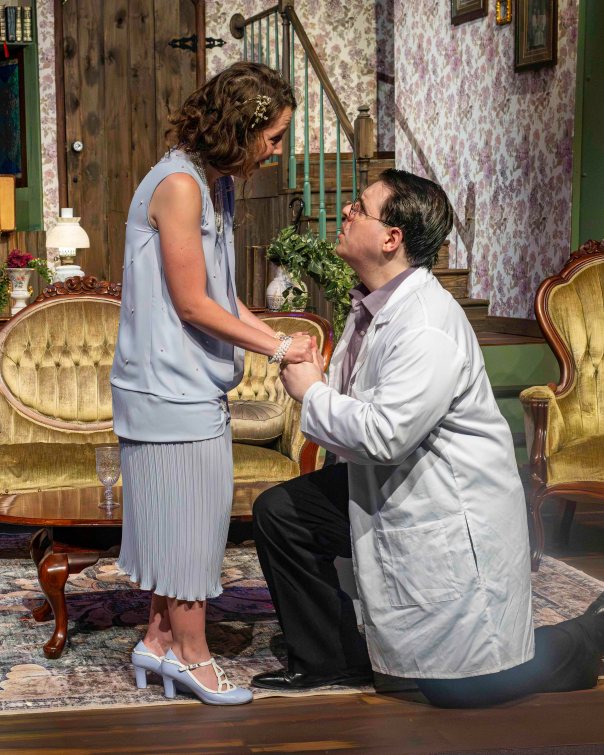
Williams, as Deirdre’s ex, has a past that’s as chequered as Deirdre’s, but all of that came since he and Sylvia last met many years ago. In everyday life, when not boasting of murdering Deirdre’s lovers, he passes for an everyday pharmacist, so the role offers a delicious range for Williams in spite of his late arrival.

To her credit, Sarah Deutsch’s costume designs are only slightly upstaged by the set. If you know who Stanley Baldwin was and his political affiliation, identifying the era of Rustin’s lively farce won’t be a formidable challenge. Otherwise, Hanley doesn’t orient us in either the printed or the digital program. The gorgeous Victrola must be your guide.

But only Rustin is to blame for Richard’s lame excuse for his false beard and mustache, so I’m not blaming anybody at DCP for making these disguises glaringly clumsy. Let the moment pass and richly enjoy the rest. This production is definitely worthy of its pedigree.


Keys and Blackstone Deliver Gold in “Hell’s Kitchen,” but Clarity? Blame It on the Belk

Review: Hell’s Kitchen at Belk Theater

By Perry Tannenbaum

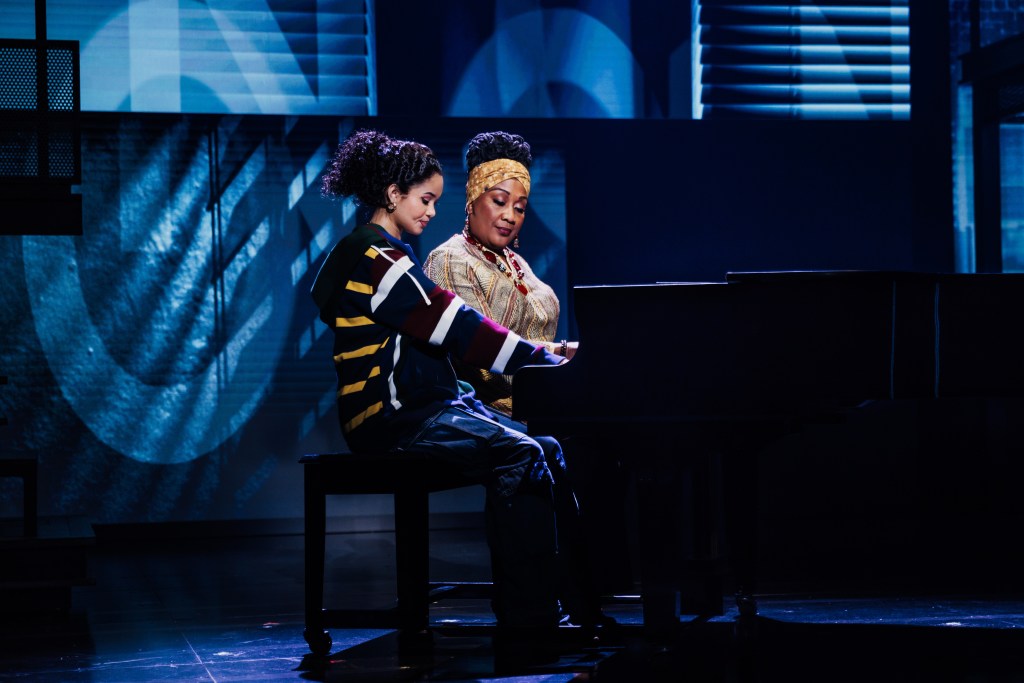
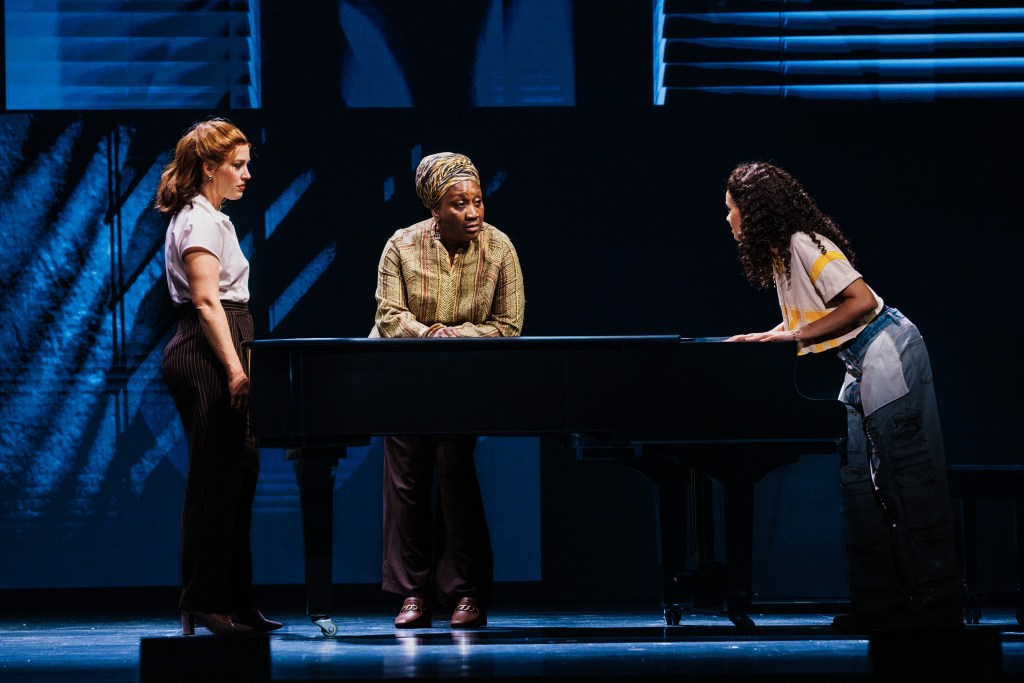
When you’re served a verbal soup instead of songs, when smooshed syllables largely replace dialogue, it’s hard to recommend a musical. But when you’re sitting at Belk Theater on opening night as a critic who has covered the beat for nearly 40 years, you just shake your head when Alicia Keys’ Hell’s Kitchen rolls into town and becomes the latest touring show to be sabotaged by an unruly sound system at Charlotte’s marquee venue.

Often after a jukebox musical, I turn to Spotify, today’s most ubiquitous jukebox, to dig further into a spotlit artist’s work during the ride home. It can be Tina Turner if you live in the Queen City, Carole King, Cher, ABBA, MJ, the Million-Dollar Quartet, Frankie Valley, or – looming on the horizon – Neil Diamond. The jukeboxers whet your appetite to revisit the original recordings if you know them or to seek out more if you don’t.

Sadly, the sound booth settings rarely dial in on opening night with the pristine perfection of MJ. So it’s an aspect of production that stands out all too clearly when it does happen. Keys was so ill-served at her QC opening that summoning her on Spotify on the highway served multiple purposes that should be needless: to confirm that original recordings of her hits were more intelligible than what we’d heard live and to learn, besides the notes, exactly what she had written.

The comparative clarity of Keys’ recordings was a relief rather than a surprise. If it weren’t for the stellar performances by Roz White and Desmond Sean Ellington on Keys’ bluesier songs, we could say that more lyrics were clearer on my car’s speaker within my first 10 minutes on the road than were intelligible all evening long at the Belk.

Even if the sound crew got their act together, I had a far more substantial and meaningful revelation as my wheels hummed down I-77 South. Without exception, every song that we heard live that evening sounded better than the hits they covered. Part of the difference was the quality of White’s and Ellington’s voices, as well as those of Kennedy Caughell and JonAvery Worrell, all of whom spectacularly support Maya Drake as Ali, whose story significantly parallels Keys’ hardscrabble upbringing without exactly replicating it.

For me, the bigger parts of the musical’s upgrade are the arrangements by Keys and Adam Blackstone, further elevated by the Tony Award-winning orchestrations layered on by Blackstone and the legendary Tom Kitt. Clear as they may be, Keys’ original recordings struck me as thin and pallid by comparison. Now, 1.7 billion players of “Empire State of Mind” on Spotify and nearly the same following for “If I Ain’t Got You” can’t be dead wrong – nor can the smaller number of voters who won Keys 17 GRAMMY Awards (and counting) – but I’d invite them all to give this touring cast a hearing.

All except Drake are sensational, whose vocals are lithe enough – almost on par with Keys’ – with a quality that might actually be a notch above when she’s not emulating her model. The real problem with Drake on opening night was that, even when she wasn’t tethered to the tempo of Keys’ raps, she still delivered her dialogue at a panicked pace that would have likely remained problematic even if the sound system were optimal.

Disagreements between Drake and Caughell as her white mom, Jersey, looked heated enough, but what they were about was mostly conveyed by listening to mom’s paranoia rather than Ali’s teenage angst. The contours of Kristoffer Diaz’s book never gave me a feeling that its ambitions rose far above furnishing Keys’ songlist with a recognizable framework.

Ali has fallen hard for Knuck, a construction worker by day and a mean street percussionist after dark when the whole Hell’s Kitchen neighborhood seems to pulsate to a driving beat. She takes to following him to work, shedding the company of her pals after introducing herself, verging on stalking as she wears down his resistance – enough that Mom comes home to her apartment and finds them in heat. Poor Knuck is under the impression that Ali is of age.

It’s possible to come away thinking Worrell brings more individuality to Knuck than Caughell brings to Jersey – but only if you manage to ignore the force of nature that Caughell becomes when she sings, evolving into one of Miss Liza Jane’s acolytes. White is even more stately than she is bluesy as Liza, the calm and grounded antithesis of both Jersey and Ali. She presumably teaches Jersey less about parenting than she teaches Ali about music.

White’s regal bearing is a wonderful prelude to her anthemic “Authors of Forever,” making Act 2 as much of an ascent from Act 1 as it is a continuation. For it’s obvious we are on a loftier plane when Ellington, as Jersey’s wayward husband, follows with “Fallin’” and – as Ali’s dad, Davis – the imposing architecture of his fatherly “If I Ain’t Got You.” Musically, then, Liza and Davis are Ali’s artistic parents, both as pianists as well as singers.

The brief or near-reconciliation between Jersey and Davis, until he has to hit the road for his livelihood, humbles Mom a bit, reminding her of what it is to be young and in love. Her epiphany, “Pawn It All,” enabled Caughell to rock the Richter Scale almost as much as White had before.

So Jersey seeks reconciliation with Ali, but the blossoming teen isn’t having it right away. One of Drake’s very best moments comes with the concluding “Empire State,” done up by director Michael Grief, choreographer Camille A. Brown, projection designer Peter Nigrini, lighting designer Natasha Katz, the orchestrators, and the arrangers with enough epic flair to remind Keys’ fans of the “Empire State” video sung with JAŸ-Z. Judge for yourselves which is better.

The live version is a tough act to follow. Tempo helps slow Drake down; repetition helps us understand her.

As for any frustrations that came with not hearing Keys’ words clearly, these were later allayed by looking past the frontispiece of the playbill to the back of the program booklet. There, in small print taking up more than a column with no indentations, the listing of music credits voluminously belies the idea that all the melodies and words are Keys’. For “Empire State (Part II)” alone, six other writers join Keys in the byline.

Roll those credits down with all the black space of Hollywood film credits, and you realize that a whole community wrote and produced this quasi-bio without ever having Hell’s Kitchen in mind. Another village did envision this show and did a damn good job. Too bad a sound system let them all down.

“Thought for Food” Transcends Its Zippy Title at the Warehouse

Review: Thought for Food at Warehouse PAC

By Perry Tannenbaum

Cornelius, NC – When Hollywood studios look for hot new stories for their next blockbusters, the bestseller lists, whether New York Times or Amazon, are among their top go-tos, even if it ignites a bidding war. But if you’re an aspiring playwright out in Concord, looking for a prime property after a 30-year career in secondary theatre education, pickings and budgets are slimmer.

By chance or by design, Andrea Rassler came upon the perfect formula. Ranked a lowly 231,578th in Kindle Store popularity and 2,027th in Women’s Psychological Fiction, Vicky Zimmerman’s Miss Cecily’s Recipes for Exceptional Ladies is temptingly obscure for anybody seeking to obtain adaptation rights on the cheap. First published in the UK in 2019 with a far more moribund title, Zimmerman apparently crafted a laudable gem, boasting a 4.5-star average from nearly a thousand Amazon readers of the American edition, 90% of them four stars and above.

Premiered at the Warehouse Performing Center as Thought for Food, three years after getting a public reading at Charlotte’s CAPA Center, Rassler’s adaptation skillfully distills and compresses Zimmerman’s 427-page novel. In the process, with a kind of Steel Magnolias sway from laughter to tears, our emerging local playwright arguably intensifies the chick-lit flavor of the original.

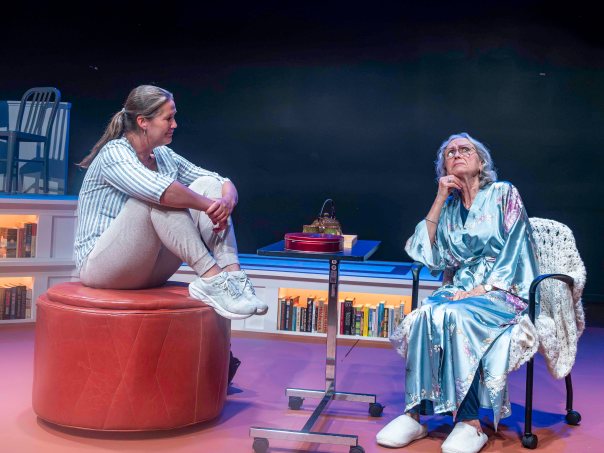
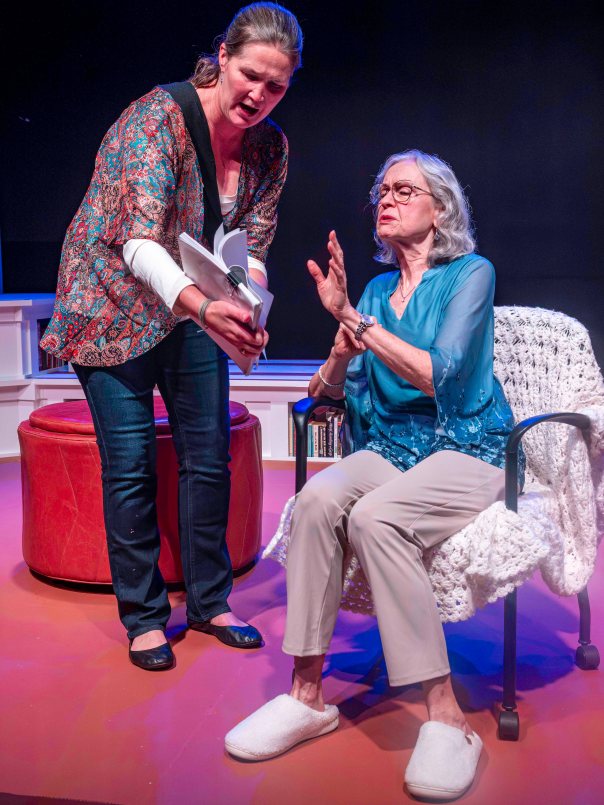
Nor will they mind that Nick, Kate’s “intimacy anorexic” boyfriend, has been stripped of the opportunity to appear onstage and say a single word on his own behalf. This cast, like Magnolias, is all-women, but two of them, Kate’s mom and crotchety 97-year-old Cecily, were so quirky and nutsy that I didn’t mind.

Who wanted the first-hand experience of hearing Nick alternately gushing his fitful adoration for our protagonist and then venting all his anxieties, trepidations, self-doubts, and frustrations? Enough stage time already falls to Kate for those purposes. And she’s right here. We can judge for ourselves and recalibrate as the story unfolds.

Better to have Cecily scalding Kate with her no-holds-barred tough love and Rita, Kate’s mom, bombarding her with unsolicited advice. From a comedy standpoint, the best decision Kate will ever make in life is to move back in with her mom. Though there were no mentions of Kate’s biological clock (maybe universal recognition that it was her own damn business?), the lady is undoubtedly behind the curve in establishing her independence and developing a backbone.

Men can quietly see that Cecily, who can ultimately tell Kate not to darken her door at the old folks’ home unless she can report some progress, is actually the father figure Kate needs in disguise. Cranky? Absolutely. Add in bullying and demanding. But able to impart the rigid standards that are the foundations of self-regard.

Women, meanwhile, can see Cecily as the tough old bird that saves Kate’s life.

These traits are normally in Becca Worthington’s wheelhouse, but here we had the pleasure of experiencing her playing against her usual type as the needy, befuddled, and irresolute Kate. One or two of the barbs and zingers hurled at her didn’t seem to hurt as much as they should. But mostly, the toughness we saw from Worthington in The Lehman Trilogy and the savagery at the forefront of Misery had vanished into Kate’s vulnerability, unrewarded patience, her wide streak of cluelessness, and her occasional wit.

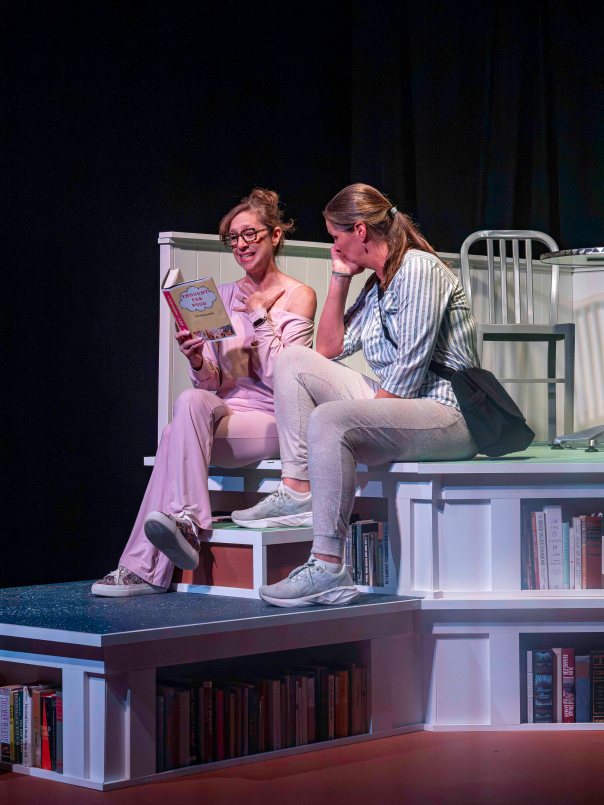
Even without Kate’s dubious beau on the scene, her female tormentors found ample means of rattling, angering, and humiliating her. Amid that fertile forest of comedy gold, Kate had to glean whatever kernels of encouragement and sound advice that she could. Helping her out – when not piling on well-meant advice of her own – was her best friend, Bailey.

At times, Allison Graham’s chief comedy value as Bailey was in helping Kate fend off her mom’s chirruping criticisms and ill-judged suggestions – or in helping Worthington to convey the prodigiousness of Rita’s bad parenting. Just by the fussy and officious way she walked in on her first arrival, Stephanie Dipaolo signaled that there wasn’t a nurturing bone in Rita’s body. All of her recommendations tended to aim Kate toward fulfilling her vision of what her daughter should be, without the slightest recognition or consideration of who Kate is.

She only hits paydirt when those two visions accidentally coincide. Luckily, Bailey is on the scene to help Kate recognize this cosmic event.

Dipaolo’s sprightly energy underscores how much delight she’s taking in blithely inflicting so much suffering, and her quick, snippy exits assure us that numerous other opportunities urgently await her elsewhere. A busy bee, she is, with multiple stingers.

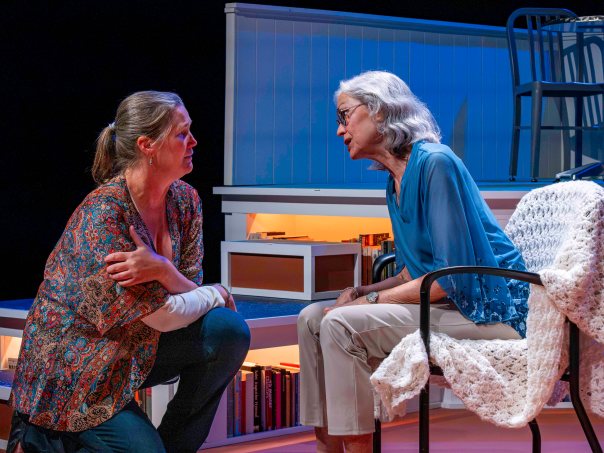
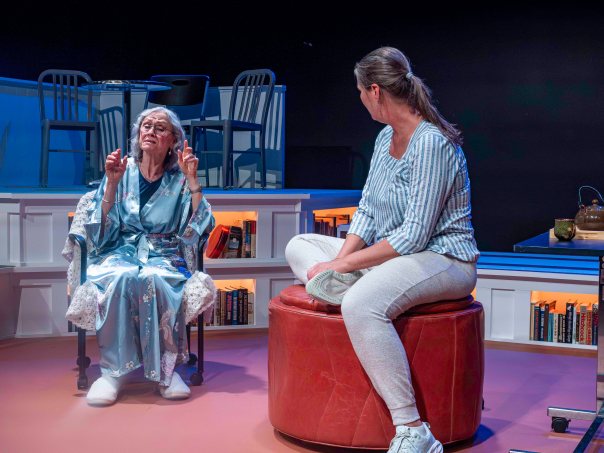
That makes for a fabulous contrast with Paula Baldwin as the memorable Cecily Finn, who reigns at the Lauderdale House from a throne that doubles as a walker. Indeed, Baldwin frequently reminded me of my own mum, oozing superiority at the Carriage Club past her 103rd birthday, especially after she lost her determination to regularly get her hair done.

So, on a couple of occasions in Act 2 as her tutelage neared an end, I expected Kate to make her weekly pilgrimage to Lauderdale only to find her mentor’s room empty. There was a bit of sugar mixed into Cecily’s saltiness that would make an acolyte wish to return, stray drops of sympathy and empathy mixed into her contempt for Kate, and a grain of self-interest at the center of her impatience.

Baldwin has done many more celebrated roles on stage, but she still appreciates the measure of this one.

As for Rassler, she hasn’t yet poured enough into all of her characters just yet. Bailey’s ultimate function in her storyline sticks out all too clearly because she draws too little opportunity to divert us, and Lesi Jonap is similarly shortchanged as Jackie Gaffney, the director of care at Lauderdale. As the administrator who guided Kate into Cecily’s austere presence, there was danger that we would see her as mere courtier. I would have appreciated more insight from Jackie, maybe a choice cut or two of what she knows about Cecily’s background.

That would certainly enhance her regal aura even more.

Ultimately, Food for Thought transcended its title without those finishing touches, delivering profundities beyond what it seemed to promise.

“Sovereignty” Brings Cherokee History Home

Review: Sovereignty at The Arts Factory

By Perry Tannenbaum

An impromptu survey of four people, myself among them, after the Charlotte premiere of Mary Kathryn Nagle’s Sovereignty at The Arts Factory, confirmed what I had strongly come to suspect during a long, sometimes difficult, and immensely rewarding evening of theatre. More people have heard of the 1838 Trail of Tears than have heard of VAWA, the acronym given to the Violence Against Women Act passed by Congress in 2013 (with Native Provisions attached).

We get to see how both of these events have impacted the Cherokee Nation in a groundbreaking Three Bone Theatre production directed by Carolyn Dunn. Thanks partly to a grant from the Cherokee Preservation Foundation, the production will pull up stakes when its Charlotte run is done on September 6, and sojourn for the next six days in Cherokee, NC, offering free theatre workshops to Cherokee High School students on the weekdays and two special performances at the Qualla Boundary on September 11 and 12.

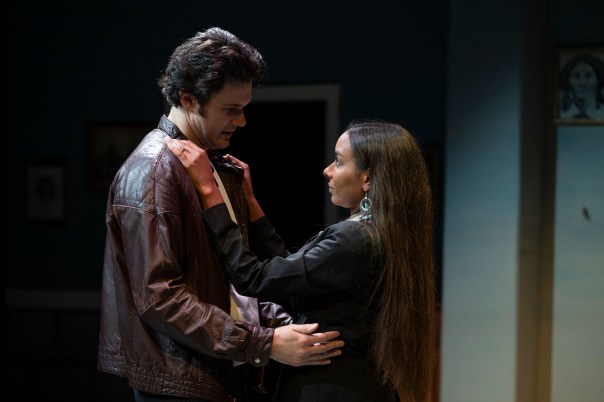
The Cherokee largesse is also evident in the casting and production team, since all the actors portraying Nagle’s Cherokee characters can claim Native American descent, converging on this labor of love from near and far. Admirably bolstering this ethnic authenticity are Dunn, costume designer Lorna Bowen, cultural consultant Yona Wade, and language coach David Jumper.

Quite audacious. Three Bone is already fairly unique among local companies in acknowledging – on their website and in all their digital playbills – that they rehearse and perform on the traditional, ancestral, stolen territory of the Catawba Indian Nation, including the Catawba and Sugaree tribes.

So they haven’t stopped there. They’re walking the walk and touring the tour.

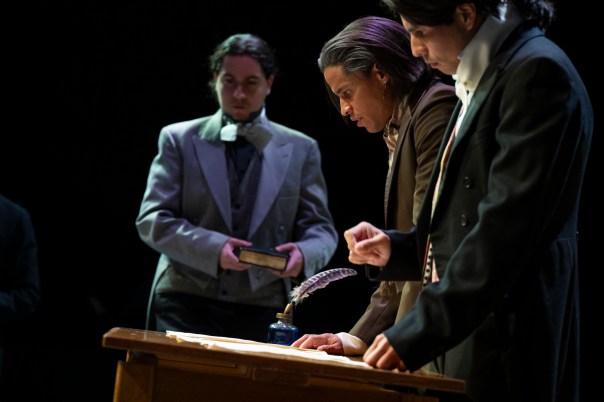
With respect to the Trail of Tears, we are taken very much to the center of the agonizing preamble, both at the White House and back on tribal land in Georgia, where an impossible ultimatum begins to break the Cherokee Nation apart into a devastating ideological fracture. Written in 2015 and premiered three years later, the depiction of President Andrew Jackson already foreshadowed the current monster in the Oval Office.

It reaches us now in a 2020 edition, which likely makes Sovereignty even more pointed and relevant. There’s more wallop to this history than ever.

Nagle knows how to personalize both of her stories. The first begins in the 1820’s and climaxes in the signing of the Treaty of New Echota in 1835. The second begins in the “Future” – 2019, four years after the original script was completed – and stretches up to a decade afterwards. Or as long as it takes for a couple to meet, fall in love, have a child, dramatically break up, and create legal disputes that are not resolved until the US Supreme Court issues its judgment.

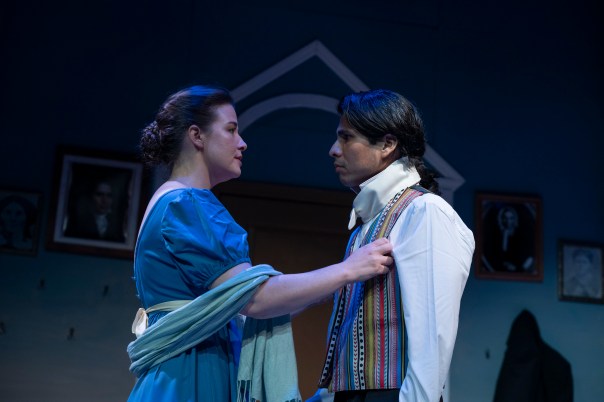
So each of Nagle’s crisscrossing timelines has enough breathing room for their lawyer protagonists to grow into their history-making roles. In 1835, we first see John Ridge as an effete invalid, convalescing somewhere in Connecticut, proposing to a local schoolmaster’s daughter. Transitioning to 2019, we encounter the betrothed couple’s future descendant, Sarah Ridge Polson, a Yale Law School graduate returning to her Cherokee Nation home in Oklahoma, visiting her ancestors’ graves at Polson Cemetery.

We’re talking about what is likely the most radical jump-cut this reviewer has ever seen onstage. Since John’s bride-to-be is also named Sarah, when her mom calls to her offstage in Cornwall, Connecticut, the overlap between the two scenes has Flora, Polson’s cousin, greeting her as she returns to her homeland and pays homage to the lovebirds who are exiting. In a split second, 184 years have elapsed, and we’ve traveled 1370 miles westward.

Dunn doesn’t bother explicating these transitions – nor even specifying that we’re time-traveling to a freely imagined future – any more than Nagle’s dialogue provides, a source of bewilderment and disorientation throughout the evening. While I’d be happy to see such guideposts flashed somewhere as projected visuals, or in the printed and digital programs, it’s pretty clear that Dunn is taking her cue from the circumspection of Nagle’s manuscript.

Unless you already know that Tahlequah is the capital of Cherokee Nation, you may not be any surer that Polson is back on Native American soil than you will be about VAWA when it is offhandedly mentioned a few times. Anyone who emerges from Sovereignty thinking that Nagle’s script is didactic would probably be layering on the helpful info on VAWA and the historic timeline that Three Bone has posted on the wall of the corridor as you enter the theatre space.

We’re more firmly grounded when Nagle takes us to the White House and to Georgia Before Removal. Multitudes of chilling lessons – or reminders – bombard us as soon as we’re in the presence of President Andrew Jackson.

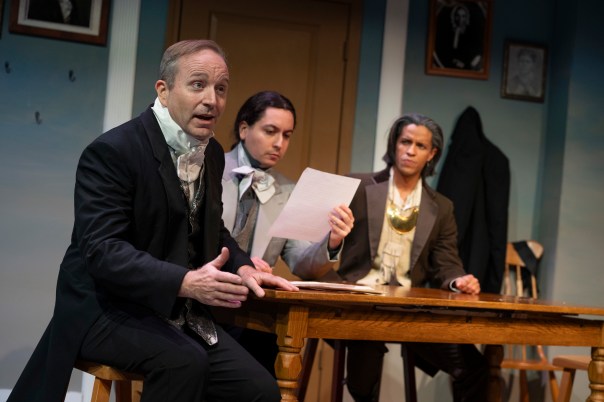
He is charming and candid to the Cherokee delegation, including Major Ridge, who fought by his side in the Creek and Seminole wars. Casually horrifying: “I say this as your friend. You find yourselves established in the midst of a superior race, and although you do not appreciate the cause of your inferiority, if you do not yield to the force and progress of civilization and move West, you will disappear.”

Affable and chilling. When Americans lecture Israel on how they treat Arab citizens and residents of Gaza, they might look to their own history as this so-civilized atrocity unfolds with the zealous assistance of John Forsyth, Governor of Georgia. What Jackson and Forsyth are cooking up (after encouraging the rape of Cherokee women) is a startling pair of alternatives that flout the Supreme Court judgment of 1832, in Worcester v. Georgia, ruling that Georgia’s unilateral extension of its laws over Cherokee territory was illegal and unconstitutional.

Cherokee Nation had sovereign status, true nationhood, so only the Federal Government could legitimately deal with them. To John Ridge’s claim that Jackson must enforce the law of the land, our President, with a heartlessness that would not be duplicated in the Oval Office for nearly two centuries, curtly replies:

“[Chief Justice] John Marshall made his decision. Let him enforce it.”

Bang. With malignant lines like that, it’s no wonder that Kyle Riggs as Jackson often upstages our Cherokee protagonists. He’s no less shocking when, in a matter of seconds, he first transforms from Sarah’s genial 2019 fiancé, Ben, into the sourpuss “Old Hickory” of yore, simply by turning his back to us, donning a formal overcoat, and changing his expression.

Yet Lance Claymore as John must face up to Jackson’s perfidy and decide what’s best for his family and his people. He can be pragmatic and abandon his ancestral home in Georgia, signing away his people’s heritage in the Treaty of New Echota with the consolation of being allowed to relocate to a specified territory in Oklahoma, which wouldn’t achieve statehood for over 70 years. Or he can stand on principle and the decided law of the land and watch Jackson & Co. take their homeland by force and drive away its people.

Without any consolation at all.

Cherokee Nation had been a democracy since 1827, with a constitution, a court, and elected governmental leaders, so John wouldn’t be making this decision alone – or signing any treaty alone. He finds himself united with his father in the pragmatic “Treaty Party” while the opposition National Party, headed by Chief John Ross, stands by principle and refuses to sign.

The political fracture ensured a deep-set antagonism between the Ridges and the Rosses that still lasts – and it made a horrible emigration mess inevitable. Whichever party you were affiliated with, you were leaving the sovereign Cherokee Nation, willingly or by force. Obviously, if you were among the majority who re-elected Ross, in Georgia and Oklahoma up to the middle of the Civil War, you were brutally forced of your home and likely blaming the Ridges for your ensuing sufferings.

That’s why Polson, applying for a job in the attorney general’s office in Tahlequah, controlled by the Ross family, is being so careful not to mention her Ridge ancestry. As Cousin Flora tells her – with genuine historical precedent – “The day you trust a Ross is the day they kill you.”

So while Billie D. Merritt as Sarah Ridge is quickly on the receiving end of Ben’s goofball marriage proposal, she is also a supplicant when she appears for her job interview. As you’ll see, Sarah is a long way from fully asserting herself both professionally and in her mixed-race relationship. Much like John before her, she’ll need to make a weighty, risky decision before she can make a positive difference.

On opening night, it was unfortunate to find Sarah’s personal growth coinciding with Merritt’s progress from the threshold of audibility to full authority after intermission, when she argues her case to tomorrow’s Supreme Court. Whether she wins or not does not diminish the fact that Nagle, in her conclusion, is envisioning a long overdue reconciliation between the Rosses and the Ridges. Hopefully, Merritt has turned up the volume and the Three Bones’ run continues.

Of course, the power of Nagle’s reconciliation depends on Mvnte July’s portrayal of both Chief John Ross back in Georgia and his descendant, Jim Ross, in the Tahlequah attorney general’s office. He is pivotal in creating the breach with the Ridges and, in the near future, in healing the rift. As a proud Cherokee citizen of Tulsa, it must be beyond a dream for July to be playing such a prominent historical figure, and as a past performer in Unto These Hills, no less a kick to be circling back to Cherokee, NC, with this production.

With opposition coming from July at home and Riggs from the White House, two powerhouse performers, Claymore’s softness and resilience as John Ridge come across all the more poignantly. Toughening the challenge for Marco Fuller as Ross’s most formidable opponent, Major Ridge, he must speak most of his lines in Cherokee, without any transliterated assistance from our playwright.

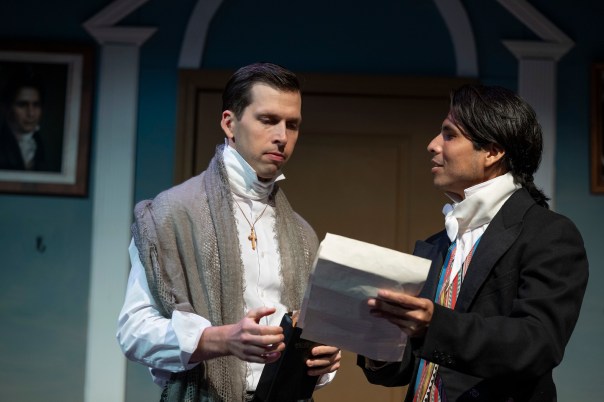
Josh Orsi helps Nagle to make a couple of key points on Cherokee sovereignty and free speech. Assaulted by a white drunk on Cherokee soil as Watie, Sarah Ridge’s brother, he has no power to arrest or prosecute, even though he’s a police officer. As Elias Boudinot, Major Ridge’s brother and founder of The Cherokee Phoenix, that nation’s first newspaper, he must face down threats from Chief Ross when their political opinions clash.

Along with Keely Kidwell as Sarah Northrup and Flora Ridge, Nathan Ahlgrim can exude a nice splash of goodwill and rectitude from non-natives. As Mitch, he’s a credulous modern-day lawyer, and as Samuel Worcester, he’s a soft-spoken – but iconoclastic – preacher who gets arrested for settling on Cherokee soil. Governor Forsyth and a redneck sheriff are Ryan Dunn’s chief cameos, but he also gets to play a good guy or two.

There is more than enough forgotten history here to richly educate most Charlotte theatergoers, and the posted materials, the digital program, and the discussion guide are fine accoutrements. If Sovereignty is greeted as warmly as we can expect, then it may linger in Cherokee as required reading for schoolchildren. Assuming that those kids to our west are as ignorant of their true heritage as ours, an annotated edition would be quite valuable. Nor would it be bad if Attorney Mary Kathryn Nagle’s future fan