Tag Archives: Tom Kitt

Keys and Blackstone Deliver Gold in “Hell’s Kitchen,” but Clarity? Blame It on the Belk

Review: Hell’s Kitchen at Belk Theater

By Perry Tannenbaum

When you’re served a verbal soup instead of songs, when smooshed syllables largely replace dialogue, it’s hard to recommend a musical. But when you’re sitting at Belk Theater on opening night as a critic who has covered the beat for nearly 40 years, you just shake your head when Alicia Keys’ Hell’s Kitchen rolls into town and becomes the latest touring show to be sabotaged by an unruly sound system at Charlotte’s marquee venue.

Often after a jukebox musical, I turn to Spotify, today’s most ubiquitous jukebox, to dig further into a spotlit artist’s work during the ride home. It can be Tina Turner if you live in the Queen City, Carole King, Cher, ABBA, MJ, the Million-Dollar Quartet, Frankie Valley, or – looming on the horizon – Neil Diamond. The jukeboxers whet your appetite to revisit the original recordings if you know them or to seek out more if you don’t.

Sadly, the sound booth settings rarely dial in on opening night with the pristine perfection of MJ. So it’s an aspect of production that stands out all too clearly when it does happen. Keys was so ill-served at her QC opening that summoning her on Spotify on the highway served multiple purposes that should be needless: to confirm that original recordings of her hits were more intelligible than what we’d heard live and to learn, besides the notes, exactly what she had written.
The comparative clarity of Keys’ recordings was a relief rather than a surprise. If it weren’t for the stellar performances by Roz White and Desmond Sean Ellington on Keys’ bluesier songs, we could say that more lyrics were clearer on my car’s speaker within my first 10 minutes on the road than were intelligible all evening long at the Belk.

Even if the sound crew got their act together, I had a far more substantial and meaningful revelation as my wheels hummed down I-77 South. Without exception, every song that we heard live that evening sounded better than the hits they covered. Part of the difference was the quality of White’s and Ellington’s voices, as well as those of Kennedy Caughell and JonAvery Worrell, all of whom spectacularly support Maya Drake as Ali, whose story significantly parallels Keys’ hardscrabble upbringing without exactly replicating it.

For me, the bigger parts of the musical’s upgrade are the arrangements by Keys and Adam Blackstone, further elevated by the Tony Award-winning orchestrations layered on by Blackstone and the legendary Tom Kitt. Clear as they may be, Keys’ original recordings struck me as thin and pallid by comparison. Now, 1.7 billion players of “Empire State of Mind” on Spotify and nearly the same following for “If I Ain’t Got You” can’t be dead wrong – nor can the smaller number of voters who won Keys 17 GRAMMY Awards (and counting) – but I’d invite them all to give this touring cast a hearing.
All except Drake are sensational, whose vocals are lithe enough – almost on par with Keys’ – with a quality that might actually be a notch above when she’s not emulating her model. The real problem with Drake on opening night was that, even when she wasn’t tethered to the tempo of Keys’ raps, she still delivered her dialogue at a panicked pace that would have likely remained problematic even if the sound system were optimal.

Disagreements between Drake and Caughell as her white mom, Jersey, looked heated enough, but what they were about was mostly conveyed by listening to mom’s paranoia rather than Ali’s teenage angst. The contours of Kristoffer Diaz’s book never gave me a feeling that its ambitions rose far above furnishing Keys’ songlist with a recognizable framework.

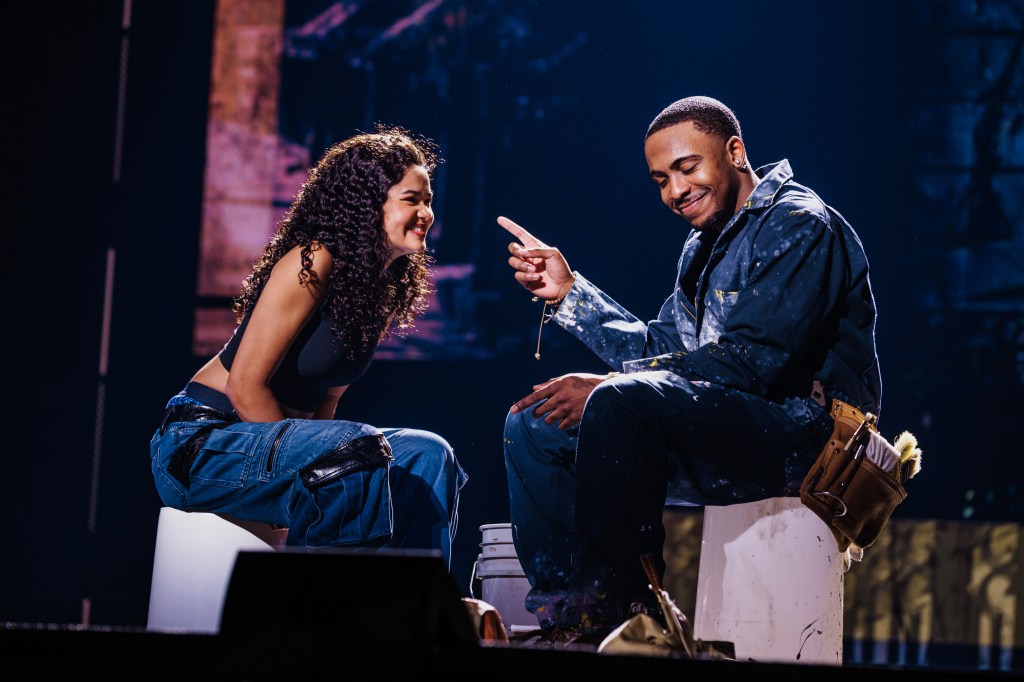
Ali has fallen hard for Knuck, a construction worker by day and a mean street percussionist after dark when the whole Hell’s Kitchen neighborhood seems to pulsate to a driving beat. She takes to following him to work, shedding the company of her pals after introducing herself, verging on stalking as she wears down his resistance – enough that Mom comes home to her apartment and finds them in heat. Poor Knuck is under the impression that Ali is of age.
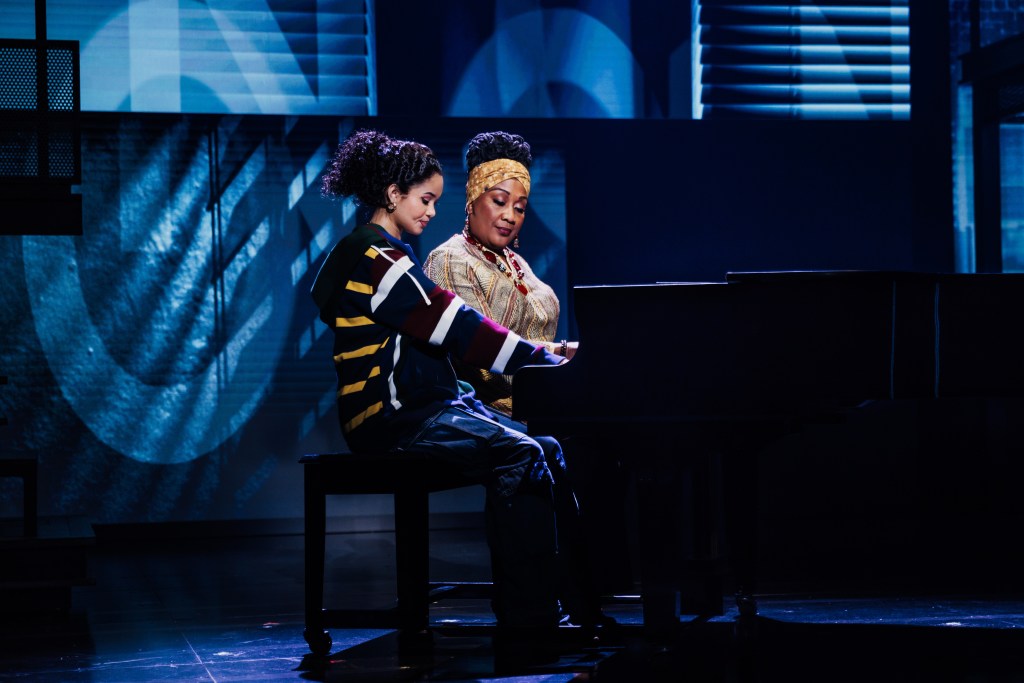
It’s possible to come away thinking Worrell brings more individuality to Knuck than Caughell brings to Jersey – but only if you manage to ignore the force of nature that Caughell becomes when she sings, evolving into one of Miss Liza Jane’s acolytes. White is even more stately than she is bluesy as Liza, the calm and grounded antithesis of both Jersey and Ali. She presumably teaches Jersey less about parenting than she teaches Ali about music.

White’s regal bearing is a wonderful prelude to her anthemic “Authors of Forever,” making Act 2 as much of an ascent from Act 1 as it is a continuation. For it’s obvious we are on a loftier plane when Ellington, as Jersey’s wayward husband, follows with “Fallin’” and – as Ali’s dad, Davis – the imposing architecture of his fatherly “If I Ain’t Got You.” Musically, then, Liza and Davis are Ali’s artistic parents, both as pianists as well as singers.

The brief or near-reconciliation between Jersey and Davis, until he has to hit the road for his livelihood, humbles Mom a bit, reminding her of what it is to be young and in love. Her epiphany, “Pawn It All,” enabled Caughell to rock the Richter Scale almost as much as White had before.
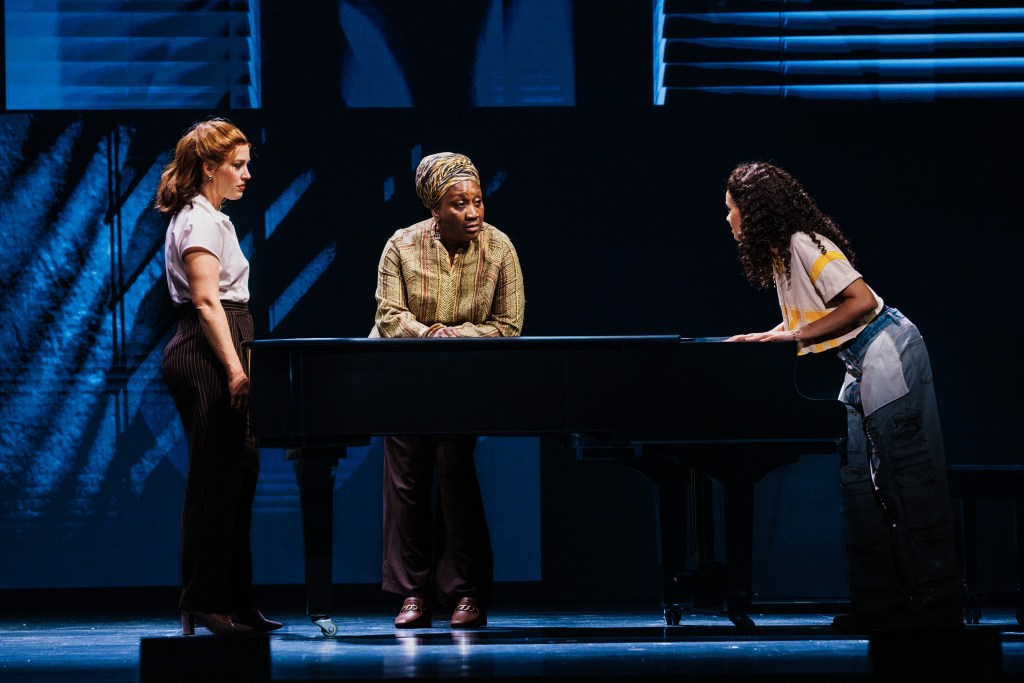
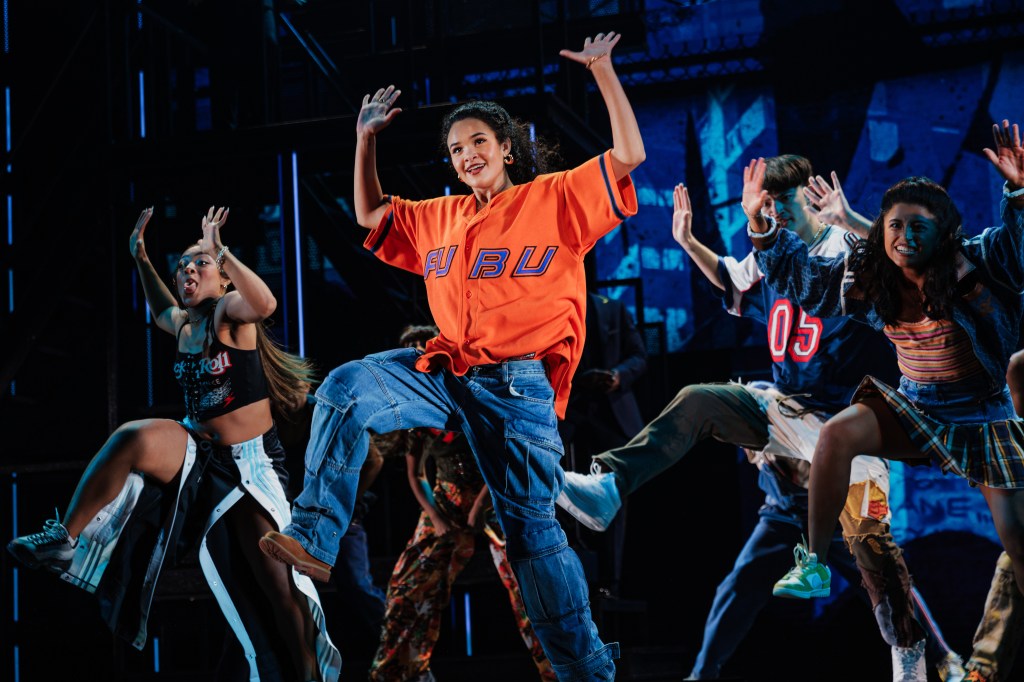
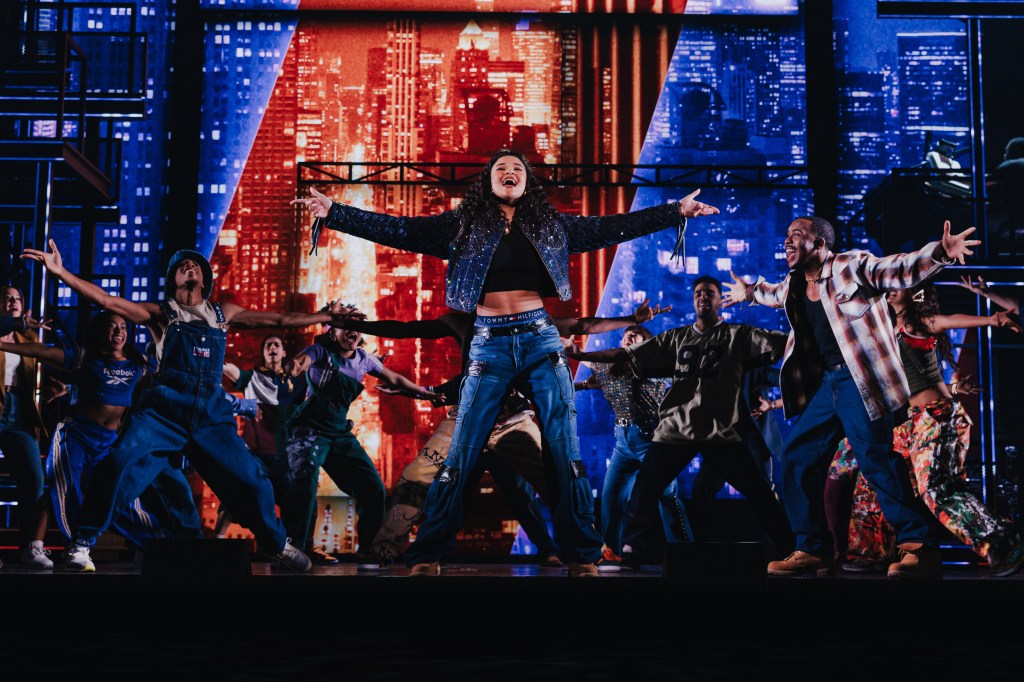
So Jersey seeks reconciliation with Ali, but the blossoming teen isn’t having it right away. One of Drake’s very best moments comes with the concluding “Empire State,” done up by director Michael Grief, choreographer Camille A. Brown, projection designer Peter Nigrini, lighting designer Natasha Katz, the orchestrators, and the arrangers with enough epic flair to remind Keys’ fans of the “Empire State” video sung with JAŸ-Z. Judge for yourselves which is better.

The live version is a tough act to follow. Tempo helps slow Drake down; repetition helps us understand her.

As for any frustrations that came with not hearing Keys’ words clearly, these were later allayed by looking past the frontispiece of the playbill to the back of the program booklet. There, in small print taking up more than a column with no indentations, the listing of music credits voluminously belies the idea that all the melodies and words are Keys’. For “Empire State (Part II)” alone, six other writers join Keys in the byline.

Roll those credits down with all the black space of Hollywood film credits, and you realize that a whole community wrote and produced this quasi-bio without ever having Hell’s Kitchen in mind. Another village did envision this show and did a damn good job. Too bad a sound system let them all down.

“Next to Normal” Is Alive at the Barn!

Review: Next to Normal at Theatre Charlotte

By Perry Tannenbaum

July 4, December 7, September 11, and October 7 are all dates we remember for their historic meaning to the nation and the world. A similar earthshaking significance can descend on a single day in the life of a relationship, a marriage, or a family that can reverberate for generations – whether you were at the event or even alive at the time.

That’s essentially what we’re watching in Brian Yorkey’s Next to Normal with music by Tom Kitt, winner of the Pulitzer Prize for Drama in 2010 after winning Tony Awards for Best Musical, Best Book, and Best Orchestrations the previous year. Instead of doing things the traditional way, setting up the location and the situation in a big opening number that stages or recaps the prime catastrophe, Yorkey fast-forwards us more than 17 years, when the original hurt in the Goodman family has marinated and metastasized – a fissionable maelstrom that will soon explode.

With a fresh set of seismic events.

Diana is at the vortex of the mushrooming crises, so it’s both interesting and wickedly deceptive that Yorkey brings us into her drugged and delusional mind for much of the opening action. We still see the basic outlines of the family turmoil clearly enough. Her husband, Dan, keeps trying to go with the flow of Diana’s bi-polar mood swings. She navigates a series of therapists, looking for either a therapeutic epiphany or the perfectly calibrated cocktail of meds.

Meanwhile, Diana’s teen daughter Natalie feels neglected and unappreciated, living in the shadow of Mom’s obsessive devotion to her older brother Gabe. Warily, Natalie navigates her self-worth issues as schoolmate Henry tries to get closer and establish a relationship. When Natalie overcomes her shame and allows Henry, after much hesitation, to meet her family, we seem to have arrived at a breakthrough.

It’s a brave move and all goes swimmingly at the Goodman dinner table between Natalie and Henry until Diana walks in with a birthday cake, all smiles, candles lit. Yorkey’s sleight-of-hand has worked so beautifully that we wonder which of the two teens is the target of the birthday surprise. Suddenly things are going downhill – off a high cliff.

Like we’ve been overdosing on the meds so far.

Yorkey is very good at these slow build-ups where we see budding new hopes dashed by a sudden disappointment and fresh Diana relapses. After portraying Dan, the long-suffering husband in Queen City Theatre Company’s fine production in 2013, Billy Ensley takes the reins at Theatre Charlotte’s slightly slicker version. His suffering, grimly stoical, was very different from Johnny Hohenstein’s unfiltered and uncontrolled anguish. It’s easier to breathe at the old Queens Road barn when emotions get a space to release.

On the other hand, the Broadway edition starring Alice Ripley in 2009 (which toured here with Ripley in 2011) took a dimmer, more skeptical view of psychiatry and pharmacology, giving those productions directed by Michael Greif a darker, satirical, mad scientist edge. Around the corner from a cluster of medical centers and hospitals, Josh Webb’s set design on Queens Road is easily the brightest and most antiseptic I’ve seen. The usual two-story scaffolding that adorns rock operas is outfitted with colorful fluorescent lighting, though some flickering occasionally marred the serene pastels (intentionally?) inside the translucent fixtures.

So in transit to Charlotte, the emphasis continues to shift more emphatically away from the quackery to the suffering. Hohenstein’s broadened performance now rivals Melissa Cook’s bipolarity as Diana, for he’s still a domesticated dad to Natalie and a cheerful host to Henry between bouts of stressing and losing it in private and with his wife. In its fits and starts, Hohenstein helps us to balance the toll mental illness takes on its victims and on their loved ones. Easily the best of Hohenstein that I’ve seen and the most intensely consistent performance of the night.

Cook’s performance as Diana is as genuine and riveting as any I’ve seen in Charlotte or on Broadway – except when it isn’t. Whether you call it resistance or retreat, there are whole songs where she is suddenly no longer a cri-de-coeur rock singer and becomes a more traditional Broadway belter: sweeter voice with noticeably less emotion and intelligibility. Suddenly, it isn’t about how sensationally Cook is acting but about the singing, likely more in her comfort zone.

I can’t say for certain that the duality was there from the start, but there should be no turning back after the big birthday reveal.

And the words here are important – I could almost hear Ensley stressing this at rehearsals – for we get the best sound in a musical production, local or touring company, since MJ stormed the Belk last September at the beginning of the season. Kudos to Ensley for his pertinacity and, if there was any acoustic work or equipment upgrades in the mojo, glory to the staffers involved in the push, beginning with artistic director Chris Timmons and managing director Scot P J MacDonald. The old barn is sounding better than ever.

It needed to. In contrast with Spirit Square’s more intimate Duke Energy Theatre, where Glenn Griffin directed Normal, a musical on Queens Road requires ample decibels to reach the back of the house. Keeping with Theatre Charlotte wisdom, music director Ellen Robison trims her rock band to six musicians while placing them behind the singers.

Instinctively, Ensley finds a perfect pathway for his cast to turn up the volume. As if inspired by grand opera, he dials up the melodrama past suburban proportions so that most of the characters are wearing their hearts on their sleeves. Craig Allen as Drs. Madden and Fine, allows himself to be callous and ghoulish for the blink of an eye when the script absolutely demands it. Otherwise, he is the throbbing soul of earnest concern – moonlighting as a rock star in Diana’s delusions.

As Natalie, the only lonely daughter, I found Cornelia Barnwell to be more shut-down and compulsive than Abby Corrigan was on her express route to stardom in 2013. Barnwell’s voice is purest rock, piercing as a poignard with no blade. She seems to be the studious type in her scenes at school or alone with Henry. But she can flip and go rogue as soon as she sings. Very appropriate for Natalie, so anti-meds at the beginning because she has seen the wreck of her mom – before following in her footsteps. At the same upstairs medicine cabinet.

If a stoner-slacker can be seen as an oasis of calm, then that’s how Zach Linick will appear as Henry, faithfully devoted, non-judgmental, discreetly giving Natalie her space. There aren’t too many laugh-out-loud moments on this bumpy road to tentative stability, but when Natalie, resistant at first to Henry’s weed, leapfrogs him into wanton pill popping, Linick’s reaction bears watching.

Melodramatic or not, Ensley’s read on Next to Normal is more in tune with our chaotic times than the 2013 original, when Yorkey likely turned to the mad laboratory aspects of pharmacology and electroshock therapy to provide a counterweight to the suffering and gloom. Everybody is wronged here as if the world were all MAGA malcontents, but the uplift and electricity of Kitt’s score have always been there to supply lightning, spirit, and zest. Ensley relies on Robison’s band to deliver and their chemistry with all the suffering Goodmans is fire.

It’s especially white-hot in the stunning performance of Joey Rising as the disembodied Gabe. What a wonderful nuisance he is, impervious to all who ignore him! Over and over, he quashes the best hopes of his mom and dad, and he’s hardly less devastating to our own. If you find it hard to imagine a mad-scientist horror movie strain in this musical, the chill of hearing Rising’s defiant, jubilant “I’m Alive” will convince you that Yorkey believes devoutly in melodrama after all.

We in audience become like the frenzied villagers in Frankenstein, collectively yearning for Gabe’s destruction while wondering at Rising’s fire. But after he beats a full retreat, he returns, fierier than before. And then he multiplies!

A Labor of Rockin’ Love and Face-Melting Fury

IMG_5366[5]

Preview:  American Idiot

By Perry Tannenbaum

Anger, alienation, disillusionment, and frustration were all part of the high-octane fuel that powered Green Day’s punk rock opera, American Idiot, in 2004. The group’s first post-9/11 CD struck a chord, winning awards on both sides of the Atlantic, including Best Rock Album at the Grammys. The targets of the group’s wrath – media, suburbia, Bush Era militarism, and ubiquitous TV – remained fresh enough for Green Day lead singer Billie Joe Armstrong and stage director Michael Mayer to transform the celebrated album into a Broadway musical in 201o.

Starting their second consecutive season in exile from their planned-and-purchased permanent home on Freedom Drive, still tangled up in a red tape mess of zoning, safety, and building regulations – on an existing building, mind you – Actor’s Theatre of Charlotte has a bit of pent-up anger, frustration, and disillusionment of their own. They may be wrapping all of that into their incoming American Idiot grenade.

The Charlotte premiere opens in previews this week on the campus of Queens University, the second consecutive show that Actor’s Theatre has brought to Hadley Theater. Official opening night will happen next Wednesday.

ATC artistic director Chip Decker not only empathizes with the angst of American Idiot, he gets the band.

“I have loved Green Day’s music since the [1991] album Kerplunk,” Decker boasts. “American Idiot dropped in 2004, and I could not listen to it enough. I think we were all reeling still from 9/11, the wars, etc., and this album gave a release valve to many who were angry, scared, lost, disillusioned and looking for hope in a difficult time.”

IMG_4580[9]

The leading men feel at least as deeply about the music as their director. In fact, you can gauge their respective ages by when they climbed aboard the Green Day bandwagon. Matt Carlson, who plays Johnny, the Jesus of Suburbia hero from the album, says he latched onto American Idiot when he was about 14, and that it was the first album he learned to play on guitar from beginning to end.

Jeremy DeCarlos, a mainstay in the finest Actor’s Theatre productions since 2004 –onstage or thrashing his guitar – plays Johnny’s alter ego, St. Jimmy, leading the suburban Jesus into citified debaucheries. He says he got the Green Day bug during the summer of 1994, when “Basket Case” was a hit single off the Dookie album.

“I felt like Billie Joe wasn’t just singing to me, but as me in a way,” DeCarlos recalls. “I ran out and bought the album and wore a hole into it. When my mother presented me with my first guitar, I told myself that if I ever learned how to play one song on it, it would be Green Day’s ‘Good Riddance (Time of Your Life).’ It took me roughly a month, but the first song I ever learned on guitar was a Green Day song!”

So how does a punk rock opera with three characters become a musical that can fill a Broadway stage? Well, Armstrong and Mayer added new characters, and Green Day chipped in with more music, conveniently ripped off from 21st Century Breakdown, the follow-up album to American Idiot.

Now instead of one disgruntled Jesus itching to escape suburbia, there are three – Johnny, Will, and Tunny – along with three women. Johnny and Tunny do escape, respectively to the wicked city and the US Army, but Will won’t, dutifully staying behind when he learns that Heather (the only woman in the show with a name) is pregnant with his child. So yes, we get three depressing outcomes to wail over.

“The book is wafer thin, single ply generic toilet paper thin,” Decker admits, “but I feel like that was a very intentional choice. I was able to find my own voice and feelings in the album, and I think that is what the story lines do in this. They present a thought and feeling, but do not try and insist that the viewer (or listener) accept that view as the truth.”

And just because he reveres the music doesn’t mean that Carlson worships the suburban Jesus he’s delivering to us as the leading man. Johnny actually comes off as something of a jerk when Carlson describes him, and he isn’t sure we’ll like him: “He is the edgy, cocky punk guy you knew in high school who never did anything with his life.”

But the music! That draws a different reaction from the young rocker. Like many of Green Day’s faithful, Carlson was a bit leery and disappointed when he first heard that the punk band was taking their act to Broadway. Had to be an artistic sellout, right?

When he eventually encountered to final product, Carlson was pleasantly surprised. “The American Idiot album is so different versus the stage score,” he opines. “I love the simple punk rock sound of the album, but maybe because I’m into musical theatre, I like the stage version even better. On stage, the concept album is made more complete with the play script and music.”

IMG_4372[13]

There’s more music in the musical, but all of it remains guitar-and-drum driven. Instead of muscling up with strings, winds, and brass, Broadway orchestrator/arranger Tom Kitt beefed up the sound with more voices and harmonies. You’ll hear a pronounced difference, to take just one example, if you listen to the Broadway cast album version of “Give Me Novacaine.”

The lyrics come through just a tad more clearly, as if we’re in a theater rather than concert hall. The sound of the steel guitar is noticeably richer, with a more relaxed Hawaiian flavor. With the onset of the thrashing section, the crescendo is more dramatic, louder drums and added male voices yield an anthemic thrust. Reaching the soothing outro, we hear – can it be true? – a group of female backups caressing our ears.

But hold on a second. The prospect of seeing ATC musical director Ryan Stamey lead a Broadway-sized band into Hadley Theater isn’t any more likely than the possibility we’ll see over three dozen flat-screen TV monitors stuck up on the back wall. One violin and one cello are promised, but the instrumental congregation will be trimmed from eight to five, a definite U-turn toward true punk rock intimacy.

Yes, we’ll see two guitars, just like on Broadway.

Decker has been known to strap on a bass guitar himself, and he often lurks in the wings as a sound designer when he isn’t acting or directing. One of the most admirable Actor’s Theatre achievements over the years has been their ability to deliver the youthful energy of such high voltage musicals as Hedwig and Rock of Ages without repulsing their graying subscribers who prefer decibel levels below triple digits.

“You know, this is always a tough balancing act,” Decker says, “because our bands are legit power musicians who want everything to go to 11! But there is so much story in the lyrics of musicals, that if you can’t hear the words, you don’t know the story. So yeah, keeping it balanced and rocking is the challenge. Our cast is doing a great job telling their story, and I think people will dig it. Or you can just go and rock the fuck out. Either way, your face will be melted.”