Tag Archives: August Wilson

Save Your No Kings Protests, King Hedley II Remains Defiant

Review: King Hedley II @ The Arts Factory

By Perry Tannenbaum
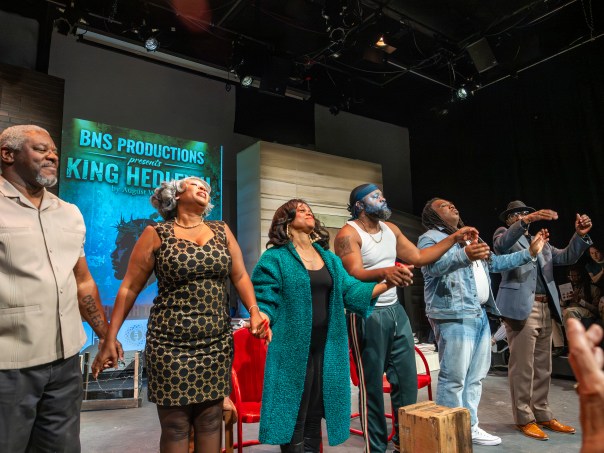
With over 3,300 No Kings protests popping up across the USA and on three other continents last weekend, you can go ahead and call BNS Productions’ local premiere of August Wilson’s King Hedley II an example of serendipitous or awkward timing. But you couldn’t deny that Wilson’s tragedy, the first BNS piece to be staged at the Arts Factory, was timely.

While a record eight million US citizens took to the streets, many reclaiming turf that was only recently terrorized by ICE G-Men chasing down an imaginary alien threat, basic living conditions of the 1980s, shown vividly by Wilson in all their wildness and squalor, still plague our inner cities. Religion, magic, and honest hard work offer no surer cure than guns, crime, and hopelessness.

Wilson’s clear vision and wisdom targeted the Hill District of Pittsburgh, illuminating each of the decades in the 20th century from a distinctively African-American perspective, forming an incomparably epic ten-play Century Cycle. In some ways, The Century (or Pittsburgh) Cycle is also incomparably complex. Some characters appear in multiple decades, while others mentioned in one of the dramas appear onstage in another.

In achieving his Cycle, to further complicate matters, Wilson did not move through the decades of his Century chronologically. Amid this seeming haphazardness, King Hedley II, commemorating the 1980s when it opened in 1999, anchors the most cohesive trio of plays in the whole series.

King’s father appears in Seven Guitars,the 1995 play that Wilson wrote immediately before Hedley II, along with Ruby and Elmore – but we see them four decades earlier in the 1940s, when King Jr is in embryo. Prominently mentioned in Hedley II, Aunt Ester will finally be seen, some 81 years younger, in Gem of the Ocean, the first play in the overall Cycle, premiering unforgettably on Broadway in 2003, starring Phylicia Rashad, depicting the 1900s decade.

If, as Wilson has said, Aunt Ester is a folk priestess who symbolizes the weighty history of African American tragedy and triumph, then her death at age 366 during Hedley II marks an unmistakable low point in the Cycle. The tempest of contention that breaks out at her home in Radio Golf, both the final play in the Pittsburgh Cycle (depicting the 1990s) and Wilson’s final work, can be viewed as piling insult onto injury or as a kind rebirth.
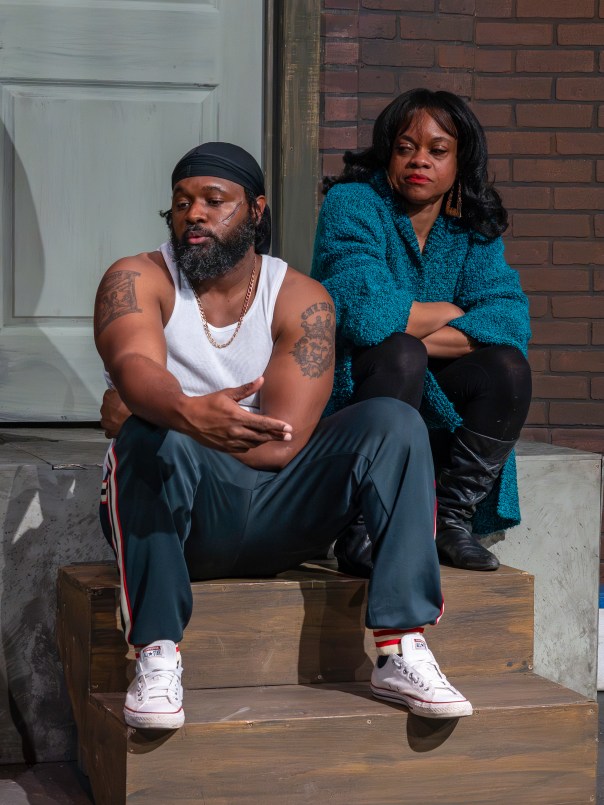
Like Hedley I, King would take it badly if anyone didn’t call him by his regal name. In fact, when we first see him, he is returning home from a seven-year stretch in prison for killing a man named Pernell, who not only slashed King’s face, leaving a permanent scar, but also insisted on calling him Champ. Hedley Sr. also committed murder for the same reason, so if you caught the Charlotte premiere of Seven Guitars in 2015, you would assume, like father, like son, that Hedley II has no regrets.

Not yet.

There’s another side to King that promises a fresh start, for he states concrete ambitions of opening a video store, a venture that cannot fail, and begins planting a garden in his front yard. Both Tonya and Ruby, the wife and mother who have held down this rundown fortress for seven years, are skeptical: they can’t believe King can follow a straight path to success. As sure as that bad dirt in their front yard won’t grow anything, King is bound to take the crooked way and land back in jail.

Hearkening back to Lorraine Hansberry’s A Raisin in the Sun, Wilson sets up a similar situation in the ‘80s to the one the Younger family encountered in the ‘50s. Only Wilson’s is a far bleaker view. Walter Younger held down a job, started a family, and his little sister had middle-class dreams and prospects.

King is more primal and dangerous than Walter, no less easily swayed and played. You’d better not stomp on those seeds King planted, though he sees the common sense of fencing off his little plot to prevent accidental incursions. Barbed wire, a bit aggressive, is his choice for fencing.
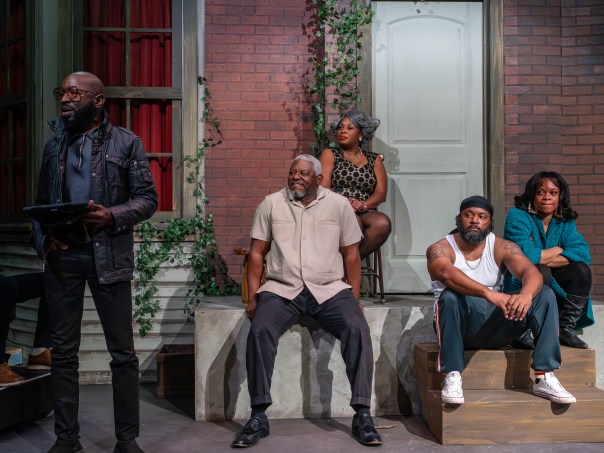
We can hope that the GE refrigerators that King and his best friend, Mister, are selling around town came from a legitimate source, but Tonya knows her man better than we do and presumes they’re stolen. An additional reason to trust Tonya’s misgivings comes when Mister proposes a heist at a jewelry store that he has cased.

Meanwhile, smooth-talking gambler Elmore is back in town with an eye toward reclaiming Ruby, getting married, and settling down. Proof of his wiliness comes after he talks King into letting him in on the GE scheme. Smooth operator, but he’s playing with fire. Even Mister knows better than to shoot dice with Elmore until he can bring a crooked set to the game.

Toi Aquila R.J., who also portrays Tonya, has a secure grasp of the costume designs that give each of the major characters his or her own distinctive style. There is black menace for King, a Sporting Life hipness for Elmore, and a diva flair for Ruby, the former big band vocalist. These core four are the strongest performers in director Rory Sheriff’s shrewdly chosen cast.

Much of the power that Jonathan Caldwell generates as King comes from those moments when he is open to reason, yet still seething somehow in these calmer moments. Explosions seem impending and inevitable. Tim Bradley as Elmore, on the other hand, sports a weaponized smile that conquers the ladies and confounds the men. As Ruby, Myneesha King gets to impress by belting a few bars, yet there’s no less sass in how her Ruby sees through both her son’s and her lover’s lies while succumbing to them.

For all that he packs into each of his plays, Wilson is anything but concise. Aquila’s anger as Tonya is as towering as her husband’s, and her monologue arguably encapsulates the passions and grievances that the playwright expresses most powerfully.

Yet there are ancient Greek elements artfully woven into Wilson’s script. Not knowing who you or your parents really are goes all the way back to Sophocles, most famously in Oedipus Rex, but the more overt thread in Hedley, the true prophet cursed with never being believed, goes back to Aeschylus and his pitiful Cassandra. Here in Pittsburgh this time, it’s Stool Pigeon, with Tone X laying heaps of Scripture on us all – and Wilson’s most delicious line:

“God’s a bad motherfucker.”

Now there’s some Greek attitude! Rounding out the cast is Andrew Monroe as Mister, appropriately the most inexperienced actor playing the most ordinary character. Not only does Mister bring King’s plight down to earth and help universalize it, but he also fails to move King with his pleadings – and to match his uncontrollable machismo when the heist goes down.

Deadly conflict between King and Elmore seems as foreordained as a dark storm first viewed on the far horizon. The best and zestiest view is at the Arts Factory through this weekend.

New Sheriff Greenlights a Complete Cycle

Preview: Two Trains Running

By Perry Tannenbaum

DSC05583

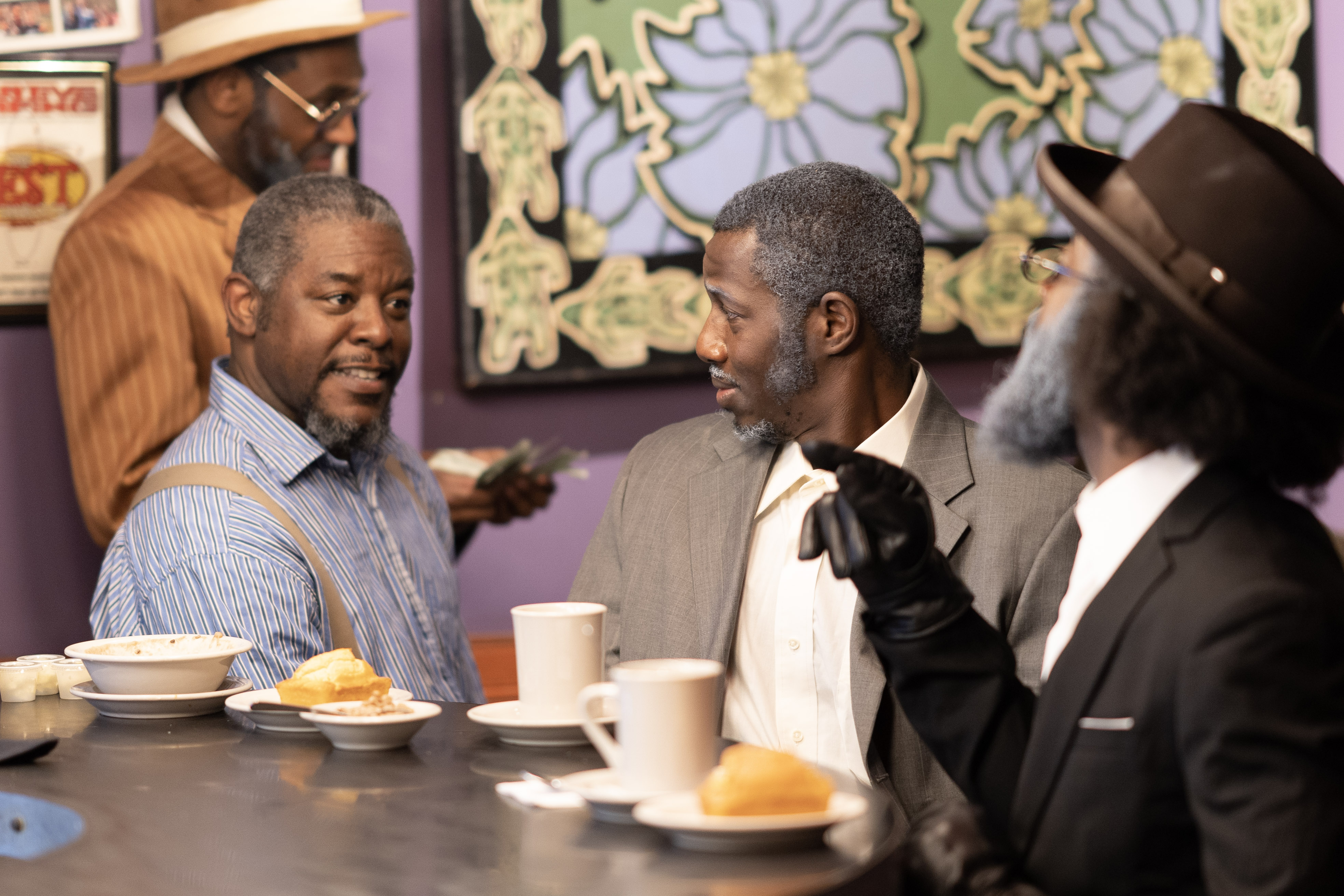
Rory Sheriff, the founder and producer at Brand New Sheriff Productions – and the author of two works staged at Spirit Square, Be a Lion and Boys to Baghdad – has a special affinity with the work of August Wilson. After presenting Wilson’s Jitney at Duke Energy Theater in 2017, BNS is back this Thursday with Two Trains Running, another drama from Wilson’s acclaimed 10-play Pittsburgh Cycle.

The special appeal of America’s pre-eminent black playwright for Sheriff is twofold – as a writer and as a Pennsylvanian.

“As a playwright myself,” Sheriff explains, “I am fascinated with August Wilson’s style of writing, more so the characters he writes about. Growing up in Reading PA, I can relate to every last character, situation and location he speaks about in Two Trains Running. The beautiful thing is I can now see and understand these people from an adult point of view. They are my dad, his friends, my uncles, my neighbors. I guess what I’m trying to say is I’m reliving my childhood through the works of Mr. Wilson.”

Each of the plays in Wilson’s Cycle is set in a different decade of the 20th century, and all of them are set Pittsburgh’s Hill District, except for one Chicago excursion representing the 1920s, Ma Rainey’s Black Bottom. The only play that predates Ma Rainey was the one Sheriff first plunged into, Jitney, which premiered in 1982 and represents the 1940s. By the time Two Trains, representing the 1960s, premiered in 1990, Wilson had already finished six of the plays in his Cycle.

So Sheriff has honed in on decades that his dad and uncles would recognize, but as he takes us back to the days of Malcolm X and the rise of the Black Panthers, Sheriff is promising that Two Trains won’t be his last stop.

“Yes,” he proclaims, “BNS Productions is committed to producing all ten of Mr. Wilson’s works. We will produce at least one of his works every season. Here’s an exclusive: We will be ending this season with Jitney, and next season we will be doing Radio Golf.”

This extraordinary announcement comes during an extraordinary launch of Black History Month, with three theatrical productions featuring black performers opening in the same week – making some unprecedented Charlotte history. While Theatre Charlotte is waiting until the first of the month on Friday to open Ain’t Misbehavin’, Actor’s Theatre is jumping the gun, officially opening Nina Simone: Four Women on Wednesday.

None of these productions is miniscule, testifying to the depth of black acting and musical talent across the Queen City. So the time is ripe for Brand New Sheriff to be making bolder, more confident and ambitious plans.

Sheriff is definitely packing some high-powered ammunition onstage for Two Trains.

DSC05863

“All of the actors in Two Trains Running have been in at least one Wilson play,” says Corlis Hayes, who will direct. Hayes is no slouch herself. Combined with the four she has directed at CPCC, where she teaches in the drama program, Hayes has now directed six of the 10 Pittsburgh plays, including the two Pulitzer Prize winners, Fences and The Piano Lesson.

Like Jitney, the action in Two Trains Running takes place in a building slated for acquisition and demolition by City of Pittsburgh. The wrongheaded concept of urban renewal evidently had a cancerous grip on black community life for a long time. Here it’s a restaurant rather than a gypsy cab company facing its doom, and the restaurant owner, Memphis, is our protagonist. He’s holding out for a fair price on his property – against the lowball bids of both the city and the ghoulish, rapacious West, who owns West’s Funeral Parlor across the street.

DSC05592

Memphis also has some unfinished business back in his hometown of Jackson, Mississippi, where he was driven off his land many years earlier and not paid a dime. He’s typical of the black men in Wilson’s plays, struggling against a system that white society has rigged against them. Echoing that reality – or responding to it – men in both Jitney and Two Trains Running play the numbers, hoping that luck will supply the boost that honest work doesn’t.

Recently discharged from prison, another recurring Wilson motif, Sterling is trying to interest Memphis and his male customers in attending an upcoming Black Power rally. Jonovan Adams, who has performed in all the Wilson plays that Hayes staged at CP, will portray the restless, volatile Sterling. Activism isn’t his only pursuit: he asks everybody he speaks with for a job or at least a lead, and he’s persistently trying to make headway with Risa, Memphis’s troubled waitress.

DSC05659

Estranged from his wife, Memphis seems to have a blind spot when it comes to women. Debating with Holloway, one of his older customers, about why Risa has mutilated herself, Memphis labels her dangerous while Holloway sees her as searching for someone who will love her true inner self.

“I feel both of these men hit on some truths about Risa,” says actress LeShea Nicole, whose previous venture into Wilson’s world was as Vera in the On Q Performing Arts production of Seven Guitars in 2015.

“Dangerous is definitely not a word I would use to describe Risa, because she never resorts to violence or threats, but I believe she feels ruined from some form or forms of abuse that she encountered in her past that has caused her to shut down socially/emotionally and even distort her appearance. Risa may feel ruined, but not beyond repair. She seeks guidance and solace from Prophet Samuel, which, in my eyes, equals hope.”

Working on her second Wilson drama, Nicole is switching companies and directors. The legendary Lou Bellamy, founder of Penumbra Theatre Company in St. Paul, Minnesota, worked directly with Wilson on multiple occasions. Bellamy not only directed Nicole for On Q, he also directed her as an understudy for the Blumenthal Performing Arts production of The Mountaintop that played at Booth Playhouse in 2014.

In their first-ever collaboration, Nicole says that Hayes measures up.

DSC05797


“I am extremely pleased and energized with her process of directing,” Nicole says. “She’s well versed and makes it her mission to stay true to Wilson’s vision. Dr. Hayes allows actors to explore, find depth in our characters and tap into our creative freedom without jeopardizing the integrity of the production. It is a tricky balancing act that she masters effortlessly. Hayes’ extensive acting career truly makes her an ‘actor’s director’ which is wonderful.”

Whether it’s Prophet Samuel, who lies in state at West’s funeral parlor, or it’s hitting the numbers; whether it’s promoting a Black Power rally or gleaning wisdom from the mysterious Aunt Ester, a 322-year-old soothsayer; the people of Two Trains Running are seekers. The emphasis on ritual especially sets this play apart from other plays in the Pittsburgh Cycle, according to Hayes, but there’s still a common thread.

“Always with Wilson,” Hayes observes, “reunion and reconciliation with the past heals the wounds of the present, bridges gaps between loved ones, and clears the path for a promising future.”