Review: Stereophonic @ Knight Theater
By Perry Tannenbaum
Pressure and deadlines are good for creatives. Or as Duke Ellington famously put it, “Necessity is the mother.” What David Adjmi’s Stereophonic explores – at excruciating length – are the consequences of no time pressure at all. Adjmi’s band, not named and not quite historical, closely tracks with Fleetwood Mac in the 1970s as they returned to their studio to cut what would become their megahit Rumours.
With music by Will Butler worthy of a supergroup, Stereophonic was a megahit in its own right, scoring a record number of Tony Award nominations and winning the top prize. For the ensuing national tour, now at Knight Theater for a rare second week, Adjmi and director Daniel Auken have cut into the show’s notorious four-act, four-hour bulk, so that the tourismo model arrives at a trim, but still overweight, 2:45 running time.
The group’s first album climbs to the top of the charts as they go deeper into hibernation, rehearsing, refining, composing, and crafting their more and more eagerly awaited sequel as expectations climb. But producer and lead singer Peter has no deadline to answer to, no set limit on whether the new release will be a single or double album, so new songs can be added on the fly while others, recorded earlier, can be shelved.
For the 1970’s, that was fairly outré. Such highly produced CTI jazz albums as Milt Jackson’s Sunflower, Airto’s Fingers, Ron Carter’s All Blues, and Hubert Laws’ In the Beginning (a double album), all recorded at the famed Van Gelder Studio, were produced in four days or less. Not enough time for an epic Fleetwood Mac soap opera, though no less music was released.
In line with the Sonny & Cher/Ike and Tina Turner/Lindsey Buckingham-Stevie Nicks template, lead singer – and Peter’s life partner – Diana is about to emerge as an industry supernova. That seems to fluster the not-so-subtly controlling Peter, a taskmaster and a perfectionist. Nor is perfectionism confined to the glamor couple. Band manager Simon can obsess for days over a phantom rattle in his drum kit after buck engineer Grover first detects it. And days more after Grover stops hearing it.
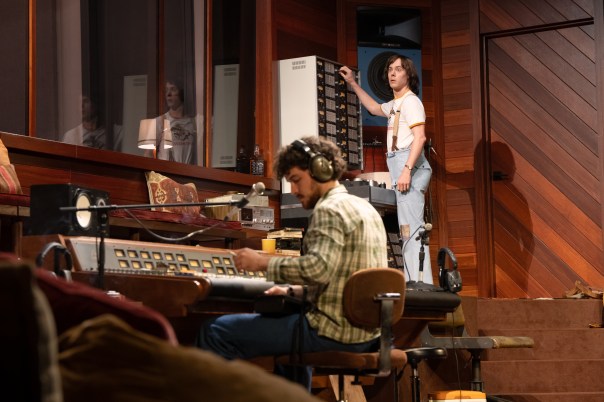
We can see that the claustrophobia of a group recording gig that goes on for over a year can wear on Diana and Peter’s already patched-up relationship. Naturally enough, Simon’s ongoing separation from his family pitches him gradually toward depression and moodiness. Less overtly, we can watch Grover’s growing confidence at the control board and his burgeoning influence over the band.
So yes, songs and takes can grow in polish and cohesion while they wane in energy and spontaneity. Compound that natural entropy with a souring romantic chemistry between two lead singers.
That’s when Grover’s new influence is crucial to the process. After numerous rehearsals and fine-tunings, the engineer at the control board notices that energy, spontaneity, and tempo have all sagged on one of the best tunes. Now Grover, previously a hanger-on who has falsified his resume to land this prestigious gig, grabs the driver’s seat and keeps prodding the band, through retake after retake, towards more authentic fire.
Animosity can be an obstacle or a creative trigger at this point.
By default, another lead singer composer, ace keyboardist Holly, becomes the most stable band member when Simon and his British cool unravel. Her emergence becomes all the more marked as she deals with her husband Reg’s increasing alcoholism, a drag to the whole band since he’s the bassist.
Holly’s relative stability enables Emilie Kouatchou to seize the dubious distinction of being the most consistently under-projecting actor on the Knight stage. Intimate conversations between the women, warmly spotlit by lighting designer Jiyoun Chang, were particularly difficult for me to decipher.
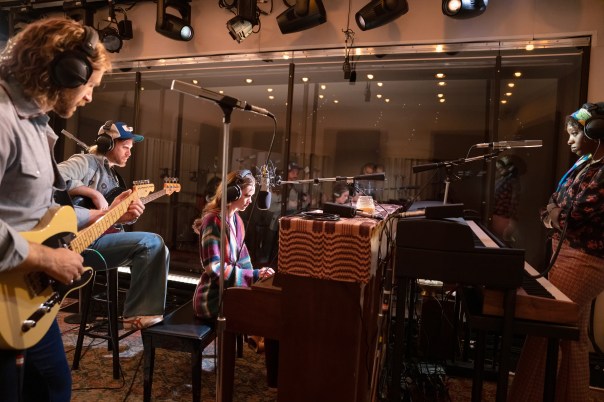
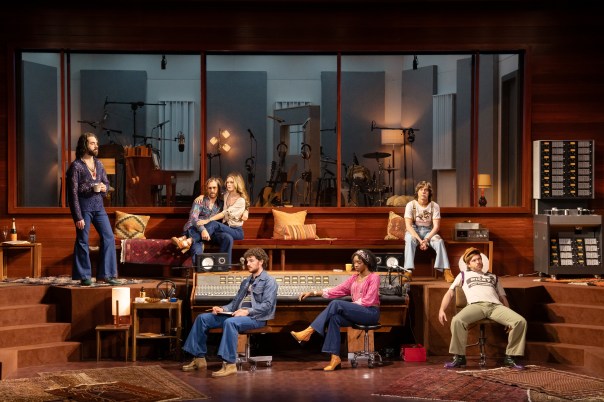
That sets up a bit of a paradox, for the control room/lounge area of the studio is closest to the audience, while the glassed-in recording studio is elevated a third of a flight up behind it. And of course, this actor band is really playing, simulating the 1976-1977 studio conditions, so the music is presumed to be recorded on real 3M reel tape, with multiple tracks mixed down to piddly two-track stereophonic.
Obviously, sound reaching us from that the more distant, highly-controlled electronic environment is cleaner – and more immediate – than the more mundane sound that’s closer to us downstage. You get the feel, since musicians gather there far less frequently than for their more casual, personal, technical, and candid conversations below, that dazzlingly brighter, hazier studio space is a loftier place in every way.
Foremost, because we sense that history is unfolding there.
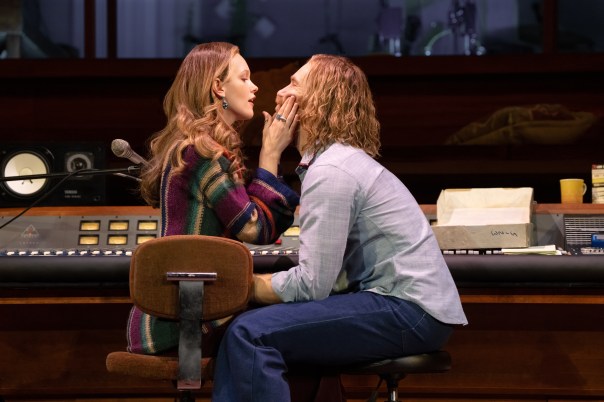
Leaving the studio for a private argument offstage, Peter and Diana inadvertently demo the improved audibility of the hallowed ground when they leave their mikes on. Not only can Grover and fellow sound engineer Charlie hang on the power couple’s every word, so can we, adding a patina of hilarity to the backstage drama.
Drug use might be considered another bugbear threatening the group’s enterprise, but nobody in the band seems to be worried about the pigs busting in on a raid, despite the readily visible gallon-sized bag of cocaine. The dust makes it inside the studio, where Diana and her bandmates take a snort or three to perk themselves up, but no joints are lit up there. These are professionals.
We wait long enough for this supergroup-in-the-making to begin recording extensively in the studio to be starving for the serious rock we’ll hear – and that enhances the already rich gratification when we finally do. This is one very tight band, both vocally and instrumentally. A slight overlay of suspense when the women began their vocals. With both Kouatchou as Holly and Claire DeJean as Diane facing their respective studio mics in profile, I couldn’t detect whose solo led the take off.
I was more comfortable with the other key undetectables, knowing that virtually all other audience members were equally clueless: about cuts to the script and the playlist that happened in transit from Broadway to the road, and maybe along the road to Charlotte. Neither of the two scripts was available from Blumenthal Arts, so I couldn’t begin to weigh how much Adjmi and Butler’s “Radio Edit” strengthened or weakened the Broadway version that won five of the possible 10 Tony Awards it was up for.
No less than five members of that were nominated for the two Featured Actor laurels, so the record total of nominations was 13.
Sometimes, more is more. At no time would I agree with the NY Times assessment that Stereophonic is “a fiery family drama, as electrifying as any since Who’s Afraid of Virginia Woolf?” Ironic for a drama that dramatizes the pitfalls of an open-ended incubation process, Stereophonic may feel longer because, with so many microaggressions redlined, the “Radio Edit” may never have had the potential of rising to the heights – or rage – of Edward Albee’s masterwork. Or Tracey Letts’ more recent August: Osage County.
Other than their sonic dropouts, a serious matter for me, I couldn’t find any fault with the “Travelin’ Light” cast. They played and sang flawlessly, even on the outtakes. Maybe a blinking metronome, hidden from us, guides those oh-so-gradual increases in tempo. Only the enthusiasm level notches up noticeably when they find the true groove.
As Diana’s confidence, independence, and star power grew, it became more and more difficult to take my eyes off DeJean’s performance. Intermittently, thanks to costume designer Enver Chakartash’s alternating flair and reserve, Diana goes from fretting over the onset of her fame to wearing it. In the studio, there’s a parallel transformation (it may have been more correctly called an evolution in the longer version).
She seemed comparatively glued to the microphone during the first extended studio take. By Act 3 (after the only intermission), Diana roams the studio like the rock diva she has become, deigning to approach the microphone only when she sings. Ascending to rock royalty, she no longer asks Peter what she can do with her hands, no longer pleads with him to pick up a tambourine.
She just does it. From demure to diva, DeJean alluringly navigates all the curves and all the romantic bumps on the road to superstardom as the artistic flame within her burns more and more brightly and defiantly.
To be clear, Peter isn’t nearly as toxic as Ike Turner was in The Tina Turner Musical, so Denver Milord gets to play a far more nuanced role here. Yes, he is more than a little peacock-ish, but from the early moments, if you take notice of his reactions toward the debut album’s continued ascent on the pop charts, he is ambivalent about the band’s success.
This is partly to his credit, though we have more reason to detest Peter’s jealousy. Like Ike, we have to acknowledge that he’s a shrewd judge of talent who fiercely follows his instincts. So that male ambivalence that Milord plays, distasteful as it might be, also stems from his inability to even imagine resorting to Ike-like violence to keep Diana with him.
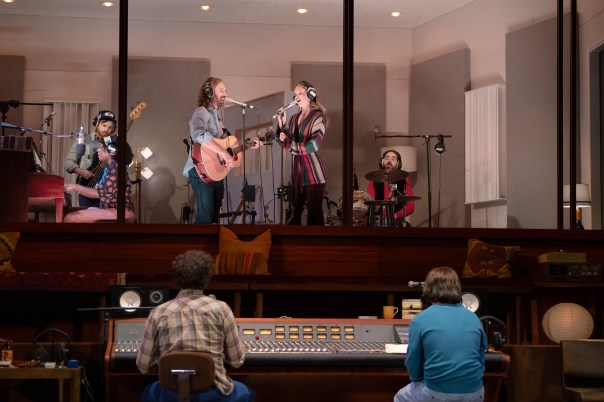
Ultimately, he sings like a god, she reigns like a goddess, and they produce a masterwork together. We are right to cut Peter some slack, particularly when Milord reveals his ability to earnestly apologize.
Extra kudos go to Milord and Kouatchou, both of whom understudied their touring roles on Broadway. It had to be brain-busting to unlearn so much of the original version while learning the new script and song arrangements.
Otherwise, it’s Christopher Mowod as Reg who garners the most attention, half amusing and half annoying. His pre- and post-alcoholic manifestations were remarkably balanced in drawing my delight and disdain, yet radically different. Even the concept of his character arc had a clever mirror-like reversal.
When he was most boisterous and boozy in the control room, Reg was literally self-effacing in the studio, devoutly facing away from his bandmates and the audience. Flip to the serene Reg 2, with a simplified wardrobe from Chakartash, he’s almost Maharishi-like outside the studio, but much more of a gregarious animal when he straps on his axe.
That’s another advantage of recording a new album within the time pressure of a single week: the same people play on all of it.