Tag Archives: Sung Lee

NC Baroque’s A Musical Offering Merits Enthusiastic Acceptance

Review: A Musical Offering @ Davidson Bach Festival

By Perry Tannenbaum
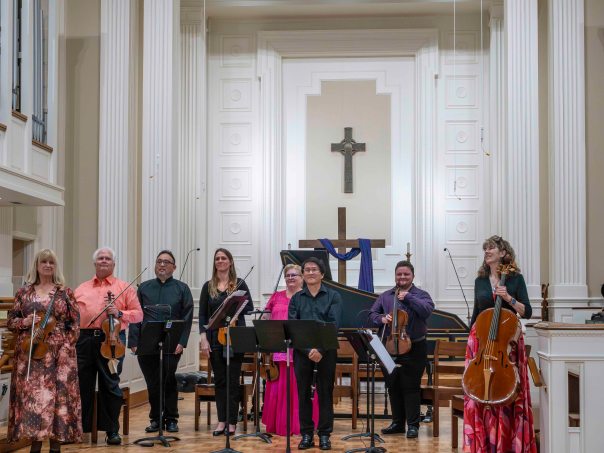
March 7, 2026, Charlotte, NC – Since I hadn’t reviewed a North Carolina Baroque Orchestra performance at Davidson College Presbyterian Church in over 10 years, you are welcome to conclude that my return trip this past weekend was also my first sampling of the Davidson Bach Festival, which launched its first season slightly less than a year ago. In some respects – age, size, duration, number of venues, and variety – the Davidson fest is like the Charlotte Bach Festival in miniature. They don’t import a world-class chorus or perform the mighty masses and oratorios, and they don’t offer noonday lecture concerts with choir, orchestra, AV presentations, and scholarly erudition.

Yet there are aspects of this relative simplicity that can be prized. Unlike the Charlotte fest or the Oregon Bach Festival, its regal template, Davidson hasn’t ventured beyond Bach so far. Nor has it hopscotched around the city or the college campus, cleaving exclusively to the Presbyterian. Upon reacquainting myself with that sanctuary, I found what many would consider an advantage. Although the organ at St. Peter’s Episcopal, in uptown Charlotte, can speak in earthshaking thunder, an organist performing a concert for over an hour at Davidson Presbyterian can be viewed far more comfortably. You have to turn around in your pew to even glimpse the organ and the organist at St. Peter’s. Even then, you’ll only see his back, often at a greater distance, and always in dimmer light.

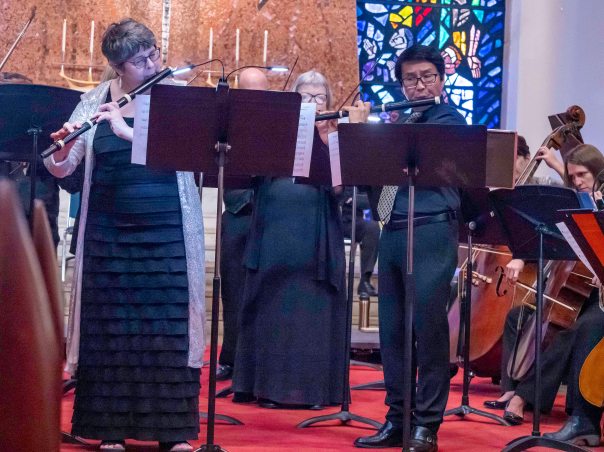
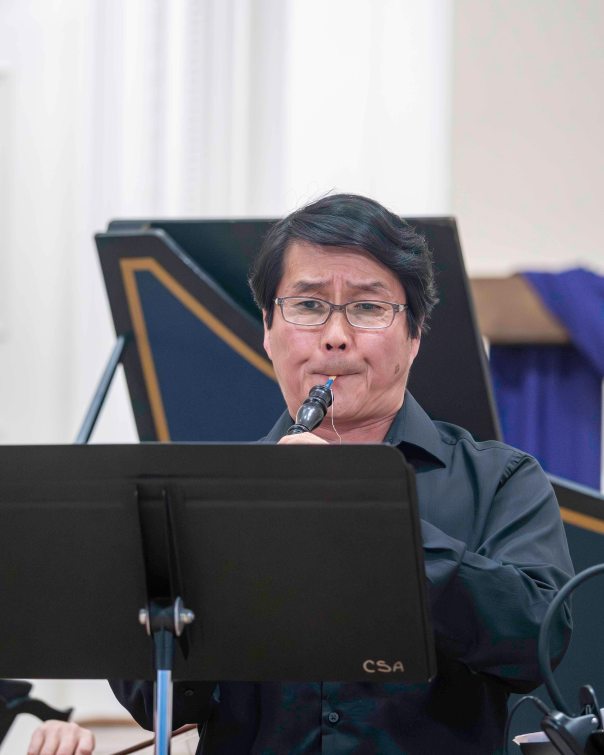
That was my only pang of regret when I opened the festival program and recalled that the “Bach Birthday Bash” with award-winning organist Chase Loomer was scheduled for the following afternoon. Meanwhile, “A Musical Offering,” with three Bach concertos (culminating in a Brandenburg) and a Trio Sonata from his Musikalisches Opfer, would provide ample consolation for missing tomorrow’s rumble. Playing lead oboe or flute on three of the four pieces, Sung Lee was certainly going to draw the most scrutiny.
On the other hand, harpsichordist Francis Yun seemed destined to lurk inconspicuously behind the other musicians until the opening movement of the treasurable Brandenburg Concerto No. 5. Unless you were already with the epic harpsichord cadenza in the opening Allegro, you had little idea how emphatically Yun would emerge.

The same can be said, of course, for the myriad Bach compositions known to us chiefly by their featured instruments and BWV numbers. Familiar melodies lurk in them that multitudes of music lovers will instantly remember, but only specialist musicians and musicologists can anticipate. For most of us, Bach’s delicious Easter eggs are only further scrambled by the multiple times he might repurpose his best melodies in various compositions.

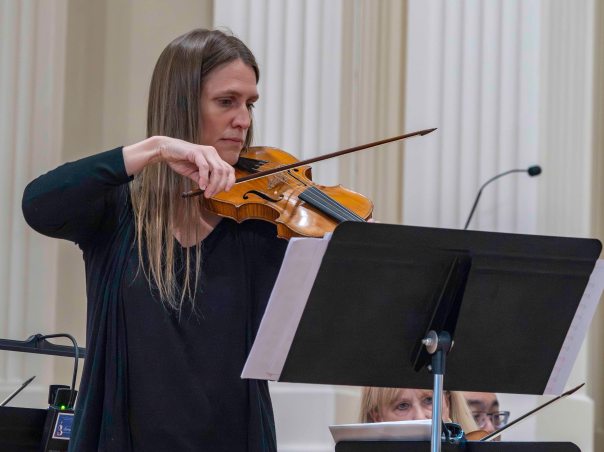
The Concerto for Oboe and Violin in C minor, BWV 1060r, starting off BC Bach’s “Musical Offering,” is an apt example. Starting out as a concerto for two harpsichords and strings, it was recast into a Violin and Oboe version. Either way, there were sighs of satisfaction – and relaxation – when the melody of the opening Allegro was recognized with its delightful echo motif. Lee was partnered with violinist Jeanne Johnson for the main instrumental interplay, perhaps even more beautifully in the middle Adagio movement, because it sounded less familiar, with a more minor-key flavor. As one becomes more experienced as a listener, one appreciates the variety of Allegro that sensitive and discerning soloists bring to the stage. The closing Allegro here was brisker than the earlier one.
Even if you were sitting in the second row, as we were, the hall was part of the sound, softening it. Yet the second piece, the Trio from A Musical Offering, was more subdued in various ways. The ensemble was reduced by half to four players, and all were seated in a chamber music style. Compared with recent recordings we might sample on Spotify or Apple Classical, NC Baroque’s chamber ensemble played the second movement Allegro conspicuously slower after a perfectly judged Largo with gorgeous counterpoint.

Lee, Yun, violinist David Wilson, and cellist Barbara Krumdieck meshed beautifully throughout, rightly reveling in the sonority of the penultimate Andante, which is always slowed down – even on the Kujiken brothers’1994 recording, the best of the bunch. Less of an outlier than the earlier Allegro, the concluding movement was also a bit lethargic, better propelled by Krumdieck’s continuo. Overall, the interpretation aligned best with the 1974 recording by the Academy of St. Martin in the Fields, where the middle movements are marked Allegro Moderato and Andante Larghetto.
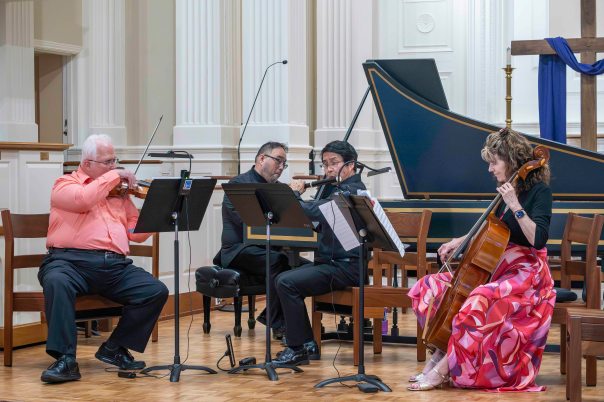
Everything about the E Major Violin Concerto No. 2 sounded wonderfully familiar to me, even the slow movement. Bach lovers could have come to the catchy melodies through this BWV 1042 violin version, almost perfectly judged at Davidson Presbyterian by soloist Janelle Davis, or a subsequent BWV 1054 harpsichord version, pitched a full step lower. Davis was very close to the speed that unlocks the opening Allegro’s full flair and immersed herself lyrically in the middle Adagio. But it was Davis’s joyful playing in the closing Allegro assai that made this Concerto such a tough act to follow.
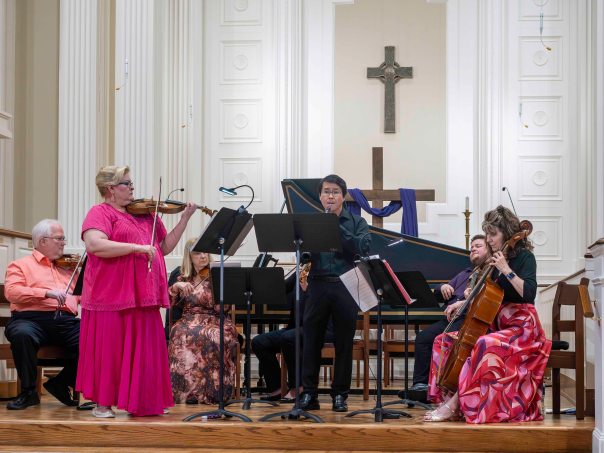
In hindsight, Davis’s joyous tempo provided the perfect launching pad for Yun’s prodigious three-minute rampage, climaxing the opening Allegro of the Brandenburg 5. Tempo-wise, the whole movement was perfectly grooved. A little more ardor from Lee in the middle Affetuoso would not have been amiss, but we ascended to a far loftier plane when Bach’s harmonies flooded the music. Though a little less prayerful and sublime than the opening Allegro, the final movement of this immortal concerto – especially appealing with Lee sparkling jubilantly – is no less quintessentially Bach and baroque. Every time we recall these bookended gems, we realize that they’re living inside us all the time.

Heinichen Highlights NC Baroque’s “Magnificent” Concert

Review: Magnificent Baroque at St. Mark’s Lutheran

By Perry Tannenbaum

August 8, 2025, Charlotte, NC – Baroque music may not be synonymous with magnificence, but magnificence was arguably what baroque composers strove for most ardently in their music, particularly in a sacred setting. Little wonder, then, that over 80 percent of baroque music concerts in the Metrolina area are performed in churches – or that St. Mark’s Lutheran Church has now hosted the area’s three foremost baroque ensembles, Carolina Pro Musica, Bach Akademie Charlotte, and The North Carolina Baroque Orchestra.

Though based in Davidson, musicians in the Orchestra hail from more than ten different states across the US. Currently in their fifteenth year, they are still led by their sister co-founders, artistic director Frances Blaker and executive director Barbara Blaker Krumdieck. Ailing in San Francisco, Blaker yielded her conducting chores to concertmaster Martie Perry. Titling their St. Mark’s concert “Magnificent Orchestral Music of the Baroque,” NC Baroque wasn’t obliged to stray far from familiar composers or their warhorses. Yet even with J.S. Bach and Antonio Vivaldi on the program, the selections were all adventurous, with works by Johann David Heinichen and Joseph Bodin de Boismortier in the mix.

It’s never a terrible idea to begin with Vivaldi, but the Concerto in D minor was especially apt, since it allowed opportunities for both our co-hosts, Perry and first cellist Krumdieck, to immediately swing into action. Indeed, the chief delights of the opening Allegro were the exchanges between the two violinists, Perry and Annie Loud, and the phalanx of four cellists led by Krumdieck. The slow movements, an Adagio and a Largo, were charming, but the Allegros following them underscored one of the chief characteristics we cherish in Vivaldi, his abrupt changes in tempo and dynamics.

Vivaldi wrote over five hundred concertos in his lifetime, hundreds more than the famously prolific Georg Philipp Telemann, so NC Baroque had no problem unearthing repertoire that we had never heard before – or outside the familiar keyboard and string orbit. Fourteen oboe concertos and over 40 bassoon concertos are out there, to cite a couple of examples. Still, it’s a labor of patience, endurance, and discernment for the ensemble to settle on a single Concerto for Two Flutes in C (RV 533) – and from that three-movement concerto, to single out the opening Allegro molto. For the occasion, Sung Lee and Barbara Norton rose from the front pew of St. Mark’s, took their places centerstage between the violins and the cellos, and played flawlessly on their authentic instruments. What a lovely blend.

Krumdieck did the honors in introducing the double flute Vivaldi, but it was Perry who introduced the rarely-heard Heinichen, perhaps being offered for the first time in the region. Our Cultural Voice index mentions the German just twice over the years, both at performances in the Triangle Area: a Sonata for oboe, viola, and harpsichord, played in Raleigh by Mallarmé Chamber Players in 2015, and two unspecified Dresden Concertos played at the American Dance Festival in Durham two years earlier – likely through loudspeakers – accompanying a new work, Perpetual Dawn, by the Paul Taylor Dance Company.

If Spotify and Apple Music are to be trusted, virtually nobody knew about Heinichen until 1993, for that was when the much-lauded 2-CD collection of 11 Dresden Concertos was released on the Archiv label, performed by the Musica Antigua Köln led by Reinhold Goebel. My own familiarity with Heinichen, many of whose works were destroyed in the Dresden bombings of 1945, began shortly after reading a rave review of the recording (and Goebel’s introductory essay) in Gramophone.

On this night, the Concerto Grosso in G major (S. 215) and the Concerto Grosso in F (S. 232) – apparently Heinichen’s favorite keys – were the highlights, delivering the most magnificence. They were rightfully presented in ascending, chronological order, the G major after the Vivaldi works and the F major as the program finale after a sheaf of Bach Sinfonias. Again we would hear Lee and Norton on their flutes, but both Heinichen scores added a pair of oboes, played by Will Thauer and Sarah Weiner, that clashed rather than blending with the other winds.

After the first Heinichen, the two movements from Boismortier’s comic ballet, “Don Quichotte chez la duchesse,” were more than pleasant. My only problem with the performance was finding myself oversold on Perry’s tasty intro. Never did detect the promised windmills or underworld in the music, and if Mendelssohn had done Sancho Panza’s donkey, I’m sure little Rucio wouldn’t also have eluded me. Yet the Overture and Chaconne by the Frenchman provided a nice transition to the unique Bach segment of the program: four introductory instrumental pieces from four Bach Cantatas, an interlude comprised of four preludes.

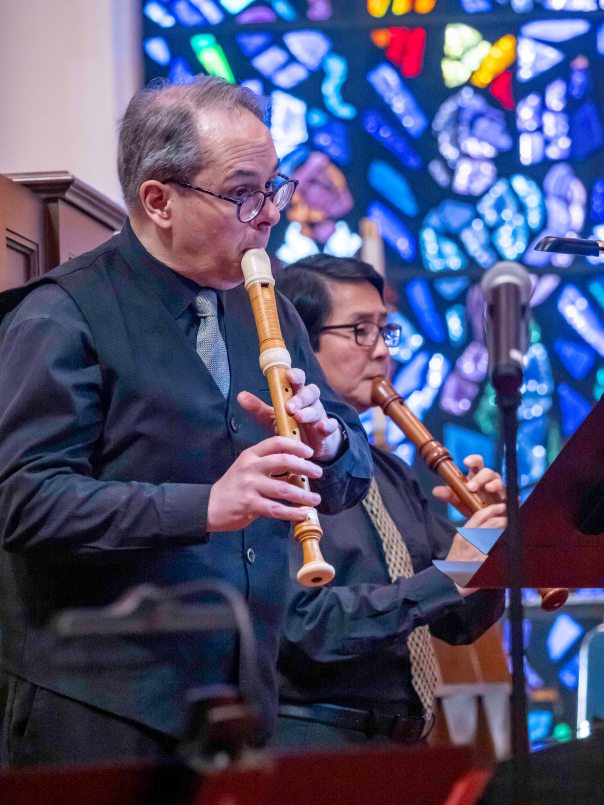
All of these pieces were well chosen, none of them coming off like background Divertimentos or lackadaisical baroque elevator music. They offered fresh opportunities for soloists to take on different instruments. Subbing for Blaker on recorder, Weiner intertwined beautifully with Trauer’s oboe in the contrapuntal passages of the opening Sinfonia from the Tritt auf die Glaubensbahn (“Step onto the path of faith”) Cantata.

Trauer and Lee both switched from oboe to recorder for Gleichwie der Regen und Schnee vom Himmel fällt (“Just as the rain and snow fall from heaven”), bringing the Sinfonia set to a sparkling finish. Other versions you may audition on Spotify won’t sound as crisp, for it seems they’re fronted by oboes. Not that the oboes were slighted in the Sinfonia set. Weiner switched back to her customary instrument, playing beautifully on the Weinen, Klagen, Sorgen, Zagen (“Weeping, lamenting, worrying, fearing”) Sinfonia. Yet she had already been upstaged by Lee’s achingly lovely rendition of the Ich steh mit einem Fuß im Grabe (“I stand with one foot in the grave”) Sinfonia, likely repurposed from a previous concerto and subsequently recycled into the Harpsichord Concerto in F minor. Nectar of the gods.

Bach Akademie Charlotte’s Epiphany Concert Includes Schütz and Amon Appetizers in a Cantata Feast

Review: Bach Akademie Charlotte’s Epiphany Concert

By Perry Tannenbaum

2019~Epiphany Cantatas_0014

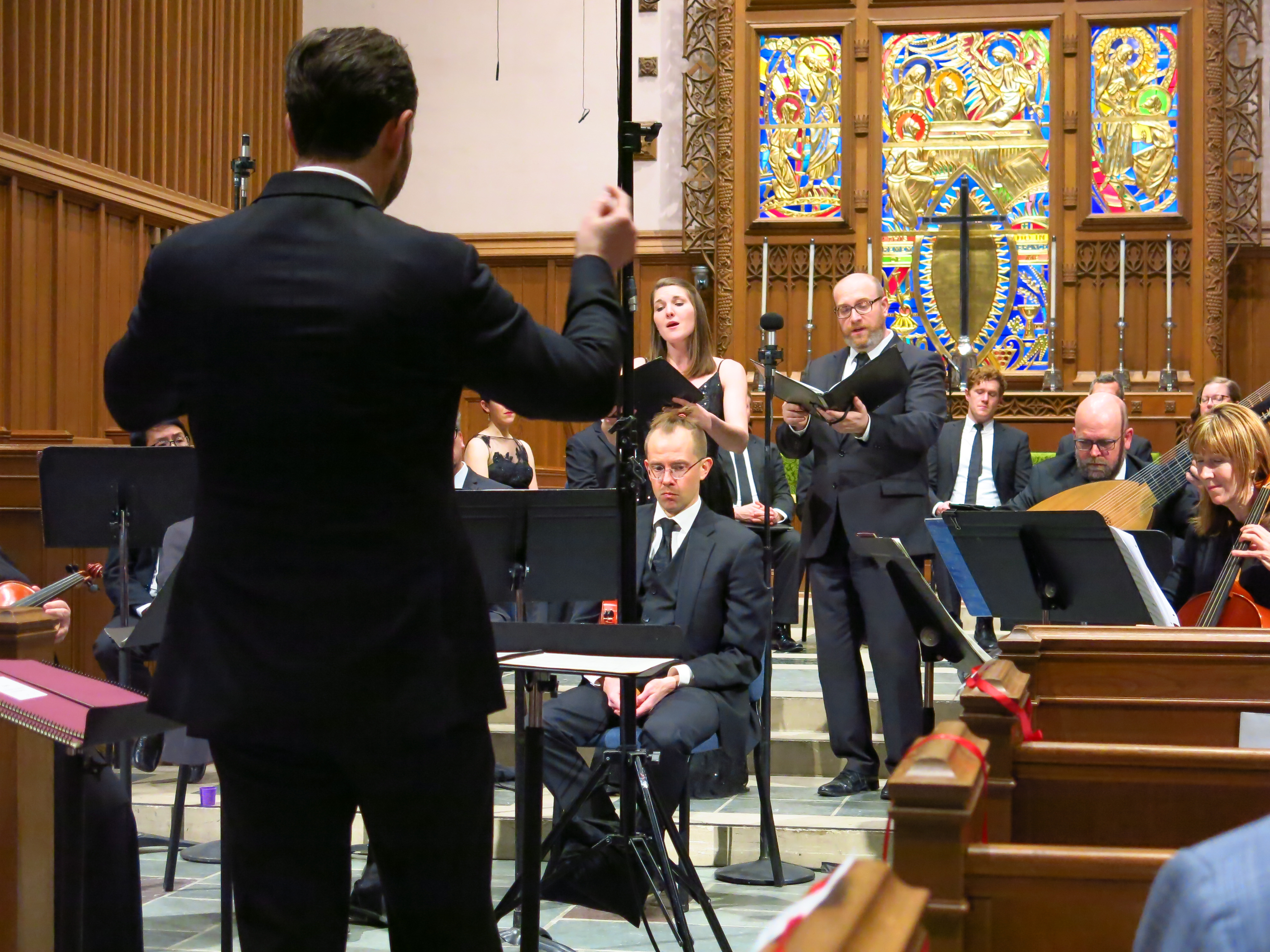
Word has spread quickly about Bach Akademie Charlotte, their professional choir, and their polyphonic excellence. After their biggest splash last spring, the first annual Charlotte Bach Festival with its Oregon Bach aspirations, Akademie reconnected with their audience in the fall with “Priceless Treasure: Bach and the Motet Tradition” at Christ Church Charlotte. They rekindled the flame in a midwinter program, “Epiphany Cantatas,” last Saturday night at Myers Park Presbyterian Church in front of a robust turnout. It wasn’t all Bach or all cantatas, with motets by Heinrich Schütz (1585-1672) and Blasius Amon (ca. 1560-1590) sprinkled in between, and while it’s always so apt to hear Bach’s sacred cantatas in a church, these were sung and played nearly four Sundays after this year’s Feast of Epiphany.

Programmed and conducted by artistic director Scott Allen Jarrett, rest assured that the concert was aptly themed on the Epiphany celebration. While the BA Cantata Choir was reduced in size to 12, about half the maximum number that performed the B Minor Mass last June, there was nothing off-season about its membership, including choristers and soloists who flew in from as far north as New York and as far west as California. The 18-member North Carolina Baroque Orchestra also sported ace guests who had traveled from afar.

2019~Epiphany Cantatas_0002

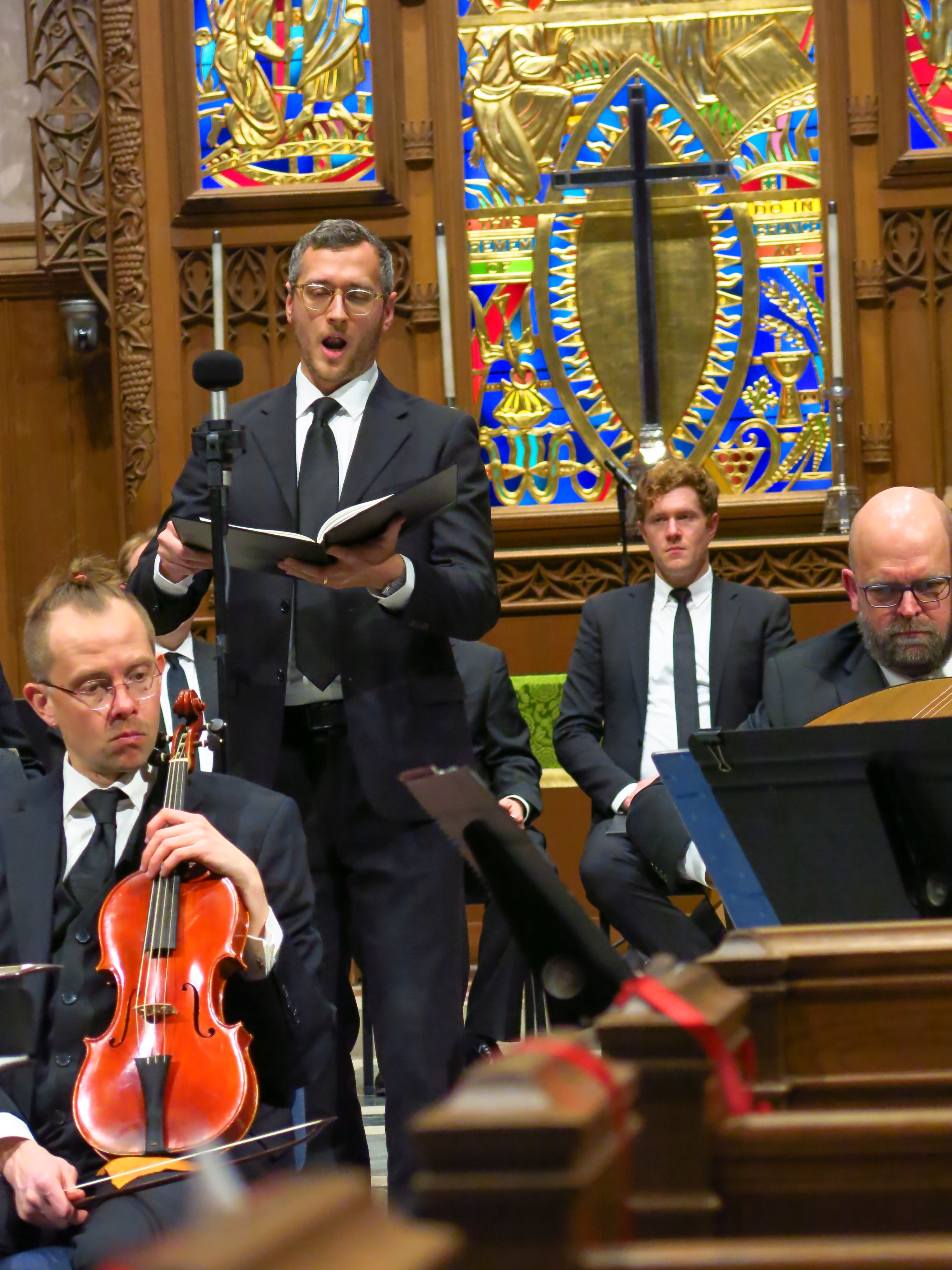
The opening piece of the evening, “Fallt mit Danken, Fallt mit Leben” (“prostrate yourselves with thanks and praise”), was easily the most extended work of the evening – but not exactly a cantata. Actually, it was the fourth part of Bach’s Christmas Oratorio and, celebrating the circumcision of Jesus, performed on New Year’s Day. Do the math, recall the Jewish custom, and you’ll know why. There’s a pretty little orchestral prelude before the chorus enters that gave hornists Chris Caudill and Rachel Niketopoulus a chance to shine, and once the Cantata Choir broke in, there were appealing spaces provided for oboists Geoffrey Burgess and Sung Lee. Burgess surpassed himself later on with his charming obbligato in the “Flösst, mein Feiland, Flösst dein Namen” (“does your name, my savior, instill”) aria where Molly Quinn floated her echoes, soprano to soprano, from upstage to Arwen Myers’s lead vocal up front.

As the Evangelist, tenor Bryon Grohman underscored the deeper significance of the circumcision, reminding us in “Und da Acht Tage” recitative that Jesus was given his name during that eighth-day ritual. Most impressive of the solo vocalists, starting with the length of his contribution, was bass baritone Jason Steigerwalt, who drew two recitatives during this piece. The first of these, “Immanuel, o Süsses Wort!” (“Emmanuel, oh sweet word!”), not only showed off Steigerwelt’s gorgeous lower range to better advantage, it pleasantly surprised us when three sopranos stood up to accompany him midway through.

2019~Epiphany Cantatas_0011

Instrumentally, some of the accompaniment for the soloists was spare, and while organist Nick Haigh played ably, a sweeter more robust instrument would have especially elevated the thinner recitatives. The Choir bolstered Steigerwalt’s second recitative, “Wohlan, dein Name Soll Allein” (“well then, your name alone”), effectively following the echo aria. Two violinists, Martha Perry and Janelle Davis, joined tenor Gene Stenger in his genial “Ich will nur dir zu Ehren leben” (“I will live only to honor you”) aria, with additional backup from Haigh, Simon Martyn-Ellis’s theorbo, and Susan Yelanjian’s violone. The two horns returned with the orchestra and Choir for the closing Chorale, raising the devotional level to exuberance and joy while repeatedly reminding us – with six mentions of the name Jesus – of the meaning of the day.

Schutz’s Das ist je gewisslich wahr, based on the testimonial recorded in the opening chapter of 1 Timothy, immediately impressed with the awesome layered entrance of the Choir in verse 15 (New RSV): “The saying is sure and worthy of full acceptance, that Christ Jesus came into the world to save sinners – of whom I am the foremost.” Radically contrasting the slow opening bars of this motet with the speed-up that followed, Jarrett and his Cantata Choir dramatized the swiftness of Christ’s coming more emphatically than I’ve heard on any recording, with a light sense of liberation emanating from the women’s voices.

2019~Epiphany Cantatas_0006

Briefly showcased as the Evangelist in BWV 248.IV, Grohman made more indelible impressions in the tenor recitative and aria of Bach’s BWV 124 Cantata for January 7, Meinem Jesum, lass ich nicht (“I will not let go of my Jesus”). With Burgess excelling again in a lovely obbligato, Grohman was especially smooth in the aria, “Und wenn der herte Todesschlag” (“and when the cruel stroke of death”), notwithstanding its wide intervals. Burgess also sweetened the opening chorus, but they were all soon to be upstaged by the soprano-alto duet sung by Margaret Carpenter Haigh and countertenor Jay Carter, “Entziehe dich eilends, mein Herze, die Welt” (“withdraw swiftly, my heart, from the world”).

Jarrett boldly speculated that Amon’s three-minute motet, “Magi videntes stellam” (“the Magi, seeing the star”), was likely the composer’s Charlotte debut. Finding that the piece represents one-third of Amon’s output available on Spotify, I won’t dispute that assertion. “Rorat Coeli de super,” mixing solo and choral vocals, would be my choice as the best of the three Amon titles I’ve heard, but the Cantata Choir advocated beautifully for this moment of biblical revelation, and it was certainly a fitting bridge to Bach’s Epiphany Cantata, BWV 65, with its mentions of gold, frankincense, and myrrh.

2019~Epiphany Cantatas_0008

No surprise, then, that Jarrett drew our attention to the gloss on the iconic gifts that Stenger would sing in his tenor recitative, equating gold with faith, frankincense with prayer, and myrrh with patience. Jarrett also welcomed back the horn players in his introductory remarks, pointing out the extra tubing that Caudill and Niketopoulus would be adding to their valveless instruments, allowing them to play lower than before. Burgess and Lee were also asked to stand and display their curved oboes da caccia, the third different kind of oboe they would play during the evening, having slipped a pair of oboe d’amores past us earlier.

First performed on Epiphany Sunday in 1724 and one of Bach’s earliest Leipzig compositions, Sie warden aus Saba alle kommen is framed by the chorus as the fulfillment of Isiah’s prophecy in 60:6, “all those from Sheba shall come. They shall bring gold and frankincense and shall proclaim the praise of the Lord.” Steigerwelt returned to give the baritone’s recitative explicating the fulfillment of the prophecy. Then he sang a very lovely aria, “Gold aus Ophir ist zu schlecht” (“gold from Ophir is too base”), exhorting Christians to offer their hearts instead of mere gold as their gifts to the newborn. With its own orchestral intro, the climactic tenor aria, “Nimm mich dir zu eigen hin” (‘take me to you as your own”), offered Stenger the chance to match Steigerwalt’s exploits, and he responded with his heartiest, most heartfelt singing of the evening.

The orchestral postlude to Stenger’s aria, peppered with pulsing horns and exchanges between a pair of recorders, was actually livelier than the closing chorale, which brought the concert to a calm, anthemic close. Altogether, this Epiphany concert was a memorable enough feast to leave us looking forward to the 2019 Charlotte Bach Festival, already scheduled for June 7-16, culminating with performances of the St. Matthew Passion on the final two nights.

The Queen City Has a Regal New Bach Festival to Call Its Own

42857183534_3fc07101fe_kReview: Charlotte Bach Festival~Opening Celebration

By Perry Tannenbaum

Boasting unmistakable DNA from the Oregon Bach Festival, at the podium and in its administrative offices, the new Bach Akademie Charlotte has launched its first annual Charlotte Bach Festival in grand style, heralding national ambitions. The Festival Opening Celebration filled the chapel at Christ Church Charlotte with listeners eager to hear Bach’s vocal music performed by a professional choir and to see Johann Sebastian’s orchestral music played on authentic baroque instruments. Conducted by Scott Allen Jarrett, the combined forces of the Akademie’s Cantata Choir and the North Carolina Baroque Orchestra obliged, filling the room with robust, cleanly sculpted sound. All hands were on deck for Cantata 147, “Herz und Mund und Tat und Leben” including guest instrumentalists and vocalists. This centerpiece was preceded by the Orchestra Suite No. 1 in C Major, where we made the acquaintance of the fullest assembly of the NC Baroque Orchestra that I’ve ever seen. Concluding the concert, the “Singet demrrn ein neues Lied” motet showcased the Choir with light accompaniment from keyboardist Nicolas Haigh, violone player Sue Yelanjan, and NC Baroque executive director, cellist Barbara Krumdieck.

Jarrett is not merely a guest conductor at Oregon Bach Festival. He directs the Vocal Fellows Program there, and he is slated to deliver the lecture concerts of their Discovery Series this summer. Adam Romey, the new managing director, is the son of Kathy Romey, longtime assistant of OBF founder Helmuth Rilling; and the Bach Akademie president, Michael H. Trammell, has sung with Rilling at festival in Europe. In welcoming the audience and in introducing the pieces, Jarrett reminded me of how Helmuth Rilling engaged his OBF audiences when he was artistic director there. He isn’t as sparing, concise, gnomic, or orotund as Charlotte Symphony’s Christopher Warren-Green in making his remarks. There is a more relaxed informality and a gentle pedagogical touch. Jarrett didn’t walk off into the wings between pieces and, since he had served as music director of the Oratorio Singers of Charlotte from 2004 to 2015, he could address us with a familiarity that must have taken Rilling years to achieve in Eugene, Oregon.

Intimacy between the audience and the musicians was sustained by the compact size of the ensembles, a mere 14 musicians taking the stage for the Orchestral Suite. Yet it did not take long for these members of NC Baroque to prove they could produce a roar in the opening Ouverture movement. Deceptively stately, for the oboes are doubling and quadrupling the pace with embellishments, the movement is far longer than any one of those that follow, with a slow-fast-slow-fast-slow structure that is most satisfying when the tempo contrasts are emphatic. Not only were the wind players on point – oboists Margaret Owens and Sung Lee backed by bassoonist Allen Hamrick – but the string players, led by concertmaster Martha Perry, were also up to the task, sounding effortless in the swift episodes. There was a nice balance later on in the Gavotte movements when strings and winds veered off in different directions and a delicious blend afterwards between the sections in the Menuets. The paired Bourées were also impressive, the strings showing their nimbleness in the fleet outer portions of this movement and, in the middle, Owens and Sung interweaving nicely over Hamrick’s continuo.

Glorious was a better description of the Cantata 147 performance than merely impressive, for all of the forces at Jarrett’s command were at their shining best – and the music includes the familiar “Jesu, Joy of Man’s Desiring,” one of Bach’s greatest hits, played twice to conclude each of its two parts. Here Josh Cohen made his first appearance with his valveless natural trumpet, launching the cantata with some stunning flourishes. Most of the vocal soloists were drawn from the Charlotte Cantata Choir, underscoring the fact that Jarrett has chosen the crème de la crème of Charlotte’s plentiful choral talent. I was most delighted by Edmund Milly’s renditions of the bass recitative (“Stubbornness can blind the mighty”) and the bass aria in the penultimate song (“I shall sing of Jesus’ miracles”), both ringing with power and authority, yet there was also considerable power from soprano Margaret Carpenter Haigh in her aria (“Prepare now, O Jesus, the way”).

With native talent of that caliber, the imports figured to be outstanding, and they were. Countertenor Charles Humphries was definitely a highlight in the alto aria (“Be not ashamed, O soul”), with a lovely obbligato from Owens over Hamrick’s bassline. Tenor Patrick Muehleise had the earnest warmth that his aria demanded (“Help me, Jesus, to acknowledge Thee”), giving Krumdieck, who is so often relegated to continuo at local concerts, a chance to show her true mettle in the cello obbligato. Among the obbligatos, I don’t think any outshone the paired oboes of Owens and Sung behind alto Elizabeth Eschen’s sweet recitative (“The wondrous hand of God’s omnipotence”). For sheer luminosity, however, nothing could compare with the live performances of the “Jesu” movements, numbers 6 (“I am blest to have Jesus”) and 10 (“Jesus remains my joy”). The familiar melody is played by the orchestra, but it’s the stately choral singing that elevates the music heavenward. Which melody is accompanying the other? Part of what nearly brought me to tears, besides the sheer beauty of the performance, were the realizations of how rarely such music is heard in a live concert and the foretaste of how much this new festival could mean to this community. Jarrett delivered an additional foretaste in his introduction to this cantata, explaining its architecture, a glimpse of what he would be doing later in the Festival when will clone his work at OBF’s Discovery Series and bring it Charlotte as The Bach Experience, exploring and then performing Cantatas 75 and 76 at Myers Park United Methodist Church in separate midday concerts.

Concluding the Opening Celebration, the Cantata Choir sounded relaxed and celebratory in their motet after scaling to the pinnacle of this concert. Jarrett didn’t let up on the ensemble in the opening movement (“Sing a new song to the Lord”), calling for a slightly brisker tempo than I’ve usually heard, and I’ve certainly encountered more hushed and reverent accounts of the choruses in the middle movement. Yet there was still a definite éclat when the ensemble lit into the final “Lobet den Herrn in seinen Taten” (“Praise the Lord in His works”), similar to the opening movement in its ecumenical return to the mother of us all, the Psalms of the Old Testament. Once more, Jarrett and the Choir accelerated with effortless speed, producing satisfying layers of melody, rich textures and counterpoint, building to what many people would call a cathedral of sound. Less pretentious folk could simply – and rightly – call this concert a grand opening.