Daily Archives: May 4, 2026

Save Your No Kings Protests, King Hedley II Remains Defiant

Review: King Hedley II @ The Arts Factory

By Perry Tannenbaum
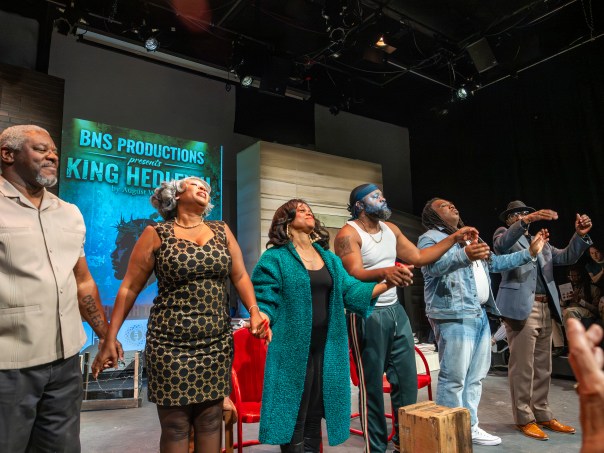
With over 3,300 No Kings protests popping up across the USA and on three other continents last weekend, you can go ahead and call BNS Productions’ local premiere of August Wilson’s King Hedley II an example of serendipitous or awkward timing. But you couldn’t deny that Wilson’s tragedy, the first BNS piece to be staged at the Arts Factory, was timely.

While a record eight million US citizens took to the streets, many reclaiming turf that was only recently terrorized by ICE G-Men chasing down an imaginary alien threat, basic living conditions of the 1980s, shown vividly by Wilson in all their wildness and squalor, still plague our inner cities. Religion, magic, and honest hard work offer no surer cure than guns, crime, and hopelessness.

Wilson’s clear vision and wisdom targeted the Hill District of Pittsburgh, illuminating each of the decades in the 20th century from a distinctively African-American perspective, forming an incomparably epic ten-play Century Cycle. In some ways, The Century (or Pittsburgh) Cycle is also incomparably complex. Some characters appear in multiple decades, while others mentioned in one of the dramas appear onstage in another.

In achieving his Cycle, to further complicate matters, Wilson did not move through the decades of his Century chronologically. Amid this seeming haphazardness, King Hedley II, commemorating the 1980s when it opened in 1999, anchors the most cohesive trio of plays in the whole series.

King’s father appears in Seven Guitars,the 1995 play that Wilson wrote immediately before Hedley II, along with Ruby and Elmore – but we see them four decades earlier in the 1940s, when King Jr is in embryo. Prominently mentioned in Hedley II, Aunt Ester will finally be seen, some 81 years younger, in Gem of the Ocean, the first play in the overall Cycle, premiering unforgettably on Broadway in 2003, starring Phylicia Rashad, depicting the 1900s decade.

If, as Wilson has said, Aunt Ester is a folk priestess who symbolizes the weighty history of African American tragedy and triumph, then her death at age 366 during Hedley II marks an unmistakable low point in the Cycle. The tempest of contention that breaks out at her home in Radio Golf, both the final play in the Pittsburgh Cycle (depicting the 1990s) and Wilson’s final work, can be viewed as piling insult onto injury or as a kind rebirth.
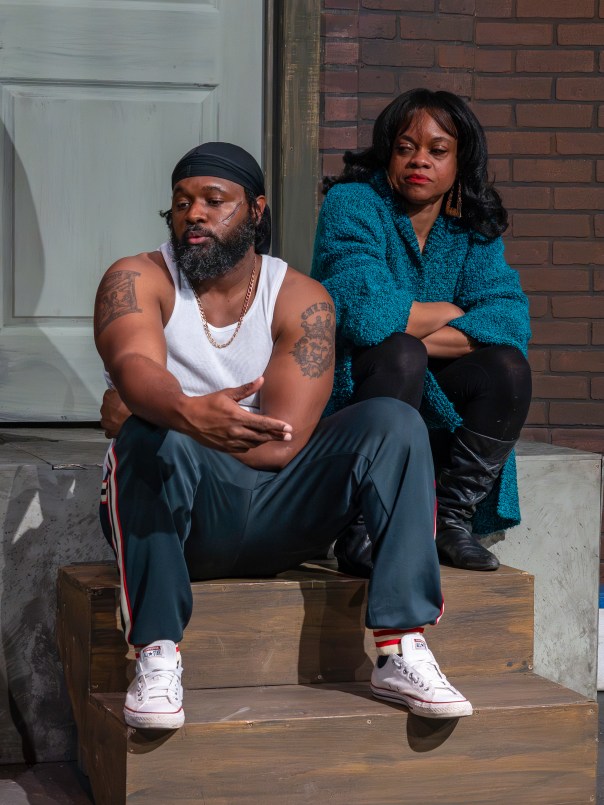
Like Hedley I, King would take it badly if anyone didn’t call him by his regal name. In fact, when we first see him, he is returning home from a seven-year stretch in prison for killing a man named Pernell, who not only slashed King’s face, leaving a permanent scar, but also insisted on calling him Champ. Hedley Sr. also committed murder for the same reason, so if you caught the Charlotte premiere of Seven Guitars in 2015, you would assume, like father, like son, that Hedley II has no regrets.

Not yet.

There’s another side to King that promises a fresh start, for he states concrete ambitions of opening a video store, a venture that cannot fail, and begins planting a garden in his front yard. Both Tonya and Ruby, the wife and mother who have held down this rundown fortress for seven years, are skeptical: they can’t believe King can follow a straight path to success. As sure as that bad dirt in their front yard won’t grow anything, King is bound to take the crooked way and land back in jail.

Hearkening back to Lorraine Hansberry’s A Raisin in the Sun, Wilson sets up a similar situation in the ‘80s to the one the Younger family encountered in the ‘50s. Only Wilson’s is a far bleaker view. Walter Younger held down a job, started a family, and his little sister had middle-class dreams and prospects.

King is more primal and dangerous than Walter, no less easily swayed and played. You’d better not stomp on those seeds King planted, though he sees the common sense of fencing off his little plot to prevent accidental incursions. Barbed wire, a bit aggressive, is his choice for fencing.
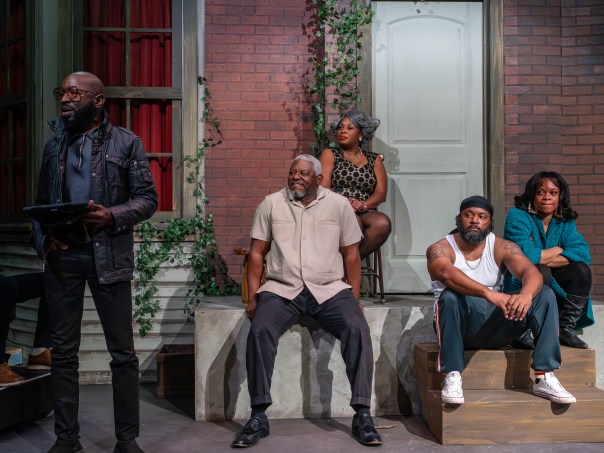
We can hope that the GE refrigerators that King and his best friend, Mister, are selling around town came from a legitimate source, but Tonya knows her man better than we do and presumes they’re stolen. An additional reason to trust Tonya’s misgivings comes when Mister proposes a heist at a jewelry store that he has cased.

Meanwhile, smooth-talking gambler Elmore is back in town with an eye toward reclaiming Ruby, getting married, and settling down. Proof of his wiliness comes after he talks King into letting him in on the GE scheme. Smooth operator, but he’s playing with fire. Even Mister knows better than to shoot dice with Elmore until he can bring a crooked set to the game.

Toi Aquila R.J., who also portrays Tonya, has a secure grasp of the costume designs that give each of the major characters his or her own distinctive style. There is black menace for King, a Sporting Life hipness for Elmore, and a diva flair for Ruby, the former big band vocalist. These core four are the strongest performers in director Rory Sheriff’s shrewdly chosen cast.

Much of the power that Jonathan Caldwell generates as King comes from those moments when he is open to reason, yet still seething somehow in these calmer moments. Explosions seem impending and inevitable. Tim Bradley as Elmore, on the other hand, sports a weaponized smile that conquers the ladies and confounds the men. As Ruby, Myneesha King gets to impress by belting a few bars, yet there’s no less sass in how her Ruby sees through both her son’s and her lover’s lies while succumbing to them.

For all that he packs into each of his plays, Wilson is anything but concise. Aquila’s anger as Tonya is as towering as her husband’s, and her monologue arguably encapsulates the passions and grievances that the playwright expresses most powerfully.

Yet there are ancient Greek elements artfully woven into Wilson’s script. Not knowing who you or your parents really are goes all the way back to Sophocles, most famously in Oedipus Rex, but the more overt thread in Hedley, the true prophet cursed with never being believed, goes back to Aeschylus and his pitiful Cassandra. Here in Pittsburgh this time, it’s Stool Pigeon, with Tone X laying heaps of Scripture on us all – and Wilson’s most delicious line:

“God’s a bad motherfucker.”

Now there’s some Greek attitude! Rounding out the cast is Andrew Monroe as Mister, appropriately the most inexperienced actor playing the most ordinary character. Not only does Mister bring King’s plight down to earth and help universalize it, but he also fails to move King with his pleadings – and to match his uncontrollable machismo when the heist goes down.

Deadly conflict between King and Elmore seems as foreordained as a dark storm first viewed on the far horizon. The best and zestiest view is at the Arts Factory through this weekend.

God of Carnage Bites but Merrily Refuses to Draw Blood

Review: God of Carnage @ Theatre Charlotte

By Perry Tannenbaum

Human masterworks and monstrosities cover the globe, fly through the air, and reconfigure the sky, bringing breathtaking changes to land, sea, and climate. So it’s rather quaint to spend an evening with a playwright who has built her reputation on the notion that civilization is a thin veneer clothing our innate selfishness and savagery.

Morals, ideals, aesthetics, and manners were all shown to be shams in Yasmina Reza’s Art, her 1994 breakout sensation. Trading in her sharper scalpel for a blunter instrument – a wrecking ball – Reza gleefully bludgeoned the veneers of sophistication, liberalism, reason, consensus, and even adulthood in God of Carnage, an even more smashing Tony Award-winning success in 2009.

It’s an unabashedly macro takedown of humanity and the progress of the race. Yet it’s deeply rooted in the soul of art and in the tradition of drama. For Sophocles and the Greeks, the tragic joke was that, no matter how mighty or regal we might be, or even how brilliant, we were all the playthings of the gods. Modern science reframed the picture, grimly enslaving us to our inner demons while liberating us from external forces. For O’Neill, Albee, and other moderns, the prospects were no less grim.

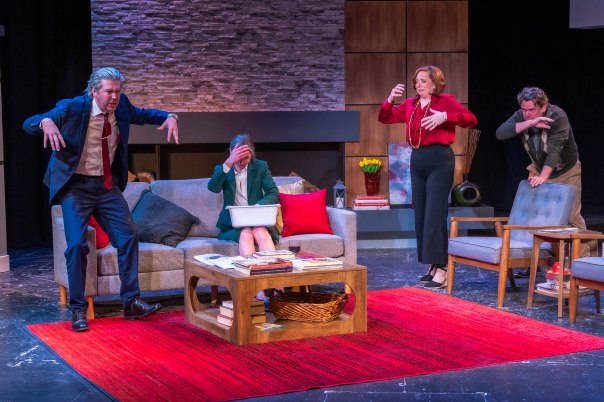
What’s especially disarming about the new Theatre Charlotte revival is just how lightly this heavy Carnage can play. To say that director Brian Lafontaine takes an impish approach to this adult powwow between parents of two schoolkids would be a grossly misleading understatement. Once disagreements between the two couples, the two genders, and the two husbands and wives escalate, no holds, shticks, or slapstick are barred.

If I had to apportion the hijinks at the Queens Road Barn to Reza’s script and Lafontaine’s embellishment, I’d give a decided edge to Lafontaine’s frou-frou. The recent altercation that precipitated the comedy action, between Henry Novak and Benjamin Raleigh about 30 minutes after sundown at Cobble Hill Park in Brooklyn, NY, was surely more violent than what we will witness onstage, with two of Henry’s teeth broken by Benjamin’s bamboo rod.

But the hostilities that break out between the adults are more epic in length, malice, and pettiness. Outbreaks of empathy, conciliation, appreciation, and apology only compound the impacts of their childishness and breaches of decorum.

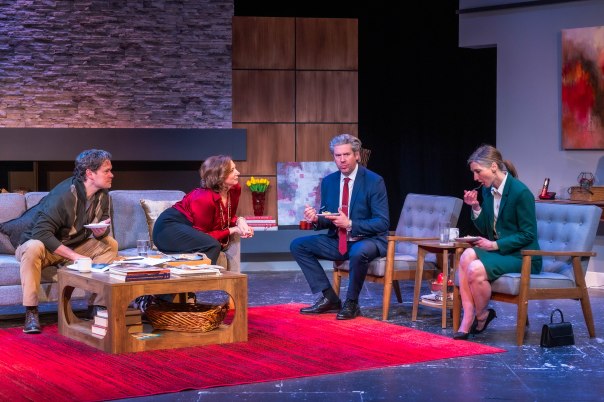
So does the sleek neatness of Chris Timmons’ set design, where not a single hair or tulip seems out of place. Our hostess, Veronica Novak, writes about Ethiopian culture and civilization while working part-time at an art history bookshop. Not the expected match for Michael, her husband, a wholesaler who traffics in doorknobs, saucepans, and toilet fittings.

We rightly presume that the neatness, the stylishness, and the tulips emanate from her. On the other hand, both Reza and Lafontaine appreciate the special comedy spark that hostile women can ignite more readily than men. That’s why Reza has Veronica and Benjamin’s mother, wealth manager Annette Raleigh, initiating the most startling fireworks. Lafontaine delights in piling on additional aggressions from his women, Jenn Grabenstetter feasting on Veronica with serial hurler Aimee Thomas on the counterattack as Annette.

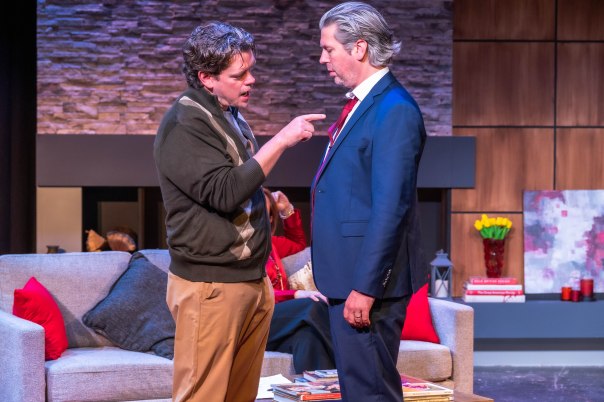
The menfolk are mostly on the receiving end of attacks, so Reza fiendishly contrives to make them as supremely irritating as their wives are judgmental. Most outré and obnoxious is Paul Riley as Benjamin’s dad, Alan. Like Veronica, Alan has also spent quality time in Africa – with a radically different, primal takeaway.

Lafontaine has special affinities and insights into Alan Raleigh, since he played the role in the 2012 Charlotte premiere at Actor’s Theatre.

We can only guess that Lafontaine yearned to be even meaner, obnoxious, and amoral than he was. That was my takeaway from Riley’s Alan, as he pokes among the objects in the Novaks’ bookcase and allows himself peeks at the upstairs. Mostly, he infuriates everyone by rudely answering his cellphone every time it buzzes, no matter how involved he should be in deliberations with his wife and hosts.

Unless you find it more irritating that, aside from frankly admitting that he has fathered a savage, he is spearheading damage control for his client, a big pharma company responsible for a widely available drug newly found to cause hearing loss and ataxia. That insider info hits home when Brandon Samples, as Michael, is obliged to take a phone call from his hospitalized mom.

One of the people Alan and Pharma are victimizing is now on the line. The same drug has just been prescribed for Mom.

So maybe Riley is most obnoxious when he arrogantly declares that his hosts shouldn’t be eavesdropping on his privileged attorney-client conversations. There’s a lot to choose from with Alan.

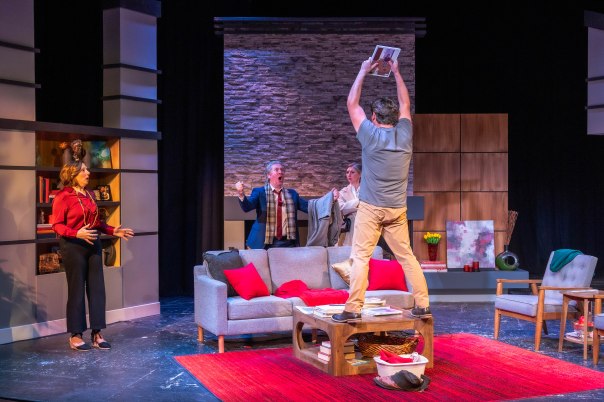
And a blizzard of suffering that the Novaks must endure, especially when Annette barfs all over her hosts’ coffee table and their precious art books. You might say that we’re a bit out of control at this point, belly-laughing at the panic and queasiness that ensues from the phlegmatic deluge. What an odd thing to unite these families in damage control!

Lafontaine decrees that Samples shall be the queasiest of them all, likely taking his cue from Reza, who makes this dealer in doorknobs and toilet fittings surprisingly skittish about handling his daughter’s pet hamster. Quite a different sample of Samples than we saw last October when he portrayed Hercule Poirot.

What makes Michael irritating is subtler than what we readily see in Alan. He seems at first to be the resurrection of Yvan, the conciliator in Art who tries so valiantly to agree with both Serge and Marc despite their wildly differing views on modern art and Yvan’s impending marriage. Similarly, everybody seems to be making a good point in Michael’s view.

Such pliability and ambivalence, under Reza’s merciless scrutiny, prove to be as fundamentally amoral and uncaring as Alan’s jaded pragmatism. That’s what opens the floodgates of Veronica’s fury when the compliant Michael breaks rank with her. Grabenstetter, notwithstanding all her sophistication and empathy for “the tragedy in Darfur,” snaps like an alligator, pursuing her husband around their living room like a rabid wolf. Serves him right after Samples’ scene-stealing response to the massive vomiting.

Aided by some very fine Antigua rum, Thomas also gets a marvelous character arc to track with Annette, overcoming her nausea, attacking her spouse, and avenging herself on Veronica. That pleasure, sad to say, did not quite allow me to forget my earlier difficulties hearing Thomas when she was still in her diffident cocoon.

God of Carnage doesn’t exactly match Hamlet for length and power, but its captivating turbulence stems from the same source: the push-and-pull of visceral urges struggling against societal norms. The Novaks and the Raleighs do lose control like their savage sons, but they lose it like adults rather than 11-year-olds.

So there’s hope for us. That amazing restraint is the heart and conscience of this singularly chaotic comedy. Maybe that’s why we have so much fun. Get ye to the Queens Road Barn!

NC Baroque’s A Musical Offering Merits Enthusiastic Acceptance

Review: A Musical Offering @ Davidson Bach Festival

By Perry Tannenbaum

March 7, 2026, Charlotte, NC – Since I hadn’t reviewed a North Carolina Baroque Orchestra performance at Davidson College Presbyterian Church in over 10 years, you are welcome to conclude that my return trip this past weekend was also my first sampling of the Davidson Bach Festival, which launched its first season slightly less than a year ago. In some respects – age, size, duration, number of venues, and variety – the Davidson fest is like the Charlotte Bach Festival in miniature. They don’t import a world-class chorus or perform the mighty masses and oratorios, and they don’t offer noonday lecture concerts with choir, orchestra, AV presentations, and scholarly erudition.

Yet there are aspects of this relative simplicity that can be prized. Unlike the Charlotte fest or the Oregon Bach Festival, its regal template, Davidson hasn’t ventured beyond Bach so far. Nor has it hopscotched around the city or the college campus, cleaving exclusively to the Presbyterian. Upon reacquainting myself with that sanctuary, I found what many would consider an advantage. Although the organ at St. Peter’s Episcopal, in uptown Charlotte, can speak in earthshaking thunder, an organist performing a concert for over an hour at Davidson Presbyterian can be viewed far more comfortably. You have to turn around in your pew to even glimpse the organ and the organist at St. Peter’s. Even then, you’ll only see his back, often at a greater distance, and always in dimmer light.

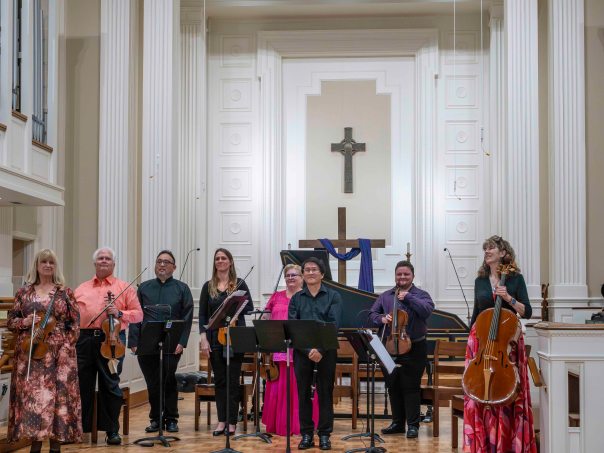
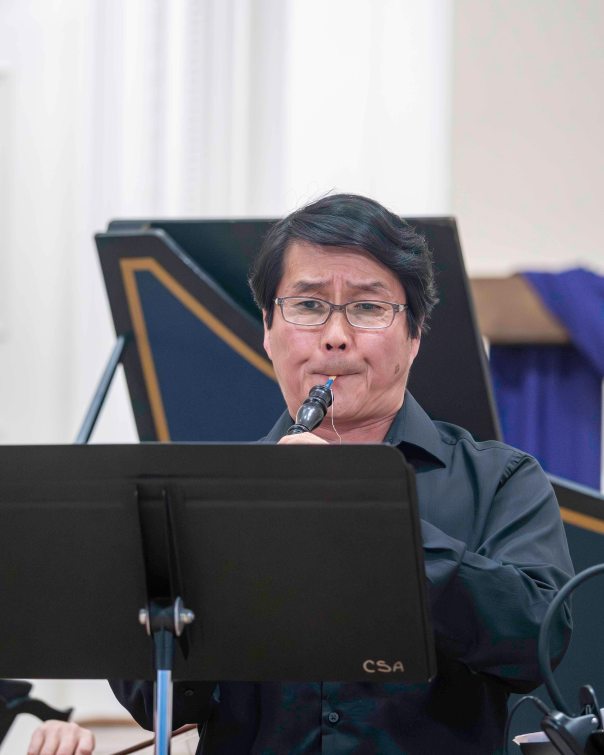
That was my only pang of regret when I opened the festival program and recalled that the “Bach Birthday Bash” with award-winning organist Chase Loomer was scheduled for the following afternoon. Meanwhile, “A Musical Offering,” with three Bach concertos (culminating in a Brandenburg) and a Trio Sonata from his Musikalisches Opfer, would provide ample consolation for missing tomorrow’s rumble. Playing lead oboe or flute on three of the four pieces, Sung Lee was certainly going to draw the most scrutiny.

On the other hand, harpsichordist Francis Yun seemed destined to lurk inconspicuously behind the other musicians until the opening movement of the treasurable Brandenburg Concerto No. 5. Unless you were already with the epic harpsichord cadenza in the opening Allegro, you had little idea how emphatically Yun would emerge.

The same can be said, of course, for the myriad Bach compositions known to us chiefly by their featured instruments and BWV numbers. Familiar melodies lurk in them that multitudes of music lovers will instantly remember, but only specialist musicians and musicologists can anticipate. For most of us, Bach’s delicious Easter eggs are only further scrambled by the multiple times he might repurpose his best melodies in various compositions.

The Concerto for Oboe and Violin in C minor, BWV 1060r, starting off BC Bach’s “Musical Offering,” is an apt example. Starting out as a concerto for two harpsichords and strings, it was recast into a Violin and Oboe version. Either way, there were sighs of satisfaction – and relaxation – when the melody of the opening Allegro was recognized with its delightful echo motif. Lee was partnered with violinist Jeanne Johnson for the main instrumental interplay, perhaps even more beautifully in the middle Adagio movement, because it sounded less familiar, with a more minor-key flavor. As one becomes more experienced as a listener, one appreciates the variety of Allegro that sensitive and discerning soloists bring to the stage. The closing Allegro here was brisker than the earlier one.

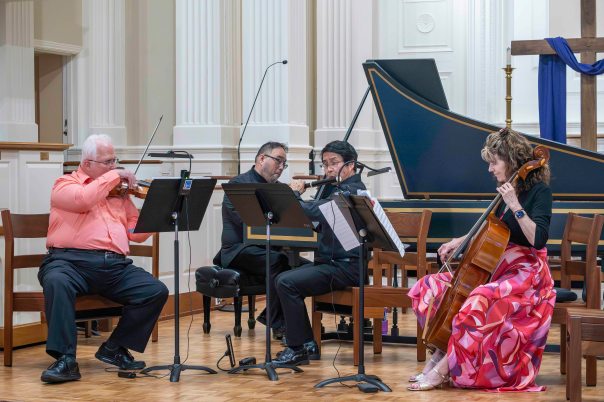
Even if you were sitting in the second row, as we were, the hall was part of the sound, softening it. Yet the second piece, the Trio from A Musical Offering, was more subdued in various ways. The ensemble was reduced by half to four players, and all were seated in a chamber music style. Compared with recent recordings we might sample on Spotify or Apple Classical, NC Baroque’s chamber ensemble played the second movement Allegro conspicuously slower after a perfectly judged Largo with gorgeous counterpoint.

Lee, Yun, violinist David Wilson, and cellist Barbara Krumdieck meshed beautifully throughout, rightly reveling in the sonority of the penultimate Andante, which is always slowed down – even on the Kujiken brothers’1994 recording, the best of the bunch. Less of an outlier than the earlier Allegro, the concluding movement was also a bit lethargic, better propelled by Krumdieck’s continuo. Overall, the interpretation aligned best with the 1974 recording by the Academy of St. Martin in the Fields, where the middle movements are marked Allegro Moderato and Andante Larghetto.

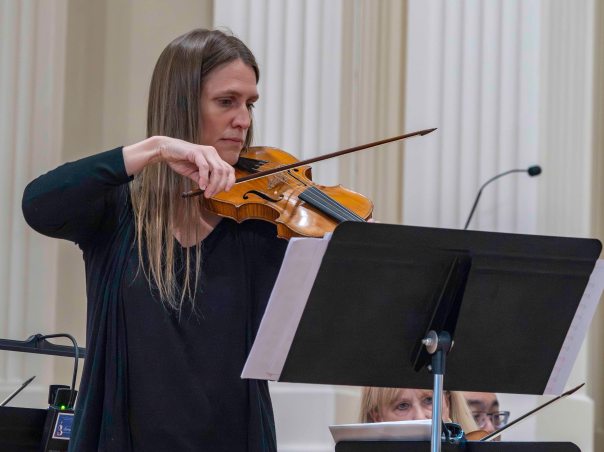
Everything about the E Major Violin Concerto No. 2 sounded wonderfully familiar to me, even the slow movement. Bach lovers could have come to the catchy melodies through this BWV 1042 violin version, almost perfectly judged at Davidson Presbyterian by soloist Janelle Davis, or a subsequent BWV 1054 harpsichord version, pitched a full step lower. Davis was very close to the speed that unlocks the opening Allegro’s full flair and immersed herself lyrically in the middle Adagio. But it was Davis’s joyful playing in the closing Allegro assai that made this Concerto such a tough act to follow.

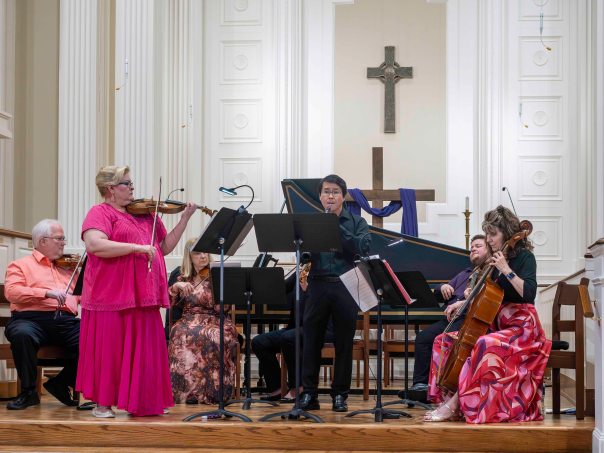
In hindsight, Davis’s joyous tempo provided the perfect launching pad for Yun’s prodigious three-minute rampage, climaxing the opening Allegro of the Brandenburg 5. Tempo-wise, the whole movement was perfectly grooved. A little more ardor from Lee in the middle Affetuoso would not have been amiss, but we ascended to a far loftier plane when Bach’s harmonies flooded the music. Though a little less prayerful and sublime than the opening Allegro, the final movement of this immortal concerto – especially appealing with Lee sparkling jubilantly – is no less quintessentially Bach and baroque. Every time we recall these bookended gems, we realize that they’re living inside us all the time.