Category Archives: Theatre

A Labor of Rockin’ Love and Face-Melting Fury

IMG_5366[5]

Preview:  American Idiot

By Perry Tannenbaum

Anger, alienation, disillusionment, and frustration were all part of the high-octane fuel that powered Green Day’s punk rock opera, American Idiot, in 2004. The group’s first post-9/11 CD struck a chord, winning awards on both sides of the Atlantic, including Best Rock Album at the Grammys. The targets of the group’s wrath – media, suburbia, Bush Era militarism, and ubiquitous TV – remained fresh enough for Green Day lead singer Billie Joe Armstrong and stage director Michael Mayer to transform the celebrated album into a Broadway musical in 201o.

Starting their second consecutive season in exile from their planned-and-purchased permanent home on Freedom Drive, still tangled up in a red tape mess of zoning, safety, and building regulations – on an existing building, mind you – Actor’s Theatre of Charlotte has a bit of pent-up anger, frustration, and disillusionment of their own. They may be wrapping all of that into their incoming American Idiot grenade.

The Charlotte premiere opens in previews this week on the campus of Queens University, the second consecutive show that Actor’s Theatre has brought to Hadley Theater. Official opening night will happen next Wednesday.

ATC artistic director Chip Decker not only empathizes with the angst of American Idiot, he gets the band.

“I have loved Green Day’s music since the [1991] album Kerplunk,” Decker boasts. “American Idiot dropped in 2004, and I could not listen to it enough. I think we were all reeling still from 9/11, the wars, etc., and this album gave a release valve to many who were angry, scared, lost, disillusioned and looking for hope in a difficult time.”

IMG_4580[9]

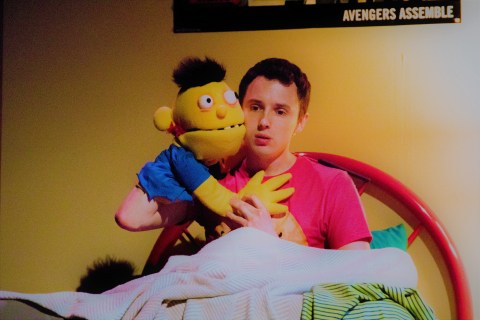
The leading men feel at least as deeply about the music as their director. In fact, you can gauge their respective ages by when they climbed aboard the Green Day bandwagon. Matt Carlson, who plays Johnny, the Jesus of Suburbia hero from the album, says he latched onto American Idiot when he was about 14, and that it was the first album he learned to play on guitar from beginning to end.

Jeremy DeCarlos, a mainstay in the finest Actor’s Theatre productions since 2004 –onstage or thrashing his guitar – plays Johnny’s alter ego, St. Jimmy, leading the suburban Jesus into citified debaucheries. He says he got the Green Day bug during the summer of 1994, when “Basket Case” was a hit single off the Dookie album.

“I felt like Billie Joe wasn’t just singing to me, but as me in a way,” DeCarlos recalls. “I ran out and bought the album and wore a hole into it. When my mother presented me with my first guitar, I told myself that if I ever learned how to play one song on it, it would be Green Day’s ‘Good Riddance (Time of Your Life).’ It took me roughly a month, but the first song I ever learned on guitar was a Green Day song!”

So how does a punk rock opera with three characters become a musical that can fill a Broadway stage? Well, Armstrong and Mayer added new characters, and Green Day chipped in with more music, conveniently ripped off from 21st Century Breakdown, the follow-up album to American Idiot.

Now instead of one disgruntled Jesus itching to escape suburbia, there are three – Johnny, Will, and Tunny – along with three women. Johnny and Tunny do escape, respectively to the wicked city and the US Army, but Will won’t, dutifully staying behind when he learns that Heather (the only woman in the show with a name) is pregnant with his child. So yes, we get three depressing outcomes to wail over.

“The book is wafer thin, single ply generic toilet paper thin,” Decker admits, “but I feel like that was a very intentional choice. I was able to find my own voice and feelings in the album, and I think that is what the story lines do in this. They present a thought and feeling, but do not try and insist that the viewer (or listener) accept that view as the truth.”

And just because he reveres the music doesn’t mean that Carlson worships the suburban Jesus he’s delivering to us as the leading man. Johnny actually comes off as something of a jerk when Carlson describes him, and he isn’t sure we’ll like him: “He is the edgy, cocky punk guy you knew in high school who never did anything with his life.”

But the music! That draws a different reaction from the young rocker. Like many of Green Day’s faithful, Carlson was a bit leery and disappointed when he first heard that the punk band was taking their act to Broadway. Had to be an artistic sellout, right?

When he eventually encountered to final product, Carlson was pleasantly surprised. “The American Idiot album is so different versus the stage score,” he opines. “I love the simple punk rock sound of the album, but maybe because I’m into musical theatre, I like the stage version even better. On stage, the concept album is made more complete with the play script and music.”

IMG_4372[13]

There’s more music in the musical, but all of it remains guitar-and-drum driven. Instead of muscling up with strings, winds, and brass, Broadway orchestrator/arranger Tom Kitt beefed up the sound with more voices and harmonies. You’ll hear a pronounced difference, to take just one example, if you listen to the Broadway cast album version of “Give Me Novacaine.”

The lyrics come through just a tad more clearly, as if we’re in a theater rather than concert hall. The sound of the steel guitar is noticeably richer, with a more relaxed Hawaiian flavor. With the onset of the thrashing section, the crescendo is more dramatic, louder drums and added male voices yield an anthemic thrust. Reaching the soothing outro, we hear – can it be true? – a group of female backups caressing our ears.

But hold on a second. The prospect of seeing ATC musical director Ryan Stamey lead a Broadway-sized band into Hadley Theater isn’t any more likely than the possibility we’ll see over three dozen flat-screen TV monitors stuck up on the back wall. One violin and one cello are promised, but the instrumental congregation will be trimmed from eight to five, a definite U-turn toward true punk rock intimacy.

Yes, we’ll see two guitars, just like on Broadway.

Decker has been known to strap on a bass guitar himself, and he often lurks in the wings as a sound designer when he isn’t acting or directing. One of the most admirable Actor’s Theatre achievements over the years has been their ability to deliver the youthful energy of such high voltage musicals as Hedwig and Rock of Ages without repulsing their graying subscribers who prefer decibel levels below triple digits.

“You know, this is always a tough balancing act,” Decker says, “because our bands are legit power musicians who want everything to go to 11! But there is so much story in the lyrics of musicals, that if you can’t hear the words, you don’t know the story. So yeah, keeping it balanced and rocking is the challenge. Our cast is doing a great job telling their story, and I think people will dig it. Or you can just go and rock the fuck out. Either way, your face will be melted.”

One-Two Punch of Surprises Powers “Eat the Runt”

Review: Eat the Runt

By Perry Tannenbaum

Even before you set out for the Charlotte Art League, the quest for parking, and the unique Eat the Runt from Donna Scott Productions, you need to remember one key preparation: bring your smartphone. Yes, you’ll be asked to turn off or silence the device when the action is set to begin, but before that, you’ll be asked to join the remainder of the audience in choosing the cast for that evening’s performance.

Eight actors vie for the seven roles listed in your program. The audience goes through the cast list one by one, voting their choice for each role on a group texting setup by punching the number assigned to each actor. Playwright Avery Crozier gives each of the characters at his (or her) second-tier art museum a unisex name, so any member of the ensemble directed by Tonya Bludsworth might play any of the roles on a given night.

To execute all of the possible 40,320 casting permutations, each actor must be prepared to play all of the roles, wear all of the costumes, and pounce on cues from all his or her castmates. That not only multiplies what each character has to memorize and the number of costumes designer Luci Wilson has to create, it also multiplies the amount of time that the ensemble must devote to rehearsal – even though they can’t begin to cover all the possible scene partners they will have during the actual run of Runt performances.

On the Saturday night that I attended, I voted with the audience on four of our choices: Ericka Ross as grantwriter Chris, Stephen Seay as human resources coordinator Jean, Tracie Frank as curator of modern art Hollis, and Kevin Shimko as museum director Pinky. Andrea King won the juiciest – and most demanding – role as Merritt, interviewing for a vacant position at the museum. Kevin Aoussou as director of development Royce and Jenn Grabenstetter as museum trustee Sidney rounded out the cast.

Somehow Stephen West-Rogers’ previous exploits in theatrical versions of Fight Club and Trainspotting had escaped the notice of Donna Scott fans. Nor did his new clean-shaven look bring fresh evocations of his ruggedness. As a result, West-Rogers was the odd man out, sent away to take the night off when Shimko snagged the last remaining role.

After this poignant moment, presided over by Scott, we were asked to give the cast a few minutes to sort things out, a reasonable enough request, I thought. When they returned, it was virtually impossible to find any indication that this wasn’t the fixed cast that had rehearsed Eat the Runt every night. King especially was a delight as Merritt, deftly bringing out the applicant’s uncanny ability to take the ideal approach for each museum official who interviewed her.

Merritt’s chameleonic shifts bespoke either a dangerously unstable personality or a cunning Machiavel – one perhaps gifted with psychic powers. Whether it’s the hemorrhoidal HR coordinator, the horny development director, the coke-addicted curator, or the defensive trustee, Merritt always seems to pounce on the perfect approach without any need for probing. It’s only when she’s spouting Ayn Rand to the museum director that Merritt drops hints of a supernatural gift.

Forget about the gimmickry at the top of the evening, it’s very rare for any playwright to be able to detonate a walloping surprise at the end of Act 1 and at the end of Act 2. Crozier not only achieved that, but the surprise at the end of the evening slickly explains away much of the puzzlement we may experience as the series of job interviews metastasizes and explodes.

A few days later, some of the deception that had been played on me became clearer. By then, I couldn’t regret the fun ride that Eat the Runt had taken me on. It may be radically different for you if your casting choices turn out to be more incongruous, risqué, or preposterous. That may increase the already plentiful comedy.

Alfred’s “Brown Tale” Is Very Chicago and Very Funny

Review: A Brown Tale

By Perry Tannenbaum

Notwithstanding the lingering leeriness I feel about going to see them, one-person shows can be memorable and truly special. Billy Crystal’s 700 Sundays, Frank Gorshin’s Say Goodnight, Gracie and Colin Quinn’s Long Story Short stand out as the best that I’ve seen by men, while I’d point to Julie Harris’s Belle of Amherst, Lily Tomlin’s The Search for Intelligent Life in the Universe, and Tova Feldshuh’s Golda’s Balcony as the best by women – plus two more at Spoleto this year, Avital Lvova’s Angel and Ayodele Casel’s While I Have the Floor.

Well, all of those stellar performers need to make some room for James T. Alfred, who has written and is currently performing A Brown Tale at Spirit Square. The OnQ Performing Arts production, directed by Lou Bellamy, runs through September 23, and you need to catch it or miss perhaps the funniest one-person show I’ve ever seen.

Quinn’s tour-de-force is the only show I can remember that was as howlingly hilarious as Brown Tale, but Alfred may deserve the edge because Quinn took all of human history for his subject while Alfred confines himself to his own life. Unless you saw Alfred starring as Martin Luther King in a touring production of The Mountaintop at Booth Playhouse in 2014, you might not even recognize his name.

I had interviewed Alfred for a Mountaintop preview feature three years ago, but while it was clear that the actor was closely acquainted with the playwright who penned that Olivier Award-winning script, there was never a hint that he himself was a writer. Alfred’s admiration for Bellamy certainly came through, and the esteem must be mutual, since Alfred is a permanent member of the Penumbra Theatre, the great African American theatre company founded by Bellamy in 1976 in St. Paul.

So aside from MLK, the Penumbra connection ensures that Alfred’s past credits include a swath of August Wilson plays, not exactly a harbinger of the rich array of broad physical comedy that A Brown Tale offers. Speaking to Alfred a few years ago, I got the word that he was currently based in Chicago. His performance at Duke Energy Theater shows that he and Chicago go back a long way, most memorably during years living with his grandma in the projects.

We get to hear about how déclassé the high-rise projects were compared to the equally humble squat dwellings that surrounded them. But the most amusing comparisons began at the top of the show when Alfred introduced us to his very rightfully estranged parents. Mom was a devout churchgoing Christian, while Dad was a spawn of Satan and emulator of James Brown – plus a hypochondriacal DJ forever questing after VA compensation for his PTSD.

What must have united them, for the short time it took to conceive James, were their foul mouths. Mom was the rare phenomenon of a cursing Christian, and Dad couldn’t finish a sentence with punctuating it with an expletive.

More daring comparisons occurred later after Alfred went to college, where we get the inside scoop on the difference between getting over on black women and picking up whites. A parallel episode, with greater scope for mimicry and physical comedy, subsequently compares the service we can expect at a black-staffed McDonald’s and what we routinely encounter in a “pink” neighborhood McD’s. Probably not material a white performer could get away with, which adds to the zest.

Alfred isn’t always going for the funny bone. There are segments about the neighborhood candy store, the local Boys & Girls Club, local schools, and the annual rite of shopping for new school clothes for the new school year. You get a hint of warmth in these vignettes, particularly when Alfred recalls how neighbors in the projects kept an eye out for the welfare of each other’s kids, and he spills over into anger recalling the politics that killed family life in the projects.

Three extended scenes are at the heart of A Brown Tale and why you’ll enjoy it. The first is a colorful travelogue taking you room-by-room through a project apartment, beginning with the daily conversion of the kitchen into a hair salon. Our end point is Alfred’s initiation into the world of substitute teaching – taking over a special education class that’s off in an annex separated from the main building of an elementary school.

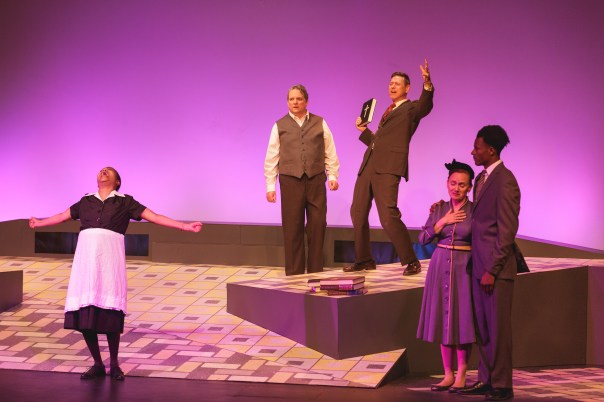
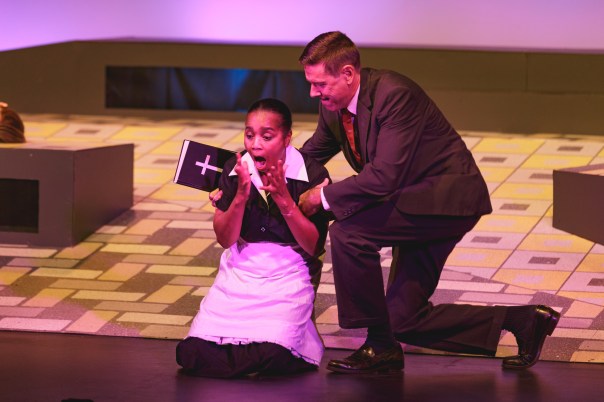
But the greatest crowdpleaser last Friday night was clearly the evocation of a Sunday church service, with cameos from the preacher, the choir director, and a church elder, plus a coda on Christian dating. The highlight here was the elder’s testimony, beginning in subdued awkwardness and ramping up to a frenzied climax of shouting, high-stepping righteousness, sprinkled with some babbling in tongues.

It can’t be easy to walk the tightrope between crude mockery and hilarious gusto when you’re onstage evoking an impoverished special needs child or an ecstatic churchgoer bathed in the Blood of the Lamb. You need to be able to trust an objective pair of eyes watching you perform and sculpting a scene. Clearly, Alfred and Bellamy are a very special team that’s able to hit exactly the right tone, and we’re very lucky that OnQ brought them here so we can cherish their masterful teamwork.

Angels Provocateur Returns as Conciliator

Preview: The Christians

By Perry Tannenbaum

There’s plenty of history between Steve Umberger and the Queen City, stretching back to 1976 when he founded the Actor’s Contemporary Ensemble. That company became Charlotte Repertory Theatre, which gave us an epic production of Angels in America, Parts 1 and 2, in 1996. On the wings of Umberger’s supreme achievement as Rep’s artistic director came a firestorm of local homophobia and negative national publicity that strafed the cultural landscape of this city like nothing before or since.

Reverberations from that controversy kept rumbling for years afterward, resulting in the eventual ouster of Umberger in 2002, and the self-immolation of the company he founded by a rogue board of directors in 2005. In an acrimonious parting shot in the announcement closing Rep down, board chairman William Parmelee charged that Charlotte had little interest in supporting professional theatre.

Well, Umberger is back, and he isn’t here to stir up any new controversies or settle old scores. He is here to remind us that differences of opinion don’t need to be acrimonious – and maybe, just maybe to prove that Parmelee was dead wrong.

Picking a drama that can achieve those aims wasn’t simple, but Umberger and his PlayWorks Group chose Lucas Hnath’s The Christians, a work that premiered in 2014 at the prestigious Humana Festival in Louisville and went on to win acclaim in Chicago, Houston, San Francisco, and off-Broadway. Hnath made a bigger New York splash earlier this year on Broadway when A Doll’s House, Part 2, his sequel to Henrik Ibsen’s famed feminist drama, picked up eight Tony Award nominations.

Umberger honed in on Hnath before the playwright’s Broadway triumph – at exactly the right moment.

“I first read it right after the election,” Umberger recalls, “when everyone was starting to find everyone else’s viewpoint contemptible. I wondered if there was a play out there that would truly represent everyone fairly and let them tell their side of it in a way that would be heard. Then I found The Christians.”

Set in a megachurch, The Christians fits Charlotte like a glove. After building up his church from a storefront acorn to a mighty oak, Pastor Paul delivers a progressive sermon that proposes to take his church and all who belong to it on a spiritual hairpin turn. Because in a recent conversation with God, God told Paul that there is no hell.

Quite a bombshell for the associate pastor whom Paul has mentored, for church elders who have backed and supported Paul for 20 years, and for his wife Elizabeth, who was blindsided by her husband’s bold new doctrine. So are many members of the congregation, which now numbers in the thousands. They have believed strongly in Pastor Paul, but everyone isn’t ready to be redirected like sheep into strange new beliefs.

It’s as if a Republican were elected President and told his party that they were mean.

Only there’s a bond between these people as they wrestle with their faith amid the fallout from Paul’s sermon. Spiritually, how far is Associate Pastor Joshua willing to bend and still serve his mentor’s church in good conscience? Administratively, how can Elder Jay keep supporting his church’s founder if there are massive defections from the flock? And personally, how can Elizabeth forgive Paul for not consulting her on a move that could have such a dramatic impact on his livelihood and their family?

Yes, there is mutual love and respect between all of these Christians. Yet the issues are substantial, and Paul, the visionary leader, may be the most selfish and inconsiderate in the group.

Umberger gets to reunite with some of the same suspects who worked with him decades ago on Angels – set designer Joe Gardner, lighting guru Eric Windbreaker, and actor Graham Smith, who made Roy Cohen such a demonic firebrand. Two other Rep vets are in the cast, playing the lead couple. Chandler McIntyre last hooked up Umberger and Rep in Wit (2001), and Brian Robinson, playing Pastor Paul, is a two-time CL Actor of the Year who played key roles in three CL Shows of the Year: Malice Aforethought (1992) and Falsettos (1993) for Rep, and Take Me Out (2004) with Actor’s Theatre.

More recently – and more to the point – Robinson gave a fine account of Father Flynn in another religious cliffhanger, John Patrick Shanley’s Doubt, playing opposite Umberger’s wife, actress Rebecca Koon. That North Carolina Stage Company actually toured Charlotte with that production in 2008 after Robinson had moved to Atlanta.

“When I lived and worked as an actor here from 1988 until 2008, the city was teeming with homegrown theatre. It’s certainly not all gone, but it is certainly greatly diminished,” says Robinson. “Rebecca and I had done Doubt together, and our friendship became quite close. In August 2016, I was exploring the idea of creating some theatre. Steve was the one of the first people I thought of when considering with whom I would want to partner. I asked Rebecca what he was up to. Her response was, ‘I think he’s in a similar place. You should call him.’ And now here we are, one year later, about to unveil the fruits of this first collaboration.”

Burnt by the lackluster support from the CharMeck Arts & Science Council after the Angels flap when he led the Rep, Umberger is relying on a more conservative, self-sufficient financial model with PlayWorks Group.

“Even though [The Christians] is a single production, it’s set up so that it could actually pay for itself, if enough people come,” Umberger explains. “That could also conceivably be expanded to multiple plays in some sort of season that looks like a company. It doesn’t require massive corporate sponsorship or grant funding or big giving. It only takes enough people buying a ticket.”

Umberger is also tapping into homegrown talent he hasn’t worked with before in mounting his new venture. He saw Jonavan Adams in Ma Rainey’s Black Bottom this past spring and has tapped him to play the schismatic Pastor Joshua. Strangely enough, Umberger had never met playwright/actress/director April C. Turner until Christians auditions, though her C.O.T.O.: Chocolate on the Outside drew a Loaf nomination for Best Drama back in 1997.

Turner turns up as Jenn, the truth-seeking congregant whose questions wreak havoc among Paul’s flock. Just as convinced as Hnath must have been in 2014 that Hitler was synonymous with evil, Jenn asks if Der Fuhrer is earmarked for hell.

“Steve is a pro,” says Turner of her first Umberger experience. “He is passionate about his work, and he owns his voice as a director. He’s a gentle director, yet firm in his vision. We spend a lot of time asking and answering questions about ‘what’s really going on’ and digging into the details of the needs of each character.”

Adams, who came to understand who Umberger was only after he was cast as Joshua, also chimes in with a glowing review.

“It’s surpassed my expectations in every way,” says Adams of the rehearsal process. “This play calls for a uniquely gifted director to be able to explore its nuanced complexity.”

But we still need to wonder whether Parmelee was right more than 12 years ago – whether Charlotte really is fertile ground for professional-grade homegrown theatre. Since Rep died in 2005, Charlotte hasn’t had an Actor’s Equity company that was part of LORT, the top-tier League of Regional Theatres.

It’s sad, says Robinson: “The citizens of Charlotte deserve and need a thriving professional theatre scene that is locally produced.”

Will we turn out to help make it happen? This may be our last best chance.

Triumphant “Aïda” Cast Slogs Through Tedious Sir Elton Score

Review: Aïda

By Perry Tannenbaum

Strip away the triumphal march, the trumpets, and the whole processional parade – complete with elephants, if you’re lucky enough to see the famed outdoor productions in Verona – and we discover that Verdi’s Aïda is a rather compact story. The captured Ethiopian princess is at one corner of the love triangle, opposite her slavemistress, Princess Amneris. Both of them love Radamès, the dynamic Egyptian general who is ordained by the goddess Isis to lead the Pharaoh’s army against the forces led by King Amonasro, Aïda’s father.

Pulling against the strong Aïda-Radamès chemistry are their loyalties to their warring countries, the jealousy of Amneris, and the obedience that Aïda owes to her father. Sealing their fates, Pharoah rewards Radamès for capturing Amonasro in battle by promising his daughter’s hand in marriage to the victorious chieftain.

It’s fascinating to watch how Linda Woolverton modernizes the 1871 libretto in her book for the Disney version currently running at Theatre Charlotte – with a couple of deft feminist touches layered on.

Raised on soaps and romcoms, modern audiences could never abide a torrid relationship between romantic leads already established before the curtain rises. So Woolverton efficiently wedges a mini-courtship into her storyline, with Radamès giving Aïda to Amneris as a gift to lighten his beloved’s sufferings in captivity.

Verdi and librettist Antonio Ghislanzoni were perfectly content to portray Amneris as a cunning, vicious shrew from beginning to end. Not Woolverton. She gives the beautiful princess a slick character arc in a thorough makeover, starting her off as a vain and pampered clothes horse on loan from Legally Blonde. Amneris evolves into a peace-loving reformer who not only empathizes with the martyred lovers but also narrates their story, three or more millennia later, returning in mummified form, a shining presence in a gooey stew of museum mystery and reincarnation.

If composer Elton John and lyricist Tim Rice had done their jobs as well as Woolverton, Aïda would be a masterwork. It’s often amusing to see what John, Rice, and Theatre Charlotte do to compensate for the absence of Verdian spectacle – but it’s never thrilling, despite the collection of talent that director Corey Mitchell has assembled at the Queens Road barn. John’s parade of power ballads grows tedious as the evening wears on, and the longueurs are compounded by unnecessary outbreaks of dance that, notwithstanding choreographer Ashlyn Summer’s exertions, display little precision and less sensuality.

Mitchell previously directed this show for Northwest School of the Arts with a little more sparkle, orchestra, and budget – a production that ran briefly at Booth Playhouse in 2009. Maybe Sir Elton’s Aïda works better in the hands of high schoolers. The one holdover from the NWSA edition, Emily Witte as Amneris, is even more stunning this time around, most notably when she hits us with the full force of her arrogance in her “My Strongest Suit” showcase. It’s the kind of superficial villainy that will deeply satisfy fans of Wicked, Glee, and Kristin Chenoweth.

There is a slight country twang to Witte’s singing that would have added a bit of unique abrasiveness to Amneris, but music director Zachary Tarlton encourages the same style from Ron T. Diaz as Radamès, so that twang becomes an Egyptian trait – as if, in Disneyworld, everybody who hails from Memphis, whether it’s Egypt or Tennessee, sounds alike.

Further detracting from the gravitas Diaz should be aiming for is Radamès’ bizarre confrontation with his father, the evil priest Zoser. You wonder just how seriously we can take either adversary when costume designer Hali Hutchison seems to be mimicking Disney’s Aladdin in designing the mighty general’s costume and Zoser’s ministers brandish glowing fuchsia staves.

Diaz never gets a shot at a passionate solo, so he shines brightest in “Elaborate Lives,” sharing the best of the power ballads with his darling Aïda. They sing it full out, face-to-face, no frills, near the end of Act 1, Victoria Fisher’s lighting dimming around them to augment the drama. Maya Sistruck does nearly the whole evening as Aïda with a simple resolute dignity, allowing herself the luxury of discernable facial expressions only at peak moments when she is romantically consumed or royally pissed.

Other than taking radical precautions not to reveal her royal origins, I’m not sure what justifies Hutchison’s humble sackcloth design for a captive princess. We do upgrade to red in the palace, but why Amneris would tolerate such a plainly dressed servant is still baffling. Yet the illogic does pay off in an enduring dramatic contrast, first in the climactic tête-à-tête duet before intermission and shortly afterwards in the “Step Too Far” trio, the most self-consciously operatic moment in the John-Rice score.

Aïda is simply better and purer than these Egyptians are – not Memphis or Nashville at all! – and just knowing her ultimately makes them better and purer.

While Josh Webb’s set design is no more impressive than the costumes or the choreography, budgetary constraints may have been holding him back. The cut-rate budget and the lackluster score might obscure the fact that the excellence of the cast runs deep. Aside from most of the dancers, Howl Cooper makes the only inauspicious debut as Amonasro, though he definitely has a warrior’s demeanor.

Jason Hickerson makes a wonderfully scruffy Pharaoh, a Charlotte debut only slightly eclipsed by Carlos Jimenez’s usefully cheerful depiction of Mereb, the perfect Disney servant. Implausibly, Mereb draws more solo spotlight than Radamès, yet Jimenez is decisively upstaged among the supporting players by the steely-voiced Paul Leopard, fulminating melodramatically as the murderous, conniving Zoser.

Thank heaven for vampires, witches, and pagans. Otherwise, there would be no class of people left for all of us to wholeheartedly hate.

Fire, Fury, and Painful Memories Drive Wilson’s “Jitney”

Review: Jitney


By Perry Tannenbaum

Allowing for inflation and cost-of-living increases since 1977, fares at Becker’s Car Service seem to be fiercely competitive – so competitive that the five cab drivers at the core of August Wilson’s Jitney all seem to be barely scraping by. The drivers’ lounge, adorned with a decaying Ali-Frazier poster, has a ramshackle look to it with a dust-colored couch held together by generous swaths of duct tape.

We never see whether the drivers’ jitneys (slang for gypsy cabs) are in any better repair than this crumbling HQ, but the idea seeps in that the struggling black customers in the Hill district of Pittsburgh are in no position to press the point. Early on in this fine BNS Productions effort at Spirit Square, director Corlis Hayes pushes the pace hard enough for us to assume that we’re in the midst of an urban rush hour.

These are men in a hurry – who aren’t necessarily getting anywhere. Pretty much the same can be said for Wilson’s story until Becker himself arrives. He takes off a fedora hat and lays down a satchel, signs that he’s better off than his employees, but he takes turns answering the phone – a pay phone – and giving rides. Still not rushing his story along in his flurry of driver entrances and exits, Wilson has Becker announcing two key strands of the plot.

After keeping it from his drivers a little longer than he should, Becker tells Doub, his steadiest driver, that the city has earmarked the property for urban renewal. The Car Service office will be boarded up in a matter of weeks. If that weren’t enough upheaval, Becker’s son Booster is getting out of the slammer after serving 20 years for murder. Becker never visited his son even once during his incarceration, so this does not figure to be a joyous reunion.

If you’ve seen Wilson’s Fences recently, you will likely find echoes of Troy Maxson in the elder Becker’s sternness and stubbornness. If anything, the father-son chemistry will prove even more important here. But Becker is more of a people person, as he would need to be in running a business, and he has a few soft spots beneath his tough hide.

We see one of those when he gives Fielding, a former tailor who has destroyed himself with drink, yet one more chance to come back on the job and straighten himself out. Becker also shows strength and courage defusing a heated confrontation between Vietnam War vet Youngblood and the gossipy Turnbo, who has meddled in the younger driver’s domestic affairs, frustrated at not stealing his girlfriend Rena.

There’s a fascinating range of personalities and back stories among the core quintet of drivers plus the boss’s son. Baring their souls – and their motives – everybody seems to get a monologue. Nor do Hayes and lighting designer Tony Wright veil the kinship between these monologues and long, lyrical jazz solos. Hayes usually directs her actors to blow their solos straight into the Duke Energy Theater audience, while Wright intensifies the light where they deliver.

During the passionate showdown between Youngblood and Rena, where both have been right and wrong, each of the combatants has a heartfelt monologue. Yet Wilson had even more pure audacity in a casual scene where the often-comical Fielding meets the tightly-wound Booster. The playwright brashly showcases his virtuosity by unleashing two consecutive monologues, one by the rueful Fielding recalling his better days when he tailored suits for Billy Eckstein and Count Basie, followed by Booster’s recollection of his first hard lesson in life when, as a child, he had a vivid dream about riding a red bicycle.

With so many monologues so evenly distributed, you need a cast that’s strong, deep and – when Wilson digresses – engaging. Hayes and producer Rory D. Sheriff have definitely produced with this ensemble. Though he isn’t given free enough rein in the opening scene as Fielding (we should be sure that the $4 he borrows from Doub will go toward refilling his whisky flask), Gerard Hazleton shoulders enough of the drunkard’s comedy without letting us lose our warm feelings toward him.

There’s a little more comedy squeezed from the gossipy Turnbo by Tim Bradley, probably because his sleaziness and nosiness are so outrageous, but he also forces us to take him seriously when he goes ballistic on Youngblood. More on the periphery, James Lee Walker II gives the local numbers runner, Shealy, a dandified flair though we still empathize with his romantic difficulties. On the other end of the cunning spectrum, Danius Jones makes Philmore a singularly quirky and clueless passenger, attaining full dopiness only when he returns in his bellhop uniform.

Partly because they subtly echo the central father-son relationship, Doub and Youngblood are closer to the heart of Wilson’s drama than the men who garnish it with comedy or the colorful aspects of city life. Both of them are war vets, but Youngblood – if not as senseless as Turnbo makes him out to be – has been slightly warped by his Vietnam experience. Doub, traumatized and shaken to his core in the Korean War, has retained a stone-cold outlook beneath his cheery, avuncular demeanor.

With Keith Logan delivering Doub’s Korea monologue, it becomes the warmest moment of the evening, transcending its payload of advice for Youngblood. In its tacit acknowledgement of Youngblood’s essential goodness – and his confidence in Youngblood’s ability to benefit from sound advice – he’s a perfect model of the parenting skills that Becker lacks. Ironically, there are times when Logan’s acting is similarly exemplary for Jonathan Caldwell. While Caldwell brilliantly projects Youngblood’s immaturity and confusion, he could use a tip or two on either quickening his cue pickup or timing his delayed reactions.

Caldwell’s occasional awkwardness may slightly mar Youngblood’s scenes with Doub and Turnbo, but it meshes very well with Juanita Green in the confrontations with Rena. Hayes decrees a more conciliatory rapport between the lovers when we last see them than you might find in other productions, but Green keeps this becalmed closure from becoming saccharine.

Although Becker isn’t quite the perfect boss, he deals empathetically with his drivers, so there needs to be a powerful reason why he is so cold and cruel toward his son. John W. Price provides it indelibly in the most electrifying monologue of the night. The fire and thunder from Price as he’s excoriating Booster are unlike anything I’ve seen or heard from him before, fueled by white-hot fury and pain.

It’s an earthquake, and you can see Jermaine Gamble as Booster trembling amid the seismic shock. We get the idea from Gamble that Becker’s boy has grown up, hardened by prison, a fully formed yet scarred individual. Booster does fire back at his dad, but Gamble acutely calibrates the restraint and the hope that are wrapped into his resentments, almost like he’s still an adolescent in his father’s presence. It’s simply respect – all the more moving for its futility.

Within the space of two weeks, we’ve heard from two playwrights, Jeff Talbott in The Submission and August Wilson in Jitney, who have ignited their peak moments with the N-word. This one is far more unexpected – and shattering.

Playwright Imposter Goes Off-Script in “The Submission”

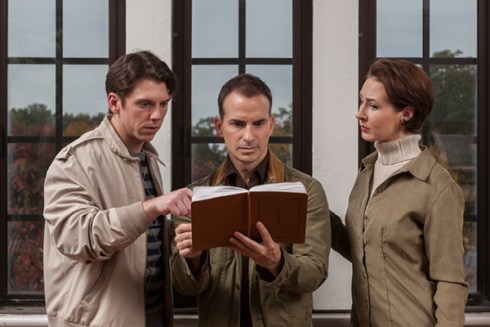
Group1_HiRes

Review: The Submission

By Perry Tannenbaum

A gay white playwright and a black actress walk into a bar… Not a promising lead-in to a joke, because nothing funny or violent should happen. Writers who pen scripts about racists or homophobes for theatre, film, and TV usually draw a free pass when we ask ourselves if they might be harboring prejudices of their own. Same with the actors who appear in such productions. Surely they are as progressive and tolerant as the authors who create their roles.

Maybe more progressive and tolerant than we are.

In Jeff Talbott’s The Submission, currently at Spirit Square in a Three Bone Theatre presentation, we can trash those presumptions – under circumstances that would ordinarily strengthen them. Talbott’s protagonist, white gay playwright Danny Larsen, has written a drama about a black alcoholic mom, her cardsharping son, and their struggles to escape the projects. Takes some empathy to do that, right?

Danny has never had a play of his produced before, but he thinks this one might be special. His best friend Trevor agrees, so Danny submits his street saga to the prestigious Humana Festival, hoping that he will be among the elite few whose work will be premiered at the annual New Play Festival in Louisville. But to make sure his whiteness doesn’t become an obstacle in recognizing the merits of a play with black leads, he invents the African name of Shaleeha G’ntamobi to become its author.

When Humana phones to tell Danny that his script has been selected for the New Play Festival, he could own up to his subterfuge right then. But – reasonably or not – Danny is afraid that the prize will be withdrawn of he comes clean. So he temporizes, saying the playwright isn’t at home, and hurries out to hire an actress to impersonate Shaleeha.

It takes a few moments before the chosen actress, Emilie, can grasp Danny’s intentions – and for Danny to convince her that there’s no kinkiness involved. Wile Danny has demonstrated considerable empathy toward black people, Emilie is honestly impressed with the play, despite the playwright’s fears that he has trespassed onto forbidden territory. Plenty of goodwill on both sides.

Yet things go badly after the first meeting. Danny has a number of personal insecurities, more than a little buyer’s remorse, but worst of all, casual prejudices against black artists that he hasn’t faced up to. They begin to pour out during a second meeting – at a coffee shop, not a bar – when Danny refers to black actors as “blactors” and the awards they win as “blawards.” The unsavoriness of that viewpoint is compounded for me by the signals I get from Danny that feels entitled to speak his mind so brusquely because he’s Emilie’s employer.

Emilie doesn’t listen to these slurs passively – unless you construe a response like “You’re so full of shit your eyes are brown” as deferential. What began as a mutually beneficial relationship has already degraded into an uneasy détente. As the pre-production process unfolds in Louisville, with Danny missing out on all the little perks of close contact and communication with the big-name artists converging on the festival, Danny’s resentments and jealousies heat up and his attitude toward Emilie becomes more toxic. Dropping the director’s nickname can set him off.

No doubt about it, the balance of my sympathies went out to Emilie as she kept drawing Danny’s scorn for merely doing what he hired her for. Even when some of Emilie’s anti-gay attitudes surfaced, things didn’t even out for me, because some rational thought verifiable observation was actually mixed in with her resentment – and because Danny goes nuclear in their final verbal faceoff.

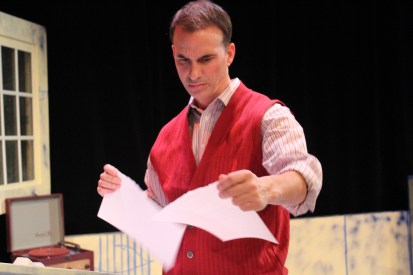
If you can see this explosion coming, the venomous crossfire may feel a wee bit overlong, and I was not very convinced by the way Talbott has Danny handling the aftermath of his festival acclaim. But director Sidney Horton keeps the action as taut as possible, and Scott A. Miller keeps us fascinated with each new slimy twist of Danny’s personality. We can believe that the same insecurities inside Danny that produce such aberrant attitudes might also produce great art.

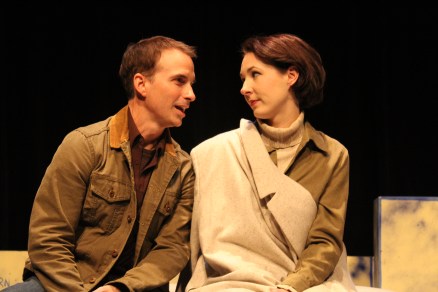
On the other hand, Talbott has incorporated some entertaining – and dramatic – complexities into Emilie. In her Charlotte debut, Lechetze D. Lewis captures all that’s engaging and spontaneous about Emilie and all that’s strong. Not only does she deliver a groupie’s euphoria while she’s mingling with theatre royalty, she adds an extra dollop of giddiness as romance blossoms between her and Trevor. You don’t really marvel that a free spirit like this would go off-script when she’s supposed to read Danny’s acceptance speech.

But is she more cunning and All-About-Eve than she first appears? That’s a big question Talbott keeps nicely float, helped by Lewis’s pugnacity.

Trevor is caught in the middle of the crossfire as he becomes more seriously involved with Emilie. He’s somebody who readily grasps Danny’s blind spots, and Daniel Henry perfectly calibrates his weakness as a right-minded peacemaker – so I completely bought his allowing himself to be told to shut up while the main battle raged.

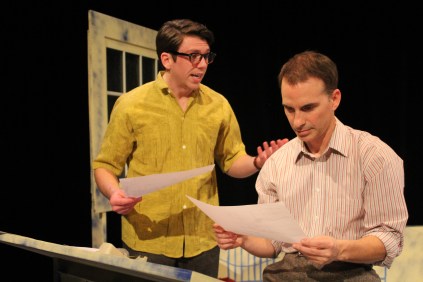
I’m not sure that Talbott didn’t intend Pete, Danny’s CPA-like partner, to be more of a clueless hunk. Yet Horton’s somewhat outré casting choice, Dan Grogan, keeps things very real during the marital infighting. Though Pete remains a needless appendage in the plot, he’s a stuffy outsider who makes our badly behaving protagonists seem more palatable. There’s an intentional poetic justice when Grogan’s best moment happens while he’s offstage. He’s that untheatrical.

Talbott is appealing with his self-regarding cleverness, particularly when Danny’s play mirrors his own. But more often, he seems intent on wearing the David Mamet mantle for faithfully transcribing Generation X. Sentences from these 28-year-olds repeatedly proceed after multiple false starts and loose fragments, often getting tangled in multiple detours before reaching a period – particularly when Miller deftly navigates as Danny. Every person onstage, especially the artists, seems compelled to drop at least two f-bombs with every breath.

Peppered with fucks and the occasional shit, the dialogue at Duke Energy Theatre doesn’t shock me so much as irritate me as The Submission barrels along. If this tedium and annoying effect are the crux of Talbott’s point, he’s making it too obliquely. And if he’s trying to assert that effing Gen-Xers really effing talk this way, I do not effing agree.

But selfies of a hot actress’s boobs messaged to her boyfriend? In the age of Anthony Weiner (and Snapchat), I wouldn’t be shocked to learn it’s happening right now.

A Farce That Turns Fierce

Preview :  Three Bone Theatre’s The Submission

By Perry Tannenbaum

We’re right to be suspicious of leaders who loudly spout their righteous certitudes. Thoughtful people know that moral rectitude, ethnic traditions, civil liberties, and political correctness can often crisscross into bewildering tangles and conundrums.

Sidney Horton, who is directing Three Bone Theatre’s The Submission, puts it more bluntly: “We all are clumsy when we deal with race and sexual orientation.”

Opening at Spirit Square this Thursday, Jeff Talbott’s comedy drama goes one better than holding up a mirror to our clumsiness. The playwright turns his mirror back around from his audience and shows that the same clumsiness – and assorted prejudices – also afflict theatre artists.

Talbott’s protagonist, Danny Larsen, has written a play about an African American mother and her cardsharping son striving to escape the projects to build a better life. Trouble is, Danny is white, which could seriously hurt his chances of getting produced at the prestigious Humana Theatre Festival, where he submits his manuscript. At an ill-advised moment, Danny decides to overcome this liability by submitting his playscript under the very African name of Shaleeha G’ntamobi.

Getting selected for the festival compounds Danny’s woes, because he can’t come clean about his true race and gender. Instead, he decides to hire a black actress to bring Shaleeha to life. But Danny is in for a lot more blowback than he bargains for: Emilie isn’t buying Danny’s premise that, just because he’s gay, he can understand the challenges of growing up black in America.

Horton’s choice to play Danny isn’t exactly surprising. Tackling Talbott’s playwright, Scott Miller is playing his second writer in the past four months after his role as Trigorin in Stupid F@#%ing Bird, an Anton Chekhov knockoff staged by Actor’s Theatre. It’s also déjà vu for Miller with Three Bone at Duke Energy Theater, where he was Martin, the most promising writing student in the acerbic Seminar last August.

“Trigorin in Stupid F@#%ing Bird was a joy to play because he’s one of those characters that knows how sleazy he is and revels in it,” Miller says. “Danny is the most troubling to play, and the most challenging in many regards. He justifies his prejudices and thinks his self-appointed victimhood gives him license to do more-or-less whatever he wants.”

Standing up to such insidious entitlement is a formidable task, and Horton has made a bold choice in casting his Emilie. After returning to the Carolinas from Emerson College in Boston, where she earned a graduate degree in publishing, Lechetze D. Lewis has circled the QC in three previous outings – two in Concord, one in Mooresville – but her role in The Submission will mark her Charlotte debut.

“Lechetze had a fire about her in auditions,” Horton recalls. “I knew I had to have someone strong that could more than hold her own against Scott. I took a chance with Lechetze, and boy did it pay off.”

Needing to ensure that all four of his cast members felt comfortable with one another at rehearsals, Horton made sure there was plenty of discussion about the issues that Talbott’s script addresses. Yes, there were disagreements as the cast talked things out, but professionalism has prevailed.

“The play deals with LGBT rights, racism, discrimination, affirmative action, non-traditional casting and who has the right to say or do things when it comes to someone else’s identity or culture,” Horton declares. “All of these issues are pretty hot right now in America – we are more divided now that we have been in recent years. The thing that strikes me most, and one of the main reasons I wanted to do this play, is it deals with these issues in the arts community. We as artists like to think of ourselves as being all-accepting and non-judgmental. Are we really?”

With such questions floating in the air, rehearsals can be stressful. In the heat of the moment, hurtful comments hurled in your face by a fellow actor addressing your fictional character can still hurt. Identifying with Emilie as a black artist, as Lewis must, she can hardly be invulnerable when the conflict with Danny has so much relevance to her daily life and self-image.

“Something that really gets to me is his idea that black actors who win awards don’t deserve to win what was created for whites,” Lewis says. “As an artist, I hope that any awards I receive will be acknowledged as something that my hard work has earned… but Danny doesn’t see it that way. Scott is an amazing actor to work with and he definitely doesn’t hold these views, but he’s talented enough to make those words sting. I am so lucky to be working with an actor who takes the time to check in on how we’re both feeling and if we’re okay to move forward.”

Horton has also been helpful for Lewis, frequently reminding her that she does win in the end. Conversations with Miller and the other two cast members, Dan Grogan and Daniel Henry, about how the script has affected them personally have been doubly beneficial for Lewis – not only soothing her emotions but helping her to shape her performance.

Of course, Emilie also dishes out a harsh word or two.

“I will admit to having a bit of fear regarding how she’ll be perceived,” Lewis confides, “because so much of what she says is hypocritical. But it doesn’t mean that, in some aspects, she’s completely wrong.”

Horton has another succinct comment about the intensity of the crossfire in The Submission: “Thank God for the comedy in this show – it makes it palatable.”

Talbott doesn’t turn on the heat immediately. There’s a certain point, says Miller, when the tone begins to change. Even then, there’s a gradual crescendo leading up to the inevitable fireworks between Danny and Emilie. Along the way, we realize that Talbott’s farcical plotline isn’t going to play out strictly for laughs.

At the same time, the playwright is turning his telltale mirror toward us. There will likely be a recoil factor when we recognize ourselves.

“While watching The Submission,” Miller cautions, “many people will agree with some of the controversial things the characters say. I predict several lines will get a chuckle before the audience realizes the inappropriateness of the character’s comment. The play is not out to condemn or chastise anyone in the audience. But I think – or hope – it will make many think about their implicit and explicit biases.”


ShakesCar Puts Women Behind “The Iron Mask”

Review:  The Man in the Iron Mask

By:  Perry Tannenbaum

Hand it to Shakespeare Carolina and Amy Schiede. Producing their own adaptation of Alexandre Dumas’s The Man in the Iron Mask outdoors at the Winthrop University Amphitheatre, they haven’t stinted on the swordplay or the fighting. Even though two of the major swashbuckling roles – identical twins who take turns ruling France as Louis XIV – have been handed over to women (including Schiede herself), the hostile action sustains a high standard.

Better yet, in choosing the final installment of the epic Three Musketeers saga, they’ve also maximized the drama and the suspense. Some of our heroes didn’t survive when Dumas closed the book on Aramis, Porthos, Athos, and D’Artagnan. Like the film and TV series before it, Schiede’s adaptation takes a free-range approach in incorporating plot points, assigning actions to various characters, and determining their fates. Perhaps the most suspenseful element is Schiede’s choice of which identical twin, Louis or Phillipe, ultimately sits on the throne.

The 1937 Hollywood version had it differently than the novel, serialized between 1847 and 1850.

There’s no hurry in unveiling Aramis’s plot to unseat King Louis as he brings Athos to a tailor to be measured for evening attire worthy of a reception that superintendent of finances Fouquet is hosting at his home for the conceited monarch. Aramis will need both Athos and Porthos to help free Phillipe from the Bastille, where he has been imprisoned since birth, unaware of his own royal origins. But we won’t learn the motives for Aramis’s machinations until much later. Needless to say, only lofty ambitions would justify such risk.

Fellow musketeers, Athos and Porthos don’t question Aramis closely at the outset, After all, didn’t they originate the famous gung-ho “All for one, and one for all!” slogan? But Aramis is sly enough not to divulge his scheme to D’Artagnan, who is fiercely loyal to the king despite reservations about Louis’s character. So with finance minister Colbert intriguing against Fouquet, D’Artagnan protecting Louis, and Phillipe totally ignorant about all that reigning as the king of France entails, there is plenty of suspense surrounding the success of the three musketeers’ plot.

Obviously, the perils won’t be over if Phillipe is secreted onto the throne.

With straight-arrow D’Artagnan on the royalist side of the conflict, you might experience some ambivalence about whom to root for as the moon rises over this production. David Hensley is rather starchy and subdued as D’Artagnan at the outset, making it easier for us to lean toward Aramis and Philippe, but Hensley does perk up when his king imperils his pals.

Tom Ollis makes sure that we see Aramis as more rascally and duplicitous than noble, but Schiede epitomizes naïveté and nonchalant regality as Philippe. She is surely the more righteous and beneficent claimant to the throne, especially since Katie Bearden revels in Louis’s arrogance, even when the monarch is cast into the Bastille and encased in the iron mask.

Charles Holmes directs at a near-galloping pace, which accounted for some bobbled lines on opening night and some audibility dropouts, particularly from a couple of the women. Nobody will find Holmes’s set designs particularly lavish when Louis holds court, nor do we descend into dim dreariness when we shift to the Bastille. Yet I liked the overall concept, placing the kings’ dungeon up a flight of stairs and above the action rather than below or in a dingy corner. Homage is paid to the idea that royals are imprisoned in towers awaiting their fates – and angelic Phillipe’s early monologue about being content with the daily sight of the skies plays better there.

Holmes also lurks onstage as Athos, sufficiently lighthearted to be carried along in the perilous drift of the musketeers’ plot, yet tender enough to be broken by the death of his son. David Hayes is even more rightfully cast as Porthos, the Ajax among the musketeers. Unfortunately, the prop fashioned for him at a climactic moment – the barrel of dynamite that he hurls into a tunnel – doesn’t sufficiently emphasize his preternatural strength.

A richer script from Schiede would have given Chris O’Neill more to work with in evoking Fouquet’s corrupt tendencies, but that opens the door for Gina Belmont to come off all the more wicked as his rival, Colbert. More detail might have helped us determine whether Anne, the queen mother, was duped by Colbert or strategically taking his side. Amy Hillard is so icily imperious as Anne that she’s also mysterious. Watch her faint when she sees the two twins standing in front of her for the first time. You’ll never know whether she’s shocked to learn she has two sons – or shocked to find that her evil plot against one of them has failed.

Chicklet Is Back – All Five of Her!!

Preview: Psycho Beach Party @ The Warehouse PAC

PsychoBeachParty5[5]

By Perry Tannenbaum

Odd juxtapositions like ketchup and cantaloupe don’t always work on your taste buds. But in comedy, the results can be spectacular. Ranging far beyond the incongruities of The Odd Couple, actor/playwright Charles Busch created a sea of contrasts and hairpin turns for himself, bridging the gap between Gidget and Alfred Hitchcock in Psycho Beach Party.

Combining the sunny surfboard innocence of Gidget with the multiple personalities that marked Marnie, the title character of a Hitchcock thriller, Busch became Chicklet in 1987, tossing flamboyant cross-dressing into the mix. Four years later, Alan Poindexter brought the role to Charlotte at the Pterodactyl Club under the direction of George Brown, a prime reason why the future artistic director of Children’s Theatre took CL’s Actor of the Year honors for 1991.

Fast-forward to 2017 as The Warehouse brings Psycho Beach to Cornelius for a three-week run starting on Friday. The most recent sighting of a Busch lampoon in Charlotte was The Divine Sister in 2013, preceded by Queen City Theatre Company’s Die Mommie Die in 2008. Psycho Beach hasn’t washed ashore anywhere in the Metrolina region since BareBones Theatre Group produced it – for a second consecutive season – in 2005.

Busch pretty much surrendered his enfant terrible status when he crafted a Broadway hit, The Tale of the Allergist’s Wife, in 2002. In an age when importance is gauged by what’s on people’s tongues and in their tweets, Busch’s trusty Hollywood targets – Gidget, Hitchcock, Psycho, Joan Crawford – have also lost traction.

You have to explain a lot of the once-familiar references to today’s audiences. Same goes for today’s actors. Jesse Pritchard, who takes on the role of Chicklet, admits to a learning curve.

“I was not familiar at all with the play,” he says. “It seemed funny, and so I wanted to try it out. I did have a bit of a brain blast looking into all of the different cultural references that the play portrays, but other than that, it all came over pretty well.”

PsychoBeachParty2[13]

Chicklet is your basic beachcombing ingénue, innocent and wholesome, hoping to capture the eye of ace surfboarder Kanaka. Embedded within the demure Chicklet is the personality of dominatrix Ann Bowman, whose desires go far beyond The Great Kanaka, all the way to world dominance.

And there’s far more lurking inside of Chicklet, expanding the diva role.

“I don’t even think I know all her personalities yet,” Pritchard confides. “Tylene is a bit of a stretch, a strong black woman in a loving relationship. She may be the biggest stretch because it’s hard for me to embody her truthfully. Doctor Rose Mayer is like the mom of the group. The accent is a bit much, but I feel like I’ve made headway with her. Steve is also fun, the male model.”

Behind all this pathology? That’s where Joan Crawford gets layered on, channeled into Chicklet’s harpy mother, Mrs. Forrest. Two divas will dominate Warehouse’s diminutive storefront stage, with Mara Rosenberg taking on the Mommie Dearest allusions.

Presiding over the auditions, director Vito Abate liked Pritchard’s stage presence and his ability to capture Chicklet’s girlish innocence. But of course, the comedy needs to go nuclear.

“I was fortunate enough to have Mara and Jesse audition together,” Abate reveals, “and there were instant fireworks and a connection between them. I’ve had the pleasure of working with Mara before, as an actor and director. I knew she would be good fit for the role. She captured the passive-aggressive nature of Mrs. Forrest, and I knew she’d enjoy taking on the different ages and aspects of the character.”

A mainstay at Theatre Charlotte, where he originated the Just Do It series, Abate’s most recent wallow in trashiness came when he directed Sordid Lives at Spirit Square last fall. That production featured Ann Walker as LaVonda, reprising the role she played onscreen and in the TV series.

PsychoBeachParty3[14]

Both of those stages dwarf the storefront in Cornelius where Abate will be bringing his Beach. That suits him fine.

“The intimacy of the Warehouse really lends itself to the fluid nature of this show,” Abate insists. “Every time I see a production in this space, I have a sense of being part of something quite special happening between the actors and the audience, and it’s a unique theatre experience. The title of the play strongly suggests a party and that’s exactly what we plan on delivering!”

Abate got a taste of that intimacy as a performer when he appeared in Fuddy Meers three years ago. In the eight-year history of Warehouse Performing Arts Center, Fuddy Meers, along with Wonder of the World and Mr. Marmalade, has been as edgy as it gets. Red, Sylvia, Road to Mecca, Last of the Red Hot Lovers, and An Empty Plate at the Café du Grand Boeuf are the more customary style of wares at 9216-A Westmoreland Road.

Boomer nostalgia and the silly summer season may prove that the time – and the tide – are right for bringing the smuttiness and perversion of Psycho Beach to Cornelius. America has evolved so much in the 30 years since Busch introduced Chicklet & Co. that’s it’s likely politically incorrect to call anything in Psycho Beach smutty or perverted anymore.

“The first group sale [of tickets] was several weeks ago and it was from a senior community in Davidson!” says Abate. “It’s summertime and in my opinion it’s always time to laugh, and this is a perfect show for both. I’m sure many who come will be fans of the movie, some of Charles Busch, and others just out to see a comedy.”

Pritchard’s Charlotte debut back in February, as the Clybourne Park emissary in A Raisin in the Sun, didn’t exactly give him the chance to show off his comedic talents. But he feels like Chicklet is nearer to his wheelhouse than Karl Lindner. Down at Winthrop University, where he earned his Performing Arts degree, Pritchard did some cross-dressing as the sidekick in Leading Ladies, and he logged additional comic turns at Rock Hill Community Theatre, including Hillbilly Hankerin’.

He takes direction well, according to Abate. But there’s a reason for that: “Vito definitely has a vision and a keen eye to detail,” says Pritchard, “and so I’m working to make it just as he sees it.”

Abate has been very satisfied with his cast as opening night approaches, and he’s confident that his dueling divas will shine brighter afterwards. “I expect their chemistry to grow during the course of the run, with a mix of typical teenage mother-daughter relationship stuff with some severe psychological and behavioral problems thrown in.”