Review: Mary Poppins
By Perry Tannenbaum
It’s a strange proposition when you decide to bring Mary Poppins to Children’s Theatre at ImaginOn, Charlotte’s pre-eminent fantasy palace. Yes, it’s Disney, but it shatters the Children’s Theatre norm of 90 minutes or less, running over 145 minutes. And the story of how Mary Poppins turns the Banks family from bitterness to joy is only half about children.

Mary P is definitely needed to halt the vicious cycle of bad behavior from Jane and Michael, the Banks siblings, who seem to live for the thrill of defying and driving away their nannies. But there are marital issues plaguing George and Winifred Banks at the same time, some of them rooted in Victorian sexism; and their ideas about nannies, parenting, and the primacy of money could use a reset. George’s basic failures of self-examination and communication are ultimately the prime reasons why his family is so dysfunctional.
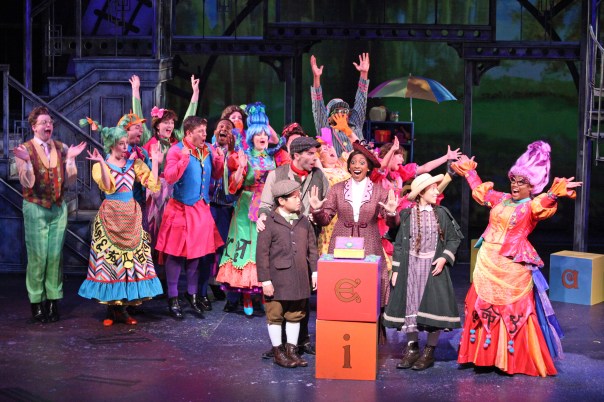
Although the problems are nicely laid out, neither of the two rehab stories is told cogently. Yet the re-education of Jane and Michael certainly has sensational episodes. Statues come to life at a park, a beggar lady sings a heartfelt ballad, the sibs frolic with a preternaturally long word, they cavort with all of London’s chimney sweeps on top of their roof under a midnight moon, and most importantly, they get to discard their castor oil regimen in favor of a sugary tonic. Surely, these are experiences that all good moms and nannies can give their children, right?
Well, they can at ImaginOn, where Children’s Theatre has raised the bar for spectacular technical derring-do – a bar that, among local theatre companies, has mostly been theirs during my 30 years on the beat. While the “Feed the Birds” street scene might strike you as saccharine, and you might accuse the magical park scenes of silly pandering to the anklebiters in the audience, it’s difficult for children of all ages to resist the enchantment of the darkling rooftop scene, further elevated and charmingly smudged by Ron Chisholm’s choreography.
Even that wonder is eclipsed by the flying effects engineered by ZFX, Inc. The only thing I can compare with Mary’s final voyage at ImaginOn are the flying effects I witnessed in the Broadway production of Spider-Man: Turn Off the Dark. Credit Aimee Hanyzewski’s lighting design for enhancing the wonder.

Swimming against the current of the kid-friendly storyline, Steven M. Levine and Lisa Schacher do their best to stretch fledgling attention spans when they dominate the actionas the elder Bankses. Poor Winifred gets the impression – like we all do – that George reveres his childhood nanny, since he keeps invoking her as a standard, yet Schacher manages to make Mrs. Banks seem credulous rather than stupid, loving rather than meek.
We like her as much as we despise the perversity of George’s parenting ideas, but the simple intervention of Mary – just showing up at his workplace with his children – seems to be enough of an influence for him to do the right thing. All of George’s contradictions and vacillations may seem to be dubious on paper, but Levine makes them work onstage, merging essential morality with a starchy aloofness.
As we get to know Mary better and better, we realize that Bert, her admirer and confidante, is by far the warmest character in the whole crew. Poppins may be able to furlough some statues from their pedestals, but who can muster all the chimney sweeps in London for a midnight frolic other than good ole Bert? Caleb Ryan Sigmon reminds me that Bert is a slightly mischievous and broadly chameleonic creature more than any actor I’ve seen onstage before. Sigmon is also a practicing magician who serves as the show’s magic consultant, so he definitely holds up that end of the bargain.

Perhaps because of Jill Bloede’s offstage ministrations as dialect coach, I could believe that Janeta Jackson was channeling Julie Andrews in almost every word and note. We probably perceive Jackson as a starchier Poppins than Andrews because she doesn’t arrive with any Sound of Music baggage. Her elegant serenity is hardly sweet at all, even when she sings her signature “Spoonful of Sugar”: she almost makes a point of not emphasizing the sugar, thereby adding weight to the medicine.
The starchier approach helps us to believe in the nurturing distance she maintains with the Banks kids – whom she claims not to love – and in her fundamental capriciousness. Normally, I’m somewhat aghast when “The Perfect Nanny” punishes Jane and Michael by abandoning them. For abusing a ragdoll? Next thing you know, that beggar lady will be wailing “Feed the Toys.”
Jackson comes the closest I’ve ever seen to making this cruel medicine go down, and she has the highest voice I’ve ever heard singing Mary. That extra range pays extra dividends when Olivia Edge enters the fray as Miss Anderson, Mr. Banks’ fearsome nanny of yore. Not only do Jane and Michael flee in terror from Miss Anderson, so does Papa George!

Edge’s preternaturally high range, fueling her “Brimstone and Treacle” showstopper, pitted against Jackson’s stratospheric soprano – and her “Spoonful of Sugar” philosophy – makes for a climactic showdown of double-barreled power. Since Edge is also fearsomely large in her frilly, funereal gray-and-black dress (designed by costumer Ryan J. Moller), her disposal is specially delightful, a sadistic mix of the witches we loved in Hansel and Gretel and Wizard of Oz.

Somehow, director Michael J. Bobbitt gets a Charlotte cast that is stronger than the national tour that blew through here in 2010. Getting their equals from the local talent pool of children, 15-year-old Haley Vogel as Jane and 12-year-old Alex Kim as Michael, not only underscores Bobbit’s discernment and directing skills, it also reaffirms what we’ve come to expect at Children’s Theatre: the ability to attract, excite, and mentor the best young theatre talent in town.
Bratty and lovable is a tough balance to sustain, but Vogel and Kim have just the right energy and verve, with a grasp of their character arcs and an appreciation of how the Banks kids might be helping their dad to get his head straight. Like the original Broadway cast and the national tour, Vogel and Kim share their roles with alternates. If Lydia Farr and Ryan Campos are up to the same standard, you will not be disappointed.














![IMG_5366[5]](https://artonmysleeve.net/wp-content/uploads/2017/10/img_53665.jpg?w=604)
![IMG_4580[9]](https://artonmysleeve.net/wp-content/uploads/2017/10/img_45809.jpg?w=492&h=328)
![IMG_4372[13]](https://artonmysleeve.net/wp-content/uploads/2017/10/img_437213.jpg?w=524&h=349)


