Category Archives: Theatre

Classics Collide!!

Preview:  The Grapes of Wrath and The Crucible

By Perry Tannenbaum

We can’t explain this curious phenomenon, but the Queen City’s performing arts companies seem to have outgrown their customary October fixations with vampires and spooks. Instead, this coming Halloween weekend, if not entirely witch-free, will be more haunted by a swarm of classics.

After gorging on the full score of Harry Potter and the Sorcerer’s Stone last weekend, Charlotte Symphony returns to Belk Theater on a strict diet of Mozart & Beethoven. As a spectacular Mary Poppins finishes its run on the east side of ImaginOn, Children’s Theatre of Charlotte slips Ezra Jack Keats’s The Snowy Day and Other Stories into the west.

Saturnalia Central will be located at Central Piedmont Community College, where CPCC Theatre presents The Crucible, Arthur Miller’s weaponizing of the Salem Witch Trials to take aim at the infamous anti-Communist witch-hunts led by Senator Joseph McCarthy in the 1950s. Counting the Robert Ward adaptation produced by Opera Carolina, we’ve had at least five opportunities to view this classic in the Metrolina area since 1998.

Another Tony Award winner has had to wait longer than that for its first run here. Frank Galati adapted and directed John Steinbeck’s epic Depression Era novel, The Grapes of Wrath, winning the 1990 Tony less than three months after its Broadway opening. To all those theatre lovers wondering over the past 27+ years when this classic would finally reach us, Theatre Charlotte is answering: now’s the time.

Steinbeck’s biblical exodus begins in the Dust Bowl during the Depression Era, focusing on one family of dispossessed Oklahoma farmers, the Joads, as they journey to California in search of jobs – and their lost dignity. What the Okies find at the end of their journey isn’t a Promised Land at all. Joining a severely overpopulated workforce, they’re plunged into a sun-kissed cesspool of migrant worker exploitation.

The sheer size of the story, in geography and humanity, is a prime reason why it took so long before the 1939 Pulitzer Prize winner was adapted for the stage – and for the additional delay before a local theatre company brought it here. Galati’s Broadway edition had a cast of 31 playing 45 roles, and that’s not counting the seven musicians on hand to play Mike Smith’s original incidental music.

Theatre Charlotte executive director Ron Law, taking over the creative reins for this production, is taking a simplifying approach, reducing his cast to a mere 23. Running the first local company to pick up the gauntlet on producing this behemoth, he can empathize with those that haven’t.

“The cast is large, which means a bigger costume budget,” Law points out. “If you are paying actors, that makes for a big salary line. There are also some very violent scenes in the play that really require a certified fight choreographer. The play calls for a river, campfires, a grave and a truck. Our space is very limited – virtually no wing space, no traps, no fly system. I truly favor minimalism in theatre, focusing on narrative and characters. But sometimes minimalism is not really all that simple.”

With so many roles, Charlotte’s community also had to worry about who would sign up. Decreasing the cast creates more multiple roles to keep the volunteers busy, and Law was pleased to be able to fill nearly half of his cast list with local theatre vets, including Vic Sayegh, Annette Gill and Paula Baldwin.

Gill and Baldwin have similar pedigrees at the Queens Road barn, playing Linda Loman in the two most recent revivals of Death of a Salesman in 1998 and 2009. Baldwin, the more recent Linda, has also aced auditions at a variety of local companies for prominent – and powerful – roles in Three Tall Women, August: Osage County, The Actress, and Who’s Afraid of Virginia Woolf?

Baldwin chafes against the notion that Ma Joad, her role in The Grapes, is a softie by comparison.

“She fulfills her role as the Mother who nurtures, cooks and cleans,” she admits, “but Pa comes to her for her opinion and follows it even when he, at first, doesn’t agree with her. She is truly the backbone of the family. When the men start to falter and give up, she continues to be positive and strong. Ma has several wonderful monologues, and one of my favorites is when Pa has all but given up and she tells him that life for a woman is ‘all one flow, like a stream, little eddies, little waterfalls, but the river, it goes right on.’”

Vilified by bankers and landowners for his workingman sympathies, scorned by literary critics who preferred the apolitical beauties of Hemingway, Faulkner, and Fitzgerald, the sun began to set on Steinbeck’s reputation and continued to decline after he won the Nobel Prize in 1962. The socialist label, not a problem in Europe, hampered him here.

So let’s look around and see the political reasons why the time may be ripe for The Grapes. An avowed socialist nearly captured the presidential nomination of one of our major parties, and the shadows of fascism and demagoguery hang over our land as heavily as they did when Steinbeck published his masterwork.

Baldwin and Law both cite the sowing of divisions and the widening chasm between the haves and have-nots as reasons why the Joads’ odyssey still resonates today.

“The question then seems to be the same as today,” says Baldwin. “What price are we willing to pay to affect change? Is America truly a land of opportunity for all?”

In the 2007 production of The Crucible at Theatre Charlotte, director Matt Cosper dipped into the screenplay that Miller had written for the 1996 film, freshening the version that had previously run on Queens Road in 1988. Tom Hollis, chairman of the CPCC Drama Department, has settled on an even more daring way to give the old classic a new look.

Directing at Pease Auditorium, Hollis is transposing the 1692 Salem Witch Trials to 1952, when the Miller script was released, while preserving the antique Puritan dialect that the playwright invented for his historical characters. From what we’re told about the impact Hollis hopes to achieve in juxtaposing Salem’s infamous trials and Sen. McCarthy’s infamous Senate hearings, we could possibly see a trace of Sen. Joe or his nemesis, Joseph Welch. Maybe some video cameos?

“The naming of names and the accuser being somehow sacrosanct has been an age-old issue in human affairs,” Hollis observes. “The hysteria of the Salem Witch Trials and the 50’s Communist hunts all echo with the proliferation of ‘fake news’ today. Did not Orwell predict that the shouting of a lie loud enough and long enough will make it true? The inability of many to separate belief from objective reality is more disturbing today than ever.”

After a couple of memorable performances in 1776 and Ragtime last season, Josh Logsdon gets an even meatier role as Miller’s martyr, John Proctor, in his first non-musical foray at CP. He is tempted and traduced by the adulterous Abigail Williams while further tortured and frustrated by his unforgiving wife, Elizabeth – tasked with finding his authentic self while living in a sexist world.

“The text does paint him as domineering and harsh at times when arguing with Elizabeth,” Logsdon says. “But I try to draw on more of his softness with both Abi and Elizabeth. His relationship with Elizabeth transitions from one of resentment and more pain to a reclaimed love and a final peace. He has a softness to Abigail as much as he denies it, but he eventually sees that she’s willing to destroy everything and everyone to have what she wants, and he’s definitely horrified by it.”

Not quite a vampire, but chillingly close – and certainly in season.

Best of Charlotte, 2017

Best of Charlotte, 2017

By Perry Tannenbaum

                                           Best ActorJeremy DeCarlos


Among local performers, there are strong candidacies from Brian Logsdon (Pride and Prejudice and Ragtime), Jonavan Adams (Ma Rainey’s Black Bottom and The Christians), Scott A. Miller (Stupid F@#%ing Bird and The Submission), Jermaine Gamble (A Raisin in the Sun and Jitney) and Tyler Smith (Ragtime and Memphis). All of them sparkled on multiple occasions. But the runaway victory goes to Jeremy DeCarlos, who laps the field – in range and productivity – with four scintillating outings. Draped in a braided Hussar jacket, DeCarlos just finished channeling his inner Jimi Hendrix as the devilish St. Jimmy in American Idiot. That was the last of his Actor’s Theatre gems over the past year, including some cross-dressing preaching in Bootycandy, his insouciant devotion in Stupid F@#%ing Bird, and his amazing transformation – from Jerry Lewis nerd to Incredible Hulk-ish monster – in The Toxic Avenger.

Best Actress – Shar Marlin

The field of contenders is larger among the ladies, but the roles were more thinly distributed, eliminating productivity as a decisive criterion. But which other benchmark should override all others? If it’s flesh-crawling menace, Sarah Woldum gets the edge, bringing Sheridan LeFanu’s Carmilla to life in She Who Watches. Leslie Giles was the funniest as the blind librarian in The Toxic Avenger, Lucia Stetson the most revelatory as Mother in Ragtime, and Allison Snow Rhinehart was better than her Broadway counterpart as Mama in Memphis. And how can I forget the sizzling dominatrix arrogance of Nonye Obichere as Whatsername in American Idiot? I’m turning instead to Shar Marlin for her sheer power and imperial dominance in Ma Rainey’s Black Bottom, a dramatic stunner that also showed Shar’s blues singing chops. Dignity in the face of exploitation and discrimination. Diva!

Best Comedy – Women Playing Hamlet


Theatre Charlotte’s You Can’t Take It With You and the Citizens of the Universe farewell, The Hitchhiker’s Guide to the Galaxy, were arguably the zaniest productions of the 2016-17, while the Chekhov knockoff from Actor’s Theatre, Stupid F@#%ing Bird, was surely the most poignant. And what about OnQ Productions’ A Brown Tale from James T. Alfred, maybe the funniest one-man show I’ve ever seen? All were worthy candidates, but I’m going to let Chickspeare split this prize with Donna Scott Productions for their joint production of Women Playing Hamlet. Glynnis O’Donoghue starred as the soap queen saddled with the lead role in the Mona Lisa of tragedies, and the galaxy of comediennes – all in multiple roles – offering her questionable advice included Tania Kelly, Andrea King, Vivian T Howell, and Sheila Snow Proctor.

Best Musical – Ragtime

Ragtime Promo Photos

Folks who confine their diet of musicals in Charlotte to touring productions at the PAC are missing out bigtime on the locally-produced blockbusters playing out at smaller venues around town. Actor’s Theatre scrambled to produce a marvelous Toxic Avenger at a storefront church because this city doesn’t have the vision to see the arts flourish on Freedom Drive without a needless morass of red tape. Still in exile, they just brought the noise of American Idiot to Queens University for a face-melting month. After reminding us how finely they can produce A Year With Frog and Toad, Children’s Theatre astonished with the world premiere of The Best Christmas Pageant Ever: The Musical. With more than one Broadway-level performance, Theatre showed us their mettle with Memphis, and CPCC re-emphasized that their musical excellence isn’t confined to summer anymore. Maybe it was sheer luck, but CP’s wintertime production of Ragtime was the most timely of the year, underscoring the sad fact that institutional racism, police brutality, and prejudice against immigrants aren’t quaint relics of the Jazz Age. As the martyred Coalhouse Walker, Tyler Smith’s impassioned “We are all Coalhouse!” reverberated through a city in turmoil.

Best Drama – Jitney

Early last season, PaperHouse Theatre proved that The Frock Shop on Central Avenue was the perfect site for a creepshow with a dazzling She Who Watches, and early this season, a legend made a comeback when Steve Umberger and his Playworks Group brought a sterling production of The Christians to Booth Playhouse. In between, as Charlotte was fully wakening to how badly we have neglected and mistreated our underclass, theatergoers may have finally been zonked by the realization that our city is exceptionally rife with African American acting and directing talent. Kim Parati made an auspicious directorial debut at Theatre Charlotte with a freshened-up Raisin in the Sun, but this was a vintage year for August Wilson – in two dramas directed by Corlis Hayes, Ma Rainey’s Black Bottom at CPCC and Brand New Sheriff’s Jitney at Spirit Square. Hayes brought out the best in John W. Price and Jermaine Gamble as the father-son antagonists in Jitney, with Gerard Hazelton adding a mix of comedy and poignancy as the gypsy cab company’s resident lush. Move over OnQ Productions, there really is a brand new black company in town – our second! – producing professional-grade work.

Best Night @ Symphony – Mahler’s “Resurrection”

While a well-played Beethoven symphony, a Rossini overture, a Strauss tone poem, or a Mozart concerto might be the secret sauce to get newcomers to become Charlotte Symphony subscribers, longtime concertgoers like me wish to dismount the warhorses and hear something off the beaten trail. There’s plenty out there that will please both camps: big, unfamiliar orchestral works that will instantly grab you by the lapels even if Symphony hasn’t reprised them within the last decade. Armed with an audacious orchestra and choir, plus two soloists who have sung with Opera Carolina, Davidson College showed the way with a rousing performance of Ralph Vaughan Williams’ A Sea Symphony, set to poetry by Walt Whitman. That’s the sort of daring we hope for from Charlotte Symphony’s British maestro, Christopher Warren-Green. We did get a British Isles-themed evening when pieces by Edward Elgar and Peter Maxwell Davies, spiced up with a bagpiper, were served with Mendelssohn’s “Scottish.” Utilizing the Symphony Chorus and distinguished guest vocalists, Warren-Green turned up the power with a pair of Bruckner chorales last November and Mendelssohn’s Elijah last March. If you wanted to sample the full capabilities of Symphony, their chorus, and the guest vocalists Warren-Green can summon to Belk Theater, you had to hear them introducing the wonders of Mahler’s “Resurrection” Symphony No. 2 to an astounded audience.

Best Night @ the Opera – The Girl of the West

Under maestro James Meena, Opera Carolina does the oldies better than ever, as their uproarious Barber of Seville and their vivacious, ultimately anguished La Traviata amply proved. There was even some audacity in the 2016-17 programming as OpCar partnered with Warehouse Performing Arts Center and the D9 Brewing Company to produce an evening of three short operas – including the world premiere of Scott Joiner’s “Connection Lost (The Tinder Opera)” – at the brewery in Cornelius. Yes, a world premiere on Treynorth Drive! But most exciting was the Charlotte premiere of Puccini’s The Girl of the West, as Meena collaborated with six other international companies, including New York City Opera and Teatro del Giglio in Lucca, Puccini’s hometown. Singing was exemplary, persuading me that this second-tier Puccini opera was actually a first-rate work, and staging was anything but stodgy or conservative: much of the scenery was animated and bold, with authentic relics evoking the Wild West supplied by our own dearly beloved Wells Fargo. An appreciable, if infinitesimal, atonement for all the bank’s Wild West chicanery.


Little Discoveries Yield Big Laughs in “The Snowy Day”

Review:  The Snowy Day

By Perry Tannenbaum

Faced with the problem of turning Ezra Jack Keats’ children’s classic, The Snowy Day, into an hour-long stage production, Children’s Theatre of Charlotte and adaptor Jerome Hairston have resisted the temptations of bloating the story with needless pabulum or stretching it with irrelevant songs. Instead, they’ve balled up the original story Keats wrote about Peter with subsequent titles he wrote about his urban hero – including Whistle for Willie, Goggles! and A Letter to Amy – into a sizable snowball.

The mighty tetralogy ran a lordly 44 minutes at the performance I attended. Gauging by the delighted reception I saw last Saturday afternoon, I’d say both the length and the treatment were ideal.

Both the scenic and costume design, by Alessia Carpaca and Ketti Shum Mcrae respectively, seem eye-poppingly close to the original Keats illustrations, especially the iconic red snowsuit. Stage director Mark Sutton seems to have horded all the latitude – and fun – to himself before generously divvying it up among his cast.

All of them seem to having a great time at the Wells Fargo Playhouse in ImaginOn. Lydia Williamson not only gets to regress into childhood, she also swaps genders to play Peter in all four stories. Crunching the freshly fallen snow, puffing up agonizingly in attempts to whistle, sporting new goggles Peter is lucky enough to find, and stressing over his birthday invitation to Amy are all prodigious romps for Williamson to feast on.

Abigail Aukerman has the most chameleonic outing, appearing as Mom from time to time when she isn’t branching out into neighbor kid Archie and first crush Amy. Ron Lee McGill remains Dad in an oddball straw hat, hardly changing at all when he’s propelling Peter’s dopey dog, Willie. McGill also gets to chip in some narration – and assorted stagehand work while Peter’s adventures are in progress.

Much of the comedy works because we view it from an older, wiser perspective. We know what will happen when Peter stomps into the snow, though Sarah Tundermann’s projections are a nifty confirmation. And we can anticipate Peter’s heartbreak when he wakes up in the middle of the night and discovers that the snowball he stowed away in the pocket of his snowsuit that afternoon has vanished. How does that happen?

So it’s nice to find that nobody in The Snowy Day And Other Stories is cajoling us to participate or react. We take it all in privately, frequently laughing or marveling at what we see. That’s exactly what Peter is doing, except for those delicious moments when we’re a couple of steps ahead of him.

Children’s Theatre’s “Mary Poppins” Raises the Bar While Flying Its Star

Poppins(C)DBise063

Review:  Mary Poppins

By Perry Tannenbaum

It’s a strange proposition when you decide to bring Mary Poppins to Children’s Theatre at ImaginOn, Charlotte’s pre-eminent fantasy palace. Yes, it’s Disney, but it shatters the Children’s Theatre norm of 90 minutes or less, running over 145 minutes. And the story of how Mary Poppins turns the Banks family from bitterness to joy is only half about children.

Mary Poppins 7

Mary P is definitely needed to halt the vicious cycle of bad behavior from Jane and Michael, the Banks siblings, who seem to live for the thrill of defying and driving away their nannies. But there are marital issues plaguing George and Winifred Banks at the same time, some of them rooted in Victorian sexism; and their ideas about nannies, parenting, and the primacy of money could use a reset. George’s basic failures of self-examination and communication are ultimately the prime reasons why his family is so dysfunctional.

Although the problems are nicely laid out, neither of the two rehab stories is told cogently. Yet the re-education of Jane and Michael certainly has sensational episodes. Statues come to life at a park, a beggar lady sings a heartfelt ballad, the sibs frolic with a preternaturally long word, they cavort with all of London’s chimney sweeps on top of their roof under a midnight moon, and most importantly, they get to discard their castor oil regimen in favor of a sugary tonic. Surely, these are experiences that all good moms and nannies can give their children, right?

Well, they can at ImaginOn, where Children’s Theatre has raised the bar for spectacular technical derring-do – a bar that, among local theatre companies, has mostly been theirs during my 30 years on the beat. While the “Feed the Birds” street scene might strike you as saccharine, and you might accuse the magical park scenes of silly pandering to the anklebiters in the audience, it’s difficult for children of all ages to resist the enchantment of the darkling rooftop scene, further elevated and charmingly smudged by Ron Chisholm’s choreography.

Even that wonder is eclipsed by the flying effects engineered by ZFX, Inc. The only thing I can compare with Mary’s final voyage at ImaginOn are the flying effects I witnessed in the Broadway production of Spider-Man: Turn Off the Dark. Credit Aimee Hanyzewski’s lighting design for enhancing the wonder.

Poppins(C)DBise 142

Swimming against the current of the kid-friendly storyline, Steven M. Levine and Lisa Schacher do their best to stretch fledgling attention spans when they dominate the actionas the elder Bankses. Poor Winifred gets the impression – like we all do – that George reveres his childhood nanny, since he keeps invoking her as a standard, yet Schacher manages to make Mrs. Banks seem credulous rather than stupid, loving rather than meek.

We like her as much as we despise the perversity of George’s parenting ideas, but the simple intervention of Mary – just showing up at his workplace with his children – seems to be enough of an influence for him to do the right thing. All of George’s contradictions and vacillations may seem to be dubious on paper, but Levine makes them work onstage, merging essential morality with a starchy aloofness.

As we get to know Mary better and better, we realize that Bert, her admirer and confidante, is by far the warmest character in the whole crew. Poppins may be able to furlough some statues from their pedestals, but who can muster all the chimney sweeps in London for a midnight frolic other than good ole Bert? Caleb Ryan Sigmon reminds me that Bert is a slightly mischievous and broadly chameleonic creature more than any actor I’ve seen onstage before. Sigmon is also a practicing magician who serves as the show’s magic consultant, so he definitely holds up that end of the bargain.

Mary Poppins 4

Perhaps because of Jill Bloede’s offstage ministrations as dialect coach, I could believe that Janeta Jackson was channeling Julie Andrews in almost every word and note. We probably perceive Jackson as a starchier Poppins than Andrews because she doesn’t arrive with any Sound of Music baggage. Her elegant serenity is hardly sweet at all, even when she sings her signature “Spoonful of Sugar”: she almost makes a point of not emphasizing the sugar, thereby adding weight to the medicine.

The starchier approach helps us to believe in the nurturing distance she maintains with the Banks kids – whom she claims not to love – and in her fundamental capriciousness. Normally, I’m somewhat aghast when “The Perfect Nanny” punishes Jane and Michael by abandoning them. For abusing a ragdoll? Next thing you know, that beggar lady will be wailing “Feed the Toys.”

Jackson comes the closest I’ve ever seen to making this cruel medicine go down, and she has the highest voice I’ve ever heard singing Mary. That extra range pays extra dividends when Olivia Edge enters the fray as Miss Anderson, Mr. Banks’ fearsome nanny of yore. Not only do Jane and Michael flee in terror from Miss Anderson, so does Papa George!

Poppins(C)DBise 572

Edge’s preternaturally high range, fueling her “Brimstone and Treacle” showstopper, pitted against Jackson’s stratospheric soprano – and her “Spoonful of Sugar” philosophy – makes for a climactic showdown of double-barreled power. Since Edge is also fearsomely large in her frilly, funereal gray-and-black dress (designed by costumer Ryan J. Moller), her disposal is specially delightful, a sadistic mix of the witches we loved in Hansel and Gretel and Wizard of Oz.

Poppins(C)DBise 160

Somehow, director Michael J. Bobbitt gets a Charlotte cast that is stronger than the national tour that blew through here in 2010. Getting their equals from the local talent pool of children, 15-year-old Haley Vogel as Jane and 12-year-old Alex Kim as Michael, not only underscores Bobbit’s discernment and directing skills, it also reaffirms what we’ve come to expect at Children’s Theatre: the ability to attract, excite, and mentor the best young theatre talent in town.

Bratty and lovable is a tough balance to sustain, but Vogel and Kim have just the right energy and verve, with a grasp of their character arcs and an appreciation of how the Banks kids might be helping their dad to get his head straight. Like the original Broadway cast and the national tour, Vogel and Kim share their roles with alternates. If Lydia Farr and Ryan Campos are up to the same standard, you will not be disappointed.

Gunderson’s “Revolutionists” Reminds Us That 1793 Wasn’t a Very Good Year

Review : The Revolutionists

By Perry Tannenbaum

It’s easier to enjoy Lauren Gunderson’s The Revolutionists, a finely polished comedy gem from PaperHouse Theatre, than it is to find it. My GPS app resisted the 1776 Statesville Avenue address that was on my smartphone calendar, forcing me to choose between a Camp North End and a Goodyear Arts destination nearly 100 address numbers apart. Choosing the 1824 Statesville address got me to the Camp North End gate well enough after dark, and there was a PaperHouse emissary at the gate to tell us how to proceed. But as we navigated through a desolate concrete-and-asphalt landscape of vast warehouses, it was definitely an uh-oh episode for Milady GPS, who spun around from “Recalculating” to “Turn Right” in her instructions like a dog chasing its tail.

Following traffic wasn’t a reliable remedy, and I apologize to anyone who followed our lead on opening night and wound up parking a wilderness away from the PaperHouse performing space. Within sight of what looked like the building entrance – and another PaperHouse emissary – I still probably walked nearly a quarter of a mile after thinking I had sufficiently improved my parking spot. You walk through that building to another one.

Fortunately, PaperHouse is much better at producing plays than at getting you to them. (They will deploy more guides for future performances, I was assured.) Once you do arrive a the site of the action, with scenery by Jordan Ellis that strikes us as much with its simulated blood-spattered walls upstage as it does with the ascending scaffold in front of them, you can start to believe you’ve really reached the French Revolution during the Reign of Terror. You’re a bit of a pioneering revolutionary yourself if you’ve persevered and reached this secluded spot.

In the meta-world of her own – and history’s – making, The Revolutionists is Gunderson’s play, and it isn’t. We seem to be watching French feminist playwright Olympe de Gouges battling an onset of writer’s block as she ponders her next response to the rampaging Reign of Terror in the seclusion of her study. She is much in demand, for while Olympe is thrashing around, trying to settle on her message and her medium – shall it be another play? or perhaps a pamphlet? or a manifesto? – in walks Charlotte Corday, pressing the writer to compose a memorable line she can declaim when she assassinates the rabid revolutionary Jean-Paul Marat in his bathtub.

Olympe isn’t in advertising, so one-liners and slogans aren’t her forte. She hopes to come up with the right zinger during the course of composing a longer work, a plan that doesn’t jibe well with Charlotte’s mad impatience. Just when you think that the comedy will crest with the standoff between Charlotte’s insane homicidal urgency and Olympe’s many artistic hesitancies, in walks Marie Antoinette, dressed to the 17’s by costume designer Barbi Van Schaick. Her Highness wants a rewrite, a play by Olympe that will rebrand her tarnished reputation.

Everything seems to become absurd and almost surreal at this point – and likely stays that way with Marie’s queenly vanities and Olympe’s nervous vacillations. But if you go home and Google, you find that Olympe de Gouges really did embark on writing a play to rehab Marie Antoinette’s reputation, and that the playwright really did put herself in that work as an enlightened agent who reconciles the queen with the revolutionaries. If that weren’t enough, it’s also true that de Gouges wrote the courageously feminist Declaration of the Rights of Woman and the Female Citizen, thereby punching her ticket to the guillotine.

In the play, Olympe writes her manifesto in response to some principled prodding from Marianne Angelle, a Haitian revolutionary seeking independence from France, the one fictitious character in Gunderson’s script. In the real world, de Gouges seems to have had no problem standing up for herself – and against the Revolution’s bloodthirsty zealots.

So you might take the layered-on comedy a couple of ways. Gunderson may be telling us that she prefers her feminist heroes to be more fallible and true-to-life rather than impossibly glorified. Or she might be substituting herself for Olympe and showing us how far short of the French revolutionary’s greatness she falls.

Gunderson nudges us to that second, self-effacing hypothesis with little anachronisms that she occasionally drops into the dialogue, like Marie’s rebranding and rewrite ideas. PaperHouse artistic director Nicia Carla takes the anachronisms beyond what Gunderson specifies in her stage directions, and she doesn’t waste any time about it. Lydia Williamson makes her first entrance as Marianne carrying a garish, polka-dotted plastic suitcase, and when Shawna Pledger as Olympe begins writing at her escritoire, she quickly switches from a quill to a BIC ballpoint.

So Pledger is only superficially presiding over a play that Olympe has written for her queen with a plum role for herself. She is actually channeling Gunderson writing a dark comedy about herself, and if you saw Pledger last season as the fretful Sister Shelley who runs the soup kitchen in Grand Concourse, you already know that she excels at stressed-out indecisive women who are so eager to please. Surrounded by this madhouse, Williamson as Marianne doesn’t get as many comedy opportunities as the true historical figures, but she does loosen up from time to time, on temporary leave from her hectoring. Cumulatively, she leaves us with the impression that the French, whatever their politics, have no special call for commanding an empire.

Au contraire.

Sarah Woldum has now haunted PaperHouse productions for two consecutive Octobers, last year as Sheridan LeFanu’s vampire Carmilla and this year as the notorious Corday. This time, she can milk a laugh or two from the assassin’s irrational zeal and her PR impulses, but she’s unmistakably insane. I’m not sure she ever blinked.

As for Caroline Bower, she does enter as an overdressed Barbi doll with some truly vain, insensitive, and bubbleheaded lines to delight us with. But Marie Antoinette’s grand gown, the ribbons she loves so frivolously, and the ridiculous piled-high wig and feathers all do come off as the Reign of Terror sweeps its scythe through our women, and its Bower’s humbling – still cohering with the incredibly spoiled brat we first saw – that brings home how monstrous the French Revolution turned out to be.

In the end, we might realize that our man’s world of today is hardly less bloody than it was in the fatal year of 1793 – and that Gunderson isn’t entirely playful or self-critical when hinting that she trembles in the face of such brutality.


Actor’s Theatre Makes “American Idiot” an Immersive Face-Melting Experience

Review: American Idiot

By Perry Tannenbaum

Young love and the ills of the world are so frequently the focus of rock musicals that we sometimes feel little need to decipher the words that jangle together with the actions and emotions we’re seeing onstage. This week is a particularly rockin’ and raucous week in Charlotte, with the 20-year revival tour of Rent and the new Actor’s Theatre of Charlotte production of American Idiot opening on consecutive nights.

The original premiere of the Jonathan Larson musical and the 2004 Green Day album were separated by a mere eight years. While the young adult angst lived on, the world had completely changed: the old preoccupations with AIDS and AZT were supplanted by post-9/11 disillusionment and a scattershot scorn for suburbia, corporate America, the war-mongering George W, and the powerlessness of teens to change any of it.

Actor’s Theatre certainly knows powerlessness. Scheduled to open their new location on Freedom Drive last October, they had to be content to offer tours of their production-ready facility. Governmental regulations, foot-dragging and red tape have pushed back the opening to a still undetermined date in 2018. For a second consecutive show, Actor’s Theatre is relying on the kindness of Queens University and their Hadley Theatre, a facility they share with Myers Park Traditional School. Once you get past the decorous entrance and the antiseptic hallway, the black box venue actually possesses much of the off-Broadway feel we’ve come to expect from this company.

At the core of this production are a stage director, music director, choreographer, and a couple of lead actors who have figured prominently in past Actor’s Theatre productions at their demolished former home on Stonewall Street. They may be taking their exile from a permanent home personally, now that it’s prolonged to nearly 18 months, with an understandable urge to scream. Producing artistic director Chip Decker didn’t appear to be worried about reining any of them in, especially music director Ryan Stamey and choreographer Tod A. Kubo.

Stamey stands behind a keyboard at the edge of the stage, looking up at a six-piece band perched above the middle of the stage, occasionally leaning into a microphone and joining the vocalists. There’s a cellist embedded in the sextet whom I never heard. Likewise, the tropical strains of steel guitar, so clearly soothing in the background of the Broadway cast album on “Give Me Novacaine,” has been almost completely sandpapered away by Stamey’s heavy-metal approach.

The storyline, not exactly robust on the Grammy Award-winning concept album, has been somewhat bolstered by lead singer Billie Joe Armstrong and stage director Michael Mayer in their book. Instead of a single Jesus of Suburbia, the musical has three. We have the original Johnny, who escapes the burbs only to encounter his hipster, heroin-shooting alter ego, St. Jimmy, and the possible love of his life, Whatsername.

At a neighborhood 7-Eleven, Johnny meets two other chums who have been crucified by suburbia – and turned into American Idiots – Will and Tunny. Only one of those two will use the bus tickets Johnny has purchased for the trio’s glorious breakaway. Will’s girlfriend, Heather, shows up and places his hand on her belly, obviating the need of saying to him that she’s pregnant. Apparently, punk rockers aren’t very articulate, for Tunny doesn’t do much of anything in the big city, mostly lying face down on a bed until lured by a US Army commercial to go off and fight in an unspecified foreign war.

With two more self-pitying saviors and two additional girlfriends worked into the story – Tunny eventually finds The Extraordinary Girl – Armstrong added more Green Day music to his score, conveniently taken from 21st Century Breakdown, the follow-up album to American Idiot. Their decibel level tamped down to barely bearable, the band is so face-meltingly loud that you have to admire the singers’ will to prevail. Decker doles out the most expressive and outré action to Johnny and St. Jimmy, keying electrifying performances from Matt Carlson and Jeremy DeCarlos respectively.

From his defiant and rebellious posturing in suburbia, Carlson became pure decadence in the city, simulating casual sex, shooting dope, and reeling around in a stupor as he sang. To contrast with this charismatic dissipation, DeCarlos had to take extreme measures to strike us as Johnny’s inner Beelzebub. There has always been a physical resemblance between DeCarlos and Jimi Hendrix, and I had to suspect that St. Jimmy would be the role to set it loose. Costume designer Carrie Cranford audaciously joined in the conspiracy, supplying a flamboyant jacket that evokes the Hussar military jacket Hendrix sported back in the late ‘60s. There wasn’t a headband or a Mexican bandit’s sombrero in the outfit, but the outrageous hairdo more than compensated, so puffed and straightened that I didn’t notice the thin dangling braids at first.

Coupled with this look were spell-casting gesticulations that went beyond the Wicked Witch of the West and World Wide Wrestling in their shamelessness, and I’ve never heard DeCarlos sing with such ferocity before, though there are also seductive and manic moments for St. Jimmy. Where exactly in this charismatic performance the ministrations of Kubo’s choreography began was difficult for me to divine, but the choreographer should definitely get a large proportion of the credit for making this American Idiot such an immersive, visceral experience. Like Actor’s Theatre general manager Martin Kettling told us in his curtain speech, the ensemble frequently used the platform looming above the stage as a jungle gym, often joining the musicians at the top. Over and over, I saw daring dance moves that must have come after Kubo hopefully asked, “Can you try this?” in rehearsals.

Some of the most arresting action came from the women, differentiating the Charlotte American Idiot from the Broadway edition, where hard rock seemed to be the exclusive playpen of macho sexist louts. Nonye Obichere was particularly stunning as Whatsername, all Johnny could handle and more, singing and dancing with a dominatrix edge. As Heather, Lizzie Medlin was more bitchy and Gothic, upstaging Steven Buchanan, who was mostly confined to the vicinity of a sofa once Will grudgingly chose domesticity as his direction in life.

Grant Zavitkovsky was underpowered, undermiked, and largely unintelligible as Tunny in the early going, but those problems thankfully vanished by the time he enlisted. While the budgetary concessions Decker made in his set design worked well, the technical economies he adopted meant that Tunny’s wartime travails were far less catastrophic. No matter how well Grant Zavitkovskyperformed the role, The Extraordinary Girl couldn’t be nearly as extraordinary in her devotion.

There’s a self-critical bent in Armstrong’s leading men that is totally at odds with the striving, sentimental nobility and martyrdom of the Rent heroes and heroines. Lyrical and melodic takeaways from American Idiot aren’t as vivid or memorable as those you might find in the sassy “Out Tonight” or the anthemic “What You Own” that Larson crafted for his glorified squatters. I didn’t find myself nearly as much on the side of Armstrong’s troubled American Idiots, but I did feel they should be listened to. Even if I hadn’t known how passionately Carlson and DeCarlos felt about this music, I would have heard it in their voices and seen it in their actions.

Davidson Takes Astonishing Flight on “Neverland” Tour

Review:  Finding Neverland

By Perry Tannenbaum

So wait a second: John Davidson – the Hollywood Squares host and the incurably wholesome crooner on too many variety shows to completely avoid – is far better now as an actor than he ever was as a TV personality or a singer??!? Capable of savagery and raw power? Watching the Charlotte premiere of Finding Neverland at Belk Theater earlier this week turned my long-held convictions upside-down.

Davidson takes on the role of Peter Pan playwright James M. Barrie’s implacable theatre producer, Charles Frohman, becoming the inspiration for Barrie’s most famous villain, Captain James Hook. While Billy Harrington Tighe stars as Barrie alongside Christine Dwyer as Sylvia Llewelyn Davies, the mother of four adorable boys who help liberate the playwright’s inner child, it’s Davidson who dominates. Since the current Charlotte engagement is the first of a 24-city tour through April 2018, theatergoers across the US from Rhode Island to Arizona should be on the lookout for Davidson’s bravura.

Maybe “dominates” isn’t the right word for what Davidson accomplishes, for he rescues a show that flounders rather pitifully through nearly the entire first act, despite the sometimes strained efforts of Tighe and Dwyer, the hyperactivity of the purportedly inspirational kiddies, and assorted meaningless outbursts of spectacle that end up pointing up what they’re intended to hide – a total absence of imagination, magic, and enchantment. Adding to this strain to entertain, amid a moribund book by James Graham paired with tepid music and lyrics by Gary Barlow and Eliot Kennedy, sound designer Jonathan Deans seems to have potted volume levels some 15-20 decibels above those I experienced at the 2015 Broadway production.

Deans’ ministrations, however, prove to support a key strategic aim of director Diane Paulus as we sail into intermission. The final two songs prior to the break, “Hook” and “Stronger,” almost literally explode, undergirded by thunderous volleys of percussion that seem to shake the walls of the theater. Here is where Frohman, after throwing a portentous shadow of a hook onto the upstage wall, transforms into Captain Hook and Scott Pask’s mix of Victorian and Kensington Garden settings suddenly turns dark, swarming with pirates.

It’s a thrusting nautical moment that echoes the thrill of Douglas Sills singing “Into the Fire,” when the foppish Sir Percy Blakeney, exhorting his marauding band of revolutionaries, showed his true heroic self for the first time in The Scarlet Pimpernel. It’s Tighe latching onto Davidson’s lurid coattails to become stronger. But Hook doesn’t materialize out of thin air – or that comical silhouette. He explains that he is actually a part of Barrie that the playwright has kept repressed.

The Davies siblings have liberated Barrie’s inner child, but it’s Hook who unleashes the beast. After intermission, he even prods the unhappily married Barrie to give the widowed Mrs. Davies a kiss.

So it’s almost accurate to say that Davidson co-stars with Tighe as Barrie, for there are times when he’s clearly sharing the role. Yet even when Davidson is aboard with all of Frohman’s orneriness, all is not well. Confronted with Barrie’s script for Peter Pan, the first rehearsal scene that Frohman presides over is fairly lame; and when the conceited, over-refined acting troupe adjourns to a pub, where Barrie and Sylvia encourage them to “Play” more like children, the regression humor falls even flatter. Graham would like us to believe that legitimate actors are familiar with King Lear and not A Midsummer Night’s Dream – and that Barrie’s previous masterwork, The Admirable Crichton, was a clichéd drawing room comedy.

Graham’s book improves slightly when the four boys prepare to entertain their mom and Barrie with Peter Davies’ new play. But if the boys’ “We’re All Made of Stars” nearly rises to that festive backyard occasion, we must endure the lackluster “When Your Feet Don’t Touch the Ground” when Barrie and Peter (Connor Jameson Casey on the night I attended) have their most dramatic father-son exchange. With more touching emotional power, the musical ascends from there as Peter Pan premieres and triumphs while Elizabeth expires.

Somehow it doesn’t matter that Dwyer hasn’t given us any indication of Elizabeth’s frailty until moments before she exits to her deathbed. Graham finally mixes some magic into the personal transformations of Barrie and Peter, Daniel Wurtzel sprinkles in some enchanting air sculpture from Fairyland, and a little glint of that fairy dust begins to gleam in Frohman’s child-hating soul.

Maybe when Kelsey Grammer growled as Hook and softened as Frohman in the original Broadway cast, the ending had more emotional power than this. I seriously doubt it. I can only say that the leaden ending I experienced when an understudy took over the role at the Lunt-Fontanne Theatre did not begin to compare with the climax that brought a nearly full house to its feet at Belk Theater on opening night. Barlow and Kennedy never seem to even search for Neverland, let alone succeed in finding it, but Davidson certainly does with his astonishing Phoenix-like rebirth.

Candle Burns More Brightly in “Rent” After 20 Years

Review:  Rent

By Perry Tannenbaum

Twenty years – or as Jonathan Larson would have phrased it, 10,519,200 minutes – is a long time to expect a trend-setting, very much of-the-moment musical to retain its currency. Rent actually did quite well, lasting over 12 years and 5,000 performances on Broadway during its singularly funky run. During those first hot box office years, I remember deploying my daughter to the Nederlander Theatre on 41st Street in hopes of snagging a couple of rush tickets while I kept my place on a long Times Square TKTS line in case the Rent raid didn’t pan out.

It didn’t. Rent fans were a multitudinous rabid cult, so we went to Plan B for that evening’s discount tickets.

Like AIDS, AZT breaks, answering machine beeps, and young lives structured around demonstrating and protesting, rush tickets to Rent was a rite of passage that slowly faded away. Since Rent premiered in 1996, the 20-year tour presumably began last year – before it seemed like demonstrating and protesting just might be coming back full force.

The current tour at Belk Theater does occasionally look like a period piece. Mark Cohen, our narrator, walks around with a film camera taking movies, and he shows them on a contraption called a projector. Cordless phones haven’t become ubiquitous, settling in an abandoned building hasn’t become an outré idea, a power outage brings city life to a standstill, and young people seem capable of surviving without TV’s and video screens glowing in their faces (by contrast, take a peep at the TV saturation in the current Actor’s Theatre production of American Idiot at Queens University).

What turned me off to the first tours I saw was the rock ‘n’ roll arrogance of the lead players, who seemed to take the adulation of their audiences as a license to strut and preen instead of actually doing their jobs. Ironically, it was the “Farewell Tour” that brought the original Roger and Mark to town, Adam Pascal and Anthony Rapp, and showed me what actors could do with the roles that wannabe rockstars couldn’t. With a bit of commitment from the players, I also saw the gay romance between Tom and Angel come to life as more than a comical sideshow.

But although the drug-addicted, AIDS-afflicted Mimi on that tour could rock an ultra-tight pair of glittery turquoise pants, she didn’t bring enough romantic fire to her “Light My Candle” duet with Pascal to set it ablaze. Even more icy and moribund were slumlord Benny and lawyer/community organizer Joanne. There was plenty of room for improvement.

Under the direction of Evan Ensign, the 20th anniversary edition has become off-limits for self-absorbed posturing and strutting – and nobody is s-o-o-o cool that he or she threatens to freeze before our eyes. The chief heat source is Skyler Volpe as Mimi Marquez, not only scorching her “Out Tonight” showpiece but also igniting the whole evening with her suggestive “Light My Candle” seduction.

With Marcus John restoring life and force to Benny, there’s suddenly a reason why Mimi would forsake Roger for him besides money and a warm place to crash, and with Jasmine Easler as Joanne, we begin to see why she’s even in the show. Kaleb Wells and Sammy Ferber, if not the equals of Pascal and Rapp, play to their castmates and us without ever basking in their own I’m-starring-in-Rent awesomeness.

Aside from the dynamic Volpe, the biggest improvements here are Aaron Harrington as the woebegone Tom Collins and Aaron Alcaraz as the frail and flamboyant Angel, the quirky transvestite who briefly lights up Tom’s life like a meteor. The warmth between them is there almost from the moment they meet. Instead of a flash of comic relief that suddenly turns serious – and sentimental – at the end, the denouement of the Tom-Angel romance can now legitimately substitute for the tragedy that doesn’t happen between Roger and Mimi.

Notwithstanding the candle scene and the electric reprises of “Musetta’s Waltz” on Roger’s guitar, the shadow of Puccini’s La Boheme doesn’t seem to hover over Rent so heavily after 20 years. Nor is it quite as agonizing to hear the jejune repeats of “525,600 minutes” throughout Act 2. We are now more likely to look back and see that the two theatre pieces that best captured “living in America at the end of the millennium” were Angels in America and Rent. Both seem more worthy of their Pulitzers than ever.


Family and Romance Tug at an Iowa Housewife in “Madison County”

Review:  The Bridges of Madison County

By Perry Tannenbaum

When the touring production of The Bridges of Madison County came to Knight Theater in the spring of 2016, I can easily imagine CPCC Theatre set designer James Duke watching the rusticated wooden bridge as it descended from the fly loft. “We can do that!” he would be thinking to himself. And nearly 17 months later at Halton Theater, he has done it, in a spare, taciturn design style that works well with the Midwest – in this case, Iowa – ably complemented by Jeff Childs’ lighting design.

One additional inverted V goes a long way to simulating the lonely Johnson homestead where roaming National Geographic photographer Robert Kincaid falls in love with Francesca, a stoically transplanted Italian housewife marooned on the prairie after raising a wholesome 4H family. Scenery pieces at ground level aren’t quite as mistakable for the touring version, largely because crew and cast shuffle them in and out of the wings with conspicuously less professional polish.

Once everything is set in place, the sound of the current CPCC Theatre production consistently overachieves. I can also imagine Rebecca Cook-Carter, CPCC Opera Theatre’s artistic director, looking at the touring version of Madison County and saying, “We can do that!!” Look down in the orchestra pit at the Halton and you won’t find brass, woodwinds, and batteries of electric guitars and keyboards. Musicians are overwhelmingly classical string players, and their conductor, Craig Estep, has made valuable contributions to both theatrical and operatic productions at CP in the past.

In adapting the wildly popular bestseller by Robert James Waller, James Robert Brown’s score does occasionally soar toward opera in its ambitions when we listen to his melodies and orchestrations, both of which won Tony Awards. But there’s a very relaxed vibe to the roving photographer that contrasts with Francesca’s operatic frustrations, swooping toward chamber and country music. When the storyline detours toward the nosy neighbors and the raucous State Fair, velvety classical violins are likely to mutate into bluegrass fiddles.

If she hadn’t been on my radar in 2011, playing a supporting role in the CPCC Summer Theatre production of Hello, Dolly! I would have thought that Sarah Henkel was a genuine Italian neophyte as Francesca. Hand movements were shy, awkward, and clichéd at first when we looked at the opening wartime scene that tied Francesca’s fate to the uniformed Bud, who pales to humdrum farmer by the time we see him again in Iowa.

With Robert’s arrival, the shy awkwardness begins to work for Henkel, and as the couple’s intimacy increases, the fumbling and tentativeness dissolve, so there’s no longer a disconnect between Henkel’s actions and her soaring mezzo-soprano voice. I still missed a lot of the lyrics she was singing, but as passion took the place of preliminary exposition, that difficulty mattered much less. Compared with the virtually indecipherable Elizabeth Stanley on the national tour, Henkel was clarity itself.

Since I raved about Andrew Samonsky as the lanky dreamboat who captivated Francesca on tour, its no small compliment to say that Ryan Deal is nearly as fine as Robert. Deal may even be better at getting into the vagabond country lean of the music. As passionately as many local theatergoers might feel that he will never surpass his previous autumn exploits in Phantom of the Opera and Les Miz at the Halton, Deal delivers here, seemingly more comfortable in this music.

While Deal is not likely to be mistaken for a lean, rugged Marlboro man, the gap between him and Samonsky might have been bridged at least partially if Deal, along with director Cary Kugler and costume designer Rachel Engstrom, had seriously considered what a hippie looked like in 1965. To get instantly labeled as a hippie by a provincial Iowan, more hair and looser, more casual clothes are required. An untucked sport shirt just won’t do.

Politeness and consideration, mixed with a heavy sprinkling of artistic intensity, are also part of Robert’s appeal, and Deal conspires very nicely with Henkel on the chemistry of the mutual seduction. Looking at how Kugler directs and how Engstrom dresses the townsfolk, you will likely think that Marsha Norman borrowed heavily from Meredith Willson’s Music Man in crafting the Iowans in her script.

Next door neighbors, Taffy Allen as Marge and Jeff Powell as Charlie, are exactly as you would expect. She’s unsatisfied unless she’s ferretted out every spec of scandalous gossip while, even when she’s most annoying, he can be mollified with a fresh slice of pie. Closer to the vortex of the central romance, Francesca’s family is humdrum rather than silly. Steven Martin as Bud, the husband, is a solid and confident blockhead, but we get the hint from Martin that some of his cocksureness comes from Francesca’s support.

Yet Bud is the primary reason that the kids need Mom. Gabe Saienni as Michael needs Mom to help him convince Dad that there is an alternative future for him that doesn’t include taking over the farm. Sharing the role with Olivia Aldridge from night to night, Leigh Ann Hrischenko convinces us that Carolyn’s needs are even more acute and poignant. Mom stands as buffer between Carolyn and her father’s brusqueness, and despite the fact that she may have raised a prize-winning steer, it’s Mom who must bolster the younger sib’s determination and self-confidence.

As the romance heats up, Francesca must choose between her inner drive to break free and globetrot with Robert or the tug of her loyalty, calling upon her to remain in Iowa with a family that needs her. After two hours and 18 minutes, plus a 20-minute intermission, you wouldn’t want the choice to be easy, would you?


“The Christians” Has Much to Say About America Under The Donald

Review: The Christians

By Perry Tannenbaum

When Pastor Paul picks up his microphone at an unspecified megachurch to begin his sermon in Lucas Hnath’s The Christians, he tells his congregants – thousands of them, flocking to the Sunday service – that there is a crack in their church. Describing this crack in a four-part sermon, Paul weaves together a 20-year history of the astonishing growth of his church with two epiphanies, both involving conversations with God.

One of these epiphanies results in Paul’s marriage to the beautiful Elizabeth, who sits proudly next to her husband on the mainstage. The other leads to a new perception of God’s goodness and justice, one that rejects the idea of eternal damnation for all people, no matter how virtuous, who have not accepted Jesus as their savior.

So on the same Sunday that Paul can announce that the vast church property has finally been fully paid for, including its “parking lot that you can get lost in,” he also proclaims that his church no longer believes in hell.

Ironically, the crack that Paul described in his sermon was abstract, not previously perceived by anyone else in the assembly, but by the end of the Sunday service, Paul has created a real, tangible crack. Unable to accept the new doctrine, Associate Pastor Joshua walks out after some spirited disputation from the pulpit. The very visible rifts won’t end there.

As a native New Yorker and someone who takes his Bible seriously – at least the Old Testament – this opening scene combines two of the irritating qualities that I discovered in Christians when I emigrated from Gotham. So many of them converse so regularly with God, a most exclusive privilege in the Bible that I was raised on, that they must believe that their God is handling as many simultaneous personal conversations as Ma Bell.

More irritating is the whole spectacle of Christians who “wrestle” with their faith and feel like other people should care. So when I saw the world premiere at the Humana Festival of New Plays in 2014, I often found the Actor’s Theatre of Louisville production tedious and bland. Later that year, adjudicating the 2015 Steinberg Award as a member of the American Theatre Critics Association panel, Hnath’s script appeared in my Inbox.

Although the panel kept Hnath’s drama among the elite scripts into the final voting, for me, it was definitely middle of the pack among the 27 works we considered. Did I miss something when I read the script? Or perhaps did Actor’s Theatre of Louisville miss something when they brought it to life?

I was hoping so when I entered Booth Playhouse, for Steve Umberger and his Playworks Group were bringing The Christians to town in its local premiere with a cast that evoked Umberger’s years as artistic director of Charlotte Repertory Theatre. In his return to Charlotte, Umberger was also backed by a design team associated with his greatest directorial triumph, the 1995 production of Angels in America, Parts 1 and 2.

From the outset, Umberger’s answer to both of my questions was a resounding yes. The Playworks church choir – “the bigger the better,” Hnath urges in his playscript – is far more energetic and spirited in Charlotte than it was in Louisville, led by Dareion Malone from an electric keyboard and populated with singers who can rock the house when they solo. Set design by Joe Gardner is slicker, more dynamic than the Humana production, with twin projection screens above the action cuing the congregation on the lyrics of the songs and the key points of Pastor Paul’s sermon.

Brian Robinson decisively exorcises blandness from this production as soon as he launches into Pastor Paul’s sermon, slick and confident with the mic and moderately charismatic so that he never becomes a Joel Osteen caricature. There is enough self-confidence and self-absorption to qualify as hubris, yet Pastor Paul’s geniality and approachability keep him far short of Oedipal arrogance. Paul tells Joshua he can leave his church, not that he must. Big difference, and Robinson gets it.

But it’s Chandler McIntyre’s performance as Sister Elizabeth, arguably McIntyre’s best ever, that crystallizes what the Louisville version missed. Embedded in Paul’s narrative about how he met his future wife on an airplane is a theme that is more relevant to us all today than whether hell exists. Here he passes along a note via a helpful stewardess, quoted from an NYU English prof that serves as the play’s epigraph: “I feel an uncontrollable urge to communicate with you, but I find the distance barrier insurmountable.”

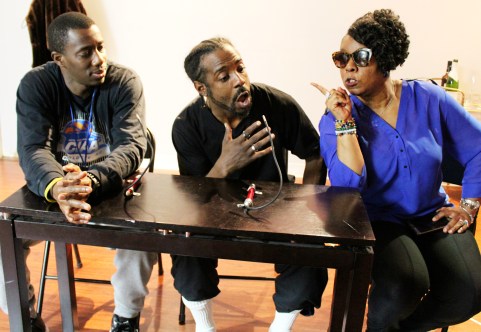
It’s a pretty classy pickup line – until it becomes something totally unexpected in a bedroom scene unlike any that you’ve ever seen before. All through this drama, everybody speaks into a microphone, and there are no scenery shifts. Those conditions are only mildly incongruous when we see Elder Jay, representing the church’s governing board, coming into Paul’s office, picking up a microphone, and discussing the repercussions of Joshua’s defection.

Husband and wife picking up mics in the privacy of their bedroom takes the incongruity into comical territory. Sister Elizabeth starts off this climactic scene much as she has seemed before, a loyal, decorous, and diffident pastor’s wife. As Paul airs his suspicions and she reviews his breaches in respect and trust, we watch the quiet pulpit ornament grow into a whirlwind that could intimidate Job, let alone Paul.

Soon afterwards the question scribbled more than 20 years earlier on an airplane is reprised, but we see a different slant from Hnath on the insurmountable distance Paul has spoken of. In a way that hadn’t jumped at me off the pages of the playwright’s script nor the Louisville production, I can now see that Hnath is asking this: Can we work, pray, or even live together anymore after we’ve recognized that we fundamentally disagree?

It’s a very American question, transcending theology. Our nation rests on two very contradictory pillars – the narrow “Sinners in the hands of an angry God” dogmatism of the first Puritan settlers and the “liberty and justice for all” openness of the Deists who framed our Constitution. We probably thought the insurmountable distance between these outlooks had been permanently bridged long ago. What Humana and I didn’t see in 2014 was the election of 2016. A serious crack in our society has re-emerged.

We get fine performances from the rest of the cast that further humanize and texturize their disagreements. As Joshua, Jonavan Adams fumbles a bit in his disputation with his mentor – as he should, since the new doctrine has caught him off-guard and he’s explicitly “wrestling” with his mentor’s sermon. But Adams helps us focus on how much he would like to believe there isn’t a hell, for he vividly envisions his mom there.

April C. Turner emerges from the choir as Jenny, a troubled congregant whose questioning of Pastor Paul is even more powerful than Joshua’s – because she’s had the time to write down her thoughts and gather reactions from around the community in the wake of the schism. To a lesser extent than Sister Elizabeth, Turner grows more formidable right before our eyes as Jenny becomes more comfortable behind the microphone in the spotlight. There’s also a gentle hint that she becomes progressively more irritated and emboldened when Pastor Paul seems to be patronizing the seriousness of her concerns.

Before and during this huge turning point, Graham Smith makes his presence felt as Elder Jay. This isn’t the most towering performance we’ve seen from Smith – he was, after all, Roy Cohn, in Angels back in ’95 – but it ranks among his most rusticated. And the man can still make an exit. His private conversation with Pastor Paul, which had been most notable for me in getting across Jay’s practical business anxieties, registered more deeply this time around, for they also discuss Associate Pastor Joshua and bring out more about him than we knew.

Joshua not only harbors that “Sinners in the hands of an angry God” viewpoint, he’s been aggressively talking up hellfire on the streets of town. So Paul may actually have had Joshua in mind when he perceived a crack in his church, and his defection may not have been as sudden and unanticipated as it first appeared. Pastor P may be as cunning and calculating as Jenny suspects.

Needless to say, I found The Christians to be a far more substantial piece the third time around – and it’s not surprising to learn that Umberger first encountered it in the aftermath of the 2016 election. The revitalized impact of a production like this reminds us how important a professional theatre company can be in the cultural life of a city. Response from the audience during the post-performance talkback confirmed that a satisfying cross-section of people at Booth Playhouse can instantly get what The Christians is saying to us now.

We had that extra intellectual jolt in our community far more often during the years that Charlotte Rep became a prominent member League of Regional Theatres (LORT) under Umberger’s leadership. Umberger could possibly build his current Playworks enterprise to similar prominence, if The Christians draws the support it deserves.