Category Archives: Theatre

Written in the Stars

Theater Review: Fly by Night

Jerry Colbert as Narrator and Lisa Smith Bradley as Miriam in Fly by Night. (Photo by George Hendricks Photography)

By Perry Tannenbaum

Is everything pre-ordained by a higher power? Or might everything that happens simply be the inevitable outcome when the algorithms of time and space work upon the star stuff that materialized in the wake of the Big Bang? If not, might a lucky ring or a soothsayer’s gaze into a crystal ball shift the gears of an oncoming fate? These are a few of the notions that Kim Rosenstock was playing with when she conceived Fly by Night, the last musical Actor’s Theatre of Charlotte will ever stage at 650 E. Stonewall Street.

Will Connolly and composer Michael Mitnick joined Rosenstock’s writing team, producing a storyline that revolves around two South Dakota sisters who fall in love with the same New York slacker, Harold McClam, a full-time sandwich maker and songwriter. Daphne and Miriam are as radically different as sisters can be. Daphne is impatient to leave Hill City behind and become a Broadway star, while Miriam is perfectly content to stick around home and pour coffee for the townsfolk at her waitressing job.

But Miriam already is a star in the sense that, listening to her dearly departed dad, she has absorbed the notion, during fondly remembered stargazing sessions, that we all come from that star stuff they were counting in the nighttime sky. Aspirationally, there is a link between Harold and Daphne, who meet first at the clothing shop where she clerks and again across his sandwich counter. Vocationally and temperamentally, Harold has a kinship with Miriam. They spark more instantaneously, more intensely, and more lastingly. Trouble is, they meet at the Brooklyn diner where Miriam works when Harold is already engaged to marry Daphne.

Hovering over the action, as a kind of providential presence with avuncular Our Town overtones, the Narrator frequently shape-shifts into some of the orbiting characters in his tale, including both of the sisters’ parents and the eccentric soothsayer. We actually begin the main story on November 9, 1964, with the funeral of Harold’s mother – exactly one year before his dad’s abortive suicide attempt.

There will be a certain providence in Mr. McClam’s survival, to be sure, but until then, his morose appearances can be somewhat trying and tedious. Each of the three central characters is being tormented by a livelier, more interesting nemesis. Daphne has Joey, a commercially successful playwright who’s getting serious about his craft by writing a play just for her. With plenty of revisions, stretching out the rehearsal process. Harold is bedeviled by the sandwich shop owner, Crabble, a quintessentially cranky New Yorker. The only inkling we get that Crabble has a heart is his chronic hesitation to fire Harold for all his delinquencies and screw-ups.

Miriam has the most important tormentor, that kooky soothsayer who gives her the most improbable set of omens for determining her destined true love, wrapped into a prophecy that promises bliss and catastrophe. All of them begin to recur when Harold walks into her life, sending Miriam scurrying back to South Dakota when the two are on the verge of connecting.

Fleeing fate is no less futile for Miriam than it was for Macbeth or Oedipus. She holds out the hope that her doom isn’t settled until time stands still. That will happen on November 9, 1965 – twice.
Three significant events will happen on that date, only one of them anticipated: the postponed opening of Daphne’s play. Ironically, the only stars shining on Broadway that night will be those that twinkle mockingly in the sky.

With Chip Decker directing and Jerry Colbert narrating, Fly by Night moves along briskly with plenty of verve and heart. Colbert has aged gracefully into the paternal wisdom that the Narrator and Miriam’s dad deliver, yet there is comical extravagance each time he becomes the Brooklyn soothsayer or the South Dakota mom. This Narrator seems to become most personable when he stops the action to guide us into a prefatory flashback, so we appreciate Colbert more and more as these time loops proliferate.

Colbert himself loops back to his heydays, flying by night to some fairly high notes and singing with an ease we haven’t heard from him since, oh, maybe 1997 in the 1940’s Radio Hour. Perhaps he’s inspired or rejuvenated by his co-stars. The sisters, Cassandra Howley Wood as Daphne and Lisa Smith Bradley as Miriam, are aptly cast, already ablaze in their early pair of star songs. Wood repeatedly chants “I’m a star!” with Broadway conviction belting out her anthemic “Daphne’s Dream” as she begins navigating the New York rat race, and there’s a cute Avenue Q silliness to her “More Than Just a Friend” duet with Harold.

Bradley simply torches her calling card, “Stars I Trust,” creating a wider gulf between the sisters than you’ll find on the original cast album, and there’s a greater maturity to her lighter “Breakfast All Day” sequel as she settles into Brooklyn, with less of a shuffling rock beat from the three-piece band directed by Ellen Robison. So easily grooved into a humdrum rut, it’s surprising how unnerved Miriam becomes when the soothsayer sings his “Prophecy” – in two parts – and when her eyes first meet Harold’s. Bradley, Colbert, and Christopher Ryan Stamey make it all work.

Stamey cut his teeth at Actor’s Theatre as their go-to wild man in trashy treasures like Slut and The Great American Trailer Park Musical, so to watch him mellowed into the relatively colorless Harold could be jarring to those who have witnessed his vintage exploits. But he actually nails it as both the nerdy Romeo and the mistake-prone sandwich drone. Best of all, he’s the adult in the room in his ultimate showdown with Miriam, “Me With You,” tapping into who he is and what we all believe must be right in the face of implacable destiny.

FLY 4[11]

Supporting roles all draw superb performances. Stephen Seay is wonderfully hyper as Joey when he first pursues his muse Daphne in “What You Do to Me” – and still spoiled rotten, revision after revision. James K. Flynn captures the working class vulgarity of Crabble with a poifect accent, combining with Stamey in “The Rut,” a paean to workplace hopelessness and drudgery. Perpetually toting a wee record player and a vinyl recording of La Traviata in his pathological grief, Rob Addison eventually gets to break out of his stonefaced depression as Mr. McClam. Toward the end, he decides to actually go see that opera and later, when someone finally has the time to listen, he pours out his sad, sad love story, “Cecily Smith.” Which just happens to rhyme with one of the best lines of the night: “Who cares what you are listening to? It’s who you’re listening with.”

The design team, Dee Blackburn for the set and Carley Walker for the lights, give us a nice off-Broadway sense of the various locations, efficiently transporting us to Miriam’s yard and front porch in South Dakota, the seedy nightclub where Harold tries out his song, Crabble’s misspelled sandwich shop, and McClam’s bathtub.

When we get to Penn Station and Times Square, however, an SOS goes out to our imaginations. After “At Least I’ll Know I Tried,” a tasty quintet ushering in the eventful denouement, I prophesy you’ll answer that SOS willingly.

Up, Up and Away After a Poignant Deportation

Theater Review: The Magic Kite


Magic Kite (C)DBise  - 018

By Perry Tannenbaum

Papa Roberto dabbles in magic, to the delight of his kids, Tito and Milagro. His most treasured father-and-son moments are spent building and flying kites – until Papa goes off to work and never returns. How Tito reacts to his dad’s sudden deportation to Mexico is the heart of The Magic Kite, now in its world premiere production at ImaginOn. Children’s Theatre of Charlotte commissioned the new work by José Cruz González because artistic director Adam Burke was moved by artist-activist Rosalia Torres-Weiner’s paintings and her Papalote Project here in town.

At the same time that this project gives children of deported parents the opportunity to vent some of their anguish through artistic expression, classmates, teachers and parents become more aware that families fractured by deportation are living right here in Charlotte. Staging this new play at the Wells Fargo Playhouse is a great way to extend that worthy mission to an even wider audience.

González, whose adaptation of Tomás and the Library Lady was staged at the same venue five years ago, seems a bit rushed here when establishing the kite and magic strands of his plot at the beginning and when he ties them together at the end. There’s plenty going on in just over 45 minutes as Burke directs the four members of the Children’s Theatre Resident Touring Company, since each of the performers communicates with us through at least one puppet – and a few sprinklings of Spanish.

Although Mark Sutton’s puppet designs have a nice folksy quality to them, narrowing our attention is a bit challenging with Torres-Weiner’s paintings flanking the stage while we jump back and forth from the magic scenes to the kite scenes. Scott Miller presides over these early scenes warmly and authoritatively as Papa with officious, worried support from Veda Covington as Mama Esperanza. It turns out that it’s really important for Roberto to get his taillight fixed.

When Papa gets picked up and deported, the weight of the story falls upon Tito, and Rahsheem Shabazz moved me in making Tito’s transition from awestruck child to the little man of the house. Leslie Ann Giles seems shortchanged at first, drawing the role of littler Milagro, but she soon gets her hands on a couple of other puppets. The most significant of these is Tito’s school chum Jamal, aggrieved by the loss of his mother, but Giles also gets the choicest cameo as the pet cat.

As often happens in children’s literature, wounds and losses that two kids have in common help in bridging their differences and cementing their friendship. González poignantly employs magical realism when Tito takes his family skyward on his kite, journeying to Mexico where they can be reunited with Papa. But an invisible barrier prevents them from crossing the border, so Tito and his family can see his beloved Papa, but they cannot join him.

At such fantastical moments, puppets can facilitate wonders. It’s just the aftermath that González bungles, loosening his grip on the tiller as we sail toward a consoling affirmation. I’m reminded of my teaching days, when I’d notice the class bell sneaking up on me. I’d rush through – or even skip over – the crucial ending of my lesson to assign the homework before the students rushed out.

Pretty much the same thing happens here as González tells us that more kites fly upwards after Tito’s sadly lands. We just don’t get a satisfying account of how that happens or what it means. The Magic Kite could easily unfold all its potential magic if González could add 10-15 minutes to it. Meanwhile, it was very useful to have Torres-Weiner hanging around after last Sunday’s matinee to answer kids’ questions in the talkback. They asked some really good ones.

Steering Tragedy Towards Mirth

Theater Review: The Winter’s Tale

IMG_0019

By Perry Tannenbaum

Misdeeds in Shakespeare come in dark and light hues: they are prankish and trivial when the Bard smiles, malign and fatal when he glowers. Misunderstandings follow a similar pattern, absurd and accidental when they aren’t horrifying and purposeful. When such complications are resolved at the end of Shakespeare’s earlier plays, all is mended in the comedies and all is lost in the tragedies. But a new curvature enters the Bard’s storylines toward the end of his career, when he begins to concoct the bittersweet confections that became classified as romances. These include The Tempest, Cymbeline, Pericles and – now at Spirit Square in an outstanding Shakespeare Carolina production – The Winter’s Tale.

In these plays, tragedy strikes. But it’s survived, and we veer towards mirth. Keats may not have understood Shakespeare best among the romantic poets, for Coleridge had the finest critical mind among them, but he was best attuned to this mellowed, autumnal Shakespeare when he referred to life as “a vale of soul-making.” The protagonists in these plays reach wisdom and contentment only through great and prolonged suffering.

Before we reach these romances, Shakespeare strives to compress time as much as possible. Factions and countries seem able to raise armies and launch wars overnight in Caesar and Lear. When we reach The Winter’s Tale, Time is not only a prime element in the story, he or she is an actual character. At Duke Energy Theatre, he comes out at the end of Act 3 in the script, dressed very much like Dickens’ last Christmas ghost, to announce the intermission, leaving an hourglass on a stool.

When we come back, Time properly names himself to start Act 4, tells us that 16 years have passed while we were gone and, cued by the Bard’s blank verse, flips the hourglass to launch the continuation in Bohemia. Back in Sicilia, King Leontes has royally messed things up. Outdoing Othello in jealousy, Leontes has decided that his virtuous Queen Hermione is having an affair with his longtime buddy King Polixenes of Bohemia. Flouting all common sense, he is equally certain that Polixenes has fathered the child she is on the verge of delivering.

Stubborn and decisive, Leontes imprisons his wife, orders his most trusted servant to murder Polixenes, and sends his most valued courtier overseas to dispose of his newborn daughter. Now why was he so sure Hermione is an adulteress? When Polixenes refused Leontes’ entreaties in the opening scene to stay an extra week in Sicilia, Leontes asked Hermione to try – and she succeeded.

Polixenes and the servant escape together, and by the time Leontes discovers his folly, he has lost his wife, his son, his best friend, and his newborn daughter. And according to the Delphic oracle, whose declarations he ignored when they vindicated Hermione and Polixenes, he will remain childless and lose his kingdom unless he finds his lost daughter. Instead of tracking the infant’s scent while it is still fresh, Leontes goes to the opposite extreme of his previous bellicosity, cloistering himself with his sufferings and sorrows, mourning the true wife he wronged.

Not only does the wintry action in Sicilia turn to springtime in Bohemia when the hourglass is flipped, a whole new generation seizes the spotlight. The action blows in the opposite direction, on the wings of two young lovers who will be true to one another. Taking advantage of the new time and place, director Tony Wright flips a large portion of the cast into new roles during intermission.

Perhaps the most significant of these changes occurs just before the break when S. Wilson Lee as Antigonus, the Sicilian courtier who brings the king’s unlucky child to Bohemia, makes one of the most famous exits in theatre history, “pursued by a bear.” Lee comes back almost immediately in a new costume as a new character, the Shepherd who hears of the courtier’s grisly mauling and discovers the babe in the basket. Clearly things have turned toward comedy when a rustic illiterate marvels at his clone’s demise.

And it makes eminently good sense for Faith Benton to reverse the gender deployment that was routine in Elizabethan times, when women were barred from acting, playing Leontes’ son Mamillius in the opening act and his lost daughter Perdita after the break. Benton has a nicely understated elegance that works well for a noble who is ignorant of her nobility, and she projects virginal purity at the heart of the Bohemian scenes that artfully parallels Katie Bearden’s maternal and wifely purity at the center of the Sicilia drama.

It’s quite remarkable that Bearden can bring so much freshness to a role that reminds us of so many Desdemonas and the falsely accused Hero in Much Ado About Nothing. But it’s certainly helpful for Russell Rowe to be deceiving himself so powerfully as Leontes, a lion who creates his own dreary winter out of an apparently loving marriage.

Lowe’s overbearing authority makes Bearden’s steadfast truth and devotion all the more poignant, but it also sparks other forms of opposition. Amy Hillard as the vanished Antigonus’ tart-tongued widow is unsparing in her denunciations of the King, granting him her special clemency only when the Delphic oracle’s prophecy is fulfilled. Just as useful in the wide arcs of this storyline is Kevin Sario as Leontes’ trusted servant Camillo, an anti-Iago who saves his King from himself, ultimately engineering his redemption.

Camillo and Polixenes bridge the two halves of this Tale, so it’s interesting to watch the subtle imperfections that Charles Holmes brings to the King of Bohemia. He probably is a little more affectionate toward Hermione than is strictly proper, and when his family hurtles into crisis, his aversion toward hearing out his son Florizel parallels Leontes’ deafness toward Hermione. In this sunny new comedy world, Polixenes’ faults are more fortunate.

With his bushy hair, Cole Pedigo as Florizel strikes me as more rustic than Benton, but they do make an adoring – and adorable – couple. He actually gets to dress down when Florizel and Perdita decide to elope. Or seek asylum? Obliging him gladly is Ted Patterson as the thieving con-artist Autolycus, who will gladly favor us with a song when he’s not swindling the Old Shepherd and his Clown (Michael Anderson). Like other Shakespeare rascals, Autolycus is luckier than he is smart. Until he isn’t.

In the cavalcade of reunions that closes out this romance, the last is by far the most moving because it redeems so much lost time. A bit of a downer throughout the evening, the scenic simplicity of the production becomes most effective in this tenderest of moments, but Robert Jaeger’s costumes also lift us out of visual poverty along the way. Turns out that it has been a novel idea in Charlotte to do a Shakespeare play – rather than a riff on one – to celebrate the 400th anniversary of the Bard’s death.

One expects a knowing selection from a company that takes the Bard’s name in vain, and Winter’s Tale, a work that resonates with Shakespeare’s final years, proves to be a very apt choice. With this current crop of newcomers and seasoned veterans, this is the best serious Shakespeare this company has done. Shakespeare Carolina really is a mature Shakespeare company now, knowing what they mean and meaning what they, Both the comedy and the drama come at us with the swagger of assured confidence. If only somebody would give them a few bucks!

Did Somebody Just Kidnap Petruchio?

Theatre Review: The Taming

By Perry Tannenbaum

Should I say the dog ate my homework? No, after returning home from assignment at the Savannah Music Festival, I plum forgot about The Taming amid the bustle of BOOM and Sensoria, and Opera Carolina’s U.S. premiere of Aleko. Even when I caught up with the latest from Donna Scott Productions at the Charlotte Art League this Wednesday, I was less vigilant than I should be.

I came into the funky South End gallery aware that there was a connect between Lauren Gunderson’s wacky political fantasia and Shakespeare’s The Taming of the Shrew. But by intermission, I’d completely forgotten about tracking the parallels. That’s because the storylines are so different in this all-female script, and where there are parallels, Gunderson has totally flipped the script.

Katherine is no longer the clawing, curst hellcat who scares away every sensible man in the kingdom except the opportunistic Petruchio. Here she’s charming, brainy, and talented – so charming, brainy, and talented that she’s Miss Georgia, for crying out loud, on a trajectory to become our President and reframe our cherished Constitution. Goodbye, Electoral College!

Nor is she kidnapped after any shotgun wedding. Katherine is in control as she kidnaps Patricia, the brains behind a powerful GOP Senator, and Bianca, a leftwing one-cause blogger and provocateur. This latterday Kate has not only drugged the diametrically opposed politicos, she’s locked them inside of her hotel suite, and – most devastating of all – confiscated their cellphones! If she can get these Red State and Blue State zealots to pull in the same direction with her, Kate reasons, revolution is possible.

Both of these high-energy women remain equally obdurate, but if you pay more attention to their names than I did, you’ll divine that Patricia is our Petruchio. So when Katherine has to drug everybody to calm them the hell down – including, oops, herself – it’s Patricia who wakes up after intermission as James Madison during the original Constitutional Convention of 1787. Bianca is now South Carolina’s Charles Pinckney, the South’s chief proponent of slavery, and Kate is now George Washington, still gushing with charm and still urging compromise.

So yes, mea culpa. By the time the three women had conked out on ether and time-travelled to Philadelphia, birthing constitutional government while switching genders, I had long-forgotten The Taming of the Shrew. When the women returned to present day and Kate triumphed as Miss America, only then did Gunderson conk me over the head: for Patricia, acknowledging Katherine’s superiority, pretty much parrots the scolding that the “tamed” Kate delivers to the other newlyweds in Shakespeare’s Act V.

Now you can go to The Taming without having to backtrack like I did to decode it. Donna Scott makes a wonderfully infuriating Republican as Patricia, and Glynnis O’Donoghue, armed with her righteous pout, is equally apt as the deviously myopic liberal. No surprises there, but Katherine Drew, stunningly slick and sufficiently gorgeous as Kate, is completely new to me. Gunderson drops a couple of lesbian hints into her lines, so it’s a treat to see how excellently Drew personifies this gorgeous George.

All of this frothy comedy would run 79 minutes without the intermission, but director Tonya Bludsworth, who does so much so right, needs to take her foot off the accelerator. Not only did the frantic pace cause the normally infallible Scott and O’Donoghue to bobble lines in the third week of this production, the dialogue zoomed by so fast that I missed stuff. Superfast or not, there are plenty of goodies here, and Gunderson’s crosshairs are trained more on us than on the Bard.

Spying on Hamlet for Laughs

Reviews: Rosencrantz and Guildenstern Are Dead and BOOM

By Perry Tannenbaum

Rosencrantz and Guildenstern are Dead PromosIf you’re playing Rosencrantz or Guildenstern in Hamlet, you’re not exactly one of the Danish Prince’s most formidable adversaries. On the contrary, you’ve been specially chosen by King Claudius to spy on your old friend Hamlet, who sees through your treachery rather quickly. You’re not exactly peripheral, either: you come on early in Act 2, lurk fairly often onstage until late in Act 4, and the pair of you have nearly 5% of the tragedy’s lines.

But the most telling comical point that Tom Stoppard makes about you in Rosencrantz and Guildenstern Are Dead, the playwright’s 1966 riff on Shakespeare’s text, is that neither of you has enough personality to distinguish yourself from the other. Winner of the 1968 Tony Award, the play is a centerpiece of the current Sensoria celebration of the arts at Central Piedmont Community College, a natural in the month and year marking the 400th anniversary of the Bard’s death.

With a title that telegraphs the fate of its protagonists, there are easier scripts to produce. Other than the UNC Charlotte staging in 1992 directed by Bill Morrison (#12 on my list of best shows for that year), I can’t recall a single local production that truly satisfied. On the contrary, each of the three revivals I’ve seen in the past eleven years, including this one at Pease Auditorium piloted by Tom Hollis, has come freighted with enough confusion and incoherence to make most audience members wonder: why?

To be fair, Hollis is working with the most inexperienced CPCC Theatre cast that I can recall. Yet at the same time, he and scenic designer James Duke try to keep things simple. There’s usually an upstairs-downstairs distinction between the royals who dominate Shakespeare’s stage and Stoppard’s flunky protagonists. Costumes by Jamey Varnadore aren’t lavish – down-market Elizabethan for the royals and courtiers, and a touch of commedia for The Player and his acting troupe.

Fifty years ago, it was only a slight exaggeration to declare that the pervasive influence of Hamlet in modern literature and culture was overbearing. Responding to all that was obviously a part of Stoppard’s agenda in his offstage retelling. But 50 years ago, Stoppard could be fairly sure that nearly everyone in the audience – on both sides of the pond – was in on the joke. In Stoppard’s native England, that’s probably still true. In 2016 Charlotte, after overhearing someone in the lobby confess that she’d never read Hamlet, I’d have to concur that it would have been helpful.

Quick quiz: what was The Murder of Gonzago? You might want to brush up on that stuff before you spend two hours and 40 minutes with Rosie, Guildy, and the gang.

Of course, it helps to have Shakespearean actors playing those portions that Stoppard swipes from the Elizabethan master. Yet what I saw from Jacob D. Page as Hamlet, Cara Cameron as Ophelia, Nick Southwick as Horatio and Polonius, Dwayne Helms as King Claudius, and Kristina Blake as Queen Gertrude didn’t convince me that any of them could give a credible full-length performance of any of those roles.

Rosencrantz and Guildenstern are Dead Promos

I did detect some promise in this group of nobles and even more in the actors that Hollis found for his leads, particularly Tyson Hamilton as Guildenstern, usually the straight man in the comedy. If Kyle Willson had delivered more broadly and confidently as the simple-minded Rosencrantz, the chemistry might have worked better. Similarly, I saw plenty to praise in Larry Wu’s animation as The Player, but his scenes with the title characters lost traction as inevitably as the duo’s dialogues.

A familiarity with the absurdist chitchat between Vladimir and Estragon in Beckett’s Waiting for Godot is also recommended for all who plan to see or perform in R&G. Curiously, it was when the chitchat paused and Page appeared on the scene as the troubled Prince that my interest perked up. These are islands of realism in Stoppard’s world, for our bumbling antiheroes actually behave differently when confronted with their betters.

In the bustle of Friday evening in Plaza-Midwood, I wasn’t sure how many of the people crowding the nightspots were even aware of the new BOOM festival in their midst, and its special vibe. My wife Sue and I took in two events that night, On Q’s Mo’ Betta and Taproot’s DinnerBell, and two more the following afternoon, Sinergismo’s Not a Cult and Sarah Emery’s Threads of Color.

It was far easier to find parking on Saturday afternoon. Yet the shows we saw were just as well-attended.

All the fare I sampled was delightful. My favorite was the spoofery of Not a Cult: the True, Unbiased, Authentic History of Sinergismo at Petra’s Piano Bar & Cabaret. Mat Duncan was the Sinergismo Scholar, Dr. Reginald Haephestus Winterbottom, our guide to the sacred birth, copulation, sickness, celebration, and funeral rites of the ancient Gismo society, performed by re-enactors from Charlotte, their only known descendants.

Duncan likely concocted and directed all this fakery, including the first pair audience questions after the Winterbottom lecture. But who fleshed out the archeological spoof with the re-enactors’ costumes, choreography, and ceremonial masks is open to conjecture. The artisan who sculpted the sacred mound from whence all Gismo life issued and to whence it returned is also shrouded in mystery. Likewise the bogus, cheesy props, including a dispenser for the healing mound squeezings, a mound flower, and a severed head.

Probably the best aspect of Duncan’s performance was its lack of polish. Challenged by the planted audience member on why the mating ritual had omitted the jingling turtles, Winterbottom responded with the bluster of a true mountebank.

IMG_JazzyGala_2014_dcost_2_1_9L3PEP1I_L97362418

Mo’ Betta was an old-timey mix of jazz, stand-up comedy, and improv poetry hosted by Quentin Talley. Jazz vocalist Kenya Templeton, backed by pianist Tim Scott Jr. and his trio, was the standout. Freed of the scripted constraints of last January’s Children of Children retrospective, where Marian Anderson and Ella Fitzgerald were her primary inspirations, Templeton floated beyond strict 4/4 time, sounding more like Betty Carter in an exemplary rendition of “Afro-Blue.”

DinnerBell may add an “e” to its mealtime compound before long, since it was a compendium of feminine grace, hospitality, beauty pageantry, and genial racism that comprise the heritage of Southern belles. Brianna Susan Smith was the singer/narrator steering this “Field Guide to Impolite Southern Conversation” on its chameleon path – sometimes campy, sometimes satirical, and sometimes bluntly direct. There were biscuits, deviled eggs, collard greens, and bread pudding served up by the same ensemble that vied in the Ms. Georgia Cow beauty contest. The Q&A at the end of that contest was the best part.

For her suite of seven dance pieces, Emery took her inspiration from the paintings of local ArtPop Street Gallery artists, each of them projected on a huge wall at Open Door Studios as the dancers performed. With Emery taking a solo in “Sixth Season” and former Charlotte Ballet standout Emily Ramirez included in three other pieces – and taking a cameo in yet another – the ensembles and soloists were consistently proficient. Wrapped into the community feel that Emery orchestrated in her show was a dazzling array of costume designers who diverted my eyes as excitingly as the dancers and the projected paintings.

A great start for Boom and a great boost for Plaza-Midwood, where Actor’s Theatre of Charlotte plans to open early in 2017. You can help make that happen at atcharlotte.org.

Keller Keeps Tugging at Our Emotions

Theatre Reviews: The Miracle Worker and I’ll Eat You LastMiracle Worker

By Perry Tannenbaum

With most dramas, I find that successive productions I review tend to exert less of a powerful tug on my emotions each time I see the same drama again. Yet I’ve found quite the opposite to be true of The Miracle Worker, William Gibson’s 1960 Tony Award winner for Best Play, the chronicle of young Annie Sullivan’s diligent efforts – on her first paying job and her first plunge into the Deep South – to reach the deaf-and-blind Helen Keller and teach her the concept of language.

Last time I covered The Miracle Worker at CPCC in 2008, I found myself choking back sobs when I merely saw the furshlugginer water pump at the start of Act 2. So I was grateful, in a way, to see the pump already in place downstage when I ambled toward my seat for the current production at Theatre Charlotte. Gillian Albinski’s set design, a rather bland thing compared to some of the artistry I’ve seen at the Queens Road barn, seemed to be building up my immunity.

I was mistaken, for it isn’t until intermission that they set up the little guesthouse where Annie is allowed to have exclusive care of Helen for two weeks, during which time she must repair their relationship, tame the child’s wildness, and give her the keys to communication. Just seeing the contours of that secluded place brought on a surge of emotions that I fought to hold in check.

When you think of it, The Miracle Worker is rather unique in establishing powerful associations with each of its different locales at the Kellers’. There’s the upstairs bedroom where Annie must be rescued by ladder because she allows Helen to outsmart her and lock her in during their first encounter. Nor do we forget the dining room, scene of two epic battles between Helen and Annie – and the place where James finally stands up to his imperious father, Captain Keller.

Okay, so the production levels don’t rival the notorious 2003 Charlotte Rep production that was envisioned as a launching pad for Hilary Swank’s Broadway debut. (Never happened, the producers’ verdict on what we saw.) But the gulf between those Broadway-bound costumes and those by Luci Wilson isn’t ridiculously wide at all, and while Theatre Charlotte’s Helen wasn’t victorious in any nationwide search, I think you’ll find Emily Bowers quite extraordinary.

There is never a sense that director Paige Johnston Thomas is trying to replicate the iconic 1962 film, which brought fresh awards to Anne Bancroft and Patty Duke, the original Broadway stars. Quite the contrary: Thomas makes it easier for Sarah Woldum in her Charlotte debut as Annie Sullivan by allowing her to drop the Irish accent that plagued Swank, and Alex Duckworth – notwithstanding his syrupy drawl – may be the least youthful James that I’ve seen.

Throughout the evening, beginning when Kate Keller discovers her daughter’s disabilities upstairs in the nursery, lighting designer Chris Timmons and music composer Grover Smith make telling contributions. Caylyn Temple as Kate and Philip Robertson as Captain Keller do a beautiful job of setting up the dignified family tone. While it’s customary for the Captain to show a lack of love for his daughter – he’s taken aback when Annie calls him on it – Robertson seems to want to love Helen more than any father I’ve seen. Besides the crippling excess of motherly indulgence, Temple partners well with Duckworth in the somewhat awkward relationship between Kate and her stepson.

Woldum is certainly a more youthful Annie than Swank was, more youthful than Joanna Gerdy was when Theatre Charlotte last presented Miracle Worker in 1997. That is the dimension I most love about this production. Sullivan’s age – she’s merely 20 – is arguably what makes her most unfit for the challenge she’s undertaking. Not only can we see Annie’s youth peeping through here, we can perceive how it becomes a double asset when the challenge is engaged.

It’s a matter of sheer physical vitality when Annie confronts Helen’s unruliness in the dinner table scenes and at the guesthouse, but it’s also a matter of empathy. I’m not a big fan of the flashback interludes, when Annie recalls her younger brother’s death, but I’m more reconciled to them in this production, and Timmons delineates them well with his lighting.

Charles Holmes gets credit for the fine fight choreography when the action heats up and the spoons begin to fly, but it’s Bowers’ lack of inhibition that makes it all work. There’s always enough luminosity in her blankest expressions for us to believe in her openness, and when she’s finally sitting quietly and eating at the guesthouse, I found a tinge of pride amid Helen’s exhausted submission.

Maybe the reason I find The Miracle Worker so compelling after all these years is the fact that it becomes less dated with the passage of time. The more I’ve learned about child development and the acquisition of language, the more spot-on Annie’s observations on these subjects have become. One time, the water pump gets to me; the next time, the guest cottage floors me. I wouldn’t be surprised if I’m fighting back tears the next time I see Sullivan lifting the stupid egg. I can only envy those of you who may be just beginning your journeys with this rich drama. It has surprising, rewarding depths.

Anne Lambert as Sue Mengers 3 Feb 2016

An elaborate sofa and its many pillows becomes a luxuriant throne when the star of I’ll Eat You Last: A Chat With Sue Mengers appears to graciously grant us an audience at UpStage in NoDa. Born into a Jewish family in Hamburg, Mengers tells us how her family fled Nazi Germany in 1938 and wound up in Utica, New York – not the most likely beginnings for a woman who would become a Hollywood superagent, whose clientele included Faye Dunaway, Candice Bergen, Michael Caine, Burt Reynolds, Cybill Shepherd, and – preeminently – Barbra Streisand.

John Logan’s one-woman script memorialized Mengers on Broadway, in a production starring Bette Midler, less than two years after her death in 2011. Anne Lambert is the leading lady here in a performance that was shaped in a three-weekend run up in Cornelius before settling into NoDa last weekend and continuing through Sunday. It’s obvious that Mengers considers herself royalty, for she favors us with her rules on throwing a party and succeeding as an agent.

There’s a phone by her right arm that she hopes will ring so that she might heal a troublesome rift with La Barbra. Meanwhile, before we arrive at those circumstances, Mengers dishes on her struggles with Sissy Spacek, Ali McGraw, and Steve McQueen. Landing the Oscar-winning role of Popeye Doyle for Gene Hackman in The French Connection is clearly her ultimate triumph, and Lambert can tell it in spellbinding detail.

Problems only creep into this performance with the chronic buzzing of the electronics – the lights, I’m guessing – compounded by Lambert’s tendency to swallow the ends of punch lines she’s tossing off. Otherwise, she bridges the moments of tension and relaxation well, calling upon an audience member to fetch her a jewelry box stocked with joints and a refill from the bar. There are moments when she could stand to be meaner and more arrogant while she’s getting high, but that’s showbiz.

UNC Charlotte Drops a Russian Clown into the Cogs of Heiner Müller’s “Hamletmachine”

hamletmachine-360px

By Perry Tannenbaum

March 19, 2016, Charlotte, NC – More than with most scripts, it’s difficult to say what exactly Heiner Müller had in mind when he wrote Hamletmachine in 1977. Performances of Müller’s plays were banned in East Germany until the fall of the Berlin Wall, so the 1979 world premiere was presented – in translation – in Paris, and when Müller himself finally directed the piece for the first time in his homeland, it was as the play-within-a-play in a far larger 1990 production of Hamlet, presumably in his own translation since that what was what he had completed before embarking on his own.

Looking at this script, which occupies just three pages in The Wadsworth Anthology of Drama (4th ed.), I’d have to say it’s presumptuous to call it a play at all, for it doesn’t offer a list of characters and doesn’t actually assign any dialogue to anyone until the second of its five parts. We can hardly greet that as a clarifying moment when Müller writes, “Ophelia (Chorus/Hamlet): I am Ophelia.” Nor is the custom of attribution religiously observed afterwards in a text that often resembles T.S. Eliot’s The Waste Land in its stream-of-consciousness style and allusiveness. We should not be surprised that the current production at UNC Charlotte’s Robinson Hall, presented by the College of Arts + Architecture at the Anne R. Belk Theater, not only boasts three directors but also three Ophelias and four Hamlets in a production that clocked in at just under 38 minutes.

A wide latitude of interpretation is built into the text, which explains the fact that one Japanese production lasted 12 hours. That surely isn’t the outer limit, for Müller decrees “Snow. Ice Age,” after the executions of Marx, Lenin, and Mao at the end of Part IV. Yet I must say that the UNC Charlotte production follows the text far more closely – and recognizably – than the previous production I saw in Charlotte, presented by Off-Tryon Theatre Company as part of a double bill with Rosencrantz and Guilderstern Are Dead in 2005. Leading the all-female directing team, UNCC assistant professor Robin Witt has eliminated (among other things) the appearances of King Claudius, the striptease by Ophelia, and the gravestones or lecterns that should be the university of the dead in Part III. A whole motif involving Hamlet’s armor and his axe is altered beyond recognition, and the executions of the Communist trinity, which should have been done by Hamlet with that axe, are now done bloodlessly by hanging.

I’m not sure whether there was a malfunction in Benjamin J. Stickels’ sound design, but I never discerned the voices of Lenin, Mao, and Marx, though three are listed for them in the program booklet. Similarly, the men and women dressed in white by costume designer Beth Killion are all designated as Chorus in the playbill, so I wasn’t aware until later, when I’d revisited the script, that the segment choreographed by Alex Baesen was a ballet of the dead women. It looked more like a dance of angels to me, though the woman with the little stove around her head should have told me that she was a suicide or a Holocaust victim.

There are also additions to the script by Witt and her team, including Marc Smith as a German Speaker and, most conspicuously, Kineh N’Gaojia as a Russian Clown who beautifully sings Leon Russell’s “A Song for You” for no particular reason. Before her concluding monologue as Ophelia Wheelchair, Raven Monroe inserts Todd Rundgren’s “Can We Still Be Friends.” Of course, when she begins her monologue declaring, “This is Electra speaking,” and ends by vaguely alluding to the Manson Family and Sqeaky Fromme, it’s hard to be sure who Monroe is as the lights go down on her in her wheelchair.

The sinew of Müller’s text is given when Hamlet Flag (née The Actor Playing Hamlet) has his long monologue in Part IV, “Pest in Buda / Battle for Greenland.” I’d say that the upshot of this ramble, ably delivered by Matt Miller, is that the revolutionaries who had ushered in the triumph of Communism in Eastern Europe had succeeded so well that they had rendered the possibility of current and future revolutions extinct. Looking frankly at himself, the Actor Playing Hamlet asserts that the Hamlet who once was, the brooding assassin who engineered a coup d’état, no longer exists and can no longer exist. The executions that follow are merely wishful thinking – by a populace of Hamlets who remained too indecisive too long.

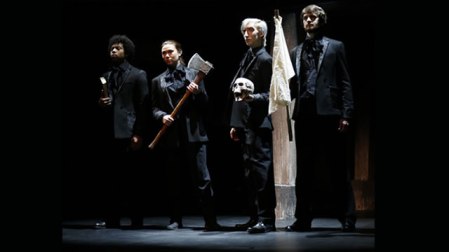
Jamie Gonzalez was my favorite among the Ophelias. Her heart is not visibly a clock as the text demands. Instead, she is wheeled onstage as Ophelia Bed to deliver her lurid monologue, giving her a kinship with the Ophelia Wheelchair to come. No such connections are attempted among the Hamlets, since all four of them parade in front of us at the outset. Noah Tepper seems like he will be dominant as Hamlet Skull, conversing with a puppet Horatio (Brittany White), but he is succeeded by Tykiique Cuthkelvin as Hamlet Book and Jennifer Huddleston as Hamlet Axe before Miller’s Flag takes over. The gender bending in Witt’s casting becomes plausible enough when Miller’s Hamlet announces, “I want to be a woman.” He gets his wish when the Chorus surrounds him and dresses him up as Ophelia, but he’s back in tacky 1970s leisure wear by the time he launches into his big monologue.

While the thrust of Müller’s script is unmistakably an outcry against living under totalitarianism, its production at UNCC paradoxically affirms the benefits of dictatorship. It’s not a total coincidence that the most admired production of this piece, the 1986 revival directed by Robert Wilson (even Müller preferred it to his own), was presented at another university, NYU. Not only can university professors ignore commercial viability when deciding what they present on their stages, they can lavish resources upon each project that leave the prudential considerations of capitalism deeper in the dust.

That is the true wonder to behold when comparing the staging at Robinson Hall to the Off-Tryon version I saw in 2005. Tom Burch’s scenic design lifts this production to a frightful level of gritty German expressionism that is simply phenomenal, mirrored by the imaginative artistry of the props and costumes. Primitive stairways lead up to a platform where the mutilated German Speaker can babble, and the wall behind that platform is large enough to project the titles of each of the five parts we’re watching. When the script alludes to a television, Burch can deploy four of them, each one broadcasting nothing more than white noise.

The obvious reward of such excess is a Hamletmachine that is vivid and engaging – but no less mystifying than it is on the page. No doubt the post-performance discussion following the Saturday evening performance was helpful for amazed and baffled audience members who remained afterwards, and another discussion is scheduled with the cast and designers after the March 21 performance. Otherwise, there’s plenty to be gleaned from dramaturg Jeanmarie Higgins’ program note and the handy Tumblr website she and her dramaturgy students have established online.

© 2016 CVNC + Perry Tannenbaum

Spymaster With a Shopping Cart

By Perry Tannenbaum

I’ve seen over 200 productions by Children’s Theatre of Charlotte since I began covering the local scene in 1987, but only a handful have been as emotionally powerful as Danny, King of the Basement, now at the Wells Fargo Playhouse through Sunday. Grim realities pursue Danny Carter and his mom, Louise, who are fleeing from her latest bad decision when we first see them, an abusive boyfriend. That makes eight moves in the last two years, according to Danny, who keeps a more diligent count than Mom.

Danny’s disintegrating confidence in his mom and the wandering, often homeless nature of his life combine to push him into a world of fantasy – where he’s perpetually undercover as a juvenile spy, always an outsider looking in, always preparing for the next hasty getaway. So much always seems to be hanging by a thin thread in Canadian playwright David S. Craig’s penetrating script. To get their crummy new basement apartment, Louise has lied to the new landlady, pretending to be single and childless.

It’s only by speaking with Penny, the landlady’s daughter, that Danny discovers the deception. We can understand Danny’s wariness about his mom’s landing a job and not foolishly spending the little money that they have, since we’re a bit skeptical ourselves. While Danny remains uncertain about whether his mom will be able to make next month’s rent, his situation becomes more anguished because he’s actually making friends with Penny and another new neighbor, Angelo.

These other kids also have their woes. Angelo can’t seem to please his dad, whose presence is signaled by a lion’s roar that occasionally emanates from behind the entryway to his apartment. Dad might respect Angelo more once he scores his first hockey goal, but where is the confidence needed to score that goal going to come from?

Penny seems to be confident and affluent enough, but her parents are divorced and her dad is delinquent with support payments, spooking the cashflow. When Mom and Dad bicker over money, they do it through Penny, who carries two cell phones to field their calls. At one point, when she has both combatants on the line, Penny wraps the two phones together and drops them in a trashcan so they can duke it out.

Craig finds an even funnier way to defuse the seriousness of Angelo’s problems, as Danny and Penny perform a mock brain surgery that removes the bad thoughts ruining his self-confidence. Danny carries a shopping cart filled with carefully curated junk that becomes an eccentric toy chest that beautifully serves the kids’ pretend games.

The camaraderie cemented by this rollicking surgery unravels when Danny goes to school with his new chums. Instead of dutifully reading when his teacher calls on him, Danny cuts up and improvises his own story, earning himself a swift trip to the principal’s office. The smokescreen may bamboozle the new teacher, but Angelo and Penny see through it instantly – the collateral damage of Danny’s unsettled ramblings is a lingering illiteracy. It will be cataclysmic when Danny’s new chums call him out on it.

Beneath all of his spymaster tale-spinner façade, Danny is deeply ashamed – of his mom and of himself. He prides himself in being able to make friends, even best friends, in the space of a day. Yet Danny has moved around so much that he has never truly realized that the friends he makes can be a support system. That’s the deeply moving aha moment we witness here.

The only parent or teacher we actually see onstage here is Danny’s mom, but she is so flawed, so prone to unwise decisions and failure, that we’re apt to see her as under Danny’s care rather than the other way around. It’s a world of children we’re seeing, with adult intrusions but hardly any adult perspective or authority. With adults portraying all of these roles, there’s a fascinating crossroads of empathy that makes this a special experience, even for the ImaginOn fantasy palace.

Under Mark Sutton’s finely nuanced direction, the cast immerses itself into these kids and their interactions without regressing into them. Even the lighter, sillier moments aren’t tainted with excess mimicry. I was especially impressed with Scott Miller’s rendering of Danny, his guarded slouch persisting even when he resolves to do something remarkably brave. Danny’s vulnerability remains near the surface no matter how merry the moment, so his sudden disintegration comes as no surprise.

As Penny, Veda Covington must change from her kid-on-the-street self to her daughter personality each time one of her cellphones rings. There’s a little of the spoiled brat to the kid, but as the ambassador between her bickering parents, she isn’t always the submissive child. Sometimes she’s the real grownup. With Angelo, the differences are perhaps more subtle for Rahsheem Shabazz. There are different shades of inferiority that he feels toward the affluent Penny and his abusive dad, but it’s wariness rather than superiority that dominates his attitude toward Danny.

Leslie Ann Giles has so often been the grownup in the room during her 10 seasons with the Children’s Theatre touring company, particularly in their various Commedia lampoons. So it’s interesting to see her going against that grain as Louise, the wayward adult who needs to beg for a second and third chance – from her son! Giles obviously revels in the opportunity to be so complicated, wanting to be the good mother and provider but frequently sliding backwards in those uphill battles.

As hard as some parents struggle to maintain the illusion that they’ve got everything under control, I wonder how uncomfortable taking their children to see the Carters might be. Danny could be the perfect medicine for such parents. I know that I felt myself rooting ardently for both Danny and Louise.

Jews, Blacks, and JFK Converge at Concertized Kushner

Theatre Review: Caroline, or Change

2016~Caroline or Change_0028-1_edited-3
L-R: Brittany Currie, Tracie Frank, and Veda Covington

By Perry Tannenbaum

The relationship between African Americans and Jews has been a fascinating convergence of parallel histories and unavoidable class conflict. We’ve had a couple of dramas here before that dramatized the relationship, beginning with Alfred Uhry’s famed Driving Miss Daisy, which reached the Charlotte stage in 1991, just two years after the Oscar-winning movie. The 1988 Pulitzer Prize winner took us back to Atlanta after World War 2, when the curmudgeonly Daisy was in denial about her physical deterioration, her racist attitudes, and the prevalence of anti-Semitism in her city.

Just over three years ago, Actor’s Theatre of Charlotte brought us Matthew Lopez’s The Whipping Boy, transporting us to the first days of Reconstruction after the Civil War, when two emancipated slaves returned to their former owner’s home for Passover. Between Uhry’s drama and Lopez’s auspicious 2011 debut, Tony Kushner collaborated with composer Jeanine Tesori on a musical – a chamber opera, really – that looks at yet another Jewish household where an African American was employed.

Until last February 26, when Theatre Charlotte brought Caroline, or Change to its lobby for one night only, the widely-hailed 2003 piece had never been performed in the Queen City. It’s unquestionably the most ambitious Grand Night for Singing event held at the 501 Queens Road barn. The format has been in a cabaret spirit, songs selected from a rarely performed musical taking up half of the program, more rarities by the same composers after intermission. With Caroline, music director Zachary Tarlton staged a concert-style production of the full show – and so many people bought tickets that Theatre Charlotte executive director Ron Law nearly had to move the performance out of the lobby and into the auditorium.

Caroline Thibodeaux works in the bowels of a home owned by Stuart Gellman and his second wife, Rose, but the core of Kushner’s story – an autobiographical one according to the playwright’s intro to the printed edition – is the relationship between Caroline and Noah, Stuart’s 8-year-old son from a previous marriage. Although Caroline takes place in 1963, closer in time to Daisy than Whipping Boy, its resemblances to Lopez’s script are strong enough that it could have served as the younger playwright’s model. During the Passover holiday celebrated by Caleb DeLeon in Whipping Boy, President Abraham Lincoln is assassinated. In the November-December timeline of Caroline, John F. Kennedy is assassinated before the Gellmans’ Chanukah celebration.

If Kushner had a model, the likeliest candidate would be another autobiographical play, Athol Fugard’s Master Harold, in which the title character also behaves unforgivably toward a black person working for his dad. In her dignity, in the way Caroline absorbs Noah’s abuse in apartheid Lake Charles, Louisiana, she very much resembles Sam’s forbearance toward Hally in apartheid Port Elizabeth, South Africa, in 1950. The big difference is that Kushner looks at Caroline as critically as he looked at Noah.

She’s a divorced, conspicuously joyless mother of three, staunchly resistant to change. The entire cast was outstanding, but we were especially fortunate to have Tracie Frank in the title role. We had a brief sampling of Frank’s gospel fire last spring in Theatre Charlotte’s production of Jesus Christ Superstar, but even her Whitney Houston bravura singing “I Don’t Know How to Love Him” hardly cushioned the surprise of this sustained excellence, her silent reactions nearly as taut as her vocals.

Stuart and Rose realize they’re not paying Caroline enough to comfortably take care of her three children, but they do what they can. In order to teach her stepson a lesson – and to slip the Thibodeauxs some extra cash – Rose decrees that Caroline can have whatever loose change Noah carelessly leaves in his pockets when she puts his clothes in the washing machine. Noah is more softhearted than Rose, so he starts leaving loose change in his pockets on purpose – until Chanukah rolls around.

Grandpa Stocknick, Rose’s dad, gives Noah a $20 bill in Chanukah gelt. Some days later, Noah is back in school and realizes that he has left the 20 in a pair of pants earmarked for the laundry. His piddling charity is in serious jeopardy of becoming lavish generosity, and he rushes home to retrieve his gift. Too late. It’s nearly Christmas, her three kids expect something under the tree, so do you think Caroline is going to put that $20 bill back in the bleach cup for Noah?

Noah is even less likable than Caroline in the fight that ensues, so it’s to Rixey Terry’s credit that he made the transition from adulating schoolboy to beneficent master to sore and abrasive loser so convincingly over the course of the night – and no fewer than 15 songs. Terry didn’t try to emulate an eight-year-old, so he didn’t sound at all like Harrison Chad on the cast album, a prudent choice for this reading-stage style presentation, adroitly stage directed by Corey Mitchell. He and the other younger members – the three Thibodeaux siblings and The Radio – had their music down pat, thanks to some good hard work and, I suspect, that cast album.

2016~Caroline or Change_0017-1_edited-1

Yes, the dramatis personae included some inanimate objects that brought Caroline’s basement domain quirkily to life, often with a gospel flavor. Dani Burke was Caroline’s Washing Machine while Maya Sistruck, Dominique Atwater, and Kayla Ferguson were The Radio, even more amazing when they harmonized than when they soloed. Among these kitchen accouterments, Tyler Smith was the king of appliances as The Dryer in an electrifying performance, Tesori’s score starting him off with a mix of street shout, yelped with Porgy and Bess gusto, and R&B that he crushed into the depths of his velvety bass baritone – with The Radio providing backup.

More of Kushner’s fanciful universe turned up outside of Caroline’s basement. Much to our delight, Smith returned to the row of lecterns at centerstage as The Bus taking Caroline and her friend Dotty home from work, but Brittany Currie often lurked on the side as The Moon, emblematic of change. The change that Noah leaves in his pants isn’t the only change Caroline struggles with. Although $30 a week isn’t enough to get by, it’s Dotty who is resolved to do something about it, going to night school in an effort to better herself.

So it’s both Dotty’s energy and initiative at the end of a long workday that irritates Caroline. Watching Veda Covington as Dotty, bragging that her daytime employer is actually proud of what she’s doing, I found myself a little irritated with both women, Dotty for needling her friend and Caroline for her unremitting sullenness. Currie as The Moon was a somewhat soothing presence crooning about change, but there was also a wisp of sultry sensuality in her vocals, very effective in this cabaret setting.

2016~Caroline or Change_0030-1_edited-1
L-R: Yabi Gedewan, Ibrahim Web, and TyNia Brandon as Caroline’s children

Mitchell had the races sitting at opposite sides of the stage when they weren’t at the lecterns, accentuating how little they actually interact during this musical. It’s mostly Noah and stepmama Rose who show an active interest in Caroline. Although she badly flubbed the Yiddish word for navel, Allison Snow Rhinehardt was an otherwise credible balaboosteh: a little unsure of her footing with both the new stepson and the help, somewhat sensitive to their feelings, yet definitely reveling in her mission to run the household and to command.

Upstairs-downstairs decorum was broken momentarily at the Chanukah party in one of Kushner’s most insightful scenes. Asked to help with the extra party housework, Caroline’s eldest daughter Emmie gets into an argument with Rose’s father about the efficacy of Dr. King’s non-violent civil rights movement. Caroline is outraged by her daughter’s presumption, Emmie is angered by her mother’s inbred meekness, and Mr. Stopnick thinks this is the first real conversation he has had since coming South to visit his daughter. Excellent work here from Frank, TyNia Brandon, and Vito Abate.

I would have been quite content just to witness some local theatre company putting Caroline on its feet after all these years. The fortunate few who attended the February 26 performance saw something far finer. With a minimum of rehearsal, the 17 singers and Tarlton performed nearly flawlessly, all the more astonishing when you consider that the musical director was never in the line of sight of any of the performers even once as they performed this challenging two-hour Tesori score.

Here’s hoping that we don’t have to wait another 13 years before Caroline, or Change is produced here again – and that, when Kushner’s lone musical returns, it will be fully staged in a larger hall for a larger audience in a longer run. As it deserves.

Photos by Perry Tannenbaum

“The Realish Housewives of Charlotte” Serves Up Skits, Improv, and Spoofery

By Perry Tannenbaum

Bravo, Charlotte! After missing the boat on Bravo’s cable TV franchise of Real Housewives reality TV shows – now spinning out Real Housewives of Orange County, Atlanta, New York City, Jersey, Beverly Hill and others – the Queen City has hopped aboard a theatrical Real-ish franchise on a whirlwind tour. Detroit, San Diego, Seattle, Minneapolis, and Des Moines have already sampled the satiric backlash. When the six-member cast of The Realish Housewives of Charlotte barreled into Booth Playhouse, it was sufficiently armed with the lowdown on the metro area to dish out plenty of gasps and belly laughs.

The whole scene surprised me. With hardly a scrap of publicity, nearly every seat in the orchestra and balcony was sold out, filled mostly with avid women who had this set-up figured out before I could begin to get the hang of it. When Jackson Evans comes out as our host, Randy Bowen, it looks like Realish is a talkshow. The couches flanking him and the logotype behind him practically scream it out.

But the studio where we’re ostensibly filming the upcoming season actually serves as a substitute for those scenes on the Real series where we see the regulars profiled – or commenting cattily on action we’ve just seen. So the opening scene introduces us to the ladies – only one of whom seems to be a housewife. Ravonka claims to be married to “the baron,” but there hasn’t been a sighting of this queen bee’s globetrotting husband in years. So when Lori McClain ladles on her Russian accent, she’s apparently not evoking a Trump wife.

A rich wife, yes, for Ravonka dangles the possibility of an exotic getaway to all the others, including the tall and slim newcomer, Brooke. She’s apparently a business barracuda, quick to resent Ravonka’s superior attitude and become her adversary – even to the extent of rejecting the idea of the free vacation at Ravonka’s expense. More than one of the scenes to come will stop dead in its tracks so that Lindsey Pearlman as Brooke and McClain can have a lethal stare-down. The pushy entrepreneur makes a living out of alterations to women’s jeans that make her the butt of Ravonka’s slights.

Opposites in their way, Gwen and Desiree aren’t part of the drama. Desiree is a neck model and a fro-yo addict, and Emjoy Gavino gives her all the squeaky kookiness you’d expect from such a airhead. It’s neat that the other gals take Desiree’s addiction so seriously that they stage an intervention. Gwen, a City Councilwoman who served time for her misdeeds as a Mayor Cannon advisor, takes herself more seriously than all the others combined. All of the women seem to host at least one of the scenes, with nothing more than a lighting change to take us there in flashback.

Desiree’s event is a neck photo shoot, of course – and Gwen’s, inevitably, is a fundraiser for a worthy cause, and Katie Caussin gives her such a starchy rectitude that, for a while, you might actually believe it’s real. Played by Katy Carolina Collins with a Myers Park girl-next-door wholesomeness, C.L. is the only housewife in the bunch. She found her husband out in the audience on opening night, an unsuspecting Andy who played along enthusiastically as soon as C.L. drew in range.

While the script by Kate James and Tim Sniffen is more often about filling in the blanks with deftly researched local dirt – notorious local scandal here, nearby backwater worthy of ridicule there – space is left open for improv when the audience is engaged. All of the cast members are Chicagoans, and a couple of them have toured with The Second City, a wellspring of American sketch and improv comedy for over 50 years. When Randy revealed that Ravonka’s secret daughter, Prosecco, was sitting out in the audience, McClain’s shtick was very much in her Second City vein, clever and quick, when Prosecco spat out what she had been caught stealing at school.

Elaborately phony air-kisses are dispensed by the dozen, triggering the overall kiss-and-tell formula of Realish Housewives , but it wouldn’t be the same – or last entire seasons, if you think about it – if there weren’t epic reconciliations after the epic feuds. Or punctuating those feuds, which come back in coming episodes and seasons like fleas. Here the climactic confrontation between Ravonka and Brooke ends in mutual understanding and the customary post-mortems. It’s all so deliciously catty, trivial, insincere, and emotional that the audience couldn’t get enough of it.

I even peeped in on Bravo the following night. Yeah, this trash can be habit-forming.