Tag Archives: Cole Pedigo

Lips Are Sealed on Whodunit at CP

Preview:  The Mousetrap

By Perry Tannenbaum

Between the time that Queen Elizabeth II began her reign and the official date of her coronation in 1953, another queen began her ascent to a regal London throne. Late in November 1952, Agatha Christie brought her murder mystery drama The Mousetrap to the Ambassadors Theatre. By the time the show transferred to the larger St. Martin’s Theatre in 1974, Dame Agatha had long since worn the crown for the longest running show in London’s fabled West End – for both plays and musicals.

It’s been there ever since, making St. Martin’s a London landmark.

This week, The Mousetrap returns to CPCC Summer Theatre after a hiatus of 37 years. Paula Baldwin, who directs the whodunit, says she saw a production a few years ago in Mint Hill. Scarcely as popular in Metrolina as it is in the UK, productions have only appeared on the outskirts of Charlotte since the turn of the millennium, popping up in Davidson during the summer of 2004 and again at Fort Mill in 2008.

“I love the script!” says Baldwin. “The characters are well developed and they all have a secret. In many murder mysteries, the audience knows who the killer is and watches for the climactic moment, but in The Mousetrap, the audience makes discoveries as the characters do, and all of the characters appear to be guilty at one point or another.”

That includes Giles and Mollie Ralston (Andrew Tarek and Lisa Hatt), our hosts at Monkswell Manor. On a snowy night, after listening to radio reports of a murder and a police manhunt, the Ralstons welcome four anticipated boarders to their isolated guesthouse – plus two people they hadn’t bargained for. Mr. Paravicini (Charles Laborde) seeks shelter from the storm after his car has overturned in a snowdrift. That’s his story, anyway. After that, Detective Sergeant Trotter (Cole Pedigo) arrives to investigate, believing that the murderer is somewhere in the house.

Don’t bet against it. Nor should we assume that all the killing is over, especially since – hey, we’re back in the ‘50s, and it’s been snowing! – the lights and the phone might go out.

So is it murder and suspense that account for the uncanny success of The Mousetrap? Probably not. Nor is the notorious pact with the audience not to reveal the final plot twists unique to this mystery thriller.

Ticket sales aren’t completely on autopilot midway into the show’s 67th year. Marketing continues long after some might see its necessity. “The mystery lives on!” proclaims the current poster, evidence that somebody might be up late at night worrying about the future.

Truth be told, reputation and tradition are likely more pertinent to the endless run than mundane marketing. Next to Shakespeare and the authors of the Bible, Christie has sold more books than anyone one else in the history of the planet, the best-selling novelist of all time. We can safely declare that Dame Agatha benefits from a build-up of goodwill and adoration. Nor was the Queen of Crime a one-hit wonder on the stage. Productions of Witness for the Prosecution and Ten Little Indians are still done.

If there’s a secret ingredient to the success of The Mousetrap, it’s Christie’s charm.

“Agatha Christie had a lot of fun with this particular play and really pokes fun at murder mysteries with some of the dialogue and actions within the play,” says Baldwin when asked to detect its secret sauce. “I do think that seeing the show in London has become a tradition for tourists, very much like American tourists flock to see shows like Phantom of the Opera or Wicked when they go to New York. Londoners go to see the show when the cast changes or to take their children and later their grandchildren.”

Of course, 37 years after the last CP Summer Mousetrap, people who saw the 1981 production might just come back to refresh their memories – with or without kids and grandkids. Baldwin has no intentions of layering on any updates or retrospective condescension, planning to preserve the suspense built into the script and present the snowbound mystery as a period piece.

The new CP production will sport a not-so-secret sauce of its own, the 15th collaboration between Baldwin and LaBorde since the two met up at Carolina Actors Studio Theatre in 2008 in the CAST production of Foxfire. It was Baldwin’s Charlotte debut and LaBorde’s first acting gig after retiring from his position as principal of Northwest School of the Arts.

“I feel we clicked immediately,” LaBorde recalls. “We each liked the other’s professionalism and commitment to hard work on the process. She is quite firm but nice. She’s often been a strong positive character in shows we have done together – Foxfire, Metamorphoses, Death of a Salesman, To Kill a Mockingbird.”

Ah yes, but then there are all of Baldwin’s mean and nasty roles in Streetcar Named Desire, Who’s Afraid of Virginia Woolf? and The Actress. Maybe meanest of all was August: Osage County, where she usurped the leadership of the Weston family and yelled out at the end of Act 2, “I’M RUNNING THINGS NOW!”

LaBorde has directed Baldwin eight times, if we count Angels in America twice for Parts 1 and 2. Mousetrap really will be the first time in their professional relationship that Baldwin is turning the tables and running things.

“It has been an easy transition to acting for her and being bossed around by her,” LaBorde tells us, diplomatically. “I’ve had the good sense to learn my lines, do the blocking she gives me, and keep my mouth shut at other times.”

After getting cast by LaBorde as Blanche DuBois in Streetcar and Martha in Virginia Woolf, Baldwin couldn’t be blamed if she retaliated by casting LaBorde as Christie’s killer. But did she? Baldwin won’t say.

“Everybody is a suspect!” she exclaims.

We don’t get a full confession from LaBorde, either.

“Paravicini is a mysterious character to be sure,” he evades. “He drops in out of the storm unannounced, he speaks with a French accent – peppering his speech with oui’s, charmante’s, and even soupçon. But he has an Italian name, which he appears to make up on the spot. He is clearly worried about the arrival of the police, but his more obnoxious self gets the better of him and sets him in a battle of wits with the detective.”

Cross-examination proves to be fruitless. Even when we ask a trick question, how many people did Paravicini murder, LaBorde answers ambiguously. Asked whether there’s anything we will like about Paravicini, the wily LaBorde finally divulges some poop.

“He seems to have perverse fun with the subject of murder,” he says wickedly, “always a crowd-pleaser in an Agatha Christie play.”


Homespun “Barbecue Apocalypse” Improves With Age

Reviews: Barbecue Apocalypse, The Sherlock Project, Life Is a Dream, and Madagascar

By Perry Tannenbaum
IMG_5740

In a year that included Lucas Hnath’s The Christians, Robert Schenkkan’s The Great Society and Rebecca Gilman’s Luna Gale among the top contenders, I could only give Matt Lyle’s Barbecue Apocalypse a lukewarm endorsement for best new play of 2015, ranking it #13 among 27 eligibles that I read for that year’s Steinberg Awards. Nor did colleagues from the American Theatre Critics Association strongly disagree with my verdict, since Lyle’s dystopian comedy didn’t make the cut for the second ballot, when we considered our consensus top 10.

But before Charlotte’s Off-Broadway decided to stage this show at The Warehouse PAC up in Cornelius, they did some reading and balloting of their own. From January through March, the company offered monthly “Page to Stage” readings presenting two different plays on each occasion. Then they asked ticketholders to vote on which of the six plays they would like to see in a fully staged production. Less than two months after the votes were counted, Barbecue is back for my reconsideration as the audience favorite.

And on further consideration, I must credit director Anne Lambert and her professional cast for convincing me that Barbecue Apocalypse is even better than I thought it would be – far more to my liking than real barbecue.

IMG_5885

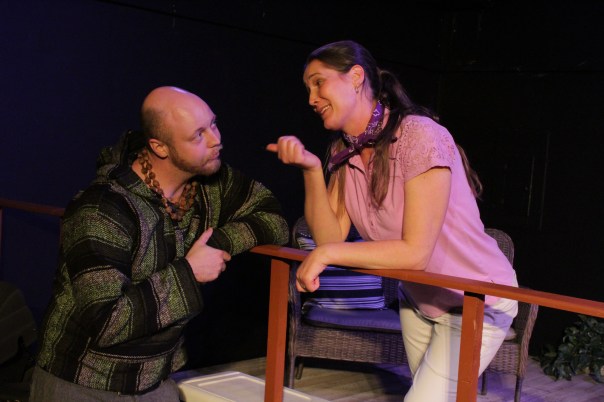
Lyle would probably concur, since his patio hosts, Deb and Mike, are only grilling and basting because they want to avoid the embarrassment of having their friends – who are more trendy, stylish, and successful – see the interior of their home, decorated with lame movie posters. Deb succinctly describes her strategy as lowering expectations for the cuisine and the ambiance. Outdoors, she can point with pride to the fact that Mike has built the rear deck himself. Yet the barbecue event has obligated Mike to buy a propane grill off Craig’s List, and he’s afraid to light it.

He would also like Deb not to mention that he’s a professional writer, for his career earnings, after one published short story, now total 50 bucks.

All four of the guests feed the hosts’ sense of inadequacy. Deb is a decorator, foodie, and gourmet cook who makes sure to bring her own organic meat, and her husband Ash is a gadget freak, armed with the best new smartphone equipped with the most awesome apps. Win pretty much embodies his name, a former high school QB, now a successful businessman with Republican views. He lives to put Mike down and can seemingly get any woman he wants. Even his bimbo of choice, Glory with her Astrodome boobs, can claim formidable accomplishments, arriving late to the barbecue after nailing her Rockette audition.

What ultimately happens to this insulated suburban group reminds me of The Admirable Crichton, the excellent James M. Barrie tragicomedy I came across a couple of times during TV’s golden age, when colleges had core curriculums. A perfect butler to the Earl of Loam in Mayfair, London, Crichton and his betters were shipwrecked on a desert island in the Pacific, where his natural superiority emerged.

There are two basic differences between Barrie’s back-to-nature tale and Lyle’s. The shipwreck situation was reversible with rescue. Apocalypse isn’t. More to the point, Barrie was clearly targeting the blind rigidity of class distinctions. Here if we consider the implications of Barbecue Apocalypse, Lyle seems to have modernity in his crosshairs – how our world warps our aspirations and our self-worth, how it channels us into modes of living that are far from our authentic selves.

In the cramped storefront confines of the Warehouse, Lambert doesn’t attempt to design a deck that lives up to Mike’s pretensions, and Donavynn Sandusky’s costume designs are similarly déclassé, especially for the nerdy Ash. This robs Lyle’s concept of much of its slickness, which for me turned out to be a good thing. Aside from the Craig’s List mention, Lambert also dropped in a couple of local references that added to the overall homespun flavor.IMG_6440

Becca Worthington and Conrad Harvey were nearly ideal as our hosts, keenly aware of each other’s limitations and their own, yet visibly crazy for one another. Worthington with her status-conscious rigidity and stressing was clearly the closest actor onstage to Lyle’s vision, beautifully flipping her “We suck” persona after intermission and the apocalypse, when a full year of roughing it has elapsed. Harvey was more than sufficiently cuddly and self-deprecating – but credulity is stretched when a man of such size and stature is repeatedly dominated by his adversaries.

If you can accept that Greg Paroff was ever on a football field, let alone as a QB, you’ll be quite pleased with how he handles Win’s asshole antics. He is confident, he is arrogant, and if he’s possibly past 40, that only increases the disconnect between Win and his limber Rockette. Julia Benfield is absolutely adorable as Glory, and I absolutely adore how she’s still mincing around in high heels when she makes her disheveled entrance in Act 2. We totally believe that her familiarity with Tom Wopat doesn’t extend to The Dukes of Hazard in the ‘80s.

Probably not the best moment for Lambert when she cast Cole Pedigo and Jenn Grabenstetter as Ash and Lulu. They should remember the ‘80s, but I needed to stifle my doubts. Wardrobe and just the way he’s absorbed in his iPhone might help Pedigo out – and make him less wholesome, winsome, and juvenile before the apocalypse. Grabenstetter overcomes all objections when free-range Lulu gets snockered on generic canned beer, and both Pedigo and his scene partner truly click when adversity brings Ash and Lulu to a new lease on life in Act 2. I believe that’s an antler dance.

I won’t disclose what happens when Maxwell Greger walks on for his cameo deep in Act 2, but I do respect how Lyle makes him earn his paycheck with a sizable monologue. Greger does the denouement with a slight manic edge, and the technical aspects of his departure are impressively handled.

So it’s fair to say that apologies are in order for rating Barbecue Apocalypse in the middle of the pack when I first read it. Or excuses, since a rational man resided at the White House in 2015, and apocalypse seemed so fantastical.

But hold on. Charlotte’s Off-Broadway has already programmed two other plays from their “Page to Stage” readings for two fully-staged productions in the near future, Susan Lambert Hatem’s Confidence (and The Speech) for September and Lauren Gunderson’s Exit, Pursued by a Bear for next February. Maybe when these runner-ups get fleshed out, supporters of Lyle’s winning script might reconsider their votes!

A Catch-All Catch-Up

Our recent travels to Greece, Israel, and Jordan compelled us to miss a bunch of high-profile openings after we reviewed the reinvented Rite of Spring at Knight Theatre on April 6 and CP’s On Golden Pond the following evening. Even before we left, we had to pass on the Charlotte Dance Festival and CP’s Elixir of Love so we could adequately prepare for our trip. To see the birthplace of theatre, the Holy Land, and Petra, we had to miss out on the BOOM Festival, the reprise of Beautiful: The Carol King Musical, and the opportunity to host a pre-show preview of The Marriage of Figaro for Opera Carolina.

New openings when we returned were a must, so we hit the ground running with Charlotte Ballet’s Spring Works and Symphony’s Brahms-and-Bartok program. But our need to catch up with Carolina Shakespeare’s Life Is a Dream made us put off seeing PaperHouse Theatre’s Sherlock Project until it second week. It gets complicated. But I’ve tried to get up to speed while working on more reviews and features. File these under gone but not forgotten:

The Sherlock Project So a dozen actors and writers collaborated on PaperHouse Theatre’s mash-up of Sir Arthur Conan Doyle’s short story gems, producing a script that follows three guiding principles: keep it funny, keep it moving, and don’t, don’t, don’t ever explain how the great Sherlock Holmes arrives at his incredible deductions. Going back to their roots at the Frock Shop on Central Avenue, PaperHouse and director Nicia Carla found a frilly complement to the Victorian chronicles of Dr. John Watson.

But the frame of the story was wholly new, telling us that the deadeye detective in the deerstalker cap is a woman. Watson protects the woman who should be credited with all the purported exploits of Scotland Yard’s Inspector Lestrade because he knows that Sherlock is right: The general public is even less prepared to believe a female is capable of such brilliancies than Watson is.

Besides all of the Sherlockian brilliance and nonchalant arrogance, Andrea King reveled in all of the detective’s eccentricities, whether it was shooting up a 7% solution of cocaine, tuning up a violin, or lighting up a calabash pipe. Opposite King’s insouciant self-confidence, Chaz Pofahl wrung maximum comedy from Watson’s wonder and timidity – a phenomenon compounded by the gender factor as Pofahl switched from paternal protectiveness to awe or terror while King wryly twinkled and smiled.

The two main supporting players slipped into multiple roles, Angie C as a cavalcade of damsels in distress and Berry Newkirk in the plumiest cameos, ranging from the dull-witted Lestrade to the razor-sharp Professor Moriarty, mythically uncatchable. Apart from directing behind the scenes, Carla conspired in the action as Mrs. Hudson, Holmes’s discreet housemaid. Carla not only ushered in Sherlock’s distraught clientele or evil adversaries, she also presided over scene changes, when audience members had to exit the Frock Shop’s parlor to a murder scene in the adjoining room or out on the porch when Sherlock was pursuing… something. Had to do with fire.

Or when it was intermission, time for little cucumber sandwiches.

The whole show was a wonderful diversion. PaperHouse had to add another performance to their run, which we caught last Wednesday, and the remaining nights were already sold out. Like the PaperHouse faithful, I couldn’t get enough of The Sherlock Project. I wanted lots more – beginning with how did Sherlock deduce that Watson had just come from Afghanistan when they first met?

Life Is a Dream – Convinced it was a comedy rather than a political melodrama, Shakespeare Carolina and director S. Wilson Lee kidnapped Pedro Calderón de la Barca’s classic, written during Spain’s Golden Age, and transported it more than three centuries forward from a mythical Poland to a mythical Las Vegas. There in a seedy club on the strip, the two factions with their eyes on the throne were Frank Sinatra’s Rat Pack and Marlon Brando’s Wild Bunch.
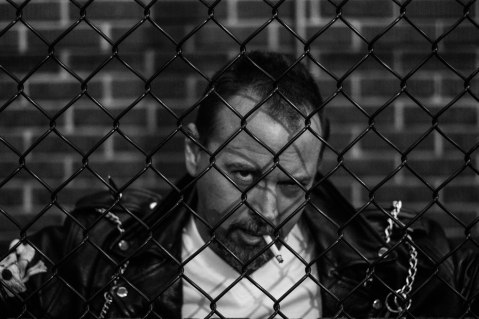
Lee’s wild conceit didn’t do nearly as much harm as I thought it would, mainly because ShakesCar didn’t have the budget to carry it too far at Duke Energy Theatre, and the strong cast mostly played their roles as the text, sensibly adapted by Jo Clifford, said they should. So much depended on the broad shoulders of David Hayes as Segismundo. Heir to the throne of Poland, Segismundo has been locked away Prometheus-like in a mountain dungeon for his whole life by his father, King Basilio, who is foolishly trying to ward off the dire destiny predicted by an astrologer.

A boiling rage seethes inside of Segismundo, and a less mightily built actor than Hayes might need to strain himself to encompass it. Hayes projected the mighty rage rather naturally, which made it easier for him to flow convincingly into Segismundo’s softer emotions when – before he has even suspected his royal lineage – he is handed the Polish throne and the power to act on his newly awakened sexual urges as he sees fit.

Called upon to give a far more nuanced performance as Basilio, Russell Rowe delivered. Yes, he was cruel, but also conflicted, with a lifelong dread deftly mixed into his forcefulness. Though I feared the convoluted plot might be abridged or simplified, the intrigue, the complexity, and the epic monologues were almost entirely intact. As the vengeful Rosaura, Teresa Abernethy brought forth the masculine-feminine blend that the transgendered Clifford was aiming for in her translation, and James Cartee, an actor who often keeps nothing in reserve, showed unusual probity and maturity as Clotaldo, even as he tried to figure out his long-lost child’s gender.

Nobody was more suavely dressed by costume designer Mandy Kendall than James Lee Walker II as Astolfo, the successor that Basilio wanted if the true heir didn’t pass his test. But if anybody was victimized by Lee’s Rat Pack concept, it was Walker. I have no idea why he persisted in speaking so rapidly and unintelligibly, unlike any work I’d seen from him before. Was he attempting a Sammy Davis Jr. imitation? Couldn’t figure out what accounted for this curious outing.

Betrothed to this strange hipster, Maggie Monahan beautifully brought out the agonies of queen-to-be Estrella. Maybe the most Shakespearean role in this ShakesCar production was Ted Patterson as Clarin, who tags after the disguised Rosaura from the opening scene, as either her companion or servant – but definitely our clown.

On the strength of this effort, theatergoers can be excited about ShakesCar’s next invasion of Spirit Square, The Tragical History of the Life and Death of Doctor Faustus at Duke Energy from June 28 to July 7.

DSC03442

Madagascar – Okay, so I’ll grant that the musical adaptation of the 2005 Dreamworks film didn’t have the gravitas of the greatest Children’s Theatre of Charlotte extravaganzas of the past like their Boundless Grace and The Lion, the Witch, and the Wardrobe – or the bite of Ramona Quimby and Tales of a Fourth-Grade Nothing. But this confection was nearly perfection. Under the direction of Michelle Long, Madagascar hit a family-friendly sweet spot, straddling the realms of cartoon silliness, cinematic adventure, and theatrical slapstick and dance. I just didn’t like the deejay, everybody-get-up-and-act-stupid thing.

Scenic design by Jeffrey D. Kmiec never lost its freshness thanks to a slick stage crew and the eye-popping lighting by Gordon W. Olson, while the animal costumes by Magda Guichard probably made the strongest case for live theatre against multiplex animation. Choreography by Tod A. Kubo chimed well with Long’s direction, which used areas of McColl Family Theatre that rarely come into play.

Centering around four animals that break out of Central Park Zoo, Madagascar introduced us to Marty the zebra and his wanderlust. We moved swiftly from there. Following the lead of four penguins bound for Antarctica, Marty escaped the zoo, seeking a weekend in Connecticut. Not only are police, animal control, and TV bulletins on his trail, so were his pals Gloria the hippo, Alex the lion, and Melman the giraffe. Embarking underground in the Manhattan subway, Marty hardly stretched credulity much further by winding up off Africa.

Deon Releford-Lee was a spectacular triple-threat as Marty, but what dazzled most was the multitude of gems in this supporting cast, beginning with an intimidating Alex from leonine Traven Harrington and – on stilts, of course – a timorous Melman from Caleb Sigmon. Dominique Atwater disappointed me as Gloria, but only because we didn’t get enough of our hippo after her first big splash. Olivia Edge, Allison Snow-Rhinehart, and Rahsheem Shabazz fared better, drawing multiple roles.

While the book by Kevin Del Aguila shone more brightly than the musical score by George Noriega and Joel Someillan, I was amazed that so much story and song could be squeezed into barely more than 60 minutes. Combined with last October’s Mary Poppins, the exploits of Madagascar prove that musical production is an enduring strength at Children’s Theatre. I can’t think of a season at ImaginOn that had sturdier bookends than these musicals that began and concluded 2017-18. The crowd that turned out for the final performance affirmed that the 7th Street fantasy palace has perfected the craft of producing family fare.

Not only that, it showed me that Charlotte families have spread the word.

The Other Shue Drops at Theatre Charlotte With “The Nerd”

Review: The Nerd

By Perry Tannenbaum

It’s only infrequently that playwright Larry Shue’s name crops up on the Charlotte theatre scene. The New Orleans native, whose comedies were all premiered at the Milwaukee Repertory Theater, died in an airplane crash at the age of 39, while his most familiar work, The Foreigner, was still playing off-Broadway. Charlotte Repertory Theatre staged that backwoods farce during the same year that Shue died, 1985, and it was a huge hit, so huge that when Rep marked its 25th anniversary in 2001, a revival of The Foreigner was part of their celebration.

Yet Shue’s “other” comedy, The Nerd, also figured significantly in Rep’s history, for when the company went from a summertime schedule to year-round status in 1988, The Nerd was the company’s first non-summer production. Thirty years later, the current Theatre Charlotte presentation of The Nerd is actually its Charlotte premiere, for Rep staged this wacky comedy at Davidson College.

Wacky might be considered a gracious description of The Nerd, which premiered in Milwaukee two years before The Foreigner and arrived on Broadway two years after its worthier sibling. Silly, over-the-top, and unfocused might be better ways to describe this belated coming-of-age story of young architect Willum Cubbert. We first encounter the low-key Willum as he’s insufficiently surprised by his 28th birthday party. The surprises have hardly begun, for the party is wildly impacted by the unexpected arrival of the title character, Rick Steadman, who retains Willum’s undying gratitude for saving his life in Vietnam.

Thanks to other guests, excesses abound before Rick’s bodacious entrance. Not only is Willum’s current client, Warnock Waldgrave, insensitive to the niceties of Willum’s architectural drawings, he comes to the party with a neurotic wife and a fiercely obnoxious daughter. The little brat has thrown two or three tantrums, assaulted her dad and other adults, and locked herself stubbornly in the bathroom on multiple occasions a sedate warmup compared to the action after Rick arrives. As you might presume, the extremely starchy Warnock and the preternaturally eccentric and irritating Rick are not destined to get along.

Aside from Willum, whose gratitude toward Rick and dependence on Warnock prevent him from taking a hard line, two of Willum’s friends, Axel Hammond and Tansy McGinnis, try to mediate as the party spirals further out of control. Tansy is particularly sympathetic toward Willum. She’s his girlfriend now but will soon be breaking his heart when she moves from Terre Haute, Indiana, to DC, where she has a job waiting for her as a TV weathergirl. Axel is a drama critic, so he’s more inclined to crack wise than be helpful.

Just when it seems that Willum’s evening can’t get any worse, Rick makes his second entrance, suitcases in hand, intent on moving in. It’s here that Shue begins to misdirect us or lose focus, for everyone onstage except Rick becomes intently preoccupied with expelling Willum’s noxious visitor. We’re likely to forget that Tansy has really set the agenda early on in a conversation with Axel.

With set and lighting by John P. Woodey, this Theatre Charlotte production has a very sharp and detailed look to it, augmented by Sabrina Blanks’ splendid costume designs. Mom Clelia and daughter Thoralee clash like crazy in their party outfits, and Rick, dogged in insisting that this is a Halloween party, is positively unearthly when he arrives. Directing this mayhem, Jill Bloede takes a sensible approach, drawing outré performances from her three most noisome players, Trulyn Rhinehardt as the incorrigible Thoralee, Simon Donaghue as a perpetually outraged Warnock, and Jonathan Slaughter as The Nerd.

Rhinehardt misbehaves with such savage zest that you’ll want to take a stick to her. I don’t mind saying that I most delighted in Thoralee when she fainted from fright. Even if Bloede hadn’t changed Thoralee’s gender – Shue originally saddled Warnock with a Thor – I don’t think that a fainting spell by a bratty boy would have been any more satisfying. Donoghue’s powerful take on Warnock seemed to be the only misguided aspect of Bloede’s approach: why didn’t he take a stick or a belt – or a machine gun – to his unruly daughter, and why didn’t he simply fire Willum on the spot for ruining his day? Whatever softness accounted for Warnock’s forbearance wasn’t visible.

Slaughter’s way with Rick, not far distant in its absurdity from the sound and awkwardness of the Nutty Professor minted by Jerry Lewis, always bordered precariously on the unbelievable. There were times when Rick seemed to be trying to irritate everyone in sight, exactly the impression that Shue would have approved of. A tad too young to be playing Willum, perhaps, Cole Pedigo was a near-perfect foil for Rick’s nuttiness once he conquered his opening-night jitters. Shue wanted us to see a talented desirable man who is kind, grateful, and accommodating to a fault. That was exactly how we saw Pedigo.

Shue’s women weren’t as well drawn here as they would be in The Foreigner, but Bloede probably could have pushed Allison Kranz as Tansy and Audrey Wells as Clelia further toward farce. They also suffer at the epic birthday party from hell, Tansy especially after she slaves over a custom-made dinner and Clelia most memorably when she quizzes Rick about his love life. Perhaps if Shue had made her more decisive, Tansy would have seemed less vanilla as the would-be weathergirl, so Kranz definitely needed to pick her spots to show us that she was worthy of Willum’s adoration. Mostly, Shue and I forgot about her. Of course, Clelia was as much generic comedy material as her child, but Shue gave her some bravura business to perform in her reactions. Bloede should have lit the fire that would have made these diva moments for Wells. We weren’t as close to Carol Burnett as we should have been.

Deep in the weave of Shue’s plot is Axel, whose scheme to exorcise Rick in Act 2 is approximately as disastrous as the birthday party was before intermission. Chip Bradley is sufficiently urbane and snarky as this theatre critic, but I sometimes got the impression that he was a late addition to the cast. Along with a few instances of slow cue pickup, Bradley fumbled a few lines before getting them right. I’ve seen him do better in productions just as fast-paced as this one, so I’m expecting better performances in the nights ahead.

Coping with so many moving parts and quirks, Charlotte Rep also had some rough edges in its opening night performance of The Nerd 30 years ago. You wouldn’t want to tame all of this volatile ball of energy, but a little more energy here and a little sharpening there would help Theatre Charlotte’s production to snap into better shape.


Soot of Sodom Chases the Joads in “The Grapes of Wrath”

Review: The Grapes of Wrath @ Theatre Charlotte

By Perry Tannenbaum

If you’ve ever read John Steinbeck’s sprawling masterwork, The Grapes of Wrath, you know that it’s framed with a seething anger as a picture of America’s unfulfilled promises, the cruel exploitation of the poor, and the undiminished aspirations of the Joad family. These dispossessed and determined Oklahoma sharecroppers believe in the dream.

But the Okies are tested before they reach the Promised Land of California and once they’ve arrived. Like the Israelites in the Old Testament, they must cross burning desert. Clutching onto the printed handbills promising work and honest wages, they must resist the report of a broken, disillusioned man who found California to be nothing like the handbills’ hype. They must endure attacks from anti-labor thugs who fear the latent strength of worker groups.

Perhaps most difficult of all, they must strive to hold together despite forces of attrition from within – disagreements, defections, and death. Manna doesn’t shower down upon them from heaven to ease the journey.

We easily presume, with their consuming hope of a Promised Land, that the Joads’ journey is an exodus, a liberation from the landowners who have burdened them with sufferings. Another biblical parallel suggests itself on Queens Road, where Frank Galati’s stage adaptation of Steinbeck’s novel is making its local debut at Theatre Charlotte – a mere 37 years in the wilderness after winning the 1980 Tony Award for Best Play.

Since vile bankers and beancounters cannot loom as large on the stage as they do on the vast canvas of Steinbeck’s pages, another biblical parallel emerges clearly. Under Ron Law’s direction, with severely weathered scenery by Chris Timmons, and stark, pitiful costume designs by Chelsea Retalic – Okie clothing and faces equally sooty – I couldn’t help sensing echoes of the destruction of Sodom and Gomorrah in this depiction of Dust Bowl devastation.

One faint echo is the drugging of Grampa Joad when he resists leaving, a parallel to how Lot’s daughters bamboozled their dad. The loudest echo came from Ma Joad, proving that she’s the antithesis of Lot’s Wife. You’ll recall that when Lot’s family was commanded not to look back while God was raining fire and brimstone on the sinful cities, Lot’s wife disobeyed and paid a famous price.

As the Joads embark, one of Ma’s kinfolk asks if she is going to take one last look back. Her no in response, with the aid of modest embroidery, is so emphatic that we take it as a philosophy. Ma Joad looks forward and moves forward. She lives by doing what needs to be done.

It’s an outlook that she successfully hands down to her daughter, Rose of Sharon, in the poignantly perverse pieta that ends the epic story.

With a performance like Paula Baldwin’s as Ma, we readily grasp that Steinbeck wished us to see her as the steadying bedrock of the family. The jut of Baldwin’s jaw and the tightened sinews of her neck were unlike anything I’d seen from her in her numerous leading roles. She’s unrelentingly purposeful, sternly nurturing, with all the patience and endurance of the ground she stands on.

Standing firm isn’t all that simple on the raked stage that Timmons has built. His pared-down design must accommodate campfires, a riverbank, and a ramshackle jalopy able to accommodate the whole clan. The skin-and-bones truck is altogether worthy of the ridicule it draws. Inspiration taken from the Little Engine That Could? You decide.

Vying with Ma for the right to be called the backbone of the family is the second-eldest son, Tom Joad, a volatile straight-shooter who is coming home from prison after serving his time for murder. It is so telling – about Tom and his fellow Okies – that everyone seems disappointed that Tom didn’t break out of jail. Easy to rile when he or his family is threatened, Tom is a seeker of truth, curious to learn how the system works.

Max Greger subordinates Tom’s volatility to his heartland wholesomeness in a promising Charlotte debut, holding his own when he shares the spotlight with Baldwin or the wild-eyed Andrew Tarek, who shambles brilliantly about as Jim Casy, a former preacher who feels like he has lost the calling. Yet in the same way that Tom is branded as an outlaw after killing in self-defense, Casy is branded as a holy man despite his renunciation – with Steinbeck’s approval, we presume, since four gospels were written about a man with the same initials.

Amid a dust cloud of bleakness and hopelessness, these running gags slightly lift the gloom.

And though there are strong unionist sympathies in the framework of Steinbeck’s yarn, you will also find an all-American emphasis on teamwork, which Law’s cast underplays enough to keep us from smelling Hollywood. Chris Melton has an adolescent randiness as Al Joad that augurs trouble and a shotgun marriage, but he also has a way with cars, performing the marvel of getting the Joads’ jalopy going. Between bouts of guilt, discouragement, and drinking sprees, Victor Sayegh as Uncle John often struck me as the most fatherly in the clan with a generous spirit.

With a cast of 23 trafficking back and forth on the sloped stage, Law needed to shape a deep ensemble that bonded together while divvying up two hours and 15 minutes of running time. Nor could he rely on the top tier of players to deliver all the little crevasses of comedy and poignancy that lurk in the wide tapestry.

Annette Gill and Rick Taylor are largely responsible for getting us off to a rousing start as the ever-bickering oldsters, Granma and Grampa Joad, portraying them as loud and slightly doddering. We get an interesting take on Pa Joad from Ryan Dunn, who doesn’t seem broken by his family’s rude displacement but rather gladly retired from the responsibility of it all, a bit dazed by the turn of events.

Zach Radhuber goes light on the simplemindedness of Noah Joad, yielding a touching moment when he sets off on his own, and Cole Pedigo gives a nerdy edge to the befuddlement of Connie Rivers, Rose of Sharon’s husband. In some ways, Ailey Finn represents the best of the new generation as “Rosasharn,” but it’s suffering that strengthens and ennobles her, and the mysterious smile that ends the novel can’t be incorporated into a stage adaptation.

Law keeps the concept of incidental music from the Broadway version but discards the content, switching from a Tin Pin Alley songlist to a folksy Woody Guthrie flavor. “California, Here I Come” steps aside for “This Land Is Your Land.” Strumming an appropriate guitar, Tom Schrachta attacks the material a bit harshly with his robust voice, but I grew fond of that discord. Schrachta also drew the acting chore of donning a rumpled trench coat (a hint of the spy parallel in the biblical exodus story) and delivering the bad news about California to the Joads.

That same harshness remained in Schrachta’s voice. Yet now it was mixing grief, discouragement, futility, and rage – very much what Steinbeck felt about the ruinous actions of America’s bankers when he wrote The Grapes of Wrath.