Tag Archives: Quentin Talley

Three Bone Theatre Responds to this Moment with “Hands Up”

Review: Hands Up: 7 Playwrights, 7 Testaments

By Perry Tannenbaum

Actor- Jay Ward

The stats and the realities have been out there for years – before a racist took up residence in the White House. Racial profiling by people with badges, guns, and gavels had already been documented with actuarial precision. The disproportionate number of black men stopped and ticketed for broken tail lights, frisked at checkpoints, picked up on ticky-tack drug violations, incarcerated for maximum sentences on trumped -up evidence, and gunned down or choked to death by police without cause or provocation? All of it had been calculated over and over.

When Ferguson happened in 2014, triggering an oft-repeated American awakening, Michael Brown lay in the streets for hours after he was murdered. Police brutality seemed to be hidden in the shadows under the cover of darkness during those primordial days. Our iPhones and mandated police bodycams have opened our eyes since then. Now in 2020, after the brutal suffocation of George Floyd in broad daylight, the essence of the Black Lives Matter grievance is no longer the abstract result of a statistical calculation. It is vivid and visceral for millions of us here and around the globe.

And maybe, just maybe, the worldwide unrest has made a dent in policemen’s brazenness, in police chiefs’ and unions’ defiance, in mayors’ aloofness, and in legislators’ indifference. Normally, black and guerilla theatre companies might be expected to help sustain momentum for change, but in a time of pandemic, norms themselves have changed. So it’s welcome that Three Bone Theatre has returned to the Charlotte scene at this moment focusing on an issue that seems lately to be waning among our priorities – distantly behind ejecting a noxious clown from the Oval Office.

Following up on commissioning a set of 10-minute plays sparked by the murder of Trayvon Martin the previous year, the New Black Fest commissioned Hands Up: Six Playwrights, Six Testaments. An early reading stage version preserved on YouTube was recorded in November 2014, just three months after the Michael Brown shooting. That six-pack retained its original formulation when the piece was formally premiered in Philadelphia on June 10, 2015, in a Flashpoint Theatre Company production directed by Joanna Settle.

Actor- LeShea Nicole

One might infer that Settle influenced the subsequent trajectory of the piece, for its subtitle is now 7 Playwrights, 7 Testaments, and smack in the middle of the previously all-male lineup of playwrights and protagonists, we now have “Dead of Night… The Execution Of…” by Nambi E. Kelley, in a stunning performance by LeShea Nicole that any production, past or future, would benefit from.

Mainly, the black men keep asking how they need to act to shield themselves from racial profiling, police paranoia, and the hail of bullets fired at them without impunity. “Hands up, don’t shoot,” the slogan that quickly cropped up during the Ferguson protests of 2014, has sadly retained its currency alongside “I can’t breathe” and “Get your knee off our necks.” That slogan gets a riveting workout in the concluding playlet, “How I Feel” by Dennis A. Allen II. The fact that Sultan Omar El-Amin didn’t have an audience in the house to interact with at Duke Energy Theater hardly detracted from the power of the grim communal ritual he led.

Added to the intrinsic power of the 7 Testaments, the current Three Bone production forcefully reminds us that nothing has changed since Hands Up had its first reading six years ago. Quentin Talley’s stage direction helps us grasp all that is still true about the difficulties blacks face in navigating everyday life in America – and all that was prescient in these seven scripts about what would be so graphically demonstrated on TV and social media. As a society we aren’t merely discovering the systemic racism thriving in our midst the systemic racism thriving in our midst. We’re taking our blinders off.

Talley’s audio setup at Spirit Square frequently let him and the other performers down as this compelling livestream unfolded. The dropouts pretty much ruined Mason Parker’s rendering of “They Shootin! Or I Ain’t Neva Scared…” by Idris Goodwin and intermittently – but annoyingly – cut the argumentative thread of “Abortion” by NSangou Njikam as Gerard Hazelton engagingly prowled the stage. “Walking Next to Michael Brown” by Eric Micha Holmes fared slightly better, dramatically delivered by Laurence Maher.

My hypothesis was that microphone placement was nearly as much responsible for the dropouts as the wayward streaming signal. Talley had these guys moving around more in his blocking than Nicole, whose audio was comparatively solid. When Talley himself opened the show, performing “Superiority Fantasy” by Nathan James, his voice tended to fade when he distanced himself from centerstage. That’s probably why the full force of James’s distinction between whites and Caucasians didn’t quite register as it should. It was a distinction that, for millions of people of good will, would have come in handy decades ago.

Members of the audience who have waited in vain for spokespersons from Antifa or the Deep State to share their views could hear more pointed and realistic testimonies about how it feels to wake up every morning and walk America’s streets in a black skin. Talley’s character described it as constantly walking on eggshells even when he wore his carefully crafted non-threatening smile. Jay Ward, performing Nathan Yungerburg’s “Holes in My Identity,” recalls the cringeworthy moment in grade school when a classmate mispronounced the River Niger and all the other white students turned towards him.

Actor- Sultan Omar El-Amin

Perhaps the most poignant evocation was in El-Amin’s testimony when he overheard his mother remembering how, when she was pregnant, she had wished that her child would not be a boy. We’ve seen enough tearful moms on the evening news to know why. El-Amin went on to describe how radically blacks and whites would need to change before Mom could discard those fears. Even then, he wasn’t betting that systemic racism would be on the ropes.

So he finally lowered his hands and simply vented: “Fuck you! And fuck this shit!”

The concluding Allen ceremony and rant justifiably gave the New Black Fest collection its title, surely the most stirring piece in this Three Bone production. But the Yungerburg monologue struck me as the most nuanced and sneakily persuasive. The main “hole” in this speaker’s identity as a black person was that he had reached the age of 43 without ever having been stopped, frisked, interrogated, or beaten for no reason. It’s not an initiation you seek out, of course, but it’s a condition that drives Ward’s character to a therapist.

Eventually, he pierces to the core of why the hurts fester in the hearts of police victims, no matter how trivial – or even paranoid – the victimization might be. “Dismissal steps quietly,” he says, because we’re not always aware that we’re doing it while the victim feels it keenly. At a certain point, Ward’s uncannily untouched character, during a walk in the park with a black partner, discovers that he himself has dismissed his friend’s fears as a silly phobia.

And he takes the opportunity, then and there, to apologize. It’s at that pivotal moment that Yungerburg and Allen are empathizing with us, grasping that we often don’t know how to cope with an unbridgeable divide – and showing us the way.

“That’s where the healing begins.”

Three Nights of Resounding Sermons Hit Spirit Square

Preview:  God’s Trombones

godstrombones image

By Perry Tannenbaum

OnQ doesn’t usually perform at McGlohon Theater in Spirit Square, but when it does, it’s big, big, big. So shall it be, brothers and sisters, when God’s Trombonessounds big, doesn’t it? – comes wailing, praising, shouting, and testifying into town next week for a three-night run, beginning next Tuesday. Capping OnQ’s “Redemption Song” season 11, the cast is among the company’s biggest ever, with around 25 actors, singers, dancers, and musicians performing onstage.

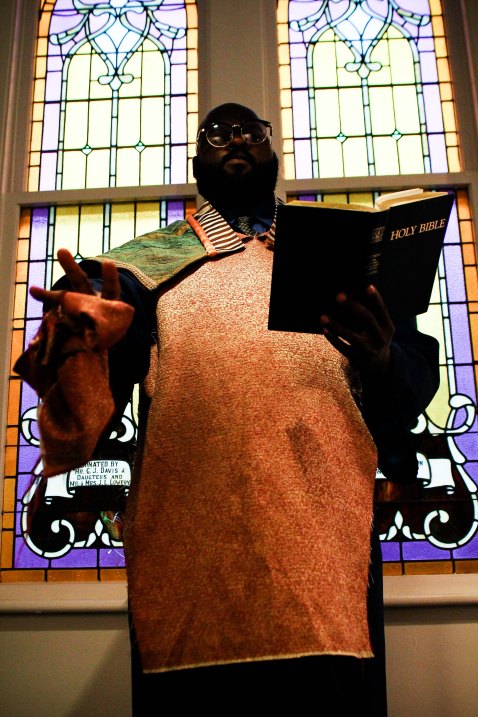
And if you’ve ever attended an event at McGlohon, or you know its recent history as the home of Pastor Stephen Furtick’s Elevation Church – or Spirit Square’s origins as the First Baptist Church – you’ll realize that OnQ has chosen the right place for James Weldon Johnson’s “Seven Negro Sermons in Verse.” McGlohon retains its stained glass, Sunday church vibe to this day.

Johnson was a seminal figure in African-American literature as a poet, novelist, essayist, critic, anthologist, songwriter, and collector of spirituals. Oh yeah, he also served as US consul in Venezuela and Nicaragua under Teddy Roosevelt and as executive secretary of the NAACP. He is best remembered for writing the lyrics to “Lift Ev’ry Voice,” for The Autobiography of an Ex-Colored Man, his novel, and for his most anthologized poem, “The Creation,” from God’s Trombones, first published in 1927.

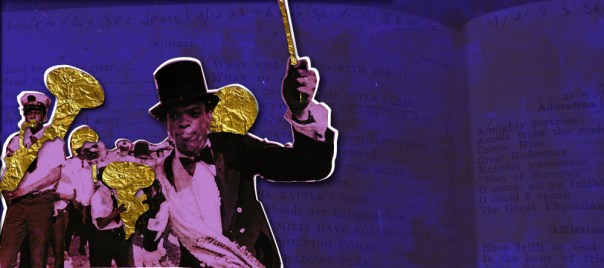
OnQ artistic director Quentin Talley hasn’t wanted to present this classic for quite that long, but he has loved the piece since he was around 12 years old. That’s when his youth choir participated in a production presented by an association of black Baptist churches in his hometown of Greenwood, SC. It was one of Talley’s formative theatre experiences, and by the time he reached college age, it was foundational.

“I even ended up doing the ‘The Crucifixion’ as my dramatic monologue audition piece for Winthrop [University] and received a First Night Scholarship.”

In his original preface, Johnson said that he’d prefer his verse sermons to be spoken aloud – or “intoned” – so it’s natural that singing and dancing should be added to the package. Costuming will remind us where we are, a mix of pastoral robes, choir robes, and Sunday best.

IMG_0282

“We begin like we are in a church service,” says Talley, “and once the sermons build, we take on various locations and time periods. Our choir is absolutely amazing, and the audience will probably want to stand up, sit down and say amen. All are encouraged to do so, but it’s not mandatory.”

Leading the choir in his first stint with OnQ is Dennis Reed Jr., whose GAP singers have worked with such notables as Fantasia, Bebe Winans, New Kids on the Block, and Shania Twain. On this gig, Reed is also auditioning the singers, picking the songs, and penning the arrangements. So does Reed fire up his newly-formed choir with righteous gospel music played on a hallowed Hammond B3 organ?

“Hahahahaha!” Reed responds. “That’s correct! You’ll hear the B3, piano, bass, and live drums. Much of the black church tradition is rooted in live music. What’s really cool is that we are taking a little liberty with song choice. We will fuse traditional hymns, Negro spirituals, and even new elements of music such as hiphop loops! As far as choreography goes, we’ll see a lot of it come together in practice and much of it happens organically.”

Though he’s never worked with Talley before, Reed is a fan of his work. A proud grad of NW School of the Arts, Reed has numerous musician and singer friends who have collaborated with Talley and OnQ – and his ties to Charlotte are not at all tenuous. He founded Inspire the Fire here more than 15 years ago, when he was 17, to bring the arts to young people between the ages of 10 and 21, earning Community Leader of the Year honors at the 2015 Queen City Awards.

GAP stands for God’s Appointed People, so gospel music and God’s Trombones should as much up Reed’s alley as Talley’s.

Johnson pieced his sermon suite together using “vague memories” of sermons he had heard or collected, and their subjects are familiar church staples. The typical old-time Negro preacher, Johnson recalled, “preached a personal and anthropomorphic God, a sure-enough heaven and a red-hot hell. His imagination was bold and unfettered. He had the power to sweep his hearers before him; and so himself was often swept away.”

Aside from “The Creation,” the poet hearkens back to the Old Testament in sermons on Noah and Moses. Christian themes include the Prodigal Son, the Crucifixion, Judgment Day, and a non-scriptural funeral sermon.

“Each sermon will have a different approach,” Talley promises. “Most are recited, some acted out or sung, some are poetry slam form, but all have down-home preaching undertones.”

A mix of OnQ ensemble regulars – and authentic preachers – will deliver the sermons. Familiar OnQ faces will include Omar El-Amin for the Prodigal and Ron McClelland for the Crucifixion. Slam poet extraordinaire Bluz leads us aboard Noah’s Ark and Q himself orates “The Creation.” Preacher Yolanda Bynum launches the show with Johnson’s “Listen Lord” prayer, and Rev. Madeline Salder leans into “Let My People Go.”

Johnson intended us to hear trombones when his verse was read aloud – if they authentically replicated the preachers he heard in his youth. Listening to the trombone, Johnson heard expressive capabilities beyond any other instrument, approximating “the varied range of emotions encompassed by the human voice – and with greater amplitude.”

Of course, it’s fascinating that Talley, in reviving this Johnson gem, is hearkening back to his own youth, positioning himself to capture some extra flavors of its spirit.

“This show has been on our list for years,” Talley affirms, “but never really fitted with themes we’ve had in the past couple of years. With this season’s theme being ‘Redemption Song,’ it fit perfectly. As artistic director after 11 years of producing ups and downs, this show is a reminder to keep the faith. Running an arts org is taxing physically, emotionally, financially and spiritually, and sometimes you need a reason from a higher power to keep going, especially at the end of a season.”

Sometimes we also need to check out a worthy writer like Johnson who has unjustly fallen from his loftiest esteem, perhaps because he led the NAACP or perhaps because of the folksy, down-home flavor of God’s Trombones. Or perhaps because we prefer to say black or African-American instead of Negro. All these trivial reasons evaporate when you delve into Johnson with any depth.

You could start with The Autobiography of an Ex-Colored Man, or you might begin with Johnson’s actual autobiography, Along This Way. Here is something trenchant that he observes there:

“On occasions, I have been amazed and amused watching white people dancing to a Negro band in a Harlem cabaret; attempting to throw off the crusts and layers of inhibitions laid on by sophisticated civilization; striving to yield to the feel and experience of abandon; seeking to recapture a taste of primitive joy in life and living; trying to work their way back into that jungle which was the original Garden of Eden; in a word, doing their best to pass as colored.”

Now that’s not folksy at all, but it is the keen intelligence embedded in God’s Trombones. More than 20 years ahead of Norman Mailer’s The White Negro and Joni Mitchell’s “Woodstock.”