Tag Archives: Ellen Robison

Change Comes to Sixties Baltimore in a Rockin’ Good Way at Matthews Playhouse With “Hairspray”

Review: Hairspray at Matthews Playhouse
By Perry Tannenbaum

July 10, 2026, Matthews, NC – One of the most confounding things humans ask themselves and each other is “When are things going to change?” Too many things are changing all the time for that generalized question to be taken seriously – and too many people asking that question seriously have too little inclination to make change happen. In Hairspray, adapted from John Waters’ 1988 film, change comes to Baltimore in 1962, a year before Bob Dylan declared that “the answer, my friend, is blowing in the wind,” and two years before LBJ signed the Civil Rights Act into law.
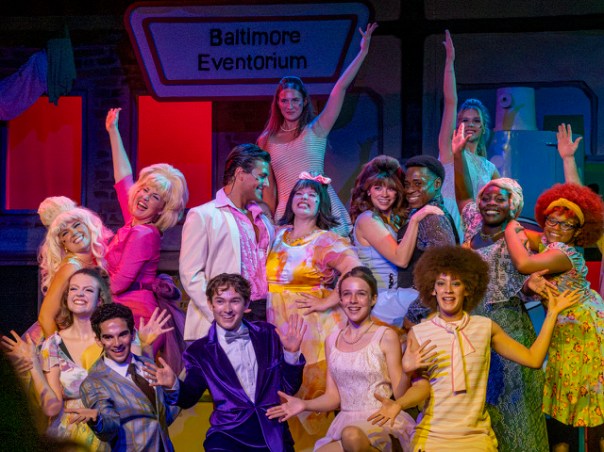
Waters’ script was a rewrite of history that stuck, given new life by the Tony Award musical adaptation. Because you not only can change things with a winning strategy and sufficient effort; when you do, and you’re one of history’s winners, you get to rewrite history as you see fit and invent new heroes. Watching Tracy Turnblad spark change in 1962 Baltimore, you just set aside the need for JFK, Dylan, MLK, and LBJ for a couple of hours. Leave it to Tracy, supported by her dad, to rally a whole city and overturn segregation at a teen dance show on local TV.

The current Matthews Playhouse production, directed by Sidney Horton, reminds us why Hairspray not only won Best Musical in 2003, but seven additional Tonys. These included Thomas Meehan and Mark O’Donnell for best script and statuettes for Marc Shaiman and Scott Wittman honoring their best musical score. When Horton put out the casting call, the Metrolina talent pool could eyeball four different roles that were juicy enough to deliver Tony nominations to the original Broadway cast. All three Turnblads won the prize, led by Harvey Fierstein as Edna, who undergoes a personal makeover, inspired by her plucky daughter.

Watching Horton’s players at the Matthews Playhouse, you may find yourself surprised that only four original cast members won Tony nominations. What about Corny Collins, the deejay who fronts the afternoon TV dance-a-thon, receptive to the new grooves on the airwaves and open to featuring Blacks more often than on the current once-a-month “Negro Day”? Or Motormouth Maybelle, Corny’s counterpart when the Afro-Americans get their brief chances to shine? Or Link Larkin, the dreamboat teen idol Tracy craves, pragmatic about his career, yet open to developing as a musician and a person?

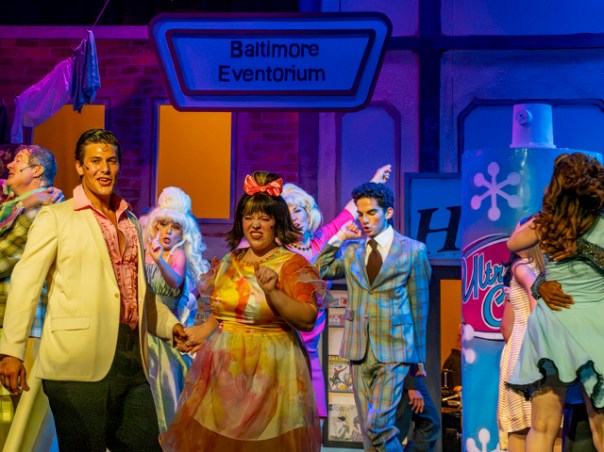
All three of these prove to be plum roles for Johnny Hohenstein, so charismatic last July as the iconic baddie in Peter and the Starcatcher, and two newcomers, Carter Poulson and Olivia Greene. Corny’s pragmatism allows Hohenstein to be different characters when he’s on-air holding a mic, behind the scenes sparring with his station manager or the show’s sponsor, and out in the wild scouting talent. It’s a less outré ride than Black Stache, but there’s a wider range of phoniness to savor.
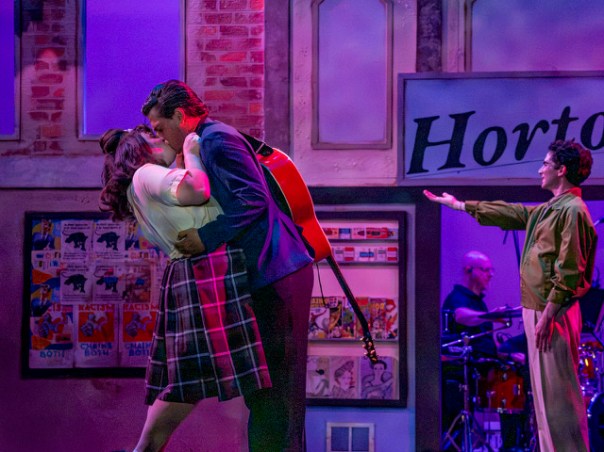
At first, Poulson appears to be the trophy boyfriend of fellow Corny Collins regular Amber Von Tussle, the daughter of WZZT station manager – and former Miss Baltimore Crab – Velma. But when Corny suggests that he croon his new song, “It Takes Two,” as a serenade to Tracy, newly installed on the show over the Van Tussles’ objections, he addresses only his opening overtures to Amber. With both lasses vying for his attention, Tracy nearly drooling, Poulson’s appeal swells the more he croons and swivels his guitar from back to front. Then he comes on to Tracy with a cinematic zeal that would make any girlfriend jealous. A dreamboat’s dream kiss ends the song.
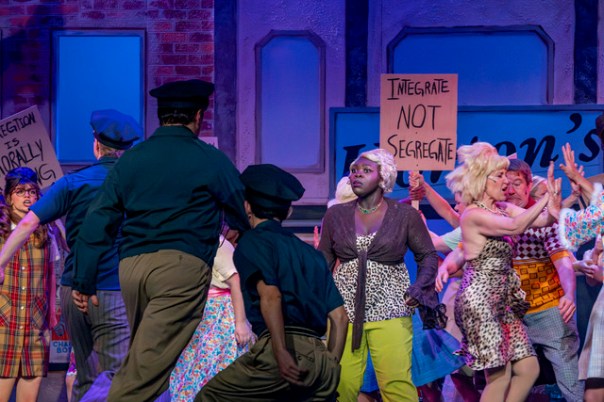
Thematically, Maybelle may be pre-eminent in Hairspray, the mother that Tracy, her bestie Penny, and Amber should have had in their earlier years. Off-air, she’s the den mother to all the talented Afros on The Corny Collins Show who have been relegated to second-class status. Her own brood includes Seaweed, the Afro stud who teaches Tracy and Link some slick moves, and Little Inez, whose audition for the open slot on Corny’s show is doomed by her race. As this living rebuke to Velma, Greene needed to be a big personality from the start. She must grow bigger when she and Tracy lead a street demonstration outside WZZT, demanding desegregation. By the end of the show, Greene must sing “I Know Where I’ve Been,” the anthemic peak of Hairspray.

In her auspicious Matthews debut, Greene showed us that her role in the doo-wop trio in Theatre Charlotte’s Little Shop of Horrors was a mere foretaste of her capabilities. True, she seemed a bit small for Motormouth’s shoes when we first saw her, yet she was more than ample for her climactic showstopper, her crusading gospel spirit getting by far the loudest roar from the opening night audience prior to the big crowning of Miss Teenage Hairspray and the spectacular Edna Turnblad reveal.
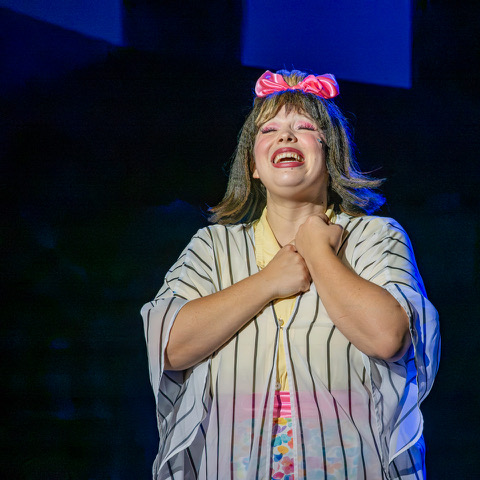
So at various times, the Turnblad clan was gloriously upstaged at Matthews’ Fullwood Theatre. When they’re all professionals or seasoned community performers, that’s not a problem at all. Although I’d never seen her in performance before, Logan Cosper took command of the full Fullwood stage as Tracy from the moment we woke up with her in “Good Morning Baltimore.” Not really your ideal candidate for body shaming, Cosper’s only truly plus-sized aspects were her energy and her smile. As the stage fills up around her, making her way through the city to her high school, those two ingredients are perfect: she needs that sunny cheer so the comedy will click when she passes a drunken derelict on the street. And make no mistake: she’s not merely one of Link’s admirers; she’s his most fanatical. We see significant personal growth from there.

If you spotted Leopard at Booth Playhouse a couple of months ago in his leather motorcycle outlaw outfit in Queen City Concerts’ We Will Rock You, you likely emerged with the impression that he’s way tall and rail thin, not the best fit for Edna. But if you’ve caught him at Theater Charlotte in either Something Rotten! or The Producers, where he formally cross-dressed as the Chrysler Building,you would also realize that sashaying and drag are right up his alley. God and costume designer Beth Levine-Chaitman only know what garments and appliances may lurk under Edna’s housecoat and subsequent makeovers to transform Leopard into the Turnblads’ plus-sized fashion plate.
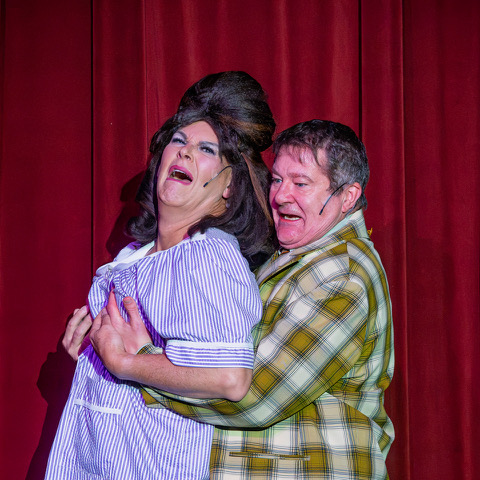
Yet I was a wee bit disappointed to see him so controlled and disciplined. Leopard’s voice could have been an octave lower at key moments for the fullest plus-sized Edna experience. Nor were the constraints strictly directorial. The kitchen or laundry room that scenic designer Chris Morgan provided for Tracy’s mom and dad was woefully minus-sized, barely allowing breathing, let alone stateliness or flamboyance. For the novelty showstopper, Edna’s “You’re Timeless to Me” duet with Wilbur, Horton wisely closed the curtains on the entire set. The effect was very vaudevillian, drawing lusty ovations before and after the couple’s reprise.

That duet was probably the best hook-up between Horton and choreographer Rachel Peterson – or one of the turning points. Through most of Act 1, dancers often moved in place rather than zipping around, so the tableaus lacked depth until the climactic chaos of the protest riot at WZZT. Seemed to me that the onrush of cops and Billy clubs was what transformed the righteous protest into a riot. You can be the judge whether Horton is making that point.

Honoring (or disregarding) the script, Horton allows Mike Carroll, in one of Levine-Chaitman’s tackiest costumes, to attend the big integration protest as Wilbur. Yet somehow, he isn’t arrested along with his family, the Von Tussles, and the Black folk. Overnight during intermission, he is able to sell his store and raise bail for everybody – except Tracy, specially targeted by the malign Velma. So despite his seeming subservience, Wilbur is a mover and shaker, a chief driver in the changes dramatized in Hairspray.Not only is he a struggling store owner, but also a believer in Tracy’s ambitions, in Edna’s dormant dreams, a liberator of jailed protestors, and a supporter of Tracy’s adopted Black community. Along with Tracy, Maybelle, and Corny, truly one of the chief engines of change.
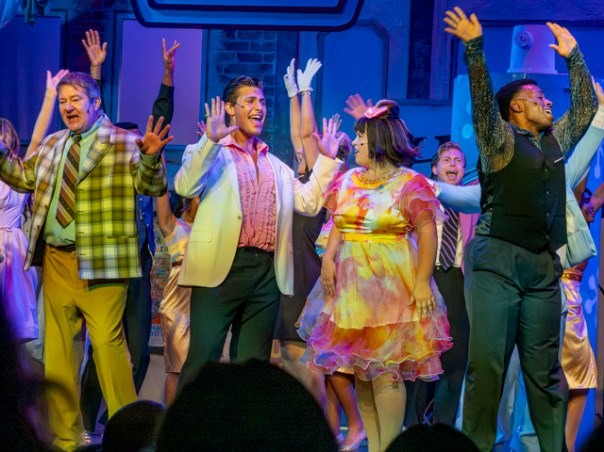
Yet at times, Carroll makes Wilbur cuddly if not diminutive. You may recognize a Buddy Hackett impishness to him in his “You’re Timeless to Me” serenade, before and after Edna warms to it. Apparently, he isn’t Jewish. His best quip, “Shabbat Shalom!” was mangled beyond recognition on opening night, with none of the requisite gusto. OK, Horton does not have the right DNA to make the correction by himself, but where were you, Levine-Chaitman, when we needed you?

On the other hand, we can probably credit L-C for the horrid wigs that crowned the VanTussles’ toxicity, so we can partially commute whatever punishment she deserves for not supplying Carroll with the necessary Hebrew. Keenan Tabor as Velma was far more repellent as Velma when the spotlight was on her for “Miss Baltimore Crabs” in Act 1, but the apple didn’t fall far from the tree when Layne Harder seized center stage for her “Cooties” showpiece. Most of the bug motif that infested the original Waters movie has been fumigated in this Meehan-O’Donnell adaptation. Mercifully so, but Harder’s opportunities to be singularly noxious are curtailed and muted by this cleansing.
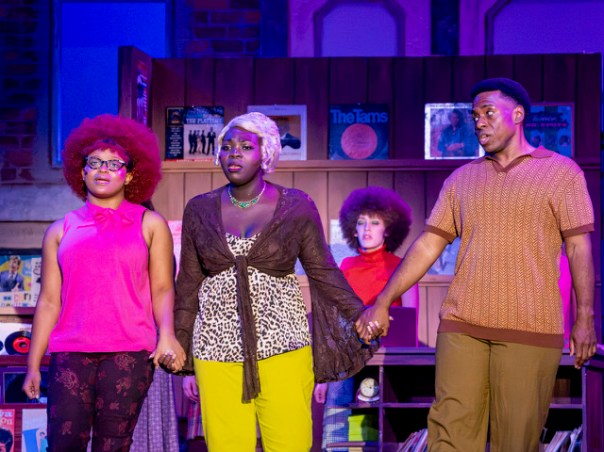
Who to single out among all the other players? Todd Burnette as Seeweed Stubbs was likely the coolest, hippest sight on stage, and Eve Monroe as Little Inez – the standout WZZT auditioner spurned for her race – also springs instantly to mind. As Tracy’s best friend, Penny Pingleton, Corinn Bordelon doesn’t gush over Burnette as Cosper does over Poulsen, but she’s ready enough for love in her shy way. In the breakout double-duet, “Without Love,” where both of the young couples exult over their newfound bliss, it’s a shame that the volume of the eight-piece band, so zestfully led by Ellen Robison, threatened to drown out Bordelon’s most hilarious lyric.

That budding romance Waters filmed in the late 80s wasn’t quite daring enough to say, “now I’ve tasted chocolate and I’m never going back.” So our journey back to the twist and shout and the Madison of the 60s has a sprinkling of the new millennium. Change is good.

Vox Populi Deafeningly Lauds “Little Shop” at The Barn

Review: Little Shop of Horrors at Theatre Charlotte

By Perry Tannenbaum

Sunny, frolicsome, dark, and bizarre: it’s tough to say whether the best landing spot for Little Shop of Horrors is during the spring, that fragrant time of flowering hope and romance, or the fall, that decaying season of colorful rot and the macabre. All of the Metrolina theatre companies and colleges that have taken us back to Skid Row this century have chosen one of those two seasons for reprising Howard Ashman’s 1982 adaptation of Roger Corman’s cult comedy flick.

The tally among executive directors, department heads, and boards has been decisively autumnal. Judging by the full house on opening night last week at Theatre Charlotte, which previously staged Little Shop in the spring of 2008, I’d say that the movers and shakers at the Queens Road Barn have seen the light and aligned with the popular vote.

No other explanation for the robust turnout – or the rabid response – springs to mind. There was nothing novel or pricey about TC’s prepublicity, unless Facebook and Instagram are suddenly breakthroughs. Nor is name recognition a factor when you consider the director, the lead couple, or the choreographer.

Only if they knew that Kevin Roberge would be can’t-miss as Mr. Mushnik, owner of a perishing Skid Row flower shop – or that real-life dentist Nehemiah Lawson would be don’t-miss as sadistic dentist Orin – would people be flocking to Queens Road with raised expectations. And if you hadn’t seen their award-winning collaboration in Next to Normal down at Fort Mill Community Playhouse two years ago, you wouldn’t know if it was director Scott Albert who chose Peter Liuzzo as his preternaturally nebishy Seymour or the other way around.

Sometimes you need to listen to the vox populi, and sometimes you must try to blot it out. For me on opening night of Little Shop, it was both. My Apple Watch faithfully notifies me the next morning when sound pressure levels reach or exceed 95dB at concerts, musicals, or plays attended the night before. If the noise tops 100dB, the usual number of notices is one to three.

Little Shop smashed that norm, hitting or exceeding the 100dB bar 14 times, and topping out at an astonishing 115dB. I could see it coming when Liuzzo and Gabriella Gonzalez as Audrey, his newly-won sweetheart, merged their voices in the climactic “Suddenly Seymour.” Three doo-wop vocalists emerged from a tenement apartment door, adding glitz, glamour, and sensuality to the spectacle: Olivia Greene as Ronnette, Tia Robbins as Crystal, and Jessica Milner, a trio of rookies.

Then as Seymour and Audrey responded to each other, Liuzzo dug out his coming-into-manhood voice and began belting wildly. Not to be upstaged, Gonzalez, previously confined to the sugary “Somewhere That’s Green,” let loose with her piercing pipes.

When something is this sensational in a community theatre production, I often find myself weeping or sobbing. This time, my instincts had me clamping my hands over my ears in self-defense. Didn’t do much good.

Tinted by J.P. Woody’s groovy lighting, scenic design by Gordon Olson revels in the squalor of the skids with a doo-wop funk and loving detail that reminded me of Mad Magazine comic strips devoured in my youth. The era is the prehistoric ‘50s, when teens toted transistor radios to stay in touch with the Top 40, and Alan Menken’s musical score reveres those vibes as if they are gospel.

From Seymour’s nerdy sweater vest to Orin’s biker black jacket, Rachel Engstrom’s costume designs are also onboard with the ‘50s beat, with such an outrageous variety of looks for the vocal trio that you can look at them as district goddesses. Props, including a mini press camera and various-sized potted Audrey 2’s that double as puppets, are also a treat from Lea Harkins – plus Orin’s diabolical dentist’s drill.

Besides getting the right moves from his talented cast alongside choreographer Georgie DeCosmo, Albert’s stage direction fosters all kinds of synergies that pave the way for Audrey 2 to have the sleek looks of a garish concept sports car and the voice of a rabid boar. Named after his idolized co-worker, Audrey 2, the carnivorous plant that Seymour suddenly discovers during a total eclipse of the sun, has a special cunning, speaking only to Seymour to get his way.

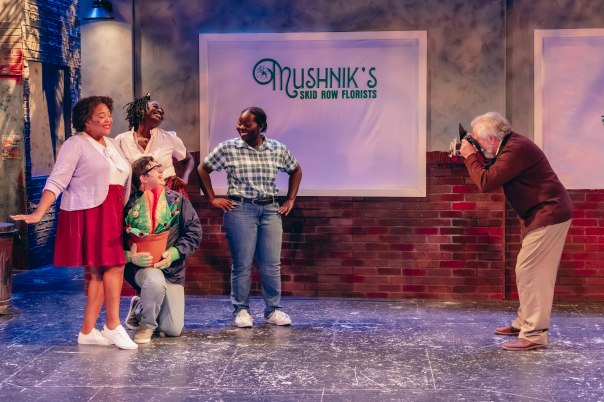
The voice comes lustily from Toni “Aideem” Morrison, and the movements of her leaves and tendrils come mostly from a team of three unseen puppeteers. When the side wall of Mushnik’s Skid Row Florists slides shut to hide the store, a beehive of activity with puppeteers and stagehands is dressing the interior more and more lushly with Audrey 2’s foliage as the bloodthirsty monster grows.

By the end of opening night, that side wall had been dinged with cracks and bruises, and one stagehand, in damage-control mode, was seen frantically exiting at the end of a scene change. The tech perfection extended similarly to the sound: just one brief dropout assailed Gonzalez, and that’s all. Every note from the four-piece band led by Ellen Robison from the keyboard came through undimmed.

Except when the audience broke loose.

Aside from the original Audrey, none of the main characters is burnished with virtue. Seymour’s origins, though not otherworldly, are no less mysterious than Audrey 2’s, orphaned at the flower shop’s doorstep as a babe and living there ever since. His homicidal tendencies, awakened by the arrival of Audrey 2, prove to be benign when he has to pull the trigger.

Munchnik is no less compromised. Although he has opened his door to Seymour, the lad has always slept out front under the cash register. Until he overhears Orin advising Seymour to leave Skid Row with his newfound cash cow, Mushnik never considers adopting the waif or making him his heir. In the hard times, when Mushnik is on the verge of permanently shutting down his shop, there’s not a peep from him that indicates he has given Seymour’s future so much as a thought.

Liuzzo plays his side of this relationship with gratitude, servility, and fear, while Roberge as Mushnik can load up on scorn, exploitation, and intimidation. Nebishy meets nasty. With those considerable hits to Seymour’s self-esteem, Liuzzo’s timidity can extend toward keeping his feelings for Audrey hidden, especially since she is already in Orin’s firm and abusive grasp.

Framed by the threats of an insanely sadistic dentist and a man-eating alien plant with dreams of global domination, the mundane frictions between Seymour and Mushnik can seem comical. But the best comedy contrivance, preserved by Ashman from the Charles Griffith screenplay, is the mutual non-relationship between Seymour and Audrey: both of these sweethearts have good reason to feel unworthy of the other.

It’s pretty classic how clearly Liuzzo and Gonzalez venerate one another before they connect – adding fuel to the explosive audience reaction in Act 2 when they have their “Suddenly Seymour” moment. Roberge coming up on them and taking it all in during an extended smooch is a cherry on top.

Contrasting with all this bliss and twisted domesticity are the crazed, barbecued voices of Lawson and Aideem. Since the days of silent film, dentistry has proudly perched on the knife’s edge between comedy and horror. Thanks to this delicious script, Lawson gets to sharpen that blade more keenly by adding masochism. Not to worry, after Orin nourishes Audrey 2 piecemeal, Lawson returns after intermission in a series of cameos to entice Seymour with additional money-making opportunities.

Yet it’s Aideem who endures forever as Audrey 2, aided by a wonderful tech flourish in the epilogue. His bubbly vibrato is not the deepest I’ve heard out of Audrey 2’s maw, but it’s more than sufficiently low, spirited, and spicy. Aideem’s performance will likely draw another noise notification if you’re wearing an Apple Watch. The final bows certainly will.

“Next to Normal” Is Alive at the Barn!

Review: Next to Normal at Theatre Charlotte

By Perry Tannenbaum

July 4, December 7, September 11, and October 7 are all dates we remember for their historic meaning to the nation and the world. A similar earthshaking significance can descend on a single day in the life of a relationship, a marriage, or a family that can reverberate for generations – whether you were at the event or even alive at the time.

That’s essentially what we’re watching in Brian Yorkey’s Next to Normal with music by Tom Kitt, winner of the Pulitzer Prize for Drama in 2010 after winning Tony Awards for Best Musical, Best Book, and Best Orchestrations the previous year. Instead of doing things the traditional way, setting up the location and the situation in a big opening number that stages or recaps the prime catastrophe, Yorkey fast-forwards us more than 17 years, when the original hurt in the Goodman family has marinated and metastasized – a fissionable maelstrom that will soon explode.

With a fresh set of seismic events.

Diana is at the vortex of the mushrooming crises, so it’s both interesting and wickedly deceptive that Yorkey brings us into her drugged and delusional mind for much of the opening action. We still see the basic outlines of the family turmoil clearly enough. Her husband, Dan, keeps trying to go with the flow of Diana’s bi-polar mood swings. She navigates a series of therapists, looking for either a therapeutic epiphany or the perfectly calibrated cocktail of meds.

Meanwhile, Diana’s teen daughter Natalie feels neglected and unappreciated, living in the shadow of Mom’s obsessive devotion to her older brother Gabe. Warily, Natalie navigates her self-worth issues as schoolmate Henry tries to get closer and establish a relationship. When Natalie overcomes her shame and allows Henry, after much hesitation, to meet her family, we seem to have arrived at a breakthrough.

It’s a brave move and all goes swimmingly at the Goodman dinner table between Natalie and Henry until Diana walks in with a birthday cake, all smiles, candles lit. Yorkey’s sleight-of-hand has worked so beautifully that we wonder which of the two teens is the target of the birthday surprise. Suddenly things are going downhill – off a high cliff.

Like we’ve been overdosing on the meds so far.

Yorkey is very good at these slow build-ups where we see budding new hopes dashed by a sudden disappointment and fresh Diana relapses. After portraying Dan, the long-suffering husband in Queen City Theatre Company’s fine production in 2013, Billy Ensley takes the reins at Theatre Charlotte’s slightly slicker version. His suffering, grimly stoical, was very different from Johnny Hohenstein’s unfiltered and uncontrolled anguish. It’s easier to breathe at the old Queens Road barn when emotions get a space to release.

On the other hand, the Broadway edition starring Alice Ripley in 2009 (which toured here with Ripley in 2011) took a dimmer, more skeptical view of psychiatry and pharmacology, giving those productions directed by Michael Greif a darker, satirical, mad scientist edge. Around the corner from a cluster of medical centers and hospitals, Josh Webb’s set design on Queens Road is easily the brightest and most antiseptic I’ve seen. The usual two-story scaffolding that adorns rock operas is outfitted with colorful fluorescent lighting, though some flickering occasionally marred the serene pastels (intentionally?) inside the translucent fixtures.

So in transit to Charlotte, the emphasis continues to shift more emphatically away from the quackery to the suffering. Hohenstein’s broadened performance now rivals Melissa Cook’s bipolarity as Diana, for he’s still a domesticated dad to Natalie and a cheerful host to Henry between bouts of stressing and losing it in private and with his wife. In its fits and starts, Hohenstein helps us to balance the toll mental illness takes on its victims and on their loved ones. Easily the best of Hohenstein that I’ve seen and the most intensely consistent performance of the night.

Cook’s performance as Diana is as genuine and riveting as any I’ve seen in Charlotte or on Broadway – except when it isn’t. Whether you call it resistance or retreat, there are whole songs where she is suddenly no longer a cri-de-coeur rock singer and becomes a more traditional Broadway belter: sweeter voice with noticeably less emotion and intelligibility. Suddenly, it isn’t about how sensationally Cook is acting but about the singing, likely more in her comfort zone.

I can’t say for certain that the duality was there from the start, but there should be no turning back after the big birthday reveal.

And the words here are important – I could almost hear Ensley stressing this at rehearsals – for we get the best sound in a musical production, local or touring company, since MJ stormed the Belk last September at the beginning of the season. Kudos to Ensley for his pertinacity and, if there was any acoustic work or equipment upgrades in the mojo, glory to the staffers involved in the push, beginning with artistic director Chris Timmons and managing director Scot P J MacDonald. The old barn is sounding better than ever.

It needed to. In contrast with Spirit Square’s more intimate Duke Energy Theatre, where Glenn Griffin directed Normal, a musical on Queens Road requires ample decibels to reach the back of the house. Keeping with Theatre Charlotte wisdom, music director Ellen Robison trims her rock band to six musicians while placing them behind the singers.

Instinctively, Ensley finds a perfect pathway for his cast to turn up the volume. As if inspired by grand opera, he dials up the melodrama past suburban proportions so that most of the characters are wearing their hearts on their sleeves. Craig Allen as Drs. Madden and Fine, allows himself to be callous and ghoulish for the blink of an eye when the script absolutely demands it. Otherwise, he is the throbbing soul of earnest concern – moonlighting as a rock star in Diana’s delusions.

As Natalie, the only lonely daughter, I found Cornelia Barnwell to be more shut-down and compulsive than Abby Corrigan was on her express route to stardom in 2013. Barnwell’s voice is purest rock, piercing as a poignard with no blade. She seems to be the studious type in her scenes at school or alone with Henry. But she can flip and go rogue as soon as she sings. Very appropriate for Natalie, so anti-meds at the beginning because she has seen the wreck of her mom – before following in her footsteps. At the same upstairs medicine cabinet.

If a stoner-slacker can be seen as an oasis of calm, then that’s how Zach Linick will appear as Henry, faithfully devoted, non-judgmental, discreetly giving Natalie her space. There aren’t too many laugh-out-loud moments on this bumpy road to tentative stability, but when Natalie, resistant at first to Henry’s weed, leapfrogs him into wanton pill popping, Linick’s reaction bears watching.

Melodramatic or not, Ensley’s read on Next to Normal is more in tune with our chaotic times than the 2013 original, when Yorkey likely turned to the mad laboratory aspects of pharmacology and electroshock therapy to provide a counterweight to the suffering and gloom. Everybody is wronged here as if the world were all MAGA malcontents, but the uplift and electricity of Kitt’s score have always been there to supply lightning, spirit, and zest. Ensley relies on Robison’s band to deliver and their chemistry with all the suffering Goodmans is fire.

It’s especially white-hot in the stunning performance of Joey Rising as the disembodied Gabe. What a wonderful nuisance he is, impervious to all who ignore him! Over and over, he quashes the best hopes of his mom and dad, and he’s hardly less devastating to our own. If you find it hard to imagine a mad-scientist horror movie strain in this musical, the chill of hearing Rising’s defiant, jubilant “I’m Alive” will convince you that Yorkey believes devoutly in melodrama after all.

We in audience become like the frenzied villagers in Frankenstein, collectively yearning for Gabe’s destruction while wondering at Rising’s fire. But after he beats a full retreat, he returns, fierier than before. And then he multiplies!