Review: A Raisin in the Sun at Matthews Playhouse
By Perry Tannenbaum
Did somebody just say something about FREE SPEECH?? Yeah, about a billion times per second if you’re tracking social media, college campuses, nation’s capitals, and late night TV. Still no theatre critic we know would dare suggest in today’s torrid media climate that the subject generates too much heat and too little light – or that babble about free speech serves as a black hole for time and breath better spent discussing other freedoms.
Addressing the US Congress in 1941, Franklin Delano Roosevelt looked forward to “a world founded on four essential freedoms.” Useful, breathtaking, and a better way to spend January 6 than a subsequent US President chose. When I was graduating junior high more than a half century ago, those four freedoms were still on the curriculum, and my entire class wrote essays about them.
For the record, I wrote about FDR’s Freedom #4, Freedom from Fear.
One of the things we love about Afro-American literature is that their writers show us that freedoms worth prizing are as numerous as personalities – that those dearest to us are an uphill struggle to achieve. In Lorraine Hansberry’s A Raisin in the Sun, returning to the Metrolina area for at least the sixth time this century, every member of the Younger family knows the struggle from the moment they rise in the morning.
Now some of these struggles are fairly picayune, giving a homey warmth to Hansberry’s various yearnings for freedom that we easily empathize with. Take little Travis (Solomon Doleman), for instance, yawning himself awake with his mom’s help for another school day. The youngest Younger doesn’t have a room or a bed of his own, sleeping right before our eyes on the living room couch as the lights go up.
Hell, he doesn’t even have a regular bedtime, since we’ll soon learn that he cannot claim his place on the couch until Dad has finished scheming and schmoozing with his ambitious pals. Walter Lee and his son Travis may both be sleep deprived due to the drinking and scheming of the previous evening, but their first challenge of the day requires teamwork.
Otherwise, they won’t be able to visit the toilet or groom themselves for the day. As if out in the wild, the family must post a lookout on the hallway, so that they can seize control of the single bathroom that serves multiple families in their Chicago tenement. Then this treasured privacy must be passed along to another member of the clan. Yes, it’s a bit comical to watch so much family tension generated over so little. Yet this is part of the layout of the Youngers’ survival.
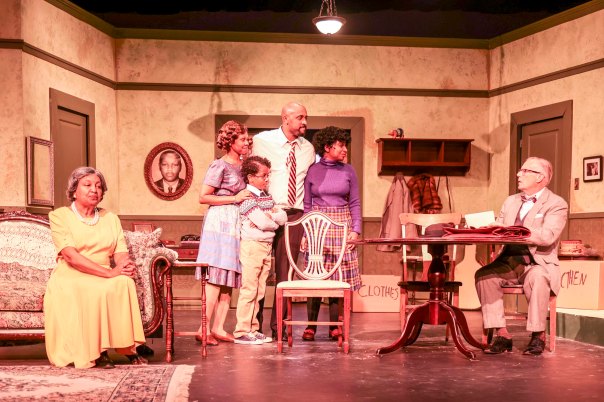
FDR’s Freedom #2, Freedom from Want, is also in the foreground as the Youngers’ successful capture of the bathroom plays out as a backbeat in opening scene. Looking at the Youngers’ apartment for the first time at Matthews Playhouse, we find that director Corlis Hayes and set designer Bob Croghan have pulled back a little in rendering the wear and weariness we should be seeing if Hansberry’s description of the kitchen-dining-living room were followed to the letter. “Cracking walls”? Didn’t see them.
Throughout the evening, there’s a similar shift away from the groaning and wailing tones you might remember from the last time you saw Raisin. That suffering patina has been natural for Raisin since it premiered as the first drama by an African-American female playwright to reach Broadway in 1959. The weight of ancestors hung in the Ethel Barrymore Theatre on opening night, and the fate of the race seemed tethered to the audience’s response.
Likely, at the tender age of 29, Hansberry didn’t view her rise to prominence with such solemnity. The heritage of her family and its struggles, including her father’s fight against a restrictive Chicago housing covenant, are in the annals of the Supreme Court and resulted in a Hansberry v. Lee victory in 1940. As seething, cautionary, and defiant as Raisin often seems, we can look at all the Youngers and see them as positive, determined, and aspirational.
Her banner is Langston Hughes’s 1951 poem, “Harlem,” and its main subject, “a dream deferred.” Hughes offers half a dozen prognostications of what might happen to it. Next to sugaring over, drying like a raisin would seem to be the most benign outcome.
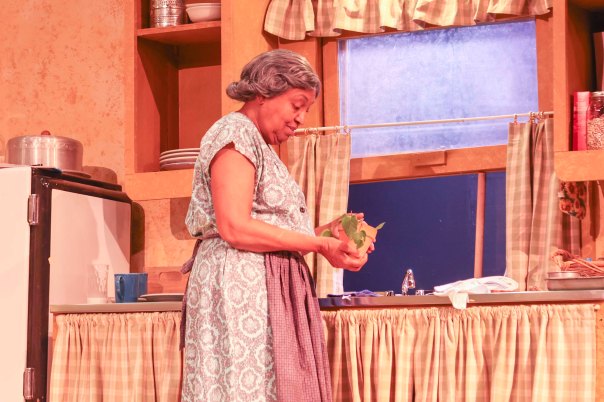
Walter Lee’s dream of opening a liquor shop can hardly be deferred for more than a day, when his mama Lena expects a $10,000 check from his late father’s life insurance. Before he even has his necktie on properly, Walter Lee is lobbying his wife Ruth to soften Lena up so he can calmly present his business plan to his god-fearing mama. Ruth has other concerns: on the surface, it’s feeding her guys breakfast and getting them out the door.
Deeper, and still hidden from everyone else, Ruth is also considering the future of her family from her perspective as a mother.
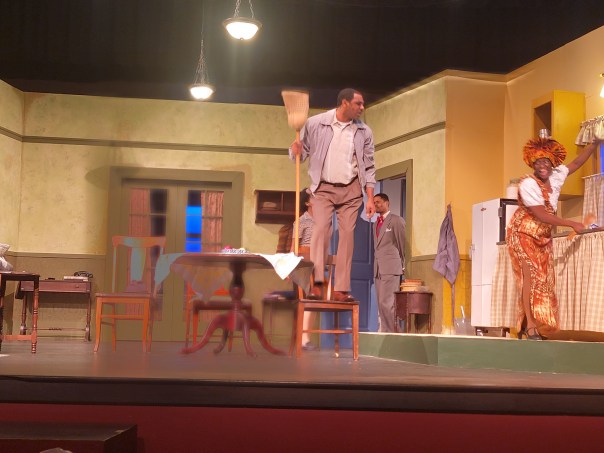
Ruth’s worries and dreams do not align with her husband’s at all – aside from wishing him success. Two other dreams vie for priority in the family. The comparatively breezy Beneatha wants to go to medical school. But not right now. First, Walter Lee’s younger sister wants to start guitar lessons. Or to see what new revelations from Africa come her way from her new Nigerian acquaintance, Joseph Asagai, who clearly aspires to supplant Beneatha’s current beau, the starchy and monied George Murchison.
But the $10,000 check will be in Lena’s name, so what does she want? Here the BNS Productions’ dingy set is absolutely true to Hansberry’s spirit, for Croghan only provides a sliver of a window to allow any light in from the outdoors. It’s barely enough for Lena’s scraggly little houseplant, propped up with wee splints, to survive. Hardly big enough for more than a couple of Youngers to gaze out at the street.
Lena isthe Younger who cherishes the dream of Carl Augustus Hansberry, the playwright’s father, to live in a house that can accommodate all her family – along with a little plot for her to maybe grow a garden. If the best value for her money happens to be in Clybourne Park, a whites-only subdivision, fine: her family will certainly not trouble anyone else’s.
Such a rock! Yet Lily Oden plays Lena with a maternal softness, speaking her mind clearly, but never thundering like a prophet on a mountaintop. She does come off as old-fashioned in her confrontation with the godless Beneatha. The slap is still there, life-sized rather than the hand of God. While it may serve to compromise her moral authority, it emphasizes the intensity of her dream, coloring it with a determination to somehow repair and unify her crumbling family.
Along the way, we can feel that Oden has her recognizing that slapping and bullying aren’t always the best paths. That’s especially true in this Playhouse version where BNS mainstay Jonavan Adams is Walter. The way Adams gazes out at us as he articulates his dreams is a bit drier and wearier than most Walters we’ve seen, needing less of a gap to close before shedding his supplicating impulses and coming into manhood.
It appears as if he may let us down in the crunch, but Hayes gives him a life raft at a key moment in his planned capitulation to the white homeowners’ representative: a portrait of Walter’s father, “Big Walter,” hanging on an upstage wall. We see this – and Lena’s insistence that Travis remain in the room – working on Adams at his tipping point.
Unless you’ve seen Renee Welsh-Noel and her wackier exploits at Children’s Theatre of Charlotte, you might not fully appreciate all the nuance and texture she brings to Ruth and her strained position among the Youngers. She’s the bad cop tasked with prodding the menfolk awake, getting them fed, and off to work and school on time… the responsible parent who must deny Travis his 50¢ for school because the family can’t afford it.
Over and over, she is overruled by Walter and Lena, who can point proudly to Beneatha as the outcome of their spoiling. It’s almost as if Ruth doesn’t have aspirations anymore – until the breaking point when her yearnings and her resolve gush forth.
About the only flaw I found in the Regal cast (a second, overlapping Grove cast takes on all the morning and afternoon performances) was K. Alana Jones’s portrayal of Beneatha. I like how Jones plays and exploits the two men who are dating B, and the relationship with Walter is pitch-perfect. But Jones doesn’t seem to get how brainy and rad Beneatha is for a Southside Chicago co-ed in the ‘50s – or how full of herself and entitled she feels as such a progressive try-everything visionary.

The boyfriends for this BNS-Matthews Playhouse production are exactly as you remember them. Sha’Heed J. Brooks is delightfully starchy as George, the snobbish plutocrat who looks down upon Beneatha’s kin, particularly Walter, to his peril. By contrast, Dionte Darko as Asagai wonderfully captures both the exotic and the naïve aspects of the foreign exchange student. Yet with a worldly urbanity mixed with ancient wisdom, Asagai can effortlessly put Beneatha on the defensive.
With brisk pacing – and maybe some deft cutting – the production speeds by, the three original acts performed with one intermission. Yet Hayes somehow squeezes in the visit from the Youngers’ neighbor, Mrs. Johnson, whose scene and character has been dropped from every Raisin production to reach Broadway, including the revivals that featured Phylicia Rashad in 2004 and, ten years later, Denzel Washington.

Ericka Ross is quite obnoxious and brassy as Johnson, chiding Lena for buying into a white neighborhood and forecasting doom, even if she won’t convince everyone that the scene should stick. Bobby Tyson as Bobo and Henk Bouhuys as Karl Linder stand on firmer ground – and draw more dramatic assignments.
Nattily dressed in one of costume designer Emily McCurdy’s most stylish creations, Tyson is the only person during the whole liquor store scheme who doesn’t merely phone in. He has the guts to come by and deliver the bad news to his crony in person … and the moxie to show his irritation when Walter doesn’t immediately grasp how thoroughly they’ve both been screwed.
You’ll notice an awkward exit or two from guests at the Younger abode but none more heated or satisfying than the retreats of Mr. Linder, the Clybourne Park emissary. Bouhuys endows him with all the patronizing pomposity you might expect from an upper level Wells Fargo executive. Hayes strips Linder’s scenes of the buffoonery we may remember in past productions, where it might have seemed proper to boo and hiss his every word.
Bouhuys doesn’t bumble, but he does seem doubly non-plussed. He really cannot grasp why the Youngers won’t defer their dream any further when faced with the absurdity of moving into a neighborhood where they are not wanted – so not wanted that community has banded together to buy them out. Don’t they understand the arithmetic? By accepting Clybourne Park’s offer they could make a profit!
Or at least they could negotiate. Who are these maniacs that refuse to cash in?
What’s often overlooked in the onrush of the great Raisin in the Sun climax is how pivotal Walter Lee’s most humiliating moments are in triggering his turnaround. Yes, he stoops to Stepin Fetchit minstrelsy in furiously declaring his determination to ask Linder back and accept his offer, rightfully drawing Beneatha’s disgust. But Adams shows us that Walter has also seen the spectacle he has made of himself.


