All posts by perryt77

Miller’s “Crucible” Roars Its Power at CP

Final Dress Rehearsal for The Crucible; Pearse Auditorium, October 26th, 2017

Review: The Crucible

By Perry Tannenbaum

Powerful men abound in the annals of drama, but few can vie with the formidability of Deputy-Governor Danforth in Arthur Miller’s The Crucible. Reminding the petitioning Francis Nurse just exactly whom he’s dealing with, he can honestly claim to have jailed nearly 400 people in various towns across Massachusetts with his signature – and sent 72 to the gallows with that many strokes of his pen.

“We burn a hot fire here,” he warns soon-to-be martyred John Proctor. “It melts down all concealment.”

If those declarations sound to you like they should be spoken softly, you are not reading them the way stage director Tom Hollis did for the current CPCC Theatre production at Pease Auditorium. Panoramic Pease is a challenging place acoustically, often frustrating audience members, especially the elderly, who chance to be seated in one of the side sections, trying to hear what actors are saying at the other end of the stage.

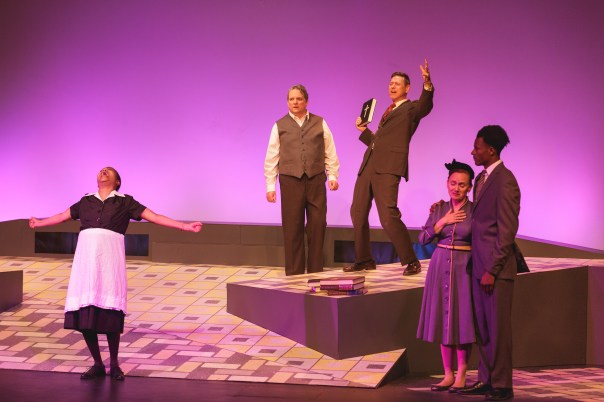
Anybody who has been reluctant to go to Pease, or stayed away because of that frustration is now encouraged to come back. There has never been such a roaring production at Pease – or anywhere else on the CPCC campus. It would be misleading to say that it begins with Tim Huffman, who gives a fearsome account of the Dep Governor in the climactic scene at the Salem Meeting House, ground zero of the infamous Salem Witch Trials. He doesn’t appear in the drama until the second scene after intermission, or Act 3 in the original script.

Final Dress Rehearsal for The Crucible; Pearse Auditorium, October 26th, 2017

We don’t hear anything about the full extent of Danforth’s rampage until he announces it himself, but the steady roar of the panicked citizens of Salem – and the shrieks of the pubescent girls who incredibly become their accusers – testify to the hysteria that has gripped the whole colony. Reverend Samuel Parris intrudes upon his servant Tituba leading a pagan moonlight ritual, with his daughter Betty and his niece Abigail Williams among her acolytes, in a marvelously creepy scene that Miller added to his 1953 script for his 1996 screenplay.

The secret of how that cinematic lagniappe was converted to stage may be locked in a local recipe, since the brief prologue isn’t referenced in the playbill’s rundown of the scenes. When we cut to the original opening scene in an upstairs bedroom of the Reverend’s home, Parris is huddled over the seemingly comatose Betty who will not waken since returning from her midnight revels. As great as Parris’s fears may be for his daughter’s life, his greatest fear is that the word “witchcraft” might be whispered around town about members of his family. His career is at stake.

The fear flips Reverend Parris from his initial condemnation of Betty and Abigail to becoming their staunchest supporter no matter how outrageously they overreach in their reign of terror. Cole Long may be giving us the most chilling performance here as Parris for he is never in the least soft-spoken. This rabid weasel speaks in a passionate, panicky squeal that threatens to shatter glass, most heinously in his waspish attacks upon John Proctor. Long’s high-voltage intemperance makes it easy for Huffman to become mightily annoyed with his zeal.

Final Dress Rehearsal for The Crucible; Pearse Auditorium, October 26th, 2017

Hollis also finds strong – yet sweet – voices for the two most important accusers: Sarah Clifford is the implacably wicked and wanton Abigail, and Ashley Gildersleeve is the ambivalent Mary Warren, the witness Proctor enlists to debunk Abigail’s masquerade. Interestingly, Mary is Abigail’s successor in the Proctor household, hired after Abigail was told to hit the road when she had committed adultery with a now-penitent John.

Clifford gives us a shameless and forceful Abigail. Hollis is wise to include the nocturnal confrontation between Abigail and Proctor, written by Miller for the stage shortly after the original Broadway production, for it reveals Clifford’s full range. Switches between Abigail’s vamping, seductive mode to her imperious affirmations of divine judicial authority can be played so abruptly that the wench can seem to have an insanely split personality. But Hollis and Clifford find the bridge between the two Aby’s in her arrogant self-confidence – she obviously has no doubt that John will ultimately succumb to her charms.

Final Dress Rehearsal for The Crucible; Pearse Auditorium, October 26th, 2017

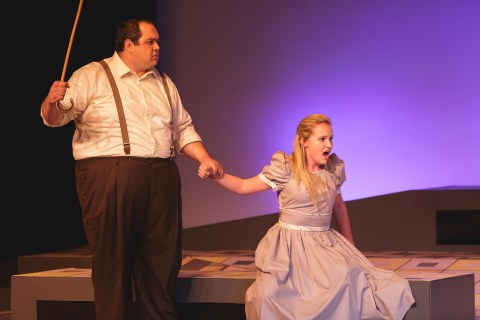
Gildersleeve proves to us that Mary is also quite a powerful role, pulled ferociously hard in opposite directions by John and Abigail, pivotal in the outcome of the climactic court scene. Hollis is going against the usual impulse to cast Mary as a diminutive mouse who will cower in the proximity of the domineering Abigail. Making her more substantial magnifies the power of both adversaries who tug at her, and Hollis – not withstanding today’s political correctness – does not gloss over John’s abusiveness toward his servant.

The biggest payoff with Gildersleeve is how taut the tension can become before Mary makes her fatal choice. We can see that she isn’t going to break easily. When inevitability sets in, the chaos that breaks out in Danforth’s court is as alarming as you’ll ever see, like a vast cauldron coming to a boil and overflowing.

Nothing less can bring Josh Logsdon down in his hulking, near-Promethean performance as Proctor. There are few mild-mannered moments in his tragic odyssey toward the gallows. If, as he claims, he has walked tiptoe around his own home since his great sin, Logsdon certainly turns the corner when John confronts Elizabeth, raging and roaring at her like a tyrant before her unexpected arrest. Then he turns on the gendarmes with leonine fury as they take her into custody. Then on the quailing Mary, who has brought the incriminating poppet to his house from Salem.

Final Dress Rehearsal for The Crucible; Pearse Auditorium, October 26th, 2017

Torn between taking advantage of Abigail’s affection and risking her fury, Logsdon is comparatively becalmed in their forest scene, but he’s only truly temperate in the presence of the Dep Governor when Elizabeth’s fate hangs in the balance. Even then, we see him as a powder keg, ready to explode in a heartbeat.

The Gothic aspects of such sulfurous action are somewhat muted by the raked and abstract set design by Beth Aderhold and costume designer Jason Estrada’s execution of what could have been Hollis’s most daring concept – transporting the 1692 atrocities to the McCarthy Era 1950s when Miller’s tragedy premiered. But the concept gathers little further momentum. We find no TV in the Proctor home that could be tuned to the HUA or Army-McCarthy hearings, and no projections on the blank upstage wall from contemporary newspapers heralding the anti-Commie hysteria that Miller was obliquely targeting.

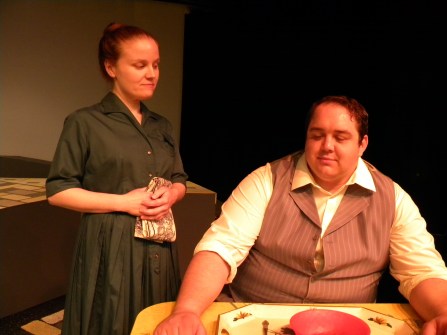
It’s Caryn Crye who unexpectedly brought me the strongest flashback to the 50s as Elizabeth. Again and again, Crye’s quietly assertive and judgmental portrayal evoked the Emmy Award-winning Audrey Meadows in her iconic role as Alice Kramden on The Honeymooners (1952-57). This is a cold and grudging Elizabeth who knows a woman’s place yet never backs down. She comes to see her own failings and their causes in the poignant final dialogue with John. Yet when we hear her last words, it’s hard to discard the notion that nothing less John’s march to the gallows could convince her of his complete atonement for his infidelity.
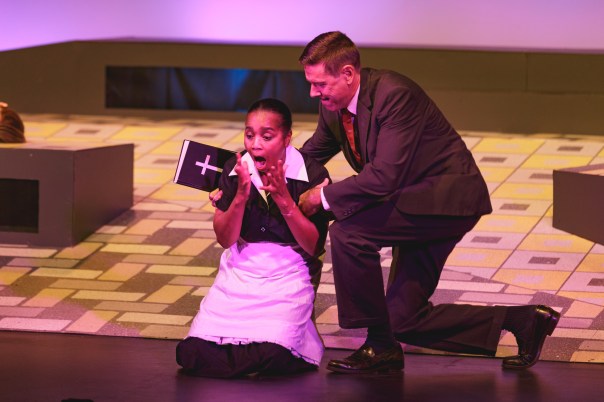
The depth and power of the CP cast helps to shine new light on Miller’s lesser characters. Giles Corey usually comes off as a contentious, litigious, and ultimately harmless old fool, but Tom Ollis – among the loudest actors we have – bellows him to a different place, now fully consistent with the defiant eulogy Elizabeth gives him. Reverend John Hale is also prone to trivializing, apt to be portrayed as a naïve student who needs the books he carries to substantiate his witch-sleuthing credentials.

Tony Wright plops those books down in the Parris bedroom as if he has read and absorbed very word, needing them merely to double-check his vast erudition and point out chapter and verse to the common folk who have hired him. Most Hales seem to be windblown by the dizzying events in Salem, but Wright’s is open-minded and discerning, ultimately bewildered by the insanity that surrounds him, still grasping and feeling the tragedy as deeply anyone.

Final Dress Rehearsal for The Crucible; Pearse Auditorium, October 26th, 2017

My only disappointment was Corlis Hayes, who starts off so spectacularly in her second pass at Tituba at CP, where she also excelled in 2001. Abetted by James Duke’s lighting design and Marilyn Carter’s movement coaching, she’s an object of terror in the opening blood ritual. She “lays low” obsequiously enough, if I might be permitted an Uncle Remus allusion, as cries of witchcraft pursue her like the Eumenides. Hayes breaks so pitifully under the merest pressure that it’s almost comical.

Ah, but when she reaches the prison – the first to be branded a witch – Hayes mangles the words of Rev. Parris’s hapless servant so badly that they are unintelligible. That’s a shame, because Tituba has the freshest, wittiest, big-picture perspective on the whole Puritan catastrophe.

“Devil, him be pleasure-man in Barbados, him be singin’ and dancin’ in Barbados. It’s you folks – you riles him up ‘round here; it be too cold ‘round here for that Old Boy.”

Those who profess to fear and loathe Satan come to rule in 1692 Salem – zealots, scoundrels, and a pack of screaming she-wolves led by a vengeful, slatternly she-devil – wreaking havoc that even Satan might marvel at. Miller wrote The Crucible in 1952 to show postwar Americans that history can repeat itself, destroying us from within. Miller’s message still resonates in post-2016 America, and CP is serving it up scorching hot at maximum volume.

Classics Collide!!

Preview:  The Grapes of Wrath and The Crucible

By Perry Tannenbaum

We can’t explain this curious phenomenon, but the Queen City’s performing arts companies seem to have outgrown their customary October fixations with vampires and spooks. Instead, this coming Halloween weekend, if not entirely witch-free, will be more haunted by a swarm of classics.

After gorging on the full score of Harry Potter and the Sorcerer’s Stone last weekend, Charlotte Symphony returns to Belk Theater on a strict diet of Mozart & Beethoven. As a spectacular Mary Poppins finishes its run on the east side of ImaginOn, Children’s Theatre of Charlotte slips Ezra Jack Keats’s The Snowy Day and Other Stories into the west.

Saturnalia Central will be located at Central Piedmont Community College, where CPCC Theatre presents The Crucible, Arthur Miller’s weaponizing of the Salem Witch Trials to take aim at the infamous anti-Communist witch-hunts led by Senator Joseph McCarthy in the 1950s. Counting the Robert Ward adaptation produced by Opera Carolina, we’ve had at least five opportunities to view this classic in the Metrolina area since 1998.

Another Tony Award winner has had to wait longer than that for its first run here. Frank Galati adapted and directed John Steinbeck’s epic Depression Era novel, The Grapes of Wrath, winning the 1990 Tony less than three months after its Broadway opening. To all those theatre lovers wondering over the past 27+ years when this classic would finally reach us, Theatre Charlotte is answering: now’s the time.

Steinbeck’s biblical exodus begins in the Dust Bowl during the Depression Era, focusing on one family of dispossessed Oklahoma farmers, the Joads, as they journey to California in search of jobs – and their lost dignity. What the Okies find at the end of their journey isn’t a Promised Land at all. Joining a severely overpopulated workforce, they’re plunged into a sun-kissed cesspool of migrant worker exploitation.

The sheer size of the story, in geography and humanity, is a prime reason why it took so long before the 1939 Pulitzer Prize winner was adapted for the stage – and for the additional delay before a local theatre company brought it here. Galati’s Broadway edition had a cast of 31 playing 45 roles, and that’s not counting the seven musicians on hand to play Mike Smith’s original incidental music.

Theatre Charlotte executive director Ron Law, taking over the creative reins for this production, is taking a simplifying approach, reducing his cast to a mere 23. Running the first local company to pick up the gauntlet on producing this behemoth, he can empathize with those that haven’t.

“The cast is large, which means a bigger costume budget,” Law points out. “If you are paying actors, that makes for a big salary line. There are also some very violent scenes in the play that really require a certified fight choreographer. The play calls for a river, campfires, a grave and a truck. Our space is very limited – virtually no wing space, no traps, no fly system. I truly favor minimalism in theatre, focusing on narrative and characters. But sometimes minimalism is not really all that simple.”

With so many roles, Charlotte’s community also had to worry about who would sign up. Decreasing the cast creates more multiple roles to keep the volunteers busy, and Law was pleased to be able to fill nearly half of his cast list with local theatre vets, including Vic Sayegh, Annette Gill and Paula Baldwin.

Gill and Baldwin have similar pedigrees at the Queens Road barn, playing Linda Loman in the two most recent revivals of Death of a Salesman in 1998 and 2009. Baldwin, the more recent Linda, has also aced auditions at a variety of local companies for prominent – and powerful – roles in Three Tall Women, August: Osage County, The Actress, and Who’s Afraid of Virginia Woolf?

Baldwin chafes against the notion that Ma Joad, her role in The Grapes, is a softie by comparison.

“She fulfills her role as the Mother who nurtures, cooks and cleans,” she admits, “but Pa comes to her for her opinion and follows it even when he, at first, doesn’t agree with her. She is truly the backbone of the family. When the men start to falter and give up, she continues to be positive and strong. Ma has several wonderful monologues, and one of my favorites is when Pa has all but given up and she tells him that life for a woman is ‘all one flow, like a stream, little eddies, little waterfalls, but the river, it goes right on.’”

Vilified by bankers and landowners for his workingman sympathies, scorned by literary critics who preferred the apolitical beauties of Hemingway, Faulkner, and Fitzgerald, the sun began to set on Steinbeck’s reputation and continued to decline after he won the Nobel Prize in 1962. The socialist label, not a problem in Europe, hampered him here.

So let’s look around and see the political reasons why the time may be ripe for The Grapes. An avowed socialist nearly captured the presidential nomination of one of our major parties, and the shadows of fascism and demagoguery hang over our land as heavily as they did when Steinbeck published his masterwork.

Baldwin and Law both cite the sowing of divisions and the widening chasm between the haves and have-nots as reasons why the Joads’ odyssey still resonates today.

“The question then seems to be the same as today,” says Baldwin. “What price are we willing to pay to affect change? Is America truly a land of opportunity for all?”

In the 2007 production of The Crucible at Theatre Charlotte, director Matt Cosper dipped into the screenplay that Miller had written for the 1996 film, freshening the version that had previously run on Queens Road in 1988. Tom Hollis, chairman of the CPCC Drama Department, has settled on an even more daring way to give the old classic a new look.

Directing at Pease Auditorium, Hollis is transposing the 1692 Salem Witch Trials to 1952, when the Miller script was released, while preserving the antique Puritan dialect that the playwright invented for his historical characters. From what we’re told about the impact Hollis hopes to achieve in juxtaposing Salem’s infamous trials and Sen. McCarthy’s infamous Senate hearings, we could possibly see a trace of Sen. Joe or his nemesis, Joseph Welch. Maybe some video cameos?

“The naming of names and the accuser being somehow sacrosanct has been an age-old issue in human affairs,” Hollis observes. “The hysteria of the Salem Witch Trials and the 50’s Communist hunts all echo with the proliferation of ‘fake news’ today. Did not Orwell predict that the shouting of a lie loud enough and long enough will make it true? The inability of many to separate belief from objective reality is more disturbing today than ever.”

After a couple of memorable performances in 1776 and Ragtime last season, Josh Logsdon gets an even meatier role as Miller’s martyr, John Proctor, in his first non-musical foray at CP. He is tempted and traduced by the adulterous Abigail Williams while further tortured and frustrated by his unforgiving wife, Elizabeth – tasked with finding his authentic self while living in a sexist world.

“The text does paint him as domineering and harsh at times when arguing with Elizabeth,” Logsdon says. “But I try to draw on more of his softness with both Abi and Elizabeth. His relationship with Elizabeth transitions from one of resentment and more pain to a reclaimed love and a final peace. He has a softness to Abigail as much as he denies it, but he eventually sees that she’s willing to destroy everything and everyone to have what she wants, and he’s definitely horrified by it.”

Not quite a vampire, but chillingly close – and certainly in season.

Best of Charlotte, 2017

Best of Charlotte, 2017

By Perry Tannenbaum

                                           Best ActorJeremy DeCarlos


Among local performers, there are strong candidacies from Brian Logsdon (Pride and Prejudice and Ragtime), Jonavan Adams (Ma Rainey’s Black Bottom and The Christians), Scott A. Miller (Stupid F@#%ing Bird and The Submission), Jermaine Gamble (A Raisin in the Sun and Jitney) and Tyler Smith (Ragtime and Memphis). All of them sparkled on multiple occasions. But the runaway victory goes to Jeremy DeCarlos, who laps the field – in range and productivity – with four scintillating outings. Draped in a braided Hussar jacket, DeCarlos just finished channeling his inner Jimi Hendrix as the devilish St. Jimmy in American Idiot. That was the last of his Actor’s Theatre gems over the past year, including some cross-dressing preaching in Bootycandy, his insouciant devotion in Stupid F@#%ing Bird, and his amazing transformation – from Jerry Lewis nerd to Incredible Hulk-ish monster – in The Toxic Avenger.

Best Actress – Shar Marlin

The field of contenders is larger among the ladies, but the roles were more thinly distributed, eliminating productivity as a decisive criterion. But which other benchmark should override all others? If it’s flesh-crawling menace, Sarah Woldum gets the edge, bringing Sheridan LeFanu’s Carmilla to life in She Who Watches. Leslie Giles was the funniest as the blind librarian in The Toxic Avenger, Lucia Stetson the most revelatory as Mother in Ragtime, and Allison Snow Rhinehart was better than her Broadway counterpart as Mama in Memphis. And how can I forget the sizzling dominatrix arrogance of Nonye Obichere as Whatsername in American Idiot? I’m turning instead to Shar Marlin for her sheer power and imperial dominance in Ma Rainey’s Black Bottom, a dramatic stunner that also showed Shar’s blues singing chops. Dignity in the face of exploitation and discrimination. Diva!

Best Comedy – Women Playing Hamlet


Theatre Charlotte’s You Can’t Take It With You and the Citizens of the Universe farewell, The Hitchhiker’s Guide to the Galaxy, were arguably the zaniest productions of the 2016-17, while the Chekhov knockoff from Actor’s Theatre, Stupid F@#%ing Bird, was surely the most poignant. And what about OnQ Productions’ A Brown Tale from James T. Alfred, maybe the funniest one-man show I’ve ever seen? All were worthy candidates, but I’m going to let Chickspeare split this prize with Donna Scott Productions for their joint production of Women Playing Hamlet. Glynnis O’Donoghue starred as the soap queen saddled with the lead role in the Mona Lisa of tragedies, and the galaxy of comediennes – all in multiple roles – offering her questionable advice included Tania Kelly, Andrea King, Vivian T Howell, and Sheila Snow Proctor.

Best Musical – Ragtime

Ragtime Promo Photos

Folks who confine their diet of musicals in Charlotte to touring productions at the PAC are missing out bigtime on the locally-produced blockbusters playing out at smaller venues around town. Actor’s Theatre scrambled to produce a marvelous Toxic Avenger at a storefront church because this city doesn’t have the vision to see the arts flourish on Freedom Drive without a needless morass of red tape. Still in exile, they just brought the noise of American Idiot to Queens University for a face-melting month. After reminding us how finely they can produce A Year With Frog and Toad, Children’s Theatre astonished with the world premiere of The Best Christmas Pageant Ever: The Musical. With more than one Broadway-level performance, Theatre showed us their mettle with Memphis, and CPCC re-emphasized that their musical excellence isn’t confined to summer anymore. Maybe it was sheer luck, but CP’s wintertime production of Ragtime was the most timely of the year, underscoring the sad fact that institutional racism, police brutality, and prejudice against immigrants aren’t quaint relics of the Jazz Age. As the martyred Coalhouse Walker, Tyler Smith’s impassioned “We are all Coalhouse!” reverberated through a city in turmoil.

Best Drama – Jitney

Early last season, PaperHouse Theatre proved that The Frock Shop on Central Avenue was the perfect site for a creepshow with a dazzling She Who Watches, and early this season, a legend made a comeback when Steve Umberger and his Playworks Group brought a sterling production of The Christians to Booth Playhouse. In between, as Charlotte was fully wakening to how badly we have neglected and mistreated our underclass, theatergoers may have finally been zonked by the realization that our city is exceptionally rife with African American acting and directing talent. Kim Parati made an auspicious directorial debut at Theatre Charlotte with a freshened-up Raisin in the Sun, but this was a vintage year for August Wilson – in two dramas directed by Corlis Hayes, Ma Rainey’s Black Bottom at CPCC and Brand New Sheriff’s Jitney at Spirit Square. Hayes brought out the best in John W. Price and Jermaine Gamble as the father-son antagonists in Jitney, with Gerard Hazelton adding a mix of comedy and poignancy as the gypsy cab company’s resident lush. Move over OnQ Productions, there really is a brand new black company in town – our second! – producing professional-grade work.

Best Night @ Symphony – Mahler’s “Resurrection”

While a well-played Beethoven symphony, a Rossini overture, a Strauss tone poem, or a Mozart concerto might be the secret sauce to get newcomers to become Charlotte Symphony subscribers, longtime concertgoers like me wish to dismount the warhorses and hear something off the beaten trail. There’s plenty out there that will please both camps: big, unfamiliar orchestral works that will instantly grab you by the lapels even if Symphony hasn’t reprised them within the last decade. Armed with an audacious orchestra and choir, plus two soloists who have sung with Opera Carolina, Davidson College showed the way with a rousing performance of Ralph Vaughan Williams’ A Sea Symphony, set to poetry by Walt Whitman. That’s the sort of daring we hope for from Charlotte Symphony’s British maestro, Christopher Warren-Green. We did get a British Isles-themed evening when pieces by Edward Elgar and Peter Maxwell Davies, spiced up with a bagpiper, were served with Mendelssohn’s “Scottish.” Utilizing the Symphony Chorus and distinguished guest vocalists, Warren-Green turned up the power with a pair of Bruckner chorales last November and Mendelssohn’s Elijah last March. If you wanted to sample the full capabilities of Symphony, their chorus, and the guest vocalists Warren-Green can summon to Belk Theater, you had to hear them introducing the wonders of Mahler’s “Resurrection” Symphony No. 2 to an astounded audience.

Best Night @ the Opera – The Girl of the West

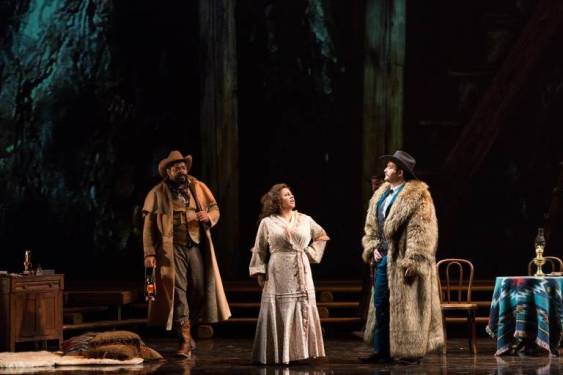
Under maestro James Meena, Opera Carolina does the oldies better than ever, as their uproarious Barber of Seville and their vivacious, ultimately anguished La Traviata amply proved. There was even some audacity in the 2016-17 programming as OpCar partnered with Warehouse Performing Arts Center and the D9 Brewing Company to produce an evening of three short operas – including the world premiere of Scott Joiner’s “Connection Lost (The Tinder Opera)” – at the brewery in Cornelius. Yes, a world premiere on Treynorth Drive! But most exciting was the Charlotte premiere of Puccini’s The Girl of the West, as Meena collaborated with six other international companies, including New York City Opera and Teatro del Giglio in Lucca, Puccini’s hometown. Singing was exemplary, persuading me that this second-tier Puccini opera was actually a first-rate work, and staging was anything but stodgy or conservative: much of the scenery was animated and bold, with authentic relics evoking the Wild West supplied by our own dearly beloved Wells Fargo. An appreciable, if infinitesimal, atonement for all the bank’s Wild West chicanery.


Little Discoveries Yield Big Laughs in “The Snowy Day”

Review:  The Snowy Day

By Perry Tannenbaum

Faced with the problem of turning Ezra Jack Keats’ children’s classic, The Snowy Day, into an hour-long stage production, Children’s Theatre of Charlotte and adaptor Jerome Hairston have resisted the temptations of bloating the story with needless pabulum or stretching it with irrelevant songs. Instead, they’ve balled up the original story Keats wrote about Peter with subsequent titles he wrote about his urban hero – including Whistle for Willie, Goggles! and A Letter to Amy – into a sizable snowball.

The mighty tetralogy ran a lordly 44 minutes at the performance I attended. Gauging by the delighted reception I saw last Saturday afternoon, I’d say both the length and the treatment were ideal.

Both the scenic and costume design, by Alessia Carpaca and Ketti Shum Mcrae respectively, seem eye-poppingly close to the original Keats illustrations, especially the iconic red snowsuit. Stage director Mark Sutton seems to have horded all the latitude – and fun – to himself before generously divvying it up among his cast.

All of them seem to having a great time at the Wells Fargo Playhouse in ImaginOn. Lydia Williamson not only gets to regress into childhood, she also swaps genders to play Peter in all four stories. Crunching the freshly fallen snow, puffing up agonizingly in attempts to whistle, sporting new goggles Peter is lucky enough to find, and stressing over his birthday invitation to Amy are all prodigious romps for Williamson to feast on.

Abigail Aukerman has the most chameleonic outing, appearing as Mom from time to time when she isn’t branching out into neighbor kid Archie and first crush Amy. Ron Lee McGill remains Dad in an oddball straw hat, hardly changing at all when he’s propelling Peter’s dopey dog, Willie. McGill also gets to chip in some narration – and assorted stagehand work while Peter’s adventures are in progress.

Much of the comedy works because we view it from an older, wiser perspective. We know what will happen when Peter stomps into the snow, though Sarah Tundermann’s projections are a nifty confirmation. And we can anticipate Peter’s heartbreak when he wakes up in the middle of the night and discovers that the snowball he stowed away in the pocket of his snowsuit that afternoon has vanished. How does that happen?

So it’s nice to find that nobody in The Snowy Day And Other Stories is cajoling us to participate or react. We take it all in privately, frequently laughing or marveling at what we see. That’s exactly what Peter is doing, except for those delicious moments when we’re a couple of steps ahead of him.

Ballet’s Hope Muir Makes Some Noise in “Fall Works” Debut

Review: Charlotte Ballet Fall Works

By Perry Tannenbaum

We didn’t have to wait long before realizing that Charlotte Ballet didn’t bring Hope Muir aboard as their new artistic director so that she would meekly follow in her predecessor’s footsteps. Jean-Pierre Bonnefoux made a lasting impression on Charlotte’s dance scene during his 20 years at the helm, and the first program at Knight Theater after his retirement, Fall Works, paid a graceful tribute to him with George Balanchine’s Apollo, one of Bonnefoux’s most important roles during his years as principal dancer with New York’s City Ballet. Sandwiching that tribute, last staged here by Patricia McBride in 2010, were a pair of choreographers we will no doubt be seeing more of after this 2017-18 season opener, Johan Inger and Javier de Frutos. Our first taste of Inger, Walking Mad, didn’t disappoint, and the de Frutos finale, Elsa Canasta, was a foretaste of the excitement he’ll be bringing to the Knight next March, when his fairytale pop ballet, The Most Incredible Thing, gets its American premiere.

Due partly to technical difficulties, Inger wound up upstaging de Frutos on opening night. Walking Mad began with a quiet surprise as Ryo Suzuki, dressed in a simple coat and bowler hat, climbed onto the darkened stage from the orchestra pit, continuing to advance toward the rear until we became aware of a rather plain-looking wooden wall. Without any warning, the whole wall advanced, sweeping Suzuki downstage with all the finesse of a snowplow. Signs of life appeared comically at both ends of this wall, and our presumption that the wall was ordinary – or stationary – was soon demolished in the traffic of the dancers. Eight more of them would emerge. Doors appeared in the wall for entrances and exits, the wall separated and folded, and for another episode, lay flat on the stage like a palette. If that weren’t bizarre and sufficiently unpredictable, what we saw from the dancers and what we heard in the music compounded the surprises.


Boys streamed out in nerdy little party hats, followed by girls in the same pointy hats. Maurice Ravel’s “Bolero” sprang up loudly, each new pass of the melody roughly marking the beginning of an unpredictable episode. Moods swung suddenly from party jubilation to trembling anxiety. Loose joyous limbs were succeeded by spasmodic tremblings of fear and anxiety, the 2001 choreography often resembling the Gaga dance idiom we’ve previously seen in Ohad Naharin’s work. Most affecting, perhaps, were the trepidations of Elizabeth Truell in her duets and trios, almost fetal in her withdrawal at times, throwing partners violently into the wall at others, and getting thrown in return. There were even moments when dancers were almost impossibly splayed on the wall. Suddenly, as the “Bolero” was growing wild, it seemed to stop as the wall went into yet another permutation, folding so that its two halves were perpendicular, Truell huddled in the corner. But the sound was only being muffled while she was in her agonizing isolation, returning to full blast as suddenly and unpredictably as the volume had dropped. The audience went wild as the Ravel concluded, but the spotlight on Suzuki signaled that Inger wasn’t done. Set to the somber “Für Alina” by Arvo Pärt, the choreographer added a coda, Suzuki making fumbling attempts to connect with Sarah Hayes Harkins before grabbing his coat, his hat, and fading upstage. The spare piano solo gently underscored the pathos.

After this dark and jagged piece, Balanchine’s Apollo was a very sunny contrast as Josh Hall portrayed the sun god. McBride, carrying on at Charlotte Ballet as associate artistic director after her husband’s retirement, had to be pleased with Hall’s equipoise and majesty, but there was also scintillating work from Apollo’s Three Muses. Drab as they had looked in

Walking Mad, Harkins as Polyhymnia and Chelsea Dumas as Calliope returned resplendently. Apollo handed out the appropriate props before the soloing began to Igor Stravinsky’s score, a plastic scroll to Calliope signifying poetry, a comedy mask for Polyhymnia signifying theatre and rhetoric, and a lyre to Terpsichore signifying music and dance – Alessandra Ball James making her first appearance of the season. Since he is often depicted with a lyre, Apollo inevitably chose Terpsichore for the climactic pas de deux after the second of his solos, and James certainly earned the honor. If Harkins is the most fearless and precise member of the troupe, I must say that James remains the most lyrical by virtue of her supreme fluidity. Just watch her arms and hands in this piece and you’ll see the essence of James’s musicality. After the Muses’ mini-festival of the arts, it’s always satisfying – and slightly surprising – to see the Muses teaming with Apollo to form a radiant sun in the last tableau.

Solo brilliance and individuality weren’t absent from Elsa Canasta, a piece built on familiar Cole Porter songs and a rarity among his works, “Within the Quota” – a ballet written for Sergei Diaghilev and his Ballet Russes, the same impresario and dance company that premiered Apollo in 1928. Diaghilev rejected Porter’s ballet even though the composer had just rescued him and his company when they skipped out of a swank Venice hotel without paying their bill. The de Frutos piece premiered in 2003 with Muir in the cast while she was still a member of the Rambert Dance Company in London, but it has undergone some intriguing evolution. Taking his cue from Ethel Merman’s rousing recording of Porter’s “Ridin’ High” (from Red, Hot and Blue), de Frutos originally had a female hostess at his party scene, his title a mash-up of famed hostess Elsa Maxwell and a bygone card-game fad that could have infused her parties.

Now the host is Levi Kreis, the charismatic singer and actor who won a Tony Award for his portrayal of Jerry Lee Lewis in Million Dollar Quartet. Here he’s in a jazzy Tin Pan Alley mode, a “sort of modern day Cole Porter,” according to the description that de Frutos sent Kreis. Needless to say, Ben Pope has had to transpose the keys of his original orchestration to accommodate Kreis, and he has added a prologue that didn’t exist in London. To make the new Charlotte Ballet presentation more of a singular event, Pope conducted his own score live for the first time, leading an ensemble that included a string quartet and an octet from Charlotte’s Jazz Arts Initiative.

Staging by Muir was less than ideal, for the varied percussion that might have blared forth in “Ridin’ High” when Kreis summoned bells, horns, and gongs was almost entirely interred in the orchestra pit. Worse still, Kreis was scandalously overmiked, garbling many of Porter’s familiar lyrics and rendering whatever he was saying in the Prologue unintelligible. Whether or not that malfunction threw the performance into disarray was hard to say. Kreis was listed as a participant in the instrumental “Within the Quota” segment, but he was gone after his wonderful interpretation of “So in Love” was compromised by sound problems. Nevertheless, with a passionate duet between Hall and Peter Mazurowki as Kreis sang, “So in Love” remained the most poignant episode in this piece, clearly depicting the anguish of forbidden love. Porter’s empathy and Kreis’s were particularly apt here, coming from gay artists.

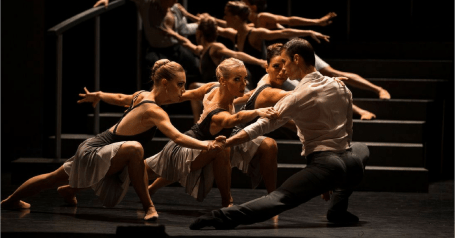
Kreis’s absence during Porter’s ballet music, a stunning orchestration from Pope, may have been a last-minute change by Muir after programs had been printed. Or perhaps Kreis was backstage frantically trying to contact the soundbooth. Either way, something major needed to be fixed before the next performance. When Kreis returned, so did the glorious James, this time partnered by James Kopecky. Adding delicious dimensions of danger and difficulty to the choreography, set designer Jean-Marc Puissant spread a modernistic staircase across half of the Knight stage, moodily lit by Bruno Poet. Ensemble action and the duets played up and down this rising horizontal expanse, and I found myself holding my breath during several jumps and lifts.

Aside from the deafening mic, my biggest disappointment was Kreiss’s physical detachment during the ensemble segments. He needed to be closer, truly communicating with the dancers, and I regretted his absence during the ballet, which ran over eleven minutes in the piano version I obtained prior to the performance. And if he’s truly our host, Muir and de Frutos ought to consider having Cole Porter’s guests pay attention to him. I’m not sure anybody onstage favored Kreis with a single glance.


Bourne’s Stylish “Red Shoes” Misses the Train

Marcelo Gomes

Review: The Red Shoes

By Perry Tannenbaum

When Matthew Bourne decided to adapt The Red Shoes for the stage, he had to confront the fact that the unique film was about ballet but was itself neither a ballet nor a musical. Musicals are Bourne’s métier as a director, but nobody sang in the film except for an operatic soprano in the background for a moment or two. Taking the more obvious route and making a Red Shoes musical would mean putting himself – as a director and choreographer – in the service of largely new score with a leading lady who would have an exhausting load of singing and dancing.

THE RED SHOES

In practical terms, then, Bourne and his New Adventures company took a more prudent path, turning The Red Shoes into a full-length ballet. That meant scrapping all of the original dialogue from the Emeric Pressburger screenplay and filling out the scant instrumental score. If you’ve seen the film, you know that “The Red Shoes” is the ballet within the story that makes Victoria Page a star for the jealous impresario god of ballet, Boris Lermontov, and his world-renowned company.

When Victoria leaves Lermontov Ballet for the man who composed the “The Red Shoes” – because Boris has decreed that she must choose between the man she loves and the man who will make her a great artist – the impresario refuses to allow the composer, young Julian Craster, to take with him the work he wrote under contract. Boris also refuses to allow the ballet that made Victoria a star to be performed again unless she performs it.

THE RED SHOES

Shedding the dialogue doesn’t allow Bourne to communicate the niceties of the breakup between Victoria and Lermontov. Nor can he cut away to show us Julian afterwards when he’s about the premiere an opera at Covent Garden while Victoria has snuck off to Monte Carlo to return to Lermontov Ballet and “The Red Shoes.” My wife Sue, who hadn’t seen the film, couldn’t figure out where the train came from – or why – any better than I could before I reacquainted myself with the film.

Confronted with the scarcity of ballet music in the film, Bourne turned to the film music of prolific composer Bernard Herrmann and scores he wrote for Citizen Kane, The Ghost and Mrs. Muir, and Fahrenheit 451, avoiding his troves of Hitchcock scores. The result seemed very tepid to me in Act 1 as both Victoria and Julian strove to win Boris’s esteem. Nuances of Lermontov’s character, including his seeming indifference to artists he prizes just to make them work harder, were drained from Bourne’s scenario. And that charming episode in the film that inspired the climactic selection moment in A Chorus Line has also been axed.

THE RED SHOES

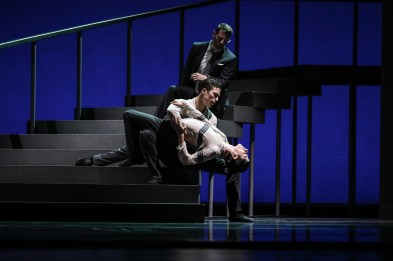
Lez Brotherston’s set and costume designs compensate for the early drabness of the music and the steamrolling of character contours, but they are ultimately a mixed blessing. The revolving proscenium that Brotherston has framing the action could become a thing in future theatre tech, smoothing transitions between scenes. It is especially effective – and cinematic – when Victoria and Julian are on the skids after breaking with Lermontov. She’s sitting on a bed at some flophouse, quietly bemoaning the career she threw away, while he’s in his posh bedroom lounging in a maroon smoking jacket, brooding over the marquee attraction he pushed away.

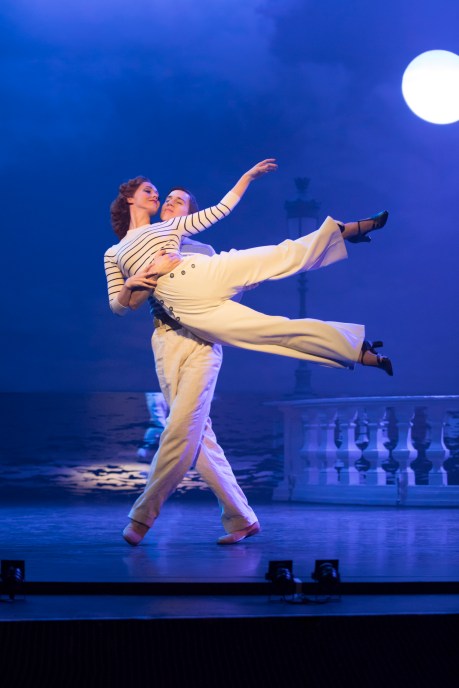
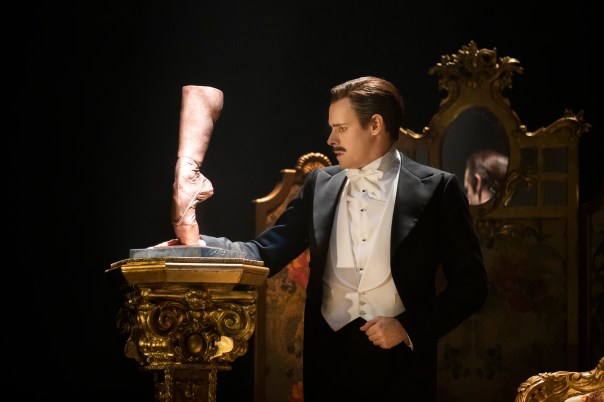
Really, it’s after the breakup that the drama and the music perk up, even if we veer towards melodrama. That smoking jacket is also the first strong echo of the film. We never see anything of the suave fedora Boris frequently wears onscreen nor the harlequin face painting that especially distinguishes Grischa, the ballet master who dangles the fatal red shoes. Costumes for Victoria and Julian are a triumph, notably in the blithe seaside scene that starts Act 2, but harlequin excess isn’t the brand of horror Brotherston goes for. When Grischa turns into a dancing Mephistopheles, Brotherston favors the Addams Family type of suit that a Dick Tracy villain might wear. Red pinstripes on midnight blue.

THE RED SHOES

Not all the abridgements of the film plot misfire, and some additions and substitutions make sense for a ballet conversion. My favorite substitution, though it belies Victoria’s aristocratic pedigree and her artistic prestige, is in the degradation she experiences in the sleazy show she hooks up with during her self-imposed exile. The lowbrow choreography that Bourne inserts here, augmented by some lascivious leering from Victoria’s co-workers, makes for a precipitous and affecting fall from grace. But you basically need to know what goes on in the film’s denouement to have a clue about Bourne’s botched staging of it. For no reason that I can fathom, he has both Julian and Boris running out on Victoria.

All of the major roles are at least double-cast, with four different dancers possible for the role of Irina, the ballerina Victoria replaces. Despite the fact that he isn’t allowed to appear even slightly artistic, I was most impressed by Sam Archer as Boris – partly because, for two-thirds of the evening, I thought he was transforming into the Mephisto tempter dangling the red shoes. No, that credit belonged to Leon Moran as Grischa, the ballet master, with a lightning-bolt streak of white through his hair when he turned sinister. Did I mention the Addams Family motif in the design? Or was that Young Frankenstein?

THE RED SHOES

The lovebirds, Ashley Shaw as Victoria and Dominic North as Julian on the night we went, were quite adorable. That says something for the depth of the Red Shoes company, since press night came a day after we attended. Complementing Brotherston’s stagecraft, projections by Duncan McLean were an airy atmospheric counterbalance to the mechanical artifice of the revolving proscenium. Although frequently deflected and derailed from telling its mutated Hans Christian Anderson fairytale in the fashion revered by balletomanes since 1948, Sir Matthew’s new adaptation is always a handsome one.

Children’s Theatre’s “Mary Poppins” Raises the Bar While Flying Its Star

Poppins(C)DBise063

Review:  Mary Poppins

By Perry Tannenbaum

It’s a strange proposition when you decide to bring Mary Poppins to Children’s Theatre at ImaginOn, Charlotte’s pre-eminent fantasy palace. Yes, it’s Disney, but it shatters the Children’s Theatre norm of 90 minutes or less, running over 145 minutes. And the story of how Mary Poppins turns the Banks family from bitterness to joy is only half about children.

Mary Poppins 7

Mary P is definitely needed to halt the vicious cycle of bad behavior from Jane and Michael, the Banks siblings, who seem to live for the thrill of defying and driving away their nannies. But there are marital issues plaguing George and Winifred Banks at the same time, some of them rooted in Victorian sexism; and their ideas about nannies, parenting, and the primacy of money could use a reset. George’s basic failures of self-examination and communication are ultimately the prime reasons why his family is so dysfunctional.

Although the problems are nicely laid out, neither of the two rehab stories is told cogently. Yet the re-education of Jane and Michael certainly has sensational episodes. Statues come to life at a park, a beggar lady sings a heartfelt ballad, the sibs frolic with a preternaturally long word, they cavort with all of London’s chimney sweeps on top of their roof under a midnight moon, and most importantly, they get to discard their castor oil regimen in favor of a sugary tonic. Surely, these are experiences that all good moms and nannies can give their children, right?

Well, they can at ImaginOn, where Children’s Theatre has raised the bar for spectacular technical derring-do – a bar that, among local theatre companies, has mostly been theirs during my 30 years on the beat. While the “Feed the Birds” street scene might strike you as saccharine, and you might accuse the magical park scenes of silly pandering to the anklebiters in the audience, it’s difficult for children of all ages to resist the enchantment of the darkling rooftop scene, further elevated and charmingly smudged by Ron Chisholm’s choreography.

Even that wonder is eclipsed by the flying effects engineered by ZFX, Inc. The only thing I can compare with Mary’s final voyage at ImaginOn are the flying effects I witnessed in the Broadway production of Spider-Man: Turn Off the Dark. Credit Aimee Hanyzewski’s lighting design for enhancing the wonder.

Poppins(C)DBise 142

Swimming against the current of the kid-friendly storyline, Steven M. Levine and Lisa Schacher do their best to stretch fledgling attention spans when they dominate the actionas the elder Bankses. Poor Winifred gets the impression – like we all do – that George reveres his childhood nanny, since he keeps invoking her as a standard, yet Schacher manages to make Mrs. Banks seem credulous rather than stupid, loving rather than meek.

We like her as much as we despise the perversity of George’s parenting ideas, but the simple intervention of Mary – just showing up at his workplace with his children – seems to be enough of an influence for him to do the right thing. All of George’s contradictions and vacillations may seem to be dubious on paper, but Levine makes them work onstage, merging essential morality with a starchy aloofness.

As we get to know Mary better and better, we realize that Bert, her admirer and confidante, is by far the warmest character in the whole crew. Poppins may be able to furlough some statues from their pedestals, but who can muster all the chimney sweeps in London for a midnight frolic other than good ole Bert? Caleb Ryan Sigmon reminds me that Bert is a slightly mischievous and broadly chameleonic creature more than any actor I’ve seen onstage before. Sigmon is also a practicing magician who serves as the show’s magic consultant, so he definitely holds up that end of the bargain.

Mary Poppins 4

Perhaps because of Jill Bloede’s offstage ministrations as dialect coach, I could believe that Janeta Jackson was channeling Julie Andrews in almost every word and note. We probably perceive Jackson as a starchier Poppins than Andrews because she doesn’t arrive with any Sound of Music baggage. Her elegant serenity is hardly sweet at all, even when she sings her signature “Spoonful of Sugar”: she almost makes a point of not emphasizing the sugar, thereby adding weight to the medicine.

The starchier approach helps us to believe in the nurturing distance she maintains with the Banks kids – whom she claims not to love – and in her fundamental capriciousness. Normally, I’m somewhat aghast when “The Perfect Nanny” punishes Jane and Michael by abandoning them. For abusing a ragdoll? Next thing you know, that beggar lady will be wailing “Feed the Toys.”

Jackson comes the closest I’ve ever seen to making this cruel medicine go down, and she has the highest voice I’ve ever heard singing Mary. That extra range pays extra dividends when Olivia Edge enters the fray as Miss Anderson, Mr. Banks’ fearsome nanny of yore. Not only do Jane and Michael flee in terror from Miss Anderson, so does Papa George!

Poppins(C)DBise 572

Edge’s preternaturally high range, fueling her “Brimstone and Treacle” showstopper, pitted against Jackson’s stratospheric soprano – and her “Spoonful of Sugar” philosophy – makes for a climactic showdown of double-barreled power. Since Edge is also fearsomely large in her frilly, funereal gray-and-black dress (designed by costumer Ryan J. Moller), her disposal is specially delightful, a sadistic mix of the witches we loved in Hansel and Gretel and Wizard of Oz.

Poppins(C)DBise 160

Somehow, director Michael J. Bobbitt gets a Charlotte cast that is stronger than the national tour that blew through here in 2010. Getting their equals from the local talent pool of children, 15-year-old Haley Vogel as Jane and 12-year-old Alex Kim as Michael, not only underscores Bobbit’s discernment and directing skills, it also reaffirms what we’ve come to expect at Children’s Theatre: the ability to attract, excite, and mentor the best young theatre talent in town.

Bratty and lovable is a tough balance to sustain, but Vogel and Kim have just the right energy and verve, with a grasp of their character arcs and an appreciation of how the Banks kids might be helping their dad to get his head straight. Like the original Broadway cast and the national tour, Vogel and Kim share their roles with alternates. If Lydia Farr and Ryan Campos are up to the same standard, you will not be disappointed.

First Night at the Knight Succeeds With Rodrigo Concerto

Review: Rodrigo Guitar Concerto

By Perry Tannenbaum

pablo-1

Christopher Warren-Green has done some new and innovative things since becoming the musical director at Charlotte Symphony: KnightSounds concerts aimed at young professionals, Thursday evening concerts, and live outdoor video broadcasts. But last week’s Rodrigo Guitar Concerto, the first Classics Series concert ever at Knight Theater, was unique, for Warren-Green himself wasn’t there to launch the new venture.

Not to worry, his stand-ins were sensational in their Charlotte debuts. First, there was guest conductor Marcelo Lehninger, who brought with him an engaging program of Latin-flavored pieces written between 1913 and 2003 by five different composers, most of them new to Symphony and to its subscribers.

How many pieces they played is actually open to dispute. There were two different Astor Piazzola selections, “Oblivion” and “Spring” (from Four Seasons in Buenos Aires), but pieces by Alberto Ginastera and Gabriela Lena Frank might be called single multiples. Frank’s 2003 suite was Three Latin-American Dances, each with its own title, and Ginastera’s Four Dances were no less individualized, excerpted from his 1941 Estancia ballet score.

Even the opening piece, Manuel De Falla’s Three-Cornered Hat Suite No. 1, was brimming with titles, four of them. The first, “Introduction – Afternoon,” was bold, brash, and filled with sunny fiesta exuberance, but everyone’s adrenalin onstage was flowing too freely, for the volume level was a little too fierce for the house. One wonders whether the orchestra had rehearsed without the acoustic shell that now surrounded them, since the brass especially needed taming.

While Symphony adjusted to the hall, Classics subscribers habituated to Belk Theater were also acclimating themselves to the greater immediacy of the orchestra sound at the Knight. There were also quieter episodes after the opening trumpet and timpani cannonade where we heard the clarinet, French horn, and oboe carving out space for themselves – even a rare bassoon spot – so the orchestra’s principals could recalibrate how loudly they played. Already the evening promised to be very colorful, with flute, harp, and a muted trumpet joining the symposium before “The Grapes” steered us back to jubilation.

Despite his Madrid concert with Plácido Domingo in front of 85,000 people, I had never heard of Pablo Sáinz Villegas before he strode into Knight Theater for his first Charlotte performance. Unlike the better-known Sharon Isbin, who played Joaquín Rodrigo’s Concierto de Aranjuez at Belk Theater in 2009, Villegas didn’t bring any amplification with him.

He didn’t need it. Villegas quickly proved his virtuosity and charisma in the opening Allegro con spirito movement of the Concierto. Almost as quickly, the sound of his guitar became the preeminent reason why the Knight was such a brilliant choice for this music. Warren-Green should have been there, if only to hear his choice vindicated. He might also have joined with the audience in giving Villegas an unusual ovation at the end of the first movement. The strumming and the Spanish tinge that Villegas poured so plentifully into his playing seemed to infuse the strings with a special transparency when they entered.

But of course an Aranjuez must be judged by how well the soloist plays the familiar middle movement Adagio. The score has such sublimity to begin with that a critic finds it difficult to remember his pen, and Villegas treated this Adagio with no less reverence. Where the solo part touches the stratosphere with high harmonics, Villegas was exquisite, and where the long cadenza later on goes low, he caressed it with a fervid vibrato and a soft touch, providing a long runway to ramp up his intensity. Lehninger and Charlotte Symphony didn’t spoil the magic. Terry Maskin played the English horn’s runs at the melody as beautifully as ever, the ensemble’s answer to the mighty cadenza was never rushed, and the flurry of harmonics from Villegas at the end was the best I’ve ever heard.

Instead of a standing, stomping ovation, the audience maintained a rapt, stunned silence. Two or three people actually walked out, possibly because that music alone was what they had come to hear, or possibly because they didn’t wish to sully their ears with anything that might erase the deep impression lingering there. Not even Rodrigo’s next movement.

Fortunately, Villegas didn’t get the wrong impression himself, for he played the final Allegro gentile as if he were already celebrating a triumph, not the slightest restraint remaining in his strumming. The previously withheld ovation burst forth with equal joy that clearly touched the young guitarist, even if it didn’t surprise him. The first encore he delivered, “Gran Jota de concierto” by Francisco Tárrega, sported tuned percussive effects delivered by hitting the body of his instrument with an open right hand while playing the neck with his left. Another section sounded so dry that it was like hearing the tattoo of a snare drum. Impossible for us to let him go after that display.

So Villegas finished with Tárrega’s melancholy classic, “Recuerdos de la Alhambra,” returning us to Spain for his farewell. The beauty of it is the melody and the tremolo rolling together in wistful waves. Villegas kept the two strands separate and soulful, so it never sounded the least bit like an etude.

If the two encores kept the concert from ending at 9pm as promised in the program booklet, intermission added further delay, for Villegas was out in the Knight lobby signing his CD, and an unusually hefty line formed for the privilege.

Before the lollipops of Piazzolla and the beefier Ginastera, the little suite by Frank assuaged anxieties that 21st century composers are all about chaotic cacophony. Many Americans have now awakened to contemporary works emanating from Europe, Asia, and South America and realized that they are out of step.

After a deluge of mallet percussion, Frank used the violins to build a bridge to tonality in “Jungle Jaunt,” the first of her three dances. “Highland Harawi” was more tranquil in its percussion, most unique for the unusual instrument that Lehninger thoughtfully introduced us to, percussion tubes that produced gentle sounds of rain. Tubular bells, woodblocks, harp, and voodoo piano runs were part of the mystery. As if reaching a clearing, “The Mestizo Waltz” began with the kind of trumpet heraldry that conjured up Mexico and mariachi before settling into 3/4 time as promised.

Uncharacteristically, concertmaster Calin Lupanu began the evening with a paean to live music, confiding in us that nearly all recorded music is fake, edited and doctored by sound engineers before it’s reproduced on the medium and player of your choice. Lupanu’s frank intro, the new venue, and the preponderance of unfamiliar music were all symptoms of a basic urge to break some of the old rules. So nobody seemed to mind the breach of etiquette when the audience applauded Villegas two movements early.

It was all good, exciting, youthful and fresh, without the slightest hint of dumbing down or condescension. The exhilaration in the lobby at intermission carried over to the end of the concert, because new discoveries kept coming.


Gunderson’s “Revolutionists” Reminds Us That 1793 Wasn’t a Very Good Year

Review : The Revolutionists

By Perry Tannenbaum

It’s easier to enjoy Lauren Gunderson’s The Revolutionists, a finely polished comedy gem from PaperHouse Theatre, than it is to find it. My GPS app resisted the 1776 Statesville Avenue address that was on my smartphone calendar, forcing me to choose between a Camp North End and a Goodyear Arts destination nearly 100 address numbers apart. Choosing the 1824 Statesville address got me to the Camp North End gate well enough after dark, and there was a PaperHouse emissary at the gate to tell us how to proceed. But as we navigated through a desolate concrete-and-asphalt landscape of vast warehouses, it was definitely an uh-oh episode for Milady GPS, who spun around from “Recalculating” to “Turn Right” in her instructions like a dog chasing its tail.

Following traffic wasn’t a reliable remedy, and I apologize to anyone who followed our lead on opening night and wound up parking a wilderness away from the PaperHouse performing space. Within sight of what looked like the building entrance – and another PaperHouse emissary – I still probably walked nearly a quarter of a mile after thinking I had sufficiently improved my parking spot. You walk through that building to another one.

Fortunately, PaperHouse is much better at producing plays than at getting you to them. (They will deploy more guides for future performances, I was assured.) Once you do arrive a the site of the action, with scenery by Jordan Ellis that strikes us as much with its simulated blood-spattered walls upstage as it does with the ascending scaffold in front of them, you can start to believe you’ve really reached the French Revolution during the Reign of Terror. You’re a bit of a pioneering revolutionary yourself if you’ve persevered and reached this secluded spot.

In the meta-world of her own – and history’s – making, The Revolutionists is Gunderson’s play, and it isn’t. We seem to be watching French feminist playwright Olympe de Gouges battling an onset of writer’s block as she ponders her next response to the rampaging Reign of Terror in the seclusion of her study. She is much in demand, for while Olympe is thrashing around, trying to settle on her message and her medium – shall it be another play? or perhaps a pamphlet? or a manifesto? – in walks Charlotte Corday, pressing the writer to compose a memorable line she can declaim when she assassinates the rabid revolutionary Jean-Paul Marat in his bathtub.

Olympe isn’t in advertising, so one-liners and slogans aren’t her forte. She hopes to come up with the right zinger during the course of composing a longer work, a plan that doesn’t jibe well with Charlotte’s mad impatience. Just when you think that the comedy will crest with the standoff between Charlotte’s insane homicidal urgency and Olympe’s many artistic hesitancies, in walks Marie Antoinette, dressed to the 17’s by costume designer Barbi Van Schaick. Her Highness wants a rewrite, a play by Olympe that will rebrand her tarnished reputation.

Everything seems to become absurd and almost surreal at this point – and likely stays that way with Marie’s queenly vanities and Olympe’s nervous vacillations. But if you go home and Google, you find that Olympe de Gouges really did embark on writing a play to rehab Marie Antoinette’s reputation, and that the playwright really did put herself in that work as an enlightened agent who reconciles the queen with the revolutionaries. If that weren’t enough, it’s also true that de Gouges wrote the courageously feminist Declaration of the Rights of Woman and the Female Citizen, thereby punching her ticket to the guillotine.

In the play, Olympe writes her manifesto in response to some principled prodding from Marianne Angelle, a Haitian revolutionary seeking independence from France, the one fictitious character in Gunderson’s script. In the real world, de Gouges seems to have had no problem standing up for herself – and against the Revolution’s bloodthirsty zealots.

So you might take the layered-on comedy a couple of ways. Gunderson may be telling us that she prefers her feminist heroes to be more fallible and true-to-life rather than impossibly glorified. Or she might be substituting herself for Olympe and showing us how far short of the French revolutionary’s greatness she falls.

Gunderson nudges us to that second, self-effacing hypothesis with little anachronisms that she occasionally drops into the dialogue, like Marie’s rebranding and rewrite ideas. PaperHouse artistic director Nicia Carla takes the anachronisms beyond what Gunderson specifies in her stage directions, and she doesn’t waste any time about it. Lydia Williamson makes her first entrance as Marianne carrying a garish, polka-dotted plastic suitcase, and when Shawna Pledger as Olympe begins writing at her escritoire, she quickly switches from a quill to a BIC ballpoint.

So Pledger is only superficially presiding over a play that Olympe has written for her queen with a plum role for herself. She is actually channeling Gunderson writing a dark comedy about herself, and if you saw Pledger last season as the fretful Sister Shelley who runs the soup kitchen in Grand Concourse, you already know that she excels at stressed-out indecisive women who are so eager to please. Surrounded by this madhouse, Williamson as Marianne doesn’t get as many comedy opportunities as the true historical figures, but she does loosen up from time to time, on temporary leave from her hectoring. Cumulatively, she leaves us with the impression that the French, whatever their politics, have no special call for commanding an empire.

Au contraire.

Sarah Woldum has now haunted PaperHouse productions for two consecutive Octobers, last year as Sheridan LeFanu’s vampire Carmilla and this year as the notorious Corday. This time, she can milk a laugh or two from the assassin’s irrational zeal and her PR impulses, but she’s unmistakably insane. I’m not sure she ever blinked.

As for Caroline Bower, she does enter as an overdressed Barbi doll with some truly vain, insensitive, and bubbleheaded lines to delight us with. But Marie Antoinette’s grand gown, the ribbons she loves so frivolously, and the ridiculous piled-high wig and feathers all do come off as the Reign of Terror sweeps its scythe through our women, and its Bower’s humbling – still cohering with the incredibly spoiled brat we first saw – that brings home how monstrous the French Revolution turned out to be.

In the end, we might realize that our man’s world of today is hardly less bloody than it was in the fatal year of 1793 – and that Gunderson isn’t entirely playful or self-critical when hinting that she trembles in the face of such brutality.


Bach and O’Carolan Mesh in a Genial Robin Bullock Recital

Review:Music @ St. Alban’s with Robin Bullock

By Perry Tannenbaum

Guitar, mandolin and their kindred are among the earliest classical instruments, so finding them up in Davidson at a Music @ St. Alban’s concert wasn’t exactly shocking, but when I sat down at the Episcopal Church and noticed that Robin Bullock’s instruments would be steel-stringed, I began to expect something unusual. There was also a network of electrical wires snaking across the platform, a small speaker lurking behind the chair where Bullock would sit, and the cittern that rounded out his arsenal – an oversized “octave” mandolin, he would later explain – was double-strung like a 12-string guitar.

Program booklets handed out as we entered St. Alban’s didn’t reinforce my faith that a classical concert was about to begin, since no musical selections were listed, but the personable Bullock allayed my misgivings with his opening remarks. Yes, a couple of these instruments would be stretched into the realm of J.S. Bach, but more often, they would be deployed in the more predictable confines of Celtic and Americana.

Virtuosity was certainly plentiful as Bullock launched into “Riding the Road,” a piece he has played with fellow guitarist Alex de Grassi. The admirable density in Bullock’s playing was not coupled with sufficient variety or beauty to sustain my interest. More to my liking was the second guitar selection, “Lord Inchiquin” by Turlough O’Carolan, an Irish composer who has become a longtime crusade for Bullock.

A contemporary of Bach’s, O’Carolan’s interest in music was a survival tool when he was blinded by smallpox at the age of 18. With the aid of a horse, a guide, and three years of musical training, he set out as a roving composer/harpist, and his tunes are often named for the patrons he found during his travels across Ireland. There were some dulcimer glints in Bullock’s adaptation for guitar – and obvious affection.

The most comical and risqué song of the concert was the only one that Bullock actually sang (in a folksy winsome style that certainly warranted an encore), and the only one he played on cittern, “The Fair Maid of Northumberland.” Its plucky heroine from England’s northernmost county devises a modest stratagem to avoid becoming a serial murderer-rapist’s seventh victim, clearly the primary spark for the audience’s enthusiastic response, but the two instrumental breaks that Bullock tossed into the middle and end of the song added to the heat – and of course, the suspense.

Switching back to guitar, Bullock made his first foray into Bach with “Jesu, Joy of Man’s Desiring,” which he described as Bach’s “greatest hit.” Naturally, this hit has been done on guitar before, by Leo Kottke with steel strings and Christopher Parkening in his arrangement for classical nylon. Bullock made more of an attempt to point us toward the original Cantata 147 experience that Bach intended, once again impressing me with the sheer density of his rendition. The sound on steel strings was noticeably crisper than you would hear on my vinyl Parkening Plays Bach LP, and Bullock snuck in a wisp of rubato as the piece wound down, very gracefully done. The speaker Bullock hooked up to with his guitar was no bigger than eight-by-eight inches, smaller than the rig classical soloist Sharon Isbin tours with, so there was no degradation in the sound quality.

As a result, I was more eager to hear what Bullock would do with a Bach cello suite on mandolin, but first the guitarist reverted to folk mode with a coupling of “Shaker Hymn” and “Salutation,” a combo that appears on his Alone and Together CD from 2015. Around the corner from WDAV, the college FM station that touts itself as “your classical companion for relaxing,” this piece was right at home, slightly more engaging than elevator or station break music. Programmatically, we had been offered a palate cleanser before the main dish.

It was a little odd to see the wee mandolin chosen for the lordly Bach Cello Suite No. 1, part of an ongoing project which will culminate with Bullock transcribing – and subsequently recording – all six of the suites. Even as Bullock tuned the instrument, it sounded tinnier than the guitar, and when he launched into the opening Prelude movement, the tinny quality remained. If you knew this music through the classic cello recordings of Casals or Rostropovich, rather than the guitar transcriptions played by John Williams, the absence of legato would strike you as forcefully as the higher pitch of the mandolin. Knowing the Williams version, I also picked up on the whinier, sometimes twangy sound of the smaller instrument, though this still wasn’t bluegrass Bach.

In the livelier movements, Bullock took advantage of the mandolin’s graceful way with triplets and strummed chords; and in the slower middle movements, he discreetly added harmonics, underscoring the higher pitch rather than attempting to minimize it. In the concluding Gigue, Bullock showed us that he was not to be confined by the top speeds we associate with cello or guitar, making for a very invigorating finale that metabolized like a hummingbird while maintaining a driving 3/4 pulse.

The O’Carolan that followed, “Bishop John Hart,” was more satisfying than the first by the Irish bard – and more like Bach, with a sunniness that faintly resembled the previously heard “Jesu.” What followed is part of a project that is taking shape alongside the Bach cello initiative, a compilation of folk instrumentals with a blues tinge. The proffered pairing, “My Home’s Across the Blue Ridge Mountains” and “Poor Boy a Long Ways from Home,” reached an intensity and funkiness from Bullock that we hadn’t heard before, at a speed even brisker than the Bach Gigue when the guitarist crossed over to the second tune.

There could be no more perfect moment for Bullock to turn to the Gavotte from Bach’s Violin Partita No. 3 for its calming effect, augmented in this church setting. Reaching in a more overtly spiritual direction, Bullock played what he called “the American folksong,” the traditional “Oh, Shenandoah,” though the memorable notes of the melody at “you rolling river” and “Across the wide Missouri” were all but submerged in this arrangement. Nonetheless, the sanctified tone was unmistakable and heartwarming.