Tag Archives: PaperHouse Theatre

Ludlam’s “Reverse Psychology” Proves Devilishly Ridiculous

Review: Reverse Psychology at VisArt Video

By Perry Tannenbaum

Best known for his international comedy hit, The Mystery of Irma Vep, Charles Ludlam and his Ridiculous Theatre Company struggled for 17 years before his 1984 breakthrough brought him financial security. But AIDS took him down, so he couldn’t enjoy his celebrity and notoriety for long. Ludlam was gone less than two months after my first reviews and features appeared on the Charlotte theatre scene in 1987.

Vep wasn’t too long in finding me. Following up on previous drag triumphs in Psycho Beach Party and Vampire Lesbians of Sodom at the storied Pterodactyl Club, Alan Poindexter and innovative Theatre Company introduced the crowning Ridiculous Theatre glory to the Queen City in 1993. Poindexter was only partially mincing in Ludlam’s flamboyant footsteps, for the Long Island native not only wrote a large chunk of his Ridiculous rep but also starred and frequently directed.

In all, Ludlam’s Complete Plays runs to over 900 pages, including such promising titles as Turds in Hell, Eunuchs of the Forbidden City, Isle of the Hermaphrodites, Secret Lives of the Sexists, and Der Ring Gott Farblongett. Despite these temptations, we’ve waited over 30 years to dip further into the Ridiculous oeuvre.

But it’s not surprising that PaperHouse Theatre is the perpetrator. After all, they exhumed Irma Vep two summers ago at VisArt Video’s clubby setting at the rear of their alley. It’s also rather discerning of them to ignore Ludlam’s more sensational titles in favor of Reverse Psychology.

The original 1980 production drew one of the strangest reproaches ever seen in a review. Writing for the New York Times, Frank Rich declared that Ludlam’s new farce did not live up to the playwright’s Ridiculous brand: “Silly? Perhaps. Clever? Certainly. Funny? Absolutely,” he conceded. “But ridiculous? When a play is as well-crafted and sharply written as Mr. Ludlam’s, honest-to-God respect must be paid.”

Rich wasn’t done, citing Ludlam’s production for selling his own play short.
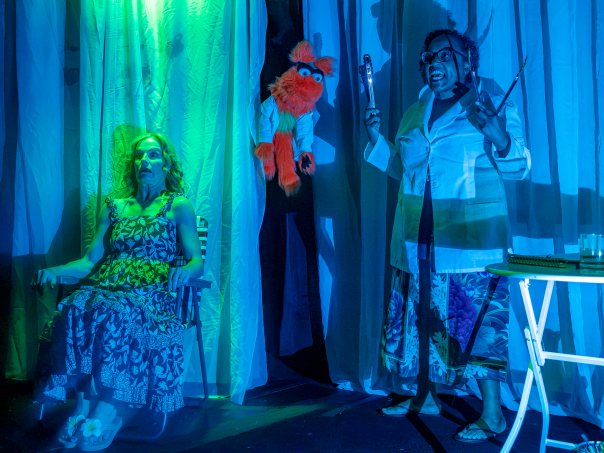
PaperHouse doesn’t make the same mistake – or any others, for that matter. Shrewdly in charge, PaperHouse founder and artistic director Nicia Carla gives her players free rein to go with the freaky flow of the action and to underscore their quirks and hypocrisies, even if they trespass the borderlines of caricature. But they keep their mischief within the two psychiatrists and their two patients, never breaking character or milking an easy laugh.

That approach enriches the ironies Ludlam explores and sharpens the satirical points he scores with his four intertwined adulterers.
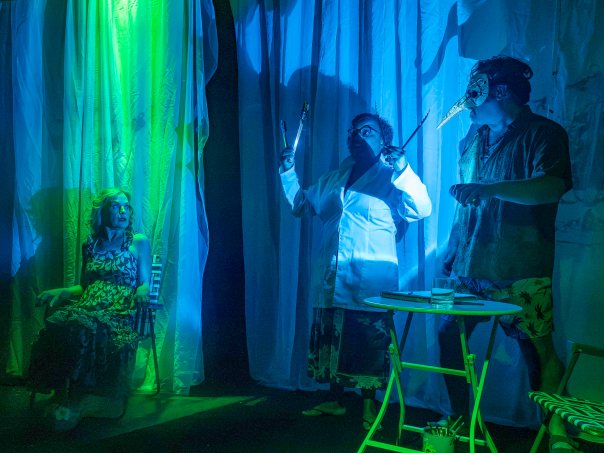
Leonard Silver and his wife, Karen Gold, are the psychiatrists who begin secret affairs at the beginning of Act 1, neither of them aware that their new paramours, Silver’s Eleanor and Gold’s Freddie, are also patients of their spouses. Ludlam is showing us all this gradually in a series of two-handed scenes between Silver and Eleanor, Silver and Freddie, Freddie and Eleanor – yes, they’re married – and Silver and Gold.

So the accumulation of deliciously absurd discovery adds fuel to the comedy as we piece together the big secret that this unfaithful quartet doesn’t, that they’re all being cheated on. Yet the business end of this farce, juxtaposed with the couples’ home lives, compounds the comedy long before their intertwined deceits unravel.

For the most absurd thing you’ll notice is that the psychiatrists’ marital relationship is far more hostile and acrimonious than their patients’! They’re the ones who need therapy!

Nevertheless, Gold is making Freddie, a struggling artist, feel guilty because she can lavish all the money she receives from Eleanor and her other clientele on a new gallery where Freddie can paint and exhibit. Silver, meanwhile, is wowing Eleanor on her own dime, if we presume that Freddie can’t really afford his therapy on his own.

Ludlam will keep leaning into this point even after the farcical climax in Act 2, where all four of his sex-driven cheaters are found out in a frantic scene at a beachside resort. The upshot of all these blasted deceptions is a double fake-out epilogue that serves to magnify Ludlum’s exploitation theme to the magnitude of horror.

And yes, Rich may have missed what Ludlam saw as the most ridiculous aspect of his satirical tale. A specter of promiscuity hovers over it all. All the wicked stealth and hurried cover-ups are driven by axiomatic beliefs in the sanctity of marriage, fidelity, and monogamy. Each of these pieties may have seemed supremely ridiculous to Ludlam – inside the box – before he was diagnosed with AIDS a mere two months before his death.

Carla and her cast make it clear that the psychiatrists are definitely among the loonies that we see. The most promiscuous of these is Ashby Blakely as the ravenously omnivorous Dr. Leonard Silver, madly attracted to all the other people onstage except his wife. Brilliantly layered on in the epilogue is an eerie touch that would have been unavailable to Ludlam when he originated this role: a spot-on evocation of Anthony Hopkins as Hannibal Lecter.

It’s pretty obvious that Carla and Lisa Schacher, in her yummiest role yet, see Eleanor as the polar opposite of Silver, the least guilt-ridden by promiscuity and the most horribly victimized. Partly due to her sunny histrionics and partly due to Ludlam’s portraiture, we find Eleanor the most artless and appealing of these risk-takers. Her most extreme travails begin midway through Act 2 when she is visited by a quasi-nightmare.

This is when Rasheeda Moore comes to the fore as Dr. Karen Gold and begins to seize her rightful place as the cunning and evil of the bunch. Blakely as Silver offers keen competition, shamelessly wooing Freddie during multiple therapy sessions and shredding his Hippocratic oath when his dear patient forsakes him. Moore is merely cruel and unscrupulous with Eleanor, taking multiple phone calls in the middle of their session and then brusquely shutting her down mid-question when time is up.

How does Chaz Pofahl as Freddie manage to keep paying Silver if the starving artist cannot sell even one of his paintings? Supreme poseur and part-time sponge, the stylish and cavalier Pofahl charmingly shows us that our Freddie cares nothing for such mundane matters, slickly picking up Gold at a museum when only one of them can pay the cab fare to his humble abode.

On your ride home, with your impressions of Reverse Psychology still fresh, you may consider the notion that Eleanor and Freddie have somehow cured their therapists.

That may be the last of multiple meanings that you’ll find in Ludlam’s title. It’s the last of his ironies, for sure, and devilishly ridiculous.

Or it was the last irony in this farce. Grimmer ironies surfaced when Ludlam’s death was front page news in the New York Times. Public Theatre’s legendary Joseph Papp, with whom Ludlam was engaging in contract talks, put it bluntly, as he always did: “We lost an extraordinary artist who was just on his way to a tremendous breakthrough in the theater and opera.”

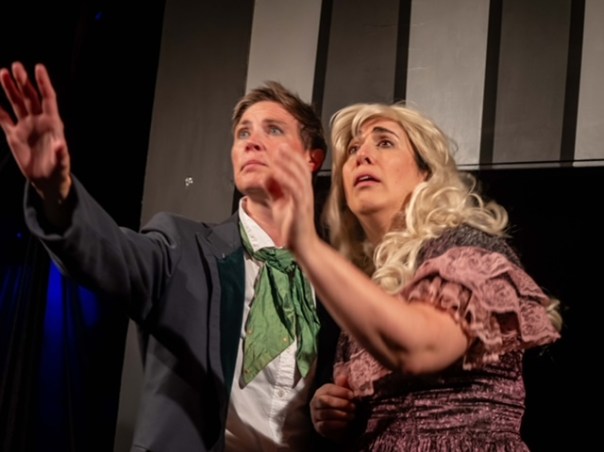
“Irma Vep” Brings Giddiness to VisArt

Review: The Mystery of Irma Vep – A Penny Dreadful at VisArt Video

By Perry Tannenbaum

My first hints that PaperHouse Theatre’s new production of The Mystery of Irma Vep would be truly unique came when I glanced at a hidden nook of the set and saw a little half-hidden bar napkin that read “Homo Sweet Home.” Shortly before or afterwards, my first peep at the playbill revealed that there were more directors on this project than players. Two more.

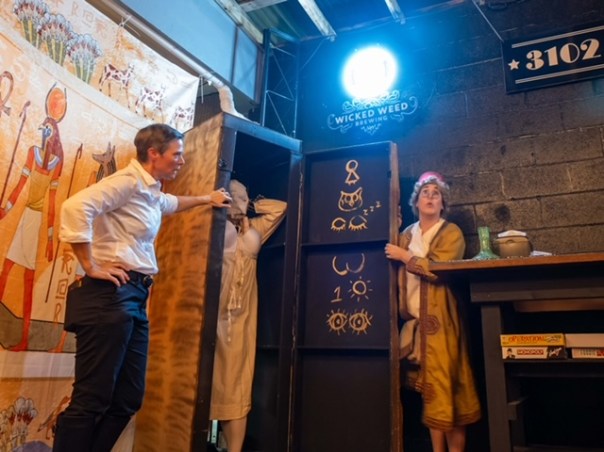
Then before intermission, the aluminum loading dock closure at VisArt Video was raised by the entire cast of two, Nicia Carla and Andrea King, while we joined them on the other side, exiting through the front door to the outside alleyway – the al fresco part of the store. The final Egyptian scene was played out on a second stage, facing out to a few seats, under the shadow of a Wicked Weed Brewing sign. With a nifty little Egyptian tapestry and a fairly gaudy, full-sized sarcophagus.

What really clinched it for me was rolling pin in Act 2 – deployed for a purpose you’d never dream of. That settled it: the new Irma Vep, a Charles Ludlum gem not seen in Charlotte since 1993, is far more than a loving revival. Far more than a couple of hambone actors led by an unusually comical director.

No, this is pure out-of-this-world madness, a starburst of hysteria fueled by a team of four directors feverishly brainstorming in the merciless grip of writer’s room giddiness. Who can possibly care about a three-inch square napkin? Who would conceive of taking the one underground scene in Vep outdoors? And the rolling pin: I can barely imagine the uproarious laughter when that touch was unveiled. Perfect.

Some of the zaniest futzing could have happened spontaneously during rehearsals, since Carla and King, splitting eight roles between them, are also part of the directorial team, joined by Kevin Lorms and Chaz Pofahl. So scenic designer Kel Wright may have lavished so much attention on her precious sarcophagus that she didn’t notice when that homo napkin got slipped into the wicker basket back at Mandacrest.

That’s where theatre legend Lady Enid Hillcrest, newly married to Lord Edgar Hillcrest, will feel oddly ill-at-ease in the library as a portrait of her predecessor, Milady Irma Hillcrest, stares down at her. Greeting her as maidservant Jane Twisden, King ought to be scornful and sepulchral, since she is replicating Judith Anderson’s role as Mrs. Danvers in Rebecca opposite Carla while she resurrects the Joan Fontaine naif.

Yet by the time Lady Enid sashays into view, numerous other parodies have already been set into motion in Ludlam’s wicked mockery of the “penny dreadful” style of Victorian England. Sleuthing, sarcophagi, werewolves, vampires, witches, and a Wuthering Heights heath are all mixed into this undeadly brew. Plus the obligatory mummy. So why not give King the freedom to jubilantly shatter the Dame Judith mold, sporting a bright red wig and occasionally breaking a smile?

Anderson may never have even slightly bared her teeth before she set Hitchcock’s Manderley ablaze.

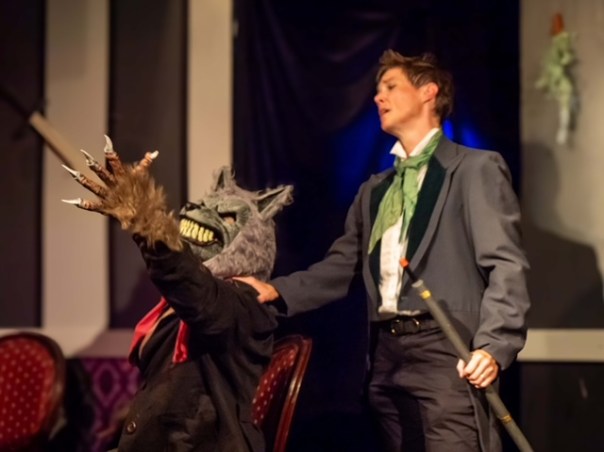
Squinting her eyes like a savvy sleuth in the opening scene, Carla as the swineherd Nicodemus quickly references the nearby heath and his determination to hunt down the werewolf suspected in the death of Lord Edgar’s son. As the action speeds up and the creepy creatures proliferate (inspiring Carla’s more outré costume designs), we need to be watchful in keeping track, not only with who’s who but with who’s what. Once the thunder stops, the full moon will have its effect, so we can be on the lookout for the kindred of Lon Chaney, Bela Lugosi, Sir Laurence Olivier, Lady Macbeth, and Edgar Allen Poe.

Ludlam wrote all the roles that Carla plays in this quick-change romp for himself and the others for Everett Quinton, his partner in the Ridiculous Theatrical Company and in life. And Ludlam also directed the 1984 premiere. Small wonder, then, that legendary actor/director Alan Poindexter was actually dissatisfied with Innovative Theatre’s storied 1993 production at the fabled Pterodactyl Club – for he merely starred in that historic riot. He told me in 1995 that he was itching to revisit the script.

Where he didn’t say, but presumably, Poindexter yearned to act and direct next time around, the dual roles that both Carla and King are fulfilling now. The fun they’re having with it was unmistakable almost from the start last Friday. Those many costume changes certainly quicken the heartbeat and release the adrenalin when these gifted players are switching outfits backstage – often speaking lines of dialogue while they do.

It’s gotta be dark back there, so in a small space where so many costumes are parked, Lorms must be especially adept as he switches hats and takes on the stage managing. If there’s an additional person hanging up the hastily discarded clothes, it must really be mayhem back there!

While Carla is shuttling between her Nicodemus and Lady Enid costumes, King is shedding her maidservant uni – and that wig – whenever the Lord Edgar returns from his various adventures. Tortured soul! After losing his ex to a vampire and his son to a werewolf, noble Edgar tasks himself with tracking down both supernatural monsters, with only Nicodemus for backup. Poor choice.

Leaving a beautiful lady alone on a lonely manor; especially near moors, heaths, mists, and hail; is never a good idea, confirmed by even a smattering of familiarity with Hollywood horror. After discovering that an Intruder has left telltale teeth marks around his beloved’s jugular, Lord Edgar proves that he has learned his lesson by immediately traipsing off to Egypt to solve this mystery. Thoughtfully, he checks Lady Enid into a sanatorium.

While Milady convalesces, Carla can transform into two Egyptians, Lord Edgar’s turbaned guide and his royal quarry, the remarkably well-preserved Princess Pev Amri. More hilarity for us; more heartbreak for Lord E.

An easier mystery for us to solve was why the Egyptian scene was moved back from the beginning of Act 2 to the end of Act 1. That sarcophagus appears on both stages, so Carla and King can rely on outside help in schlepping it. In its wake, we’re left facing a handy cantina where we can line up for refreshment during intermission.

No doubt the respite is a godsend for Carla, King, and the hidden crew as they regroup, relax, and hydrate. Action is noticeably more frenetic after the break. Masks appear more frequently, and we’re treated to cameos by vampires and various werewolf body parts, far eclipsing the wolf’s carcass tossed into Act 1. In the hurly-burly, all the mysteries and who’s-whats are solved – but you’d better be alert if you want to catch all the solutions.

By then, you may have been laughing too hard to care.

Vampires and Trumpers

Reviews: Vampire Lesbians of Sodom and Thanksgiving: 2016

By Perry Tannenbaum

For devout upstanding citizens who had decided way back in the hippie ‘60s that Greenwich Village was an abominable den of sin, Charles Busch’s Vampire Lesbians of Sodom was a flaming and perverse poke in the eye. Or an argument clincher when it landed on Macdougal Street in 1985. The New York Times raved, the extravagant little trio of sketches became a cult obsession, and Vampire Lesbians had a five-year run.

Busch slipped away from his castmates when the review came out in the early morning after the Provincetown Playhouse premiere and had a good cry. Why did this diva desecrate his mascara? His career in theatre was now assured. He would write more outrageous comedies and send-ups that he, as the prima donna, could cross-dress and slay in, most famously Psycho Beach Party.

Vampire Lesbians made it to Charlotte at the Pterodactyl Club in 1991, after the slightly wholesomer Psycho Beach had paved the way during the previous year. George Brown directed this orgy of sacrilege with fiendish glee, while Innovative Theatre co-founder Alan Poindexter starred with Keith Bulla as the titular vamps.

With the Rev. Joe Chambers carrying the torch for fundamentalism in the wake of Jim Bakker’s disgrace, Banktown was still a very Christian place. It was my sacred duty to bring my daughter, not yet bat mitzvahed, to see Poindexter in all his counter-culture glory. After beholding the kinky wonders of Psycho Beach, my Ilana would have kissed Alan’s feet.

Flash forward to 2023. Poindexter is gone and the Pterodactyl Club, the one-time cultural capital of Freedom Drive, is goner. But thanks to Nicia Carla and her PaperHouse Theatre, Hollywood antagonists La Condesa and Madeleiné Astarté (a Succubus and a Virgin Sacrifice back in their Sodom days) are undead again!

Taking on Busch’s mantle, Carla directs and stars in this stunning revival at VisArt Video, tucked into the nether region of a strip mall on Eastway Drive – I’m trying to make this little suburban dive sound as risqué as the Pterodactyl! Walls are black as you walk inside, and hostesses in Goth attire and makeup are there to greet you. Whatever Google Maps has told you (it misled both me and my wife Sue on separate occasions), you can now be sure you’re in the right place.

Small as it is, the inner sanctum of VisArt is perfectly sized for Busch’s secret forbidden rites. The seats are soft enough to keep butt burnout at bay for 90 minutes, even if you don’t stretch for intermission and fall prey to the treats in the lobby. Yet sightlines are not ideal according to Sue’s scouting report.

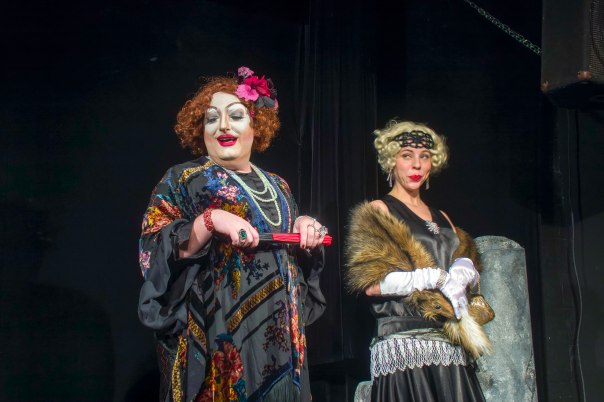
The PaperHouse cast multitasks even more than Busch’s original ensemble, just six players covering the 14 roles instead of seven. All six are battle-tested in madcap comedy, so this outrage is hardly outside their comfort zones. Nicia probably hasn’t had this much fun onstage since Poindexter directed her as The Witch in Hansel & Gretel. She minces and manipulates here as the Virgin Sacrifice, growing regal and stentorian as theatrical megastar Astarté as she assaults the Left Coast. Opposite her, Ashby Blakely is a steely, sneering diva bridging four millennia as The Succubus, aging gracefully into La Condesa and crossdressing in costume designer Beth Levine Chaitman’s most outré couture.

That isn’t to say that Josh Looney and Charlie Carla are anything less than visions of decadence as Sodomite musclemen Ali and Hujar in complementary S&M outfits and Wagnerian wigs. Nicia is already fairly slutty in the opening sketch despite her somewhat revealing white dress, willing to break her hymen with Ali or cut a deal with the cave monster Succubus. Subsequent scenes in Hollywood and Sin City climax in a couple of startling onstage costume changes, most improbably by Tanya McClellan who snoops into La Condesa’s boudoir as gossip columnist Oatsie Carewe.

Gosh, it’s good to see McClellan back onstage in manic comedy mode. Squinting her snoopiness, she sniffs out the ungodly acts performed by Nicia as Astarté on La Condessa’s protégée, luminous Sarah Molloy as flapper Renee Vain, and her meddlesome boy toy, Looney as matinee idol King Carlyle.

Hard times for a vampire? You’ll need to come back after intermission for Blakely’s final transformations. Andrea King’s choreography, on loan from Jane Fonda, elegantly shows off McClellan’s dancing prowess.

Anyone who reads advice columns or cruises social media at this time of year will have an accurate inkling of what Thanksgiving: 2016 might be about. Millions of Turkey Day hosts are wondering how they will keep opposing family factions from shouting their lungs out or coming to blows while the sharp cutlery is still on the table. Playwright Elaine Alexander smartly calculates that the situation is prime fuel for a dining room comedy – or tragedy – but the world premiere of Charlotte’s Off-Broadway production now at VAPA also reveals that the NC native had a tough time deciding which way to go.

Ground Zero for the annual onset of hosting panic was clearly in November 2016 when Hillary Rodham Clinton resoundingly won the popular vote for the US presidency while Donald Jefferson Trump won the Electoral College – and the White House – just as resoundingly. Liberals, Democrats, and rational folk are still in shock. Yet as Alexander deftly reminds us along the way, they are all blissfully unaware of the betrayals of good sense, rationality, rule of law, and democracy to come.

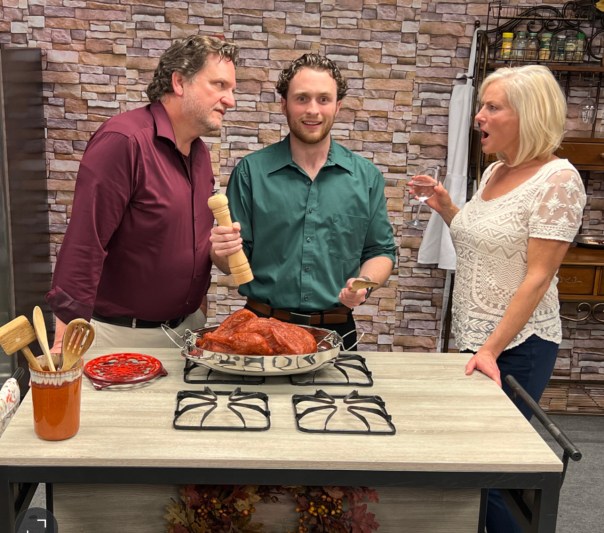
As the West family up in the liberal Northeast prepares to host young Eric’s girlfriend, riding up the highway from Alabama, the aroma of crisis already fills the suburban kitchen. Papa Harry, after diligently knocking on hundreds of doors crusading for Clinton, was hospitalized – either for a nervous breakdown or a heart attack – immediately after watching CNN declare Florida for Trump. The chief Turkey Day watchword from Harry’s physician is for wife and son to prevent the shell-shocked Hillary soldier from indulging his CNN addiction.

Taking to drink in the wake of her husband’s collapse, either out of worry or guilt, Renee has pretty much abandoned any serious intent to impress Brittany, the Southern belle she’ll be meeting for the first time. So it has fallen to young Eric to try to cook a luscious feast for his beloved, even though Mom hasn’t properly shopped for the occasion. Some improvising and substitution will need to be done. Worse, frozen will occasionally need to stand in for fresh.

Worst of all, Brittany voted for Trump, so Eric desperately hopes to keep talk of politics – the subject Dad is obsessed with and still agonizing over – away from the holiday dinner table. Harry has enough difficulty digesting that his son would date a girl from Alabama. Nor does Dad have enough self-awareness to realize that, in a reflexive action stemming from his years in community theatre, he mocks every Southern drawl he comes in contact with.

Finding out she’s a Trump voter could send him over the edge. Getting Dad to refrain from talking politics promises to be even tougher than steering him away from CNN. Finessing how to keep Brittany off the touchy subject is a bridge Eric hasn’t crossed yet.

As a director, Alexander casts father and son perfectly. Matthew Howie is a master of timorous anxiety as Eric. He can craft crescendos of panic and befuddlement while doing a hilariously awful job of warding off disaster with a shit-eating smile. Nor could we improve much on Tom Ollis as Harry. Since his 1997 debut at Theatre Charlotte in Arsenic and Old Lace, Ollis has grown into the most visible volcano on the Metrolina theatre landscape. Whether as Mr. Blonde in Reservoir Dogs, Sweeney Todd, or Titus Andronicus, Ollis is peerless at seething, suspecting, and erupting into towering, raving rages.

Since Harry is also a trial lawyer recently dismissed from his law firm because of his excessive zeal, Ollis can feast on numerous opportunities to cross-examine everyone in sight, bullying and browbeating every witness. Alexander’s women don’t get nearly as much scenery to chew, but her casting choices are nearly as impeccable.

Donna Norcross seemed to be battling opening night jitters early in Act 1 as Renee, but as Mom yielded to a multitude of wine refills, Norcross also relaxed, becoming quite powerful in the Act 2 denouement. Quite ripe for stereotyping, Michelle Strom as Renee entered the West home like a sudden ray of sunshine, without the preamble of a knock or a doorbell chime, her drawl as wide as the Mississippi. No, Dad could not restrain himself, nor could I blame him.

As you can imagine, the setup of Thanksgiving: 2016 is almost pure comedy – until the Trumper truth finally comes out, as an announcement rather than a shy confession, with the proud flourish of a cheerleader’s somersault. Looking from Strom to Ollis as we reach intermission, we can only wonder whether Dad will clutch his head or his heart.

But what can come afterward from our host, our hostess, and from poor Eric? Admirably enough, Alexander lets her characters carry her along across Act 2. But her impulse to bludgeon Harry with more secrets and uncomfortable turns this comedy upside-down. We transition, not very gradually, from a Neil Simon comedy of futile secret -eeping to an impactful series of revelations that conjures up Sophocles’ Oedipus, Strindberg’s The Father, or Albee’s Virginia Woolf. Those revelations are topped off by a  couple of increasingly jaw-dropping ideological rebukes to Harry’s smug liberalism that might shake you up a bit.

We seem to fall over a cliff here, with too little before intermission to prepare us for the high drama afterward. By the time the cast is taking their bows, Renee has radically transformed from a borderline bimbo into a pieta resembling Steinbeck’s Rose of Sharon on the final pages of The Grapes of Wrath. Instead of dumping us off a high cliff, I’d advise Alexander to lay down more track that would guide us around the mountain: a sudden dramatic swerve – not too sudden – would be more satisfying than this swan dive.

A visit to VAPA for Thanksgiving: 2016 is still worth it, delivering hearty laughs and a gasp or two. By all means, dig in!

Best of Charlotte, 2017

Best of Charlotte, 2017

By Perry Tannenbaum

                                           Best ActorJeremy DeCarlos


Among local performers, there are strong candidacies from Brian Logsdon (Pride and Prejudice and Ragtime), Jonavan Adams (Ma Rainey’s Black Bottom and The Christians), Scott A. Miller (Stupid F@#%ing Bird and The Submission), Jermaine Gamble (A Raisin in the Sun and Jitney) and Tyler Smith (Ragtime and Memphis). All of them sparkled on multiple occasions. But the runaway victory goes to Jeremy DeCarlos, who laps the field – in range and productivity – with four scintillating outings. Draped in a braided Hussar jacket, DeCarlos just finished channeling his inner Jimi Hendrix as the devilish St. Jimmy in American Idiot. That was the last of his Actor’s Theatre gems over the past year, including some cross-dressing preaching in Bootycandy, his insouciant devotion in Stupid F@#%ing Bird, and his amazing transformation – from Jerry Lewis nerd to Incredible Hulk-ish monster – in The Toxic Avenger.

Best Actress – Shar Marlin

The field of contenders is larger among the ladies, but the roles were more thinly distributed, eliminating productivity as a decisive criterion. But which other benchmark should override all others? If it’s flesh-crawling menace, Sarah Woldum gets the edge, bringing Sheridan LeFanu’s Carmilla to life in She Who Watches. Leslie Giles was the funniest as the blind librarian in The Toxic Avenger, Lucia Stetson the most revelatory as Mother in Ragtime, and Allison Snow Rhinehart was better than her Broadway counterpart as Mama in Memphis. And how can I forget the sizzling dominatrix arrogance of Nonye Obichere as Whatsername in American Idiot? I’m turning instead to Shar Marlin for her sheer power and imperial dominance in Ma Rainey’s Black Bottom, a dramatic stunner that also showed Shar’s blues singing chops. Dignity in the face of exploitation and discrimination. Diva!

Best Comedy – Women Playing Hamlet


Theatre Charlotte’s You Can’t Take It With You and the Citizens of the Universe farewell, The Hitchhiker’s Guide to the Galaxy, were arguably the zaniest productions of the 2016-17, while the Chekhov knockoff from Actor’s Theatre, Stupid F@#%ing Bird, was surely the most poignant. And what about OnQ Productions’ A Brown Tale from James T. Alfred, maybe the funniest one-man show I’ve ever seen? All were worthy candidates, but I’m going to let Chickspeare split this prize with Donna Scott Productions for their joint production of Women Playing Hamlet. Glynnis O’Donoghue starred as the soap queen saddled with the lead role in the Mona Lisa of tragedies, and the galaxy of comediennes – all in multiple roles – offering her questionable advice included Tania Kelly, Andrea King, Vivian T Howell, and Sheila Snow Proctor.

Best Musical – Ragtime

Ragtime Promo Photos

Folks who confine their diet of musicals in Charlotte to touring productions at the PAC are missing out bigtime on the locally-produced blockbusters playing out at smaller venues around town. Actor’s Theatre scrambled to produce a marvelous Toxic Avenger at a storefront church because this city doesn’t have the vision to see the arts flourish on Freedom Drive without a needless morass of red tape. Still in exile, they just brought the noise of American Idiot to Queens University for a face-melting month. After reminding us how finely they can produce A Year With Frog and Toad, Children’s Theatre astonished with the world premiere of The Best Christmas Pageant Ever: The Musical. With more than one Broadway-level performance, Theatre showed us their mettle with Memphis, and CPCC re-emphasized that their musical excellence isn’t confined to summer anymore. Maybe it was sheer luck, but CP’s wintertime production of Ragtime was the most timely of the year, underscoring the sad fact that institutional racism, police brutality, and prejudice against immigrants aren’t quaint relics of the Jazz Age. As the martyred Coalhouse Walker, Tyler Smith’s impassioned “We are all Coalhouse!” reverberated through a city in turmoil.

Best Drama – Jitney

Early last season, PaperHouse Theatre proved that The Frock Shop on Central Avenue was the perfect site for a creepshow with a dazzling She Who Watches, and early this season, a legend made a comeback when Steve Umberger and his Playworks Group brought a sterling production of The Christians to Booth Playhouse. In between, as Charlotte was fully wakening to how badly we have neglected and mistreated our underclass, theatergoers may have finally been zonked by the realization that our city is exceptionally rife with African American acting and directing talent. Kim Parati made an auspicious directorial debut at Theatre Charlotte with a freshened-up Raisin in the Sun, but this was a vintage year for August Wilson – in two dramas directed by Corlis Hayes, Ma Rainey’s Black Bottom at CPCC and Brand New Sheriff’s Jitney at Spirit Square. Hayes brought out the best in John W. Price and Jermaine Gamble as the father-son antagonists in Jitney, with Gerard Hazelton adding a mix of comedy and poignancy as the gypsy cab company’s resident lush. Move over OnQ Productions, there really is a brand new black company in town – our second! – producing professional-grade work.

Best Night @ Symphony – Mahler’s “Resurrection”

While a well-played Beethoven symphony, a Rossini overture, a Strauss tone poem, or a Mozart concerto might be the secret sauce to get newcomers to become Charlotte Symphony subscribers, longtime concertgoers like me wish to dismount the warhorses and hear something off the beaten trail. There’s plenty out there that will please both camps: big, unfamiliar orchestral works that will instantly grab you by the lapels even if Symphony hasn’t reprised them within the last decade. Armed with an audacious orchestra and choir, plus two soloists who have sung with Opera Carolina, Davidson College showed the way with a rousing performance of Ralph Vaughan Williams’ A Sea Symphony, set to poetry by Walt Whitman. That’s the sort of daring we hope for from Charlotte Symphony’s British maestro, Christopher Warren-Green. We did get a British Isles-themed evening when pieces by Edward Elgar and Peter Maxwell Davies, spiced up with a bagpiper, were served with Mendelssohn’s “Scottish.” Utilizing the Symphony Chorus and distinguished guest vocalists, Warren-Green turned up the power with a pair of Bruckner chorales last November and Mendelssohn’s Elijah last March. If you wanted to sample the full capabilities of Symphony, their chorus, and the guest vocalists Warren-Green can summon to Belk Theater, you had to hear them introducing the wonders of Mahler’s “Resurrection” Symphony No. 2 to an astounded audience.

Best Night @ the Opera – The Girl of the West

Under maestro James Meena, Opera Carolina does the oldies better than ever, as their uproarious Barber of Seville and their vivacious, ultimately anguished La Traviata amply proved. There was even some audacity in the 2016-17 programming as OpCar partnered with Warehouse Performing Arts Center and the D9 Brewing Company to produce an evening of three short operas – including the world premiere of Scott Joiner’s “Connection Lost (The Tinder Opera)” – at the brewery in Cornelius. Yes, a world premiere on Treynorth Drive! But most exciting was the Charlotte premiere of Puccini’s The Girl of the West, as Meena collaborated with six other international companies, including New York City Opera and Teatro del Giglio in Lucca, Puccini’s hometown. Singing was exemplary, persuading me that this second-tier Puccini opera was actually a first-rate work, and staging was anything but stodgy or conservative: much of the scenery was animated and bold, with authentic relics evoking the Wild West supplied by our own dearly beloved Wells Fargo. An appreciable, if infinitesimal, atonement for all the bank’s Wild West chicanery.


Gunderson’s “Revolutionists” Reminds Us That 1793 Wasn’t a Very Good Year

Review : The Revolutionists

By Perry Tannenbaum

It’s easier to enjoy Lauren Gunderson’s The Revolutionists, a finely polished comedy gem from PaperHouse Theatre, than it is to find it. My GPS app resisted the 1776 Statesville Avenue address that was on my smartphone calendar, forcing me to choose between a Camp North End and a Goodyear Arts destination nearly 100 address numbers apart. Choosing the 1824 Statesville address got me to the Camp North End gate well enough after dark, and there was a PaperHouse emissary at the gate to tell us how to proceed. But as we navigated through a desolate concrete-and-asphalt landscape of vast warehouses, it was definitely an uh-oh episode for Milady GPS, who spun around from “Recalculating” to “Turn Right” in her instructions like a dog chasing its tail.

Following traffic wasn’t a reliable remedy, and I apologize to anyone who followed our lead on opening night and wound up parking a wilderness away from the PaperHouse performing space. Within sight of what looked like the building entrance – and another PaperHouse emissary – I still probably walked nearly a quarter of a mile after thinking I had sufficiently improved my parking spot. You walk through that building to another one.

Fortunately, PaperHouse is much better at producing plays than at getting you to them. (They will deploy more guides for future performances, I was assured.) Once you do arrive a the site of the action, with scenery by Jordan Ellis that strikes us as much with its simulated blood-spattered walls upstage as it does with the ascending scaffold in front of them, you can start to believe you’ve really reached the French Revolution during the Reign of Terror. You’re a bit of a pioneering revolutionary yourself if you’ve persevered and reached this secluded spot.

In the meta-world of her own – and history’s – making, The Revolutionists is Gunderson’s play, and it isn’t. We seem to be watching French feminist playwright Olympe de Gouges battling an onset of writer’s block as she ponders her next response to the rampaging Reign of Terror in the seclusion of her study. She is much in demand, for while Olympe is thrashing around, trying to settle on her message and her medium – shall it be another play? or perhaps a pamphlet? or a manifesto? – in walks Charlotte Corday, pressing the writer to compose a memorable line she can declaim when she assassinates the rabid revolutionary Jean-Paul Marat in his bathtub.

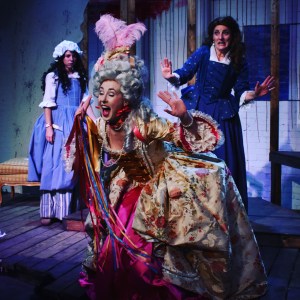
Olympe isn’t in advertising, so one-liners and slogans aren’t her forte. She hopes to come up with the right zinger during the course of composing a longer work, a plan that doesn’t jibe well with Charlotte’s mad impatience. Just when you think that the comedy will crest with the standoff between Charlotte’s insane homicidal urgency and Olympe’s many artistic hesitancies, in walks Marie Antoinette, dressed to the 17’s by costume designer Barbi Van Schaick. Her Highness wants a rewrite, a play by Olympe that will rebrand her tarnished reputation.

Everything seems to become absurd and almost surreal at this point – and likely stays that way with Marie’s queenly vanities and Olympe’s nervous vacillations. But if you go home and Google, you find that Olympe de Gouges really did embark on writing a play to rehab Marie Antoinette’s reputation, and that the playwright really did put herself in that work as an enlightened agent who reconciles the queen with the revolutionaries. If that weren’t enough, it’s also true that de Gouges wrote the courageously feminist Declaration of the Rights of Woman and the Female Citizen, thereby punching her ticket to the guillotine.

In the play, Olympe writes her manifesto in response to some principled prodding from Marianne Angelle, a Haitian revolutionary seeking independence from France, the one fictitious character in Gunderson’s script. In the real world, de Gouges seems to have had no problem standing up for herself – and against the Revolution’s bloodthirsty zealots.

So you might take the layered-on comedy a couple of ways. Gunderson may be telling us that she prefers her feminist heroes to be more fallible and true-to-life rather than impossibly glorified. Or she might be substituting herself for Olympe and showing us how far short of the French revolutionary’s greatness she falls.

Gunderson nudges us to that second, self-effacing hypothesis with little anachronisms that she occasionally drops into the dialogue, like Marie’s rebranding and rewrite ideas. PaperHouse artistic director Nicia Carla takes the anachronisms beyond what Gunderson specifies in her stage directions, and she doesn’t waste any time about it. Lydia Williamson makes her first entrance as Marianne carrying a garish, polka-dotted plastic suitcase, and when Shawna Pledger as Olympe begins writing at her escritoire, she quickly switches from a quill to a BIC ballpoint.

So Pledger is only superficially presiding over a play that Olympe has written for her queen with a plum role for herself. She is actually channeling Gunderson writing a dark comedy about herself, and if you saw Pledger last season as the fretful Sister Shelley who runs the soup kitchen in Grand Concourse, you already know that she excels at stressed-out indecisive women who are so eager to please. Surrounded by this madhouse, Williamson as Marianne doesn’t get as many comedy opportunities as the true historical figures, but she does loosen up from time to time, on temporary leave from her hectoring. Cumulatively, she leaves us with the impression that the French, whatever their politics, have no special call for commanding an empire.

Au contraire.

Sarah Woldum has now haunted PaperHouse productions for two consecutive Octobers, last year as Sheridan LeFanu’s vampire Carmilla and this year as the notorious Corday. This time, she can milk a laugh or two from the assassin’s irrational zeal and her PR impulses, but she’s unmistakably insane. I’m not sure she ever blinked.

As for Caroline Bower, she does enter as an overdressed Barbi doll with some truly vain, insensitive, and bubbleheaded lines to delight us with. But Marie Antoinette’s grand gown, the ribbons she loves so frivolously, and the ridiculous piled-high wig and feathers all do come off as the Reign of Terror sweeps its scythe through our women, and its Bower’s humbling – still cohering with the incredibly spoiled brat we first saw – that brings home how monstrous the French Revolution turned out to be.

In the end, we might realize that our man’s world of today is hardly less bloody than it was in the fatal year of 1793 – and that Gunderson isn’t entirely playful or self-critical when hinting that she trembles in the face of such brutality.