All posts by perryt77

Christopher Warren-Green Conducts a Dramatic, Joyful “Messiah” at Knight Theater

Review: Messiah

By Perry Tannenbaum

Until my first year of college, I thought I knew all that operatic singers and composers could do. My parameters were set by the matinee performances of the Metropolitan Opera and the iconic Texaco broadcasts. But on a freezing December evening at Colden Auditorium on the Queens College campus in New York, I attended my first live performance of George Frederic Handel’s Messiah, my first inkling that there were whole vocal worlds beyond Verdi, Puccini, Mozart, Wagner, and Verdi. The first hint that I was in unexplored territory was when the tenor sang his “Ev’ry Valley Shall Be Exalted” air, where the melody line straightens out the crooked and makes the rough places plain.

More jarring than that was the sound of a bass baritone shortly afterwards in the “Thus Saith the Lord” recitative performing the coloratura runs declaring he will “shake all nations.” I’d previously assumed that such virtuosic runs were reserved for higher voices – almost always female. Since then, I rarely allow a Yuletide season to go by without revisiting Handel’s most frequently performed oratorio. During those years, a couple of trends have impacted how we hear the operas and oratorios by Baroque and pre-Romantic composers. Both were in evidence as Christopher Warren-Green, for the first time in his eight seasons as music director of the Charlotte Symphony, conducted Messiah at the Knight Theater.

Both trends, when they hit, were championed in the name of authenticity. The first had to do with the modern tendency to perform Early and Renaissance music on modern instruments with larger orchestras. Authenticists trimmed the size of their orchestras and brought back original instruments. Then came the countertenors to further shake up authentic performance. Although Alfred Deller was established in his career in the late 1940s, but there was no mass influx of countertenors, reclaiming the roles originally assigned by early opera composers to castrati, until at least 50 years later.

Charlotte Symphony subscribers may have been surprised to see countertenor Brennan Hall singing the alto parts formerly taken by contraltos or mezzo-sopranos, but those who were knowledgeable could hardly have been shocked. In years gone by, purists spearheading the authentic instruments trend might have bridled at the idea that Warren-Green was bowing to ancient practice by trimming the size of his orchestra without adapting original instruments, but the requisite treaties in those wars were tacitly signed a couple of decades ago.

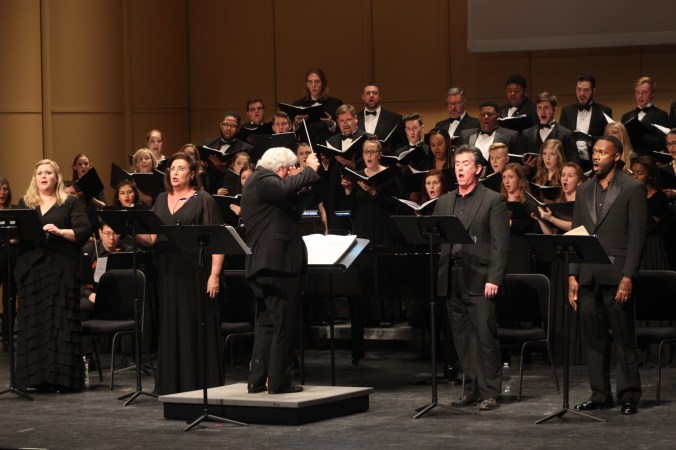
The zest that Warren-Green brought to the task wasn’t fully manifested until we reached the mighty “Hallelujah Chorus” at the end of Part 2. Somehow, while the audience was rising to their feet, two trumpeters and timpanist Leonardo Soto made their way through the Knight Theater’s acoustic shell, filling out the Symphony ensemble to 29 members. The hall shook with the sound of the orchestra and the more than nine dozen singers of the Symphony Chorus. Warren-Green was transported enough at one point to leap into the air, and the collective power of his “Lord of Lords” sent chills through me.

There was not only thunderous applause at the conclusion but also bows from the orchestra, the chorus, and the soloists, though Part 3 still lay ahead. More chills came with the tender contrast of soprano Kathryn Mueller singing “I Know That My Redeemer Liveth” after we were back in our seats. I’m not sure that I’ve ever heard Mueller’s last phrase, “the first fruits of them that sleep,” delivered with such beguiling fructose.

Those dramatic contrasts typified Warren-Green’s approach. Tempos were quicker than we usually hear on the familiar “For Unto Us a Child Is Born” and “All We Like Sheep,” further lightened by a noticeably more staccato attack from the singers. Yet the excellent tenor, William Hite, could follow the choir’s gamboling “Sheep” with an unusually strong rendition of the “All They That See Him” recitative. Other moments foreshadowing the “Hallelujah” thunder were the declamatory “The Lord Gave the Word,” a choral segment that usually escapes notice, and Symphony’s fierce introduction to bass baritone Troy Cook’s “Why Do the Nations So Furiously Rage Together?”

Cook seemed to grow continuously in power throughout the evening. His “Thus Saith the Lord” was more stolid than the best I’ve heard, not nearly in the same class as his “Why Do the Nations?” after intermission. I had already hoped for mightier deeds when I heard Cook’s unexpected sweetness in his “For Behold, Darkness Shall Cover the Earth” recitative. But the baritone’s finest moments came later with the recitative and air that culminated in “The Trumpet Shall Sound,” volleying back and forth with principal trumpeter Richard Harris, who was in fine form. Along with Mueller’s sweetness, these two men conspired to prove that Part 3 isn’t at all an anticlimax after the mighty “Hallelujah.” Warren-Green discreetly axed four segments from Part 3, “Oh Death, Where Is Thy Sting?” the most familiar, to help keep that notion afloat.

The other soloists distinguished themselves before Part 3. Hall had a more suitable range for “O Thou That Tellest Good Tidings to Zion” than many contraltos I’ve heard, though his runs weren’t the most even. Together he and Warren-Green emphasized the 3/4 meter of this air more delightfully than I could recall hearing before. The countertenor was most affecting after intermission when he sang “He Was Despised and Rejected,” layering on a superb soulfulness as he sang the verse from Isaiah for the last time.

I was even more impressed by Hite’s emotional range, whose power was the last of his attributes to be revealed. The tenderness of the tenor’s rendition of “Comfort Ye, My People” – a slight sob detectable in his delivery – served instant notice that this was going to be a special Messiah, one that respected the Charles Jennens libretto culled from the Old and New Testaments, and Hite’s “Ev’ry Valley” signaled that it would be wrapped in joy. Anyone who doubts that Warren-Green adores this score only needs to hear him conduct it.

Charlotte Ballet’s Flatter Slim-Fast “Nutcracker” Still Dazzles With Scenic Splendor and Scintillating Dance

Review : Nutcracker

1718Nutcracker_Chelsea Dumas and Juwan Alson_171208-Photo by PeterZay4286[13]

By Perry Tannenbaum

When I first heard that Charlotte Ballet would be trotting out its newish Nutcracker down in Charleston before bringing it back to the Belk Theater for its customary two-week run, it struck me as a good thing – spreading the word to South Carolina at the gloriously revamped Gaillard Municipal Center. But I hadn’t considered how the economies of putting the show on the road might affect the product at home. Musicians from the Charlotte Symphony Orchestra have been reduced this year from 60 to 35, according to Jean-Pierre Bonnefoux, the Nutcracker choreographer and past Charlotte Ballet artistic director. Furthermore, the mini-chorus that always sang from the orchestra pit in the “Waltz of the Snowflakes” at the end of Act 1 is gone. At least one orchestra member I’ve heard from isn’t pleased by the various transpositions required when you ditch the bass clarinet and are no longer tripling the flutes.

This slimmed-down score comes on the heels of last year’s million-dollar redesign of sets and costumes, austerity following ballyhooed largesse. The new sets sparkle with bright colors at the Stahlbaums’ holiday party in Act 1 and in the Land of the Sweets after intermission. The snow scenes literally glitter in both acts – and the cute little Angels float on a bed of clouds created by nicely tamed fog machines. Yet there was a two-dimensional quality to many of the new props introduced last year that, er, fell flat for me. It began, amusingly enough, with a lifesize cardboard housemaid that was wheeled out to the Stahlbaums’ anteroom and collected all the guests’ hats, coats, and scarves before wheeling back to the wings. But the two-dimensional motif didn’t end there, for the toy soldier that Herr Drosselmeyer brings for Fritz, the creatures that file off into the wings when the clock strikes midnight, the reindeer that peep into the Land of Snow, and Mother Ginger’s house are all pancake flat.

All this flattening muted bustle of the holiday party, which was deprived of the formerly grand arrivals of the Toy Doll and the Toy Soldier in cabinets, caskets, or palanquins. Mark Diamond’s shtick as Herr Drosselmeyer was radically hamstrung, stripped of his former hocus-pocus emceeing for the gift reveals, and while his leave-taking compensates a little for his no-longer-baroque-and-fussy entrance, most of the physical comedy is either gone or has lost its patina. Even the wrench Drosselmeyer used to fix Clara’s broken nutcracker seemed a shadow of its former absurdity. Where the flatness meshes with the new scenic design by Alain Vaës, the result is notably spectacular when the Christmas tree chez Stahlbaum grows to fill the entire upstage. The enchantment doesn’t stop there, for new scenery emerges behind it. Most spectacular, exceeding even Clara’s departure from the Land of Snow (escorted by the victorious Nutcracker), is Clara’s landing in the Land of Sweets below the clouds where the cute little Angels glide.

Worse than the absence of the bass clarinet for the “Dance of the Sugar Plum Fairy” (a bassoon doesn’t do) or the three flutes for the “Dance of the Reed Pipes” (barely noticeable) were the strings subbing for the mini-chorus. No matter how well they’re played, violins can’t say “Ah!” Under the baton of assistant conductor Christopher James Lees – and under the Belk stage – the Charlotte Symphony filled the hall rather nicely. With Sarah Lapointe and James Kopecky among the most elegant who have danced Sugar Plum and Cavalier, the climax of the grand “Pas de deux,” still sounded very powerful. But a subsequent listening session at home with a couple of reference recordings disclosed a shrieking piccolo that was probably missing from Tchaikovsky’s clangor at Belk Theater.

Charlotte Ballet’s dancers lifted the production high above any quibbles about props or orchestral instrumentation. The main corps and the satellite Charlotte Ballet II dancers maintained the high standard of past years while the work from apprentices, trainees, and students from the company’s academy and conservatory continues to ascend to new heights. Bonnefoux rehearsed the show in his first year away from the daily operations of the company, a great way for him to reconnect – and maybe a great burden lifted from anybody else who ventured to take on the complexities of Nutcracker casting. I was discreetly funneled into the Saturday evening performance so that I would be reviewing Cast A, the dancers who appear in all the publicity shots. An amazing 121 roles are double cast, so you can definitely say there is a Cast B. Yet there are also 21 roles that are triple cast, eight quadruples, and three – major roles – that rotate among five dancers. So on just one given night, over 150 splendid Holly Hynes costumes are in play backstage, and Bonnefoux is making sure that the cast du jour – no matter what the permutation – is in step. You can bet that he appreciates the expertise of Anita Pacylowski-Justo and Laszlo Berdo in staging and rehearsing all the student dancers.

It’s Clara and Fritz who must carry the action until Drosselmeyer dominates, so the Charlotte Ballet students aren’t merely background ornaments. Ava Gray Bobbit and Pierce Gallagher were the Stahlbaum sibs on opening night with Cast A, Gallagher one of two Fritzes and Bobbit one of four Claras. Though Gallagher absolutely reveled in Fritz’s energy and mischief making, Bobbit especially impressed me with her supple line, her perfectly calibrated childishness, and the utter ease and confidence she brought to every step. Only when Giselle MacDonald danced the Toy Doll did we ascend to the level of Charlotte Ballet II and when Maurice Mouzon Jr. followed as the Toy Soldier, we had our first brief sighting of the main company. Diamond has danced Drosselmeyer forever – yes, he gets a chunk of “Grandfather’s Dance” to strut his stuff – but he’s director of Charlotte Ballet II, not a company dancer. Even the rival rulers of the great Nutcracker war, Evan Ambrose as the Mouse King and Michael Manghini as the Nutcracker, were second-string members of Diamond’s company. Cast B digs even deeper, with company apprentices leading the Mice and the Nutcracker brigade into battle.

1718Nutcracker_Alessandra Ball James and Josh Hall_ Sugar Plum_Photo by Jeff Cravottafix_1112-8058_square[11]

Obviously, Bonnefoux has bequeathed a very deep bench to Hope Muir, his successor as artistic director. Aside from the athleticism of Mouzon, the varsity never trod the early earthbound scenes of this resplendent Nutcracker. Only when Sarah Lapointe and James Kopecky greeted us – and the dreaming Clara – in the Land of Snow, were we finally favored with the grace of the top-tier dancers. Lapointe and Kopecky were one of four couples who will perform these rites. Each of them will rotate in some of the upcoming shows into the higher empyrean as Sugar Plum Fairy and Cavalier, welcoming Clara to the Land of Sweets. Alessandra Ball James and Josh Hall took on these starring roles at the Saturday night opening, and Ball even surpassed herself. Her line and fearlessness now nearly match her peerless musicality. No less than five different couples get to excel in Tchaikovsky’s grand “Pas de deux” during the Nutcracker run.

The new Hynes costumes against the Vaës backdrops really do make the divertissements seem even more spectacular than before, showcasing the fine men in the company. Ryo Suzuki scintillated in his first year with the troupe, so his exploits now in third year fronting the “Gopak” weren’t revelatory. On the other hand, Juwan Alston brought amazing hangtime to his leaps in “Candy Cane,” even if he did teeter a bit on his final landing, and Humberto Ramazzina from Ballet II had an eye-popping precision in the “Chinese Tea.” Amelia Sturt-Dilley and Ben Ingel weren’t the most exotic purveyors of the Arabian “Coffee” duet that I’ve seen over the years, but they radiated sizzling sensual heat.

You almost wished that Charlotte Ballet could have trotted out an overhead camera or mirror when the last of the company’s great ballerinas, Sarah Hayes Harkins, made her decorous appearance as Rose at the center of the gorgeous “Waltz of the Flowers.” At the florid beginning and ending of the piece, Harkins was encircled by a dozen Flowers – petals, really, in Bonnefoux’s imagery – her height vis-à-vis the student dancers beautifully highlighted. Nothing less than the climactic “Pas de deux” could follow such pure, innocent beauty.

A Transcendent New Perspective on Verdi’s Requiem – as Sung by Jewish Prisoners Earmarked for Extermination by the Nazis

Review: Defiant Requiem: Verdi at Terezín

By Perry Tannenbaum

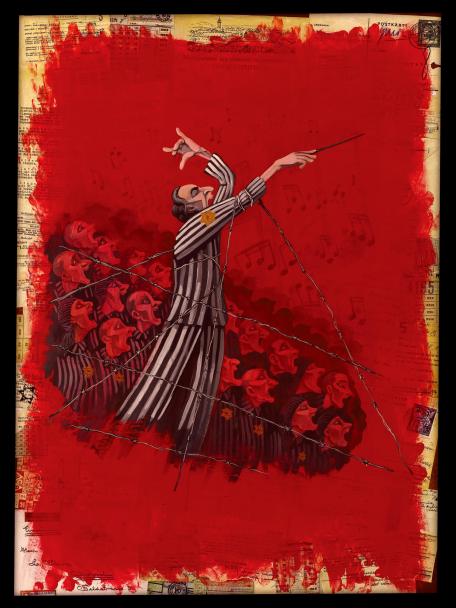
Ever since Verdi’s Requiem was first presented in 1874, singers and musicians have often observed that the composer, not a particularly religious man, steered the text of the Roman Catholic funeral mass in the direction of opera. Considering that Verdi had begun this work as a tribute to Rossini shortly after his death in 1868, those observations may be precisely what Verdi intended. Arranger/conductor Murry Sidlin offered a new perspective in Defiant Requiem: Verdi at Terezín with his new version of the Requiem for chorus, soloists and piano that premiered at the Anne R. Belk Theater on the UNC Charlotte campus. His pared-down instrumentation was not an arbitrary choice. Sidlin was aiming to pay tribute to Rafael Schächter, the Holocaust victim who organized and led the choir of Jewish prisoners that performed for the International Red Cross during their infamous inspection of the Theresienstadt concentration camp in June 1944.

In a miracle that faintly echoes the Hanukkah miracle, Schächter only had a single musical score – for piano and chorus – when the pianist-conductor arrived at Terezín. From that one little musical light, Schächter forged a chorus that offered solace to its members at evening rehearsals after hard days of labor at the concentration camp. And in the text of the Requiem, he found a massive voice that would “sing to the Nazis what we cannot say to them.”

Interspersed with a recreation of the 16 performances that Schächter conducted for the edification and delight of their fellow prisoners (there is no evidence that the Nazis in attendance were ever entertained or that those Red Cross emissaries were ever enlightened), Sidlin has interspersed clips from Defiant Requiem, a documentary that tells the story of the Theresienstadt Chorus with help from filmed interviews of its living survivors. There were also segments where Sidlin himself, turning towards us after conducting a section of the Requiem, would add his voice to the narrative. If that weren’t enough to evoke the presence of Schächter and the role he played at the original performances, one of the two actors who stepped out of the chorus and participated in this unique concert drama also portrayed Schächter.

Defiant Requiem: Verdi at Terezín has been around since 2002 and has twice been presented at New York’s Lincoln Center in Avery Fisher Hall. But those 2013 and 2015 performances at the home of the NY Philharmonic were with full orchestras. What we saw at the Anne R. Belk may have literally proven that less is more, for the replication of Schächter’s performances was certainly more faithful with just a single piano – plus a violin – replacing the orchestra at a more intimate venue. Nor was the drama diminished when we learned that the final Theresienstadt Requiem for the Red Cross was performed by a depleted choir of about 60 members: the choral group standing before us, from The University Chorale and We Are Sine Nomine, numbered 62 according to our program booklets.

Stripped down to these essentials, and replenished with the contexts supplied by Sidlin and the documentary, what usually sounds devotional and fearful now felt, by turns, poignant and defiant, dripping with vengeful fury. The “Kyrie eleison” (Lord, have mercy on us), sung first by tenor soloist Brian Cheney and followed by bass Carl DuPont, soprano Christina Pier, and mezzo Victoria Livengood sounded less like a supplication than a demand.

When the full chorus broke in with their first “Dies irae” (Day of wrath), the performance actually increased in its defiance. Prior to the ensuing “Tuba mirum” chorale, an extended solo from Arlene Shrut firmly established that the piano wasn’t to be limited to passive comping. The hushed pianissimos after DuPont softly uttered his last “Mors stupebit” (Death shall stand amazed) had a solemn eeriness that was unprecedented in the performances and DVD that I’d previously witnessed. Livengood, more reliably dramatic than on-pitch, was regally up to her supreme moment of defiance in “Liber scriptus” (Written book), where she proclaimed – with prophetic volume and fury – that on the Day of Judgment, “what is hidden shall be made manifest, nothing shall be unavenged.”

Spitting defiance in the face of the Nazis and obliquely sending an SOS to the Red Cross were the most important aspects of Schächter’s payload, but the intervening narrative gave us more nuance. There were Jews at Terezín who objected to the embrace of a Catholic Mass – and to the danger that the conductor was subjecting his choristers to should their defiant message be fully grasped by the Nazis. These nuances came from the lips of the survivors on film, who clearly viewed Schächter as an inspiration, a godsend, and even a lifesaver.

idlin’s concert drama also drove home the point that, for the Terezín singers, the “Libera me” (Deliver me) was no longer a plea to be spared from fires of hell sometime in the indeterminate future but a plea to be delivered now from their monstrous captors. Another set of testimonies told us of the uplift that the choristers felt singing the “Sanctus” (Holy, holy, holy) section of the Requiem. Somehow it escaped Sidlin that the first two lines of this section are translated from one of the most sacred Hebrew prayers, when pious Jews not only rise to recite the words but also rise on tiptoe for each of the three “Holies.”

There was plenty of engaging lagniappe to make up for this omission, including a memorable evocation of the artistic beehive of musical activity happening nightly at Theresienstadt, intertwining wisps of Schubert’s “Trout” with “Bei Mir bist du Schoen” and the bittersweet Russian Yiddish folksong, “Tumbalalaika.” But the most sobering addition that Sidlin made to his drama came in the coda that he added on after the Requiem. Instead of the customary applause, we were prompted to remain silent as the musicians filed down the aisles through hall and out into the lobby.

Violinist Oliver Kot was the only musician who remained onstage, and the exit music that he played was the melody to another prayer, the “Oseh Shalom.” It’s not only the most frequently uttered sentence in synagogue, it’s also the ending to two of our most important prayers, the “Amidah” and the various permutations of the “Kaddish” – half, full, teachers’ and mourner’s. “The maker of peace in his high places, he will make peace for us and for all Israel, and let us say, ‘Amen.’” Iconic last words, for it is customary to say them in Hebrew while taking three steps backwards, as if taking leave of a king.

Poster_Art

The new ending (a clarinetist had played it in previous orchestral performances) doubly evoked Fiddler on the Roof for me. All productions of Fiddler begin with the sound of a single violinist and many end that way. When I played Motel the Tailor in a 1987 production by Rock Hill Little Theatre at Winthrop University, it was my honor, under the cover of all the helter-skelter of Jews leaving Anatevka by decree of the Russian Czar, to light a single candle. That candle remained lit – on Tevye the Dairyman’s wagon – after the entire cast had left the stage, our tribute to the Six Million. Sidler’s staging could be taken the same way or as a direct tribute to Schächter and the Theresienstadt choristers who didn’t survive the Holocaust. We learned that Schächter had been deported to Auschwitz in October 1944, four months after the Red Cross Requiem. He survived his time there, but in the spring of 1945, he died in a death march, a month before Czechoslovakia was liberated. With that last “Oseh Shalom” tacked on, Sidler succeeded in creating the illusion that we had just witnessed something tantalizingly close to the promising conductor’s final performance.

Of course, we had the luxury of listening to better singers who had musical scores and could read them. I was most impressed overall by Cheney, who excelled in the “Ingemisco” (I groan) tenor aria. Pier sang very sweetly but was occasionally underpowered compared to some of the divas who have taken on the soprano role, so her best moment wasn’t in the powerful entrance to the “Libera me” but later on after the final “Dies irae” thunder from the chorus. Cheney’s “Requiem aeterna dona eis” (Grant them eternal rest) was nothing less than sublime, floating ethereally over the hushed chorus, a timeless little capsule that reminded me how live performance can triumphantly transcend any recording.

High-Grade, Homegrown and Professional

Preview:  Three Days of Rain

By Perry Tannenbaum

Maybe you’ve noticed: since the beginning of September, there has been an abundance of high-quality, homegrown and professionally crafted theatre productions around town – from new or returning companies as well as the usual suspects. Brand New Sheriff ignited the upswell with Jitney, the best drama of the year, and the drive continued with scintillating efforts by donna scott productions, OnQ Performing Arts, and The Playworks Group.

And that was just during the first three weeks!

3Days-ART[8]

Within the next two weeks, Actor’s Theatre unveiled a fiery American Idiot, PaperHouse Theatre trailblazed at the Goodyear Arts Center with The Revolutionists, and Children’s Theatre outdid themselves at ImaginOn with a high-flying Mary Poppins. Three Bone Theatre has sustained the seasonal glow with Fahrenheit 451 and the Actor’s Theatre encore, Hand to God, was merely better than the Broadway production.

You have several more chances to experience professional-grade excellence in local theaters before the winter solstice, including reprises by Chickspeare, OnQ, Children’s, and Actor’s of holiday faves. But if you’re itching to get a taste of the grassroots fervor that has gripped the Queen City throughout the fall theatre season – and escape the oncoming blizzard of Christmas repeats – your only choice is to check out Charlotte’s Off-Broadway.

Gestating at the Warehouse PAC up in Cornelius for the past five years in storefront productions, Charlotte’s Off-Broadway is staging an Uptown rebirth with the Metrolina premiere of Richard Greenberg’s Three Days of Rain. For founding producer Anne Lambert and her company, it’s their first presentation at Spirit Square since 2005 – and their first Actors’ Equity production ever.

Lambert isn’t coy about what she hopes will begin sprouting from all the recent professional grassroots action around Charlotte this season – a professional company with the same regional status and prestige that Charlotte Repertory Theatre had before it folded in 2005.

“Yes,” says Lambert, “I do see Three Days of Rain as a project that represents the beginning of a concerted effort to lift Charlotte’s Off-Broadway to a new level, to impact the city’s theatre scene and, yes, to move Charlotte closer to re-establishing ourselves as a logical home for a LORT (League of Resident Theatres) company.”

It begins by consistently producing high-quality shows that the community will continue to come out and see – and continue to hit their wallets and support. Butts and bucks. Part of the push on Lambert’s side is signing Equity contracts with her actors so that they are all treated and paid according to union standards. Two of the three Equity players, Caroline Bower and Brian Lafontaine, are longtime Charlotte favorites.

Lafontaine is also co-producing. He and Lambert last collaborated in 2003 when he acted in The Hotel Project, a pair of one-acts produced by Lambert and Matt Olin while they were, respectively, director of development and managing director at Charlotte Rep during its sunset years. More recently, Lambert and Lafontaine have been attending Creative Mornings, a monthly happening for Charlotte creatives organized by Olin and Tim Miner.

The old mojo began to work again during the supercharged meet-ups. Three Days of Rain was among the scripts that Lafontaine had brought with him from New York when he moved back to Charlotte. He was at a point in his career where he was thinking about producing a show that he wanted to do – at a professional level.

“Anne had told me if I ever wanted to get a show produced, she could get it done for me after we had worked together on The Hotel Project,” Lafontaine remembers. “I know how passionate she is, and how capable she is. She loves theater. She loves actors, and she loves contributing in any way that she can to the artistic community in Charlotte. She’s an incredible partner. There’s no way this would be happening without her.”

There was a notorious Broadway run of Three Days of Rain back in 2006 starring Julia Roberts, so Lambert had heard of the script when Lafontaine brought it to her. But she hadn’t read it. Months of discussions culminated in opting for the Greenberg play.

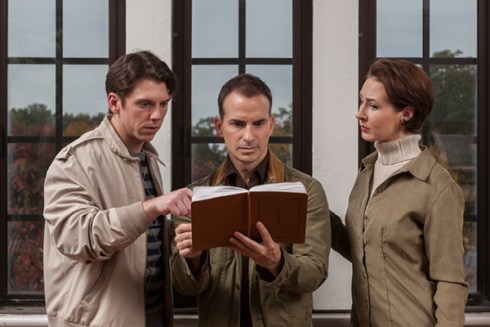
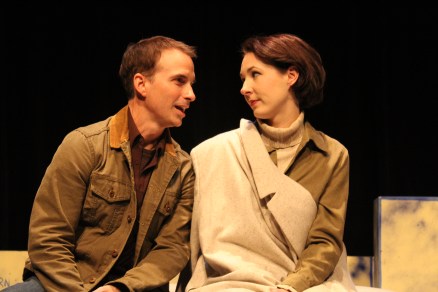
“It’s a well-written, Pulitzer Prize-nominated script,” Lambert stresses. “It’s sophisticated, it’s funny, it’s compelling, and it’s mysterious, full of Easter Eggs that reward the attentive audience member. It has six completely beguiling characters. I’m excited by the device of the dual roles, where the actors we see portraying Walker, Nan and Pip in Act 1 turn around in Act 2 and play their parents. These three talented actors in our show are so adept, so good at what they’re doing, they really are two different characters for me.”

Notwithstanding all that Roberts hoopla, Walker and Ned, the son and father Lafontaine will play, have always been the core characters at the heart of Three Days. Both are startlingly eccentric – and brilliant. After his dad’s funeral, Walker had vanished so completely that his sister Nan, the sensible branch of the Janeway family, had given him up for dead while he was holed up in Italy for a year. The siblings now meet at an unoccupied loft where, 35 years earlier, Walker’s dad had designed his masterwork, Janeway House.

But wait a second. When they finally read Daddy’s will, the sibs discover that, instead of going to them, the Janeway House has been inherited by their longtime friend Pip, the son of Theo Wexler, who was Ned’s partner at their architectural firm. It’s a mystery. To get to the bottom of it, Walker obsessively pores through his dad’s terse diary, which he discovered soon after he returned to the loft.

Friction, mystery, and brilliant minds are all in the mix.

“The dialogue is fantastic,” Lafontaine enthuses. “It has an almost Aaron Sorkin feel to it. Sure, I think it’s funny in a lot of places. Thank God. Otherwise, I think we’d be driving audience members to therapy after. And the mystery adds another interesting element to the play. But for me, it really is more of [a dramatic] study about the relationship between children and parents.”

Bower, who plays Nan and her mom Lina, burst onto the Charlotte scene in 2007 with starring roles in Thoroughly Modern Millie and The Wizard of Oz. By the time she dropped out in 2014, Bower had drawn acting paychecks from every company in town that cuts them – Actor’s, Children’s, and CPCC Summer Theatre. She became the most persuasive poster child we had for the notion that stage acting could be a viable profession in Charlotte.

Then she took a position as teacher and director at Providence Day School to expand the theatre program there and carry herself from car payment to car payment. She came out of “hiding” this past summer, choreographing Cry Baby at Theatre Charlotte, and now she is acting under her second Actor’s Equity Association contract within the space of two months.

“I am so lucky to have been a part of The Revolutionists and Three Days of Rain. Being a part of two projects that care enough about their actors to jump through the AEA hoops is humbling. Not only do the production teams care about their actors, but both of these scripts are the best of the best.”

Paige Johnston Thomas, who directs, brings an additional chunk of Charlotte Rep DNA to the Lambert-Lafontaine production team. Her first acting gig in the Queen City was in another three-person cast, playing C in Rep’s 1995 production of Edward Albee’s Three Tall Women. Thomas’s most recent paying gigs in theatre have been directing at Theatre Charlotte and Davidson Community Players.

But her most important role on the local scene is as an “anti-relocation advocate,” having founded C&J Casting with Mitzi Corrigan to help local theatre pros get steady work in commercials and film.

Thomas saw Bower’s outing at Goodyear Arts, where she portrayed a vain, charismatic, and bubble-headed Marie Antoinette.

“I texted her this after the show: ‘I couldn’t keep my eyes off you,’” Thomas relates. “Which in real life sounds kinda creepy, but in the acting world, it’s a huge compliment. She has an innocence that is constantly being belied by her quick intellect and emotional depth. It makes for great conflict, which makes great drama.”

Head for Duke Energy Theatre if you want to see it. Then consider hitting your hip if you like what you’ve seen.

Charlotte’s Off-Broadway Poignantly Pieces “Three Days of Rain” Together

Review:  Three Days of Rain

By Perry Tannenbaum

At a pivotal moment in the opening act of Richard Greenberg’s Three Days of Rain, Walker Janeway pounces on a sentence in his dead father’s journal that only becomes visible in a certain slant of light – a stain that turns out to be words. Written by celebrated architect Ned Janeway shortly after the untimely death of his business partner, Theo Wexler, the phrase leads Walker to believe he has found the answer to why his father’s will divided his estate so shockingly.

There’s a bit of a cosmic joke that Walker is playing on himself here, but we don’t get to see it until deep into Act 2, which takes us back 35 years to 1960. In the same loft where Walker pored over Dad’s journal, we encounter Ned, Theo, and Lina, the woman who is torn between them. These are the parents of the people we’ve met at the start – Walker, his best friend Pip, and his sister Nan. And they’re the same actors, so you’ll catch the resemblance.

What Walker gets wrong is the true object of that wee stain of a sentence. He presumes it refers to all the world-famous buildings and homes conceived by the Wexler-Janeway architectural firm with their genius designs. Turns out that Lina, Nan, and Walker himself were more likely at the heart of what Ned was getting at.

“Everything,” you see, can mean a lot of different things.

Probably because all eyes were on Julia Roberts when Three Days of Rain made its Broadway debut in 2006 (nine years after its original run at Manhattan Theatre Club), more than a couple of critics were as off-target as Walker in their suppositions when they sleuthed out the point of it all. Restoring the original balance of the script, which centers its concern on the relationship between Walker and Ned, the current Charlotte’s Off-Broadway production at Spirit Square enables us to see more clearly.

Sure, it might be tempting conclude that Three Days of Rain demonstrates how narrowly children know their parents, flipping the plot of King Lear. Yet this production at Duke Energy Theater, so meticulously directed by Paige Johnston Thomas, reveals all of the pains Greenberg went to in making sure that Walker and Nan are exceptionally ignorant of their parents’ relationship and inner lives. So is Pip, vis-à-vis his dad.

We hear early on from Walker that his dad was nearly mute throughout his childhood, though we don’t learn why until we meet Ned after intermission. As for Lina, she has been strung out on drugs and/or insane since Walker was eight years old. Perhaps Walker could have gained some additional insights if he had attended Dad’s big A-list funeral and listened to the eulogies, but he skipped that, preferring to brood artistically in Italy for a year. Add to those deprivations the usual distance between fabulously wealthy parents and their kids – both of whom are free to globetrot when the impulse hits – and you can see why the journal that Walker discovers at the fateful loft is like a precious canteen filled with water that surfaces in the vast Sahara.

Ryan Maloney’s set design has a loosely precise look, like a blueprint drawn free-hand. Even in its abstractness, the design doesn’t destroy the workshop vibe of the loft. From the moment he appears on these hand-drawn quadrangles, Brian Lafontaine delivers a beautifully calibrated performance as Walker. You might look back, when it becomes obvious that he’s a snooty, shiftless, and irresponsible underachiever – with sprinklings of self-pity and hypochondria– and think that Lafontaine was a little too genial and yielding at the start.

Yet he’s not only speaking to us for the first time, he’s also meeting up with Nan for the first time since he disappeared without telling anyone where he was going. During his yearlong absence, Nan had come to terms with the probability, after hired detectives came up empty, that her brother was dead. So a bit a caution and contrition must be stirred into Walker’s Bohemian mix. Especially since he has forgotten that he was supposed to rendezvous with Nan at the airport. Ooops.

The meanness and arrogance of the man, peppered with resentment and delivered with some nasty sarcasm, come out after the disposition of the estate, when Walker comes back to the loft. Now the brunt of his attention is directed at Pip, who has drawn the one property that Walker cherished most. Pip actually offers a more plausible reason why this has happened: he had actually established a normal speaking relationship with Ned. But watch the seething, stony way that Lafontaine absorbs this and other revelations from his friend. He’s not much of a listener.

As for Lafontaine’s work on Ned, it may stand as the best he has given us in over 25 years on Charlotte stages, surprisingly effortless and touching at the end. Who saw this all winding up like a bittersweet romantic comedy after the fire that brought us to intermission? Restoring Lina to lifesize, Caroline Bower is a huge reason why the Act 2 denouement is so poignant and satisfying. In the opening act as Nan, Bower is far more subtly nuanced, demonstrating how the role can bloom with a real stage actress.

Nan is the offended normal sib who has the right to be absolutely disgusted with her brother’s inconsiderate flights, but if you closely watch her reaction to his blather, you’ll see that she momentarily drops her front of stern reproach, charmed and loving in spite of herself. There’s a parallel ambivalence in her attitude toward Pip, hints thrown our way when he appears in the second scene, fireworks ready to explode when the reason is disclosed in the Act 1 climax.

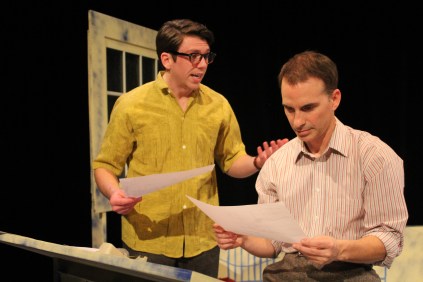
If Lafontaine and Bower embody one of the chief satisfactions of a vibrant local theatre scene, watching familiar professional performers radically transforming themselves into new roles, Chris Speed personifies the excitement a newcomer brings. After his richly textured accounts of both Pip and Theo, I can hardly wait to see what he does next. Pip realizes that, making his living as a soap opera stud, he is little more than a thin shadow of what his great father was. But he’s cool with that, though he seethes at Walker’s perpetual hypochondria and condescension, helping to bring the 1995 action so nicely to a boil.

Less open to the charge of superficiality – because he has loftier ambitions – Theo is like his son in his charismatic ability to navigate his career path. Yet he’s as undervalued when we see him in 1960 by Ned and Lina as Pip will be by their children 35 years later. We need to piece it together, connecting Theo’s final exit with the story Pip has told about him in Act 1, to realize that he’s really the best person we see, more than worthy of the barely legible tribute that Ned has written to him in his journal.

While Ned was reticent as a father after his disloyalty to his best friend, Theo was devoutly secretive with his wife and son, keeping hurts hidden that only Ned and Lina could have suspected. Speed does an excellent job of making the virtues of both Wexlers mesh together as a family trait. I found that Theo’s last walk into the wings, huddled in a trench coat on the last of Greenberg’s three days of rain, lingered long in my memory.

One other little signpost to catch in Act 2 – one that Greenberg himself pointed to in a 1998 interview with American Theatre magazine – when measuring Ned’s actual attitude toward his son against Walker’s perception. Ned expatiates at length on his desire to abandon architecture and become a flaneur, a loafer who strolls idly around town. “I find it moving,” said Greenberg, “that the father would name him after what he loved.”

And I find it ironic that, in the upshot of Walker’s life until we get our last glimpse of him, a father’s blessing has become a curse.

No, the point isn’t just that we narrowly know our parents. That’s taking Greenberg’s drama rather obtusely, for Pip lost his father at the age of three! Time after time, these young people who are so familiar with each other prove to utterly misjudge one another. They know each other narrowly and, on top of that, know themselves narrowly in different ways. So eventually, Three Days of Rain and old King Lear actually intersect.

Symphony Demonstrates Their Seasoning in Beethoven

Review:  Beethoven’s Violin Concerto

Beilman3(credit_GiorgiaBertazzi

By Perry Tannenbaum

Beginning in September with two of the pinnacles of Western music, the Emperor Concerto #5 and the Choral Symphony #9, the Charlotte Symphony has been presenting an autumn of Beethoven. They rewound Ludwig to Symphony #1 in October and checked in with two more symphonic works earlier this month, the Violin Concerto and the rarely performed “Overture to The Consecration of the House.” So it figures. They’re getting good at it.

Unlike the masses, I look forward to live performances of the Beethoven’s Violin Concerto far more eagerly than yet another iteration of the mighty Symphony #9. In fact, I played hooky from the earlier concert where the great Chorale kicked off the 2017-18 Classics Series. If Leo Direhuys, Peter McCoppin, and Christof Perick could triumph with the Symphony and their chorus (formerly known as the Oratorio Singers of Charlotte), so could their current maestro, Christopher Warren-Green.

Brassy, stately, contrapuntal, and grand, the Consecration overture convinces you that Beethoven had an English period like Haydn and Handel. Ludwig was likely studying Handel, along with Bach, when he received this commission in 1822 – or harvesting the fruits of recently studying those giants. It is music that Warren-Green, hailing from the UK, showed a natural affinity for. The maestro certainly sparked a fleet, zesty performance from the orchestra, especially the trumpets and the trombones, who brought gilded fire to the heraldic episodes.

Earmarks of the second movement of Choral Symphony showed up in the bustling section of this delightfully chameleonic work, and the ending took a similar path in amping up its intensity. I wasn’t at all surprised to discover that the composer was putting the finishing touches on both works at about the same time.

Beethoven had already completed his Symphony #5 when he wrote his lone Violin Concerto in 1805, so we can count it as one more glory of his wondrous Middle Period. After triumphing with the overture, Warren-Green wasn’t letting up on the orchestral power. The violins, sweet in their opening passages, became sharp and lively with the onset of the timpani.

You could say, then, that after 13+ minutes of prime orchestral Beethoven, guest soloist Benjamin Beilman had a tough act to follow in his Charlotte debut. But this wasn’t his Carolinas debut, for the violinist has been one of the featured artists in the Bank of America chamber music series at Spoleto Festival USA for the past three years. He makes a suave impression, and I’ve heard him excel down in Charleston in a Beethoven string trio, a Ravel duo, and piano quartets by Dvorak and Fauré. But I was interested to see what would happen when he collided with this concerto colossus.

Beilman1(c)GiorgiaBertazzi

When the collision occurs, the music should win, carrying the soloist with it. You can hear that happening on the very best recordings, such as Itzhak Perlman’s with the Philharmonia Orchestra or Isabelle Faust’s with the Orchestra Mozart. Nothing quite that magical happened as Beilman took on the epic Allegro ma non troppo opening movement. But if Beilman didn’t sweep us up to the skies, he certainly treated us to some of the most muscular high notes I’ve heard at Belk Theater and – within his first solo spot – some stunning pianissimos.

While the ideal flow of the labyrinthine lines eluded him in the early part of the movement, the virtuosity demanded by the climatic cadenza did not. In the Larghetto middle movement, the woodwinds supplied cathedral-like sounds for Beilman’s rapturous entrance, a perfect showcase for his burnished midrange.

Flaunting tradition, he actually paused before the captivating Rondo-Allegro finale. After the dilatory opening notes, however, Beilman pounced on the familiar theme like a panther and infused the pizzicato passages afterwards with eager delight. The majestic cadenza was like a mini-concerto of its own, sweet and wistful at its center with fire and intensity on both ends.

After intermission, Warren-Green needed to grab a microphone and tell us about the novelty he had embedded in Symphony’s rendition of Johannes Brahms’s Symphony #4. Apparently, the composer had attended a performance where the conductor had reduced the violas to a mere two players when their section was to be most prominent. Brahms heartily approved, so Warren-Green decided to revive the practice.

When that hushed moment came in the Andante moderato second movement, and principal violist Benjamin Geller and Ning Zhao brought brief attention to their oft-overlooked section of the orchestra, it was a curiously effective way to evoke the living presence of the composer – 132 years after his death. Warren-Green’s anecdote also subtly pointed up the meticulous preparation of the entire performance.

You could hear the scrupulous attention to detail in the sweep of the violins in the opening Allegro. Aside from the violas, principal clarinetist Eugene Kavadlo and principal oboist Hollis Ulaky distinguished themselves in the newly emphasized second movement. The ensuing Allegro giocoso had a frolicsome feel as timpanist Leonardo Soto pleasantly traded licks with a triangle. After a long respite from Beethovenian fire, the flame was relit in the Allegro energico finale.

Battles between the violins and the trumpets were deliciously intense. These were counterbalanced with solo dialogues between principal French hornist Frank Portone and principal flautist Victor Wang – and a second helping with Portone and Kavadlo. Heading out of that quiet section into the rousing finish, the whole French horn section had their best showing of the night.

DiChiera’s “Cyrano” Throbs With the Power of Love

Review: Cyrano

By Perry Tannenbaum

Since making his Charlotte debut at the end of 2001-02 season, directing a triumphant Barber of Seville, Bernard Uzan has been a key part of the Opera Carolina story for over 15 years. His artistic contributions to numerous productions – including The Marriage of Figaro, Così Fan Tutte, Faust, Roméo et Juliette, Carmen, Lucia, Nabucco, The Pearl Fishers, and last season’s reprise of his Barber – have been among the most memorable during principal conductor James Meena’s tenure as the company’s general director, which began one season earlier.

With the advantage of hindsight, it seems inevitable that when Meena cast about for an adventurous new piece to present, the first contemporary opera at Belk Theater since Margaret Garner in 2005, he would light upon David DiChiera’s Cyrano. Not only has Uzan directed this opera – twice – at Detroit’s Michigan Opera Theatre, where it premiered in 2007, he authored the libretto. Compounding that inevitability, DiChiera commissioned Margaret Garner for Michigan Opera, the company he founded and led.

Adding poignancy to the current Cyrano revival, DiChiera disclosed that he had been diagnosed with pancreatic cancer this past April, about the same time that he announced his retirement. Yet the 82-year-old composer and impresario was observed sitting next to Uzan at the Student Night preview performance, still tweaking his legacy magnum opus.

Like Henri Cain’s libretto for Franco Alfano’s 1936 Cyrano de Bergerac, Uzan strives to retain Edmond Rostand’s original verse. Predictably, Uzan’s highlighter seems to have fallen upon many of the same passages, but his emphases are different. In the opening scene, where Christian and Roxane first become captivated with each other while Cyrano is dispatching assorted foes, both Uzan and Cain are taken by Cyrano’s enthused exclamations when invited by Roxane’s duenna to a rendezvous the following morning. Despite Cyrano’s preternaturally long nose, he might win Roxane’s love!

Cain and Alfano include the lines where Cyrano proclaims that he now has 10 hearts and 100 arms – where he feels too strong to combat dwarves, calling for giants instead – but Uzan and DiChiera revel in them, repeating them as they bring the scene to a close. Earlier when Cyrano is parrying swords and insults, there is an extended skirmish with a Marquis in the entourage of the wicked Comte de Guiche, who also fancies Roxane. Cain seized upon the unique action display in this altercation, where Cyrano composes an impromptu ballade while dueling the Marquis. Uzan emphasizes the witty preamble to the duel, when Cyrano responds to the Marquis’ feeble insult of his nose by improvising a bevy of insults he should have hurled – in various styles that include aggressive, friendly, kindly, thoughtful, dramatic, and enterprising barbs.

Although the scores were unveiled more than 70 years apart, DiChiera’s music fits into the era of Strauss and Puccini almost as comfortably as Alfano’s, though the newer opera leans more towards cavatina and less toward aria and cabaletta. There are no spiky outbreaks of dissonance or raucous percussion to daunt operagoers, for the orchestration by Mark Flint, newly revised by Steven Mercurio, is both lively and lovely. Better yet, Mercurio is in the pit conducting the Charlotte Symphony, the Opera Carolina Chorus, and the men of the Johnson C. Smith University Choir, giving the music his stamp of authenticity.

The man behind the nose is baritone John Viscardi, who impressed me more and more as the evening progressed. Cyrano’s flamboyant self-caricatures weren’t nearly as spectacular coming from Viscardi as those jubilant exclamations, and I exited the opening scene feeling that we hadn’t sufficiently explored the poet’s yearning for the beauteous Roxane or the critic’s self-loathing for what he finds in the mirror.

If the rendezvous with Roxane in the next scene at a poets’ bakery doesn’t offer ample opportunities for lyricizing while his beloved is revealing her adoration for Christian, the sinuous path of her confession does give Viscardi the opportunity to underscore the fact that Uzan demands real acting from his singers. There is real snap to the ensuing episode when Cyrano’s fellow cadets invade the bakery and our hero meets the newly-enlisted Christian for the first time. Even before he volunteers to write Christian’s love letters, his enthusiasm toward the man Roxane idolizes – despite the contempt he has just absorbed from him – testifies to his own idolatry of Roxane. When he does make his pact with Christian, a spark is lit that burns brightly for the rest of the opera.

Viscardi burns brightest in the moonlit balcony scene when Cyrano is forced to step in for the handsome Christian and woo Roxane under the cover of darkness. Here Cyrano’s improvisations are so ardent and beautiful that I feared Christian might realize, an act too soon, how much Cyrano adores Roxane and how fervidly she reciprocates. That realization does come on the battlefield after the second intermission, but Rostand compressed the timeline so cruelly there that neither Christian nor Cyrano could disclose the truth to Roxane before her newlywed husband perishes.

Both in his writing and directing, Uzan makes key mistakes in the closing convent scene that affect what Viscardi leaves us with as Cyrano. You would never know that Rostand titled his Act 5 “Cyrano’s Gazette,” for no mention of Cyrano’s gadfly writings remains in the libretto. Nor does Cyrano’s best friend Le Bret come to inform Roxane how Cyrano’s satires have led to his undoing. Yes, Cyrano will read the farewell letter he wrote to Roxane on Christian’s behalf one last time before he dies, but we don’t hear any tasty tidbits from his Gazette to remind us what a witty rogue he was.

Those who are introduced to Cyrano through this opera will need to remember his wit from the opening scene, but surely everyone should be given a firm grasp of the moment when Roxane realizes that Cyrano penned every one of Christian’s glorious letters – and risked death to deliver them. As director, Uzan needs to sharpen the business where Viscardi stops reading that farewell letter and Roxane sees, totally transfixed, that he’s reciting it. Hung over from past encounters with Cyrano de Bergerac, I’m always in tears at that moment, but I’d like to be sure newcomers experience it with the same power.

Aside from that sloppy denouement, soprano Magali Simard-Galdés brought perfect enchantment to Roxane. There was a growth curve to her performance that theatergoers and opera lovers alike will savor. Through her girlish confession to Cyrano, Simard-Galdés is somewhat superficial when she sings, bubbly like a Rossini heroine. But in the moonlight, where she comes to adore Cyrano’s soul through his voice, she is not merely transported. She begins to be transformed, and we hear it in her newly rich responses, when she honestly believes she’s hearing Christian’s true self for the first time.

I’d forgotten that Roxane, with bravery to match Cyrano’s, follows Christian on to the battlefield through enemy lines, drawn by the power of his letters. What a moment! John Pascoe’s original costume designs, lovingly preserved from the 2007 premiere, go a long way toward injecting the requisite glitter into the Parisian scenes, despite the rather generic (and wisely uncredited) set design. The magnificent dress she wears after the second intermission turns her entrance through the encamped cadets into a luminous sunburst, making this tableau reminiscent of those dark gloomy Rembrandts where light is concentrated onto just one shining sector.

Simard-Galdés’s vocals shine in that scene, too, with fresh maturity and warmth. What stands out so vividly here, perhaps more vividly than in conventional stagings of Rostand’s “Heroic Comedy,” is how significantly Cyrano ennobles both Roxane and Christian during the 1640 scenes. Sadly, when the curtain comes down in 1655, he still hasn’t realized what he has achieved with those two souls.

From the moment we first see him as Christian, the power and purity of Sébastien Guèze’s singing seem to flatten his growth curve vis-à-vis Roxane’s. The tenor certainly upstaged Viscardi for me when he first emerged, but he regressed nicely when Christian’s boyish confidence collided with the necessity of saying something impressive and gallant to Roxane in their first tête-à-tête.

Guèze’s best moments come in DiChiera’s Act 3 when Christian has his epiphany after absorbing two earthshaking revelations. First, he learns how bravely, diligently, and devotedly Cyrano has acted in writing to Roxane twice daily. Then he learns that Roxane now loves him for the letters she thinks he has written and not for his physical allure. Guèze lets us see and hear that Christian gets it. Not only that, but realizing what an incredible friend Cyrano has been to him, he reciprocates as best he can, renouncing Roxane and urging Cyrano to claim her. Truly cavalier and very touching.

Worldliness gradually melts away from this story, but while it holds a grip, bass baritone Kyle Albertson as Comte de Guiche is its most malignant force, unctuous in his unwanted attentions toward Roxane and dangerous in his power over the cadets. On the lighter side, tenor Eric Johnston is the jovial baker poet Raguneau, so jolly that he escorts Roxane to the battlefield, momentarily turning the cadets’ grim situation into a block party.

Johnston comes by his enthusiasm naturally, for he played the same role in the same costume at the premiere of Cyrano a decade ago. He, Uzan, Mercurio, and DiChiera are all affirmations that this work is still alive, well, and continuing to evolve. This emotionally satisfying Opera Carolina production affirms that DiChiera’s Cyrano is well worthy of more life and wider exposure.

Actor’s Theatre Stages a Superior “Hand to God” – In Hilarious Spurts

Review:  Hand to God

By Perry Tannenbaum

There are certainly instances when a touring version of a Broadway hit comes to Charlotte – or when a local company tackles a Broadway or off-Broadway show I’ve previously reviewed – that I’m tempted to tell people that they missed out by not catching this show up in New York. On the other hand, there are stellar productions like the Actor’s Theatre take on Robert Askins’ Hand to God, currently at the Hadley Theater on the Queens University campus, that make me wish to tell all who saw the Broadway version, “You wuz robbed!”

Elements of what director Chip Decker and his Actor’s Theatre cast deliver just make me wish to exclaim “Wow!” because they’re done so well, while others make me think “Of course!” because the Broadway production missed them. The wows begin with Decker’s set, proving once and for all that the Hadley is more than a make-do location until Actor’s settles into its new facility on Freedom Drive. Next year, we hope.

Seating capacity is in the off-Broadway category, but the height and width of the drab Texas church basement, where we meet Jason and his widowed mom, belies any cramped expectations. It’s high enough so that an unexpected entrance from street level can be fairly epic – and risky. When we adjourn to a nearby playground, a pair of swings can smoothly descend from the fly loft so that Jason’s tentative overtures to Jessica, his puppet class classmate, can go freakily awry.

The chief reason why things go wrong all through this dark 80-minute comedy is Jason’s puppet, whom he calls Tyrone. If what I read about Hand to God productions around the country is indicative, props designer Carrie Cranford has created four Tyrones. And maybe some spares. Each one is bigger, more ornate, and demonic than his predecessor. From what I remember – and what I can pull down on YouTube – Cranford’s latter creations are more fearsome than those that terrorized Broadway.

We see a relatively benign incarnation of Tyrone before the action begins, recounting the story of humanity leading up to the invention of the Devil as a convenient excuse for the evil that we do. But couldn’t this disclaimer be a diversionary tactic from the Devil? Bwa-ha-ha!

Askins, of course, wants to have it both ways. There are numerous reasons for us to conclude that Tyrone’s lewd spewings stem from his troubled past, most notably the death of his father, and his mom Margery’s outré way of coping with her grief. She’s still not a great mom, doesn’t have much control over her sexual cravings, and she’s forcing Jason into this whole church-and-puppetry scene.

Pressured by Pastor Greg to present a puppet show at an upcoming Sunday service, Margery is deaf to her son’s desperate pleas to give up puppeteering. So is Tyrone, who has developed a life – and a voice – of his own.

After similar bullied roles at Actor’s Theatre in Bad Jews and Stupid Fucking Bird, we can rely upon Chester Shepherd to be a frailer Jason than the more imposing Steven Boyer was on Broadway in 2015. But the softer Jason is paired in Shepherd with a more vehement, rabid, and guttural Tyrone than Boyer was at the Booth Theatre – a voice that leaves Cookie Monster in the dust, fully worthy of Cranford’s latter puppets. Shepherd’s manipulation of these puppets is as uncanny as the abrupt and violent shifts in his voice when Jason and Tyrone engage in their fiercest showdowns.

I read that one Jason/Tyrone in a regional production steamed his vocal cords after every performance. Not sure if that would be enough to repair the abuse I saw Shepherd inflict on his larynx. At certain points, I had to worry whether Shepherd had gotten carried away – OK, possessed – by his Tyrone. It’s an extraordinary performance, that’s for sure, but never a slick one: though Jason flaps Tyrone’s toothy yap, Askins doesn’t want the lad to attempt ventriloquism.

Nicely aligned with the diminutive Shepherd, Decker has deglamorized the older generation, offering us better assurance that Margery truly is at loose ends, that Pastor Greg might be desperate for her companionship, and that we’re truly in Cypress, Texas, and not Hollywood. Longtime leading man Mark Kudisch and Geneva Carr were less reassuring on Broadway than Brett Gentile and Marla Brown are at the Hadley.

Brown is more than sufficiently attractive to believably draw the attentions of Pastor Greg and Timothy, the resentful delinquent in her puppet class. But she comes at us frumpier, more frazzled and humdrum domesticated. That works so well for the nasty surprises she has in store for us and for the two teenage boys.

From the first time he performed at Actor’s Theatre in 2004 as a domineering cop in Lobby Hero, Gentile has shown the ability to be the tough guy, capable of truly bodacious bellowing if you set him loose. Yet he can turn around and be meek and pastoral, visibly wounded by Margery’s rejection. Unlike Kudisch, with his John Wayne bulk, when Gentile confronts Timothy or the rabid Tyrone, you can wonder what the outcome will be. These were probably the chief “Of course!” moments for me at the Hadley.

Grant Zavitkovsky isn’t as wiry or urban as his Broadway counterpart, so he doesn’t come across at first with quite the same nastiness and menace as Timothy, but his better looks and substantial size are better reasons for Jason to fear him and envy his success with women. There’s also a slight patina of complacency to Zavitkovsky that works very nicely before those instants when Margery and later Tyrone shock him.

Behind the multiple layers of her costume, Lizzie Medlin remains somewhat inscrutable as Jessica throughout Act 1. She recoils from Tyrone’s first breakouts with an utter spontaneity that compounds Jason’s embarrassment. Yet her later actions partially vindicate Tyrone’s contention that his lewd frankness was the best way to go. Nothing she does prepares us for her action heroics in Act 2.

All I’ve got say about that is to congratulate Medlin, Shepherd, Decker, and Cranford on the most hilarious puppet sex I’ve ever seen – and probably the best puppet therapy. Way better than Broadway, though perhaps the elderly ladies in the front row should have been warned that they were sitting in a splash zone.

Amid this unique brew of the bawdy, the violent, and the diabolical, Askins would have us contemplate the ontology of evil, the devil, and saviors. I could see where you might wish to skip that assignment.


Subversive Energy Still Ignites “Fahrenheit 451”

Review:  Fahrenheit 451

By Perry Tannenbaum

Each time Ray Bradbury’s Fahrenheit 451 returns to Charlotte, it seems like a telltale barometer: how much closer have we come to fulfilling its grim dystopian vision – or how much further have we mercifully drifted away? Book burning and other assaults on culture may have been more virulent when the sci-fi classic was last served up at Children’s Theatre in 2005, when Taliban desecrations flamed our anger, or as recently as 2015, when ISIS insanity ruled Mosul and Palmyra.

With Kindle and Google Books, the concern nowadays seems more centered on physical books and booksellers, for notwithstanding the proud illiteracy of the toxic Agent Orange 45 – who still knows words, mind you – reading and literature appear safe for now. The battlefront seems to have shifted to information, reporting, and science. In Charlotte, the culture wars played out at local theatres back in the 90s have been upstaged by anti-LGBT initiatives in the state legislature and racial profiling on the streets.

Because of the complex crisscrossing of events in Charlotte and Charlottesville in the past few months, it gets pretty murky when we attempt to draw a sharp parallel between the firefighters that Bradbury’s hero, Guy Montag, breaks away from and the police of today. It was the protestors, after all, who carried the intimidating torches up in Virginia while police meekly looked on.

Forget the Charlottesville hullabaloo, then, if you go to see the Bradbury combustion up at Spirit Square in a crackling Three Bone Theatre production, for the company surely programmed 451 at Duke Energy Theatre between the Charlotte and Charlottesville riots.

Of course, while times inevitably have changed, productions will add another layer of difference, depending on the company and the director. Compared to the Children’s Theatre productions of 1993 and 2005, we get the full Bradbury stage adaptation now. Three Bone’s adds over 40 minutes, clocking in at 2:21, including intermission. The other big changes are the leading men that director Charles LaBorde has chosen.

With Harry Jones Jr. as Montag facing off against Thom Tonetti as Chief Beatty, we have a clash of physical titans that we haven’t seen before, both firefighters looking more like hard-working enforcers. Greater contrasts are also drawn between youth and age, innocence and experience, ignorance and knowledge. Mark Sutton could do many things onstage as Montag, but looming before us as physically – or vocally – intimidating wasn’t one of them. His early ignorance looked comparatively slack-jawed or nebbishy, slightly endearing.

Now we can see Montag as not only ignorant but also devolved and brutish. When Beatty warns that any influx of knowledge or enlightenment gained from reading will instantly register on Jones’s face, we believe it. He and the mass of mankind have evidently regressed so far that taking the first bite of the contents of a book is like beginning all over again – in a biblical or Darwinian sense.

Tonetti can roar nearly as loudly as Jones, and if he certainly isn’t any more rugged as Beatty than Scott Helm was in 2005, he has the advantage of more years to make him seem more experienced, scruffier, more cynical, and more embittered. Helm’s version of the fire chief was cooler, more inscrutable, while Tonetti is a hot boiling mess. He is erudite, filled with forbidden knowledge, and like God in Eden, able to smell the onset of intellect. But ambivalence rages within Beatty, set in his commitment to firefighting yet never able to fully vanquish the notion that he has made the wrong choice.

Library

Written in 1953, Fahrenheit 451 isn’t prescient about women’s advances in the future, but Bradbury was writing about a dystopian America, so we’re likely to give him a pass. LaBorde plants some women among the firefighters, and Bradbury’s main women, though not in the workforce, are interesting and varied. Mildred Montag, Guy’s wife, is the most conventional, unquestioning in her devotion to pills and brainless TV pap. Lisa Hatt as Mildred is mindless and sedated enough to be a likely source of Guy’s smoldering discontent.

Interestingly, there is a lax acceptance by Mildred and her neighbors of Montag’s predilection toward books. They’ll let it slide until Montag rocks the boat.

Near the Montags, a neighbor lady is found to have a vast home library that must be incinerated. Angie Cee gets a fine cameo as Mrs. Hudson, the library lady willing to burn with her beloved books, playing her with a memorable wild-eyed zeal – and just a trace of motherly love. Her martyrdom certainly gives Montag the inescapable notion that there might be something in books worth dying for.

Montag’s discontents at home and on the job make him vulnerable to the probing and teasing of his rebellious misfit neighbor, Clarisse. It’s a role that works well with the raffish delicacy that Stefani Cronley brings to it. Cronley becomes a dear and lively enough mentor to Montag for us to feel some of the same emptiness he feels when she disappears.

Perhaps the finest character Bradbury created in Fahrenheit 451 was the crazed fugitive outlaw, Faber. Somebody needs to register the horror of what has happened in America, and somebody needs to have an inkling about what can still be done. Bill Reilly brings a wild unkempt fervor to Faber, a catlike cunning wrapped into his cowardice and a divine spark twinkling in his despair. Mankind’s survival hangs on a slender thread, and he’s it – unless Montag and others like him can work out as recruits.

Like the Johann Stegmeir design concept for the 2005 Fahrenheit, Ryan Maloney’s set design and Ramsey Lyric’s costumes for Three Bone are not averse to the idea that we have entered a nuclear winter as well as an intellectual one. Other novelists have played with the idea that nuclear catastrophe might bring about reactionary rejection of science and culture. In Bradbury’s futureworld, nobody seems to know what exactly brought us to this, and that’s part of what makes it so sad.

Soot of Sodom Chases the Joads in “The Grapes of Wrath”

Review: The Grapes of Wrath @ Theatre Charlotte

By Perry Tannenbaum

If you’ve ever read John Steinbeck’s sprawling masterwork, The Grapes of Wrath, you know that it’s framed with a seething anger as a picture of America’s unfulfilled promises, the cruel exploitation of the poor, and the undiminished aspirations of the Joad family. These dispossessed and determined Oklahoma sharecroppers believe in the dream.

But the Okies are tested before they reach the Promised Land of California and once they’ve arrived. Like the Israelites in the Old Testament, they must cross burning desert. Clutching onto the printed handbills promising work and honest wages, they must resist the report of a broken, disillusioned man who found California to be nothing like the handbills’ hype. They must endure attacks from anti-labor thugs who fear the latent strength of worker groups.

Perhaps most difficult of all, they must strive to hold together despite forces of attrition from within – disagreements, defections, and death. Manna doesn’t shower down upon them from heaven to ease the journey.

We easily presume, with their consuming hope of a Promised Land, that the Joads’ journey is an exodus, a liberation from the landowners who have burdened them with sufferings. Another biblical parallel suggests itself on Queens Road, where Frank Galati’s stage adaptation of Steinbeck’s novel is making its local debut at Theatre Charlotte – a mere 37 years in the wilderness after winning the 1980 Tony Award for Best Play.

Since vile bankers and beancounters cannot loom as large on the stage as they do on the vast canvas of Steinbeck’s pages, another biblical parallel emerges clearly. Under Ron Law’s direction, with severely weathered scenery by Chris Timmons, and stark, pitiful costume designs by Chelsea Retalic – Okie clothing and faces equally sooty – I couldn’t help sensing echoes of the destruction of Sodom and Gomorrah in this depiction of Dust Bowl devastation.

One faint echo is the drugging of Grampa Joad when he resists leaving, a parallel to how Lot’s daughters bamboozled their dad. The loudest echo came from Ma Joad, proving that she’s the antithesis of Lot’s Wife. You’ll recall that when Lot’s family was commanded not to look back while God was raining fire and brimstone on the sinful cities, Lot’s wife disobeyed and paid a famous price.

As the Joads embark, one of Ma’s kinfolk asks if she is going to take one last look back. Her no in response, with the aid of modest embroidery, is so emphatic that we take it as a philosophy. Ma Joad looks forward and moves forward. She lives by doing what needs to be done.

It’s an outlook that she successfully hands down to her daughter, Rose of Sharon, in the poignantly perverse pieta that ends the epic story.

With a performance like Paula Baldwin’s as Ma, we readily grasp that Steinbeck wished us to see her as the steadying bedrock of the family. The jut of Baldwin’s jaw and the tightened sinews of her neck were unlike anything I’d seen from her in her numerous leading roles. She’s unrelentingly purposeful, sternly nurturing, with all the patience and endurance of the ground she stands on.

Standing firm isn’t all that simple on the raked stage that Timmons has built. His pared-down design must accommodate campfires, a riverbank, and a ramshackle jalopy able to accommodate the whole clan. The skin-and-bones truck is altogether worthy of the ridicule it draws. Inspiration taken from the Little Engine That Could? You decide.

Vying with Ma for the right to be called the backbone of the family is the second-eldest son, Tom Joad, a volatile straight-shooter who is coming home from prison after serving his time for murder. It is so telling – about Tom and his fellow Okies – that everyone seems disappointed that Tom didn’t break out of jail. Easy to rile when he or his family is threatened, Tom is a seeker of truth, curious to learn how the system works.

Max Greger subordinates Tom’s volatility to his heartland wholesomeness in a promising Charlotte debut, holding his own when he shares the spotlight with Baldwin or the wild-eyed Andrew Tarek, who shambles brilliantly about as Jim Casy, a former preacher who feels like he has lost the calling. Yet in the same way that Tom is branded as an outlaw after killing in self-defense, Casy is branded as a holy man despite his renunciation – with Steinbeck’s approval, we presume, since four gospels were written about a man with the same initials.

Amid a dust cloud of bleakness and hopelessness, these running gags slightly lift the gloom.

And though there are strong unionist sympathies in the framework of Steinbeck’s yarn, you will also find an all-American emphasis on teamwork, which Law’s cast underplays enough to keep us from smelling Hollywood. Chris Melton has an adolescent randiness as Al Joad that augurs trouble and a shotgun marriage, but he also has a way with cars, performing the marvel of getting the Joads’ jalopy going. Between bouts of guilt, discouragement, and drinking sprees, Victor Sayegh as Uncle John often struck me as the most fatherly in the clan with a generous spirit.

With a cast of 23 trafficking back and forth on the sloped stage, Law needed to shape a deep ensemble that bonded together while divvying up two hours and 15 minutes of running time. Nor could he rely on the top tier of players to deliver all the little crevasses of comedy and poignancy that lurk in the wide tapestry.

Annette Gill and Rick Taylor are largely responsible for getting us off to a rousing start as the ever-bickering oldsters, Granma and Grampa Joad, portraying them as loud and slightly doddering. We get an interesting take on Pa Joad from Ryan Dunn, who doesn’t seem broken by his family’s rude displacement but rather gladly retired from the responsibility of it all, a bit dazed by the turn of events.

Zach Radhuber goes light on the simplemindedness of Noah Joad, yielding a touching moment when he sets off on his own, and Cole Pedigo gives a nerdy edge to the befuddlement of Connie Rivers, Rose of Sharon’s husband. In some ways, Ailey Finn represents the best of the new generation as “Rosasharn,” but it’s suffering that strengthens and ennobles her, and the mysterious smile that ends the novel can’t be incorporated into a stage adaptation.

Law keeps the concept of incidental music from the Broadway version but discards the content, switching from a Tin Pin Alley songlist to a folksy Woody Guthrie flavor. “California, Here I Come” steps aside for “This Land Is Your Land.” Strumming an appropriate guitar, Tom Schrachta attacks the material a bit harshly with his robust voice, but I grew fond of that discord. Schrachta also drew the acting chore of donning a rumpled trench coat (a hint of the spy parallel in the biblical exodus story) and delivering the bad news about California to the Joads.

That same harshness remained in Schrachta’s voice. Yet now it was mixing grief, discouragement, futility, and rage – very much what Steinbeck felt about the ruinous actions of America’s bankers when he wrote The Grapes of Wrath.