Review: Dracula: A Comedy of Terrors at Booth Playhouse
By Perry Tannenbaum
Even before he became a Muppet or a General Mills breakfast cereal, Bram Stoker’s Dracula regularly took on a comical tinge that the novelist could not have foreseen when his masterwork was published in 1897. You can probably place the blame on Bela Lugosi, the first actor to portray the vampire in a talkie, released in 1931. Not only did numerous comedians, impressionists, gameshow hosts, and late-night TV celebs take stabs at imitating Bela’s Transylvanian bloodsucker, so did many of my classmates and kids on the block.
Extra points went to those who flicked their tongues out saying “blod,” the fang-tastic villain’s favorite elixir.
Lugosi himself was in on the joke, reprising the undead Count in an Abbott & Costello flick, but he always remained in character, a mesmerizing, dimly-lit creature of the night. Later films, in the wake of numerous cartoon desecrations, inflicted comical cracks in the mold.
In Love at First Bite (1979), George Hamilton became a New York playboy, still deadly serious but younger, more lustful, more fashionable. He even turned the silky collar of his tux down. And he loved to boogie. Compared to the white-haired Leslie Nielsen in Mel Brooks’ Dracula: Dead and Loving It (1995), however, Hamilton was orthodox. Brooks freed Dracula to be bumbling and accident-prone.
Worst of all, the Nielsen Drac could almost crack a smile. “It’s good to be dead!” he crows.
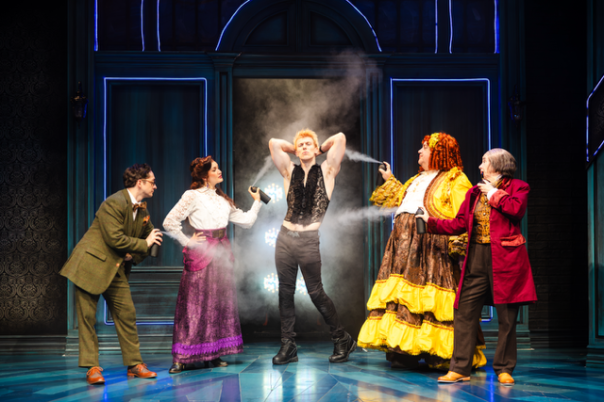
As their title tells you, Gordon Greenberg and Steve Rosen’s Dracula: A Comedy of Terrors is even more brazen. With primeval Transylvanian fogs and mists sprayed from aerosol cans, cute neighing hobby horses terrified by Dracula’s name, and puppet rivals for Lucy Westveldt’s hand, gasps of surprise stem more from mirth than terror. Even flipping the given names of Stoker’s Westveldt sisters is for the sake of getting a laugh.
So it was under Greenberg’s direction on opening night at Booth Playhouse last week, where Blumenthal Arts is presenting the show through August 9. When it came to comedy, there was no suspense at all. Fanged marquees front the lobby off Founders Hall and over the Booth’s proscenium. Themed cocktails are among the sweets and beverages available at the bar, including the lurid “Type A,” served up in a blood bag with a straw. And of course, a swag stand at the other end of the lobby and selfie backgrounds in the middle.
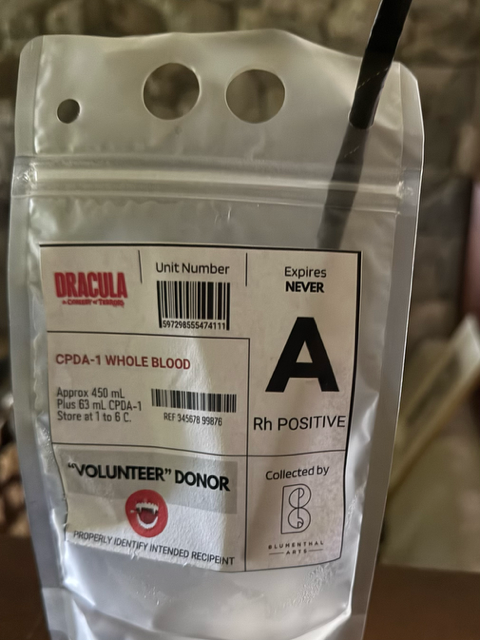
It’s decades too late to accuse the Blumenthal and other tour backers of commercializing Dracula, don’t you think? Just enjoy.
A huge part of Greenberg’s comedy, from the aerosol and hobby horses onwards, is the cheap flim-flam of his theatrics. Skimping on scenery and realism isn’t all. This Dracula also skimps on players. No, our scenery budget cannot accommodate a real spiral staircase. Nor can our cast fill all the roles in our story without most of them doubling, tripling, or quadrupling the characters they portray.
They soldier on, patching the cracks with lame shtick, shameless mugging, cheap props, hurried costume changes, and – when all else fails – pure chutzpah. The flimsier the patchwork, the funnier it gets.
Skimpy is a better word for the outfit that Christopher James Stevens arrives in as the studly Count. No coat, no sleeves, and no shirt – but production photos do reveal a bit of a collar at the top of his sheer, elaborately woven David Bowie vest. The blonde Nordic hair is as sexualized as Dracula’s black jeans and studded belt.
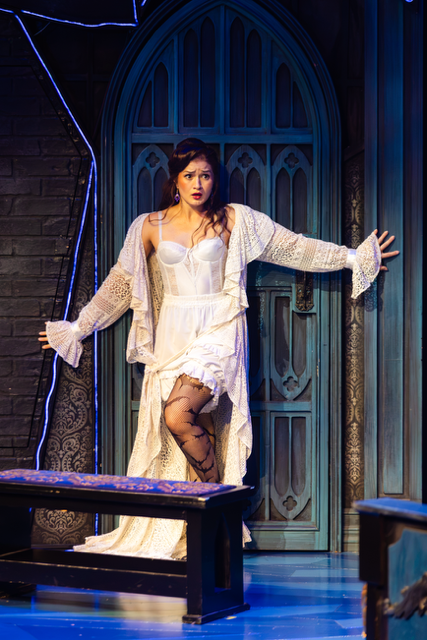
This old man looks really young. And his luscious, toothsome Lucy! What a Victoria’s Secret morsel she becomes when we see Adriane Leigh Robinson (through July 19) in her Victorian boudoir, besieged by a thirsty vampire who has never been so aroused.
With so much excess and kinkiness already on demand, Greenberg compounds it by leaning enthusiastically into crossdressing. Not only do we get a bounty of elaborate outfits for Lucy and her Transylvanian worshiper, but costume designer Tristan Raines lavishes outrageously ornate dresses for , to cross-dress into as Mina – before and after Lucy’s ugly sister is bitten and undead – and out of as he transforms into a bustling female Dr. Van Helsing.
Crossdressing goes the other way for Kelly Bashar, who mainly fails to protect the siblings as their daddy, Dr. Westfeldt, when she isn’t moonlighting as the insane, insect-eating Renfield. Her costume changes are among the swiftest, especially funny when they’re on the run.
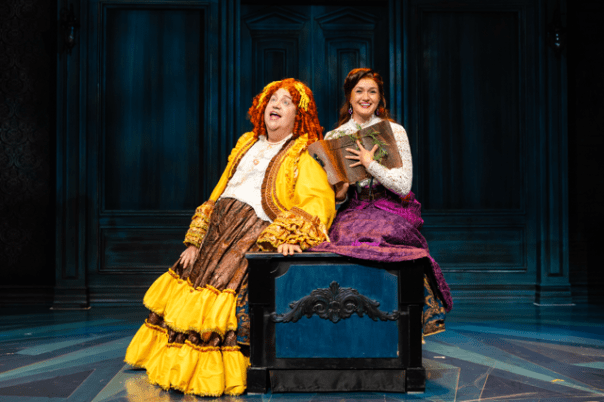
Though not as detailed, intricate, scenically sumptuous, or crammed with characters as the Brooks spoof, Greenberg and Rosen arguably skim Stoker’s storyline more faithfully. A couple of times, in letters from Jonathan Harker and Dr. Westfeldt, Greenberg and Rosen remind us that Stoker’s Dracula was often an epistolary novel when it wasn’t huge chunks of Harker’s and Mina’s journals.
So we begin with Jonathan as he travels to Castle Dracula, where his time is spent more on business, securing multiple properties for the Count in the London area, and not at all on being terrorized by bad dreams and ravenous vampiresses. As Bashar advises us, before transforming into a Man-Eating Wolf and later Dr. W, our presentation will be significantly shorter than the book’s 418 pages.
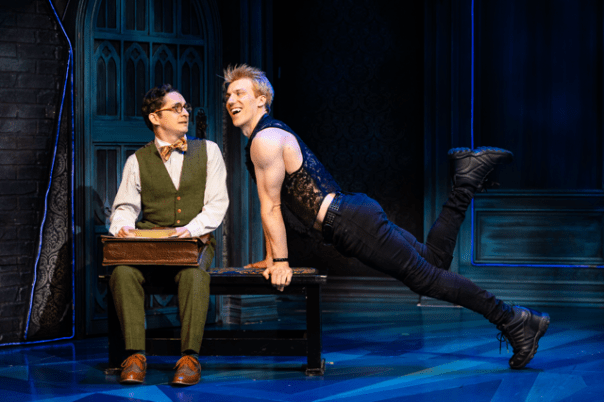
Harker is significantly different from Stoker’s vision of him – or anyone else’s. It’s almost so fine a runway for James Romney, this wonderful character arc of his, that he nearly steals scenes from Stevens’ flaming bisexuality and Robinson’s voluptuousness. He is no Indiana Jones in Transylvania, nor even a Brad from Rocky Horror. He’s a bit tremulous like Gene Wilder was as a leading man in horror films if he were played by Woody Allen, a nebishy weakling.
You begin to wonder what Lucy sees in him – and Lucy herself begins to harbor doubts. Compared with Lucy’s and Dracula’s wild animal libidos, Jonathan’s is a clam. But there is a delicious irony embedded in this Comedy of Terrors storyline, for Harker is startlingly transformed from the moment he is ravaged by his Transylvanian rival. He discovers the animal lurking within him, a midlife onrush of hormonal chaos and libido.
Suddenly, he is capable of fighting for Lucy’s love – and dressing in leather! With all the critical commentary that has been lavished on Stoker’s dark sexual themes, there’s little discussion of the possibility that Dracula is subconsciously crafting his own doom, fulfilling a secret death wish.
Comedy of Terrors brings that notion explicitly to the surface, a wild twist that might actually be a deep and discerning reading of the book. To stage that kind of welcoming of death, of course, Greenberg and Rosen violate all the rules of vampire invincibility by night and vulnerability by day. It’s a climax that audaciously challenges logic, physics, philosophy, and settled pseudo-science.
But it’s just so nutty and hilarious that we go with it. Especially if we’ve drained two Type A blood bags during the show.


