Review: Hairspray at Matthews Playhouse
By Perry Tannenbaum
July 10, 2026, Matthews, NC – One of the most confounding things humans ask themselves and each other is “When are things going to change?” Too many things are changing all the time for that generalized question to be taken seriously – and too many people asking that question seriously have too little inclination to make change happen. In Hairspray, adapted from John Waters’ 1988 film, change comes to Baltimore in 1962, a year before Bob Dylan declared that “the answer, my friend, is blowing in the wind,” and two years before LBJ signed the Civil Rights Act into law.
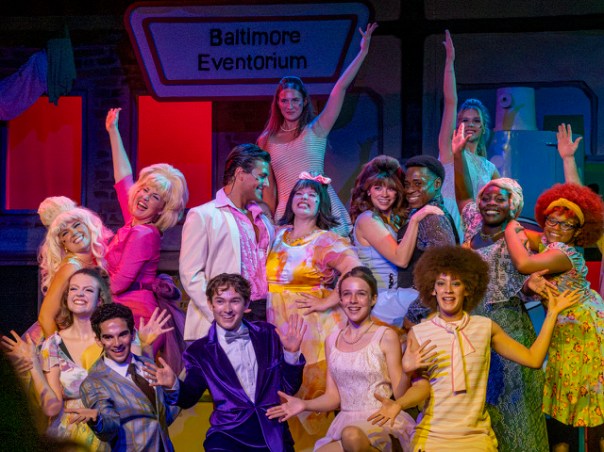
Waters’ script was a rewrite of history that stuck, given new life by the Tony Award musical adaptation. Because you not only can change things with a winning strategy and sufficient effort; when you do, and you’re one of history’s winners, you get to rewrite history as you see fit and invent new heroes. Watching Tracy Turnblad spark change in 1962 Baltimore, you just set aside the need for JFK, Dylan, MLK, and LBJ for a couple of hours. Leave it to Tracy, supported by her dad, to rally a whole city and overturn segregation at a teen dance show on local TV.
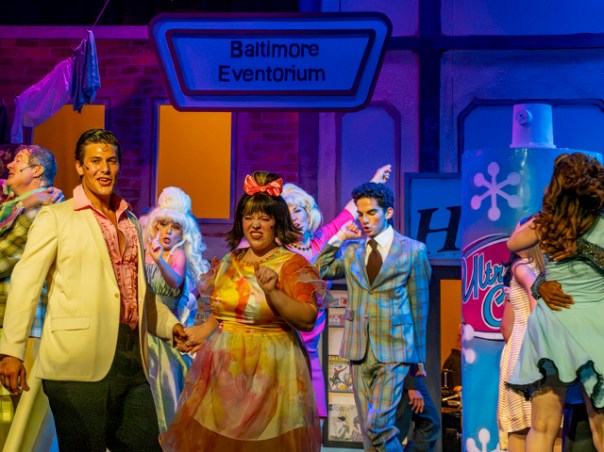
The current Matthews Playhouse production, directed by Sidney Horton, reminds us why Hairspray not only won Best Musical in 2003, but seven additional Tonys. These included Thomas Meehan and Mark O’Donnell for best script and statuettes for Marc Shaiman and Scott Wittman honoring their best musical score. When Horton put out the casting call, the Metrolina talent pool could eyeball four different roles that were juicy enough to deliver Tony nominations to the original Broadway cast. All three Turnblads won the prize, led by Harvey Fierstein as Edna, who undergoes a personal makeover, inspired by her plucky daughter.
Watching Horton’s players at the Matthews Playhouse, you may find yourself surprised that only four original cast members won Tony nominations. What about Corny Collins, the deejay who fronts the afternoon TV dance-a-thon, receptive to the new grooves on the airwaves and open to featuring Blacks more often than on the current once-a-month “Negro Day”? Or Motormouth Maybelle, Corny’s counterpart when the Afro-Americans get their brief chances to shine? Or Link Larkin, the dreamboat teen idol Tracy craves, pragmatic about his career, yet open to developing as a musician and a person?
All three of these prove to be plum roles for Johnny Hohenstein, so charismatic last July as the iconic baddie in Peter and the Starcatcher, and two newcomers, Carter Poulson and Olivia Greene. Corny’s pragmatism allows Hohenstein to be different characters when he’s on-air holding a mic, behind the scenes sparring with his station manager or the show’s sponsor, and out in the wild scouting talent. It’s a less outré ride than Black Stache, but there’s a wider range of phoniness to savor.
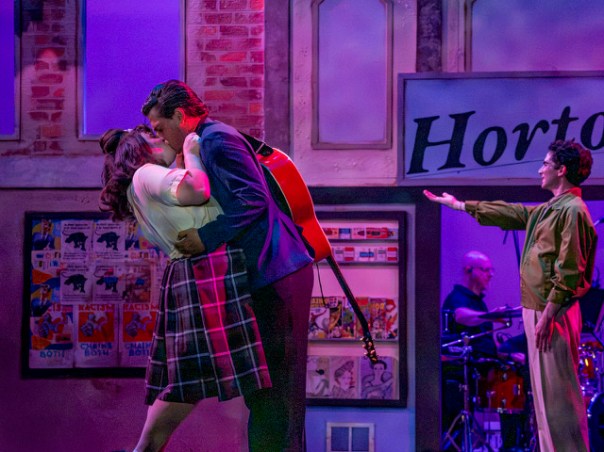
At first, Poulson appears to be the trophy boyfriend of fellow Corny Collins regular Amber Von Tussle, the daughter of WZZT station manager – and former Miss Baltimore Crab – Velma. But when Corny suggests that he croon his new song, “It Takes Two,” as a serenade to Tracy, newly installed on the show over the Van Tussles’ objections, he addresses only his opening overtures to Amber. With both lasses vying for his attention, Tracy nearly drooling, Poulson’s appeal swells the more he croons and swivels his guitar from back to front. Then he comes on to Tracy with a cinematic zeal that would make any girlfriend jealous. A dreamboat’s dream kiss ends the song.
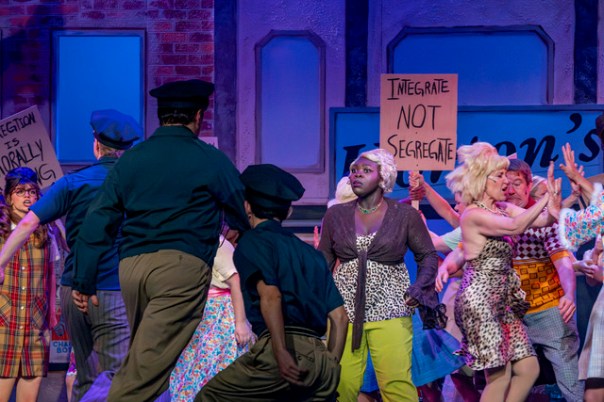
Thematically, Maybelle may be pre-eminent in Hairspray, the mother that Tracy, her bestie Penny, and Amber should have had in their earlier years. Off-air, she’s the den mother to all the talented Afros on The Corny Collins Show who have been relegated to second-class status. Her own brood includes Seaweed, the Afro stud who teaches Tracy and Link some slick moves, and Little Inez, whose audition for the open slot on Corny’s show is doomed by her race. As this living rebuke to Velma, Greene needed to be a big personality from the start. She must grow bigger when she and Tracy lead a street demonstration outside WZZT, demanding desegregation. By the end of the show, Greene must sing “I Know Where I’ve Been,” the anthemic peak of Hairspray.
In her auspicious Matthews debut, Greene showed us that her role in the doo-wop trio in Theatre Charlotte’s Little Shop of Horrors was a mere foretaste of her capabilities. True, she seemed a bit small for Motormouth’s shoes when we first saw her, yet she was more than ample for her climactic showstopper, her crusading gospel spirit getting by far the loudest roar from the opening night audience prior to the big crowning of Miss Teenage Hairspray and the spectacular Edna Turnblad reveal.
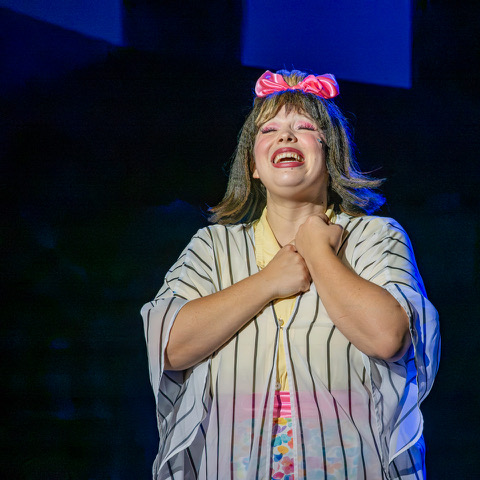
So at various times, the Turnblad clan was gloriously upstaged at Matthews’ Fullwood Theatre. When they’re all professionals or seasoned community performers, that’s not a problem at all. Although I’d never seen her in performance before, Logan Cosper took command of the full Fullwood stage as Tracy from the moment we woke up with her in “Good Morning Baltimore.” Not really your ideal candidate for body shaming, Cosper’s only truly plus-sized aspects were her energy and her smile. As the stage fills up around her, making her way through the city to her high school, those two ingredients are perfect: she needs that sunny cheer so the comedy will click when she passes a drunken derelict on the street. And make no mistake: she’s not merely one of Link’s admirers; she’s his most fanatical. We see significant personal growth from there.
If you spotted Leopard at Booth Playhouse a couple of months ago in his leather motorcycle outlaw outfit in Queen City Concerts’ We Will Rock You, you likely emerged with the impression that he’s way tall and rail thin, not the best fit for Edna. But if you’ve caught him at Theater Charlotte in either Something Rotten! or The Producers, where he formally cross-dressed as the Chrysler Building,you would also realize that sashaying and drag are right up his alley. God and costume designer Beth Levine-Chaitman only know what garments and appliances may lurk under Edna’s housecoat and subsequent makeovers to transform Leopard into the Turnblads’ plus-sized fashion plate.
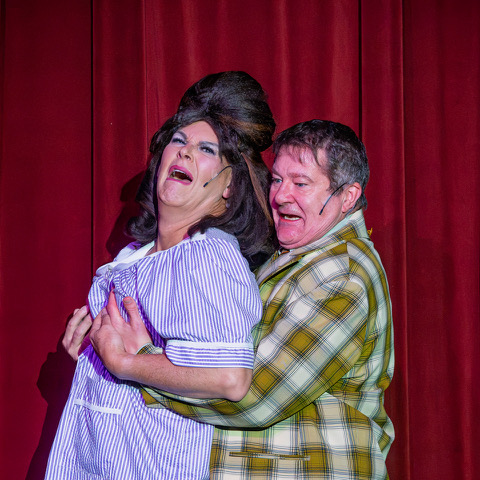
Yet I was a wee bit disappointed to see him so controlled and disciplined. Leopard’s voice could have been an octave lower at key moments for the fullest plus-sized Edna experience. Nor were the constraints strictly directorial. The kitchen or laundry room that scenic designer Chris Morgan provided for Tracy’s mom and dad was woefully minus-sized, barely allowing breathing, let alone stateliness or flamboyance. For the novelty showstopper, Edna’s “You’re Timeless to Me” duet with Wilbur, Horton wisely closed the curtains on the entire set. The effect was very vaudevillian, drawing lusty ovations before and after the couple’s reprise.
That duet was probably the best hook-up between Horton and choreographer Rachel Peterson – or one of the turning points. Through most of Act 1, dancers often moved in place rather than zipping around, so the tableaus lacked depth until the climactic chaos of the protest riot at WZZT. Seemed to me that the onrush of cops and Billy clubs was what transformed the righteous protest into a riot. You can be the judge whether Horton is making that point.
Honoring (or disregarding) the script, Horton allows Mike Carroll, in one of Levine-Chaitman’s tackiest costumes, to attend the big integration protest as Wilbur. Yet somehow, he isn’t arrested along with his family, the Von Tussles, and the Black folk. Overnight during intermission, he is able to sell his store and raise bail for everybody – except Tracy, specially targeted by the malign Velma. So despite his seeming subservience, Wilbur is a mover and shaker, a chief driver in the changes dramatized in Hairspray.Not only is he a struggling store owner, but also a believer in Tracy’s ambitions, in Edna’s dormant dreams, a liberator of jailed protestors, and a supporter of Tracy’s adopted Black community. Along with Tracy, Maybelle, and Corny, truly one of the chief engines of change.
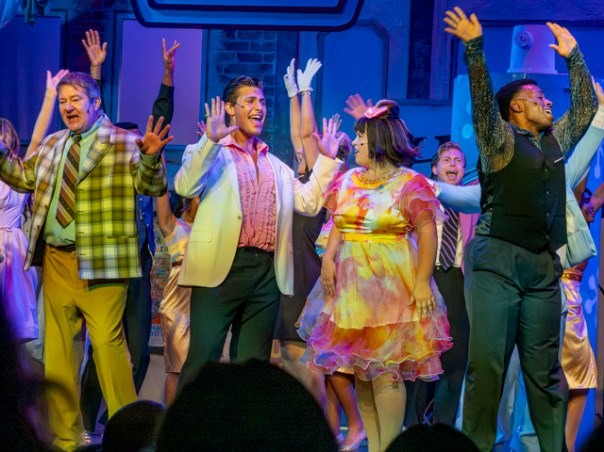
Yet at times, Carroll makes Wilbur cuddly if not diminutive. You may recognize a Buddy Hackett impishness to him in his “You’re Timeless to Me” serenade, before and after Edna warms to it. Apparently, he isn’t Jewish. His best quip, “Shabbat Shalom!” was mangled beyond recognition on opening night, with none of the requisite gusto. OK, Horton does not have the right DNA to make the correction by himself, but where were you, Levine-Chaitman, when we needed you?
On the other hand, we can probably credit L-C for the horrid wigs that crowned the VanTussles’ toxicity, so we can partially commute whatever punishment she deserves for not supplying Carroll with the necessary Hebrew. Keenan Tabor as Velma was far more repellent as Velma when the spotlight was on her for “Miss Baltimore Crabs” in Act 1, but the apple didn’t fall far from the tree when Layne Harder seized center stage for her “Cooties” showpiece. Most of the bug motif that infested the original Waters movie has been fumigated in this Meehan-O’Donnell adaptation. Mercifully so, but Harder’s opportunities to be singularly noxious are curtailed and muted by this cleansing.
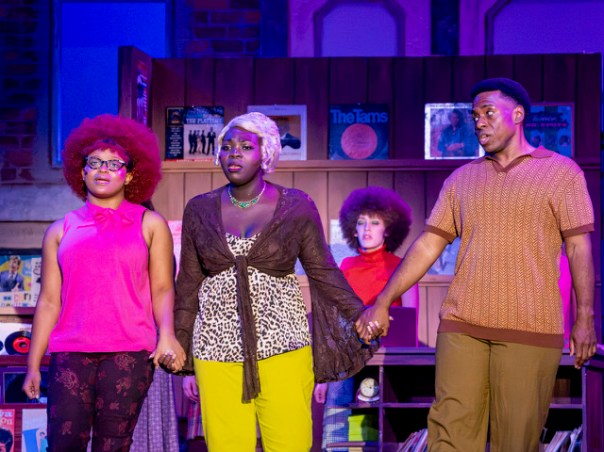
Who to single out among all the other players? Todd Burnette as Seeweed Stubbs was likely the coolest, hippest sight on stage, and Eve Monroe as Little Inez – the standout WZZT auditioner spurned for her race – also springs instantly to mind. As Tracy’s best friend, Penny Pingleton, Corinn Bordelon doesn’t gush over Burnette as Cosper does over Poulsen, but she’s ready enough for love in her shy way. In the breakout double-duet, “Without Love,” where both of the young couples exult over their newfound bliss, it’s a shame that the volume of the eight-piece band, so zestfully led by Ellen Robison, threatened to drown out Bordelon’s most hilarious lyric.
That budding romance Waters filmed in the late 80s wasn’t quite daring enough to say, “now I’ve tasted chocolate and I’m never going back.” So our journey back to the twist and shout and the Madison of the 60s has a sprinkling of the new millennium. Change is good.


