Review: Newsies The Musical

By Perry Tannenbaum
It wasn’t long after music director Drina Keen cued the opening bars of Newsies that I already knew. This Disney musical fits the CPCC Summer Theatre program like a glove. Largely fueled by singing, acting, and dancing talent fresh out of college and grad school by way of regional Southeastern Theatre Conference auditions, CP’s youthful summer company is exactly what you want for a story about underpaid New York City newsboys who dare to strike against newspaper publisher Joseph Pulitzer.
Look at the scaffolding that rises across the stage at Halton Theater, representing the tenements where the raw, gifted Jack Kelly and his fellow newsies are holed up, and you might also suspect that Robert Croghan’s set design measures up well against those of the Broadway production and the national tour. Having seen both, I can add that Croghan’s costumes and Gary Sivak’s lighting also reach those lofty levels. Differences only begin to emerge when the ensemble of paper hawkers starts to dance.
Whether constrained by the limitations of his dancers or the liability limits of CP’s insurance coverage, Ron Chisholm’s choreography doesn’t begin to compare with the high-flying exploits that brought Newsies a best choreography Tony Award in 2012. I found it illuminating to see how that shortfall reverberated through the rest of the production. Music played by the CP Orchestra seemed less vibrant behind more earthbound dancers, draining the Alan Menken score of a bit of its punch. Even the Harvey Fierstein book seemed thinner, plotlines and characters less fleshed-out.
Of course, director Tom Hollis hasn’t trimmed the script, so I’d presume that first-timers may be surprised to discover how mature this Disney product truly is. Sure, the history of the 1899 strike has been tidied up and moved to Manhattan, while the financials are fudged to amp up the drama. Kelly has been installed as the single organizer and leader while Katherine, modeled on an actual newsperson who backed the strike, has been extensively re-engineered, predictably becoming Jack’s love interest.
Jack gets a Jewish newbie named Morris as a sidekick who handles the practicalities of organizing and publicizing the strike, another vague nod toward history; and up in his office, Pulitzer does entice Jack to recant his strike support with a tempting offer. Teddy Roosevelt, then Governor of New York, makes a couple of cameo appearances, adding extra period flavoring, though not nearly as crucial as cousin Franklin was in Annie.
Other factors come into play that could deflect Jack from plunging into full-bore labor agitation. At the top of the show, he and his crippled crony stand on top of their roof, mooning over an escape from the tenements to a cleaner life in “Santa Fe.” Later on, the police raid a newsie gathering and haul Crutchie (what else does a city kid call a crippled crony?) off to jail. Jack feels responsible – and he’s on the lam from the cops himself.

Above all else, our Jack has talent. He could become a visual artist or, more to the point, an illustrator at the newspaper he’s been selling all this time. Jack’s artistic aptitude and the introduction of Katherine are the chief alterations Fierstein makes to the 1992 screenplay by Bob Tzudiker and Noni White. You may shake your head a bit at the end after watching Jack take advantage of both of these exciting opportunities. He’s still waltzing off into the sunset as a newsboy.
With awesome gravity-defying dancing in the jubilant Newsies package, you might easily ignore this gauche resolution, but at Halton Theater, we must fall back on the excellence of Ashton Guthrie as Jack. C’mon, this is all about Jack, isn’t it? Happily, Guthrie delivers. I’ve been watching Guthrie on local stages since high school when he was the evil Zoser in Aïda (from Disney to Disney, right?), and I greeted him back then in 2009 as a triple threat to watch – and keep in Charlotte.
His command of all those skills is fuller now, and the professional polish of his Jack is a constant joy to behold whether he’s speaking, singing, dancing, or simply listening to others onstage. Smoothly, he combines the poise of a natural leader with the roughness of the streets, stirring in the rebellious hormones of a teen. Familiar with much of his past work, I had to chuckle a bit at his pugnacious punk mannerisms.
The elders are so good in this cast that I have to cite them as being the other key reasons why this CP production so enjoyable. Hollis gives every one of these vets free license to give performances that are a wee bit outsized. As Pulitzer, we find that Rob Addison adds a pinch of melodramatic villainy to the brass tacks businessman, and springing off Mount Rushmore as Teddy Roosevelt, Craig Estep adds a Jerry Colonna twinkle to the Rough Rider’s vitality.
Presiding over the newsies’ hangouts, Brittany Harrison and Jonathan Buckner bring us some Big Apple diversity, Harrison as a diva nightclub hostess and Buckner as a deli owner who opens his doors to the boys even when they’re nigh broke from striking. Among the newsie gang, only two pairs of brothers really stand apart to leave as much of an impression as Treston Henderson’s Crutchie. Jalen Walker is just slightly nerdy as Morris Delancey and Patrick Stepp is precociously adorable as little brother Oscar. Collin Newton and Alex Kim are the other bros, Jack’s most enthusiastic boosters and the staunchest militants in his roused rabble.
Looking quite serene and elegant in her prim business attire, Robin Dunavant does get to sketch out a modest storyline of her own, trying to prove that women can be serious journalists long before the suffrage movement prevailed. She’s cool to Jack’s advances at first. Only when she realizes that this déclassé Jack is an upstart labor agitator does she see him as a stepping stone toward professional respectability. And we eventually learn that Katherine isn’t a nobody from nowhere. So that’s why Fierstein has added on Jack’s talents! To justify her affections.
Whatever the right degree of warming up to Jack is required, Dunavant reaches it demurely. She could have turned up the heat a little without endangering Guthrie’s dominance, but this will do.


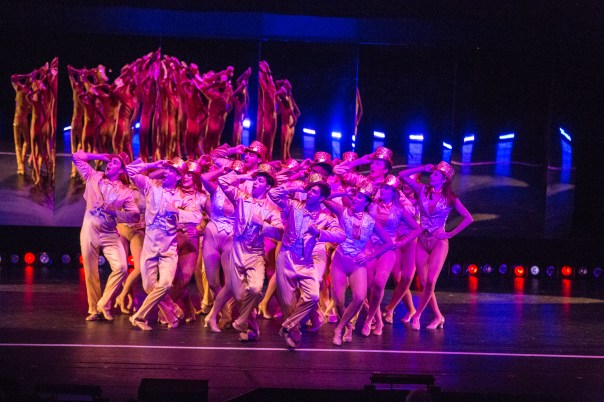

 Paul, another role that doesn’t draw a solo vocal, is the other finalist who brings the action forcefully into the present – thanks to Tyler Dema’s affecting vulnerability as he uncovers the reasons why Paul finds it impossible to open up in front of his fellow dancers. Zach’s private huddle with Paul is another highlight in Wright’s performance as well. Eleni Demos, new this season to CP, deserves a shout-out as Diana. Answering Zach’s most disturbing question, she ably leads “What I Did for Love” – the enduring anthem of A Chorus Line.

