
Raising Cain at the Cain Center With “Million Dollar Quartet”
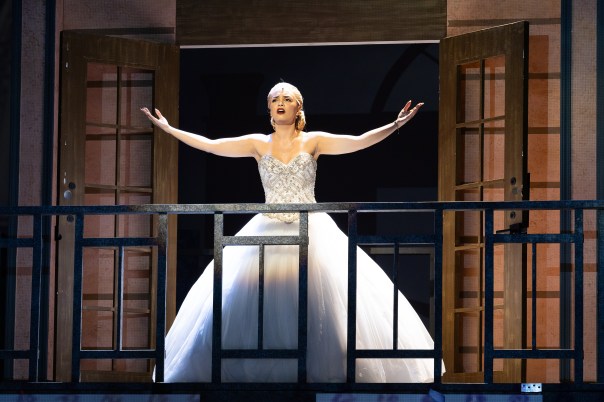
As women and as films, Evita and Melania will never be viewed as two of a kind. Yet in recent years, as Ms. Trump’s husband becomes more ceremonial, militaristic, and authoritarian, a mild kinship and a certain sisterhood have emerged between the two first ladies. There are only a few moments when the current Davidson Community Players’ production of the revered Andrew Lloyd Webber musical, directed with surprising ferocity by Steve Kaliski, seems to reference that kinship.
But there are many more instances when Eva Perón’s “New Argentina” brings present-day USA to mind in all its vulgar MAGA glory. Those happen whenever fervent religious enthusiasm is misdirected. Or when working-class people are talked up so they can be more easily exploited.
By juxtaposing Evita’s glamor, pragmatism, and humble origins with the mixture of street-smart cynicism, working-class empathy, and grudging admiration for homegrown “star quality” that we hear from Che, our narrator, Tim Rice’s libretto has always radiated a reasoned objectivity.
So Kaliski and his principals, Melissa Lozada and Neifert Enrique, aren’t reversing the political lean of Evita. They’re giving the music, the recitative, and the main characters a firm shove in a more malevolent direction.
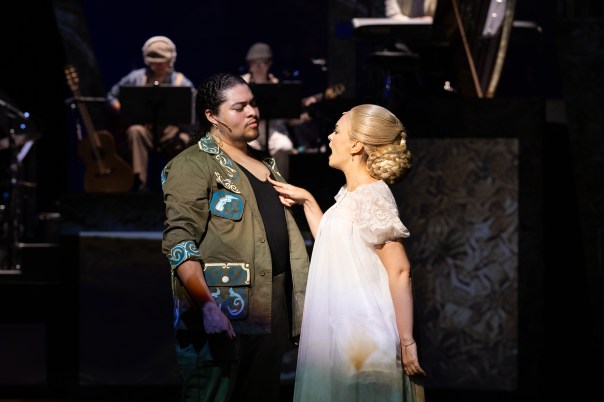
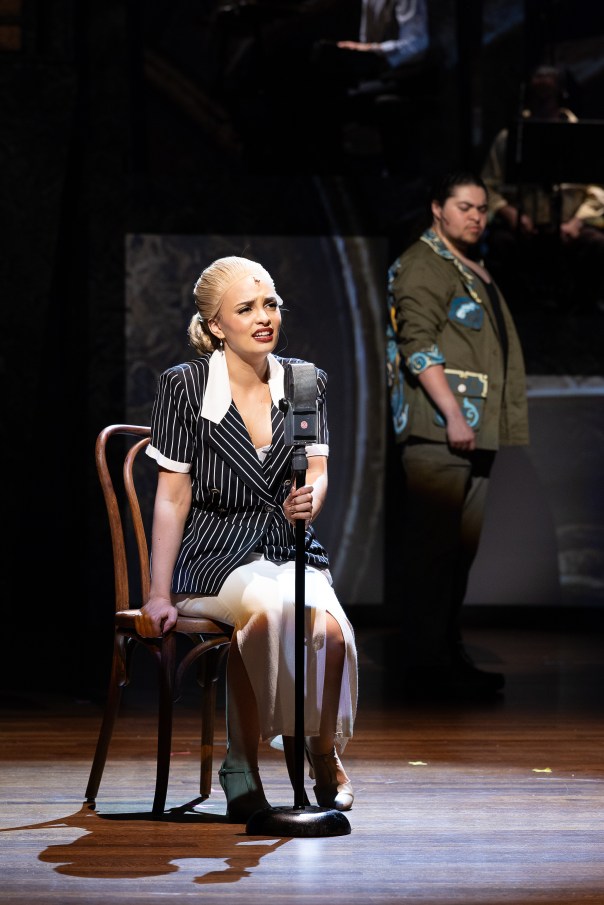
Enrique is particularly startling, easily the most dominant Che we’ve had in the QC. This is a rock tenor who can produce piercingly strong falsetto treble and, minutes later, invade the bass clef so deeply that you wonder where that voice is coming from – and Enrique never makes the mistake of yielding to Lloyd Webber’s singsong to the extent that it dulls Che’s subversive edge.
In sum, Enrique is often powerful enough to make us see the charismatic Evita through his eyes. If you wanted to see the icon as a calculating seductress, who may or may not have gotten religion through her good fortune or failing health, Whitney Drury was perfection in Queen City Theatre Company’s 2010 production, both in the sexual predation that catapulted Evita to celebrity and in her terminal suffering.
On the other hand, if you wanted to be fascinated by an enigmatic Evita, one gifted with so much natural charm and regality that she refuted the whole concept of aristocracy, Lucia Stetson was ideal at Central Piedmont in 2018 – with no shortage of Evita vanity.
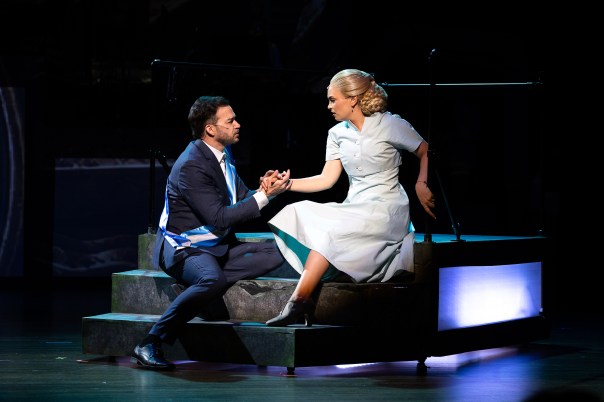
At Duke Performance Hall, on the Davidson College campus, Lozada is simply the meanest and most malignant Eva Perón you’ll likely ever see. Even her “star quality” has a punkish edge as she never quite sheds her peasant roots. There’s a somewhat ghoulish tinge that lingers softly on her final prideful declaration that she has brought her people closer “to the heart of Perón,” her autocratic husband, the nation’s president.
In that moment especially, our clueless Melania pales next to her. We must revert to the golden-haired Trump for a parallel.
Of course, if you saw Lozada in the title role of Electricidad last August, you may already be altering your plans for the final weekend of Evita.Or, if you witnessed Enrique in his most recent title-role triumph down in Matthews as The Prince of Egypt, you may be astonished to hear that his Che is as potent as his Moses.
They aren’t the only reasons why word-of-mouth touting Evita is spreading like a Lake Norman wildfire. Kaliski’s design team has also risen to the challenge of creating a spectacle to match the dimensions of the Duke. Most notable of these are costume designer Sarah Deutsch, lighting designer Kaylin Gess, choreographer Tod A. Kubo, and – perched high in the stratosphere behind the stage’s second scrim – the 10-piece band directed by Matthew Primm.
Upstaging and outsizing them all are the projections designed by Caleb Sigmon, beginning with what may be an actual Eva Perón film! Rice and Lloyd Webber wanted to simulate us all being gathered at a movie theater at the start of their musical when the flick is suddenly interrupted by the announcement of the beloved Evita’s death.

For the first time, this opening scene with its operatic choral requiem seemed prophetic, previewing the wailing and grief that is sure to engulf our streets, churches, and national monuments when 45/47’s number is up. The Amazing Tangerine tries so hard to alienate and disillusion his cult following. In vain, it seems.
Victimized by the wayward Halton Theater sound system when he portrayed Che in 2018, Ron Turner Diaz ages gracefully in the role of the militantly urbane Perón. Effortlessly, he conjures up the personality of a chieftain who will either succumb to Evita’s charm and chutzpah or slay her instantly. There’s a nice tension to their “I’d Be Surprisingly Good for You,” spiced with a tango tang of violence.
Lastly – except for dozens of aristocrats, lovers, family, military, children, and the citizen ensemble – there’s Tristan Nogueira, rounding out an all-Latino cast of major characters, conclusively answering the question of whether we have enough Hispanic talent in Charlotte to deliver a truly authentic Evita. If you saw Nogueira as the surprisingly skeptical Aaron in The Prince of Egypt, you’ll be pleasantly surprised by his transformation from the future High Priest into lounge lizard Agustin Magaldi, Evita’s first discard.
Extra bonus: Lindsay Litka-Montes sings “Another Suitcase in Another Hall” with a quiet, simmering bitterness as Juan’ s discarded Mistress.
More significant extra bonus: due to popular demand, an extra performance of Evita has been added to its closing weekend. This coming Sunday at 7pm.
Beginning at the Beginning at Cunningham Theatre Center

Before the news broke about the extra Evita performance, we returned to the Wildcats campus to usher in the summer – and celebrate Father’s Day – with Common Thread Theatre Company’s Beginning at the Beginning. Staged at the Cunningham Theatre Center, B @ the B was a miniature new play festival showcasing two works-in-progress with an intermission in between and a talkback with playwrights Brian Daye and David Scheonfeld afterwards.
This time, the trip up I-77 wasn’t quite as rewarding. Daye’s one-act, The Race, directed by Eric J. Little, was the better of the two pieces: more compelling action, fuller characterizations, and high-energy performances. Shawn Halliday portrayed the overtly racist Lavell Anderson, on death row as a convicted murderer awaiting execution, while Vanecia Boone was cast as his eleventh-hour appeals attorney, African American cub lawyer Cory Williams, understandably reluctant to take the case.

The two shrunken timeframes, the impending execution and the brevity of Daye’s script, short-circuited any racial animosities that may have clouded the budding attorney-client relationship between Cory and Lavell. He had undergone a religious transformation, and she, with even greater speed, is convinced of his innocence.

Worse, the case against Lavell, whether 19 years or three months old, is so laughably flimsy that it should never have been brought to court – unless the charge had been armed robbery. Lavell maintains that his accomplice, Vern McCluskey, was the trigger man and that he never fired his gun. Criminology or Forensics 101 are not prerequisites to knowing how Lavell’s assertion can be confirmed: anyone who has read a Perry Mason novel – the series began over 90 years ago – is aware of scientific tests that match a bullet with a gun and determine whether a person has recently used a firearm.
Open and shut. We also liked Isaac Hampton as the big, bigoted prison guard.
Scheonfeld’s Massage Group Therapy was even less fully developed and, consequently, less satisfying. Aside from a creep named John who bedevils at least half of the four masseuses, none of the playwright’s people were sufficiently fleshed out. It was a little awkward to see Justin Peoples as John upstaging the exploited women we’re intended to care about.
Even if Scheonfeld had made his massage parlor workers more distinctive, there would have been another tall obstacle to overcome for me. Switching roles from female lead to director, Boone did not insist that her players – or the dude reading stage directions – speak loudly enough to be heard.
B @ the B hits the road for its concluding weekend, resurfacing at North Carolina A&T University on June 27 and 28, up in Winston-Salem. For the time being, the more rewarding trip is to Davidson for the resumption of the Community Players’ Evita.
As for Winston, best to wait for the International Black Theatre Festival, July 27 through August 1. Charlotte’s own BNS Productions will be among the many fine Black companies there, presenting four performances of August Wilson’s Joe Turner’s Come and Gone, afternoons and evenings on July 31 and August 1.

Yes, Davidson Community Players’ executive director Steve Kaliski certainly had a point this past weekend when he declared, “My kingdom for The Autumn’s Tale!” DCP had invited Shepherd Shakespeare Company, which normally performs outdoors at The Barn on Monroe Road, to perform THE WINTER’S TALE indoors at the Armour Street Theatre, out of the cold winter.
Unfortunately, winter weather pursued the troubadours, who also bring a variety of repertoire to local elementary and high schools, up the highway to Davidson, forcing the postponement of performances scheduled for the second weekend of Winter’s Tale at Armour. Ill-starred as the engagement may have proven, it enabled me to see SSCO in action for the first time, outside of their customary morning-and-afternoon cocoon in prime evening hours.
Katy and Chester Shepherd, co-founders of the touring company, are often at the forefront of their productions. But here, they are behind-the-scenes – and they have, artistically, split up. Chester is handling the stage direction and scenic design, while Katy has designed and constructed the costumes. Another blissfully theatrical couple, Brandon and Rachel Dawson, portray the jealousy-crossed leads, Leontes and Hermione, the King and Queen of Sicilia.

Brandon, as Leontes, falls prey like Othello to the green-toothed monster, but he’s also haunted by his own inner Iago, needing no outside help to compromise and convict his innocent Queen of shameful adultery. What happens in the tragic first scene is nearly as simple and grand as Lear. The visiting King Polixenes of Bohemia, after sojourning in Sicilia for nine months, announces that he will leave on the morrow.
The Sicilia monarch tries to persuade Polixenes to lengthen his visit but cannot shake his boyhood friend’s resolve. Rachel, as Hermione remains silent – until Brandon, as her King, asks her to assist. Hermione’s attempts are wittier, more lighthearted, more charming, more insistent, and more sustained. There are no stage directions in the text during Hermione’s pleadings that indicate any physical contact with the esteemed visitor, but in Shepherd’s direction, that is not a prohibition.
Chester and Rachel have reached a key accord, without Shakespeare’s expressed consent, when Hermione playfully suggests taking the Bohemian monarch as her prisoner. Yet when Polixenes is won over, fulfilling Leontes’ wishes, and Hermione has gained her husband’s admiration, Shakespeare does add a stage direction that decrees physical contact right after she declares Bohemia to be her newly-earned friend: “Gives her hand to Polixenes.”

This is enough to spark Leontes’ jealousy and fan it into flames. Everything dearest to Leontes must be destroyed: wife, son, newborn daughter, and Polixenes, who learns the perils of a nine-month visit through grim experience. The damage that Leontes capriciously wreaks on his kingdom will take 20 years to repair, and the repair will not be complete.
Hermione’s imagined betrayal in the presence of the king’s son, Mamillius, his most trusted confidante, Lord Camillo, and numerous attendants at his Sicilia palace, so an eerie formality hovers over the DCP production’s opening scene (an introductory scene elsewhere in the palace is cut) until the king explodes. First to be targeted by Leontes’ wrath is Polixenes, genially portrayed by Jeremy Cartee, with a touch of mischief that he keeps on back order until he returns home.

Torn between loyalty and common humanity, Savannah Deal as Camillo decides not to slay Polixenes but to advise him to flee. Understanding that disloyalty to the deranged Leontes could spell death for Camillo, Polixenes rewards his honesty by bringing Camillo into his service before they depart.

We won’t hear any more of them for 20 years. Meanwhile, Act 2 applies a fairytale patina to the action as Leontes, dissuaded from burning his newborn daughter by Lord Antigonus, dispatches milord to abandon the babe in a faraway place to the mercy of the elements. We last see Andre Braza as Antigonus at the end of Act 3, sent offstage with Shakespeare’s most famous stage direction, “Exit, pursued by a bear.”

Not to worry, Braza resurfaces in Scene 3 of Act 4 as the roguish Autolycus. The remaining members of the core troupe, mostly with prior SSCO experience, also shuffle multiple roles and costumes backstage – with a couple of players besides Deal flipping genders. Most prominently, these include Iesha Nyree morphing from one of Hermione’s ladies to the Old Shepherd who parents Perdita, the sequestered newborn, and Emma Brand, becoming the grown-up foundling after a stint as Lord Cleomenes.

Really, the only faux pas in this production is the casting of Mamillius, the king’s blameless heir. No matter how cute, we need to hear the lad. Best of the rest is Joanna Gerdy, who likely knows Shakespeare’s plays nearly as well as the Bard himself, having acted in and directed so many. Here, as Paulina, Gerdy gets to fearlessly scold Leontes, engineer Hermione’s escape, and emcee the queen’s long-deserved restoration. It’s a powerful, authoritative performance that almost rivals the Dawsons’ majesties. Note: In lieu of the cancelled performances on 1/31 and 2/1, a make-up show has been added for Wednesday, 2/4, at 7:30pm. Stay tuned for other possible added s
Review: Miss Bennet: Christmas at Pemberley @ the Cain Center
By Perry Tannenbaum

If it weren’t for all the adaptations we hear about on TV and in movies, we could say that it required supreme audacity for Lauren Gunderson and , to tread in Jane Austen’s footsteps and pen a sequel to Pride and Prejudice, her wittiest and most beloved novel. But despite the obvious commercial bent of Miss Bennet: Christmas at Pemberley, Gunderson and Melcon have aimed to capture Austen’s essence and bring fresh life to her characters.
As you’ll find up at the Cain Center in Cornelius, no small thanks to the audacious direction of Steve Kaliski, the script sprinkles a bit of modern perspective on the Bennet sisters and their beaus – occasionally forcing us to recognize that Austen’s times are not so different from our own. Elizabeth Darcy, the heroine of the novel, still retains enough decorum not to call Fitzwilliam Darcy by his first name. Even in the privacy of their own home!
Likewise, elder sister Jane and her beloved Charles address each other as Mr. And Mrs. Bingley. “Happy Christmas” rather than “Merry Christmas” is the greeting norm, and the Christmas tree tradition has yet to take root in England in December of 1815. It’s Elizabeth’s audacity that brings this German custom to the Pemberley drawing room with its attached library.
In some ways, history has circled back. Back in college, my professor instantly drew our attention to the epistolary nature of Pride and Prejudice. The story is largely driven by letter writing. A chief turning point in the story is contained in a letter from Darcy addressed to Elizabeth, debunking her previous prejudices against him!
The prevalence of letter writing astonished us then – and felt alien. Ancient. Forty-plus years later, the sight of Mary Bennet, her sister Lydia, and Arthur de Bourgh exchanging billets-doux while under the same roof has to remind me of today’s texting, Instagramming youth, perpetually thumbing their cellphones. Buttressed by books, these youngsters can put quill to paper.

With Kitty off in London, not expected to arrive until Christmas Day with her parents, Mary is the only Miss Bennet we see and unexpectedly the leading lady. Arthur is an entirely new character, rivalling Mary in his bookishness. Resigned to spinsterhood, Mary is shocked to find that they’re hitting it off.
The forward-looking Gunderson and Melcon, proclaiming that Austen is for everyone, encourage diverse casting. But Kaliski and his Davidson Community Players go further, bringing us an all-female/non-binary cast. It’s an added semicircle backwards to Elizabethan days when only boys and men were permitted to perform onstage.
All three of these transpositions – Brooke McCarthy as Darcy, Rhianon Chandler as Bingley, and Jennifer Adams as De Bourgh – add a fresh patina of mirth and comedy. As for the playwrights, they inject plenty of wit and sparkle of their own. Speaking to Darcy before we see that Jane is seven-months pregnant, Elizabeth broadly hints she is arriving “safely and enormously.” Lizzy is more tactful when the expectant mother enters and they exchange greetings:
Lizzy: Look at you! You’re radiant.
Jane: I’m as large as a cottage.
Lizzy: And exactly as a cottage, you are warm, filled with life, and lit from within.

Although McCarthy plays him with some florid gestures, we soon see that he is richly endowed with breeding and tact. When the punctilious Mary presumes to correct Bingley, by informing him that the tree standing before them is a spruce and not a fir, Darcy pointedly intervenes. Before any dispute can begin, he proposes that he and his longtime chum exit for a brandy.
The ladies can now rebuke Mary, if they wish. They do, while gradually discovering that their younger sister has more charm and talent than previously suspected. Arthur’s admiration for her shocks them as much as it shocks Mary herself. As it turns out, Lizzy and Jane better be witty and perceptive, for Mary and Arthur are the plumiest roles. Fortunately, with the arrival of Lydia, the silly sister with the sham marriage, Lizzy and Jane can redirect their sharpest barbs.
Arthur is the heir to the nearby Rosings estate, but he is a distant nephew of the late Lady Catherine and has never lived there. There is some juicy history at that estate, left over from Pride and Prejudice,chiefly the presumption that Darcy would marry Milady’s daughter and not the comparatively lowborn Lizzy. Not to worry, Pemberley gracefully catches us up if we don’t remember Austen’s original.
What makes the role of Arthur so appealing is that he has no clue how to run an estate – and no solid experience with other men, women, or people. Adams carries a book around with her as if it were Arthur’s security blanket. Without one, Adams seems at a loss for what to do with her hands and arms, so we see Arthur almost perpetually in a scholarly or supplicating pose.
Attempting a billet-doux, Adams as Arthur reminded me of Christian in Cyrano de Bergerac, only he has nobody to help him out. When Arthur learns that his cousin Anne, after getting jilted by Darcy, now presumes she is betrothed to him, Adams’ awkwardness and shyness veer toward desperation and panic. When bliss is achieved, Adams’ glow is mesmerizing.

Crippled by a similar lack of self-esteem, Sahana Athreya as Mary is no more experienced and no less shy than Arthur – so she can range from being pedantic and irritating to heartbroken and pitiful to vivacious and adorable. Athreya can also freely gesticulate with her arms and sit down regally at the pianoforte.
The central triangle is further complicated by Destiney Wolfe as the compulsively silly Lydia. Glossing over her troubled marriage doesn’t inhibit Lydia from flirting shamelessly with Arthur, giving us extra tastes of how unaccustomed he is to such attentions. Nor does Kaliski bar Wolfe from being as irritating as Mary at her worst. On the contrary. Wolfe, when she isn’t pouncing, is often prancing.
At the center of all the overtures from Mary and Lydia – and the strict orders from Agatha Emma as the imperious Anne – Adams gets to be meaningful as well as stressed and sympathetic. For Mary and Lizzy, in the face of Arthur’s inclination to yield to Anne, are at considerable pains to remind him that he has what women don’t: a choice.
Of course, when Gunderson and Melcon wrote their merry comedy in 2016, they had no inking that “Your body, my choice” would be staging a comeback. But the playwrights are far from declaring that women were powerless. Even before her Christmas awakening, Mary is strong enough to proclaim that she would rather wed a plant than an unsuitable man.
Caring about their sisters, Lizzy and Jane sustain their relevance, Skylar Schock as Lizzy warming up to Mary and Emma Kitchin as the Jane becoming Lydia’s tactful benefactor. Christmas can even be celebrated by Emma, for it turns out that there’s kindness in Lydia beneath her silly, meddlesome surface.
Kaylen Gess’s scenic and lighting design complement each other handsomely, with Caleb Sigmon’s projections adding an extra festive luster. I’d imagine that Gunderson and Melcon would have envisioned a much larger, more intrusive tree at Pemberley. But as a Tannenbaum, I’m probably prejudiced.
The tree outside Cain Center, let me add, is big and bright enough for anyone.


